Noisy initial-state qubit-channel metrology with additional undesirable noisy evolution
Pith reviewed 2026-05-23 06:44 UTC · model grok-4.3
The pith
Algebraic expressions determine when n-qubit correlated protocols outperform single-qubit ones under spectator noise in mixed-state channel metrology.
A machine-rendered reading of the paper's core claim, the machinery that carries it, and where it could break.
Core claim
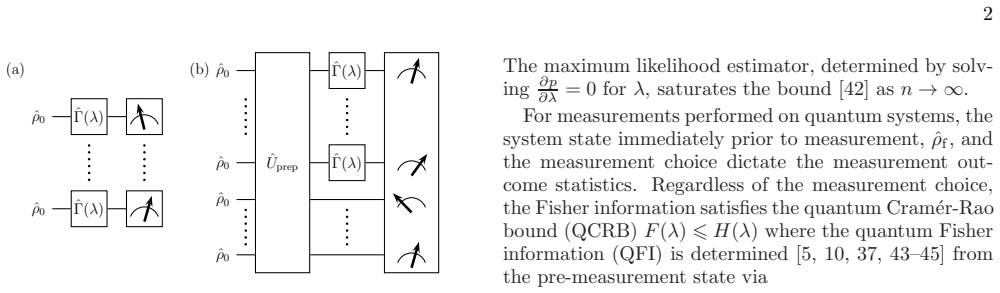
We compare two protocols, each invoking a single-parameter unital qubit channel once, via their quantum Fisher informations when initial states have very low purity. One protocol uses n qubits prepared in a particular correlated input state and queries the channel on one qubit; the other uses a single qubit. We extend prior results by allowing additional noisy evolution on the spectator qubits and provide simple algebraic expressions that determine when the n-qubit protocol is superior. We show that for certain types of noisy evolution the n-qubit protocol will be inferior but for others it will be superior, and we give a technique that can alleviate certain types of noise.
What carries the argument
Comparison of quantum Fisher informations between the n-qubit correlated-state protocol and the single-qubit protocol when spectator qubits experience additional noisy evolution.
If this is right
- When the algebraic expressions indicate higher quantum Fisher information, the n-qubit protocol should be preferred over the single-qubit protocol.
- For other noise types the expressions show the n-qubit protocol yields lower quantum Fisher information and should not be used.
- A provided technique can reduce the impact of certain spectator noise types on the estimation precision.
- The expressions allow immediate determination of protocol superiority without requiring full numerical optimization for each noise instance.
Where Pith is reading between the lines
- Experimenters using multi-qubit devices must characterize spectator noise separately before deciding on the number of qubits to employ.
- The conditional advantage suggests that error-mitigation methods tailored to spectator qubits could expand the range of noise types for which the n-qubit protocol wins.
- Similar algebraic comparisons might apply when extending the setup to non-unital channels or to estimation of multiple parameters simultaneously.
Load-bearing premise
The additional noisy evolution on spectator qubits belongs to classes for which the quantum Fisher information admits closed-form algebraic comparison with the single-qubit case.
What would settle it
Pick a concrete noise model on the spectators, compute the quantum Fisher information for both protocols, and check whether the n-qubit value exceeds the single-qubit value exactly when the paper's algebraic expressions predict superiority.
Figures


read the original abstract
We consider protocols for estimating the parameter in a single-parameter unital qubit channel, assuming that the available initial states are highly mixed with very low purity. We compare two protocols, each invoking the channel once, via their quantum Fisher informations. One uses $n$ qubits prepared in a particular correlated input state and subsequently queries the channel on one qubit. The other uses a single qubit. We extend the results of Collins [1] by allowing for additional noisy evolution on the spectator qubits in the $n$-qubit protocol. We provide simple algebraic expressions that will determine when the $n$-qubit protocol is superior. We provide a technique that can alleviate certain types of noise. We show that for certain types of noisy evolution the $n$-qubit protocol will be inferior but for others it will be superior.
Editorial analysis
A structured set of objections, weighed in public.
Referee Report
Summary. The manuscript compares two protocols for estimating a parameter in a single-parameter unital qubit channel when only highly mixed initial states are available: a single-qubit protocol versus an n-qubit protocol that prepares a correlated state, applies the channel to one qubit, and permits additional noisy evolution on the spectator qubits. Extending Collins (2023), the authors derive algebraic expressions for the quantum Fisher information (QFI) of both protocols and identify conditions under which the n-qubit protocol yields higher QFI, depending on the noise type; they also present a technique to mitigate certain spectator noises and illustrate cases of both superiority and inferiority.
Significance. If the closed-form QFI expressions and the resulting comparison criteria are correct, the work supplies concrete, noise-type-dependent guidance for protocol selection in low-purity qubit metrology. This is practically relevant for near-term experiments and extends the Collins framework by incorporating spectator noise, with the algebraic nature of the results enabling direct evaluation without numerical optimization.
minor comments (3)
- [§3] §3, after Eq. (12): the definition of the correlated n-qubit input state should explicitly state the normalization factor and confirm that the state remains valid (positive semidefinite) for the full range of the mixing parameter p.
- [Table 1] Table 1: the column headers for the three noise models are not defined in the caption; add a sentence clarifying the Kraus operators or channel parameters used for each model.
- [§4.2] §4.2: the mitigation technique is introduced via an example; a general statement of the conditions under which the technique applies (e.g., which noise classes) would improve clarity.
Simulated Author's Rebuttal
We thank the referee for their careful reading of the manuscript, positive assessment of its significance, and recommendation for minor revision. The report summarizes our extension of Collins (2023) to include spectator noise but does not list any specific major comments or points requiring clarification or correction.
Circularity Check
Minor self-citation of base case; central QFI comparison is independent
full rationale
The derivation compares n-qubit and single-qubit protocols via the standard definition of quantum Fisher information for unital qubit channels under additional spectator noise. Algebraic expressions for superiority are obtained by direct computation on the permitted noise classes, without reducing any claimed prediction to a fitted parameter or redefining quantities in terms of each other. The reference to Collins [1] supplies only the zero-additional-noise baseline; the extension to noisy spectators is self-contained and does not rely on a self-citation chain for its validity. No self-definitional, fitted-input, or ansatz-smuggling patterns appear in the supplied abstract or claims.
Axiom & Free-Parameter Ledger
axioms (1)
- standard math Quantum Fisher information is the appropriate figure of merit for comparing single-parameter channel estimation protocols under the given noise models.
Lean theorems connected to this paper
-
IndisputableMonolith/Cost/FunctionalEquation.leanwashburn_uniqueness_aczel unclear?
unclearRelation between the paper passage and the cited Recognition theorem.
We provide simple algebraic expressions that will determine when the n-qubit protocol is superior... Hcorr = r²V⊤(˙M⊤1˙M1 ⊗ M⊤2M2 ⊗ ⋯ ⊗ M⊤nMn)V + r²(r0·c)²c⊤˙M⊤1˙M1c
-
IndisputableMonolith/Foundation/RealityFromDistinction.leanreality_from_one_distinction unclear?
unclearRelation between the paper passage and the cited Recognition theorem.
We extend the results of Collins [1] by allowing for additional noisy evolution on the spectator qubits
What do these tags mean?
- matches
- The paper's claim is directly supported by a theorem in the formal canon.
- supports
- The theorem supports part of the paper's argument, but the paper may add assumptions or extra steps.
- extends
- The paper goes beyond the formal theorem; the theorem is a base layer rather than the whole result.
- uses
- The paper appears to rely on the theorem as machinery.
- contradicts
- The paper's claim conflicts with a theorem or certificate in the canon.
- unclear
- Pith found a possible connection, but the passage is too broad, indirect, or ambiguous to say the theorem truly supports the claim.
Reference graph
Works this paper leans on
-
[1]
Describe the spectator channels by channel Bloch-sphere matri- ces Mj for j = 2,
Describe the parameter-dependent channel by the channel Bloch-sphere matrix M1. Describe the spectator channels by channel Bloch-sphere matri- ces Mj for j = 2, . . . n. 10
-
[2]
Determine the diagonal decompositions ˙M ⊤ 1 ˙M1 = α aa⊤ + β bb⊤ + δ dd⊤ and (46) M ⊤ j Mj = σj sjs⊤ j + τj tjt⊤ j + υjuju⊤ j (47) where α ⩾ β ⩾ δ ⩾ 0 and 1 ⩾ σj ⩾ τj ⩾ υj ⩾ 0
-
[3]
Let Σ := σ2 . . . σ n. If nΣ ⩽ 1 then the SQSC pro- tocol is optimal regardless of any other considera- tions. If nΣ > 1 then the CS protocol might yield an advantage
-
[4]
4, where the ˆUj is the unitary cor- responding to Bloch-sphere rotation Rj = sja⊤ + tjb⊤ + ujd⊤
Implement the symmetric pairwise correlated pro- tocol of Fig. 4, where the ˆUj is the unitary cor- responding to Bloch-sphere rotation Rj = sja⊤ + tjb⊤ + ujd⊤ . Choose c = a and r0 = b. The CS protocol QFI is bounded from below via Hs opt β α + n∑ j=2 τj σj Σ ⩽ Hcorr. (48)
-
[5]
If it does, use the generic measure- ment scheme of Fig
Determine whether ˙M1 admits a real diagonal de- composition. If it does, use the generic measure- ment scheme of Fig. 5 yielding a Fisher information that saturates the lower bound, i.e. F = Hs opt β α + n∑ j=2 τj σj Σ . (49) If ˙M1 does not admit a real diagonal decomposi- tion, determine the singular value decomposition ˙M1 = ASB , where A and ...
-
[6]
Collins, Qubit-channel metrology with very noisy ini- tial states, Phys
D. Collins, Qubit-channel metrology with very noisy ini- tial states, Phys. Rev. A 99, 012123 (2019)
work page 2019
-
[7]
C. W. Helstrom, Quantum Detection and Estimation Theory (Academic Press, New York, 1976)
work page 1976
-
[8]
C. M. Caves, Quantum-mechanical noise in an interfer- ometer, Phys. Rev. D 23, 1693 (1981)
work page 1981
-
[9]
S. L. Braunstein, Quantum limits on precision measure- ments of phase, Phys. Rev. Lett. 69, 3598 (1992)
work page 1992
-
[10]
S. L. Braunstein and C. M. Caves, Statistical distance and the geometry of quantum states, Phys. Rev. Lett. 72, 3439 (1994)
work page 1994
-
[11]
P. K. Hwang Lee and J. P. Dowling, A quantum Rosetta stone for interferometry, J. Mod. Opt. 49, 2325 (2002)
work page 2002
-
[12]
M. Sarovar and G. J. Milburn, Optimal estimation of one-parameter quantum channels, J. Phys. A 39, 8487 (2006)
work page 2006
-
[13]
V. Giovannetti, S. Lloyd, and L. Maccone, Quantum- enhanced measurements: Beating the standard quantum limit, Science 306, 1330 (2004)
work page 2004
-
[14]
V. Giovannetti, S. Lloyd, and L. Maccone, Quantum metrology, Phys. Rev. Lett. 96, 010401 (2006)
work page 2006
-
[15]
Paris, Quantum estimation for quantum technology, Int
M. Paris, Quantum estimation for quantum technology, Int. J. Quantum Information 7, 125 (2009)
work page 2009
- [16]
-
[17]
V. Giovannetti, S. Lloyd, and L. Maccone, Quantum metrology, Nature Photonics 5, 222 (2011)
work page 2011
-
[18]
J. Ko/suppress lody´ nski and R. Demkowicz-Dobrza´ nski, Efficient tools for quantum metrology with uncorrelated noise, New Journal of Physics 15, 073043 (2013)
work page 2013
-
[19]
G. T´ oth and I. Apellaniz, Quantum metrology from a quantum information science perspective, J. Phys. A: Math. Theor. 47, 424006 (2014)
work page 2014
-
[20]
R. Demkowicz-Dobrza´ nski, M. Jarzyna, and J. Ko/suppress lody´ nski, Chapter four – quantum limits in optical interferometry (Elsevier, 2015) pp. 345–435
work page 2015
-
[21]
L. Pezz` e, A. Smerzi, M. K. Oberthaler, R. Schmied, and P. Treutlein, Quantum metrology with nonclassical states of atomic ensembles, Rev. Mod. Phys. 90, 035005 (2018)
work page 2018
- [22]
-
[23]
Fujiwara, Quantum channel identification problem, Phys
A. Fujiwara, Quantum channel identification problem, Phys. Rev. A 63, 042304 (2001)
work page 2001
- [24]
-
[25]
M. Frey, D. Collins, and K. Gerlach, Probing the qudit depolarizing channel, J. Phys A: Mathematical and The- oretical 44, 205306 (2011)
work page 2011
-
[26]
A. Fujiwara and H. Imai, Quantum parameter estima- tion of a generalized Pauli channel, J. Phys. A 36, 8093 (2003)
work page 2003
-
[27]
Z. Ji, G. Wang, R. Duan, Y. Feng, and M. Ying, Param- eter estimation of quantum channels, IEEE Trans. Inf. Theory 54, 5172 (2008)
work page 2008
-
[28]
Fujiwara, Estimation of a generalized amplitude- damping channel, Phys
A. Fujiwara, Estimation of a generalized amplitude- damping channel, Phys. Rev. A 70, 012317 (2004)
work page 2004
-
[29]
G. M. D’Ariano, C. Macchiavello, and P. Perinotti, Op- timal phase estimation for qubits in mixed states, Phys. Rev. A 72, 042327 (2005)
work page 2005
- [30]
-
[31]
K. Modi, H. Cable, M. Williamson, and V. Vedral, Quan- tum correlations in mixed-state metrology, Phys. Rev. X 1, 021022 (2011)
work page 2011
- [32]
-
[33]
Collins, Mixed-state Pauli-channel parameter estima- tion, Phys
D. Collins, Mixed-state Pauli-channel parameter estima- tion, Phys. Rev. A 87, 032301 (2013)
work page 2013
-
[34]
D. Collins and J. Stephens, Depolarizing-channel param- eter estimation using noisy initial states, Phys. Rev. A 92, 032324 (2015)
work page 2015
-
[35]
K. Micadei, D. A. Rowlands, F. A. Pollock, L. C. C´ eleri, R. M. Serra, and K. Modi, Coherent measurements in quantum metrology, New Journal of Physics 17, 023057 (2015)
work page 2015
-
[36]
E. Serrano-Ens´ astiga, C. Chryssomalakos, and J. Martin, Quantum metrology of rotations with mixed spin states, Phys. Rev. A 111, 022435 (2025)
work page 2025
-
[37]
C. P. Slichter, Principles of Magnetic Resonance (Springer, Berlin, 1996)
work page 1996
-
[38]
R. S. Piera, S. P. Walborn, and G. H. Aguilar, Experi- mental demonstration of the advantage of using coherent measurements for phase estimation in the presence of de- 18 polarizing noise, Phys. Rev. A 103, 012602 (2021)
work page 2021
-
[39]
G. M. D’Ariano, P. Lo Presti, and M. G. A. Paris, Using entanglement improves the precision of quantum mea- surements, Phys. Rev. Lett. 87, 270404 (2001)
work page 2001
-
[40]
R. Demkowicz-Dobrza´ nski and L. Maccone, Using entan- glement against noise in quantum metrology, Phys. Rev. Lett. 113, 250801 (2014)
work page 2014
-
[41]
P. Sekatski, M. Skotiniotis, J. Ko/suppress lody´ nski, and W. D¨ ur, Quantum metrology with full and fast quantum control, Quantum 1, 27 (2017)
work page 2017
- [42]
-
[43]
Y. Len, T. Gefen, A. Retzker, and J. Ko/suppress lody´ nski, Quan- tum metrology with imperfect measurements, Nat. Com- mun. 13, 6971 (2022)
work page 2022
-
[44]
L. Jiao, W. Wu, S.-Y. Bai, and J.-H. An, Quantum metrology in the noisy intermediate-scale quantum era, Advanced Quantum Technologies n/a, 2300218 (2023)
work page 2023
-
[45]
J. A. H. Nielsen, J. S. Neergaard-Nielsen, T. Gehring, and U. L. Andersen, Deterministic quantum phase estimation beyond n00n states, Phys. Rev. Lett. 130, 123603 (2023)
work page 2023
- [46]
-
[47]
Cram´ er,Mathematical Methods of Statistics (Prince- ton University Press, Princeton, NJ, 1946)
H. Cram´ er,Mathematical Methods of Statistics (Prince- ton University Press, Princeton, NJ, 1946)
work page 1946
-
[48]
Topics in Estimation of Quantum Channels
C. O’Loan, Topics in estimation of quantum channels, e-print (2010), arXiv:1001.3971v1 [quant-th]
work page internal anchor Pith review Pith/arXiv arXiv 2010
-
[49]
Nagaoka, in Asymptotic Theory of Quantum Statis- tical Inference , edited by M
H. Nagaoka, in Asymptotic Theory of Quantum Statis- tical Inference , edited by M. Hayashi (World Scientific, Singapore, 2012) Chap. 9, pp. 113–124
work page 2012
-
[50]
J. Liu, H. Yuan, X.-M. Lu, and X. Wang, Quantum Fisher information matrix and multiparameter estima- tion, J. Phys. A: Math. Theor. 53, 023001 (2020)
work page 2020
-
[51]
F. Chapeau-Blondeau, Optimized probing states for qubit phase estimation with general quantum noise, Phys. Rev. A 91, 052310 (2015)
work page 2015
-
[52]
L. J. Fiderer, J. M. E. Fra ¨ ısse, and D. Braun, Maximal quantum Fisher information for mixed states, Phys. Rev. Lett. 123, 250502 (2019)
work page 2019
-
[53]
F. Toscano, W. P. Bastos, and R. L. de Matos Filho, Attainability of the quantum information bound in pure- state models, Phys. Rev. A 95, 042125 (2017)
work page 2017
-
[54]
O. E. Barndorff-Nielsen and R. D. Gill, Fisher informa- tion in quantum statistics, J. Phys A: Math. Gen. 33, 4481 (2000)
work page 2000
-
[55]
S. Pang and A. Jordan, Optimal adaptive control for quantum metrology with time-dependent Hamiltonians, Nat. Commun. 8, 14695 (2017)
work page 2017
-
[56]
M. A. Rodr ´ ıguez-Garc ´ ıa, I. P. Castillo, and P. Barberis- Blostein, Efficient qubit phase estimation using adaptive measurements, Quantum 5, 467 (2021)
work page 2021
- [57]
-
[58]
B. M. Escher, R. L. de Matos Filho, and L. Davidovich, General framework for estimating the ultimate preci- sion limit in noisy quantum-enhanced metrology, Nature Phys. 7, 406 (2011)
work page 2011
- [59]
-
[60]
R. Demkowicz-Dobrza´ nski, J. Czajkowski, and P. Sekatski, Adaptive quantum metrology under general Markovian noise, Phys. Rev. X 7, 041009 (2017)
work page 2017
-
[61]
S. Zhou and L. Jiang, Asymptotic theory of quantum channel estimation, PRX Quantum 2, 010343 (2021)
work page 2021
-
[62]
M. A. Nielsen and I. L. Chuang, Quantum Computation and Quantum Information (Cambridge University Press, Cambridge, 2000)
work page 2000
-
[63]
J. A. Jones, Quantum computing with NMR, Prog. NMR Spectrosc. 59, 91 (2011)
work page 2011
-
[64]
D. Collins, K. W. Kim, W. C. Holton, H. Sierzputowska- Gracz, and E. O. Stejskal, NMR quantum computation with indirectly coupled gates, Phys. Rev. A 62, 022304 (2000)
work page 2000
-
[65]
G. Teklemariam, E. M. Fortunato, M. A. Pravia, T. F. Havel, and D. G. Cory, NMR analog of the quantum dis- entanglement eraser, Phys. Rev. Lett. 86, 5845 (2001)
work page 2001
-
[66]
Y. S. Weinstein, T. F. Havel, J. Emerson, N. Boulant, M. Saraceno, S. Lloyd, and D. G. Cory, Quantum process tomography of the quantum Fourier transform, J. Chem. Phys. 121, 6117 (2004)
work page 2004
-
[67]
C. Ju, J. Zhu, X. Peng, B. Chong, X. Zhou, and J. Du, Experimental demonstration of deterministic one-way quantum computation on a NMR quantum computer, Phys. Rev. A 81, 012322 (2010)
work page 2010
-
[68]
D. Lu, T. Xin, N. Yu, Z. Ji, J. Chen, G. Long, J. Baugh, X. Peng, B. Zeng, and R. Laflamme, Tomography is nec- essary for universal entanglement detection with single- copy observables, Phys. Rev. Lett. 116, 230501 (2016)
work page 2016
-
[69]
J. Wen, C. Zheng, X. Kong, S. Wei, T. Xin, and G. Long, Experimental demonstration of a digital quantum simu- lation of a general PT -symmetric system, Phys. Rev. A 99, 062122 (2019)
work page 2019
-
[70]
M. M. Wilde, Quantum Information Theory (Cambridge University Press, 2013)
work page 2013
-
[71]
Chapeau-Blondeau, Optimized entanglement for quantum parameter estimation from noisy qubits, Int
F. Chapeau-Blondeau, Optimized entanglement for quantum parameter estimation from noisy qubits, Int. J. Quantum Information 16, 1850056 (2018)
work page 2018
discussion (0)
Sign in with ORCID, Apple, or X to comment. Anyone can read and Pith papers without signing in.