Classical Combinatorial Optimization Scaling for Random Ising Models on 2D Heavy-Hex Graphs
Pith reviewed 2026-05-23 07:24 UTC · model grok-4.3
The pith
Sparse Ising models on heavy-hex graphs allow classical exact solvers to scale linearly or quadratically up to 100,000 variables
A machine-rendered reading of the paper's core claim, the machinery that carries it, and where it could break.
Core claim
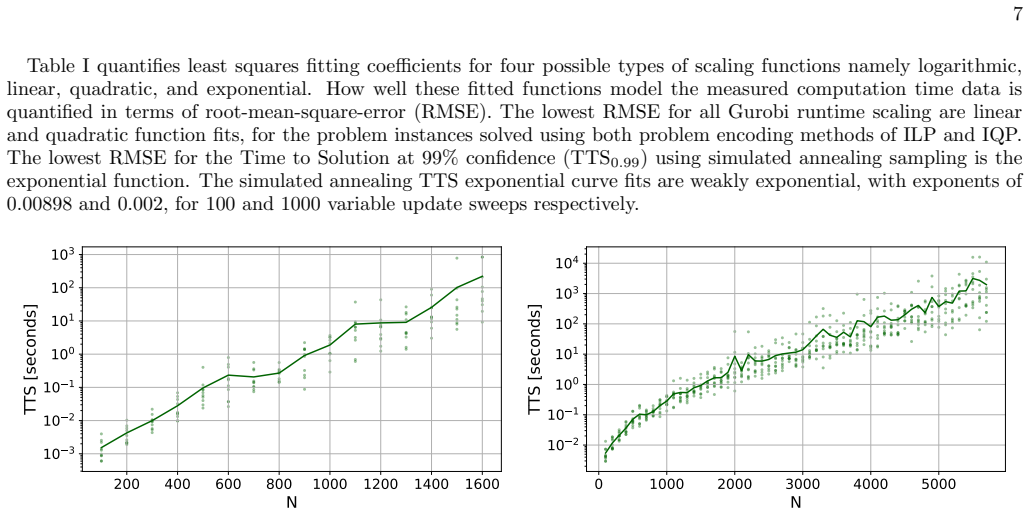
Because of the sparsity of these Ising models, the classical algorithms are able to find optimal solutions efficiently even for large instances (i.e. 100,000 variables). The Ising models both with and without geometrically local cubic terms exhibit average-case linear-time or weakly quadratic scaling when solved exactly using Gurobi, and the Ising models with no cubic terms show evidence of exponential-time Time-to-Solution scaling when sampled using simulated annealing.
What carries the argument
Sparsity of the interaction graph in Ising models on heavy-hex lattices, which limits variable dependencies and permits efficient exact solving by Gurobi
If this is right
- These sparse problems remain classically tractable at scales relevant to current hardware
- Quantum algorithms require more densely connected problems to demonstrate practical advantage over classical methods
- The choice of classical solver strongly affects reported scaling and must be optimized in any quantum-classical comparison
- Different classical algorithms exhibit exponentially different runtimes on identical instances
Where Pith is reading between the lines
- Hardware-native problems on present quantum devices may stay easy for classical exact solvers
- Systematic tests on graphs with increasing density could locate the crossover to classical hardness
- Benchmark studies should routinely include multiple classical solvers to avoid underestimating classical performance
Load-bearing premise
The random instances of Ising models on heavy-hex graphs are representative of the combinatorial optimization problems that near-term quantum algorithms and hardware would actually encounter.
What would settle it
Demonstration that Gurobi solve times on the same family of heavy-hex Ising instances grow exponentially with the number of variables once sizes exceed 100,000
Figures




read the original abstract
Motivated by near term quantum computing hardware limitations, combinatorial optimization problems that can be addressed by current quantum algorithms and noisy hardware with little or no overhead are used to probe capabilities of quantum algorithms such as the Quantum Approximate Optimization Algorithm (QAOA). In this study, a specific class of near term quantum computing hardware defined combinatorial optimization problems, Ising models on heavy-hex graphs both with and without geometrically local cubic terms, are examined for their classical computational hardness via empirical computation time scaling quantification. Specifically the Time-to-Solution metric using the classical heuristic simulated annealing is measured for finding optimal variable assignments (ground states), as well as the time required for the optimization software Gurobi to find an optimal variable assignment. Because of the sparsity of these Ising models, the classical algorithms are able to find optimal solutions efficiently even for large instances (i.e. $100,000$ variables). The Ising models both with and without geometrically local cubic terms exhibit average-case linear-time or weakly quadratic scaling when solved exactly using Gurobi, and the Ising models with no cubic terms show evidence of exponential-time Time-to-Solution scaling when sampled using simulated annealing. These findings point to the necessity of developing and testing more complex, namely more densely connected, optimization problems in order for quantum computing to ever have a practical advantage over classical computing. Our results are another illustration that different classical algorithms can indeed have exponentially different running times, thus making the identification of the best practical classical technique important in any quantum computing vs. classical computing comparison.
Editorial analysis
A structured set of objections, weighed in public.
Referee Report
Summary. The paper examines the classical tractability of random Ising models defined on heavy-hex graphs (with and without geometrically local cubic terms) by empirically measuring solve times with Gurobi and time-to-solution (TTS) with simulated annealing on instances up to 100,000 variables. It reports linear or weakly quadratic average-case scaling for exact Gurobi solutions in both cases and exponential TTS scaling for simulated annealing on the quadratic (no-cubic) models, attributing the efficiency to sparsity and arguing that denser problems are required to demonstrate quantum advantage over classical methods.
Significance. If the reported scalings are reproducible, the work supplies concrete average-case evidence that hardware-native sparse Ising models remain classically easy even at large sizes, thereby strengthening the case for using denser benchmark ensembles when comparing quantum heuristics such as QAOA against classical solvers. The explicit demonstration that different classical algorithms can exhibit exponentially different runtimes on the same ensemble is also a useful methodological reminder.
major comments (2)
- [Methods / Instance Generation] The central scaling claims rest on an ensemble of randomly generated instances, yet the manuscript provides no description of the instance-generation procedure (distribution of J_ij and h_i couplings, probability and placement of cubic terms, graph embedding details) nor the number of instances per size or random seeds used. Without these details the reported linear/weakly-quadratic versus exponential distinction cannot be independently verified or assessed for possible post-hoc selection bias.
- [Results / Scaling Analysis] The scaling plots and TTS fits lack error bars, confidence intervals, or goodness-of-fit statistics (e.g., R² or p-values for the exponential model). This omission is load-bearing because the distinction between “linear/weakly quadratic” and “exponential” regimes is the primary empirical result used to support the conclusion about quantum-advantage benchmarks.
minor comments (1)
- [Abstract and Results] The abstract states both “linear-time or weakly quadratic scaling” for Gurobi; the main text should clarify whether the quadratic regime appears only for the cubic-term instances or for both ensembles.
Simulated Author's Rebuttal
We thank the referee for their constructive comments, which highlight opportunities to strengthen the reproducibility and statistical presentation of our empirical results. We address each major comment below and will revise the manuscript accordingly.
read point-by-point responses
-
Referee: [Methods / Instance Generation] The central scaling claims rest on an ensemble of randomly generated instances, yet the manuscript provides no description of the instance-generation procedure (distribution of J_ij and h_i couplings, probability and placement of cubic terms, graph embedding details) nor the number of instances per size or random seeds used. Without these details the reported linear/weakly-quadratic versus exponential distinction cannot be independently verified or assessed for possible post-hoc selection bias.
Authors: We agree that the original manuscript lacked sufficient detail on instance generation. In the revised version we will add a dedicated subsection describing the full procedure: the uniform random distributions chosen for the quadratic couplings J_ij and linear fields h_i, the probability and geometric placement rules for the cubic terms on the heavy-hex lattice, the embedding of the logical graph onto the hardware-native connectivity, the number of independent instances generated at each problem size, and the random seeds used for reproducibility. These additions will enable independent verification and eliminate concerns about selection bias. revision: yes
-
Referee: [Results / Scaling Analysis] The scaling plots and TTS fits lack error bars, confidence intervals, or goodness-of-fit statistics (e.g., R² or p-values for the exponential model). This omission is load-bearing because the distinction between “linear/weakly quadratic” and “exponential” regimes is the primary empirical result used to support the conclusion about quantum-advantage benchmarks.
Authors: We acknowledge the absence of error bars and fit statistics in the original plots. The revised manuscript will include error bars (standard deviation across instances) on all scaling curves. We will also report quantitative goodness-of-fit measures, specifically R² values and, where appropriate, p-values or confidence intervals for the linear, quadratic, and exponential models fitted to the Gurobi and simulated-annealing data. These additions will provide the statistical support needed to substantiate the reported scaling distinctions. revision: yes
Circularity Check
No significant circularity identified
full rationale
The paper contains no mathematical derivations, fitted predictions, uniqueness theorems, or self-citations that bear load on the central claims. It generates random Ising instances on heavy-hex graphs, runs Gurobi (exact MIP solver) and simulated annealing, and directly measures wall-clock times and TTS scaling on those instances up to 100k variables. All reported results are empirical measurements on an explicitly defined random ensemble; no step reduces by construction to its own inputs or to prior self-authored results. The conclusion that these sparse models are classically tractable follows immediately from the observed linear/weakly-quadratic Gurobi scaling and exponential SA TTS, without any intermediate modeling assumptions that could introduce circularity.
Axiom & Free-Parameter Ledger
Forward citations
Cited by 1 Pith paper
-
Evaluating the Limits of QAOA Parameter Transfer at High-Rounds on Sparse Ising Models With Geometrically Local Cubic Terms
Systematic numerical study of QAOA parameter transfer on heavy-hex Ising models with local cubic terms shows transferred angles from small instances yield improving expectation values up to 49 layers on instances up t...
Reference graph
Works this paper leans on
-
[1]
The cubic ZZZ terms in the higher order Ising models are order-reduced by introducing auxiliary variables, and quadratic interactions with those auxiliary variables, that preserve the optimal solution(s) to the original problem. This order reduction is performed using the heuristic order reduction method in the Python 3 module dimod[45]. This order reduct...
-
[2]
Formulate the polynomial as a binary Integer Linear Program (ILP), where the variable states of the optimization problem are first converted into binary states. In order to convert variable states from spins into binary, with the higher order terms, the Python 3 module dimod is also used, which introduces additional higher order terms. The higher order te...
work page 2000
-
[3]
A Quantum Approximate Optimization Algorithm
E. Farhi, J. Goldstone, and S. Gutmann, A Quantum Approximate Optimization Algorithm (2014), arXiv:1411.4028 [quant-ph]. 9
work page internal anchor Pith review Pith/arXiv arXiv 2014
-
[4]
S. Hadfield, Z. Wang, B. O’Gorman, E. G. Rieffel, D. Venturelli, and R. Biswas, From the Quantum Approximate Opti- mization Algorithm to a Quantum Alternating Operator Ansatz, Algorithms 12, 34 (2019)
work page 2019
-
[5]
M. P. Harrigan, K. J. Sung, M. Neeley, K. J. Satzinger, F. Arute, K. Arya, J. Atalaya, J. C. Bardin, R. Barends, S. Boixo, M. Broughton, B. B. Buckley, D. A. Buell, B. Burkett, N. Bushnell, Y. Chen, Z. Chen, B. Chiaro, R. Collins, W. Courtney, S. Demura, A. Dunsworth, D. Eppens, A. Fowler, B. Foxen, C. Gidney, M. Giustina, R. Graff, S. Habegger, A. Ho, S....
work page 2021
-
[6]
R. Shaydulin, C. Li, S. Chakrabarti, M. DeCross, D. Herman, N. Kumar, J. Larson, D. Lykov, P. Minssen, Y. Sun, Y. Alexeev, J. M. Dreiling, J. P. Gaebler, T. M. Gatterman, J. A. Gerber, K. Gilmore, D. Gresh, N. Hewitt, C. V. Horst, S. Hu, J. Johansen, M. Matheny, T. Mengle, M. Mills, S. A. Moses, B. Neyenhuis, P. Siegfried, R. Yalovetzky, and M. Pistoia, E...
-
[7]
J. Wurtz and D. Lykov, Fixed-angle conjectures for the quantum approximate optimization algorithm on regular MaxCut graphs, Phys. Rev. A 104, 052419 (2021)
work page 2021
-
[8]
E. Farhi, D. Gamarnik, and S. Gutmann, The Quantum Approximate Optimization Algorithm Needs to See the Whole Graph: A Typical Case (2020), arXiv:2004.09002 [quant-ph]
- [9]
- [10]
-
[11]
S. Boulebnane and A. Montanaro, Solving boolean satisfiability problems with the quantum approximate optimization algorithm (2022), arXiv:2208.06909 [quant-ph]
-
[12]
A. Montanaro and L. Zhou, Quantum speedups in solving near-symmetric optimization problems by low-depth QAOA (2024), arXiv:2411.04979 [quant-ph]
-
[13]
Preskill, Quantum computing in the nisq era and beyond, Quantum 2, 79 (2018)
J. Preskill, Quantum computing in the nisq era and beyond, Quantum 2, 79 (2018)
work page 2018
-
[14]
B. Tasseff, T. Albash, Z. Morrell, M. Vuffray, A. Y. Lokhov, S. Misra, and C. Coffrin, On the emerging potential of quantum annealing hardware for combinatorial optimization, Journal of Heuristics 30, 325 (2024)
work page 2024
-
[15]
R. S. Andrist, M. J. A. Schuetz, P. Minssen, R. Yalovetzky, S. Chakrabarti, D. Herman, N. Kumar, G. Salton, R. Shaydulin, Y. Sun, M. Pistoia, and H. G. Katzgraber, Hardness of the maximum-independent-set problem on unit-disk graphs and prospects for quantum speedups, Physical Review Research 5, 10.1103/physrevresearch.5.043277 (2023)
-
[16]
E. Pelofske, A. B¨ artschi, and S. Eidenbenz, Quantum Annealing vs. QAOA: 127 Qubit Higher-Order Ising Problems on NISQ Computers, in High Performance Computing (Springer Nature Switzerland, 2023) p. 240–258
work page 2023
-
[17]
E. Pelofske, A. B¨ artschi, and S. Eidenbenz, Short-Depth QAOA circuits and Quantum Annealing on Higher-Order Ising Models, npj Quantum Information 10.1038/s41534-024-00825-w (2024)
-
[18]
E. Pelofske, A. B¨ artschi, L. Cincio, J. Golden, and S. Eidenbenz, Scaling Whole-Chip QAOA for Higher-Order Ising Spin Glass Models on Heavy-Hex Graphs, npj Quantum Information 10.1038/s41534-024-00906-w (2024), arXiv:2312.00997 [quant-ph]
-
[19]
H. G. Katzgraber, F. Hamze, and R. S. Andrist, Glassy chimeras could be blind to quantum speedup: Designing better benchmarks for quantum annealing machines, Phys. Rev. X 4, 021008 (2014)
work page 2014
-
[20]
Y. Kim, A. Eddins, S. Anand, K. X. Wei, E. Van Den Berg, S. Rosenblatt, H. Nayfeh, Y. Wu, M. Zaletel, K. Temme, et al. , Evidence for the utility of quantum computing before fault tolerance, Nature 618, 500 (2023)
work page 2023
-
[21]
K. Kechedzhi, S. V. Isakov, S. Mandr` a, B. Villalonga, X. Mi, S. Boixo, and V. Smelyanskiy, Effective quantum volume, fidelity and computational cost of noisy quantum processing experiments, arXiv preprint (2023), arXiv:2306.15970
-
[22]
T. Beguˇ si´ c and G. K.-L. Chan, Fast classical simulation of evidence for the utility of quantum computing before fault tolerance, arXiv preprint (2023), arXiv:2306.16372
-
[23]
J. Tindall, M. Fishman, M. Stoudenmire, and D. Sels, Efficient tensor network simulation of IBM’s kicked Ising experiment, arXiv preprint (2023), arXiv:2306.14887
-
[24]
T. Beguˇ si´ c, J. Gray, and G. K.-L. Chan, Fast and converged classical simulations of evidence for the utility of quantum computing before fault tolerance, arXiv preprint (2023), arXiv:2308.05077
- [25]
- [26]
- [27]
-
[28]
Gurobi Optimization, LLC, Gurobi Optimizer Reference Manual (2024)
work page 2024
-
[29]
S. Kirkpatrick, C. D. Gelatt Jr, and M. P. Vecchi, Optimization by simulated annealing, science 220, 671 (1983)
work page 1983
-
[30]
E. Crosson and A. W. Harrow, Simulated quantum annealing can be exponentially faster than classical simulated annealing, in 2016 IEEE 57th Annual Symposium on Foundations of Computer Science (FOCS) (IEEE, 2016) p. 714–723. 10
work page 2016
-
[31]
G. Palubeckis, Multistart tabu search strategies for the unconstrained binary quadratic optimization problem, Annals of Operations Research 131, 259 (2004)
work page 2004
-
[32]
Z. Zhu, A. J. Ochoa, and H. G. Katzgraber, Efficient cluster algorithm for spin glasses in any space dimension, Physical Review Letters 115, 10.1103/physrevlett.115.077201 (2015)
-
[33]
C. Chamberland, G. Zhu, T. J. Yoder, J. B. Hertzberg, and A. W. Cross, Topological and Subsystem Codes on Low-Degree Graphs with Flag Qubits, Physical Review X 10, 10.1103/physrevx.10.011022 (2020)
-
[34]
B. Het´ enyi and J. R. Wootton, Creating Entangled Logical Qubits in the Heavy-Hex Lattice with Topological Codes, PRX Quantum 5, 040334 (2024)
work page 2024
-
[35]
C. Benito, E. L´ opez, B. Peropadre, and A. Bermudez, Comparative study of quantum error correction strategies for the heavy-hexagonal lattice (2025), arXiv:2402.02185 [quant-ph]
-
[36]
S. V. Barron, D. J. Egger, E. Pelofske, A. B¨ artschi, S. Eidenbenz, M. Lehmkuehler, and S. Woerner, Provable bounds for noise-free expectation values computed from noisy samples, Nature Computational Science 10.1038/s43588-024-00709-1 (2024), arXiv:2312.00733 [quant-ph]
-
[37]
N. Sachdeva, G. S. Hartnett, S. Maity, S. Marsh, Y. Wang, A. Winick, R. Dougherty, D. Canuto, Y. Q. Chong, M. Hush, P. S. Mundada, C. D. B. Bentley, M. J. Biercuk, and Y. Baum, Quantum optimization using a 127-qubit gate- model ibm quantum computer can outperform quantum annealers for nontrivial binary optimization problems (2024), arXiv:2406.01743 [quant-ph]
- [38]
-
[39]
A. A. Hagberg, D. A. Schult, and P. J. Swart, Exploring Network Structure, Dynamics, and Function using NetworkX, in 7th Python in Science Conference SciPy’08 (2008) pp. 11–15
work page 2008
- [40]
-
[41]
C. K. Thomas, D. A. Huse, and A. A. Middleton, Zero- and low-temperature behavior of the two-dimensional ±j ising spin glass, Phys. Rev. Lett. 107, 047203 (2011)
work page 2011
-
[42]
T. Achterberg, R. E. Bixby, Z. Gu, E. Rothberg, and D. Weninger, Presolve reductions in mixed integer programming, INFORMS Journal on Computing 32, 473 (2020)
work page 2020
-
[43]
T. Achterberg1´ u, R. E. Bixby, Z. Gu, E. Rothberg, and D. Weninger, Multi-row presolve reductions in mixed integer programming (2014)
work page 2014
-
[44]
E. R. Bixby, M. Fenelon, Z. Gu, E. Rothberg, and R. Wunderling, MIP: Theory and practice—closing the gap, in IFIP Conference on System Modeling and Optimization (Springer, 1999) pp. 19–49
work page 1999
-
[45]
Z. Gu, G. L. Nemhauser, and M. W. Savelsbergh, Sequence independent lifting in mixed integer programming, Journal of Combinatorial Optimization 4, 109 (2000)
work page 2000
-
[46]
Exploring the Numerics of Branch-and-Cut for Mixed Integer Linear Optimization, Operations Research Proceedings 10.1007/978-3-319-89920-6 (2018), arXiv:1803.03455
work page internal anchor Pith review Pith/arXiv arXiv doi:10.1007/978-3-319-89920-6 2018
-
[47]
https://github.com/dwavesystems/dimod
-
[48]
R. J. Forrester and N. Hunt-Isaak, Computational comparison of exact solution methods for 0-1 quadratic programs: Recommendations for practitioners, Journal of Applied Mathematics 2020, 1 (2020)
work page 2020
-
[49]
M. Padberg, The boolean quadric polytope: Some characteristics, facets and relatives, Mathematical Programming 45, 139 (1989)
work page 1989
-
[50]
F. Glover, Improved linear integer programming formulations of nonlinear integer problems, Management Science 22, 455 (1975)
work page 1975
-
[51]
H. Sherali and C. Smith, An improved linearization strategy for zero-one quadratic programming problems, Optimization Letters 1, 33 (2007)
work page 2007
-
[52]
A note on QUBO instances defined on Chimera graphs
S. Dash, A note on QUBO instances defined on Chimera graphs (2013), arXiv:1306.1202 [math.OC]
work page internal anchor Pith review Pith/arXiv arXiv 2013
-
[53]
https://github.com/dwavesystems/dwave-neal
-
[54]
T. F. Rønnow, Z. Wang, J. Job, S. Boixo, S. V. Isakov, D. Wecker, J. M. Martinis, D. A. Lidar, and M. Troyer, Defining and detecting quantum speedup, Science 345, 420–424 (2014)
work page 2014
-
[55]
D. S. Steiger, T. F. Rønnow, and M. Troyer, Heavy Tails in the Distribution of Time to Solution for Classical and Quantum Annealing, Phys. Rev. Lett. 115, 230501 (2015)
work page 2015
-
[56]
A. Pearson, A. Mishra, I. Hen, and D. A. Lidar, Analog errors in quantum annealing: doom and hope, npj Quantum Information 6, 10.1038/s41534-020-00297-8 (2020)
-
[57]
P. Virtanen, R. Gommers, T. E. Oliphant, M. Haberland, T. Reddy, D. Cournapeau, E. Burovski, P. Peterson, W. Weckesser, J. Bright, S. J. van der Walt, M. Brett, J. Wilson, K. J. Millman, N. Mayorov, A. R. J. Nelson, E. Jones, R. Kern, E. Larson, C. J. Carey, ˙I. Polat, Y. Feng, E. W. Moore, J. VanderPlas, D. Laxalde, J. Perktold, R. Cimrman, I. Henriksen,...
work page 2020
-
[58]
Note that here we are measuring the net magnetization of the single optimal solution found, per problem instance, found by the Gurobi software
discussion (0)
Sign in with ORCID, Apple, or X to comment. Anyone can read and Pith papers without signing in.