On a linear DG approximation of chemotaxis models with damping gradient nonlinearities
Pith reviewed 2026-05-23 05:22 UTC · model grok-4.3
The pith
A linear upwind DG approximation of chemotaxis models with damping gradient nonlinearities preserves positivity and prevents blow-up.
A machine-rendered reading of the paper's core claim, the machinery that carries it, and where it could break.
Core claim
The central claim is that a novel linear positivity-preserving upwind discontinuous Galerkin approximation can be constructed for chemotaxis models with damping gradient nonlinearities. For both local and nonlocal models, the scheme maintains positivity, and the damping gradient term is shown to prevent blow-up through numerical experiments that align with prior analysis.
What carries the argument
The upwind discontinuous Galerkin discretization of the damping gradient nonlinearity, which provides the regularization and positivity preservation in the discrete setting.
If this is right
- The scheme applies to local and nonlocal models while preserving positivity.
- The damping gradient term prevents finite-time blow-up in simulations of chemotactic collapse.
- Numerical results are consistent with the theoretical analysis of the approximation.
- The method handles nonlinear diffusion, chemoattraction, chemorepulsion, and logistic growth.
Where Pith is reading between the lines
- This linear approach could be adapted to other types of nonlinear PDEs with damping mechanisms to ensure stability.
- It may facilitate long-term simulations of pattern formation in chemotaxis systems.
- Similar positivity properties might be investigated in finite element or finite volume alternatives.
- The framework could be tested on three-dimensional or more complex biological scenarios.
Load-bearing premise
The damping gradient nonlinearity serves as the regularizing mechanism in both the continuous model and the discrete scheme to control blow-up and ensure positivity.
What would settle it
A simulation of the scheme applied to a standard chemotactic collapse problem without the damping gradient term, which would be expected to exhibit either positivity violation or finite-time blow-up if the assumption holds.
Figures




read the original abstract
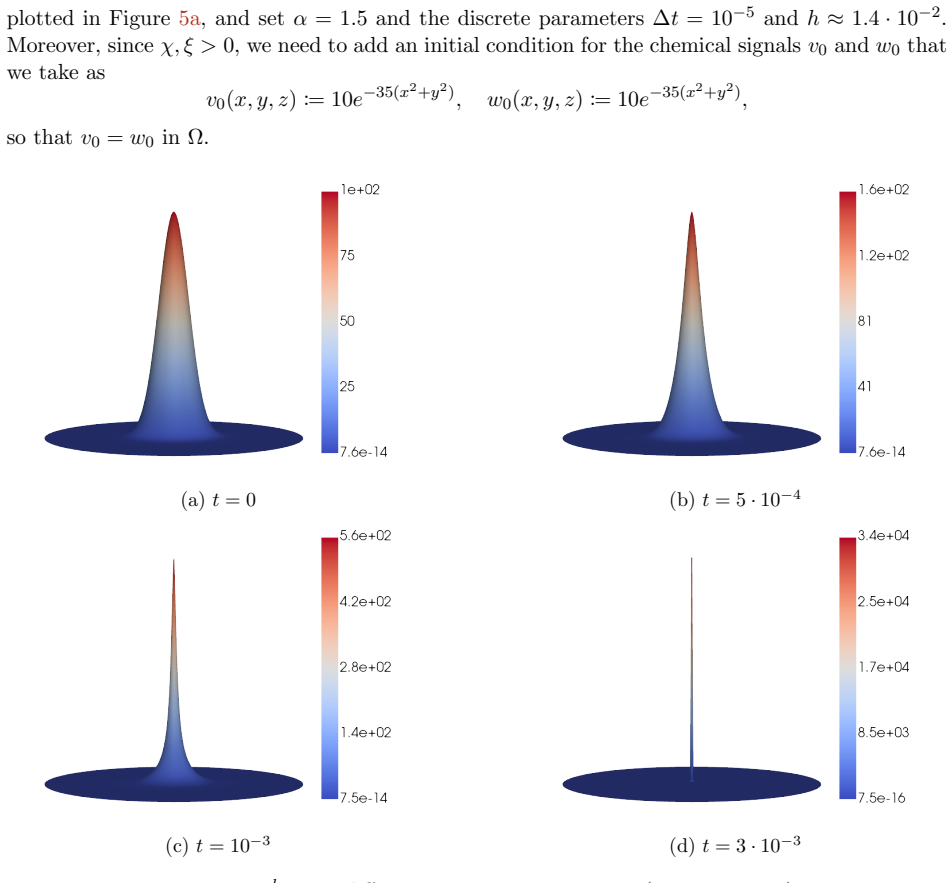
In this work we present a novel linear and positivity preserving upwind discontinuous Galerkin (DG) approximation of a class of chemotaxis models with damping gradient nonlinearities. In particular, both a local and a nonlocal model including nonlinear diffusion, chemoattraction, chemorepulsion and logistic growth are considered. Some numerical experiments in the context of chemotactic collapse are presented, whose results are in accordance with the previous analysis of the approximation and show how the blow-up can be prevented by means of the damping gradient term.
Editorial analysis
A structured set of objections, weighed in public.
Referee Report
Summary. The manuscript presents a novel linear upwind discontinuous Galerkin (DG) approximation for a class of chemotaxis models with damping gradient nonlinearities. Both local and nonlocal variants are considered, incorporating nonlinear diffusion, chemoattraction, chemorepulsion, and logistic growth. The central claims are that the scheme is positivity-preserving (via upwind fluxes and the damping structure) and that numerical experiments on chemotactic collapse scenarios align with prior analysis while demonstrating that the damping gradient term prevents blow-up.
Significance. If the positivity preservation holds as claimed, the work supplies a practical, linear DG scheme for simulating chemotaxis models without artificial blow-up, which is valuable in mathematical biology. The explicit use of upwind fluxes combined with the damping nonlinearity to establish positivity is a clear strength, as is the reported consistency between the discrete experiments and the continuous-model analysis. These elements provide a falsifiable numerical check on the regularization role of the damping term.
minor comments (3)
- [Abstract] Abstract: the reference to 'previous analysis of the approximation' is ambiguous as to whether the analysis appears in the present manuscript or a cited prior work; a brief clarification or citation would improve precision.
- The numerical section would be strengthened by the inclusion of at least one table or set of quantitative metrics (e.g., maximum cell density over time with/without damping) to make the blow-up prevention claim more directly verifiable.
- Notation for the local versus nonlocal models could be introduced with a short comparative table early in the model section to aid readers.
Simulated Author's Rebuttal
We thank the referee for the careful reading and positive assessment of the manuscript. The recommendation for minor revision is noted. No specific major comments appear in the report, so we provide no point-by-point responses below. We remain ready to address any minor points or clarifications requested by the editor.
Circularity Check
No significant circularity; derivation self-contained
full rationale
The manuscript introduces a new linear upwind DG scheme for the given chemotaxis models, derives positivity and stability directly from the discrete flux structure and the damping gradient nonlinearity in the continuous equations, and confirms consistency via numerical experiments. No load-bearing step reduces to a fitted parameter renamed as prediction, self-citation chain, or self-definitional equivalence; the damping term's regularizing effect is analyzed from the model PDEs rather than presupposed by the discretization itself.
Axiom & Free-Parameter Ledger
axioms (1)
- domain assumption Standard assumptions of DG theory for convection-diffusion equations guarantee positivity and stability when upwinding and damping are present.
Reference graph
Works this paper leans on
-
[1]
D. Acosta-Soba, F. Guill´ en-Gonz´ alez, and J. R. Rodr´ ıguez-Galv´ an. An Unconditionally En- ergy Stable and Positive Upwind DG Scheme for the Keller–Segel Model. Journal of Scientific Computing, 97(1):18, 2023. doi: 10.1007/s10915-023-02320-4
-
[2]
D. Acosta-Soba, F. Guill´ en-Gonz´ alez, and J. R. Rodr´ ıguez-Galv´ an. An upwind DG scheme preserving the maximum principle for the convective Cahn–Hilliard model. Numerical Algo- rithms, 92(3):1589–1619, 2022. doi: 10.1007/s11075-022-01355-2
-
[3]
M. Aida, T. Tsujikawa, M. Efendiev, A. Yagi, and M. Mimura. Lower estimate of the attractor dimension for a chemotaxis growth system. Journal of the London Mathematical Society , 74(2):453–474, 2006. doi: 10.1112/S0024610706023015
-
[4]
R. Almeda, H. van Someren Gr´ eve, and T. Kiørboe. Behavior is a major determinant of predation risk in zooplankton. Ecosphere, 8(2):e01668, 2017. doi: 10.1002/ecs2.1668
-
[5]
M. S. Alnaes, A. Logg, K. B. Ølgaard, M. E. Rognes, and G. N. Wells. Unified Form Lan- guage: A domain-specific language for weak formulations of partial differential equations.ACM Transactions on Mathematical Software, 40(2):1–37, 2014. doi: 10.1145/2566630
-
[6]
B. Andreianov, M. Bendahmane, and M. Saad. Finite volume methods for degenerate chemo- taxis model. Journal of Computational and Applied Mathematics , 235(14):4015–4031, 2011. doi: 10.1016/j.cam.2011.02.023
-
[7]
S. Badia, J. Bonilla, and J. V. Guti´ errez-Santacreu. Bound-preserving finite element approxi- mations of the Keller–Segel equations. Mathematical Models and Methods in Applied Sciences, 33(03):609–642, 2023. doi: 10.1142/S0218202523500148
-
[8]
N. Bellomo, A. Bellouquid, Y. Tao, and M. Winkler. Toward a mathematical theory of Keller– Segel models of pattern formation in biological tissues. Mathematical Models and Methods in Applied Sciences, 25(09):1663–1763, 2015. doi: 10.1142/S021820251550044X
-
[9]
A. Chertock and A. Kurganov. A second-order positivity preserving central-upwind scheme for chemotaxis and haptotaxis models. Numerische Mathematik , 111(2):169–205, 2008. doi: 10.1007/s00211-008-0188-0
-
[10]
P. G. Ciarlet. The Finite Element Method for Elliptic Problems . Classics in Applied Mathe- matics. SIAM, 2002. doi: 10.1137/1.9780898719208
-
[11]
A. Columbu, S. Frassu, and G. Viglialoro. Properties of given and detected unbounded so- lutions to a class of chemotaxis models. Studies in Applied Mathematics , 151(4):1349–1379,
-
[12]
doi: 10.1111/sapm.12627. 18
-
[13]
A. Columbu, R. D. Fuentes, and S. Frassu. Uniform-in-time boundedness in a class of local and nonlocal nonlinear attraction–repulsion chemotaxis models with logistics. Nonlinear Analysis: Real World Applications, 79:104135, 2024. doi: 10.1016/j.nonrwa.2024.104135
-
[14]
D. A. Di Pietro and A. Ern. Mathematical Aspects of Discontinuous Galerkin Methods , num- ber 69 in Math´ ematiques et Applications. Springer, 2012.doi: 10.1007/978-3-642-22980-0
-
[15]
A. Ern and J.-L. Guermond. Theory and Practice of Finite Elements , number 159 in Applied mathematical sciences. Springer, 2004. doi: 10.1007/978-1-4757-4355-5
-
[16]
L. C. Evans. Partial differential equations , number 19 in Graduate Studies in Mathematics. American Mathematical Society, 2010. isbn: 978-1-4704-6942-9. doi: 10.1090/gsm/019
-
[17]
I. Geipel, C. E. Kernan, A. S. Litterer, G. G. Carter, R. A. Page, and H. M. Ter Hofstede. Predation risks of signalling and searching: bats prefer moving katydids. Biology Letters , 16(4):20190837, 2020. doi: 10.1098/rsbl.2019.0837
-
[18]
F. Guill´ en-Gonz´ alez and G. Tierra. Finite element numerical schemes for a chemo-attraction and consumption model. Journal of Computational and Applied Mathematics , 441:115676,
-
[19]
doi: 10.1016/j.cam.2023.115676
-
[20]
F. Huang and J. Shen. Bound/Positivity Preserving and Energy Stable Scalar auxiliary Variable Schemes for Dissipative Systems: Applications to Keller–Segel and Poisson–Nernst– Planck Equations. SIAM Journal on Scientific Computing , 43(3):A1832–A1857, 2021. doi: 10.1137/20M1365417
-
[21]
J. D. Hunter. Matplotlib: A 2D graphics environment. Computing in Science & Engineering , 9(3):90–95, 2007. doi: 10.1109/MCSE.2007.55
-
[22]
S. Ishida, J. Lankeit, and G. Viglialoro. A Keller-Segel type taxis model with ecological inter- pretation and boundedness due to gradient nonlinearities.Discrete and Continuous Dynamical Systems-B, 29(9):3955–3969, 2024. doi: 10.3934/dcdsb.2024029
- [23]
-
[24]
E. F. Keller and L. A. Segel. Initiation of slime mold aggregation viewed as an instability. Journal of Theoretical Biology, 26(3):399–415, 1970. doi: 10.1016/0022-5193(70)90092-5
-
[25]
E. F. Keller and L. A. Segel. Model for chemotaxis. Journal of Theoretical Biology, 30(2):225– 234, 1971. doi: 10.1016/0022-5193(71)90050-6
-
[26]
T. Li, D. Acosta-Soba, A. Columbu, and G. Viglialoro. Dissipative gradient nonlinearities prevent δ-formations in local and nonlocal attraction-repulsion chemotaxis models. arXiv preprint, 2024. doi: 10.48550/arXiv.2405.03586
-
[27]
T. Li, S. Frassu, and G. Viglialoro. Combining effects ensuring boundedness in an attraction– repulsion chemotaxis model with production and consumption. Zeitschrift f¨ ur angewandte Mathematik und Physik , 74(3):109, 2023. doi: 10.1007/s00033-023-01976-0
-
[28]
M. Mimura and T. Tsujikawa. Aggregating pattern dynamics in a chemotaxis model including growth. Physica A: Statistical Mechanics and its Applications , 230(3-4):499–543, 1996. doi: 10.1016/0378-4371(96)00051-9
-
[29]
A. Quarteroni and A. Valli. Numerical approximation of partial differential equations , vol- ume 23. Springer Science & Business Media, 2008. doi: 10.1007/978-3-540-85268-1
-
[30]
N. Saito. Conservative upwind finite-element method for a simplified Keller–Segel system modelling chemotaxis. IMA Journal of Numerical Analysis , 27(2):332–365, 2007. doi: 10 . 1093/imanum/drl018. 19
work page 2007
-
[31]
M. W. Scroggs, I. A. Baratta, C. N. Richardson, and G. N. Wells. Basix: a runtime finite element basis evaluation library. Journal of Open Source Software , 7(73):3982, 2022. doi: 10.21105/joss.03982
-
[32]
M. W. Scroggs, J. S. Dokken, C. N. Richardson, and G. N. Wells. Construction of Arbitrary Order Finite Element Degree-of-Freedom Maps on Polygonal and Polyhedral Cell Meshes. ACM Transactions on Mathematical Software , 48(2):18, 2022. doi: 10.1145/3524456
-
[33]
J. Shen and J. Xu. Unconditionally Bound Preserving and Energy Dissipative Schemes for a Class of Keller–Segel Equations. SIAM Journal on Numerical Analysis , 58(3):1674–1695,
-
[34]
doi: 10.1137/19M1246705
-
[35]
P. Souplet. Finite Time Blow-up for a Non-linear Parabolic Equation with a Gradient Term and Applications. Mathematical methods in the applied sciences, 19(16):1317–1333, 1996. doi: 10.1002/(SICI)1099-1476(19961110)19:16<1317::AID-MMA835>3.0.CO;2-M
-
[36]
C. B. Sullivan and A. Kaszynski. PyVista: 3D plotting and mesh analysis through a stream- lined interface for the Visualization Toolkit (VTK).Journal of Open Source Software, 4(37):1450,
-
[37]
doi: 10.21105/joss.01450
-
[38]
A. W. Visser. Motility of zooplankton: fitness, foraging and predation. Journal of Plankton research, 29(5):447–461, 2007. doi: 10.1093/plankt/fbm029
-
[39]
G. Zhou and N. Saito. Finite volume methods for a Keller–Segel system: discrete energy, error estimates and numerical blow-up analysis. Numerische Mathematik, 135(1):265–311, January
-
[40]
doi: 10.1007/s00211-016-0793-2. 20
discussion (0)
Sign in with ORCID, Apple, or X to comment. Anyone can read and Pith papers without signing in.