Blank Space: Adaptive Causal Coding for Streaming Communications Over Multi-Hop Networks
Pith reviewed 2026-05-23 03:06 UTC · model grok-4.3
The pith
BS-AC-RLNC reduces channel usage by 20 percent in multi-hop networks through adaptive re-encoding at bottlenecks.
A machine-rendered reading of the paper's core claim, the machinery that carries it, and where it could break.
Core claim
BS-AC-RLNC introduces independent AC-RLNC (NET) re-encoding at each intermediate node. The algorithm adapts FEC rates and schedules idle periods via two mechanisms: Blank Space Period, which accounts for the forward-channel bottleneck, and No-New No-FEC, which accounts for data availability. This produces theoretical lower and upper bounds on in-order delivery delay, goodput, and throughput, with a mean bound derived for delay; the bounds extend to multicast. Experiments show a 20 percent reduction in channel usage relative to baseline RLNC while throughput and delay remain competitive.
What carries the argument
The AC-RLNC (NET) re-encoding algorithm at intermediate nodes, which adaptively adjusts FEC rates and inserts idle periods through Blank Space Period and No-New No-FEC suspension rules based on per-node bottlenecks to the destination.
If this is right
- The scheme yields lower and upper bounds on in-order delivery delay, goodput, and throughput.
- A mean bound is obtained for in-order delay.
- All analytic results extend to the multicast case.
- Channel usage drops 20 percent versus baseline RLNC while throughput and delay stay competitive.
Where Pith is reading between the lines
- Dynamic, online estimation of bottlenecks could let the same idle-scheduling logic operate in time-varying wireless links.
- The inserted blank-space idle periods may incidentally lower transmit energy at relay nodes.
- The same suspension rules could be combined with other network-coding families in larger or heterogeneous topologies.
Load-bearing premise
The physical bottlenecks from each node to the destination can be identified accurately enough to drive the independent re-encoding and idle scheduling without introducing new performance penalties.
What would settle it
Run the scheme on a network where the assumed bottlenecks are deliberately mismatched to measured capacities and check whether the reported 20 percent channel reduction and competitive throughput-delay numbers still appear.
Figures


read the original abstract
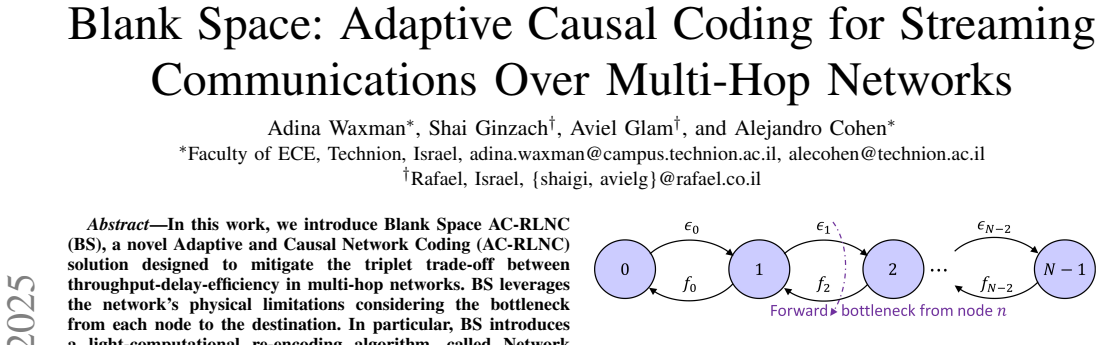
In this work, we introduce Blank Space Adaptive Causal Random Linear Network Coding (BS-AC-RLNC), a novel coding scheme designed to mitigate the triplet trade-off between throughput-delay-efficiency in multi-hop networks. BS-AC-RLNC leverages the physical limitations of the network, considering the bottleneck from each node to the destination. In particular, this approach introduces a light-computational re-encoding algorithm, called AC-RLNC (NET), implemented independently at intermediate nodes. NET adaptively adjusts the Forward Error Correction (FEC) rates and schedules idle periods. It incorporates two distinct suspension mechanisms: 1) Blank Space Period, accounting for the forward-channels bottleneck, and 2) No-New No-FEC approach, based on data availability. We present theoretical lower and upper bounds on in-order delivery delay, goodput, and throughput; in the case of in-order delay, we further derive a mean bound. These analytical results are extended to the multicast scenario, providing a broader understanding of the algorithm's performance under diverse network conditions. The experimental results achieve significant improvements in resource efficiency, demonstrating a 20% reduction in channel usage compared to baseline RLNC solutions. Notably, these efficiency gains are achieved while maintaining competitive throughput and delay performance, ensuring improved resource utilization does not compromise network performance.
Editorial analysis
A structured set of objections, weighed in public.
Referee Report
Summary. The paper introduces BS-AC-RLNC, a novel adaptive causal random linear network coding scheme for streaming communications over multi-hop networks. It leverages per-node bottlenecks to the destination to drive independent AC-RLNC (NET) re-encoding at intermediates, which adaptively sets FEC rates and inserts idle periods via two mechanisms (Blank Space Period for forward-channel bottlenecks and No-New No-FEC for data availability). Theoretical lower/upper bounds (plus a mean bound for in-order delay) are derived for delay, goodput and throughput, extended to multicast, and experiments report a 20% channel-usage reduction versus baseline RLNC while preserving competitive throughput and delay.
Significance. If the central efficiency result holds under realistic conditions, the scheme offers a practical way to improve resource utilization in multi-hop streaming by exploiting network bottlenecks for adaptive coding and scheduling. The provision of analytical bounds on multiple metrics is a positive feature that grounds the approach beyond pure experimentation.
major comments (1)
- [Abstract] Abstract (experimental results paragraph): the reported 20% reduction in channel usage is obtained by letting each intermediate node independently set its FEC rate and insert Blank Space / No-New No-FEC idle periods according to the measured bottleneck capacity from that node onward. No indication is given that this capacity is estimated online or that the scheme was tested under capacity mismatch; any systematic error would alter the idle scheduling and directly undermine the headline efficiency number.
minor comments (1)
- [Abstract] The abstract states that bounds are extended to multicast but does not indicate whether the same bottleneck-driven idle mechanisms apply unchanged or require additional analysis.
Simulated Author's Rebuttal
We thank the referee for the constructive comment regarding the presentation of our experimental results. We address the point below.
read point-by-point responses
-
Referee: [Abstract] Abstract (experimental results paragraph): the reported 20% reduction in channel usage is obtained by letting each intermediate node independently set its FEC rate and insert Blank Space / No-New No-FEC idle periods according to the measured bottleneck capacity from that node onward. No indication is given that this capacity is estimated online or that the scheme was tested under capacity mismatch; any systematic error would alter the idle scheduling and directly undermine the headline efficiency number.
Authors: The manuscript presents BS-AC-RLNC under the modeling assumption that each node knows the bottleneck capacity from itself to the destination (obtained via measurement or signaling) and uses this value to independently configure its FEC rate and idle-period scheduling. The reported 20% channel-usage reduction is obtained under this assumption. We agree that the abstract does not explicitly state whether the capacities are estimated online or whether robustness to estimation error was evaluated, and that this omission weakens the headline claim for practical settings. In the revised version we will (i) add a clarifying sentence to the abstract and (ii) insert a new subsection in the experimental evaluation that reports additional results under online capacity estimation and under controlled mismatch between the true and assumed bottleneck values. revision: yes
Circularity Check
No significant circularity detected
full rationale
The paper presents independent theoretical lower/upper bounds on in-order delay, goodput and throughput (plus a mean bound for delay) and reports experimental 20% channel-usage reduction versus baseline RLNC. No quoted equations, fitted parameters, or self-citations reduce any claimed bound or efficiency figure to its own inputs by construction. The derivation chain remains self-contained against external benchmarks.
Axiom & Free-Parameter Ledger
Reference graph
Works this paper leans on
-
[1]
Drone networks: Communications, coordination, and sensing,
E. Yanmaz, S. Yahyanejad, B. Rinner, H. Hellwagner, and C. Bettstetter, “Drone networks: Communications, coordination, and sensing,” Ad Hoc Networks, vol. 68, pp. 1–15, 2018
work page 2018
-
[2]
An overview of MANET: History, challenges and applications,
M. Kumar and R. Mishra, “An overview of MANET: History, challenges and applications,” Indian Journal of Computer Science and Engineering (IJCSE), vol. 3, no. 1, pp. 121–125, 2012
work page 2012
-
[3]
Multipath routing in wireless sensor networks: survey and research challenges,
M. Radi, B. Dezfouli, K. A. Bakar, and M. Lee, “Multipath routing in wireless sensor networks: survey and research challenges,” sensors, vol. 12, no. 1, pp. 650–685, 2012
work page 2012
-
[4]
R. Ahlswede, N. Cai, S.-Y . Li, and R. W. Yeung, “Network information flow,”IEEE Transactions on information theory, vol. 46, no. 4, pp. 1204– 1216, 2000
work page 2000
-
[5]
S.-Y . Li, R. W. Yeung, and N. Cai, “Linear network coding,” IEEE transactions on information theory , vol. 49, no. 2, pp. 371–381, 2003
work page 2003
-
[6]
A random linear network coding approach to multicast,
T. Ho, M. Médard, R. Koetter, D. R. Karger, M. Effros, J. Shi, and B. Leong, “A random linear network coding approach to multicast,” IEEE Transactions on information theory , vol. 52, no. 10, pp. 4413– 4430, 2006
work page 2006
-
[7]
J. K. Sundararajan, D. Shah, and M. Medard, “ARQ for network coding,” in 2008 IEEE International Symposium on Information Theory , 2008, pp. 1651–1655
work page 2008
-
[8]
J. K. Sundararajan, D. Shah, M. Medard, M. Mitzenmacher, and J. Bar- ros, “Network Coding Meets TCP,” in IEEE INFOCOM 2009 , 2009, pp. 280–288
work page 2009
-
[9]
Network Coding Meets TCP: Theory and Implementation,
J. K. Sundararajan, D. Shah, M. Médard, S. Jakubczak, M. Mitzen- macher, and J. Barros, “Network Coding Meets TCP: Theory and Implementation,” Proceedings of the IEEE , vol. 99, no. 3, pp. 490–512, 2011
work page 2011
-
[10]
M. Luby, “LT codes,” in The 43rd Annual IEEE Symposium on F ounda- tions of Computer Science, 2002. Proceedings. IEEE Computer Society, 2002, pp. 271–271. (a) Node 1. The capacity for SR-ARQ is 0.9. (b) Node 2. The capacity for SR-ARQ is 0.6. (c) Node 3. The capacity for SR-ARQ is ϵ2. (d) Node 4. The capacity for SR-ARQ is ϵ2. (e) Node 5. The capacity for...
work page 2002
-
[11]
A. Shokrollahi, “Raptor codes,” IEEE transactions on information theory, vol. 52, no. 6, pp. 2551–2567, 2006
work page 2006
-
[12]
On playback delay in streaming communication,
G. Joshi, Y . Kochman, and G. W. Wornell, “On playback delay in streaming communication,” in 2012 IEEE International Symposium on Information Theory Proceedings . IEEE, 2012, pp. 2856–2860
work page 2012
-
[13]
A coded generalization of selective repeat ARQ,
J. Cloud, D. Leith, and M. Médard, “A coded generalization of selective repeat ARQ,” in 2015 IEEE Conference on Computer Communications (INFOCOM). IEEE, 2015, pp. 2155–2163
work page 2015
-
[14]
F. Gabriel, A. K. Chorppath, I. Tsokalo, and F. H. Fitzek, “Multipath communication with finite sliding window network coding for ultra- reliability and low latency,” in 2018 IEEE International Conference on Communications Workshops (ICC Workshops) . IEEE, 2018, pp. 1–6
work page 2018
-
[15]
FSW: Fulcrum Sliding Window Coding for Low-Latency Communica- tion,
E. Tasdemir, V . Nguyen, G. T. Nguyen, F. H. P. Fitzek, and M. Reisslein, “FSW: Fulcrum Sliding Window Coding for Low-Latency Communica- tion,” IEEE Access , vol. 10, pp. 54 276–54 290, 2022
work page 2022
-
[16]
Network reduction for coded multiple-hop networks,
J. Du, N. Sweeting, D. C. Adams, and M. Médard, “Network reduction for coded multiple-hop networks,” in 2015 IEEE International Confer- ence on Communications (ICC) , 2015, pp. 4518–4523
work page 2015
-
[17]
Tiny codes for guaranteeable delay,
D. Malak, M. Médard, and E. M. Yeh, “Tiny codes for guaranteeable delay,” IEEE Journal on Selected Areas in Communications , vol. 37, no. 4, pp. 809–825, 2019
work page 2019
-
[18]
Network Coded TCP (CTCP) Performance over Satellite Networks
J. Cloud, D. Leith, and M. Medard, “Network coded TCP (CTCP) performance over satellite networks,” arXiv preprint arXiv:1310.6635 , 2013
work page internal anchor Pith review Pith/arXiv arXiv 2013
-
[19]
Congestion control for coded transport layers,
M. Kim, J. Cloud, A. ParandehGheibi, L. Urbina, K. Fouli, D. J. Leith, and M. Médard, “Congestion control for coded transport layers,” in 2014 IEEE International Conference on Communications (ICC) , 2014, pp. 1228–1234
work page 2014
-
[20]
Delay-aware coding in multi-hop line networks,
D. Malak, A. Schneuwly, M. Médard, and E. Yeh, “Delay-aware coding in multi-hop line networks,” in 2019 IEEE 5th World F orum on Internet of Things (WF-IoT) , 2019, pp. 650–655
work page 2019
-
[21]
Adaptive coding optimization in wireless networks: Design and implementation aspects,
Y . Shi, Y . E. Sagduyu, J. Zhang, and J. H. Li, “Adaptive coding optimization in wireless networks: Design and implementation aspects,” IEEE Transactions on Wireless Communications , vol. 14, no. 10, pp. 5672–5680, 2015
work page 2015
-
[22]
On state-dependent streaming erasure codes over the three-node relay network,
G. Kasper Facenda, E. Domanovitz, M. Nikhil Krishnan, A. Khisti, S. L. Fong, W.-T. Tan, and J. Apostolopoulos, “On state-dependent streaming erasure codes over the three-node relay network,” in 2022 IEEE International Symposium on Information Theory (ISIT) , 2022, pp. 1951–1956
work page 2022
-
[23]
Streaming erasure codes over multi-hop relay network,
E. Domanovitz, A. Khisti, W.-T. Tan, X. Zhu, and J. Apostolopoulos, “Streaming erasure codes over multi-hop relay network,” in 2020 IEEE International Symposium on Information Theory (ISIT) , 2020, pp. 497– 502
work page 2020
-
[24]
Optimal streaming erasure codes over the three-node relay network,
S. L. Fong, A. Khisti, B. Li, W.-T. Tan, X. Zhu, and J. Apostolopoulos, “Optimal streaming erasure codes over the three-node relay network,” IEEE Transactions on Information Theory , vol. 66, no. 5, pp. 2696– 2712, 2020
work page 2020
-
[25]
Adaptive relaying for streaming erasure codes in a three node relay network,
G. K. Facenda, M. N. Krishnan, E. Domanovitz, S. L. Fong, A. Khisti, W.-T. Tan, and J. Apostolopoulos, “Adaptive relaying for streaming erasure codes in a three node relay network,” IEEE Transactions on Information Theory , vol. 69, no. 7, pp. 4345–4360, 2023
work page 2023
-
[26]
Adaptive causal network coding with feedback,
A. Cohen, D. Malak, V . B. Bracha, and M. Médard, “Adaptive causal network coding with feedback,” IEEE Transactions on Communications , vol. 68, no. 7, pp. 4325–4341, 2020
work page 2020
-
[27]
Adaptive causal network coding with feedback for multipath multi-hop communications,
A. Cohen, G. Thiran, V . B. Bracha, and M. Médard, “Adaptive causal network coding with feedback for multipath multi-hop communications,” IEEE Transactions on Communications , vol. 69, no. 2, pp. 766–785, 2020
work page 2020
-
[28]
Bringing network coding into SDN: Architectural study for meshed heterogeneous communications,
A. Cohen, H. Esfahanizadeh, B. Sousa, J. P. Vilela, M. Luis, D. Raposo, F. Michel, S. Sargento, and M. Medard, “Bringing network coding into SDN: Architectural study for meshed heterogeneous communications,” IEEE Communications Magazine , vol. 59, no. 4, pp. 37–43, 2021
work page 2021
-
[29]
Broadcast approach meets net- work coding for data streaming,
A. Cohen, M. Médard, and S. S. Shitz, “Broadcast approach meets net- work coding for data streaming,” in 2022 IEEE International Symposium on Information Theory (ISIT) . IEEE, 2022, pp. 25–30
work page 2022
-
[30]
Sliding window network coding enables NeXt generation URLLC millimeter-wave networks,
E. Dias, D. Raposo, H. Esfahanizadeh, A. Cohen, T. Ferreira, M. Luís, S. Sargento, and M. Médard, “Sliding window network coding enables NeXt generation URLLC millimeter-wave networks,” IEEE Networking Letters, vol. 5, no. 3, pp. 159–163, 2023
work page 2023
-
[31]
URLLC for 5G and beyond: Requirements, enabling incumbent technologies and network intelligence,
R. Ali, Y . B. Zikria, A. K. Bashir, S. Garg, and H. S. Kim, “URLLC for 5G and beyond: Requirements, enabling incumbent technologies and network intelligence,” IEEE Access , vol. 9, pp. 67 064–67 095, 2021
work page 2021
-
[32]
M. v. d. Schaar and P. A. Chou, Multimedia over IP and Wireless Networks: Compression, Networking, and Systems . USA: Academic Press, Inc., 2007
work page 2007
-
[33]
Tiny codes for guaranteeable delay,
D. Malak, M. Médard, and E. M. Yeh, “Tiny codes for guaranteeable delay,” IEEE J. Sel. Areas in Commun. , vol. 37, no. 4, Apr. 2019
work page 2019
-
[34]
Caterpillar RLNC (CRLNC): A practical finite sliding window RLNC approach,
S. Wunderlich, F. Gabriel, S. Pandi, F. H. Fitzek, and M. Reisslein, “Caterpillar RLNC (CRLNC): A practical finite sliding window RLNC approach,” IEEE Access , vol. 5, pp. 20 183–20 197, 2017
work page 2017
-
[35]
FlEC: Enhancing QUIC with application-tailored reliability mechanisms,
F. Michel, A. Cohen, D. Malak, Q. De Coninck, M. Médard, and O. Bonaventure, “FlEC: Enhancing QUIC with application-tailored reliability mechanisms,” 2022
work page 2022
-
[36]
DeepNP: Deep Learning- Based Noise Prediction for Ultra-Reliable Low-Latency Communica- tions,
A. Cohen, A. Solomon, and N. Shlezinger, “DeepNP: Deep Learning- Based Noise Prediction for Ultra-Reliable Low-Latency Communica- tions,” in 2022 IEEE International Symposium on Information Theory (ISIT), 2022, pp. 2690–2695
work page 2022
-
[37]
An improved selective-repeat ARQ strategy,
E. Weldon, “An improved selective-repeat ARQ strategy,” IEEE Trans- actions on Communications , vol. 30, no. 3, pp. 480–486, 1982
work page 1982
-
[38]
Myths and realities of rateless coding,
N. Bonello, Y . Yang, S. Aissa, and L. Hanzo, “Myths and realities of rateless coding,” IEEE Communications Magazine , vol. 49, no. 8, pp. 143–151, 2011
work page 2011
discussion (0)
Sign in with ORCID, Apple, or X to comment. Anyone can read and Pith papers without signing in.