Energy shortcut of N-level quantum protocols by optimal control
Pith reviewed 2026-05-22 23:36 UTC · model grok-4.3
The pith
QOSTE achieves the same quantum transformations as STA protocols but at the lowest possible energy cost for N-level systems.
A machine-rendered reading of the paper's core claim, the machinery that carries it, and where it could break.
Core claim
QOSTE produces the same transformation as STA for a given protocol used in quantum technologies or thermodynamics, but at the lowest possible energy cost. In the general case of an N-level quantum system the minimal energy cost is determined by the length of the geodesic in the rotating frame given by the original protocol. For long control times the scaling of the ratio between the two energy costs of STA and QOSTE is quadratic in time.
What carries the argument
The length of the geodesic in the rotating frame defined by the original protocol, which fixes the minimal energy cost under optimal control.
If this is right
- QOSTE controls produce the identical final states as STA but with lower energy expenditure.
- The energy-cost ratio of STA to QOSTE scales quadratically with control time when times are long.
- Landau-Zener and STIRAP examples exhibit drastic energy reductions relative to standard STA.
- Gradient-based robust QOSTE protocols can exceed STA performance in both energy efficiency and robustness.
Where Pith is reading between the lines
- The geodesic correspondence could be used to minimize dissipation in quantum heat engines or thermodynamic cycles.
- The reported robustness-energy trade-off points to design rules for choosing protocols under experimental noise.
- Direct verification of the quadratic scaling could be attempted in superconducting-qubit or trapped-ion platforms.
Load-bearing premise
The length of the geodesic in the rotating frame equals the minimal energy cost without hidden costs from frame transformations or unaccounted constraints in the N-level Hamiltonian.
What would settle it
An experiment that applies the derived QOSTE controls to an N-level system and measures an energy cost strictly larger than the geodesic length calculated from the rotating frame.
Figures


read the original abstract
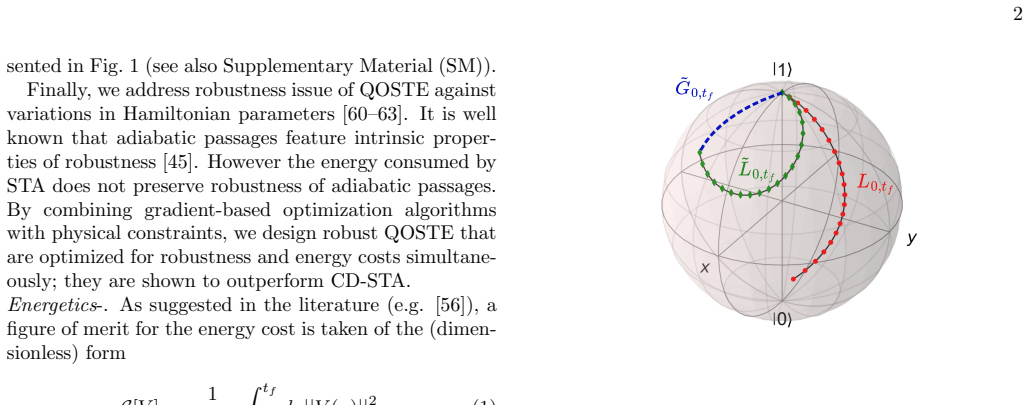
We introduce an energetically-optimal method inspired from Shortcut-To-Adiabaticity (STA) processes, named Quantum-Optimal-Shortcut-To-Energetics (QOSTE). QOSTE produces the same transformation as STA for a given protocol used in quantum technologies or thermodynamics, but at the lowest possible energy cost. In the general case of a N- level quantum system, we derive the QOSTE controls using geometrical and optimal control tools, and show that the minimal energy cost is determined by the length of the geodesic in the rotating frame given by the original protocol. For long control times, the scaling of the ratio between the two energy costs of STA and QOSTE is quadratic in time. We benchmark our results with the Landau-Zener protocol for qubits and STIRAP for three-level systems. We observe a drastic reduction in energy with respect to standard STA methods. Finally, using gradient-based optimization algorithms and highlighting the emerging trade-off between robustness and energy cost, we design robust QOSTE outperforming STA both in robustness and energy efficiency.
Editorial analysis
A structured set of objections, weighed in public.
Referee Report
Summary. The paper introduces Quantum-Optimal-Shortcut-To-Energetics (QOSTE), a method that achieves the same state transformations as Shortcut-To-Adiabaticity (STA) protocols for N-level quantum systems but at minimal energy cost. It derives the QOSTE controls via geometrical and optimal control tools, asserts that the minimal energy equals the geodesic length in the rotating frame defined by the original protocol, reports quadratic scaling of the STA/QOSTE energy ratio for long times, benchmarks on Landau-Zener (qubits) and STIRAP (three-level), and designs a robust variant via gradient optimization that trades off robustness and energy.
Significance. If the central derivation holds without hidden costs from frame transformations, the result would offer a systematic route to lower-energy quantum control protocols with clear scaling advantages, directly relevant to quantum technologies and quantum thermodynamics; the benchmarks and robustness trade-off discussion add practical value.
major comments (2)
- [Abstract] Abstract and introduction: the central claim equates minimal lab-frame energy cost directly to the geodesic length in the rotating frame of the input protocol. This requires explicit demonstration that the time-dependent frame transformation introduces no additional energy contributions when the derived controls are substituted back into the original N-level Hamiltonian; the skeptic concern on unaccounted transformation effects is not addressed in the provided description of the derivation.
- [Abstract] Abstract: the reported quadratic scaling of the energy-cost ratio for long control times is stated without reference to a specific equation or theorem establishing the asymptotic behavior; the derivation steps using geometrical/optimal-control tools must be shown to produce this scaling independently of the particular protocol.
minor comments (2)
- [Abstract] Abstract provides no equations, error metrics, or numerical data despite claiming derivations and benchmarks; this makes independent verification of the geodesic-energy equivalence impossible from the summary alone.
- The manuscript should clarify whether the SU(N) geometry fully encodes all control constraints of the physical N-level Hamiltonian or if additional bounds appear in the lab frame.
Simulated Author's Rebuttal
We thank the referee for the detailed report and constructive suggestions. We address the two major comments below and will revise the manuscript to incorporate explicit demonstrations and references as requested.
read point-by-point responses
-
Referee: [Abstract] Abstract and introduction: the central claim equates minimal lab-frame energy cost directly to the geodesic length in the rotating frame of the input protocol. This requires explicit demonstration that the time-dependent frame transformation introduces no additional energy contributions when the derived controls are substituted back into the original N-level Hamiltonian; the skeptic concern on unaccounted transformation effects is not addressed in the provided description of the derivation.
Authors: We agree that an explicit verification is needed to confirm that the rotating-frame geodesic length directly gives the lab-frame energy without hidden contributions from the time-dependent transformation. In the revised manuscript we will add a dedicated derivation (likely as a new subsection or appendix) that starts from the rotating-frame controls, substitutes them into the original N-level Hamiltonian, and shows that any frame-induced terms are exactly canceled by the optimal-control construction, leaving the energy cost equal to the geodesic length. revision: yes
-
Referee: [Abstract] Abstract: the reported quadratic scaling of the energy-cost ratio for long control times is stated without reference to a specific equation or theorem establishing the asymptotic behavior; the derivation steps using geometrical/optimal-control tools must be shown to produce this scaling independently of the particular protocol.
Authors: We will add an explicit reference (new equation or theorem statement, supported by a short proof sketch) that derives the quadratic scaling of the STA/QOSTE energy ratio for large T directly from the geodesic property in the rotating frame. The argument relies only on the general properties of the SU(N) geometry and the optimal-control problem, not on the details of any specific protocol such as Landau-Zener or STIRAP; this will be placed in the main text or an appendix. revision: yes
Circularity Check
No circularity; derivation uses optimal control to relate cost to geodesic length
full rationale
The abstract states that QOSTE controls are derived using geometrical and optimal control tools, with the result that minimal energy cost equals the geodesic length in the rotating frame of the input protocol. This is presented as an output of the optimal-control analysis rather than a definitional equivalence or fitted prediction. No self-citations, ansatzes smuggled via prior work, or renaming of known results are indicated in the provided text. The central claim retains independent content from the control-theoretic derivation and is therefore self-contained against external benchmarks.
Axiom & Free-Parameter Ledger
axioms (1)
- domain assumption Geometrical and optimal control tools suffice to derive controls that achieve the geodesic length as minimal energy for any N-level system.
Lean theorems connected to this paper
-
IndisputableMonolith/Cost/FunctionalEquation.leanwashburn_uniqueness_aczel unclear?
unclearRelation between the paper passage and the cited Recognition theorem.
minimal energy cost is determined by the length of the geodesic in the rotating frame... C[V_QOSTE] = ˜G²_{0,t_f}/(8 ω_i t_f)
-
IndisputableMonolith/Cost.leanJcost definition and convexity unclear?
unclearRelation between the paper passage and the cited Recognition theorem.
energy cost of the form C[V] = 1/(4ℏ²ω_i) ∫ ||V(u)||² du (Frobenius norm)
What do these tags mean?
- matches
- The paper's claim is directly supported by a theorem in the formal canon.
- supports
- The theorem supports part of the paper's argument, but the paper may add assumptions or extra steps.
- extends
- The paper goes beyond the formal theorem; the theorem is a base layer rather than the whole result.
- uses
- The paper appears to rely on the theorem as machinery.
- contradicts
- The paper's claim conflicts with a theorem or certificate in the canon.
- unclear
- Pith found a possible connection, but the passage is too broad, indirect, or ambiguous to say the theorem truly supports the claim.
Forward citations
Cited by 1 Pith paper
-
Symmetric $C_Z$ gate for ultracold neutral atoms based on counterdiabatic driving at Rydberg excitation
A counterdiabatic symmetric Rydberg-blockade CZ gate scheme for neutral atoms that reduces operation time versus prior adiabatic protocols, provides analytical pulse profiles, and avoids intrinsic single-qubit phase s...
Reference graph
Works this paper leans on
-
[1]
S. J. Glaser, U. Boscain, T. Calarco, C. P. Koch, W. K¨ ockenberger, R. Kosloff, I. Kuprov, B. Luy, S. Schirmer, T. Schulte-Herbr¨ uggen, D. Sugny, and F. K. Wilhelm, Training Schr¨ odinger’s cat: quantum optimal control, Eur. Phys. J. D69, 1 (2015)
work page 2015
-
[2]
C. P. Koch, U. Boscain, T. Calarco, G. Dirr, S. Fil- ipp, S. J. Glaser, R. Kosloff, S. Montangero, T. Schulte- Herbr¨ uggen, D. Sugny, and F. K. Wilhelm, Quantum op- timal control in quantum technologies. strategic report on current status, visions and goals for research in eu- rope, EPJ Quantum Technology9, 19 (2022)
work page 2022
-
[3]
C. Brif, R. Chakrabarti, and H. Rabitz, Control of quan- tum phenomena: past, present and future, New Journal of Physics12, 075008 (2010)
work page 2010
-
[4]
C. Altafini and F. Ticozzi, Modeling and control of quan- tum systems: An introduction, IEEE Trans. Automat. Control57, 1898 (2012)
work page 2012
-
[5]
D. Dong and I. A. Petersen, Quantum control theory and applications: A survey, IET Control Theory A4, 2651 (2010)
work page 2010
-
[6]
C. P. Koch, M. Lemeshko, and D. Sugny, Quantum con- trol of molecular rotation, Rev. Mod. Phys.91, 035005 (2019)
work page 2019
-
[7]
D. Gu´ ery-Odelin, A. Ruschhaupt, A. Kiely, E. Tor- rontegui, S. Mart´ ınez-Garaot, and J. G. Muga, Short- cuts to adiabaticity: Concepts, methods, and applica- tions, Rev. Mod. Phys.91, 045001 (2019)
work page 2019
-
[8]
D. Stefanatos and E. Paspalakis, A shortcut tour of quan- tum control methods for modern quantum technologies, Europhysics Letters132, 60001 (2021)
work page 2021
-
[9]
E. Torrontegui, S. Ib´ a˜ nez, S. Mart´ ınez-Garaot, M. Mod- ugno, A. del Campo, D. Gu´ ery-Odelin, A. Ruschhaupt, X. Chen, and J. G. Muga, Chapter 2 - shortcuts to adi- abaticity, inAdvances in Atomic, Molecular, and Opti- cal Physics, Advances In Atomic, Molecular, and Optical Physics, Vol. 62, edited by E. Arimondo, P. R. Berman, and C. C. Lin (Academi...
work page 2013
-
[10]
C. W. Duncan, P. M. Poggi, M. Bukov, N. T. Zinner, and S. Campbell, Taming quantum systems: A tutorial for using shortcuts-to-adiabaticity, quan- tum optimal control, and reinforcement learning, arXiv 10.48550/arXiv.2501.16436 (2025), 2501.16436
-
[11]
R. G. Unanyan, L. P. Yatsenko, K. Bergmann, and B. W. Shore, Laser-induced adiabatic atomic reorientation with control of diabatic losses, Opt. Commun.139, 48 (1997)
work page 1997
-
[12]
M. Demirplak and S. A. Rice, Adiabatic Population Transfer with Control Fields, J. Phys. Chem. A107, 9937 (2003)
work page 2003
-
[13]
M. Demirplak and S. A. Rice, Assisted Adiabatic Passage Revisited, J. Phys. Chem. A109, 6838 (2005)
work page 2005
-
[14]
M. Demirplak and S. A. Rice, On the consistency, ex- tremal, and global properties of counterdiabatic fields, J. Chem. Phys.129, 154111 (2008)
work page 2008
-
[15]
M. V. Berry, Transitionless quantum driving, J. Phys. A: Math. Theor.42, 365303 (2009)
work page 2009
-
[16]
A. Del Campo, Shortcuts to adiabaticity by counter- diabatic driving, Physical Review Letters111, 100502 (2013)
work page 2013
-
[18]
J. Deng, Q.-h. Wang, Z. Liu, P. H¨ anggi, and J. Gong, Boosting work characteristics and overall heat-engine performance via shortcuts to adiabaticity: Quantum and classical systems, Phys. Rev. E88, 062122 (2013)
work page 2013
-
[19]
M. Beau, J. Jaramillo, and A. Del Campo, Scaling-Up Quantum Heat Engines Efficiently via Shortcuts to Adi- abaticity, Entropy18, 168 (2016)
work page 2016
-
[22]
R. Dann, R. Kosloff, and P. Salamon, Quantum Finite- Time Thermodynamics: Insight from a Single Qubit En- gine, Entropy22, 1255 (2020)
work page 2020
-
[23]
R. Dann and R. Kosloff, Quantum signatures in the quan- tum Carnot cycle, New J. Phys.22, 013055 (2020)
work page 2020
-
[24]
S. Deng, A. Chenu, P. Diao, F. Li, S. Yu, I. Coulamy, A. del Campo, and H. Wu, Superadiabatic quantum fric- tion suppression in finite-time thermodynamics, Sci. Adv. 4, 10.1126/sciadv.aar5909 (2018)
-
[25]
R. Kosloff and T. Feldmann, Discrete four-stroke quan- tum heat engine exploring the origin of friction, Phys. Rev. E65, 055102 (2002)
work page 2002
-
[26]
T. Feldmann and R. Kosloff, Quantum four-stroke heat engine: Thermodynamic observables in a model with in- trinsic friction, Phys. Rev. E68, 016101 (2003)
work page 2003
-
[27]
T. Feldmann and R. Kosloff, Characteristics of the limit cycle of a reciprocating quantum heat engine, Phys. Rev. E70, 046110 (2004)
work page 2004
-
[28]
N. N. Hegade, K. Paul, Y. Ding, M. Sanz, F. Albarr´ an- Arriagada, E. Solano, and X. Chen, Shortcuts to Adi- abaticity in Digitized Adiabatic Quantum Computing, Phys. Rev. Appl.15, 024038 (2021). 6
work page 2021
-
[29]
Y.-H. Chen, W. Qin, X. Wang, A. Miranowicz, and F. Nori, Shortcuts to Adiabaticity for the Quantum Rabi Model: Efficient Generation of Giant Entangled Cat States via Parametric Amplification, Phys. Rev. Lett. 126, 023602 (2021)
work page 2021
-
[30]
A. C. Santos, A. Nicotina, A. M. Souza, R. S. Sarthour, I. S. Oliveira, and M. S. Sarandy, Optimizing NMR quan- tum information processing via generalized transitionless quantum driving, Europhys. Lett.129, 30008 (2020)
work page 2020
-
[31]
D. Liberzon,Calculus of variations and optimal control theory(Princeton University Press, Princeton, NJ, 2012) pp. xviii+235
work page 2012
-
[32]
D. D’Alessandro,Introduction to quantum control and dynamics.(Applied Mathematics and Nonlinear Science Series. Boca Raton, FL: Chapman, Hall/CRC., 2008)
work page 2008
-
[33]
D. E. Kirk,Optimal control theory: an introduction (Courier Corporation, New York, 2004)
work page 2004
-
[34]
L. S. Pontryagin, V. Boltianski, R. Gamkrelidze, and E. Mitchtchenko,The Mathematical Theory of Optimal Processes(John Wiley and Sons, New York, 1962)
work page 1962
-
[35]
M. M. Lee and L. Markus,Foundations of Optimal Con- trol Theory(John Wiley and Sons, New York, 1967)
work page 1967
- [36]
-
[37]
U. Boscain, M. Sigalotti, and D. Sugny, Introduction to the Pontryagin Maximum Principle for Quantum Opti- mal Control, PRX Quantum2, 030203 (2021)
work page 2021
-
[38]
B. Bonnard and D. Sugny,Optimal Control with Applica- tions in Space and Quantum Dynamics, AIMS on applied mathematics, Vol. 5 (American Institute of Mathemati- cal Sciences, Springfield, 2012)
work page 2012
- [39]
- [40]
-
[41]
A. d. Campo, J. Goold, and M. Paternostro, More bang for your buck: Super-adiabatic quantum engines, Sci. Rep.4, 1 (2014)
work page 2014
-
[42]
O. Abah and M. Paternostro, Shortcut-to-adiabaticity Otto engine: A twist to finite-time thermodynamics, Phys. Rev. E99, 022110 (2019)
work page 2019
-
[43]
A. Hartmann, V. Mukherjee, W. Niedenzu, and W. Lech- ner, Many-body quantum heat engines with shortcuts to adiabaticity, Phys. Rev. Res.2, 023145 (2020)
work page 2020
- [44]
-
[45]
N. V. Vitanov, A. A. Rangelov, B. W. Shore, and K. Bergmann, Stimulated raman adiabatic passage in physics, chemistry, and beyond, Rev. Mod. Phys.89, 015006 (2017)
work page 2017
-
[46]
A. E. Allahverdyan and Th. M. Nieuwenhuizen, Minimal work principle: Proof and counterexamples, Phys. Rev. E71, 046107 (2005)
work page 2005
- [47]
-
[48]
J. P. Moutinho, M. Pezzutto, S. S. Pratapsi, F. F. da Silva, S. De Franceschi, S. Bose, A. T. Costa, and Y. Omar, Quantum Dynamics for Energetic Advantage in a Charge-Based Classical Full Adder, PRX Energy2, 033002 (2023)
work page 2023
-
[49]
Energetics of Trapped-Ion Quantum Computation
F. G´ ois, M. Pezzutto, and Y. Omar, Towards En- ergetic Quantum Advantage in Trapped-Ion Quantum Computation, arXiv 10.48550/arXiv.2404.11572 (2024), 2404.11572
work page internal anchor Pith review Pith/arXiv arXiv doi:10.48550/arxiv.2404.11572 2024
-
[50]
S. Campbell and S. Deffner, Trade-Off Between Speed and Cost in Shortcuts to Adiabaticity, Phys. Rev. Lett. 118, 100601 (2017)
work page 2017
- [51]
-
[52]
E. Torrontegui, I. Lizuain, S. Gonz´ alez-Resines, A. To- balina, A. Ruschhaupt, R. Kosloff, and J. G. Muga, En- ergy consumption for shortcuts to adiabaticity, Phys. Rev. A96, 022133 (2017)
work page 2017
-
[53]
A. Tobalina, I. Lizuain, and J. G. Muga, Vanishing effi- ciency of a speeded-up ion-in-Paul-trap Otto engine(a), Europhys. Lett.127, 20005 (2019)
work page 2019
-
[54]
K. Funo, J.-N. Zhang, C. Chatou, K. Kim, M. Ueda, and A. del Campo, Universal Work Fluctuations During Shortcuts to Adiabaticity by Counterdiabatic Driving, Phys. Rev. Lett.118, 100602 (2017)
work page 2017
-
[55]
A. del Campo, A. Chenu, S. Deng, and H. Wu, Friction- free quantum machines, inThermodynamics in the Quan- tum Regime: Fundamental Aspects and New Directions, edited by F. Binder, L. A. Correa, C. Gogolin, J. An- ders, and G. Adesso (Springer International Publishing, Cham, 2018) pp. 127–148
work page 2018
- [56]
-
[57]
E. Carolan, A. Kiely, and S. Campbell, Counterdiabatic control in the impulse regime, Phys. Rev. A105, 012605 (2022)
work page 2022
-
[58]
Auff` eves, Quantum Technologies Need a Quantum En- ergy Initiative, PRX Quantum3, 020101 (2022)
A. Auff` eves, Quantum Technologies Need a Quantum En- ergy Initiative, PRX Quantum3, 020101 (2022)
work page 2022
-
[59]
M. Fellous-Asiani, J. H. Chai, Y. Thonnart, H. K. Ng, R. S. Whitney, and A. Auff` eves, Optimizing Resource Efficiencies for Scalable Full-Stack Quantum Computers, PRX Quantum4, 040319 (2023)
work page 2023
- [60]
-
[61]
M. Harutyunyan, F. Holweck, D. Sugny, and S. Gu´ erin, Digital optimal robust control, Phys. Rev. Lett.131, 200801 (2023)
work page 2023
-
[62]
L. Van Damme, Q. Ansel, S. J. Glaser, and D. Sugny, Robust optimal control of two-level quantum systems, Phys. Rev. A95, 063403 (2017)
work page 2017
-
[63]
E. Carolan, B. C ¸ akmak, and S. Campbell, Robustness of controlled Hamiltonian approaches to unitary quantum gates, Phys. Rev. A108, 022423 (2023)
work page 2023
-
[64]
M. G. Bason, M. Viteau, N. Malossi, P. Huillery, E. Ari- mondo, D. Ciampini, R. Fazio, V. Giovannetti, R. Man- nella, , and O. Morsch, High-fidelity quantum driving, Nature Physics8, 147 (2012)
work page 2012
-
[65]
G. C. Hegerfeldt, Driving at the quantum speed limit: Optimal control of a two-level system, Phys. Rev. Lett. 111, 260501 (2013)
work page 2013
-
[66]
A. Zenesini, H. Lignier, G. Tayebirad, J. Radogostowicz, D. Ciampini, R. Mannella, S. Wimberger, O. Morsch, and E. Arimondo, Time-resolved measurement of landau- 7 zener tunneling in periodic potentials, Phys. Rev. Lett. 103, 090403 (2009)
work page 2009
-
[67]
G. Tayebirad, A. Zenesini, D. Ciampini, R. Mannella, O. Morsch, E. Arimondo, N. L¨ orch, and S. Wimberger, Time-resolved measurement of landau-zener tunneling in different bases, Phys. Rev. A82, 013633 (2010)
work page 2010
- [68]
- [69]
-
[70]
N. Khaneja, T. Reiss, C. Kehlet, T. Schulte-Herbr¨ uggen, and S. J. Glaser, Optimal control of coupled spin dynam- ics: design of NMR pulse sequences by gradient ascent algorithms, J. Magn. Res.172, 296 (2005)
work page 2005
-
[71]
J.-j. Zhu, X. Laforgue, X. Chen, and S. Gu´ erin, Robust quantum control by smooth quasi-square pulses, J. Phys. B: At. Mol. Opt. Phys.55, 194001 (2022)
work page 2022
-
[72]
B. d. L. Bernardo, Time-rescaled quantum dynamics as a shortcut to adiabaticity, Phys. Rev. Res.2, 013133 (2020)
work page 2020
-
[73]
J. L. M. Ferreira, ˆA. F. d. S. Fran¸ ca, A. Rosas, and B. d. L. Bernardo, Shortcuts to adiabaticity designed via time-rescaling follow the same transitionless route, arXiv 10.48550/arXiv.2406.07433 (2024), 2406.07433
-
[74]
del Campo, Probing Quantum Speed Limits with Ul- tracold Gases, Phys
A. del Campo, Probing Quantum Speed Limits with Ul- tracold Gases, Phys. Rev. Lett.126, 180603 (2021)
work page 2021
-
[75]
S. Alipour, A. Chenu, A. T. Rezakhani, and A. del Campo, Shortcuts to Adiabaticity in Driven Open Quantum Systems: Balanced Gain and Loss and Non-Markovian Evolution, Quantum4, 336 (2020), 1907.07460v2
discussion (0)
Sign in with ORCID, Apple, or X to comment. Anyone can read and Pith papers without signing in.