Identifying Instabilities with Quantum Geometry in Flat Band Systems
Pith reviewed 2026-05-22 20:59 UTC · model grok-4.3
The pith
The overlap between the Bloch vector of the flat-band projection operator and an observable-dressed vector fully determines the mean-field susceptibility of the corresponding order parameter.
A machine-rendered reading of the paper's core claim, the machinery that carries it, and where it could break.
Core claim
For a given band structure and observable, the mean-field susceptibility of the corresponding order parameter is fully determined by the overlap between the Bloch vector of the projection operator onto the manifold of flat bands and the observable-dressed vector, possibly shifted by a momentum vector Q. When the overlap is maximized, so is the susceptibility, and this geometrically corresponds to perfect nesting of the band structure. In that case the correlation length of this order parameter, even for Q not zero, is entirely characterized by a generalized quantum metric in an intuitive manner and is therefore lower-bounded in topologically non-trivial bands.
What carries the argument
The overlap (possibly shifted by Q) between the Bloch vector of the flat-band projection operator and the observable-dressed vector, which sets the mean-field susceptibility.
If this is right
- Maximized overlap produces perfect nesting and therefore the largest mean-field susceptibility for the chosen order parameter.
- The correlation length is set by a generalized quantum metric and is lower-bounded when the flat band is topologically nontrivial.
- Staggered antiferromagnetic order can be stabilized in an exactly flat-band model, contrary to the usual association of flat bands with ferromagnetism.
- A Fulde-Ferrell-Larkin-Ovchinnikov-like paired state with nonzero center-of-mass momentum can appear in flat bands once time-reversal symmetry is broken, even without Zeeman splitting.
Where Pith is reading between the lines
- The geometric criterion offers a route to predict ordering wavevectors in other flat-band systems where Fermi-surface nesting is unavailable.
- Topological flat bands may systematically favor longer correlation lengths for certain orders because of the quantum-metric lower bound.
- The same vector-overlap construction could be applied to engineered flat bands in moiré lattices to forecast which interaction channels are most unstable.
Load-bearing premise
The mean-field susceptibility, determined by the geometric overlap, is the dominant indicator of the actual instability even when the band is exactly flat and no Fermi surface exists.
What would settle it
A direct computation or simulation that finds an instability at a wavevector where the geometric overlap is not maximal would falsify the claim that the overlap fully determines the susceptibility.
Figures
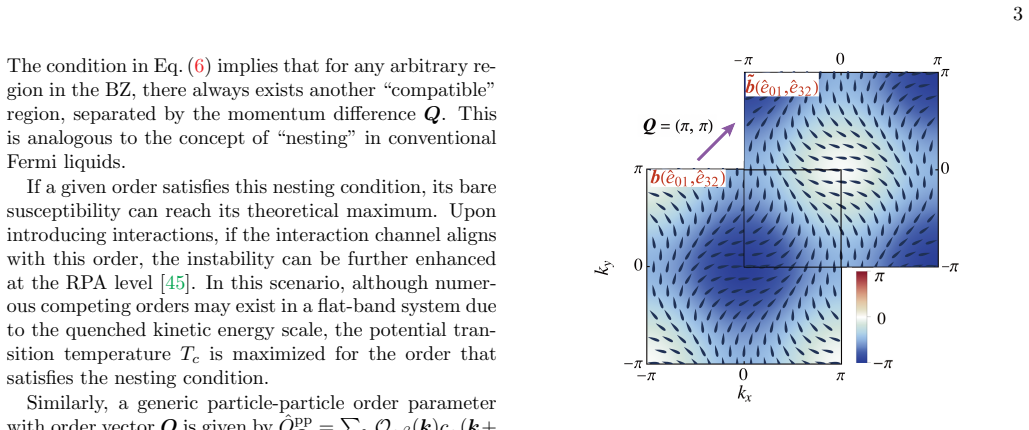


read the original abstract
The absence of a well-defined Fermi surface in flat-band systems challenges the conventional understanding of instabilities toward Landau order based on nesting. We investigate the existence of an intrinsic nesting structure encoded in the band geometry (i.e. the wavefunctions of the flat band(s)), which leads to a maximal susceptibility at the mean-field level and thus determines the instability towards ordered phases. More generally, we show that for a given band structure and observable, we can define two vector fields: one which corresponds to the Bloch vector of the projection operator onto the manifold of flat bands, and another which is "dressed" by the observable. The overlap between the two vector fields, possibly shifted by a momentum vector $\boldsymbol{Q}$, fully determines the mean field susceptibility of the corresponding order parameter. When the overlap is maximized, so is the susceptibility, and this geometrically corresponds to "perfect nesting" of the band structure. In that case, we show that the correlation length of this order parameter, even for $\boldsymbol{Q}\neq \boldsymbol{0}$, is entirely characterized by a generalized quantum metric in an intuitive manner, and is therefore lower-bounded in topologically non-trivial bands. As an example, we demonstrate hidden nesting for staggered antiferromagnetic spin order in an exactly flat-band model, which is notably different from the general intuition that flat bands are closely associated with ferromagnetism. We check the actual emergence of this long-range order using the determinantal quantum Monte Carlo algorithm. Additionally, we demonstrate that a Fulde-Ferrell-Larkin-Ovchinnikov-like state (pairing with non-zero center of mass momentum) can arise in flat bands upon breaking time-reversal symmetry, even if Zeeman splitting is absent.
Editorial analysis
A structured set of objections, weighed in public.
Referee Report
Summary. The paper claims that flat-band systems possess an intrinsic nesting structure encoded in band geometry, allowing prediction of Landau instabilities via the overlap (possibly Q-shifted) between the Bloch vector of the flat-band projector and an observable-dressed vector; this overlap fully sets the mean-field susceptibility, with its maximum corresponding to perfect nesting. The correlation length is then governed by a generalized quantum metric (lower-bounded in nontrivial bands). They illustrate hidden nesting for staggered AFM order (distinct from usual FM intuition) in an exactly flat-band model, confirm long-range order via DQMC, and show FFLO-like pairing upon TRS breaking without Zeeman splitting.
Significance. If the geometric mapping holds, the work supplies a practical, wavefunction-based diagnostic for ordering channels in flat bands lacking Fermi surfaces, relevant to moiré materials and kagome systems. Strengths include the explicit DQMC verification for one model/observable and the introduction of a generalized quantum metric that yields a concrete lower bound on correlation length in topologically nontrivial cases; these elements make the geometric criterion falsifiable and potentially parameter-free once the overlap is computed.
major comments (2)
- [Abstract / susceptibility section] Abstract and the susceptibility derivation: the assertion that the Q-shifted vector overlap 'fully determines' the mean-field susceptibility requires an explicit step-by-step reduction from the particle-hole bubble (or equivalent linear-response expression) to the stated overlap; without this, it is unclear whether the geometric quantity is derived independently or effectively redefines the susceptibility within the isolated flat-band subspace.
- [flat-band limit discussion] The section discussing the flat-band limit and mean-field validity: the mapping assumes remote-band virtual processes can be neglected and that mean-field theory remains the dominant indicator of instability when the kinetic-energy scale is identically zero; this assumption is load-bearing for the claim that geometry selects the dominant channel, yet the manuscript provides only a single DQMC check and does not quantify corrections from strong-coupling or interband effects.
minor comments (2)
- Clarify the precise definition of the 'observable-dressed vector' and its relation to the projection operator; a short appendix deriving its components from the interaction term would aid reproducibility.
- The generalized quantum metric is introduced for the correlation length; state explicitly whether it reduces to the standard Fubini-Study metric when Q=0 and whether the lower bound is saturated in known topological flat bands.
Simulated Author's Rebuttal
We are grateful to the referee for their thorough review and insightful comments on our manuscript. We have carefully considered each point and provide detailed responses below. We believe these revisions strengthen the paper.
read point-by-point responses
-
Referee: [Abstract / susceptibility section] Abstract and the susceptibility derivation: the assertion that the Q-shifted vector overlap 'fully determines' the mean-field susceptibility requires an explicit step-by-step reduction from the particle-hole bubble (or equivalent linear-response expression) to the stated overlap; without this, it is unclear whether the geometric quantity is derived independently or effectively redefines the susceptibility within the isolated flat-band subspace.
Authors: We thank the referee for this suggestion. In the revised version of the manuscript, we have added a dedicated subsection in the susceptibility section that provides a step-by-step derivation. Starting from the general mean-field susceptibility expressed as the particle-hole bubble diagram in the random phase approximation or linear response, we project the operators onto the flat-band subspace. In the flat-band limit where the kinetic energy is zero, the bubble integral reduces exactly to the momentum-space overlap between the Bloch vector of the flat-band projector and the observable-dressed vector, possibly shifted by Q. This derivation shows that the geometric overlap independently determines the susceptibility without redefining it. We have also updated the abstract to reflect this clarification. revision: yes
-
Referee: [flat-band limit discussion] The section discussing the flat-band limit and mean-field validity: the mapping assumes remote-band virtual processes can be neglected and that mean-field theory remains the dominant indicator of instability when the kinetic-energy scale is identically zero; this assumption is load-bearing for the claim that geometry selects the dominant channel, yet the manuscript provides only a single DQMC check and does not quantify corrections from strong-coupling or interband effects.
Authors: We acknowledge the importance of these assumptions. The geometric criterion is derived within the isolated flat-band approximation, where interband virtual processes are neglected. For the specific model considered, we have verified the emergence of the predicted order using DQMC, which goes beyond mean-field. In the revised manuscript, we have expanded the discussion to include a more detailed analysis of the validity of the flat-band limit, potential corrections due to remote bands, and the role of strong-coupling effects. While a complete quantification of all corrections across general systems would require additional extensive numerical work beyond the current scope, we have clarified the conditions under which the geometric mapping is expected to hold and noted it as a useful diagnostic tool. revision: partial
Circularity Check
Susceptibility equated to geometric overlap by vector definition; external DQMC prevents full circularity
specific steps
-
self definitional
[abstract]
"The overlap between the two vector fields, possibly shifted by a momentum vector Q, fully determines the mean field susceptibility of the corresponding order parameter. When the overlap is maximized, so is the susceptibility, and this geometrically corresponds to 'perfect nesting' of the band structure."
The two vector fields are defined directly from the flat-band projection operator and the observable; their overlap is then stated to determine susceptibility. This makes the 'determination' hold by construction of the vectors rather than emerging from an independent linear-response calculation that could have yielded a different functional dependence.
full rationale
The central step defines two vector fields (Bloch vector of flat-band projector and observable-dressed vector) and asserts their Q-shifted overlap fully determines mean-field susceptibility, with maximization corresponding to perfect nesting. This risks self-definitional reduction because the vectors are constructed precisely so the overlap encodes the intra-manifold response matrix elements. However, the paper invokes an independent DQMC verification for the specific model and an external generalized quantum metric lower bound, keeping the derivation from collapsing entirely to input. No self-citation load-bearing or fitted-parameter renaming is evident in the provided chain. Overall moderate circularity risk but not maximal.
Axiom & Free-Parameter Ledger
axioms (2)
- domain assumption The mean-field susceptibility for an order parameter is given by the momentum-space overlap of the flat-band projection Bloch vector and the observable-dressed vector.
- domain assumption The correlation length of the order is entirely characterized by a generalized quantum metric when the overlap is maximized.
Forward citations
Cited by 1 Pith paper
-
Quantum geometric contribution to the diffusion constant
For 3D Dirac fermions at charge neutrality the diffusion constant is purely quantum geometric in origin because the band velocity contribution cancels exactly, unlike in 2D.
Reference graph
Works this paper leans on
-
[1]
A. A. Abrikosov, L. P. Gorkov, and I. E. Dzyaloshinski, Methods of quantum field theory in statistical physics (Dover, New York, 2012)
work page 2012
-
[2]
Shankar, Renormalization-group approach to interact- ing fermions, Rev
R. Shankar, Renormalization-group approach to interact- ing fermions, Rev. Mod. Phys. 66, 129 (1994)
work page 1994
-
[3]
A. W. Overhauser, Spin density waves in an electron gas, Phys. Rev. 128, 1437 (1962)
work page 1962
-
[4]
A. W. Overhauser, Spin-density-wave mechanisms of an- tiferromagnetism, Journal of Applied Physics 34, 1019 (1963)
work page 1963
-
[5]
R. Peierls, Quantum theory of solids, International series of monographs on physics (Clarendon Press, 1955)
work page 1955
-
[6]
Gr¨ uner, The dynamics of charge-density waves, Rev
G. Gr¨ uner, The dynamics of charge-density waves, Rev. Mod. Phys. 60, 1129 (1988)
work page 1988
-
[7]
X. Zhu, Y. Cao, J. Zhang, E. W. Plummer, and J. Guo, Classification of charge density waves based on their na- ture, Proceedings of the National Academy of Sciences 112, 2367 (2015)
work page 2015
- [8]
-
[9]
O. Derzhko, J. Richter, and M. Maksymenko, Strongly correlated flat-band systems: The route from Heisen- berg spins to Hubbard electrons, International Journal of Modern Physics B 29, 1530007 (2015)
work page 2015
-
[10]
E. H. Lieb, Two theorems on the Hubbard model, Phys. Rev. Lett. 62, 1201 (1989)
work page 1989
-
[11]
A. Mielke, Exact ground states for the Hubbard model on the kagome lattice, Journal of Physics A: Mathematical and General 25, 4335 (1992)
work page 1992
-
[12]
Tasaki, Ferromagnetism in the Hubbard models with degenerate single-electron ground states, Phys
H. Tasaki, Ferromagnetism in the Hubbard models with degenerate single-electron ground states, Phys. Rev. Lett. 69, 1608 (1992)
work page 1992
-
[13]
Z. Bi, N. F. Q. Yuan, and L. Fu, Designing flat bands by strain, Phys. Rev. B 100, 035448 (2019)
work page 2019
-
[14]
H. T. Li, T. Z. Ji, R. G. Yan, W. L. Fan, Z. X. Zhang, L. Sun, B. F. Miao, G. Chen, X. G. Wan, and H. F. Ding, General method to construct flat bands in two-dimensional lattices, Phys. Rev. Lett. 134, 076402 (2025)
work page 2025
-
[15]
M. Kang, S. Fang, L. Ye, H. C. Po, J. Denlinger, C. Jozwiak, A. Bostwick, E. Rotenberg, E. Kaxiras, J. G. Checkelsky, and R. Comin, Topological flat bands in frustrated kagome lattice CoSn, Nature Communications 11, 4004 (2020)
work page 2020
-
[16]
L. Balents, C. R. Dean, D. K. Efetov, and A. F. Young, Superconductivity and strong correlations in moir´ e flat bands, Nature Physics 16, 725 (2020)
work page 2020
-
[17]
J. S. Hofmann, D. Chowdhury, S. A. Kivelson, and E. Berg, Heuristic bounds on superconductivity and how to exceed them, npj Quantum Materials 7, 83 (2022)
work page 2022
- [18]
-
[19]
E. Y. Andrei and A. H. MacDonald, Graphene bilayers with a twist, Nature Materials 19, 1265 (2020)
work page 2020
-
[20]
E. Liu, Y. Sun, N. Kumar, L. Muechler, A. Sun, L. Jiao, S.-Y. Yang, D. Liu, A. Liang, Q. Xu, J. Kroder, V. S¨ uß, H. Borrmann, C. Shekhar, Z. Wang, C. Xi, W. Wang, W. Schnelle, S. Wirth, Y. Chen, S. T. B. Goennenwein, and C. Felser, Giant anomalous Hall effect in a ferromag- netic kagome-lattice semimetal, Nature Physics 14, 1125 (2018)
work page 2018
-
[21]
M. Kang, L. Ye, S. Fang, J.-S. You, A. Levitan, M. Han, J. I. Facio, C. Jozwiak, A. Bostwick, E. Rotenberg, M. K. Chan, R. D. McDonald, D. Graf, K. Kaznatcheev, E. Vescovo, D. C. Bell, E. Kaxiras, J. van den Brink, M. Richter, M. Prasad Ghimire, J. G. Checkelsky, and R. Comin, Dirac fermions and flat bands in the ideal kagome metal FeSn, Nature Materials ...
work page 2020
-
[22]
Z. Liu, M. Li, Q. Wang, G. Wang, C. Wen, K. Jiang, X. Lu, S. Yan, Y. Huang, D. Shen, J.-X. Yin, Z. Wang, Z. Yin, H. Lei, and S. Wang, Orbital-selective Dirac fermions and extremely flat bands in frustrated kagome- lattice metal CoSn, Nature Communications 11 (2020)
work page 2020
-
[23]
E. C. Stoner, Collective Electron Ferromagnetism, Pro- ceedings of the Royal Society of London Series A 165, 372 (1938)
work page 1938
-
[24]
L. Klebl and C. Honerkamp, Inherited and flatband- induced ordering in twisted graphene bilayers, Phys. Rev. B 100, 155145 (2019)
work page 2019
-
[25]
S. Wu, C. Xu, X. Wang, H.-Q. Lin, C. Cao, and G.-H. Cao, Flat-band enhanced antiferromagnetic fluctuations and superconductivity in pressurized CsCr 3Sb5, Nature Communications 16, 1375 (2025)
work page 2025
-
[26]
P. Fulde and R. A. Ferrell, Superconductivity in a strong spin-exchange field, Phys. Rev. 135, A550 (1964)
work page 1964
-
[27]
A. I. Larkin and Y. N. Ovchinnikov, Nonuniform state of superconductors, Zh. Eksp. Teor. Fiz. 47, 1136 (1964)
work page 1964
-
[28]
J. J. Kinnunen, J. E. Baarsma, J.-P. Martikainen, and P. T¨ orm¨ a, The Fulde–Ferrell–Larkin–Ovchinnikov state for ultracold fermions in lattice and harmonic potentials: a review, Reports on Progress in Physics 81, 046401 (2018)
work page 2018
-
[29]
D. F. Agterberg, J. S. Davis, S. D. Edkins, E. Fradkin, D. J. Van Harlingen, S. A. Kivelson, P. A. Lee, L. Radz- ihovsky, J. M. Tranquada, and Y. Wang, The physics of pair-density waves: Cuprate superconductors and be- yond, Annual Review of Condensed Matter Physics 11, 231 (2020)
work page 2020
-
[30]
R. Blankenbecler, D. J. Scalapino, and R. L. Sugar, Monte Carlo calculations of coupled boson-fermion sys- tems. I, Phys. Rev. D 24, 2278 (1981)
work page 1981
-
[31]
S. R. White, D. J. Scalapino, R. L. Sugar, E. Y. Loh, J. E. Gubernatis, and R. T. Scalettar, Numerical study of the two-dimensional Hubbard model, Phys. Rev. B40, 506 (1989). 7
work page 1989
-
[32]
S. Peotta and P. T¨ orm¨ a, Superfluidity in topologically nontrivial flat bands, Nature Communications 6, 8944 (2015)
work page 2015
- [33]
-
[34]
P. T¨ orm¨ a, L. Liang, and S. Peotta, Quantum metric and effective mass of a two-body bound state in a flat band, Phys. Rev. B 98, 220511 (2018)
work page 2018
-
[35]
J. S. Hofmann, E. Berg, and D. Chowdhury, Supercon- ductivity, pseudogap, and phase separation in topological flat bands, Phys. Rev. B 102, 201112 (2020)
work page 2020
- [36]
-
[37]
K.-E. Huhtinen, J. Herzog-Arbeitman, A. Chew, B. A. Bernevig, and P. T¨ orm¨ a, Revisiting flat band supercon- ductivity: Dependence on minimal quantum metric and band touchings, Phys. Rev. B 106, 014518 (2022)
work page 2022
-
[38]
J. Herzog-Arbeitman, V. Peri, F. Schindler, S. D. Huber, and B. A. Bernevig, Superfluid weight bounds from sym- metry and quantum geometry in flat bands, Phys. Rev. Lett. 128, 087002 (2022)
work page 2022
-
[39]
S. M. Chan, B. Gr´ emaud, and G. G. Batrouni, Designer flat bands: Topology and enhancement of superconduc- tivity, Phys. Rev. B 106, 104514 (2022)
work page 2022
-
[40]
S. A. Chen and K. T. Law, Ginzburg-Landau theory of flat-band superconductors with quantum metric, Phys. Rev. Lett. 132, 026002 (2024)
work page 2024
-
[41]
P. T¨ orm¨ a, S. Peotta, and B. A. Bernevig, Super- conductivity, superfluidity and quantum geometry in twisted multilayer systems, Nature Reviews Physics 4, 528 (2022)
work page 2022
- [42]
- [43]
-
[44]
B. A. Bernevig, B. Lian, A. Cowsik, F. Xie, N. Regnault, and Z.-D. Song, Twisted bilayer graphene. V. exact an- alytic many-body excitations in coulomb hamiltonians: Charge gap, Goldstone modes, and absence of Cooper pairing, Phys. Rev. B 103, 205415 (2021)
work page 2021
-
[45]
See Supplemental Material for more technical details and additional supporting data
- [46]
-
[47]
Due to the orthogonality relation Pm(k)Pn(k) = δmnPm(k), the target space of b(k) is not an ( N2 − 2)- sphere but rather a specific 2( N − 1)-dimensional subset thereof [48]
-
[48]
A. Graf and F. Pi´ echon, Berry curvature and quantum metric in N-band systems: An eigenprojector approach, Phys. Rev. B 104, 085114 (2021)
work page 2021
-
[49]
Gell-Mann, Symmetries of baryons and mesons, Phys
M. Gell-Mann, Symmetries of baryons and mesons, Phys. Rev. 125, 1067 (1962)
work page 1962
-
[50]
L. M. Kaplan and M. Resnikoff, Matrix products and the explicit 3, 6, 9, and 12-j coefficients of the regular repre- sentation of SU(n), Journal of Mathematical Physics 8, 2194 (1967)
work page 1967
-
[51]
Z. Han, J. Herzog-Arbeitman, B. A. Bernevig, and S. A. Kivelson, “quantum geometric nesting” and solv- able model flat-band systems, Phys. Rev. X 14, 041004 (2024)
work page 2024
-
[52]
J. P. Provost and G. Vallee, Riemannian structure on manifolds of quantum states, Communications in Math- ematical Physics 76, 289 (1980)
work page 1980
-
[53]
Coleman, Introduction to many-body physics (Cam- bridge University Press, 2015)
P. Coleman, Introduction to many-body physics (Cam- bridge University Press, 2015)
work page 2015
-
[54]
J.-X. Hu, S. A. Chen, and K. T. Law, Anomalous co- herence length in superconductors with quantum metric, Communications Physics 8, 20 (2025)
work page 2025
-
[55]
Given that bR ↑ (−k) = b↓(k) in systems with time-reversal symmetry, the expansion of the uniform pairing suscep- tibility χ∆(q) with respect to small q reduces to Eq. (9)
-
[56]
T. Ozawa and B. Mera, Relations between topology and the quantum metric for Chern insulators, Phys. Rev. B 104, 045103 (2021)
work page 2021
-
[57]
Roy, Band geometry of fractional topological insula- tors, Phys
R. Roy, Band geometry of fractional topological insula- tors, Phys. Rev. B 90, 165139 (2014)
work page 2014
-
[58]
J. S. Hofmann, E. Berg, and D. Chowdhury, Supercon- ductivity, charge density wave, and supersolidity in flat bands with a tunable quantum metric, Phys. Rev. Lett. 130, 226001 (2023)
work page 2023
- [59]
-
[60]
D. Vanderbilt, Berry phases in electronic structure theory: Electric polarization, orbital magnetization and topological insulators (Cambridge University Press, 2018)
work page 2018
-
[61]
H. Tasaki, From Nagaoka’s ferromagnetism to flat-band ferromagnetism and beyond: An introduction to ferro- magnetism in the Hubbard model, Progress of Theoreti- cal Physics 99, 489 (1998)
work page 1998
-
[62]
P. M¨ uller, J. Richter, and O. Derzhko, Hubbard mod- els with nearly flat bands: Ground-state ferromagnetism driven by kinetic energy, Phys. Rev. B93, 144418 (2016)
work page 2016
- [63]
-
[64]
N. Regnault and B. A. Bernevig, Fractional Chern insu- lator, Phys. Rev. X 1, 021014 (2011)
work page 2011
-
[65]
Y.-L. Wu, B. A. Bernevig, and N. Regnault, Zoology of fractional Chern insulators, Phys. Rev. B 85, 075116 (2012)
work page 2012
-
[66]
T. Neupert, L. Santos, C. Chamon, and C. Mudry, Frac- tional quantum Hall states at zero magnetic field, Phys. Rev. Lett. 106, 236804 (2011)
work page 2011
-
[67]
E. Tang, J.-W. Mei, and X.-G. Wen, High-temperature fractional quantum Hall states, Phys. Rev. Lett. 106, 236802 (2011)
work page 2011
-
[68]
K. Sun, Z. Gu, H. Katsura, and S. Das Sarma, Nearly flatbands with nontrivial topology, Phys. Rev. Lett. 106, 236803 (2011)
work page 2011
-
[69]
A. M. L¨ auchli, Z. Liu, E. J. Bergholtz, and R. Moessner, Hierarchy of fractional Chern insulators and competing compressible states, Phys. Rev. Lett. 111, 126802 (2013)
work page 2013
-
[70]
P. Wilhelm, T. C. Lang, and A. M. L¨ auchli, Interplay of fractional Chern insulator and charge density wave phases in twisted bilayer graphene, Phys. Rev. B 103, 125406 (2021)
work page 2021
-
[71]
X.-Y. Song, Y.-H. Zhang, and T. Senthil, Phase tran- sitions out of quantum Hall states in moir´ e materials, 8 Phys. Rev. B 109, 085143 (2024)
work page 2024
-
[72]
X.-Y. Song, C.-M. Jian, L. Fu, and C. Xu, Intertwined fractional quantum anomalous Hall states and charge density waves, Phys. Rev. B 109, 115116 (2024)
work page 2024
-
[73]
J. Mitscherling and T. Holder, Bound on resistivity in flat-band materials due to the quantum metric, Phys. Rev. B 105, 085154 (2022)
work page 2022
-
[74]
N. Verma and R. Queiroz, Quantum metric in step re- sponse (2024), arXiv:2406.17845 [cond-mat.mes-hall]
-
[75]
Resta, Polarization fluctuations in insulators and met- als: New and old theories merge, Phys
R. Resta, Polarization fluctuations in insulators and met- als: New and old theories merge, Phys. Rev. Lett. 96, 137601 (2006)
work page 2006
-
[76]
Y. Onishi and L. Fu, Topological bound on the structure factor, Physical Review Letters 133 (2024), 10.1103/physrevlett.133.206602
-
[77]
I. Souza and D. Vanderbilt, Dichroic f-sum rule and the orbital magnetization of crystals, Phys. Rev. B 77, 054438 (2008)
work page 2008
-
[78]
T. Neupert, C. Chamon, and C. Mudry, Measuring the quantum geometry of Bloch bands with current noise, Phys. Rev. B 87, 245103 (2013)
work page 2013
-
[79]
Identifying Instabilities with Quantum Geometry in Flat Band Systems
P. Nozi` eres and D. Pines, Electron interaction in solids. general formulation, Phys. Rev. 109, 741 (1958). 9 Supplemental Material for “Identifying Instabilities with Quantum Geometry in Flat Band Systems” Contents Acknowledgments 5 References 6 I. Derivation Details of the Nesting Condition 9 A. Particle-Hole Excitation 9 B. Particle-Particle Excitatio...
work page 1958
-
[80]
Particle-Hole Excitations: Charge Order 19
discussion (0)
Sign in with ORCID, Apple, or X to comment. Anyone can read and Pith papers without signing in.