c-Birkhoff polytopes
Pith reviewed 2026-05-22 20:55 UTC · model grok-4.3
The pith
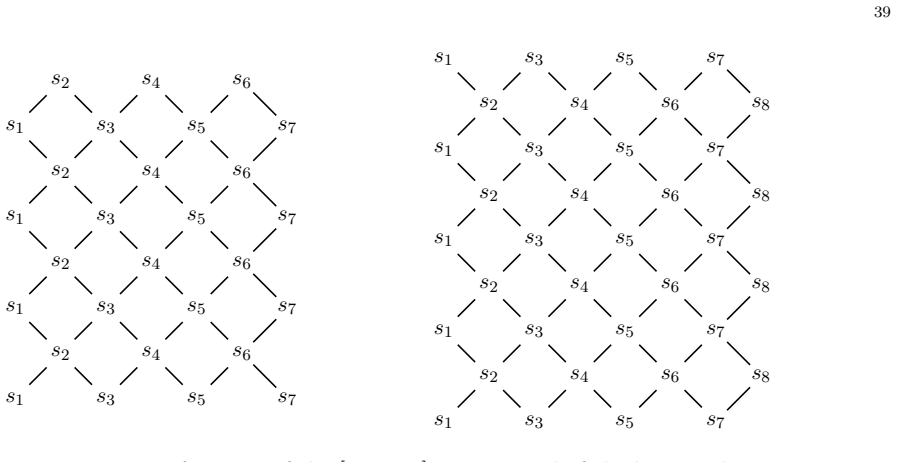
For any Coxeter element c the c-Birkhoff polytope is unimodularly equivalent to the order polytope of the heap poset of the c-sorting word of the longest permutation.
A machine-rendered reading of the paper's core claim, the machinery that carries it, and where it could break.
Core claim
For every Coxeter element c the c-Birkhoff polytope, obtained by imposing pattern-avoidance conditions derived from c, is unimodularly equivalent to the order polytope of the heap poset of the c-sorting word of the longest permutation in the symmetric group. When c is the standard product s1 s2 … sn the equivalence answers the question raised by Davis and Sagan; in general the normalized volume equals the number of longest chains in the associated c-Cambrian lattice.
What carries the argument
The heap poset of the c-sorting word of the longest permutation, whose order ideals encode the combinatorial type of the c-Birkhoff polytope under the claimed unimodular equivalence.
If this is right
- The normalized volume of the c-Birkhoff polytope equals the number of longest chains in the type A c-Cambrian lattice.
- When c equals s1 s2 … sn the result affirms the unimodular equivalence asked by Davis and Sagan.
- The lattice points and faces of the c-Birkhoff polytope are in bijection with the order ideals of the heap poset.
- The equivalence transfers enumeration and volume formulas from the Cambrian lattice to the pattern-avoiding polytope.
Where Pith is reading between the lines
- The same heap-poset construction may produce geometric models for other pattern-avoiding polytopes outside the Birkhoff family.
- Volume computations for these polytopes can now be performed by counting chains in Cambrian lattices rather than by direct polytope methods.
- Analogous equivalences might exist when the symmetric group is replaced by other finite Coxeter groups.
Load-bearing premise
The pattern avoidance conditions that define the c-Birkhoff polytope produce a polytope whose faces and lattice points match exactly the order ideals of the heap poset built from the c-sorting word.
What would settle it
For a small n and a concrete Coxeter element c, compute the normalized volume or the number of vertices of the c-Birkhoff polytope and compare it with the same quantity for the order polytope of the corresponding heap poset; any mismatch disproves the equivalence.
Figures






read the original abstract
In a 2018 paper, Davis and Sagan studied several pattern-avoiding polytopes. They found that a particular pattern-avoiding Birkhoff polytope had the same normalized volume as the order polytope of a certain poset, leading them to ask if the two polytopes were unimodularly equivalent. Motivated by Davis and Sagan's question, in this paper we define a pattern-avoiding Birkhoff polytope called a $c$-Birkhoff polytope for each Coxeter element $c$ of the symmetric group. We then show that the $c$-Birkhoff polytope is unimodularly equivalent to the order polytope of the heap poset of the $c$-sorting word of the longest permutation. When $c=s_1s_2\dots s_{n}$, this result recovers an affirmative answer to Davis and Sagan's question. Another consequence of this result is that the normalized volume of the $c$-Birkhoff polytope is the number of the longest chains in the (type A) $c$-Cambrian lattice.
Editorial analysis
A structured set of objections, weighed in public.
Referee Report
Summary. The paper defines the c-Birkhoff polytope for each Coxeter element c of S_n as the convex hull of the permutation matrices avoiding a c-dependent collection of patterns. It proves that this polytope is unimodularly equivalent to the order polytope of the heap poset of the c-sorting word of the longest element w_0. The result recovers an affirmative answer to a 2018 question of Davis and Sagan for the case c = s_1 s_2 … s_n and implies that the normalized volume equals the number of longest chains in the type-A c-Cambrian lattice.
Significance. The equivalence supplies a combinatorial model linking pattern-avoiding permutation matrices to heap posets and Cambrian lattices, thereby giving an explicit count for the volumes of these polytopes. The argument employs standard Coxeter-theoretic constructions (c-sorting words and heaps) without introducing free parameters or post-hoc fitting, and the special case directly resolves the Davis–Sagan query.
major comments (1)
- [Section 4 (bijection argument)] The central claim rests on a bijection showing that a permutation matrix satisfies the c-pattern-avoidance condition if and only if its support corresponds to an order ideal in the heap poset H_c. The manuscript must verify that this correspondence holds for every Coxeter element c (not merely for the long cycle); a single mismatch would render the polytopes combinatorially inequivalent. The proof sketch in the relevant section should include an explicit check that the covering relations induced by the pattern-avoidance rule coincide with those of the heap poset.
minor comments (2)
- [Introduction and Section 2] The precise definition of the c-dependent pattern-avoidance condition should be stated in a single numbered definition early in the paper rather than distributed across the introduction and later sections.
- [Notation section] Notation for the c-sorting word and the associated heap poset should be fixed once and used consistently; minor variations in subscripting appear in the statements of the main theorems.
Simulated Author's Rebuttal
We thank the referee for the positive evaluation and the recommendation of minor revision. The comment on the bijection argument is addressed point-by-point below.
read point-by-point responses
-
Referee: [Section 4 (bijection argument)] The central claim rests on a bijection showing that a permutation matrix satisfies the c-pattern-avoidance condition if and only if its support corresponds to an order ideal in the heap poset H_c. The manuscript must verify that this correspondence holds for every Coxeter element c (not merely for the long cycle); a single mismatch would render the polytopes combinatorially inequivalent. The proof sketch in the relevant section should include an explicit check that the covering relations induced by the pattern-avoidance rule coincide with those of the heap poset.
Authors: The argument in Section 4 is formulated for an arbitrary Coxeter element c, relying on the c-dependent definitions of the sorting word and the associated heap poset H_c. The bijection is obtained by matching the forbidden patterns (which are determined by the reduced word for c) with the covering relations in the heap. We acknowledge that the current exposition could benefit from a more explicit verification that the covering relations match for general c rather than relying primarily on the special case. We will revise the section to add a short lemma or paragraph that directly compares the covering relations coming from the pattern-avoidance conditions with those of the heap poset, using only the standard properties of heaps and c-sorting words. revision: yes
Circularity Check
No circularity: self-contained combinatorial equivalence proof
full rationale
The paper introduces the c-Birkhoff polytope by a new pattern-avoidance definition depending on a Coxeter element c, then proves unimodular equivalence to the order polytope of the associated heap poset by exhibiting a vertex bijection (permutation matrices satisfying the avoidance condition correspond exactly to order ideals). This is a direct, first-principles combinatorial argument from Coxeter theory and poset theory; it does not rely on fitted parameters, self-citations for load-bearing uniqueness theorems, or renaming of prior empirical results. The Davis-Sagan reference is external motivation only and is answered without circular reduction. The derivation chain is independent of its own inputs.
Axiom & Free-Parameter Ledger
axioms (1)
- standard math Standard properties of Coxeter groups, reduced words, sorting words, and heap posets
invented entities (1)
-
c-Birkhoff polytope
no independent evidence
Reference graph
Works this paper leans on
-
[1]
Preprojective algebras and c-sortable words
[Ami+12] Claire Amiot, Osamu Iyama, Idun Reiten, and Gordana Todorov. “Preprojective algebras and c-sortable words”. In:Proc. Lond. Math. Soc. (3)104.3 (2012), pp. 513–539.doi: 10.1112/plms/pdr020. [ASS06] Ibrahim Assem, Daniel Simson, and Andrzej Skowro´ nski.Elements of the representation theory of associative algebras. Vol
-
[2]
Ehrhart polynomials, simplicial polytopes, magic squares and a conjecture of Stanley
London Mathematical Society Student Texts. Techniques of representation theory. Cambridge University Press, Cambridge, 2006, pp. x+458.doi:10.1017/CBO9780511614309. [Ath05] Christos A. Athanasiadis. “Ehrhart polynomials, simplicial polytopes, magic squares and a conjecture of Stanley”. In:J. Reine Angew. Math.583 (2005), pp. 163–174.doi: 10.1515/crll.2005...
-
[3]
Cambrian combi- natorics on quiver representations (type A)
Encyclopedia of Mathematics and its Applications. Cambridge University Press, Cambridge, 1997, pp. xiv+336.doi:10.1017/CBO9780511529979. [Bar+23] Emily Barnard, Emily Gunawan, Emily Meehan, and Ralf Schiffler. “Cambrian combi- natorics on quiver representations (type A)”. In:Adv. in Appl. Math.143 (2023), Paper No. 102428, 37.doi:10.1016/j.aam.2022.102428...
-
[4]
123-avoiding doubly stochastic matrices
Graduate Texts in Mathematics. Springer, New York, 2005, pp. xiv+363. [BC24] Richard A. Brualdi and Lei Cao. “123-avoiding doubly stochastic matrices”. In:Linear Algebra Appl.697 (2024), pp. 49–81.doi:10.1016/j.laa.2023.07.021. [BDP14] Thomas Br¨ ustle, Gr´ egoire Dupont, and Matthieu P´ erotin. “On maximal green sequences”. In:Int. Math. Res. Not. IMRN16...
-
[5]
On the volume of the polytope of doubly stochastic matrices
Fields Inst. Commun. Springer, New York, 2013, pp. 55–77.doi:10.1007/978-3-319-00200-2\_5. [CR99] Clara S. Chan and David P. Robbins. “On the volume of the polytope of doubly stochastic matrices”. In:Experiment. Math.8.3 (1999), pp. 291–300. [CFZ02] Fr´ ed´ eric Chapoton, Sergey Fomin, and Andrei Zelevinsky. “Polytopal realizations of generalized associah...
-
[6]
Dedicated to Robert V. Moody. 2002, pp. 537– 566.doi:10.4153/CMB-2002-054-1. [DS18] Robert Davis and Bruce Sagan. “Pattern-avoiding polytopes”. In:European J. Combin. 74 (2018), pp. 48–84.doi:10.1016/j.ejc.2018.07.006. [DLY09] Jes´ us A. De Loera, Fu Liu, and Ruriko Yoshida. “A generating function for all semi- magic squares and the volume of the Birkhoff...
-
[7]
Math. Res. Akademie-Verlag, Berlin, 1988, pp. 44–
work page 1988
-
[8]
[Fis97] Peter Fishburn. “Acyclic sets of linear orders”. In:Soc. Choice Welf.14.1 (1997), pp. 113–124.doi:10.1007/s003550050055. [FN14] Susanna Fishel and Luke Nelson. “Chains of maximum length in the Tamari lattice”. In:Proc. Amer. Math. Soc.142.10 (2014), pp. 3343–3353.doi: 10.1090/S0002-9939- 2014-12069-7. [FZ02] Sergey Fomin and Andrei Zelevinsky. “Cl...
-
[9]
Transportation Research Part B: Methodological 46, 1159–1176
arXiv:2211.08935v6 [math.RT]. [HLT11] Christophe Hohlweg, Carsten E. M. C. Lange, and Hugh Thomas. “Permutahedra and generalized associahedra”. In:Adv. Math.226.1 (2011), pp. 608–640.doi: 10.1016/j. aim.2010.07.005. [IT09] Colin Ingalls and Hugh Thomas. “Noncrossing partitions and representations of quivers”. In:Compos. Math.145.6 (2009), pp. 1533–1562.do...
work page doi:10.1016/j 2011
-
[10]
Sortable elements and Cambrian lattices
Prog. Math. Phys. Birkh¨ auser/Springer, Basel, 2012, pp. 293–322.doi: 10.1007/978-3-0348-0405-9_15 . [Rea07b] Nathan Reading. “Sortable elements and Cambrian lattices”. In:Algebra Universalis 56.3-4 (2007), pp. 411–437.doi:10.1007/s00012-007-2009-1. [RS09] Nathan Reading and David E. Speyer. “Cambrian fans”. In:J. Eur. Math. Soc. (JEMS) 11.2 (2009), pp. ...
-
[11]
[Sch14] Ralf Schiffler.Quiver representations. CMS Books in Mathematics/ Ouvrages de Math´ ematiques de la SMC. Springer, Cham, 2014, pp. xii+230.doi: 10.1007/978-3- 319-09204-1. [SS85] Rodica Simion and Frank W. Schmidt. “Restricted permutations”. In:European J. Combin.6.4 (1985), pp. 383–406.doi:10.1016/S0195-6698(85)80052-4. [Sta12] Richard P. Stanley....
-
[12]
Cambridge Studies in Advanced Mathematics. Cambridge University Press, Cambridge, 2012, pp. xiv+626. [Sta86] Richard P. Stanley. “Two poset polytopes”. In:Discrete Comput. Geom.1.1 (1986), pp. 9–23.doi:10.1007/BF02187680. [Ste96] John R. Stembridge. “On the fully commutative elements of Coxeter groups”. In:J. Algebraic Combin.5.4 (1996), pp. 353–385.doi:1...
-
[13]
Lecture Notes in Math. Springer, Berlin, 1986, pp. 321–350.doi: 10.1007/BFb0072524. [Zie95] G¨ unter M. Ziegler.Lectures on polytopes. Vol
-
[14]
Springer-Verlag, New York, 1995, pp
Graduate Texts in Mathematics. Springer-Verlag, New York, 1995, pp. x+370.doi:10.1007/978-1-4613-8431-1. 46 Department of Mathematics, University of California, Riverside, Riverside, CA (USA) Department of Mathematics and Computer Science, University of Puget Sound, Tacoma, W A (USA) Department of Mathematics and Statistics, University of Massachusetts Lo...
discussion (0)
Sign in with ORCID, Apple, or X to comment. Anyone can read and Pith papers without signing in.