A Likelihood Ratio Framework for Highly Motivated Subdominant Signals
Pith reviewed 2026-05-22 15:32 UTC · model grok-4.3
The pith
A likelihood ratio test checks if subdominant new physics fits data consistent with background predictions.
A machine-rendered reading of the paper's core claim, the machinery that carries it, and where it could break.
Core claim
The paper claims that a likelihood ratio test comparing the null hypothesis of background predictions to an alternative hypothesis that adds a small contribution from a highly motivated new physics model can evaluate the model's compatibility with experimental residuals, even in scenarios where the data appears consistent with background alone, and that simplification strategies make this feasible despite complex backgrounds.
What carries the argument
The likelihood ratio test statistic comparing the background-only null hypothesis to the alternative hypothesis that includes a subdominant new physics signal from a highly motivated model, applied directly to experimental residuals.
If this is right
- The test quantifies potential compatibility for models that predict only minor deviations from background.
- Simplification strategies for backgrounds allow the framework to apply to real experiments without full modeling complexity.
- Small signals become evaluable through the improvement in fit under the alternative hypothesis.
- The approach supports checking highly motivated models against current data residuals.
Where Pith is reading between the lines
- The method could apply to reexaminations of existing collider or cosmological data sets for overlooked faint signals.
- It might combine with multi-experiment residual comparisons to strengthen constraints on the same theoretical model.
- Calibration using varied signal strengths in mock data sets would help determine practical sensitivity limits.
Load-bearing premise
That experimental residuals can be meaningfully compared to model predictions even when background modeling is complex and requires simplification strategies to remain valid.
What would settle it
A simulation that injects a known small signal into background data and finds that the likelihood ratio shows no improvement for the alternative hypothesis would challenge whether the test reliably detects subdominant effects.
Figures
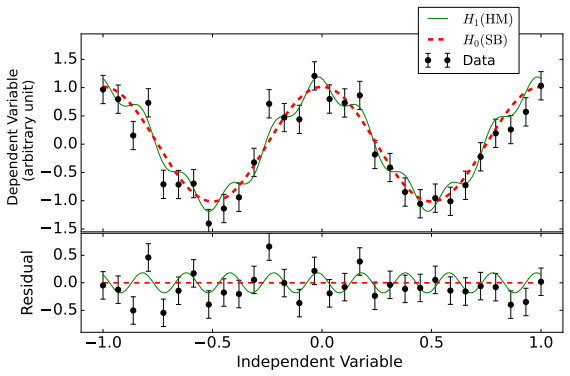


read the original abstract
In particle physics and cosmology, distinguishing subtle new physics signals from established backgrounds is a fundamental and persistent challenge for phenomenologists. This paper discuss a simple and robust statistical framework to evaluate the compatibility of highly motivated (HM) theoretical models with the residuals of experimental results, focusing on scenarios where the data appear consistent with background predictions. A likelihood ratio test is developed that compares null and alternative hypotheses, emphasizing cases where new physics introduces small deviations from the background. The practicality of the framework is highlighted, and in addition to its limitations, strategies to simplify complex background modeling are discussed.
Editorial analysis
A structured set of objections, weighed in public.
Referee Report
Summary. The manuscript proposes a likelihood ratio framework for assessing compatibility of highly motivated (HM) new physics models with experimental residuals in cases where data appear consistent with background predictions. It develops a test comparing a null hypothesis (background-only) to an alternative (background plus small deviations from HM new physics), emphasizes practicality for subdominant signals, discusses limitations, and outlines strategies for simplifying complex background modeling.
Significance. If the central assumptions hold, the framework could provide a practical statistical tool for phenomenologists to evaluate subtle new physics signals in null-result searches without requiring exhaustive background modeling, addressing a persistent challenge in particle physics and cosmology data interpretation.
major comments (2)
- [Section 3] Section 3 (framework development): The assertion that simplification strategies for complex backgrounds preserve the validity of the likelihood ratio test for subdominant signals lacks a derivation or numerical validation demonstrating that the asymptotic properties (e.g., under Wilks' theorem) remain intact post-simplification; this is load-bearing because low signal-to-background ratios make regularity conditions fragile, and the skeptic concern about distorted test statistic distributions is not addressed.
- [Discussion of limitations] Discussion of limitations: The paper treats residual interpretation against simplified backgrounds as unproblematic but provides no quantitative error analysis or bias assessment for cases where background modeling complexity could introduce systematic shifts in the likelihood ratio, undermining claims of robustness for highly motivated subdominant signals.
minor comments (2)
- [Abstract] Abstract: grammatical issue with 'This paper discuss a simple' (should read 'discusses').
- The manuscript should include at least one concrete toy example or simulation validating the framework on a simplified background to illustrate the likelihood ratio behavior for small deviations.
Simulated Author's Rebuttal
We thank the referee for their constructive comments on our manuscript 'A Likelihood Ratio Framework for Highly Motivated Subdominant Signals'. We address each major comment below and indicate the revisions we plan to make to strengthen the paper.
read point-by-point responses
-
Referee: [Section 3] Section 3 (framework development): The assertion that simplification strategies for complex backgrounds preserve the validity of the likelihood ratio test for subdominant signals lacks a derivation or numerical validation demonstrating that the asymptotic properties (e.g., under Wilks' theorem) remain intact post-simplification; this is load-bearing because low signal-to-background ratios make regularity conditions fragile, and the skeptic concern about distorted test statistic distributions is not addressed.
Authors: We appreciate the referee pointing out the need for more rigorous support for the simplification strategies in Section 3. The framework is intended for cases where the new physics signal is subdominant, and the simplifications are designed to retain the key features of the background model without introducing large distortions. While we rely on the standard application of Wilks' theorem for the likelihood ratio test, we recognize that explicit validation is valuable for low signal-to-background scenarios. In the revised manuscript, we will add a subsection or appendix with numerical simulations demonstrating that the test statistic distribution remains close to the expected asymptotic form under the proposed simplifications. revision: yes
-
Referee: [Discussion of limitations] Discussion of limitations: The paper treats residual interpretation against simplified backgrounds as unproblematic but provides no quantitative error analysis or bias assessment for cases where background modeling complexity could introduce systematic shifts in the likelihood ratio, undermining claims of robustness for highly motivated subdominant signals.
Authors: We agree that including a quantitative error analysis would enhance the discussion of limitations. However, a comprehensive bias assessment would require detailed modeling of specific background complexities, which goes beyond the scope of the general framework presented. The manuscript already discusses limitations qualitatively and emphasizes the use of highly motivated signals to mitigate some risks. We will expand this section to include guidance on how users can perform their own bias assessments and note potential sources of systematic shifts. This partial revision will address the concern while keeping the focus on the framework's practicality. revision: partial
Circularity Check
No circularity detected in derivation chain
full rationale
The paper proposes a likelihood ratio framework for assessing compatibility of highly motivated subdominant signals with experimental residuals when data are consistent with background. The abstract and framework description present this as a direct statistical construction comparing null (background-only) and alternative hypotheses, with discussion of practicality, limitations, and simplification strategies for complex backgrounds. No equations or steps reduce by construction to self-definitions, fitted parameters renamed as predictions, or load-bearing self-citations; the central claim remains a proposed tool that can be assessed independently against standard likelihood ratio properties and external benchmarks.
Axiom & Free-Parameter Ledger
axioms (1)
- standard math Likelihood ratio tests follow standard asymptotic distributions under the null hypothesis when comparing background-only and background-plus-signal models.
Reference graph
Works this paper leans on
-
[1]
Quantifying the sensitivity of oscillation experiments to the neutrino mass ordering
doi: 10.1007/JHEP03(2014)028, arXiv:1311.1822. Cousins, R.D.,
work page internal anchor Pith review Pith/arXiv arXiv doi:10.1007/jhep03(2014)028 2014
-
[2]
Cowan, G., Cranmer, K., Gross, E., Vitells, O.,
Lectures on Statistics in Theory: Prelude to Statistics in Practice arXiv:1807.05996. Cowan, G., Cranmer, K., Gross, E., Vitells, O.,
-
[3]
Asymptotic formulae for likelihood-based tests of new physics
doi: 10.1140/epjc/s10052-011-1554-0 , arXiv:1007.1727. [Erra- tum: Eur.Phys.J.C 73, 2501 (2013)]. Davies, R.B.,
work page internal anchor Pith review Pith/arXiv arXiv doi:10.1140/epjc/s10052-011-1554-0 2013
-
[4]
Hypothesis testing when a nuisance parameter is present only under the alternative. Biometrika 74, 33–43. doi: 10.1093/biomet/ 74.1.33. van Dyk, D., Lyons, L.,
-
[5]
Fogli, G.L., Lisi, E., Marrone, A., Montanino, D., Palazzo, A.,
How to Incorporate Systematic Effects into Parameter Determination arXiv:2306.05271. Fogli, G.L., Lisi, E., Marrone, A., Montanino, D., Palazzo, A.,
-
[6]
Getting the most from the statistical analysis of solar neutrino oscil- lations. Phys. Rev. D 66, 053010. doi: 10.1103/PhysRevD.66.053010, arXiv:hep-ph/0206162. Fowlie, A.,
work page internal anchor Pith review Pith/arXiv arXiv doi:10.1103/physrevd.66.053010
-
[7]
13 Fowlie, A., Hoof, S., Handley, W.,
Comment on ”Reproducibility and Replication of Ex- perimental Particle Physics Results” doi: 10.1162/99608f92.b9bfc518, arXiv:2105.03082. 13 Fowlie, A., Hoof, S., Handley, W.,
-
[8]
Nested Sampling for Frequentist Computation: Fast Estimation of Small p-Values. Phys. Rev. Lett. 128, 021801. doi: 10.1103/PhysRevLett.128.021801, arXiv:2105.13923. Gross, E., Vitells, O.,
-
[9]
Trial factors for the look elsewhere effect in high energy physics. Eur. Phys. J. C 70, 525–530. doi: 10.1140/epjc/ s10052-010-1470-8, arXiv:1005.1891. Junk, T.R., Lyons, L.,
work page internal anchor Pith review Pith/arXiv arXiv doi:10.1140/epjc/
-
[10]
Reproducibility and Replication of Ex- perimental Particle Physics Results doi: 10.1162/99608f92.250f995b, arXiv:2009.06864. Lyons, L.,
-
[11]
A Paradox about Likelihood Ratios?
A Paradox about Likelihood Ratios? arXiv:1711.00775. Navas, S., et al. (Particle Data Group),
work page internal anchor Pith review Pith/arXiv arXiv
-
[12]
Review of particle physics. Phys. Rev. D 110, 030001. doi: 10.1103/PhysRevD.110.030001. Ranucci, G.,
-
[13]
Likelihood scan of the Super-Kamiokande I time se- ries data. Phys. Rev. D 73, 103003. doi: 10.1103/PhysRevD.73.103003, arXiv:hep-ph/0511026. Wilks, S.S.,
work page internal anchor Pith review Pith/arXiv arXiv doi:10.1103/physrevd.73.103003
- [14]
discussion (0)
Sign in with ORCID, Apple, or X to comment. Anyone can read and Pith papers without signing in.