Engineering long-range and multi-body interactions via global kinetic constraints
Pith reviewed 2026-05-22 15:53 UTC · model grok-4.3
The pith
Periodic driving in a Bose-Hubbard system with global interactions creates kinetic constraints that enable direct N-qubit controlled gates.
A machine-rendered reading of the paper's core claim, the machinery that carries it, and where it could break.
Core claim
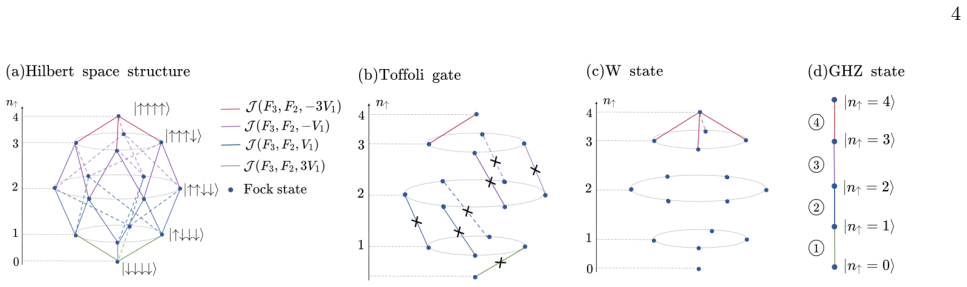
In the driven Bose-Hubbard system with global-range density-density interactions, optimally chosen driving parameters induce global kinetic constraints in which tunneling rates are selectively suppressed according to the particle-number imbalance between all even and odd sites; together with tunable local tunneling this yields efficient implementation schemes for a family of global controlled gates, illustrated by a direct construction of the N-qubit Toffoli gate.
What carries the argument
Global kinetic constraints from periodic on-site driving that suppress tunneling selectively according to the even-odd site particle imbalance.
If this is right
- The N-qubit Toffoli gate can be realized in one step rather than through a sequence of two-body gates.
- Entangled many-body states become reachable with fewer operations than standard two-body decompositions require.
- A range of other global controlled gates follows from the same tunable constraint mechanism.
- Long-range and multi-body interactions emerge from pairwise terms plus the global driving without additional hardware.
- The approach supplies a concrete route to multi-qubit operations in systems where only local tunneling and global density interactions are available.
Where Pith is reading between the lines
- The same driving protocol might be adapted to other lattice geometries or to fermionic systems to produce different classes of constrained dynamics.
- Observing the predicted imbalance-dependent suppression would also test the stability of the global interaction term against experimental imperfections.
- If the constraints remain robust at larger particle numbers, the method could reduce gate overhead in quantum algorithms that rely on multi-controlled operations.
- The selective suppression offers a new handle for engineering effective Hamiltonians that are otherwise difficult to realize with static interactions alone.
Load-bearing premise
The driven Bose-Hubbard system with global interactions can be realized in cold-atom optical lattices without introducing uncontrolled heating or decoherence that would wash out the selective tunneling suppression.
What would settle it
Measure the tunneling rate between neighboring sites while varying the even-odd particle imbalance and check whether the rate drops sharply to zero only for the predicted imbalance values while coherence times remain long.
Figures




read the original abstract
Long-range and multi-body interactions are crucial for quantum simulation and quantum computation. Yet, their practical realization using elementary pairwise interactions remains an outstanding challenge. We propose an experimental scheme based on the Bose-Hubbard system with a periodic driving of the on-site energy and global-range density-density interactions, a setup readily implementable via cold atoms in optical lattices with cavity-mediated interactions. Optimally chosen driving parameters can induce global kinetic constraints, where tunneling rates are selectively suppressed depending on the particle number imbalance between all even and odd sites. This mechanism, together with the flexible tunability of local tunneling rates, provides efficient implementation schemes of a family of global controlled gates for quantum computation. We illustrate this scheme for the $N$-qubit Toffoli gate, circumventing the need for a two-body gate decomposition, and elaborate on the efficient preparation of entangled many-body states.
Editorial analysis
A structured set of objections, weighed in public.
Referee Report
Summary. The manuscript proposes a scheme in a driven Bose-Hubbard model augmented by global-range density-density interactions (realizable via cavity-mediated couplings in optical lattices) to engineer global kinetic constraints. Periodic driving of on-site energies is claimed to selectively suppress tunneling amplitudes according to the global even-odd site particle-number imbalance, while local tunneling rates remain tunable; this is used to implement a family of global controlled gates, with an explicit illustration for the N-qubit Toffoli gate that avoids two-body decomposition, and to prepare entangled many-body states.
Significance. If the central Floquet-engineering claim holds with clean suppression and controllable errors, the work would offer a direct route to multi-body and long-range constraints in cold-atom platforms, bypassing standard gate decompositions for certain quantum-computational tasks. The approach builds on standard Bose-Hubbard and cavity-QED ingredients and supplies a concrete gate example, which strengthens its potential utility for quantum simulation and computation.
major comments (2)
- [Model and effective Hamiltonian (around the description of periodic driving)] The central claim that optimally chosen driving parameters produce selective tunneling suppression according to global even-odd imbalance rests on an unshown effective Floquet or Magnus-expanded Hamiltonian. No explicit derivation, parameter values, or estimate of residual time-dependent or higher-order terms appears in the model section or supplementary material, leaving the load-bearing mapping to constrained dynamics unverified.
- [Application to global gates (Toffoli illustration)] The proposal for the N-qubit Toffoli gate via the global constraint assumes that the induced suppression is sufficiently strong and free of unwanted effective interactions or heating; however, no quantitative error analysis, fidelity estimates, or comparison of the desired constraint scale to residual processes is provided.
minor comments (2)
- [Introduction and model] Notation for the even-odd imbalance operator and the local versus global tunneling amplitudes should be introduced with a single consistent definition early in the text.
- [Abstract] The abstract states that the scheme is 'readily implementable' but does not cite specific cavity-QED or lattice parameters that would realize the required global density-density strength relative to the driving frequency.
Simulated Author's Rebuttal
We thank the referee for their thorough review and valuable feedback on our manuscript. We address each of the major comments below and have made revisions to improve the clarity and completeness of the presentation.
read point-by-point responses
-
Referee: [Model and effective Hamiltonian (around the description of periodic driving)] The central claim that optimally chosen driving parameters produce selective tunneling suppression according to global even-odd imbalance rests on an unshown effective Floquet or Magnus-expanded Hamiltonian. No explicit derivation, parameter values, or estimate of residual time-dependent or higher-order terms appears in the model section or supplementary material, leaving the load-bearing mapping to constrained dynamics unverified.
Authors: We agree with the referee that an explicit derivation would strengthen the manuscript. The original submission focused on the physical implications, but we have now added a comprehensive derivation of the effective Floquet Hamiltonian using the Magnus expansion in a new supplementary section. This includes the chosen driving parameters that lead to the selective suppression of tunneling amplitudes conditioned on the global even-odd site particle-number imbalance, along with quantitative estimates of the residual higher-order terms to verify the validity of the approximation. revision: yes
-
Referee: [Application to global gates (Toffoli illustration)] The proposal for the N-qubit Toffoli gate via the global constraint assumes that the induced suppression is sufficiently strong and free of unwanted effective interactions or heating; however, no quantitative error analysis, fidelity estimates, or comparison of the desired constraint scale to residual processes is provided.
Authors: We thank the referee for pointing this out. To address this, we have added a quantitative analysis of the gate fidelity in the revised manuscript. This includes perturbative estimates of the error due to residual interactions and heating, as well as numerical fidelity calculations for the N-qubit Toffoli gate under the constrained dynamics for moderate system sizes. These additions demonstrate that the constraint scale can be made dominant over residual processes with appropriate parameter choices. revision: yes
Circularity Check
No circularity detected; effective model derived from microscopic driven Hamiltonian
full rationale
The proposal starts from the standard Bose-Hubbard Hamiltonian with periodic on-site driving and global density-density interactions (implementable via cavity-mediated cold atoms). It applies Floquet/Magnus expansion to obtain an effective time-independent Hamiltonian in which tunneling amplitudes are suppressed according to global even-odd imbalance. This suppression is a calculable consequence of the chosen driving frequencies and amplitudes in the microscopic model, not presupposed or fitted to the target gate. The N-qubit Toffoli illustration follows directly from the resulting tunable effective interactions without reducing to self-definition, fitted inputs renamed as predictions, or load-bearing self-citations. The derivation remains self-contained against external benchmarks of Floquet theory and Bose-Hubbard physics.
Axiom & Free-Parameter Ledger
free parameters (1)
- driving amplitude and frequency
axioms (1)
- domain assumption Bose-Hubbard model accurately describes cold atoms in optical lattices with cavity-mediated global interactions
Reference graph
Works this paper leans on
-
[1]
S. Will, T. Best, U. Schneider, L. Hackerm¨ uller, D.-S. L¨ uhmann, and I. Bloch, Nat465, 197 (2010)
work page 2010
-
[2]
A. Fedorov, L. Steffen, M. Baur, M. P. da Silva, and A. Wallraff, Nat481, 170 (2012)
work page 2012
-
[3]
R. J. Fletcher, R. Lopes, J. Man, N. Navon, R. P. Smith, M. W. Zwierlein, and Z. Hadzibabic, Sci355, 377 (2017)
work page 2017
-
[4]
H.-N. Dai, B. Yang, A. Reingruber, H. Sun, X.-F. Xu, Y.-A. Chen, Z.-S. Yuan, and J.-W. Pan, Nat. Phys.13, 1195 (2017)
work page 2017
-
[5]
P. Sala, T. Rakovszky, R. Verresen, M. Knap, and F. Pollmann, Phys. Rev. X10, 011047 (2020)
work page 2020
-
[6]
F. Petiziol, M. Sameti, S. Carretta, S. Wimberger, and F. Mintert, Phys. Rev. Lett.126, 250504 (2021)
work page 2021
-
[7]
O. Katz, M. Cetina, and C. Monroe, Phys. Rev. Lett. 129, 063603 (2022)
work page 2022
- [8]
-
[9]
M. Aidelsburger, M. Atala, S. Nascimbene, S. Trotzky, Y.-A. Chen, and I. Bloch, Phys. Rev. Lett.107, 255301 (2011)
work page 2011
-
[11]
S. Greschner, L. Santos, and D. Poletti, Phys. Rev. Lett.113, 183002 (2014)
work page 2014
- [12]
-
[13]
F. Meinert, M. J. Mark, K. Lauber, A. J. Daley, and H.-C. N¨ agerl, Phys. Rev. Lett.116, 205301 (2016)
work page 2016
- [14]
- [15]
-
[16]
P. W. Claeys, M. Pandey, D. Sels, and A. Polkovnikov, Phys. Rev. Lett.123, 090602 (2019)
work page 2019
-
[17]
J. Choi, H. Zhou, H. S. Knowles, R. Landig, S. Choi, and M. D. Lukin, Phys. Rev. X10, 031002 (2020)
work page 2020
- [18]
-
[19]
D. Bluvstein, A. Omran, H. Levine, A. Keesling, G. Se- meghini, S. Ebadi, T. T. Wang, A. A. Michailidis, N. Maskara, W. W. Ho,et al., Sci371, 1355 (2021)
work page 2021
- [20]
-
[21]
M. Kalinowski, N. Maskara, and M. D. Lukin, Phys. Rev. X13, 031008 (2023)
work page 2023
-
[22]
B.-Y. Sun, N. Goldman, M. Aidelsburger, and M. Bukov, PRX Quantum4, 020329 (2023)
work page 2023
-
[23]
H.-K. Jin, J. Knolle, and M. Knap, Phys. Rev. Lett. 130, 226701 (2023)
work page 2023
-
[24]
E. A. Martinez, C. A. Muschik, P. Schindler, D. Nigg, A. Erhard, M. Heyl, P. Hauke, M. Dalmonte, T. Monz, P. Zoller,et al., Nat534, 516 (2016)
work page 2016
-
[25]
C. Schweizer, F. Grusdt, M. Berngruber, L. Barbiero, E. Demler, N. Goldman, I. Bloch, and M. Aidelsburger, Nat. Phys.15, 1168 (2019)
work page 2019
-
[26]
G. Semeghini, H. Levine, A. Keesling, S. Ebadi, T. T. Wang, D. Bluvstein, R. Verresen, H. Pichler, M. Kali- nowski, R. Samajdar,et al., Sci374, 1242 (2021)
work page 2021
-
[27]
K. Satzinger, Y.-J. Liu, A. Smith, C. Knapp, M. New- man, C. Jones, Z. Chen, C. Quintana, X. Mi, A. Dunsworth,et al., Sci374, 1237 (2021)
work page 2021
- [28]
-
[29]
J. C. Halimeh, M. Aidelsburger, F. Grusdt, P. Hauke, and B. Yang, Nat. Phys. , 1 (2025)
work page 2025
- [30]
-
[31]
A Simple Proof that Toffoli and Hadamard are Quantum Universal
D. Aharonov, arXiv preprint arXiv:quant-ph/0301040 (2003)
work page internal anchor Pith review Pith/arXiv arXiv 2003
-
[32]
M. A. Nielsen and I. L. Chuang,Quantum Computation and Quantum Information: 10th Anniversary Edition (Cambridge University Press, 2010)
work page 2010
-
[33]
T. H¨ aner, M. Roetteler, and K. M. Svore, Quantum Info. Comput.17, 673 (2017)
work page 2017
- [34]
-
[35]
L. K. Grover, Phys. Rev. Lett.79, 325 (1997)
work page 1997
-
[36]
T. Roy, S. Hazra, S. Kundu, M. Chand, M. P. Patankar, and R. Vijay, Phys. Rev. Applied14, 014072 (2020)
work page 2020
-
[37]
A. M. Steane, Phys. Rev. Lett.77, 793 (1996)
work page 1996
-
[38]
D. G. Cory, M. D. Price, W. Maas, E. Knill, R. Laflamme, W. H. Zurek, T. F. Havel, and S. S. Somaroo, Phys. Rev. Lett.81, 2152 (1998)
work page 1998
-
[39]
P. Schindler, J. T. Barreiro, T. Monz, V. Nebendahl, D. Nigg, M. Chwalla, M. Hennrich, and R. Blatt, Sci 332, 1059 (2011)
work page 2011
-
[40]
M. D. Reed, L. DiCarlo, S. E. Nigg, L. Sun, L. Frun- zio, S. M. Girvin, and R. J. Schoelkopf, Nat.482, 382 (2012)
work page 2012
-
[41]
A. Paetznick and B. W. Reichardt, Phys. Rev. Lett. 111, 090505 (2013)
work page 2013
-
[42]
T. J. Yoder, R. Takagi, and I. L. Chuang, Phys. Rev. X6, 031039 (2016)
work page 2016
-
[43]
A. Barenco, C. H. Bennett, R. Cleve, D. P. DiVincenzo, N. Margolus, P. Shor, T. Sleator, J. A. Smolin, and H. Weinfurter, Phys. Rev. A52, 3457 (1995)
work page 1995
-
[44]
N. Yu, R. Duan, and M. Ying, Phys. Rev. A88, 010304 (2013)
work page 2013
- [45]
-
[46]
V. V. Shende and I. L. Markov, Quantum Info. Comput. 9, 461 (2009)
work page 2009
-
[47]
T. Monz, K. Kim, W. H¨ ansel, M. Riebe, A. S. Villar, P. Schindler, M. Chwalla, M. Hennrich, and R. Blatt, Phys. Rev. Lett.102, 040501 (2009)
work page 2009
-
[48]
C. Song, S.-B. Zheng, P. Zhang, K. Xu, L. Zhang, Q. Guo, W. Liu, D. Xu, H. Deng, K. Huang, D. Zheng, X. Zhu, and H. Wang, Nat. Commun.8, 1061 (2017)
work page 2017
- [49]
-
[50]
T. Bækkegaard, L. B. Kristensen, N. J. S. Loft, C. K. Andersen, D. Petrosyan, and N. T. Zinner, Sci. Rep.9, 13389 (2019)
work page 2019
-
[51]
A. J. Baker, G. B. P. Huber, N. J. Glaser, F. Roy, I. Tsit- silin, S. Filipp, and M. J. Hartmann, Appl. Phys. Lett. 120, 054002 (2022)
work page 2022
-
[52]
Y. Kim, A. Morvan, L. B. Nguyen, R. K. Naik, C. J¨ unger, L. Chen, J. M. Kreikebaum, D. I. Santiago, and I. Siddiqi, Nat. Phys.18, 783 (2022)
work page 2022
-
[53]
N. J. Glaser, F. Roy, and S. Filipp, Phys. Rev. Appl. 19, 044001 (2023)
work page 2023
-
[54]
X. Dong, S. Liu, Y.-L. Mao, B. Guo, S. Xu, H. Chen, Y. Guo, Z.-D. Li, and J. Fan, Opt. Express, OE32, 39675 (2024)
work page 2024
-
[55]
L. B. Nguyen, N. Goss, K. Siva, Y. Kim, E. Younis, B. Qing, A. Hashim, D. I. Santiago, and I. Siddiqi, Nat. Commun.15, 7117 (2024)
work page 2024
- [56]
-
[57]
X. Wang, A. Sørensen, and K. Mølmer, Phys. Rev. Lett.86, 3907 (2001)
work page 2001
-
[58]
S. E. Rasmussen, K. Groenland, R. Gerritsma, K. Schoutens, and N. T. Zinner, Phys. Rev. A101, 022308 (2020)
work page 2020
-
[59]
L. Isenhower, M. Saffman, and K. Mølmer, Quantum Inf. Process.10, 755 (2011)
work page 2011
- [60]
- [61]
- [62]
- [63]
-
[64]
S. Sch¨ utz, S. B. J¨ ager, and G. Morigi, Phys. Rev. Lett. 117, 083001 (2016)
work page 2016
- [65]
-
[66]
M. A. Norcia, R. J. Lewis-Swan, J. R. Cline, B. Zhu, A. M. Rey, and J. K. Thompson, Sci361, 259 (2018)
work page 2018
- [67]
- [68]
-
[69]
M. Ye, Y. Tian, J. Lin, Y. Luo, J. You, J. Hu, W. Zhang, W. Chen, and X. Li, Phys. Rev. Lett.131, 103601 (2023)
work page 2023
- [70]
-
[71]
X. Wu, Z. Wang, F. Yang, R. Gao, C. Liang, M. K. Tey, X. Li, T. Pohl, and L. You, Nat. Phys.20, 1389 (2024)
work page 2024
- [72]
-
[73]
A. Hudomal, I. Vasi´ c, N. Regnault, and Z. Papi´ c, Com- munications Physics3, 99 (2020)
work page 2020
- [74]
-
[75]
S. Moudgalya, B. A. Bernevig, and N. Regnault, Rep. Prog. Phys.85, 086501 (2022)
work page 2022
-
[76]
A. Chandran, T. Iadecola, V. Khemani, and R. Moess- ner, Annu. Rev. Conden. Ma. P.14, 443 (2023)
work page 2023
- [77]
-
[78]
H. Bernien, S. Schwartz, A. Keesling, H. Levine, A. Om- ran, H. Pichler, S. Choi, A. S. Zibrov, M. Endres, M. Greiner,et al., Nat551, 579 (2017)
work page 2017
-
[79]
V. Khemani, M. Hermele, and R. Nandkishore, Phys. Rev. B101, 174204 (2020)
work page 2020
- [80]
-
[81]
G.-X. Su, H. Sun, A. Hudomal, J.-Y. Desaules, Z.-Y. Zhou, B. Yang, J. C. Halimeh, Z.-S. Yuan, Z. Papi´ c, and J.-W. Pan, Phys. Rev. Research5, 023010 (2023)
work page 2023
discussion (0)
Sign in with ORCID, Apple, or X to comment. Anyone can read and Pith papers without signing in.