Nonlinear thermal and thermoelectric transport from quantum geometry
Pith reviewed 2026-05-22 01:19 UTC · model grok-4.3
The pith
Nonlinear thermal and thermoelectric transport is controlled by quantum geometry through relations parallel to the Wiedemann-Franz and Mott laws.
A machine-rendered reading of the paper's core claim, the machinery that carries it, and where it could break.
Core claim
Nonlinear thermal and thermoelectric transport coefficients are generated by quantum geometry contributions (Berry curvature dipole with time-reversal symmetry and quantum metric dipole when time-reversal is broken) and these coefficients obey a network of exact relations that parallel the standard Wiedemann-Franz and Mott relations.
What carries the argument
Berry curvature dipole and quantum metric dipole, which enter the nonlinear response functions and enforce the geometric identities that link the various thermal, thermoelectric, and electrical conductivities.
If this is right
- The same geometric identities allow thermal measurements to extract the magnitude of Berry curvature dipole and quantum metric dipole.
- The relations extend the diagnostic power of nonlinear transport to systems where time-reversal symmetry is present or absent.
- Explicit predictions exist for the nonlinear responses in Weyl-Kondo semimetals and Bernal bilayer graphene.
- The framework supplies additional constraints that any microscopic theory of these materials must satisfy.
Where Pith is reading between the lines
- If the relations hold, temperature-dependent nonlinear transport could become a standard tool for mapping quantum geometry across a wider class of topological semimetals.
- The parallel to linear Wiedemann-Franz and Mott laws suggests that quantum geometry may impose universal constraints on higher-order responses in other correlated systems.
- Experimental verification would motivate searches for analogous geometric relations in nonlinear responses involving spin or valley degrees of freedom.
Load-bearing premise
The nonlinear thermal and thermoelectric responses are dominated by quantum geometry contributions without significant interference from scattering or other band-structure effects.
What would settle it
A measurement in Bernal bilayer graphene or a Weyl-Kondo semimetal in which the ratio of nonlinear thermal to nonlinear electrical conductivity deviates from the predicted geometric value at low temperature would falsify the central claim.
Figures

read the original abstract
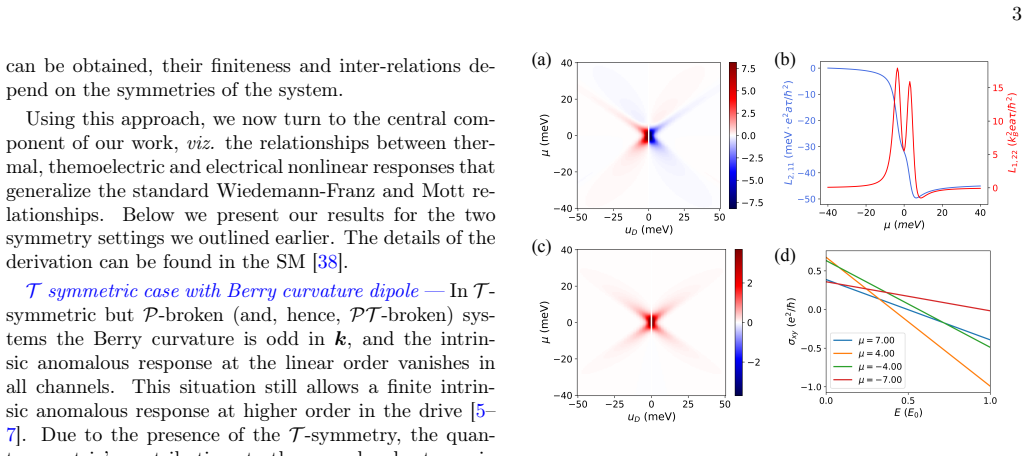
Quantum geometry may enable the development of quantum phases ranging from superconductivity to correlated topological states. One powerful probe of quantum geometry is the nonlinear Hall response which detects Berry curvature dipole in systems with time-reversal invariance and broken inversion symmetry. With broken time-reversal symmetry, this response is also associated with quantum metric dipole. Here we investigate nonlinear thermal and thermoelectric responses, which provide a wealth of new information about quantum geometry. In particular, we uncover a web of connections between these quantities that parallel the standard Wiedemann-Franz and Mott relations. Implications for the studies of a variety of topological systems, including Weyl-Kondo semimetals and Bernal bilayer graphene, are discussed.
Editorial analysis
A structured set of objections, weighed in public.
Referee Report
Summary. The manuscript investigates nonlinear thermal and thermoelectric transport in systems with nontrivial quantum geometry. It derives a set of algebraic relations among the nonlinear thermal conductivity, thermoelectric current, and related response tensors that parallel the linear Wiedemann-Franz and Mott relations; these relations are expressed in terms of the Berry-curvature dipole and quantum-metric dipole. Implications for Weyl-Kondo semimetals and Bernal bilayer graphene are discussed.
Significance. If the reported relations survive in the full transport coefficients, the work would furnish additional experimental handles on quantum geometry beyond the nonlinear Hall effect. The semiclassical Boltzmann derivation supplies a concrete, falsifiable framework that could be tested in existing materials.
major comments (1)
- [Nonlinear thermal and thermoelectric response derivations] The parallel relations are obtained after projecting onto the isolated quantum-geometry dipole terms. The manuscript does not demonstrate that the same algebraic relations continue to hold once conventional velocity-matrix-element contributions and energy-dependent scattering are restored (see the Boltzmann-equation treatment of the nonlinear thermal conductivity). This projection is load-bearing for the claim that the relations are experimentally accessible.
minor comments (1)
- [Abstract] The abstract states the existence of the parallels but supplies neither the explicit form of the relations nor the key approximations; a short sentence listing the main relations would improve clarity.
Simulated Author's Rebuttal
We thank the referee for their careful reading of our manuscript and for the constructive major comment. We appreciate the recognition that our work provides a semiclassical framework for nonlinear thermal and thermoelectric responses tied to quantum geometry. We address the concern below and have revised the manuscript to strengthen the generality of the reported relations.
read point-by-point responses
-
Referee: The parallel relations are obtained after projecting onto the isolated quantum-geometry dipole terms. The manuscript does not demonstrate that the same algebraic relations continue to hold once conventional velocity-matrix-element contributions and energy-dependent scattering are restored (see the Boltzmann-equation treatment of the nonlinear thermal conductivity). This projection is load-bearing for the claim that the relations are experimentally accessible.
Authors: We thank the referee for highlighting this important point. In the original derivation we isolated the quantum-geometry dipole contributions to emphasize the novel connections to Berry curvature and quantum metric dipoles. To address the concern, the revised manuscript now includes an extended Boltzmann-equation analysis (new subsection in Sec. III) that restores the full velocity-matrix-element terms and allows for energy-dependent scattering rates. Under the assumption of momentum-independent scattering (or scattering that preserves the relevant symmetries), we explicitly verify that the algebraic relations among the nonlinear thermal conductivity, thermoelectric current, and related tensors continue to hold. We have added a discussion of the regime in which conventional contributions remain subdominant, thereby clarifying the conditions for experimental accessibility. These additions directly respond to the load-bearing character of the projection while preserving the focus on quantum-geometry effects. revision: yes
Circularity Check
No significant circularity; derivation remains self-contained
full rationale
The paper derives expressions for nonlinear thermal and thermoelectric conductivities in terms of Berry curvature dipole and quantum metric dipole within the semiclassical Boltzmann framework, then identifies algebraic relations among those dipole contributions that mirror the linear Wiedemann-Franz and Mott forms. These relations follow directly from the structure of the integrals over the dipoles and the assumed energy-independent relaxation time; they are not obtained by fitting parameters to data and then relabeling the fit as a prediction, nor by importing a uniqueness theorem from prior self-citation. The central claim is therefore an explicit calculation rather than a tautology, and the paper states its approximations openly rather than smuggling them in via citation. No load-bearing step reduces to its own input by construction.
Axiom & Free-Parameter Ledger
axioms (1)
- domain assumption Quantum geometry (Berry curvature dipole and quantum metric dipole) determines the leading nonlinear thermal and thermoelectric responses in the systems of interest.
Lean theorems connected to this paper
-
IndisputableMonolith/Foundation/Cost/FunctionalEquation.leanwashburn_uniqueness_aczel unclear?
unclearRelation between the paper passage and the cited Recognition theorem.
we uncover a web of connections between these quantities that parallel the standard Wiedemann-Franz and Mott relations... La,bc 2,22 = L La,bc 1,11 ... La,bc 1,11 = −e (La,bc 2,11)′
What do these tags mean?
- matches
- The paper's claim is directly supported by a theorem in the formal canon.
- supports
- The theorem supports part of the paper's argument, but the paper may add assumptions or extra steps.
- extends
- The paper goes beyond the formal theorem; the theorem is a base layer rather than the whole result.
- uses
- The paper appears to rely on the theorem as machinery.
- contradicts
- The paper's claim conflicts with a theorem or certificate in the canon.
- unclear
- Pith found a possible connection, but the passage is too broad, indirect, or ambiguous to say the theorem truly supports the claim.
Reference graph
Works this paper leans on
-
[1]
The majority of the computational calculations have been performed on the Shared University Grid at Rice funded by NSF under Grant EIA-0216467, a part- nership between Rice University, Sun Microsystems, and Sigma Solutions, Inc., the Big-Data Private-Cloud Re- search Cyberinfrastructure MRI-award funded by NSF under Grant No. CNS-1338099, and the Extreme ...
-
[2]
J. P. Provost and G. Vallee, Riemannian structure on manifolds of quantum states, Communications in Math- ematical Physics76, 289 (1980)
work page 1980
-
[3]
N. Marzari and D. Vanderbilt, Maximally localized gen- eralized wannier functions for composite energy bands, Phys. Rev. B56, 12847 (1997)
work page 1997
-
[4]
S. Peotta and P. Törmä, Superfluidity in topologically nontrivial flat bands, Nature Communications6, 8944 (2015)
work page 2015
- [5]
-
[6]
E. Deyo, L. E. Golub, E. L. Ivchenko, and B. Spi- vak, Semiclassical theory of the photogalvanic ef- fect in non-centrosymmetric systems, arXiv e-prints , arXiv:0904.1917 (2009), arXiv:0904.1917 [cond-mat.mes- hall]
work page internal anchor Pith review Pith/arXiv arXiv 1917
-
[7]
I. Sodemann and L. Fu, Quantum nonlinear hall effect induced by berry curvature dipole in time-reversal in- variant materials, Phys. Rev. Lett.115, 216806 (2015)
work page 2015
-
[8]
T. Low, Y. Jiang, and F. Guinea, Topological currents in black phosphorus with broken inversion symmetry, Phys. Rev. B92, 235447 (2015)
work page 2015
-
[9]
Q. Ma, S.-Y. Xu, H. Shen, D. MacNeill, V. Fatemi, T.-R. Chang, A. M. Mier Valdivia, S. Wu, Z. Du, C.-H. Hsu, S. Fang, Q. D. Gibson, K. Watanabe, T. Taniguchi, R. J. Cava, E. Kaxiras, H.-Z. Lu, H. Lin, L. Fu, N. Gedik, and P. Jarillo-Herrero, Observation of the nonlinear hall effect under time-reversal-symmetric conditions, Nature 565, 337 (2019)
work page 2019
-
[10]
K. Kang, T. Li, E. Sohn, J. Shan, and K. F. Mak, Nonlin- ear anomalous hall effect in few-layer wte2, Nature Ma- terials18, 324 (2019)
work page 2019
-
[11]
D. Kumar, C.-H. Hsu, R. Sharma, T.-R. Chang, P. Yu, J. Wang, G. Eda, G. Liang, and H. Yang, Room- temperature nonlinear hall effect and wireless radiofre- quency rectification in weyl semimetal tairte4, Nature Nanotechnology16, 421 (2021)
work page 2021
-
[12]
H.-H.Lai, S.E.Grefe, S.Paschen,andQ.Si,Weyl–kondo semimetal in heavy-fermion systems, PNAS115, 93 (2018)
work page 2018
-
[13]
S. E. Grefe, H.-H. Lai, S. Paschen, and Q. Si, Weyl- kondosemimetalsinnonsymmorphicsystems,Phys.Rev. B101, 075138 (2020)
work page 2020
-
[14]
S. Dzsaber, L. Prochaska, A. Sidorenko, G. Eguchi, R.Svagera, M.Waas, A.Prokofiev, Q.Si,andS.Paschen, Kondo insulator to semimetal transformation tuned by spin-orbit coupling, Phys. Rev. Lett.118, 246601 (2017)
work page 2017
- [15]
-
[16]
S. Dzsaber, X. Yan, M. Taupin, G. Eguchi, A. Prokofiev, T. Shiroka, P. Blaha, O. Rubel, S. E. Grefe, H.-H. Lai, Q. Si, and S. Paschen, Giant spontaneous hall effect in a 6 nonmagnetic weyl–kondo semimetal, Proceedings of the National Academy of Sciences118, e2013386118 (2021)
work page 2021
-
[17]
H. Liu, J. Zhao, Y.-X. Huang, W. Wu, X.-L. Sheng, C. Xiao, and S. A. Yang, Intrinsic second-order anoma- lous hall effect and its application in compensated anti- ferromagnets, Phys. Rev. Lett.127, 277202 (2021)
work page 2021
- [18]
-
[19]
S. Murakami, N. Nagaosa, and S.-C. Zhang, Dissipation- less quantum spin current at room temperature, Science 301, 1348 (2003)
work page 2003
-
[20]
N. Wang, D. Kaplan, Z. Zhang, T. Holder, N. Cao, A. Wang, X. Zhou, F. Zhou, Z. Jiang, C. Zhang,et al., Quantum metric-induced nonlinear transport in a topo- logical antiferromagnet, Nature621, 487 (2023)
work page 2023
- [21]
-
[22]
T. Neupert, C. Chamon, and C. Mudry, Measuring the quantum geometry of bloch bands with current noise, Phys. Rev. B87, 245103 (2013)
work page 2013
-
[23]
M. Kang, S. Kim, Y. Qian, P. M. Neves, L. Ye, J. Jung, D. Puntel, F. Mazzola, S. Fang, C. Jozwiak, A. Bost- wick, E. Rotenberg, J. Fuji, I. Vobornik, J.-H. Park, J. G. Checkelsky, B.-J. Yang, and R. Comin, Measurements of the quantum geometric tensor in solids, Nature Physics 21, 110 (2025)
work page 2025
-
[24]
C. Zeng, S. Nandy, and S. Tewari, Fundamental relations for anomalous thermoelectric transport coefficients in the nonlinear regime, Phys. Rev. Res.2, 032066 (2020)
work page 2020
-
[25]
R. Franz and G. Wiedemann, Ueber die wärme- leitungsfähigkeit der metalle, Annalen der Physik165, 497 (1853)
-
[26]
M. Jonson and G. D. Mahan, Mott’s formula for the ther- mopower and the wiedemann-franz law, Phys. Rev. B21, 4223 (1980)
work page 1980
-
[27]
M. Cutler and N. F. Mott, Observation of anderson local- ization in an electron gas, Phys. Rev.181, 1336 (1969)
work page 1969
-
[28]
L. Smrcka and P. Streda, Transport coefficients in strong magnetic fields, Journal of Physics C: Solid State Physics 10, 2153 (1977)
work page 1977
-
[29]
Onsager, Reciprocal relations in irreversible processes
L. Onsager, Reciprocal relations in irreversible processes. i., Phys. Rev.37, 405 (1931)
work page 1931
-
[30]
H. B. Callen, The application of onsager’s reciprocal re- lations to thermoelectric, thermomagnetic, and galvano- magnetic effects, Phys. Rev.73, 1349 (1948)
work page 1948
-
[31]
N. W. Ashcroft and N. D. Mermin,Solid State Physics (Holt-Saunders, 1976)
work page 1976
-
[32]
S. M. Girvin and K. Yang,Modern Condensed Matter Physics(Cambridge University Press, 2019)
work page 2019
-
[33]
G. D. Mahan,Many-particle physics(Springer Science & Business Media, 2013)
work page 2013
-
[34]
H. Pfau, S. Hartmann, U. Stockert, P. Sun, S. Laus- berg, M. Brando, S. Friedemann, C. Krellner, C. Geibel, S. Wirth, S. Kirchner, E. Abrahams, Q. Si, and F. Steglich, Thermal and electrical transport across a magneticquantumcriticalpoint,Nature484,493(2012)
work page 2012
-
[35]
B. Ghawri, P. S. Mahapatra, M. Garg, S. Mandal, S. Bhowmik, A. Jayaraman, R. Soni, K. Watanabe, T. Taniguchi, H. R. Krishnamurthy, M. Jain, S. Baner- jee, U. Chandni, and A. Ghosh, Breakdown of semiclas- sical description of thermoelectricity in near-magic angle twisted bilayer graphene, Nature Communications13, 1522 (2022)
work page 2022
-
[36]
D. Xiao, Y. Yao, Z. Fang, and Q. Niu, Berry-phase effect in anomalous thermoelectric transport, Phys. Rev. Lett. 97, 026603 (2006)
work page 2006
-
[37]
S.Onoda, N.Sugimoto,andN.Nagaosa,Quantumtrans- port theory of anomalous electric, thermoelectric, and thermal hall effects in ferromagnets, Phys. Rev. B77, 165103 (2008)
work page 2008
-
[38]
Y. Pu, D. Chiba, F. Matsukura, H. Ohno, and J. Shi, Mott relation for anomalous hall and nernst effects in ga1−xmnxAsferromagnetic semiconductors, Phys. Rev. Lett.101, 117208 (2008)
work page 2008
-
[39]
Supplementary material
-
[40]
Y.Fang, J.Cano,andS.A.A.Ghorashi,Quantumgeom- etry induced nonlinear transport in altermagnets, Phys. Rev. Lett.133, 106701 (2024)
work page 2024
- [41]
-
[42]
The contributions from the Drude terms to trans- verse response can be eliminated by a suitable (anti- )symmetrization
-
[43]
R. Matsumoto and S. Murakami, Theoretical prediction of a rotating magnon wave packet in ferromagnets, Phys. Rev. Lett.106, 197202 (2011)
work page 2011
-
[44]
An equivalent approach is to consider the orbital mag- netization current up to magnetic quadrupole moment induced by Berry curvature [35, 61–65]
-
[45]
These integrals can be expressed in terms of polyloga- rithm functions [66]
- [46]
-
[47]
K. Das, S. Lahiri, R. B. Atencia, D. Culcer, and A. Agar- wal, Intrinsic nonlinear conductivities induced by the quantum metric, Phys. Rev. B108, L201405 (2023)
work page 2023
-
[48]
However, these contri- butions can be distinguished, as discussed in section B.2 of the SM [38]
Note that the Drude contributions mix with the contri- butions from the quantum metric. However, these contri- butions can be distinguished, as discussed in section B.2 of the SM [38]
-
[49]
H. Zhou, L. Holleis, Y. Saito, L. Cohen, W. Huynh, C. L. Patterson, F. Yang, T. Taniguchi, K. Watanabe, and A. F. Young, Isospin magnetism and spin-polarized su- perconductivity in bernal bilayer graphene, Science375, 774 (2022)
work page 2022
-
[50]
A. M. Seiler, F. R. Geisenhof, F. Winterer, K. Watanabe, T. Taniguchi, T. Xu, F. Zhang, and R. T. Weitz, Quan- tum cascade of correlated phases in trigonally warped bilayer graphene, Nature608, 298 (2022)
work page 2022
-
[51]
S. C. de la Barrera, S. Aronson, Z. Zheng, K. Watanabe, T. Taniguchi, Q. Ma, P. Jarillo-Herrero, and R. Ashoori, Cascade of isospin phase transitions in bernal-stacked bi- layer graphene at zero magnetic field, Nature Physics18, 771 (2022)
work page 2022
- [52]
-
[53]
M. Koshino and E. McCann, Landau level spectra and the quantum hall effect of multilayer graphene, Phys. 7 Rev. B83, 165443 (2011)
work page 2011
-
[54]
C. Bradley and A. Cracknell,The mathematical theory of symmetry in solids: representation theory for point groups and space groups(Oxford University Press, 2010)
work page 2010
- [55]
-
[56]
Y. Tokura and N. Nagaosa, Nonreciprocal responses from non-centrosymmetric quantum materials, Nature Com- munications9, 3740 (2018)
work page 2018
-
[57]
T. Morimoto and N. Nagaosa, Nonreciprocal current from electron interactions in noncentrosymmetric crys- tals: roles of time reversal symmetry and dissipation, Scientific Reports8, 2973 (2018)
work page 2018
-
[58]
G. D. Mahan and J. O. Sofo, The best thermoelectric., Proceedings of the National Academy of Sciences93, 7436 (1996)
work page 1996
-
[59]
N. Xu, Y. Xu, and J. Zhu, Topological insulators for ther- moelectrics, npj Quantum Materials2, 51 (2017)
work page 2017
- [60]
-
[61]
J.-S. You, S. Fang, S.-Y. Xu, E. Kaxiras, and T. Low, Berry curvature dipole current in the transition metal dichalcogenides family, Phys. Rev. B98, 121109 (2018)
work page 2018
-
[62]
D. Xiao, M.-C. Chang, and Q. Niu, Berry phase effects on electronic properties, Rev. Mod. Phys.82, 1959 (2010)
work page 1959
-
[63]
D. Xiao, J. Shi, and Q. Niu, Berry phase correction to electron density of states in solids, Phys. Rev. Lett.95, 137204 (2005)
work page 2005
- [64]
- [65]
-
[66]
R. Nakai and N. Nagaosa, Nonreciprocal thermal and thermoelectric transport of electrons in noncentrosym- metric crystals, Phys. Rev. B99, 115201 (2019)
work page 2019
-
[67]
D. Zagier, The dilogarithm function, inFrontiers in Number Theory, Physics, and Geometry II: On Con- formal Field Theories, Discrete Groups and Renormal- ization, edited by P. Cartier, P. Moussa, B. Julia, and P. Vanhove (Springer Berlin Heidelberg, Berlin, Heidel- berg, 2007) pp. 3–65. 8 SUPPLEMENT AL MA TERIALS CONTENTS References 5 Supplemental Materia...
work page 2007
-
[68]
Boltzmann equation 8
-
[69]
Quantum metric corrections to group velocity and Berry curvature 9
-
[70]
Anomalous current 10
-
[71]
Additional details of response coefficients 13
Useful formulas 11 B. Additional details of response coefficients 13
-
[72]
First order responses 14
-
[73]
Second order responses 14
-
[74]
Details of the calculations on Bilayer bilayer graphene 17
Separation of Drude, Berry curvature and quantum metric parts 16 C. Details of the calculations on Bilayer bilayer graphene 17
-
[75]
Symmetry of bilayer graphene 17
-
[76]
Hamiltonian, band structure and quantum geometry 17 A. FUR THER DET AILS ON THE SEMICLASSICAL FORMALISM FOR NONLINEAR TRANSPOR T Understanding transport phenomena is central to the study of condensed matter systems, as it provides the link between microscopic particle dynamics and macroscopic observables such as electrical and thermal conductivity. In par...
-
[77]
Boltzmann equation To start with, we use the semiclassical Boltzmann equation to derive the perturbation of distribution functionfin the presence of electric fieldEand temperature gradient∇T. The Boltzmann equation describes the time evolution of the distribution functionf(r,k, t)of our wave packet in phase space, which is a function of positionr, momentu...
-
[78]
These corrections affect the nonlinear transport
Quantum metric corrections to group velocity and Berry curvature The group velocity and anomalous velocity due to Berry curvature are modified in the presence of electric field, the corrections of which are determined by quantum metric dipoles [16, 17]. These corrections affect the nonlinear transport. In this subsection we sketch the derivation of this c...
-
[79]
Anomalous current When entering the nonlinear regime, the Berry curvature and quantum metric lead to additional contributions to the conductivity tensors. In this subsection, we summarize the formalism of nonlinear transport for a generic system with external electric field and temperature gradient and include the Berry curvature and quantum metric effect...
-
[80]
Useful formulas We find the transport coefficients can all be expressed in terms of the following integrals: In(Φk)≡ Z ∞ −∞ ∂ ∂µ n f0 Θ(ϵ−ϵ k)Φkdϵ ,(S32) Jn(Φk)≡ Z ∞ −∞ (ϵ−µ) ∂ ∂µ n f0 Θ(ϵ−ϵ k)Φkdϵ .(S33) whereΦ k is a function ofk,Θ(ϵ−ϵ k)is the Heaviside step function andf0 is the Fermi-Dirac distribution function. This motivates us the summarize the re...
discussion (0)
Sign in with ORCID, Apple, or X to comment. Anyone can read and Pith papers without signing in.