Factual Inconsistencies in Multilingual Wikipedia Tables
Pith reviewed 2026-05-21 23:32 UTC · model grok-4.3
The pith
Independent editing of Wikipedia in different languages produces factual inconsistencies in tables.
A machine-rendered reading of the paper's core claim, the machinery that carries it, and where it could break.
Core claim
Independent updates across language editions generate measurable factual inconsistencies in Wikipedia tables that can be systematically collected, aligned, and categorized to reveal impacts on reliability.
What carries the argument
A methodology to collect, align, and analyze tables from multilingual Wikipedia articles while defining categories of inconsistency.
If this is right
- Inconsistencies reduce the neutrality and reliability of Wikipedia as a reference.
- AI models trained on Wikipedia may absorb and reproduce conflicting facts.
- Multilingual knowledge verification tools become necessary for structured content.
- Design choices for AI systems that draw from Wikipedia must account for language-specific versions.
Where Pith is reading between the lines
- Automated flags could prompt editors to reconcile tables across languages during updates.
- The same alignment approach might extend to other Wikipedia structured elements such as infoboxes.
- Longitudinal tracking could reveal whether inconsistencies grow or shrink as articles mature.
Load-bearing premise
Tables from different language editions can be reliably aligned and compared without significant loss of meaning or introduction of alignment errors that distort the inconsistency measurements.
What would settle it
An expert re-alignment study showing that most measured inconsistencies vanish once alignment is performed by subject specialists rather than automated matching.
Figures


read the original abstract
Wikipedia serves as a globally accessible knowledge source with content in over 300 languages. Despite covering the same topics, the different versions of Wikipedia are written and updated independently. This leads to factual inconsistencies that can impact the neutrality and reliability of the encyclopedia and AI systems, which often rely on Wikipedia as a main training source. This study investigates cross-lingual inconsistencies in Wikipedia's structured content, with a focus on tabular data. We developed a methodology to collect, align, and analyze tables from Wikipedia multilingual articles, defining categories of inconsistency. We apply various quantitative and qualitative metrics to assess multilingual alignment using a sample dataset. These insights have implications for factual verification, multilingual knowledge interaction, and design for reliable AI systems leveraging Wikipedia content.
Editorial analysis
A structured set of objections, weighed in public.
Referee Report
Summary. The paper claims that independent editing across Wikipedia language editions produces factual inconsistencies in tabular data, impacting neutrality, reliability, and AI systems trained on Wikipedia. It presents a methodology for collecting, aligning, and analyzing multilingual tables, defines inconsistency categories, and reports quantitative and qualitative metrics on a sample dataset.
Significance. If the alignment and categorization procedures prove robust, the empirical measurements could usefully document cross-lingual discrepancies in structured Wikipedia content and inform both editorial guidelines and the design of multilingual knowledge systems for AI. The focus on real tabular data rather than free text is a constructive choice.
major comments (1)
- [§3] §3 (Alignment procedure): The central claim requires that aligned cells represent equivalent factual propositions. The manuscript must detail how the alignment algorithm handles column reordering, differing row granularity, merged cells, unit conversions, and implicit context; absent explicit validation (e.g., manual accuracy on a subsample or inter-annotator agreement), measured inconsistency rates cannot be confidently attributed to independent editing rather than alignment artifacts.
minor comments (2)
- [Abstract] Abstract: the phrase 'various quantitative and qualitative metrics' is vague; a short enumeration or pointer to the evaluation section would improve clarity.
- [Dataset description] Table 1 (or equivalent sample statistics): report the number of tables, languages, and articles in the dataset to allow readers to assess coverage.
Simulated Author's Rebuttal
We thank the referee for their constructive and detailed feedback on our manuscript. The comment on the alignment procedure raises an important point about transparency and validation, which we address below. We will incorporate the suggested clarifications and additions in the revised version.
read point-by-point responses
-
Referee: [§3] §3 (Alignment procedure): The central claim requires that aligned cells represent equivalent factual propositions. The manuscript must detail how the alignment algorithm handles column reordering, differing row granularity, merged cells, unit conversions, and implicit context; absent explicit validation (e.g., manual accuracy on a subsample or inter-annotator agreement), measured inconsistency rates cannot be confidently attributed to independent editing rather than alignment artifacts.
Authors: We agree that the alignment procedure must be described with sufficient detail to support the claim that inconsistencies arise from independent editing. The current manuscript outlines the overall alignment approach in §3 using cross-lingual embeddings and similarity metrics on the collected sample, but we acknowledge that explicit handling of the listed edge cases and formal validation are not elaborated. In the revision we will expand §3 with a dedicated subsection that specifies: (i) column reordering via joint header-content similarity matching, (ii) differing row granularity through one-to-many row alignment with partial-match scoring, (iii) merged-cell detection and expansion during preprocessing, (iv) unit normalization via a lookup table of common conversions, and (v) incorporation of implicit context from surrounding article text and section headings. We will also add a validation subsection reporting manual accuracy on a random subsample of aligned tables together with inter-annotator agreement statistics. These additions will allow readers to evaluate alignment quality independently of the reported inconsistency rates. revision: yes
Circularity Check
No circularity: empirical measurement study with independent data-driven claims
full rationale
The paper describes an empirical investigation into cross-lingual factual inconsistencies in Wikipedia tables. It outlines a methodology for collecting, aligning, and categorizing tables from multilingual articles, then applies quantitative and qualitative metrics to a sample dataset. No derivation chain, fitted parameters, predictions, or mathematical models are present that could reduce outputs to inputs by construction. Claims about impacts on neutrality, reliability, and AI systems rest directly on the observed inconsistencies in the collected data rather than on self-definitions, self-citations, or renamed known results. The work is self-contained against external benchmarks such as manual inspection of the sample tables.
Axiom & Free-Parameter Ledger
Reference graph
Works this paper leans on
-
[1]
arXiv preprint arXiv:2402.16827
Albalak, A., Elazar, Y., Xie, S.M., Longpre, S., Lambert, N., Wang, X., Muen- nighoff, N., Hou, B., Pan, L., Jeong, H., et al.: A survey on data selection for language models. arXiv preprint arXiv:2402.16827 (2024)
-
[2]
Blodgett, S., Barocas, S., Daumé III, H., Wallach, H.: Language (technology) is power:Acriticalsurveyof“bias” innlp.In:Proceedingsofthe58thAnnualMeeting of the Association for Computational Linguistics. pp. 5454–5476 (2020)
work page 2020
-
[3]
Journal of the American Society for Information Science and Technology62(10), 1899–1915 (2011)
Callahan, E., Herring, S.: Cultural bias in wikipedia content on famous persons. Journal of the American Society for Information Science and Technology62(10), 1899–1915 (2011)
work page 1915
-
[4]
Ferreira, T.C., Paul, D., Stuckenschmidt, H., Lehmann, J.: Uncertainty manage- ment in the construction of knowledge graphs: a survey (2024).https://doi.org/ 10.48550/arXiv.2405.16929, https://arxiv.org/abs/2405.16929
-
[5]
Nature Geoscience (Sep 2024), published online 30 September 2024
Han, X., Dai, J.G., Smith, A.G., Xu, S.Y., Liu, B.R., Wang, C.S., Fox, M.: Recent uplift of chomolungma enhanced by river drainage piracy. Nature Geoscience (Sep 2024), published online 30 September 2024
work page 2024
-
[6]
In: Companion Proceedings of the The Web Conference 2018
Hube, C., Fetahu, B.: Detecting biased statements in wikipedia. In: Companion Proceedings of the The Web Conference 2018. pp. 1779–1786. International World Wide Web Conferences Steering Committee (2018)
work page 2018
-
[7]
In: Findings of the Asso- ciation for Computational Linguistics: ACL 2023
Keleg, A., Magdy, W.: Dlama: A framework for curating culturally diverse facts for probing the knowledge of pretrained language models. In: Findings of the Asso- ciation for Computational Linguistics: ACL 2023. pp. 6245–6266. Association for Computational Linguistics (2023)
work page 2023
-
[8]
In: Chiruzzo, L., Ritter, A., Wang, L
Khincha, S., Kataria, T., Anand, A., Roth, D., Gupta, V.: Leveraging LLM for synchronizing information across multilingual tables. In: Chiruzzo, L., Ritter, A., Wang, L. (eds.) Proceedings of the 2025 Conference of the Nations of the Americas Chapter of the Association for Computational Linguistics: Human Language Tech- nologies (Volume 1: Long Papers). p...
work page 2025
-
[9]
Kruit, B., Boncz, P., Urbani, J.: Extracting novel facts from tables for knowledge graph completion. In: Ghidini, C., Hartig, O., Maleshkova, M., Svátek, V., Cruz, I., Hogan, A., Song, J., Lefrançois, M., Gandon, F. (eds.) The Semantic Web – ISWC 2019. pp. 364–381. Springer International Publishing, Cham (2019)
work page 2019
-
[10]
In: Companion Proceedings of the Web Conference 2021
Kruit, B., Boncz, P., Urbani, J.: Takco: A platform for extracting novel facts from tables. In: Companion Proceedings of the Web Conference 2021. p. 705–707. WWW ’21, Association for Computing Machinery, New York, NY, USA(2021). https://doi.org/10.1145/3442442.3458611, https://doi.org/10. 1145/3442442.3458611
-
[11]
In: Pan, J.Z., Tamma, V., d’Amato, C., Janowicz, K., Fu, B., Polleres, A., Seneviratne, O., Kagal, L
Kruit, B., He, H., Urbani, J.: Tab2know: Building a knowledge base from tables in scientific papers. In: Pan, J.Z., Tamma, V., d’Amato, C., Janowicz, K., Fu, B., Polleres, A., Seneviratne, O., Kagal, L. (eds.) The Semantic Web – ISWC 2020. pp. 349–365. Springer International Publishing, Cham (2020)
work page 2020
-
[12]
arXiv preprint arXiv:2108.05412 (2021)
Shaik, Z., Ilievski, F., Morstatter, F.: Analyzing race and country of citizenship bias in wikidata. arXiv preprint arXiv:2108.05412 (2021)
-
[13]
Tatariya, K., Kulmizev, A., Poelman, W., Ploeger, E., Bollmann, M., Bjerva, J., Luo, J., Lent, H., de Lhoneux, M.: How good is your wikipedia? arXiv preprint arXiv:2411.05527 (2024) Factual Inconsistencies in Multilingual Wikipedia Tables 11
work page internal anchor Pith review Pith/arXiv arXiv 2024
-
[14]
arXiv preprint arXiv:2004.04733 (2020)
Vrandečić, D.: Architecture for a multilingual wikipedia. arXiv preprint arXiv:2004.04733 (2020)
-
[15]
Communications of the ACM 64(4), 38–41 (2021)
Vrandečić, D.: Building a multilingual wikipedia. Communications of the ACM 64(4), 38–41 (2021)
work page 2021
-
[16]
Wikipedia contributors: List of wikipedias — Wikipedia, the free encyclopedia (2025), https://en.wikipedia.org/w/index.php?title=List_of_Wikipedias& oldid=1294528760, [Online; accessed 12-June-2025]
work page 2025
-
[17]
arXiv preprint arXiv:2407.01358 (2024) 9 Appendix Fig
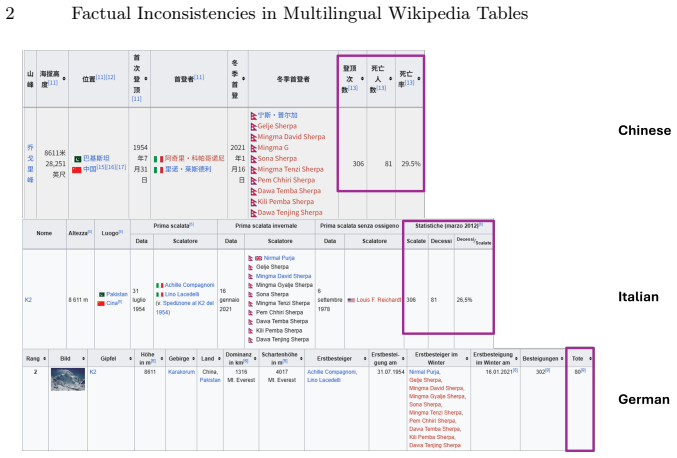
Xing, X., He, Z., Xu, H., Wang, X., Wang, R., Hong, Y.: Evaluating knowledge- based cross-lingual inconsistency in large language models. arXiv preprint arXiv:2407.01358 (2024) 9 Appendix Fig. 6. Example of timeliness: height of Mount Everest differs across language versions of Wikipedia. The death rate of climbing the mountain is explicitly provided in (...
discussion (0)
Sign in with ORCID, Apple, or X to comment. Anyone can read and Pith papers without signing in.