Steady-State or Not? The Evolution of Cosmic Ray Electron Spectra in Galaxies
Pith reviewed 2026-05-17 21:28 UTC · model grok-4.3
The pith
Time-dependent modeling shows steady-state assumptions hold for most cosmic ray electrons in galactic disks but fail at high energies and in outflows.
A machine-rendered reading of the paper's core claim, the machinery that carries it, and where it could break.
Core claim
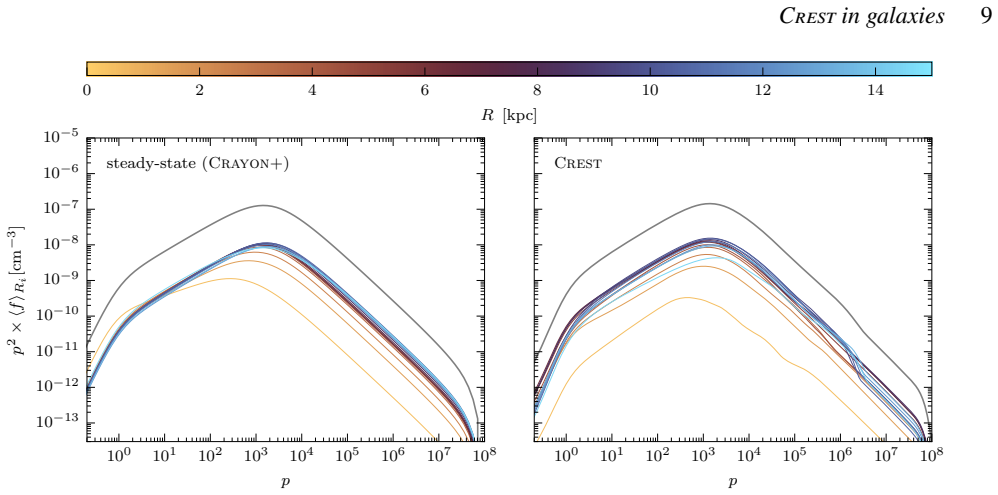
In the time-dependent treatment the global spectrum inside the simulated galactic disk closely resembles a steady-state solution up to 500 GeV. At higher energies the spectrum is steeper and lower in amplitude because it is shaped by recently injected electrons that have not yet reached equilibrium with cooling. Spatially, the electrons remain more confined to the star-forming disk than the extended distributions produced by steady-state post-processing of the same simulation.
What carries the argument
Lagrangian tracer particles that carry and evolve the cosmic ray electron spectrum under adiabatic changes together with synchrotron, inverse Compton, bremsstrahlung and Coulomb cooling, with electrons injected at supernova sites.
If this is right
- Steady-state models remain reliable for the majority of cosmic ray electrons inside star-forming disks.
- High-energy cosmic ray electrons must be modeled with their recent injection history rather than an equilibrium assumption.
- Outflowing cosmic ray electrons carry time-dependent spectral shapes that affect predictions for galactic winds and halo emission.
- Radio continuum maps at high frequencies will show more compact emission when modeled without the steady-state approximation.
Where Pith is reading between the lines
- High-frequency radio observations could be used to test how much recent supernova activity influences the observed spectrum.
- The same time-dependent approach applied to cosmic ray protons in the same runs would likely reveal where steady-state breaks for the hadronic component as well.
- Repeating the comparison across galaxies with varying star-formation rates would show how the energy threshold for steady-state validity scales with galactic conditions.
Load-bearing premise
The magnetohydrodynamic simulation with its chosen supernova injection sites and magnetic field structure correctly reproduces the injection and transport timescales that control cosmic ray electrons in real galaxies.
What would settle it
A measurement of the cosmic ray electron spectrum above 500 GeV inside the Milky Way disk, or resolved radio maps of the spatial extent of high-frequency synchrotron emission, would show whether the steeper spectrum and more compact distribution appear as predicted.
Figures





read the original abstract
Cosmic ray (CR) electrons are key tracers of non-thermal processes in galaxies, yet their spectra are often modelled under the untested assumption of steady state between injection and cooling. In this work, we present a time-dependent modelling of CR electron spectra in a galactic context using the CREST code, applied to magnetohydrodynamical simulations of an isolated Milky Way-mass galaxy performed with AREPO. CR electrons are injected at supernova sites and evolved with adiabatic changes and cooling processes on Lagrangian tracer particles, including losses from synchrotron, inverse Compton, bremsstrahlung, and Coulomb interactions. We compare these fully time-dependent spectra to local and global steady-state models computed with CRAYON+, as well as to one-zone analytic steady-state solutions. We find that the global CR electron spectrum in the simulated galactic disk closely resembles a steady-state solution up to energies of 500 GeV, with deviations only at higher energies where cooling times become shorter than injection timescales. High-energy electrons are dominated by recently injected populations that have not yet reached equilibrium, however, producing a steeper spectrum and lower normalisation than a steady-state model predicts. Spatially, the electrons modelled on-the-fly with CREST are more confined to the star-forming disk, in contrast to the more extended distributions from steady-state post-processing models. Our results demonstrate that while steady-state assumptions capture the bulk CR electron population in star-forming disks, a time-dependent treatment is essential to describe the high-energy and outflowing components.
Editorial analysis
A structured set of objections, weighed in public.
Referee Report
Summary. The paper presents a time-dependent modeling of cosmic ray electron spectra in an isolated Milky Way-mass galaxy using the CREST code applied to AREPO MHD simulations. CR electrons are injected at supernova sites and evolved on Lagrangian tracer particles including adiabatic changes and losses from synchrotron, inverse Compton, bremsstrahlung, and Coulomb interactions. The time-dependent spectra are compared to local and global steady-state models from CRAYON+ as well as one-zone analytic solutions. The central claim is that the global CR electron spectrum in the star-forming disk resembles a steady-state solution up to ~500 GeV, with deviations at higher energies where recently injected electrons dominate, producing steeper spectra and lower normalization; spatially, the time-dependent electrons are more confined to the disk than in steady-state post-processing.
Significance. If the result holds, the work shows that steady-state assumptions suffice for the bulk disk population but fail for high-energy and outflowing components, with implications for modeling synchrotron emission and interpreting radio and gamma-ray observations of galaxies. A strength is the direct comparison of on-the-fly time-dependent evolution against independent steady-state codes in a full galactic MHD context rather than one-zone models. The simulation-driven approach with multiple comparison models is a positive feature, though the absence of quantitative error bars or resolution tests limits immediate robustness.
major comments (2)
- [Results section (discussion of 500 GeV threshold and spatial distributions)] The headline result—that steady-state matches the bulk population up to ~500 GeV while time-dependent treatment is required above this energy and for outflows—depends on the ratio of cooling time to injection/transport time. This ratio is set by the AREPO simulation's magnetic-field strength, geometry, gas densities, and supernova placement. The manuscript reports no parameter variations or sensitivity tests on these MHD inputs (e.g., different SN clustering or B-field amplification), so it is unclear whether the reported 500 GeV transition is robust or specific to the chosen setup.
- [Methods (CREST implementation and tracer evolution)] No resolution or convergence tests are described for the number of Lagrangian tracer particles, time-stepping criteria in CREST, or the underlying AREPO grid resolution. Without these, numerical artifacts could affect the high-energy tail and the claimed spatial confinement differences between time-dependent and steady-state models.
minor comments (2)
- [Abstract] The abstract states the resemblance holds 'up to energies of 500 GeV' without specifying whether this is a precise value, an approximate threshold, or accompanied by any uncertainty estimate from the simulation.
- [Figure captions and results text] Figure captions and text should clarify whether the plotted spectra are volume-weighted, mass-weighted, or averaged over specific regions, as this affects direct comparison to the global steady-state models.
Simulated Author's Rebuttal
We thank the referee for their detailed and constructive report on our manuscript. We have carefully considered each comment and provide point-by-point responses below. Where appropriate, we have revised the manuscript to address the concerns raised.
read point-by-point responses
-
Referee: [Results section (discussion of 500 GeV threshold and spatial distributions)] The headline result—that steady-state matches the bulk population up to ~500 GeV while time-dependent treatment is required above this energy and for outflows—depends on the ratio of cooling time to injection/transport time. This ratio is set by the AREPO simulation's magnetic-field strength, geometry, gas densities, and supernova placement. The manuscript reports no parameter variations or sensitivity tests on these MHD inputs (e.g., different SN clustering or B-field amplification), so it is unclear whether the reported 500 GeV transition is robust or specific to the chosen setup.
Authors: We appreciate the referee pointing out the dependence of our results on the specific MHD parameters of the simulation. The 500 GeV energy marks the point where the electron cooling time becomes shorter than the typical time between supernova injections in the star-forming disk of our model. This is a direct consequence of the magnetic field strengths (typically a few μG in the disk) and gas densities in the AREPO simulation. While we agree that the exact transition energy would shift with different magnetic field amplification or supernova clustering, our study focuses on a single, well-resolved Milky Way-mass galaxy simulation to provide a concrete comparison between time-dependent and steady-state approaches. In the revised version, we have expanded the discussion in Section 4 to explicitly state that the transition energy scales with the cooling timescale, which depends on B and n, and note that our results are representative for typical galactic conditions. We believe this clarifies the scope without requiring a full parameter study, which would be a substantial extension beyond the current work. revision: partial
-
Referee: [Methods (CREST implementation and tracer evolution)] No resolution or convergence tests are described for the number of Lagrangian tracer particles, time-stepping criteria in CREST, or the underlying AREPO grid resolution. Without these, numerical artifacts could affect the high-energy tail and the claimed spatial confinement differences between time-dependent and steady-state models.
Authors: We thank the referee for this observation. The number of Lagrangian tracer particles (approximately 10^6) was chosen to ensure sufficient sampling of the supernova injection events and the volume of the galactic disk, drawing from previous applications of the CREST code. The time-stepping in CREST is adaptive based on the cooling timescales to accurately capture the energy losses. However, we acknowledge that dedicated convergence tests varying the tracer number, time-step criteria, and AREPO resolution are not included in the present manuscript. We have added a paragraph in the Methods section (Section 2) discussing these numerical choices and arguing that the high-energy tail is primarily shaped by recent injections rather than numerical diffusion. Full convergence studies are computationally intensive and will be addressed in future work focused on numerical validation. revision: partial
- Conducting a series of additional AREPO simulations with varied supernova clustering and magnetic field strengths to test the sensitivity of the 500 GeV transition energy.
- Performing systematic resolution and convergence tests for the CREST code on the full galactic simulation data.
Circularity Check
Simulation-driven comparison exhibits no circularity
full rationale
The paper evolves CR electron spectra time-dependently via the CREST code on Lagrangian tracers within an AREPO MHD simulation of an isolated Milky Way-mass galaxy, injecting electrons at supernova sites and including adiabatic changes plus synchrotron, IC, bremsstrahlung and Coulomb losses. These on-the-fly spectra are then compared against independent local/global steady-state solutions computed with the separate CRAYON+ code and against one-zone analytic steady-state models. No equation or result is obtained by fitting a parameter to the same data that is later relabeled as a prediction, nor does any central claim reduce to a self-citation chain or to a definition that presupposes the target outcome. The reported transition at ~500 GeV and the spatial confinement differences emerge directly from the numerical integration of the time-dependent transport equation against the fixed simulation fields and injection history; the derivation chain therefore remains self-contained against external benchmarks.
Axiom & Free-Parameter Ledger
axioms (2)
- domain assumption Cosmic ray electrons are injected exclusively at supernova remnant sites
- domain assumption Cooling occurs only via synchrotron, inverse Compton, bremsstrahlung, and Coulomb losses
Lean theorems connected to this paper
-
IndisputableMonolith/Cost/FunctionalEquation.leanwashburn_uniqueness_aczel unclear?
unclearRelation between the paper passage and the cited Recognition theorem.
We present a time-dependent modelling of CR electron spectra ... using the CREST code ... compare these fully time-dependent spectra to local and global steady-state models computed with CRAYON+
-
IndisputableMonolith/Foundation/ArithmeticFromLogic.leanLogicNat_induction unclear?
unclearRelation between the paper passage and the cited Recognition theorem.
High-energy electrons are dominated by recently injected populations that have not yet reached equilibrium
What do these tags mean?
- matches
- The paper's claim is directly supported by a theorem in the formal canon.
- supports
- The theorem supports part of the paper's argument, but the paper may add assumptions or extra steps.
- extends
- The paper goes beyond the formal theorem; the theorem is a base layer rather than the whole result.
- uses
- The paper appears to rely on the theorem as machinery.
- contradicts
- The paper's claim conflicts with a theorem or certificate in the canon.
- unclear
- Pith found a possible connection, but the passage is too broad, indirect, or ambiguous to say the theorem truly supports the claim.
Forward citations
Cited by 1 Pith paper
-
The diffuse gamma-ray sky of a Milky Way analogue: Local diversity and global constraints
CR-MHD simulations of a Milky Way analogue reproduce observed gamma-ray luminosities and spectra without tuning, with sky morphology set by local gas density fluctuations and angular power spectra tracing gas column r...
Reference graph
Works this paper leans on
-
[1]
U., Albert, A., Alfaro, R., et al
Abeysekara A. U., et al., 2017, @doi [Science] 10.1126/science.aan4880 , https://ui.adsabs.harvard.edu/abs/2017Sci...358..911A 358, 911
-
[2]
A., eds, 1965, Handbook of Mathematical Functions with Formulas, Graphs and Mathematical Tables
Abramowitz M., Stegun I. A., eds, 1965, Handbook of Mathematical Functions with Formulas, Graphs and Mathematical Tables. Dover Publications, Inc., New York
work page 1965
-
[3]
Aguilar M., et al., 2014, @doi [Physical Review Letters] 10.1103/physrevlett.113.221102 , 113
-
[4]
Aharonian F., et al., 2024, @doi [ ] 10.1103/PhysRevLett.133.221001 , https://ui.adsabs.harvard.edu/abs/2024PhRvL.133v1001A 133, 221001
-
[5]
Bell E. F., 2003, @doi [ ] 10.1086/367829 , http://adsabs.harvard.edu/abs/2003ApJ...586..794B 586, 794
-
[6]
Bieri R., Pakmor R., van de Voort F., Talbot R. Y., Werhahn M., Pfrommer C., Springel V., 2025, @doi [arXiv e-prints] 10.48550/arXiv.2509.07124 , https://ui.adsabs.harvard.edu/abs/2025arXiv250907124B p. arXiv:2509.07124
-
[7]
Cabral B., Leedom L. C., 1993, in Proceedings of the 20th Annual Conference on Computer Graphics and Interactive Techniques. SIGGRAPH '93. Association for Computing Machinery, New York, NY, USA, p. 263–270, @doi 10.1145/166117.166151 , https://doi.org/10.1145/166117.166151
-
[8]
Chabrier G., 2003, @doi [ ] 10.1086/376392 , https://ui.adsabs.harvard.edu/abs/2003PASP..115..763C 115, 763
work page internal anchor Pith review doi:10.1086/376392 2003
-
[9]
Chiu H.-H. S., Ruszkowski M., Thomas T., Werhahn M., Pfrommer C., 2024, @doi [ ] 10.3847/1538-4357/ad84e9 , https://ui.adsabs.harvard.edu/abs/2024ApJ...976..136C 976, 136
-
[10]
Chomiuk L., Povich M. S., 2011, @doi [ ] 10.1088/0004-6256/142/6/197 , https://ui.adsabs.harvard.edu/abs/2011AJ....142..197C 142, 197
-
[11]
Condon J. J., 1992, @doi [ ] 10.1146/annurev.aa.30.090192.003043 , http://adsabs.harvard.edu/abs/1992ARA
-
[12]
2010, , 403, 1829, 10.1111/j.1365-2966.2010.16253.x
Crain R. A., McCarthy I. G., Frenk C. S., Theuns T., Schaye J., 2010, @doi [ ] 10.1111/j.1365-2966.2010.16985.x , http://adsabs.harvard.edu/abs/2010MNRAS.407.1403C 407, 1403
-
[13]
Cristofari P., Blasi P., Caprioli D., 2021, @doi [ ] 10.1051/0004-6361/202140448 , https://ui.adsabs.harvard.edu/abs/2021A&A...650A..62C 650, A62
-
[14]
Cummings A. C., et al., 2016, @doi [The Astrophysical Journal] 10.3847/0004-637x/831/1/18 , 831, 18
-
[15]
Diesing R., Caprioli D., 2019, @doi [ ] 10.1103/PhysRevLett.123.071101 , https://ui.adsabs.harvard.edu/abs/2019PhRvL.123g1101D 123, 071101
-
[16]
Evoli C., Morlino G., Blasi P., Aloisio R., 2020a, @doi [ ] 10.1103/PhysRevD.101.023013 , https://ui.adsabs.harvard.edu/abs/2020PhRvD.101b3013E 101, 023013
-
[17]
Evoli C., Blasi P., Amato E., Aloisio R., 2020b, @doi [ ] 10.1103/PhysRevLett.125.051101 , https://ui.adsabs.harvard.edu/abs/2020PhRvL.125e1101E 125, 051101
-
[18]
Genel S., Vogelsberger M., Nelson D., Sijacki D., Springel V., Hernquist L., 2013, @doi [ ] 10.1093/mnras/stt1383 , https://ui.adsabs.harvard.edu/abs/2013MNRAS.435.1426G 435, 1426
-
[19]
Hanabata Y., et al., 2014, @doi [The Astrophysical Journal] 10.1088/0004-637X/786/2/145 , 786, 145
-
[20]
Heesen V., Dettmar R.-J., Krause M., Beck R., Stein Y., 2016, @doi [ ] 10.1093/mnras/stw360 , https://ui.adsabs.harvard.edu/abs/2016MNRAS.458..332H 458, 332
-
[21]
Heesen V., et al., 2018, @doi [Monthly Notices of the Royal Astronomical Society] 10.1093/mnras/sty105 , 476, 158
-
[22]
Heesen V., et al., 2024, @doi [ ] 10.1051/0004-6361/202451569 , https://ui.adsabs.harvard.edu/abs/2024A&A...691A.273H 691, A273
-
[23]
Helou G., Soifer B. T., Rowan-Robinson M., 1985, @doi [ ] 10.1086/184556 , https://ui.adsabs.harvard.edu/abs/1985ApJ...298L...7H 298, L7
-
[24]
Hopkins P. F., Chan T. K., Ji S., Hummels C. B., Kere s D., Quataert E., Faucher-Gigu \`e re C.-A., 2021, @doi [ ] 10.1093/mnras/staa3690 , https://ui.adsabs.harvard.edu/abs/2021MNRAS.501.3640H 501, 3640
-
[25]
Hopkins P. F., Butsky I. S., Panopoulou G. V., Ji S., Quataert E., Faucher-Gigu \`e re C.-A., Kere s D., 2022, @doi [ ] 10.1093/mnras/stac1791 , https://ui.adsabs.harvard.edu/abs/2022MNRAS.516.3470H 516, 3470
-
[26]
Hopkins P. F., Quataert E., Ponnada S. B., Silich E., 2025, @doi [arXiv e-prints] 10.48550/arXiv.2501.18696 , https://ui.adsabs.harvard.edu/abs/2025arXiv250118696H p. arXiv:2501.18696
-
[27]
Jacob S., Pakmor R., Simpson C. M., Springel V., Pfrommer C., 2018, @doi [ ] 10.1093/mnras/stx3221 , https://ui.adsabs.harvard.edu/abs/2018MNRAS.475..570J 475, 570
-
[28]
J \'o hannesson G., Porter T. A., Moskalenko I. V., 2018, @doi [ ] 10.3847/1538-4357/aab26e , https://ui.adsabs.harvard.edu/abs/2018ApJ...856...45J 856, 45
-
[29]
Kennicutt Jr. R. C., 1998, @doi [ ] 10.1146/annurev.astro.36.1.189 , http://adsabs.harvard.edu/abs/1998ARA
work page internal anchor Pith review doi:10.1146/annurev.astro.36.1.189 1998
-
[30]
Kissmann R., 2014, @doi [Astroparticle Physics] 10.1016/j.astropartphys.2014.02.002 , https://ui.adsabs.harvard.edu/abs/2014APh....55...37K 55, 37
-
[31]
Krumholz M. R., Crocker R. M., Bahramian A., Bordas P., 2024, @doi [Nature Astronomy] 10.1038/s41550-024-02337-1 , https://ui.adsabs.harvard.edu/abs/2024NatAs...8.1284K 8, 1284
-
[32]
Lacki B. C., Thompson T. A., Quataert E., 2010, @doi [ApJ] 10.1088/0004-637X/717/1/1 , http://adsabs.harvard.edu/abs/2010ApJ...717....1L 717, 1
-
[33]
Licquia T. C., Newman J. A., 2015, @doi [The Astrophysical Journal] 10.1088/0004-637x/806/1/96 , 806, 96
-
[34]
Linsky J. L., Redfield S., 2021, @doi [ ] 10.3847/1538-4357/ac1feb , https://ui.adsabs.harvard.edu/abs/2021ApJ...920...75L 920, 75
-
[35]
Linzer N. B., Armillotta L., Ostriker E. C., Quataert E., 2025, @doi [ ] 10.3847/1538-4357/ade5ad , https://ui.adsabs.harvard.edu/abs/2025ApJ...988..214L 988, 214
-
[36]
Matthews A. M., Condon J. J., Cotton W. D., Mauch T., 2021, @doi [ ] 10.3847/1538-4357/abfaf6 , https://ui.adsabs.harvard.edu/abs/2021ApJ...914..126M 914, 126
-
[37]
Matthews A. M., Cotton W. D., Peters W. M., Marchetti L., Jarrett T. H., Condon J. J., van der Hulst J. M., Moloko M., 2025, @doi [ ] 10.3847/2041-8213/ada252 , https://ui.adsabs.harvard.edu/abs/2025ApJ...978L..25M 978, L25
-
[38]
Maurin D., 2020, @doi [Computer Physics Communications] 10.1016/j.cpc.2019.106942 , https://ui.adsabs.harvard.edu/abs/2020CoPhC.24706942M 247, 106942
-
[39]
Molnár D. C., et al., 2021, @doi [Monthly Notices of the Royal Astronomical Society] 10.1093/mnras/stab746 , 504, 118
-
[40]
Morlino G., Celli S., 2021, @doi [ ] 10.1093/mnras/stab2972 , https://ui.adsabs.harvard.edu/abs/2021MNRAS.508.6142M 508, 6142
-
[41]
D., Fletcher A., Beck R., Mitra D., Scaife A
Mulcahy D. D., Fletcher A., Beck R., Mitra D., Scaife A. M. M., 2016, @doi [ ] 10.1051/0004-6361/201628446 , https://ui.adsabs.harvard.edu/abs/2016A&A...592A.123M 592, A123
-
[42]
Navarro J. F., Frenk C. S., White S. D. M., 1997, @doi [ ] 10.1086/304888 , https://ui.adsabs.harvard.edu/abs/1997ApJ...490..493N 490, 493
-
[43]
Ogrodnik M. A., Hanasz M., W \'o lta \'n ski D., 2021, @doi [ ] 10.3847/1538-4365/abd16f , https://ui.adsabs.harvard.edu/abs/2021ApJS..253...18O 253, 18
-
[44]
Pakmor R., Springel V., 2013, @doi [Monthly Notices of the Royal Astronomical Society] 10.1093/mnras/stt428 , 432, 176
-
[45]
Pakmor R., Springel V., Bauer A., Mocz P., Munoz D. J., Ohlmann S. T., Schaal K., Zhu C., 2016a, @doi [ ] 10.1093/mnras/stv2380 , http://adsabs.harvard.edu/abs/2016MNRAS.455.1134P 455, 1134
-
[46]
MNRAS , year = 2016, month = nov, volume =
Pakmor R., Pfrommer C., Simpson C. M., Kannan R., Springel V., 2016b, @doi [ ] 10.1093/mnras/stw1761 , https://ui.adsabs.harvard.edu/abs/2016MNRAS.462.2603P 462, 2603
-
[47]
Pakmor R., Pfrommer C., Simpson C. M., Springel V., 2016c, @doi [ ] 10.3847/2041-8205/824/2/L30 , https://ui.adsabs.harvard.edu/abs/2016ApJ...824L..30P 824, L30
-
[48]
Peretti E., Blasi P., Aharonian F., Morlino G., 2019, @doi [ ] 10.1093/mnras/stz1161 , https://ui.adsabs.harvard.edu/abs/2019MNRAS.487..168P 487, 168
-
[49]
Pfrommer C., Pakmor R., Schaal K., Simpson C. M., Springel V., 2017a, @doi [ ] 10.1093/mnras/stw2941 , http://adsabs.harvard.edu/abs/2017MNRAS.465.4500P 465, 4500
-
[50]
Pfrommer C., Pakmor R., Simpson C. M., Springel V., 2017b, @doi [ ] 10.3847/2041-8213/aa8bb1 , http://adsabs.harvard.edu/abs/2017ApJ...847L..13P 847, L13
-
[51]
Pfrommer C., Werhahn M., Pakmor R., Girichidis P., Simpson C. M., 2022, @doi [ ] 10.1093/mnras/stac1808 , https://ui.adsabs.harvard.edu/abs/2022MNRAS.515.4229P 515, 4229
-
[52]
Ponnada S. B., et al., 2024a, @doi [ ] 10.1093/mnras/stad3978 , https://ui.adsabs.harvard.edu/abs/2024MNRAS.52711707P 527, 11707
-
[53]
Ponnada S. B., et al., 2024b, @doi [ ] 10.1093/mnrasl/slae017 , https://ui.adsabs.harvard.edu/abs/2024MNRAS.530L...1P 530, L1
-
[54]
Quintana A. L., Wright N. J., Mart \' nez Garc \' a J., 2025, @doi [ ] 10.1093/mnras/staf083 , https://ui.adsabs.harvard.edu/abs/2025MNRAS.538.1367Q 538, 1367
-
[55]
Rodr \' guez Montero F., Martin-Alvarez S., Slyz A., Devriendt J., Dubois Y., Sijacki D., 2024, @doi [ ] 10.1093/mnras/stae1083 , https://ui.adsabs.harvard.edu/abs/2024MNRAS.530.3617R 530, 3617
-
[56]
Ruszkowski M., Pfrommer C., 2023, @doi [ ] 10.1007/s00159-023-00149-2 , https://ui.adsabs.harvard.edu/abs/2023A&ARv..31....4R 31, 4
-
[57]
Schroer B., Pezzi O., Caprioli D., Haggerty C., Blasi P., 2021, @doi [ ] 10.3847/2041-8213/ac02cd , https://ui.adsabs.harvard.edu/abs/2021ApJ...914L..13S 914, L13
-
[58]
Schroer B., Pezzi O., Caprioli D., Haggerty C. C., Blasi P., 2022, @doi [ ] 10.1093/mnras/stac466 , https://ui.adsabs.harvard.edu/abs/2022MNRAS.512..233S 512, 233
-
[59]
Sike B., Ruszkowski M., Gnedin O. Y., Chen Y., Weber M., Thomas T., Pfrommer C., 2025, @doi [arXiv e-prints] 10.48550/arXiv.2510.06134 , https://ui.adsabs.harvard.edu/abs/2025arXiv251006134S p. arXiv:2510.06134
-
[60]
Springel V., 2010, @doi [ ] 10.1111/j.1365-2966.2009.15715.x , http://adsabs.harvard.edu/abs/2010MNRAS.401..791S 401, 791
-
[61]
Springel V., Hernquist L., 2003, @doi [ ] 10.1046/j.1365-8711.2003.06206.x , https://ui.adsabs.harvard.edu/abs/2003MNRAS.339..289S 339, 289
-
[62]
Stein Y., et al., 2020, @doi [ ] 10.1051/0004-6361/202037675 , https://ui.adsabs.harvard.edu/abs/2020A&A...639A.111S 639, A111
-
[63]
Strong A. W., Moskalenko I. V., 1998, @doi [ ] 10.1086/306470 , https://ui.adsabs.harvard.edu/abs/1998ApJ...509..212S 509, 212
-
[64]
Strong A. W., Porter T. A., Digel S. W., J \'o hannesson G., Martin P., Moskalenko I. V., Murphy E. J., Orlando E., 2010, @doi [ ] 10.1088/2041-8205/722/1/L58 , https://ui.adsabs.harvard.edu/abs/2010ApJ...722L..58S 722, L58
-
[65]
Strong A. W., Orlando E., Jaffe T. R., 2011, @doi [ ] 10.1051/0004-6361/201116828 , https://ui.adsabs.harvard.edu/abs/2011A&A...534A..54S 534, A54
-
[66]
Thomas T., Pfrommer C., Pakmor R., 2025, @doi [ ] 10.1051/0004-6361/202450817 , https://ui.adsabs.harvard.edu/abs/2025A&A...698A.104T 698, A104
-
[67]
Veronese S., de Blok W. J. G., Fraternali F., Maccagni F. M., Healy J., Kleiner D., Oosterloo T. A., Morganti R., 2025, @doi [arXiv e-prints] 10.48550/arXiv.2509.18728 , https://ui.adsabs.harvard.edu/abs/2025arXiv250918728V p. arXiv:2509.18728
-
[68]
Vink J., 2012, @doi [ ] 10.1007/s00159-011-0049-1 , https://ui.adsabs.harvard.edu/abs/2012A&ARv..20...49V 20, 49
-
[69]
Werhahn M., Pfrommer C., Girichidis P., Puchwein E., Pakmor R., 2021a, @doi [ ] 10.1093/mnras/stab1324 , https://ui.adsabs.harvard.edu/abs/2021MNRAS.505.3273W 505, 3273
-
[70]
Werhahn M., Pfrommer C., Girichidis P., Winner G., 2021b, @doi [ ] 10.1093/mnras/stab1325 , https://ui.adsabs.harvard.edu/abs/2021MNRAS.505.3295W 505, 3295
-
[71]
Werhahn M., Pfrommer C., Girichidis P., 2021c, @doi [ ] 10.1093/mnras/stab2535 , https://ui.adsabs.harvard.edu/abs/2021MNRAS.508.4072W 508, 4072
-
[72]
Werhahn M., Girichidis P., Pfrommer C., Whittingham J., 2023, @doi [ ] 10.1093/mnras/stad2105 , https://ui.adsabs.harvard.edu/abs/2023MNRAS.525.4437W 525, 4437
-
[73]
Whittingham J., Pfrommer C., Werhahn M., Jlassi L., Girichidis P., 2024, @doi [arXiv e-prints] 10.48550/arXiv.2411.11947 , https://ui.adsabs.harvard.edu/abs/2024arXiv241111947W p. arXiv:2411.11947
-
[74]
Winner G., Pfrommer C., Girichidis P., Pakmor R., 2019, @doi [ ] 10.1093/mnras/stz1792 , https://ui.adsabs.harvard.edu/abs/2019MNRAS.488.2235W 488, 2235
-
[75]
Winner G., Pfrommer C., Girichidis P., Werhahn M., Pais M., 2020, @doi [ ] 10.1093/mnras/staa2989 , https://ui.adsabs.harvard.edu/abs/2020MNRAS.499.2785W 499, 2785
-
[76]
Yun M. S., Reddy N. A., Condon J. J., 2001, @doi [The Astrophysical Journal] 10.1086/323145 , 554, 803
-
[77]
Zirakashvili V. N., Aharonian F., 2007, @doi [ ] 10.1051/0004-6361:20066494 , https://ui.adsabs.harvard.edu/abs/2007A&A...465..695Z 465, 695
-
[78]
Zucker C., et al., 2022, @doi [ ] 10.1038/s41586-021-04286-5 , https://ui.adsabs.harvard.edu/abs/2022Natur.601..334Z 601, 334
-
[79]
C., 1971, , http://adsabs.harvard.edu/abs/1971A
van der Kruit P. C., 1971, , http://adsabs.harvard.edu/abs/1971A
work page 1971
-
[80]
" write newline "" before.all 'output.state := FUNCTION fin.entry write newline FUNCTION new.block output.state before.all = 'skip after.block 'output.state := if FUNCTION new.sentence output.state after.block = 'skip output.state before.all = 'skip after.sentence 'output.state := if if FUNCTION not #0 #1 if FUNCTION and 'skip pop #0 if FUNCTION or pop #1...
discussion (0)
Sign in with ORCID, Apple, or X to comment. Anyone can read and Pith papers without signing in.