Quantum state preparation and transfer based on the bound state in the doublon continuum
Pith reviewed 2026-05-17 03:30 UTC · model grok-4.3
The pith
Strong on-site interactions create a bound state in the doublon continuum that prepares high-fidelity distant four-atom entangled states and enables their coherent transfer between nodes.
A machine-rendered reading of the paper's core claim, the machinery that carries it, and where it could break.
Core claim
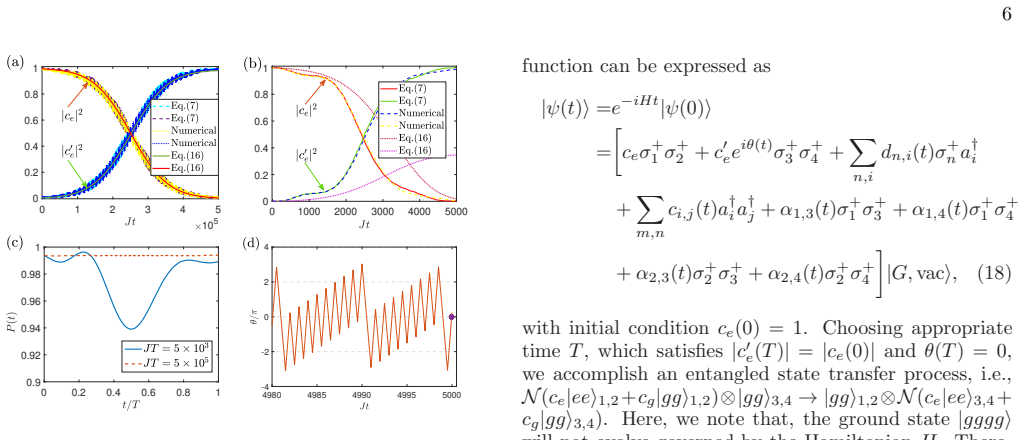
We identify and characterize a bound state embedded in the doublon continuum (BIDC) that emerges when four atoms couple to a coupled-resonator waveguide with strong on-site interaction. Exploiting this interaction-enabled BIDC, we show that (i) a distant, four-atom entangled state can be prepared with high fidelity, and (ii) quantum entangled states can be coherently transferred between spatially separated nodes. Our results establish a scalable mechanism for multi-particle state generation and routing in waveguide platforms, opening a route to interaction-protected quantum communication with many-particle BICs.
What carries the argument
The bound state in the doublon continuum (BIDC), which emerges from the four-atom coupling to the waveguide under strong on-site interaction and carries the state-preparation and transfer functions.
If this is right
- A distant four-atom entangled state can be prepared with high fidelity using the BIDC.
- Quantum entangled states can be coherently transferred between spatially separated nodes.
- The platform supplies a scalable mechanism for multi-particle state generation and routing in waveguide systems.
- It opens a route to interaction-protected quantum communication that uses many-particle BICs.
Where Pith is reading between the lines
- The same BIDC mechanism could be tested with different atom numbers or waveguide geometries to generate larger entangled clusters.
- Implementation in superconducting circuit arrays or photonic lattices would provide a concrete testbed for the transfer protocol.
- If the bound state persists at moderate interaction strengths, the method might combine with weaker-coupling regimes for hybrid quantum networks.
Load-bearing premise
The bound state in the doublon continuum exists and remains stable under the assumed strong on-site interaction and the specific four-atom coupling to the coupled-resonator waveguide.
What would settle it
An exact diagonalization or time-evolution simulation of the four-atom Hamiltonian showing no discrete eigenvalue inside the doublon continuum, or an experiment measuring fidelity below the claimed high value, would falsify the preparation and transfer claims.
Figures



read the original abstract
Bound states in the continuum (BICs) have attracted intense interest, yet their many-particle counterparts remain largely unexplored in waveguide quantum electrodynamics. We identify and characterize a bound state embedded in the doublon continuum (BIDC) that emerges when four atoms couple to a coupled-resonator waveguide with strong on-site interaction. Exploiting this interaction-enabled BIDC, we show that (i) a distant, four-atom entangled state can be prepared with high fidelity, and (ii) quantum entangled states can be coherently transferred between spatially separated nodes. Our results establish a scalable mechanism for multi-particle state generation and routing in waveguide platforms, opening a route to interaction-protected quantum communication with many-particle BICs.
Editorial analysis
A structured set of objections, weighed in public.
Referee Report
Summary. The manuscript identifies a bound state in the doublon continuum (BIDC) that arises when four atoms couple to a coupled-resonator waveguide under strong on-site interactions. It claims that this interaction-enabled BIDC enables (i) high-fidelity preparation of a distant four-atom entangled state and (ii) coherent transfer of entangled states between spatially separated nodes, providing a scalable route to multi-particle state generation and routing in waveguide QED.
Significance. If the BIDC remains decoupled and the reported fidelities hold under realistic conditions, the results would be significant for waveguide quantum optics: they extend single-particle BICs to a many-body setting and supply an interaction-protected mechanism for entangled-state preparation and routing. The work could influence designs for quantum networks that exploit continuum engineering.
major comments (2)
- [§3] §3 (BIDC construction and effective Hamiltonian): The decoupling of the BIDC from the doublon continuum is shown in the U→∞ limit. For finite but large U comparable to the hopping or coupling rates, the eigenstate acquires a nonzero overlap with scattering states, producing a finite decay rate. The manuscript must supply either a perturbative estimate of this rate or numerical diagonalization of the two-excitation sector to confirm that the lifetime exceeds the transfer timescale; without it the high-fidelity claims in the abstract are not yet substantiated.
- [§5] §5 (state-preparation and transfer protocols): The fidelity calculations and transfer dynamics are presented under the assumption of perfect BIDC isolation. Adding the finite-U leakage term would degrade both the preparation fidelity and the coherence of the transferred state; the paper should therefore report fidelity versus U and versus distance to demonstrate robustness.
minor comments (2)
- [Figure 1] Figure 1 caption: specify the precise values of the resonator-waveguide coupling and the on-site U used in the plotted spectra.
- [§4] Notation for the four-atom entangled state: define the explicit form of the target state (e.g., the coefficients in the computational basis) when it is first introduced.
Simulated Author's Rebuttal
We thank the referee for the constructive and detailed comments. We address each major point below and will revise the manuscript to incorporate additional analysis on finite-U effects.
read point-by-point responses
-
Referee: [§3] §3 (BIDC construction and effective Hamiltonian): The decoupling of the BIDC from the doublon continuum is shown in the U→∞ limit. For finite but large U comparable to the hopping or coupling rates, the eigenstate acquires a nonzero overlap with scattering states, producing a finite decay rate. The manuscript must supply either a perturbative estimate of this rate or numerical diagonalization of the two-excitation sector to confirm that the lifetime exceeds the transfer timescale; without it the high-fidelity claims in the abstract are not yet substantiated.
Authors: We acknowledge that the exact decoupling of the BIDC is derived in the U → ∞ limit. For finite but large U, a small but nonzero overlap with scattering states indeed appears. In the revised manuscript we will add a perturbative estimate of the induced decay rate obtained via a Schrieffer-Wolff transformation in the two-excitation sector, showing that the leakage rate scales as O((J/U)^2, (g/U)^2) and remains negligible compared with the inverse transfer time for the parameter regime U ≫ J, g used throughout the work. We will also include exact-diagonalization results for small lattices to confirm that the BIDC lifetime exceeds the relevant dynamical timescales. revision: yes
-
Referee: [§5] §5 (state-preparation and transfer protocols): The fidelity calculations and transfer dynamics are presented under the assumption of perfect BIDC isolation. Adding the finite-U leakage term would degrade both the preparation fidelity and the coherence of the transferred state; the paper should therefore report fidelity versus U and versus distance to demonstrate robustness.
Authors: We agree that robustness against finite-U leakage should be quantified. The revised manuscript will contain new figures that plot both the four-atom preparation fidelity and the coherent-transfer fidelity as functions of U (spanning the range U/J = 10–100) and as functions of inter-node distance. These plots will demonstrate that fidelities remain above 0.95 in the regime where the perturbative decay rate is small, while also showing the gradual degradation that occurs as U is lowered toward the scale of the hopping and coupling rates. revision: yes
Circularity Check
No significant circularity; derivation self-contained
full rationale
The paper identifies a bound state in the doublon continuum by solving the multi-atom Hamiltonian coupled to the waveguide under strong on-site interaction, then uses the resulting eigenstate for state-preparation and transfer protocols. No load-bearing step reduces to a self-definition, a fitted parameter renamed as prediction, or a self-citation chain that substitutes for independent verification. The central construction rests on explicit diagonalization or scattering analysis of the given Hamiltonian, which is independent of the target fidelity claims and can be checked against external benchmarks or numerical simulation outside the paper's fitted values.
Axiom & Free-Parameter Ledger
Lean theorems connected to this paper
-
IndisputableMonolith/Cost/FunctionalEquation.leanwashburn_uniqueness_aczel unclear?
unclearRelation between the paper passage and the cited Recognition theorem.
We identify and characterize a bound state embedded in the doublon continuum (BIDC) that emerges when four atoms couple to a coupled-resonator waveguide with strong on-site interaction.
-
IndisputableMonolith/Foundation/DimensionForcing.leanreality_from_one_distinction unclear?
unclearRelation between the paper passage and the cited Recognition theorem.
the doublon band has dispersion EK=2ωc−√(U²+16J²cos(K/2)²)
What do these tags mean?
- matches
- The paper's claim is directly supported by a theorem in the formal canon.
- supports
- The theorem supports part of the paper's argument, but the paper may add assumptions or extra steps.
- extends
- The paper goes beyond the formal theorem; the theorem is a base layer rather than the whole result.
- uses
- The paper appears to rely on the theorem as machinery.
- contradicts
- The paper's claim conflicts with a theorem or certificate in the canon.
- unclear
- Pith found a possible connection, but the passage is too broad, indirect, or ambiguous to say the theorem truly supports the claim.
Reference graph
Works this paper leans on
-
[1]
This two qubit driving is feasible in superconducting circuits [41, 46, 47]
with η and t0 be- ing the driving strength and duration respectively, Θ( ·) is the Heaviside step function. This two qubit driving is feasible in superconducting circuits [41, 46, 47]. The parameters are obtained as γ1 = g4 1f 2 K0(0)/v g(K0) and γ2 = g4 3f 2 K0(0)/v g(K0) being the individual decay rates for two type-II pairs, where vg(K) is the group ve...
work page 2000
-
[2]
C. W. Hsu, B. Zhen, A. D. Stone, J. D. Joannopoulos, and M. Solja˘ ci´ c, Bound states in the continuum, Nat. Rev. Mater. 1, 1 (2016)
work page 2016
-
[3]
S. I. Azzam, and A. V. Kildishev, Photonic bound states in the continuum: From basics to applications, Adv. Opt. Mater. 9, 2001469 (2021)
work page 2021
-
[4]
M. Kang, T. Liu, C. T. Chan, and M. Xiao, Applications of bound states in the continuum in photonics, Nat. Rev. Phys. 5, 659 (2023)
work page 2023
-
[5]
J. Wang, P. Li, X. Zhao, Z. Qian, X. Wang, F. Wang, X. Zhou, D. Han, C. Peng, L. Shi, and J. Zi, Optical bound states in the continuum in periodic structures: Mech- anisms, effects, and applications, Photonics Insights 3, R01 (2024)
work page 2024
-
[6]
A. Kodigala, T. Lepetit, Q. Gu, B. Bahari, Y. Fainman, and B. Kant ´E, Lasing action from photonic bound states 12 in continuum, Nature 541, 196 (2017)
work page 2017
-
[7]
Y. Yu, A. Sakanas, A. R. Zali, E. Semenova, K. Yvind, and J. Mørk, Ultra-coherent Fano laser based on a bound state in the continuum, Nat. Photon. 15, 758 (2021)
work page 2021
- [8]
-
[9]
L. Carletti, K. Koshelev, C. D. Angelis, and Y. Kivshar, Giant nonlinear response at the nanoscale driven by bound states in the continuum, Phys. Rev. Lett. 121, 033903 (2018)
work page 2018
-
[10]
Z. Liu, Y. Xu, Y. Lin, J. Xiang, T. Feng, Q. Cao, J. Li, S. Lan, and J. Liu, High-Q quasibound states in the continuum for nonlinear metasurfaces, Phys. Rev. Lett. 123, 253901 (2019)
work page 2019
-
[11]
Z. Yu, Y. Tong, H. K. Tsang, and X. Sun, High- dimensional communication on etchlesslithium niobate platform with photonic bound states in the continuum, Nat. Commun. 11, 2602 (2020)
work page 2020
- [12]
-
[13]
I. Benea-Chelmus, S. Mason, M. L. Meretska, D. L. El- der, D. Kazakov, A. Shams-Ansari, L. R. Dalton, and F. Capasso, Gigahertz free-space electro-optic modula- tors based on Mie resonances, Nat. Commun. 13, 3170 (2022)
work page 2022
- [14]
- [15]
- [16]
- [17]
-
[18]
M. Weng, H. Yu, and Z. Wang, High-fidelity genera- tion of Bell and W states in a giant-atom system via bound states in the continuum, Phys. Rev. A 111, 053711 (2025)
work page 2025
-
[19]
C. Chen, C. Yang, and J. An, Exact decoherence-free state of two distant quantum systems in a non-Markovian environment, Phys. Rev. A 93, 062122 (2016)
work page 2016
-
[20]
L. Guo, A. F. Kockum, F. Marquardt, and G. Johansson, Oscillating bound states for a giant atom, Phys. Rev. Res. 2, 043014 (2020)
work page 2020
-
[21]
K. H. Lim, W. Mok, and L. Kwek, Oscillating bound states in non-Markovian photonic lattices, Phys. Rev. A 107, 023716 (2023)
work page 2023
-
[22]
Q. Qiu, Y. Wu, and X. L¨ u, Collective radiance of giant atoms in non-Markovian regime, Sci. China Phys. Mech. Astron. 66, 224212 (2023)
work page 2023
-
[23]
J. M. Zhang, D. Braak, and M. Kollar, Bound States in the Continuum Realized in the One-Dimensional Two- Particle Hubbard Model with an Impurity, Phys. Rev. Lett. 109, 116405 (2012)
work page 2012
-
[24]
Y. Liu, and S. Chen, Fate of Two-Particle Bound States in the Continuum in Non-Hermitian Systems, Phys. Rev. Lett. 133, 193001 (2024)
work page 2024
- [25]
-
[26]
Monroe, Quantum information processing with atoms and photons, Nature 416, 238 (2002)
C. Monroe, Quantum information processing with atoms and photons, Nature 416, 238 (2002)
work page 2002
-
[27]
F. Flamini, N. Spagnolo, and F. Sciarrino, Photonic quantum information processing: a review, Rep. Prog. Phys. 82, 016001 (2018)
work page 2018
- [28]
-
[29]
H. J. Kimble, The quantum internet, Nature 453, 1023 (2008)
work page 2008
-
[30]
T. E. Northup, and R. Blatt, Quantum information transfer using photons, Nat. Photonics 8, 356 (2014)
work page 2014
- [31]
-
[32]
G. Ribordy, J. Brendel, J. D. Gautier, N. Gisin, and H. Zbinden, Long-distance entanglement-based quantum key distribution, Phys. Rev. A 63, 012309 (2000)
work page 2000
-
[33]
C. Simon, and W. T. M. Irvine, Robust long-distance entanglement and a loophole-free bell test with ions and photons, Phys. Rev. Lett. 91, 110405 (2003)
work page 2003
-
[34]
B. He, Y. Ren, and J. A. Bergou, Creation of high-quality long-distance entanglement with flexible resources, Phys. Rev. A 79, 052323 (2009)
work page 2009
-
[35]
L. Trifunovic, F. L. Pedrocchi, and D. Loss, Long- distance entanglement of spin qubits via ferromagnet, Phys. Rev. X 3, 041023 (2013)
work page 2013
-
[36]
W. K. Mok, J. B. You, L. C. Kwek, and D. Aghamalyan, Microresonators enhancing long-distance dynamical en- tanglement generation in chiral quantum networks, Phys. Rev. A 101, 053861 (2020)
work page 2020
-
[37]
J. I. Cirac, P. Zoller, H.J. Kimble, and H. Mabuchi, Quantum State Transfer and Entanglement Distribution among Distant Nodes in a Quantum Network, Phys. Rev. Lett. 78, 3221 (1997)
work page 1997
-
[38]
Z.-Q. Yin, and F.-L. Li, Multiatom and resonant interac- tion scheme for quantum state transfer and logical gates between two remote cavities via an optical fiber, Phys. Rev. A 75, 012324 (2007)
work page 2007
-
[39]
B. Vermersch, P.-O. Guimond, H. Pichler, and P. Zoller, Quantum State Transfer via Noisy Photonic and Phononic Waveguides, Phys. Rev. Lett. 118, 133601 (2017)
work page 2017
-
[40]
G. F. Pe˜ nas, R. Puebla, and J. J. Garc ´ ıa-Ripoll, Multi- plexed quantum state transfer in waveguides, Phys. Rev. Res. 6, 033294 (2024)
work page 2024
-
[41]
Y. He, and Y.-X. Zhang, Quantum State Transfer via a Multimode Resonator, Phys. Rev. Lett. 134, 023602 (2025)
work page 2025
-
[42]
X. Wang, J.-Q. Li, Z. Wang, A. F. Kockum, L. Du, T. Liu, and F. Nori, Nonlinear chiral quantum optics with giant emitters, arXiv: 2402. 09829 (2024)
work page 2024
-
[43]
K. Winkler, G. Thalhammer, F. Lang, R. Grimm, J. Hecker Denschlag, A. J. Daley, A. Kantian, H. P. B¨ uchler, and P. Zoller, Repulsively bound atom pairs in an optical lattice, Nature (London) 441, 853 (2006). 13
work page 2006
-
[44]
M. Valiente, and D. Petrosyan, Two-particle states in the Hubbard model, J. Phys. B 41, 161002 (2008)
work page 2008
-
[45]
Z. Wang, T. Jaako, P. Kirton, and P. Rabl, Supercorre- lated Radiance in Nonlinear Photonic Waveguides, Phys. Rev. Lett. 124, 213601 (2020)
work page 2020
-
[46]
X. Wang, J.-Q. Li, T. Liu, A. Miranowicz, and F. Nori, Long-range four-body interactions in structured nonlin- ear photonic waveguides, Phys. Rev. Research 6, 043226 (2024)
work page 2024
-
[47]
M. R. Geller, E. Donate, Y. Chen, M. T. Fang, N. Le- ung, C. Neill, P. Roushan, and J. M. Martinis, Tunable coupler for superconducting Xmon qubits: Perturbative nonlinear model, Phys. Rev. A 92, 012320 (2015)
work page 2015
-
[48]
F. Wulschner, J. Goetz, F. R. Koessel, E. Hoffmann, A. Baust, P. Eder, M. Fischer, M. Haeberlein, M. J. Schwarz, M. Pernpeintner, E. Xie, L. Zhong, C. W. Zol- litsch, B. Peropadre, J.-J. Garcia-Ripoll, E. Solano, K. G. Fedorov, E. P. Menzel, F. Deppe, A. Marx, and R. Gross, Tunable coupling of transmission-line microwave resonators mediated by an rf SQUID,...
work page 2016
- [49]
discussion (0)
Sign in with ORCID, Apple, or X to comment. Anyone can read and Pith papers without signing in.