Topological constraints on the electronic band structure of hexagonal lattice in a magnetic field
Pith reviewed 2026-05-16 19:51 UTC · model grok-4.3
The pith
Symmetry in hexagonal lattices forces Dirac band touchings at nonzero energy when the magnetic flux is pi.
A machine-rendered reading of the paper's core claim, the machinery that carries it, and where it could break.
Core claim
At pi flux the symmetry in the hexagonal lattice enforces novel Dirac band touchings at E not equal to zero, and for general rational flux it constrains the number of Dirac points at E = 0. Symmetry-imposed constraints also apply to the Chern numbers of both isolated gapped bands and band multiplets connected by Dirac-point touchings, and these constraints differ substantially from those obtained on the square lattice.
What carries the argument
Projective representations of the magnetic translation group, which classify the allowed degeneracies and force relations among Chern numbers of connected bands.
If this is right
- At pi flux, symmetry-protected Dirac points must appear at nonzero energies.
- The number of zero-energy Dirac points is limited by the projective symmetry for any rational flux.
- Chern numbers of isolated gapped bands are forced to satisfy symmetry-derived sum rules.
- Multiplets of bands linked by Dirac points carry a total Chern number fixed by the same symmetry.
- These selection rules produce band topologies unavailable on the square lattice.
Where Pith is reading between the lines
- The rules could be tested by applying a perpendicular field to graphene or transition-metal dichalcogenide monolayers and counting zero-energy Landau-level crossings.
- The constraints imply that certain sequences of Chern insulators are forbidden in hexagonal geometries even when they are allowed on square lattices.
- Including weak lattice distortions would provide a direct test of how robust the projective-symmetry constraints remain once the ideal model is relaxed.
Load-bearing premise
The lattice is perfectly hexagonal and disorder-free, so that only the magnetic translation symmetry acts and no extra terms lift the enforced degeneracies.
What would settle it
Angle-resolved photoemission or transport measurements on a clean hexagonal sample at exactly pi flux per plaquette should show band crossings at finite energy rather than only at zero energy.
Figures



read the original abstract
The impact of projective lattice symmetry on electronic band structures has attracted significant attention in recent years, particularly in light of growing experimental studies of two-dimensional hexagonal materials in magnetic fields. Yet, most theoretical work to date has focused on the square lattice due to its relative simplicity. In this work, we investigate the role of projective lattice symmetry in a hexagonal lattice with rational magnetic flux, emphasizing the resulting topological constraints on the electronic band structure. We show that, at pi flux, the symmetry in the hexagonal lattice enforces novel Dirac band touchings at E not equal to zero, and for general rational flux it constrains the number of Dirac points at E = 0. We further analyze the symmetry-imposed constraints on the Chern numbers of both isolated gapped bands and band multiplets connected by Dirac-point touchings. Our results demonstrate that these constraints in the hexagonal lattice differ substantially from those in the square lattice.
Editorial analysis
A structured set of objections, weighed in public.
Referee Report
Summary. The manuscript analyzes the constraints imposed by projective representations of the magnetic translation group on the band structure of a tight-binding hexagonal lattice at rational magnetic flux. It claims that at π flux the symmetries enforce Dirac touchings at nonzero energy, that general rational flux restricts the number of zero-energy Dirac points, and that both isolated gapped bands and Dirac-connected multiplets obey specific Chern-number constraints that differ from the square-lattice case.
Significance. If the symmetry classification is complete, the work supplies parameter-free topological constraints that are directly relevant to graphene and other hexagonal 2D materials in magnetic fields. The emphasis on multiplet Chern numbers and the explicit contrast with the square lattice are useful additions to the literature on magnetic translation groups.
minor comments (3)
- [Abstract] Abstract: replace the phrase 'E not equal to zero' with the standard mathematical notation E ≠ 0 for consistency with the rest of the manuscript.
- [Results section on Chern numbers] The manuscript would benefit from a short table or explicit listing of the allowed Chern numbers for the lowest few multiplets at representative fluxes (e.g., 1/3, 1/2, 2/3) to make the constraints immediately usable by readers.
- [Introduction] A brief comparison paragraph with the known square-lattice results (e.g., Hofstadter butterfly constraints) would help readers appreciate the hexagonal-specific features without requiring external references.
Simulated Author's Rebuttal
We thank the referee for their positive summary of our manuscript and for recommending minor revision. The assessment correctly identifies the key results on projective symmetry constraints, non-zero-energy Dirac touchings at pi flux, restrictions on zero-energy Dirac points, and the distinct Chern-number rules for gapped bands and multiplets in the hexagonal lattice.
Circularity Check
No significant circularity; derivation self-contained
full rationale
The paper classifies projective representations of the magnetic translation group on the hexagonal lattice at rational flux using standard group-theoretic methods. The claimed constraints on Dirac touchings at E≠0 for π flux, number of E=0 Dirac points, and Chern numbers of gapped bands/multiplets follow directly from these symmetry classifications applied to the ideal tight-binding Hamiltonian. No self-definitional steps, fitted inputs renamed as predictions, or load-bearing self-citations appear; the results are independent of the paper's own outputs and rest on external mathematical structure.
Axiom & Free-Parameter Ledger
axioms (1)
- domain assumption Projective representations of the magnetic translation group on the hexagonal lattice are well-defined and can be classified by standard methods
Lean theorems connected to this paper
-
IndisputableMonolith/Foundation/AlexanderDuality.leanalexander_duality_circle_linking unclear?
unclearRelation between the paper passage and the cited Recognition theorem.
projective lattice symmetry... constrains the number of Dirac points at E=0... symmetry-imposed constraints on the Chern numbers of both isolated gapped bands and band multiplets
What do these tags mean?
- matches
- The paper's claim is directly supported by a theorem in the formal canon.
- supports
- The theorem supports part of the paper's argument, but the paper may add assumptions or extra steps.
- extends
- The paper goes beyond the formal theorem; the theorem is a base layer rather than the whole result.
- uses
- The paper appears to rely on the theorem as machinery.
- contradicts
- The paper's claim conflicts with a theorem or certificate in the canon.
- unclear
- Pith found a possible connection, but the passage is too broad, indirect, or ambiguous to say the theorem truly supports the claim.
Reference graph
Works this paper leans on
-
[1]
Denote the zero energy state atK 0 as|K 0⟩
for the hexagonal Hofstadter model, i.e., the hopping parameters already satisfy Eq.(24). Denote the zero energy state atK 0 as|K 0⟩. Since the magnetic translation operator ˆT2 satisfies ˆT2H(k1, k2) ˆT−1 2 =H(k 1 + 2π p q , k2),(28) ˆT2|K0⟩is also an eigenstate withE= 0 and momentum K1 = (k 0 1 + 2π p q , k0 2). By iteration, ˆT2 can generateq distinct ...
-
[2]
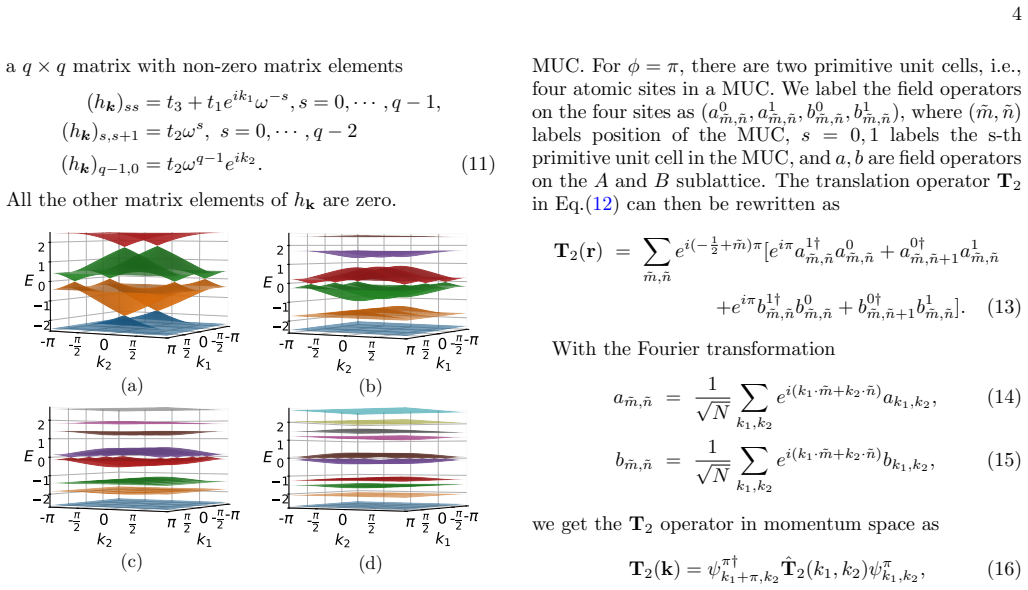
mod (2π,2π), j= 0,1,· · ·, q−1. (29) Each zero energy state corresponds to a Dirac point at E= 0 due to the sublattice symmetry so the sublattice and translation symmetry together result inqDirac points atE= 0. 4 - -2 02 - -2 0 2 2 1 0 1 2 E k1k2 (a) - -2 02 - -2 0 2 2 1 0 1 2 E k1k2 (b) FIG. 3: Electronic bands of the hexagonal Hofstadter model with q Di...
-
[3]
Theϕ=πcase To lift all the Dirac band touchings at the regime ||ti|q − |t j|q| ≤ |t k|q ≤ ||t i|q +|t j|q||, we need to break both theABsublattice symmetry and theT 2 translation symmetry of the primitive lattice. Beyond the regime ||ti|q − |t j|q| ≤ |t k|q ≤ ||t i|q +|t j|q||, we only need to break theT 2 translation symmetry to gap the bands at E̸= 0. T...
-
[4]
To lift the band degeneracy in this regime, one needs to break theAB sublattice symmetry
Theϕ̸=πcase Atϕ= 2πp/qbut not equal toπ, there is no generic symmetry enforced Dirac band touchings atE̸= 0, and the Dirac band touchings atE= 0 occur only when ||ti|q − |t j|q| ≤ |t k|q ≤ ||t i|q +|t j|q||. To lift the band degeneracy in this regime, one needs to break theAB sublattice symmetry. Beyond this regime, the electronic bands are generally gapp...
-
[5]
M. Dresselhaus, G. Dresselhaus, and A. Jorio,Group Theory: Application to the Physics of Condensed Matter (Springer Berlin Heidelberg, 2007)
work page 2007
-
[6]
H. C. Po, A. Vishwanath, and H. Watanabe, Nat. Commun.8(2017)
work page 2017
-
[7]
Z. Song, T. Zhang, Z. Fang, and C. Fang, Nat. Commun. 9, 3530 (2018)
work page 2018
-
[8]
C.-K. Chiu, J. C. Y. Teo, A. P. Schnyder, and S. Ryu, Rev. Mod. Phys.88, 035005 (2016)
work page 2016
-
[9]
C. L. Kane and E. J. Mele, Phys. Rev. Lett.95, 226801 (2005)
work page 2005
-
[10]
C. L. Kane and E. J. Mele, Phys. Rev. Lett.95, 146802 (2005)
work page 2005
- [11]
- [12]
-
[13]
B. Bradlyn, L. Elcoro, J. Cano, M. G. Vergniory, Z. Wang, C. Felser, M. I. Aroyo, and B. A. Bernevig, Nature 547, 298 (2017)
work page 2017
-
[14]
B. Bradlyn, L. Elcoro, M. G. Vergniory, J. Cano, Z. Wang, C. Felser, M. I. Aroyo, and B. A. Bernevig, Phys. Rev. B97, 035138 (2018)
work page 2018
-
[15]
J. Cano, B. Bradlyn, Z. Wang, L. Elcoro, M. G. Vergniory, C. Felser, M. I. Aroyo, and B. A. Bernevig, Phys. Rev. B97, 035139 (2018)
work page 2018
- [16]
-
[17]
M. G. Vergniory, L. Elcoro, Z. Wang, J. Cano, C. Felser, M. I. Aroyo, B. A. Bernevig, and B. Bradlyn, Phys. Rev. E96, 023310 (2017)
work page 2017
-
[18]
J. Cano, B. Bradlyn, Z. Wang, L. Elcoro, M. G. Vergniory, C. Felser, M. I. Aroyo, and B. A. Bernevig, Phys. Rev. Lett.120, 266401 (2018)
work page 2018
-
[19]
M. G. Vergniory, L. Elcoro, C. Felser, N. Regnault, B. A. Bernevig, and Z. Wang, Nature566, 480 (2019)
work page 2019
-
[20]
C. J. Bradley and A. P. Cracknell,The Mathematical Theory Of Symmetry In Solids: Representation theory for point groups and space groups(Oxford University Press, 2009)
work page 2009
- [21]
-
[22]
L. B. Shao, Q. Liu, R. Xiao, S. A. Yang, and Y. X. Zhao, Phys. Rev. Lett.127, 076401 (2021)
work page 2021
-
[23]
L. Shao, Z. Chen, K. Wang, S. A. Yang, and Y. Zhao, Phys. Rev. B108, 205126 (2023)
work page 2023
- [24]
-
[25]
Z. Y. Chen, Z. Zhang, S. A. Yang, and Y. X. Zhao, Nat. Commun.14, 743 (2023)
work page 2023
-
[26]
Z. Y. Chen, S. A. Yang, and Y. X. Zhao, Nat. Commun. 13, 2215 (2022)
work page 2022
-
[27]
J. Herzog-Arbeitman, Z.-D. Song, N. Regnault, and B. A. Bernevig, Phys. Rev. Lett.125, 236804 (2020)
work page 2020
-
[28]
J. Herzog-Arbeitman, Z.-D. Song, L. Elcoro, and B. A. Bernevig, Phys. Rev. Lett.130, 236601 (2023)
work page 2023
- [29]
-
[30]
Y. X. Zhao, Y.-X. Huang, and S. A. Yang, Phys. Rev. B 102, 161117 (2020)
work page 2020
-
[31]
A. Matsugatani, Y. Ishiguro, K. Shiozaki, and H. Watanabe, Phys. Rev. Lett.120, 096601 (2018)
work page 2018
-
[33]
K. S. Novoselov, A. K. Geim, S. V. Morozov, D. Jiang, Y. Zhang, S. V. Dubonos, I. V. Grigorieva, and A. A. Firsov, Science306, 666 (2004)
work page 2004
-
[34]
N. Ashcroft and N. Mermin,Solid State Physics, HRW international editions (Holt, Rinehart and Winston, 1976). 12
work page 1976
- [35]
-
[36]
D. R. Hofstadter, Phys. Rev. B14, 2239 (1976)
work page 1976
- [37]
-
[38]
A. Lau, C. Ortix, and J. van den Brink, Phys. Rev. Lett. 115, 216805 (2015)
work page 2015
-
[39]
A. Das, R. K. Kaul, and G. Murthy, Phys. Rev. B101, 165416 (2020)
work page 2020
- [40]
-
[41]
The plots and Tables in this manuscript can be produced by the code at https://doi.org/10.5281/zenodo.17773404
-
[42]
I. Dana, Y. Avron, and J. Zak, J. Phys. C: Solid State Phys.18, L679 (1985)
work page 1985
-
[43]
M. V. Berry, Proc. R. Soc. Lond. A392, 45 (1984)
work page 1984
- [44]
-
[45]
D. Vanderbilt,Berry Phases in Electronic Structure Theory: Electric Polarization, Orbital Magnetization and Topological Insulators(Cambridge University Press, 2018)
work page 2018
- [46]
- [47]
-
[48]
B. A. Bernevig, inTopological Insulators and Topological Superconductors(Princeton University Press, 2013)
work page 2013
-
[49]
D. J. Thouless, M. Kohmoto, M. P. Nightingale, and M. den Nijs, Phys. Rev. Lett.49, 405 (1982)
work page 1982
-
[50]
Aidelsburger,Artificial gauge fields with ultracold atoms in optical lattices(Springer, 2015)
M. Aidelsburger,Artificial gauge fields with ultracold atoms in optical lattices(Springer, 2015)
work page 2015
-
[51]
C. R. Dean, L. Wang, P. Maher, C. Forsythe, F. Ghahari, Y. Gao, J. Katoch, M. Ishigami, P. Moon, M. Koshino, T. Taniguchi, K. Watanabe, K. L. Shepard, J. Hone, and P. Kim, Nature497, 598 (2013)
work page 2013
discussion (0)
Sign in with ORCID, Apple, or X to comment. Anyone can read and Pith papers without signing in.