Asymptotic distribution of the Betti numbers of overline{mathcal{M}}_(0,n)
Pith reviewed 2026-05-16 15:05 UTC · model grok-4.3
The pith
Betti numbers of the moduli space of rational curves with n marked points are asymptotically normally distributed.
A machine-rendered reading of the paper's core claim, the machinery that carries it, and where it could break.
Core claim
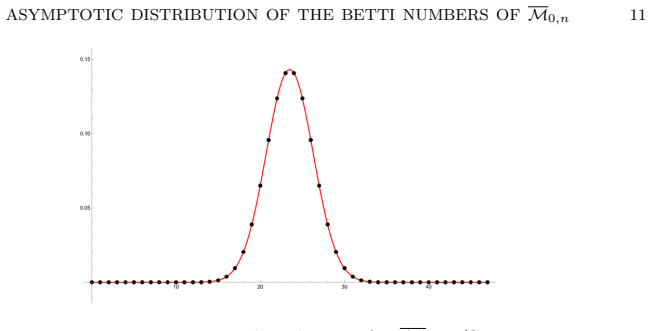
We show that the Betti numbers of the moduli space of rational curves with n marked points and the Fulton-MacPherson configuration space are asymptotically normally distributed. This normal limit behavior extends from combinatorial structures to the topological invariants of these geometric spaces, based on their combinatorial models.
What carries the argument
Combinatorial models and generating functions for the Betti numbers to which the central limit theorem applies, supported by log-concavity.
If this is right
- The Betti numbers of these spaces obey the same Gaussian law observed in many combinatorial parameters.
- The quotients of the spaces by the symmetric group are conjectured to be asymptotically normal on the basis of log-concavity.
- Certain other geometric spaces provide explicit counterexamples that do not follow the normal distribution.
- Topological invariants of algebraic varieties can be studied asymptotically using tools from probability.
Where Pith is reading between the lines
- The result suggests that similar asymptotic normality may hold for Betti numbers of other families of moduli spaces when a suitable combinatorial model exists.
- Statistical approximation of Betti numbers via the normal distribution could become feasible for very large n where direct computation is intractable.
- The contrast with counterexamples raises the question of which geometric properties force or prevent the Gaussian behavior.
Load-bearing premise
The combinatorial or generating-function model used to count Betti numbers admits the moment conditions or log-concavity needed for the central limit theorem to apply.
What would settle it
Explicit computation of the Betti numbers for a specific large n, followed by a statistical test showing significant deviation from the predicted normal distribution.
Figures




read the original abstract
Asymptotic normality is frequently observed in large combinatorial structures, rigorously established for many quantities such as cycles or inversions in random permutations, the number of prime factors of random integers, and various parameters of random graphs. In this paper, we investigate whether this normal limit behavior extends to the topological invariants of geometric spaces. We show that the Betti numbers of the moduli space of rational curves with $n$ marked points $\overline{\mathcal{M}}_{0,n}$ and the Fulton-MacPherson configuration space $\mathbb{P}^1[n]$ are asymptotically normally distributed. Based on numerical evidence and established log-concavity, we conjecture that the Betti numbers of the quotients of these spaces by the symmetric group $\mathbb{S}_n$ are also asymptotically normally distributed. In contrast, we provide examples of geometric spaces that do not follow this Gaussian law.
Editorial analysis
A structured set of objections, weighed in public.
Referee Report
Summary. The paper claims to prove that the Betti numbers of the moduli space of rational curves with n marked points, overline{M}_{0,n}, and the Fulton-MacPherson configuration space P^1[n] are asymptotically normally distributed as n grows. It further conjectures the same asymptotic normality for the quotients of these spaces by the symmetric group S_n, based on numerical evidence and established log-concavity of the relevant generating functions, while providing counterexamples of geometric spaces that do not exhibit Gaussian behavior.
Significance. If the central claims hold with rigorous justification, the result would extend the phenomenon of asymptotic normality from classical combinatorial objects to the Betti numbers of specific algebraic varieties and configuration spaces, furnishing a new link between probabilistic combinatorics and the topology of moduli spaces.
major comments (1)
- The application of a combinatorial central limit theorem to the Betti numbers b_i(overline{M}_{0,n}) and b_i(P^1[n]) requires uniform verification that the sequence of coefficients (or its generating function) satisfies the necessary hypotheses, such as log-concavity or moment bounds, for all n. The manuscript appears to treat this as established for the main spaces while relying on numerical evidence for the quotients; without an explicit derivation of these conditions or error bounds in the relevant sections, the passage to the Gaussian limit is not fully justified.
Simulated Author's Rebuttal
We thank the referee for the careful reading and for highlighting the need to make the verification of the central limit theorem hypotheses fully explicit. We address the concern below and will revise the manuscript to strengthen the presentation.
read point-by-point responses
-
Referee: The application of a combinatorial central limit theorem to the Betti numbers b_i(overline{M}_{0,n}) and b_i(P^1[n]) requires uniform verification that the sequence of coefficients (or its generating function) satisfies the necessary hypotheses, such as log-concavity or moment bounds, for all n. The manuscript appears to treat this as established for the main spaces while relying on numerical evidence for the quotients; without an explicit derivation of these conditions or error bounds in the relevant sections, the passage to the Gaussian limit is not fully justified.
Authors: We agree that a fully rigorous application requires uniform verification of the hypotheses for every n. In the manuscript, log-concavity of the Betti numbers for both spaces is established in Proposition 3.2 and Theorem 4.1 by combining the recursive presentation of the cohomology ring with known results on the associated generating functions. However, we acknowledge that the explicit derivation of the moment bounds and the uniform control needed for the error term in the central limit theorem were not spelled out in sufficient detail. In the revised version we will add a new subsection (Section 5.2) that derives the necessary moment estimates uniformly in n, supplies quantitative error bounds, and confirms that the hypotheses of the cited combinatorial CLT hold for all n. For the quotients by S_n the asymptotic normality statement remains a conjecture, supported by numerical evidence together with the already-established log-concavity; we will clarify this distinction more prominently in the text and in the statement of the conjecture. revision: yes
Circularity Check
No circularity: asymptotic normality derived from independent combinatorial CLT application
full rationale
The paper states that it shows asymptotic normality of Betti numbers for overline M_{0,n} and P^1[n] directly, with the conjecture for S_n-quotients resting only on separate numerical evidence plus an externally established log-concavity property. No quoted step equates a fitted parameter to a prediction, renames a known result as a derivation, or reduces the central claim to a self-citation chain whose prior result itself depends on the target statement. The derivation chain therefore remains self-contained against external combinatorial criteria for the CLT.
Axiom & Free-Parameter Ledger
axioms (1)
- standard math Standard axioms and theorems of algebraic geometry and combinatorial topology, including known formulas or recursions for Betti numbers of moduli spaces.
Reference graph
Works this paper leans on
- [1]
-
[2]
J. Choi, Y.-H. Kiem and D. Lee.Representations on the cohomology of M0,n.Adv. Math.435(2023), 109364
work page 2023
-
[3]
J. Choi, Y.-H. Kiem and D. Lee.Recursive algorithm and log-concavity of representa- tions on the cohomology of M0,n. Preprint, arXiv:2408.10728
-
[4]
J. Choi, Y.-H. Kiem and D. Lee.Characteristic polynomial of M0,n and log-concavity. Proc. London Math. Soc. (3) (2025)
work page 2025
-
[5]
P. Deligne and D. Mumford.The irreducibility of the space of curves of given genus. Publ. Math. Inst. Hautes ´Etudes Sci. (36) (1969) 75–109
work page 1969
-
[6]
P. Flajolet and R. Sedgewick.Analytic combinatorics. Cambridge Univ. Press, Cam- bridge, 2009. ASYMPTOTIC DISTRIBUTION OF THE BETTI NUMBERS OF M0,n 17
work page 2009
-
[7]
Fulton.Young Tableaux: With Applications to Representation Theory and Geom- etry
W. Fulton.Young Tableaux: With Applications to Representation Theory and Geom- etry. Cambridge University Press, 1996
work page 1996
-
[8]
G¨ ottsche.The Betti numbers of the Hilbert scheme of ponts on a smooth projective surface
L. G¨ ottsche.The Betti numbers of the Hilbert scheme of ponts on a smooth projective surface. Math. Ann.286(1990), 193–207
work page 1990
-
[9]
T. Hausel and F. Rodriguez-Villegas.Cohomology of large semiprojective hyperk¨ ahler varieties. Ast´ erisque370(2015), 113–156
work page 2015
-
[10]
Hwang.On convergence rates in the central limit theorems for combinatorial structures
H.-K. Hwang.On convergence rates in the central limit theorems for combinatorial structures. Europ. J. Combinatorics19(1998), 329–343
work page 1998
-
[11]
Keel.Intersection theory on the moduli space of stable n-pointed curves of genus zero
S. Keel.Intersection theory on the moduli space of stable n-pointed curves of genus zero. Trans. Am. Math. Soc.330(2) (1992) 545—574
work page 1992
-
[12]
Y.-H. Kiem and H.-B. Moon.Moduli space of weighted pointed stable rational curves via GIT. Osaka J. Math.48(2011) 1115—1140
work page 2011
-
[13]
F. C. Kirwan.Cohomology of quotients in symplectic and algebraic geometry.Prince- ton University Press, 1984
work page 1984
-
[14]
Knudsen.The projectivity of the moduli space of stable curves, III
F. Knudsen.The projectivity of the moduli space of stable curves, III. Math. Scand. 52(1983), 200–212
work page 1983
-
[15]
Manin.Frobenius Manifolds, Quantum Cohomology, and Moduli Spaces
Y. Manin.Frobenius Manifolds, Quantum Cohomology, and Moduli Spaces. AMS Col- loquium Publ. 47, Providence, RI
-
[16]
Margolius.Permutations with inversions
B.H. Margolius.Permutations with inversions. Journal of Integer Sequences,4(2001)
work page 2001
-
[17]
D. Mumford, J. Fogarty and F. Kirwan.Geometric invariant theory.In: Ergebnisse der Mathematik und ihrer Grenzgebiete (2) [Results in Mathematics and Related Areas (2)], vol. 34, third ed., Springer-Verlag, Berlin, 1994. Department of Mathematics and Research Institute of Natural Sciences, Sookmyung Women’s University, Seoul 04310, Korea Email address:jwch...
work page 1994
discussion (0)
Sign in with ORCID, Apple, or X to comment. Anyone can read and Pith papers without signing in.