Detectability of Gravitational-Wave Memory with LISA: A Bayesian Approach
Pith reviewed 2026-05-21 14:19 UTC · model grok-4.3
The pith
LISA can detect and characterize the displacement memory effect from individual massive black hole binary mergers.
A machine-rendered reading of the paper's core claim, the machinery that carries it, and where it could break.
Core claim
Using state-of-the-art simulations of the LISA instrument and Bayesian analysis, the displacement memory effect from individual massive black hole binary merger events is detectable and its amplitude can be reconstructed at a precision that opens the way to tests of general relativity and alternative theories, with estimated observation rates provided by population models.
What carries the argument
Bayesian parameter estimation performed on simulated LISA responses that include the displacement memory contribution from massive black hole binary signals.
If this is right
- Detection of the memory effect in LISA data would permit quantitative tests of general relativity through its predicted amplitude.
- The same Bayesian framework can be used to place constraints on alternative gravity theories that modify the memory contribution.
- Population models allow forecasting of the number of memory detections expected over the LISA mission lifetime.
- Successful reconstruction of memory amplitude for individual events demonstrates that LISA can extract subtle post-merger features beyond the usual oscillatory waveform.
Where Pith is reading between the lines
- The same analysis approach could be adapted to future ground-based detectors to search for memory in stellar-mass black hole mergers.
- Non-detection in the first years of LISA operation would tighten the required improvements in waveform modeling or instrument calibration.
- Combining memory measurements with other general-relativity tests from the same events could provide stronger joint constraints on modified gravity.
Load-bearing premise
The chosen LISA instrument simulations correctly reproduce the detector response to signals that contain the displacement memory effect, and the adopted black hole population models are representative of the actual universe.
What would settle it
A real LISA detection of a massive black hole merger with high signal-to-noise ratio that shows no statistically significant memory offset, or a reconstructed memory amplitude inconsistent with the general-relativity prediction at the level claimed by the analysis.
Figures




read the original abstract
Gravitational wave (GW) astronomy opens a new venue to explore the universe. Future observatories such as LISA, the Laser Interferometer Space Antenna, are expected to observe previously undetectable fundamental physics effects in signals predicted by General Relativity (GR).One particularly interesting such signal is associated to the displacement memory effect, which corresponds to a permanent deformation of spacetime due to the passage of gravitational radiation. In this work, we explore the ability of LISA to observe and characterize this effect. In order to do this, we use state-of-the-art simulations of the LISA instrument, and we perform a Bayesian analysis to assess the detectability and establish general conditions to claim detection of the displacement memory effect from individual massive black hole binary (MBHB) merger events in LISA. We perform parameter estimation both to explore the impact of the displacement memory effect and to reconstruct its amplitude. We discuss the precision at which such a reconstruction can be obtained thus opening the way to tests of GR and alternative theories. To provide astrophysical context, we apply our analysis to black hole binary populations models and estimate the rates at which the displacement memory effect could be observed within the LISA planned lifetime.
Editorial analysis
A structured set of objections, weighed in public.
Referee Report
Summary. The paper examines the detectability and characterization of the gravitational-wave displacement memory effect from individual massive black hole binary (MBHB) mergers using LISA. It employs state-of-the-art LISA instrument simulations combined with Bayesian parameter estimation to assess detectability thresholds, reconstruct memory amplitudes, explore impacts on parameter recovery, and estimate observation rates by applying the analysis to black hole population models over the planned LISA lifetime.
Significance. If the central results hold, the work would establish a concrete pathway for LISA to observe and measure the displacement memory effect, enabling direct tests of general relativity and alternative gravity theories via the permanent spacetime offset. The Bayesian framework for amplitude reconstruction and the use of population models to derive event rates are positive elements that ground the claims in realistic astrophysical contexts.
major comments (1)
- [Methods section on LISA instrument simulations and response modeling] The analysis relies on state-of-the-art LISA instrument simulations to model the response to signals containing the displacement memory effect, yet no explicit validation or cross-checks against independent analytical memory waveform models or controlled injections are reported. This is load-bearing for the detectability and reconstruction claims because the memory contribution is a low-frequency, DC-like permanent offset whose accurate capture in the time-delay interferometry channels is essential; any unmodeled attenuation or distortion would directly affect the reported precision and rates.
minor comments (2)
- [Abstract] The abstract and introduction would benefit from a brief quantitative summary of the key detectability thresholds or rate estimates to allow readers to assess the strength of the conclusions without reading the full results section.
- [Methods] Notation for the memory amplitude parameter and its relation to the waveform model should be clarified with an explicit equation reference early in the methods to avoid ambiguity when discussing reconstruction precision.
Simulated Author's Rebuttal
We thank the referee for their careful reading of the manuscript and for the constructive major comment. We address it point by point below.
read point-by-point responses
-
Referee: The analysis relies on state-of-the-art LISA instrument simulations to model the response to signals containing the displacement memory effect, yet no explicit validation or cross-checks against independent analytical memory waveform models or controlled injections are reported. This is load-bearing for the detectability and reconstruction claims because the memory contribution is a low-frequency, DC-like permanent offset whose accurate capture in the time-delay interferometry channels is essential; any unmodeled attenuation or distortion would directly affect the reported precision and rates.
Authors: We appreciate the referee highlighting the need for explicit validation of the LISA response modeling for the displacement memory effect. The instrument simulations are drawn from established LISA Data Challenge pipelines that have been cross-validated for standard waveforms in the literature. To directly address the concern for the memory signal, we have added a dedicated paragraph in the Methods section that reports two new checks: (i) direct comparison of the simulated TDI time series against an independent analytical memory waveform model for the permanent offset, and (ii) controlled injections of memory-only signals into noise-only data to verify unbiased recovery of the DC component without attenuation. These additions confirm that the low-frequency offset is faithfully captured and support the reported detectability thresholds and amplitude reconstruction precision. revision: yes
Circularity Check
No significant circularity; claims rest on external simulations and population models
full rationale
The paper performs Bayesian parameter estimation on LISA instrument simulations for MBHB signals including displacement memory, then applies the analysis to external black hole population models to estimate observation rates. No derivation step reduces a prediction to a fitted input by construction, nor does any central claim rest on a self-citation chain or self-definitional ansatz. The workflow is self-contained against external benchmarks and does not exhibit the enumerated circularity patterns.
Axiom & Free-Parameter Ledger
Lean theorems connected to this paper
-
IndisputableMonolith/Foundation/RealityFromDistinction.leanreality_from_one_distinction unclear?
unclearRelation between the paper passage and the cited Recognition theorem.
We use state-of-the-art simulations of the LISA instrument, and we perform a Bayesian analysis to assess the detectability... using NRHybSur3dq8_CCE and SEOBNRv5HM waveforms with memory computed via Eq. (5)
-
IndisputableMonolith/Foundation/AlexanderDuality.leanalexander_duality_circle_linking unclear?
unclearRelation between the paper passage and the cited Recognition theorem.
The memory effect... permanent deformation of spacetime... linked to the asymptotic structure of spacetime through the symmetries of the BMS group
What do these tags mean?
- matches
- The paper's claim is directly supported by a theorem in the formal canon.
- supports
- The theorem supports part of the paper's argument, but the paper may add assumptions or extra steps.
- extends
- The paper goes beyond the formal theorem; the theorem is a base layer rather than the whole result.
- uses
- The paper appears to rely on the theorem as machinery.
- contradicts
- The paper's claim conflicts with a theorem or certificate in the canon.
- unclear
- Pith found a possible connection, but the passage is too broad, indirect, or ambiguous to say the theorem truly supports the claim.
Forward citations
Cited by 3 Pith papers
-
Gravitational Memory from Hairy Binary Black Hole Mergers
Gravitational memory from hairy binary black hole mergers in scalar-Gauss-Bonnet gravity differs from GR by a few percent due to altered nonlinear dynamics, with direct scalar contributions suppressed, and including m...
-
Scalar memory from compact binary coalescences
In Ricci-coupled scalar-Gauss-Bonnet gravity, the change in scalar charge during binary black hole mergers generates a scalar memory contribution that modifies the total memory signal on observable timescales.
-
Probing soft signals of gravitational-wave memory with space-based interferometers
Space-based detectors can measure soft displacement-memory signals from gravitational waves at SNR greater than or equal to 10.
Reference graph
Works this paper leans on
-
[1]
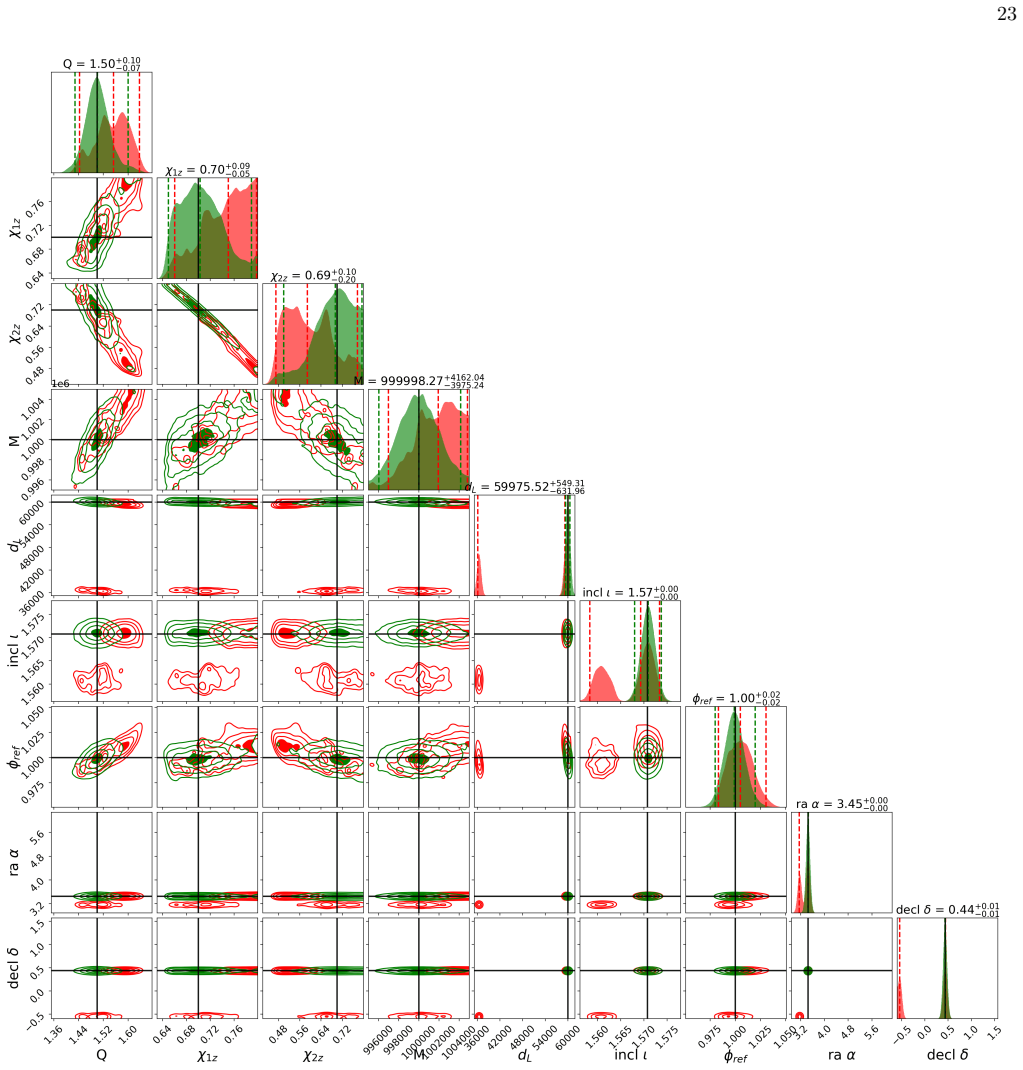
Bayesian analysis Working within the Bayesian framework offers a dou- ble benefit as it allows for both parameter estimation and model comparison. According to the Bayes theo- rem, one can express the posterior probability distribu- tionp(θ|d, m) of the source parametersθgiven the data dand the modelmas: p(θ|d, m) = p(d|θ, m)p(θ|m) p(d|m) (9) During LISA ...
-
[2]
Memory detectability criteria Having established the detectability of the memory ef- fect through the BF computation, we explore its relation- ship with the SNR, aiming to define an SNR threshold and generalize the notion of detectability criteria. To do so, we explore the variation of the BF with respect to several changes in parameter values. We start f...
-
[3]
Focus on the (2,2) and the main mass regime We first want to study if the memory effect improves the accuracy of the estimation. We performed this anal- ysis in different scenarios and checked whether the pa- rameter estimation is either unchanged or improved. We need to distinguish two cases: one where the merger will be resolved by LISA, for massM≳10 5M...
-
[4]
HMs in the low mass regime and (2,0) oscillatory component However, in the low-mass regime,M≲10 5M⊙, the in- formation from the merger – and in particular from HMs withℓ⩾3 – lies predominantly in a frequency range where LISA is less sensitive, thereby reducing the qual- ity of the reconstructed information. In this case, the low-frequency nature of the me...
work page 2000
-
[5]
Einstein, Sitzungsberichte der K¨ oniglich Preussischen Akademie der Wissenschaften pp
A. Einstein, Sitzungsberichte der K¨ oniglich Preussischen Akademie der Wissenschaften pp. 688–696 (1916)
work page 1916
-
[6]
Einstein, Sitzungsberichte der K¨ oniglich Preussischen Akademie der Wissenschaften pp
A. Einstein, Sitzungsberichte der K¨ oniglich Preussischen Akademie der Wissenschaften pp. 154–167 (1918)
work page 1918
-
[7]
J. Aasi et al. (LIGO Scientific), Class. Quant. Grav.32, 074001 (2015), 1411.4547
work page internal anchor Pith review Pith/arXiv arXiv 2015
-
[8]
Advanced Virgo: a 2nd generation interferometric gravitational wave detector
F. Acernese et al. (VIRGO), Class. Quant. Grav.32, 024001 (2015), 1408.3978
work page internal anchor Pith review Pith/arXiv arXiv 2015
- [9]
-
[10]
B. P. Abbott, R. Abbott, T. D. Abbott, M. R. Aber- nathy, F. Acernese, K. Ackley, C. Adams, T. Adams, P. Addesso, R. X. Adhikari, et al., Physical Re- view Letters116, 061102 (2016), ISSN 0031-9007, 1079-7114, URLhttps://link.aps.org/doi/10.1103/ PhysRevLett.116.061102
work page 2016
-
[11]
M. Colpi, K. Danzmann, M. Hewitson, K. Holley- Bockelmann, P. Jetzer, G. Nelemans, A. Petiteau, D. Shoemaker, C. Sopuerta, R. Stebbins, et al.,Lisa definition study report(2024), 2402.07571, URLhttps: //www.cosmos.esa.int/web/lisa/lisa-redbook
work page internal anchor Pith review Pith/arXiv arXiv 2024
-
[12]
Y. B. Zel’dovich and A. G. Polnarev, Sov. Astron.18, 17 (1974)
work page 1974
-
[13]
V. B. Braginskii and L. P. Grishchuk, Zhurnal Eksperi- mentalnoi i Teoreticheskoi Fiziki89, 744 (1985)
work page 1985
-
[14]
V. B. Braginsky and K. S. Thorne, Nature327, 123 (1987)
work page 1987
-
[15]
D. Christodoulou, Phys. Rev. Lett.67, 1486 (1991), URL https://link.aps.org/doi/10.1103/PhysRevLett.67. 1486
-
[16]
K. S. Thorne, Physical Review D45, 520–524 (1992), ISSN 0556-2821, URLhttps://link.aps.org/doi/10. 1103/PhysRevD.45.520
work page 1992
-
[17]
S. Pasterski, A. Strominger, and A. Zhiboedov, Journal of High Energy Physics2016, 53 (2016), ISSN 1029-8479
work page 2016
-
[18]
A. Strominger and A. Zhiboedov, Journal of High Energy Physics2016, 86 (2016), ISSN 1029-8479
work page 2016
-
[19]
D. A. Nichols, Physical Review D98, 064032 (2018)
work page 2018
-
[20]
E. E. Flanagan, A. M. Grant, A. I. Harte, and D. A. Nichols, Physical Review D99, 084044 (2019)
work page 2019
-
[21]
A. Ashtekar, T. De Lorenzo, and N. Khera, General Rel- ativity and Gravitation52, 107 (2020), ISSN 1572-9532
work page 2020
-
[22]
A. M. Grant and D. A. Nichols, Physical Review D105, 024056 (2022)
work page 2022
-
[23]
A. M. Grant and D. A. Nichols, Physical Review D107, 064056 (2023)
work page 2023
- [24]
- [25]
-
[26]
S. Bhattacharjee, S. Kumar, and A. Bhattacharyya, Phys. Rev. D100, 084010 (2019), 1905.12905
-
[27]
L. Bieri and A. Polnarev, Classical and Quantum Gravity 41, 135012 (2024), ISSN 0264-9381
work page 2024
-
[28]
Toward claiming a detection of gravitational memory
J. Zosso, L. Maga˜ na Zertuche, S. Gasparotto, A. Cogez, H. Inchausp´ e, and M. Jacobs (2026), 2601.23019
work page internal anchor Pith review Pith/arXiv arXiv 2026
-
[29]
The Sensitivity of the Advanced LIGO Detectors at the Beginning of Gravitational Wave Astronomy
B. Abbott, Phys. Rev. D93, 112004 (2016), [Addendum: Phys.Rev.D 97, 059901 (2018)], 1604.00439
work page internal anchor Pith review Pith/arXiv arXiv 2016
-
[30]
A. D. Johnson, S. J. Kapadia, A. Osborne, A. Hixon, and D. Kennefick, Physical Review D99, 044045 (2019), ISSN 2470-0010, 2470-0029, URLhttps://link.aps. org/doi/10.1103/PhysRevD.99.044045
-
[31]
P. D. Lasky, E. Thrane, Y. Levin, J. Blackman, and Y. Chen, Physical Review Letters117, 061102 (2016), ISSN 0031-9007, 1079-7114, URLhttps://link.aps. org/doi/10.1103/PhysRevLett.117.061102
-
[32]
S. Y. Cheung, P. D. Lasky, and E. Thrane, Classical and Quantum Gravity41, 115010 (2024), ISSN 0264-9381
work page 2024
- [33]
-
[34]
M. H¨ ubner, C. Talbot, P. D. Lasky, and E. Thrane, Phys. Rev. D101, 023011 (2020), URLhttps://link.aps. org/doi/10.1103/PhysRevD.101.023011
-
[35]
M. H¨ ubner, P. Lasky, and E. Thrane, Physical Review D 104(2021), ISSN 2470-0029, URLhttp://dx.doi.org/ 10.1103/PhysRevD.104.023004
-
[36]
S. M. Tomson, B. Goncharov, and R. van Haasteren, arXiv (2025), 2510.04537
work page internal anchor Pith review Pith/arXiv arXiv 2025
- [37]
- [38]
-
[39]
H. Inchausp´ e, S. Gasparotto, D. Blas, L. Heisenberg, J. Zosso, and S. Tiwari, Physical Review D111, 044044 (2025), ISSN 2470-0010, 2470-0029, URLhttps://link. aps.org/doi/10.1103/PhysRevD.111.044044
-
[40]
E. Barausse, I. Dvorkin, M. Tremmel, M. Volonteri, and M. Bonetti, The Astrophysical Journal904, 16 (2020), ISSN 0004-637X
work page 2020
-
[41]
E. Barausse and A. Lapi,Massive Black-Hole Merg- ers(Springer, Singapore, 2021), p. 1–33, ISBN 978-981- 15-4702-7, URLhttps://link.springer.com/rwe/10. 1007/978-981-15-4702-7_18-1
work page 2021
-
[42]
R. A. Isaacson, Phys. Rev.166, 1263 (1968)
work page 1968
-
[43]
R. A. Isaacson, Phys. Rev.166, 1272 (1968)
work page 1968
-
[44]
C. W. Misner, K. S. Thorne, and J. A. Wheeler,Gravi- tation(W. H. Freeman, San Francisco, 1973), ISBN 978- 0-7167-0344-0, 978-0-691-17779-3
work page 1973
-
[45]
E. E. Flanagan and S. A. Hughes, New J. Phys.7, 204 (2005), gr-qc/0501041
work page internal anchor Pith review Pith/arXiv arXiv 2005
-
[46]
M. Maggiore,Gravitational Waves: Volume 1: Theory and Experiments(Oxford University Press, 2007), ISBN 9780198570745
work page 2007
-
[47]
Zosso, in59th Rencontres de Moriond on Gravitation: Moriond 2025 Gravitation(2025), 2505.17603
J. Zosso, in59th Rencontres de Moriond on Gravitation: Moriond 2025 Gravitation(2025), 2505.17603
-
[48]
The Cosmological Memory Effect
A. Tolish and R. M. Wald, Phys. Rev. D94, 044009 (2016), 1606.04894
work page internal anchor Pith review Pith/arXiv arXiv 2016
-
[49]
Gravitational wave memory in $\Lambda$CDM cosmology
L. Bieri, D. Garfinkle, and N. Yunes, Class. Quant. Grav. 34, 215002 (2017), 1706.02009
work page internal anchor Pith review Pith/arXiv arXiv 2017
-
[50]
A. G. Wiseman and C. M. Will, Phys. Rev. D44, 29 R2945 (1991), URLhttps://link.aps.org/doi/10. 1103/PhysRevD.44.R2945
work page 1991
-
[51]
M. Favata, Phys. Rev. D80, 024002 (2009), 0812.0069
work page internal anchor Pith review Pith/arXiv arXiv 2009
-
[52]
C. Talbot, E. Thrane, P. D. Lasky, and F. Lin, Physical Review D98(2018), ISSN 2470-0029, URLhttp://dx. doi.org/10.1103/PhysRevD.98.064031
-
[53]
J. Yoo, K. Mitman, V. Varma, M. Boyle, S. E. Field, N. Deppe, F. H´ ebert, L. E. Kidder, J. Moxon, H. P. Pfeiffer, et al., Physical Review D108(2023), ISSN 2470-0029, URLhttp://dx.doi.org/10.1103/ PhysRevD.108.064027
work page 2023
-
[54]
S. E. Field, C. R. Galley, J. S. Hesthaven, J. Kaye, and M. Tiglio, Physical Review X4(2014), ISSN 2160-3308, URLhttp://dx.doi.org/10.1103/PhysRevX.4.031006
- [55]
-
[56]
L. Pompili, A. Buonanno, H. Estell´ es, M. Khalil, M. v. d. Meent, D. P. Mihaylov, S. Ossokine, M. P¨ urrer, A. Ramos-Buades, A. K. Mehta, et al., Physical Review D108(2023), ISSN 2470-0010, 2470-0029, arXiv:2303.18039 [gr-qc], URLhttp://arxiv.org/abs/ 2303.18039
- [57]
-
[58]
L. D. C. W. Group,Lisa rosetta stone: Conventions doc- ument (lisa-ddpc-seg-tn-007)(2026)
work page 2026
-
[59]
P. Collaboration, P. A. R. Ade, N. Aghanim, M. Arnaud, M. Ashdown, J. Aumont, C. Baccigalupi, A. J. Banday, R. B. Barreiro, J. G. Bartlett, et al., Astronomy & As- trophysics594, A13 (2016), ISSN 0004-6361, 1432-0746
work page 2016
-
[60]
Astropy Collaboration, T. P. Robitaille, E. J. Tollerud, P. Greenfield, M. Droettboom, E. Bray, T. Aldcroft, M. Davis, A. Ginsburg, A. M. Price-Whelan, et al., As- tronomy and Astrophysics558, A33 (2013), 1307.6212
work page internal anchor Pith review Pith/arXiv arXiv 2013
-
[61]
Astropy Collaboration, A. M. Price-Whelan, B. M. Sip˝ ocz, H. M. G¨ unther, P. L. Lim, S. M. Crawford, S. Conseil, D. L. Shupe, M. W. Craig, N. Dencheva, et al., Astronomical Journal156, 123 (2018), 1801.02634
work page internal anchor Pith review Pith/arXiv arXiv 2018
-
[62]
Astropy Collaboration, A. M. Price-Whelan, P. L. Lim, N. Earl, N. Starkman, L. Bradley, D. L. Shupe, A. A. Patil, L. Corrales, C. E. Brasseur, et al., Astrophysical Journal935, 167 (2022), 2206.14220
work page internal anchor Pith review Pith/arXiv arXiv 2022
- [63]
-
[64]
M. Staab, J.-B. Bayle, and O. Hartwig,Pytdi(2023), URLhttps://doi.org/10.5281/zenodo.8429119
-
[65]
J.-B. Bayle, A. Hees, M. Lilley, C. Le Poncin-Lafitte, W. Martens, and E. Joffre,Lisa orbits(2023), URL https://doi.org/10.5281/zenodo.7700361
- [66]
-
[67]
D. J. A. McKechan, C. Robinson, and B. S. Sathyaprakash, Classical and Quantum Gravity27, 084020 (2010), ISSN 0264-9381, 1361-6382, URL https://iopscience.iop.org/article/10.1088/ 0264-9381/27/8/084020
work page 2010
-
[68]
L. S. S. Team,Lisa science requirements document (2018), URLhttps://www.cosmos.esa.int/documents/ 678316/1700384/SciRD.pdf
work page 2018
- [69]
- [70]
- [71]
-
[72]
S. Koposov, J. Speagle, K. Barbary, G. Ashton, E. Ben- nett, J. Buchner, C. Scheffler, B. Cook, C. Talbot, J. Guillochon, et al.,joshspeagle/dynesty: v2.1.4(2024), URLhttps://zenodo.org/records/12537467
-
[73]
Skilling, arXiv735, 395–405 (2004), aDS Bibcode: 2004AIPC..735..395S
J. Skilling, arXiv735, 395–405 (2004), aDS Bibcode: 2004AIPC..735..395S
work page 2004
-
[74]
Skilling, Bayesian Analysis1, 833–859 (2006), ISSN 1936-0975, 1931-6690
J. Skilling, Bayesian Analysis1, 833–859 (2006), ISSN 1936-0975, 1931-6690
work page 2006
-
[75]
J. S. Speagle, Monthly Notices of the Royal Astronomi- cal Society493, 3132–3158 (2020), ISSN 0035-8711, aDS Bibcode: 2020MNRAS.493.3132S
work page 2020
- [76]
-
[77]
H. Jeffreys,The Theory of Probability(OUP Ox- ford, 1998), ISBN 9780191589676, google-Books-ID: vh9Act9rtzQC
work page 1998
-
[78]
Bilby: A user-friendly Bayesian inference library for gravitational-wave astronomy
G. Ashton et al., Astrophys. J. Suppl.241, 27 (2019), 1811.02042
work page internal anchor Pith review Pith/arXiv arXiv 2019
-
[79]
S. Sun, C. Shi, J.-d. Zhang, and J. Mei, Physi- cal Review D110, 024050 (2024), ISSN 2470-0010, 2470-0029, URLhttps://link.aps.org/doi/10.1103/ PhysRevD.110.024050
work page 2024
-
[80]
E. Thrane and C. Talbot, Publications of the Astronomi- cal Society of Australia36, e010 (2019), ISSN 1323-3580, 1448-6083, arXiv:1809.02293 [astro-ph]
discussion (0)
Sign in with ORCID, Apple, or X to comment. Anyone can read and Pith papers without signing in.