From Computational Certification to Exact Coordinates: Heilbronn's Triangle Problem on the Unit Square Using Mixed-Integer Optimization
Pith reviewed 2026-05-22 10:56 UTC · model grok-4.3
The pith
A mixed-integer nonlinear program with boundary symmetry breaking recovers exact coordinates for all best-known Heilbronn triangle configurations up to nine points.
A machine-rendered reading of the paper's core claim, the machinery that carries it, and where it could break.
Core claim
The central claim is that a suitably strengthened mixed-integer nonlinear program can be solved to epsilon-global optimality for small n and that the resulting numerical points can be certified and then converted, via exact symbolic computation, into algebraic coordinates that coincide with all known optimal configurations for n ≤ 9.
What carries the argument
Mixed-integer nonlinear programming formulation strengthened by symmetry-breaking constraints derived from boundary structure, followed by numerical certification and exact symbolic recovery of coordinates.
If this is right
- For n=9 an epsilon-globally optimal solution is obtained in 15 minutes rather than the previously reported one day of computation.
- Exact algebraic coordinates are recovered for every best-known configuration with n ≤ 9.
- Non-critical triangle areas in the optimal placements cluster around a small number of distinct numerical values.
- The clustering pattern indicates the presence of rich algebraic relations among the coordinates.
Where Pith is reading between the lines
- The same certification-plus-symbolic-recovery pipeline could be applied to other small-n instances of Heilbronn-type problems once the MINLP is solved.
- The observed clustering of areas around few values suggests that optimal point sets may satisfy low-degree algebraic equations that could be solved directly without optimization.
- Public release of the code and data makes it straightforward to test whether the method scales to n=10 or n=11 with additional computing time.
Load-bearing premise
The symmetry-breaking strategy based on boundary structure yields a substantially stronger model that still contains all globally optimal configurations without excluding them.
What would settle it
Finding a point set for any n ≤ 9 whose smallest triangle area is strictly smaller than the value obtained from the certified solution, or obtaining algebraic coordinates for n=9 that differ from the Comellas-Yebra configuration.
Figures




read the original abstract
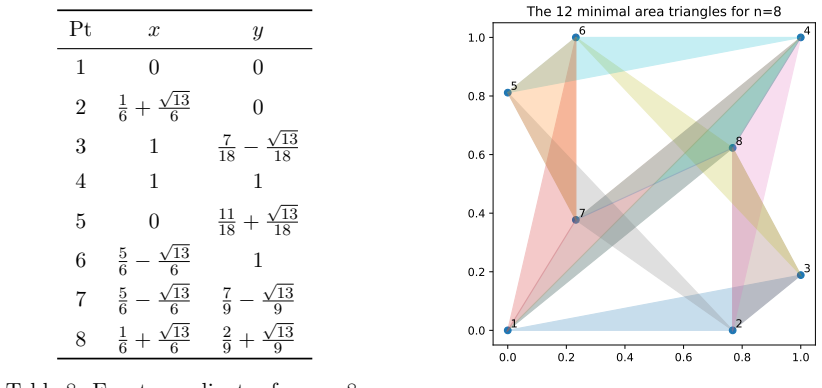
We develop a mixed-integer nonlinear programming (MINLP) approach for the classical Heilbronn triangle problem, demonstrating the capability of modern global optimization solvers to tackle challenging combinatorial geometry problems. A symmetry-breaking strategy based on boundary structure yields a substantially stronger model: for $n=9$, we compute an $\varepsilon$-globally optimal point in 15 minutes on a standard desktop computer, improving upon the previously reported effort of approximately one day. By combining numerical certification with exact symbolic computation, we recover exact coordinates matching all best-known configurations for $n\le 9$, including the $n=9$ configuration of Comellas and Yebra (2002). An analysis of these configurations reveals the clustering of noncritical triangle areas around a small number of distinct values, suggesting rich underlying algebraic structure. All code and data are publicly available.
Editorial analysis
A structured set of objections, weighed in public.
Referee Report
Summary. The manuscript develops a mixed-integer nonlinear programming (MINLP) approach to Heilbronn's triangle problem on the unit square. It introduces a symmetry-breaking strategy based on boundary structure to strengthen the model, enabling faster computation of ε-globally optimal points. For n=9, it achieves this in 15 minutes, and combines numerical certification with exact symbolic computation to recover exact coordinates matching all best-known configurations for n ≤ 9, including that of Comellas and Ybera (2002). The paper also analyzes clustering of noncritical triangle areas and makes all code and data publicly available.
Significance. If the symmetry-breaking preserves all global optima and the certification is rigorous, this work is significant for demonstrating the applicability of modern global optimization techniques to a challenging problem in combinatorial geometry. It provides a substantial computational speed-up over prior efforts and recovers exact solutions, offering insights into the algebraic structure of optimal configurations through the observed clustering of areas. The public release of code and data is a clear strength that enhances reproducibility.
major comments (1)
- [§3] §3 (Symmetry-breaking strategy): The claim that the boundary-structure symmetry-breaking yields a substantially stronger model that still contains all globally optimal configurations lacks an explicit proof or exhaustive enumeration. It is asserted that every candidate point set can be rigidly transformed (without decreasing the minimal triangle area) into one obeying the chosen boundary ordering, but no verification is provided that this holds for all possible optima. This is load-bearing for the completeness of the recovered coordinates and the ε-global optimality claim.
minor comments (3)
- [Abstract and §1] The reference to Comellas and Yebra (2002) in the abstract and introduction should be expanded with full bibliographic details and page numbers in the reference list.
- [Table 1] Table 1 (computational results): The reported times and ε values would benefit from explicit mention of the hardware specifications and solver version used for reproducibility.
- [Figure 3] Figure 3 (area clustering): The plot would be clearer with an accompanying table listing the distinct area values and their multiplicities for each n.
Simulated Author's Rebuttal
We thank the referee for their careful reading and constructive feedback on our manuscript. We address the single major comment below and will revise the paper to strengthen the justification for the symmetry-breaking approach.
read point-by-point responses
-
Referee: [§3] §3 (Symmetry-breaking strategy): The claim that the boundary-structure symmetry-breaking yields a substantially stronger model that still contains all globally optimal configurations lacks an explicit proof or exhaustive enumeration. It is asserted that every candidate point set can be rigidly transformed (without decreasing the minimal triangle area) into one obeying the chosen boundary ordering, but no verification is provided that this holds for all possible optima. This is load-bearing for the completeness of the recovered coordinates and the ε-global optimality claim.
Authors: We thank the referee for highlighting this point. The boundary-structure symmetry-breaking is based on ordering points according to their positions on the boundary of the unit square (e.g., prioritizing points on specific edges in a cyclic manner) to eliminate equivalent configurations under the square's symmetries. We acknowledge that the current manuscript asserts this transformation preserves all global optima without providing a self-contained formal proof or exhaustive enumeration for arbitrary n. In the revised manuscript we will add a dedicated paragraph in §3 that rigorously justifies the claim: any finite point set in the unit square admits a rigid motion (rotation by a multiple of 90 degrees combined with reflection if needed) that maps it to a configuration satisfying the chosen boundary ordering while leaving the minimal triangle area unchanged, because the objective function is invariant under isometries and the domain is symmetric. We will also include a small-scale exhaustive verification for n ≤ 5 by comparing solutions with and without the symmetry-breaking constraints. This revision will directly support the completeness of the recovered coordinates and the ε-global optimality statements. revision: yes
Circularity Check
No significant circularity in the derivation chain
full rationale
The paper applies standard mixed-integer nonlinear programming to the externally defined Heilbronn triangle problem of maximizing minimal triangle area for n points in the unit square. The symmetry-breaking strategy based on boundary structure is introduced as a modeling enhancement that strengthens the formulation while asserted to retain all global optima, but this does not reduce any equation or claim to a self-referential definition or fitted input renamed as prediction. Exact coordinates are recovered via numerical certification followed by symbolic computation and shown to match independently published configurations (e.g., Comellas and Yebra 2002), providing external validation rather than internal closure. No load-bearing self-citation, uniqueness theorem imported from the authors, or ansatz smuggled via prior work appears in the derivation; the approach remains self-contained against external benchmarks.
Axiom & Free-Parameter Ledger
free parameters (1)
- epsilon optimality tolerance
axioms (1)
- domain assumption The Heilbronn triangle problem admits an exact mixed-integer nonlinear programming formulation whose feasible set includes all candidate point placements.
Lean theorems connected to this paper
-
IndisputableMonolith/Cost/FunctionalEquation.leanwashburn_uniqueness_aczel unclear?
unclearRelation between the paper passage and the cited Recognition theorem.
exact coordinates... H⋆9 = −11/64 + 9√65/320
What do these tags mean?
- matches
- The paper's claim is directly supported by a theorem in the formal canon.
- supports
- The theorem supports part of the paper's argument, but the paper may add assumptions or extra steps.
- extends
- The paper goes beyond the formal theorem; the theorem is a base layer rather than the whole result.
- uses
- The paper appears to rely on the theorem as machinery.
- contradicts
- The paper's claim conflicts with a theorem or certificate in the canon.
- unclear
- Pith found a possible connection, but the passage is too broad, indirect, or ambiguous to say the theorem truly supports the claim.
Forward citations
Cited by 1 Pith paper
-
Out-of-the-Box Global Optimization for Packing Problems: New Models and Improved Solutions
New nonlinear formulations for geometric packing problems, solved with FICO Xpress and SCIP, produce improved and first-known solutions for several variants.
Reference graph
Works this paper leans on
-
[1]
Mixed- integer nonlinear optimization
P. Belotti, C. Kirches, S. Leyffer, J. Linderoth, J. Luedtke, and A. Mahajan. “Mixed- integer nonlinear optimization”. In:Acta Numerica22 (2013), pp. 1–131
work page 2013
-
[2]
T. Berthold, D. Kamp, G. Mexi, S. Pokutta, and I. Pólik.Global Optimization for Com- binatorial Geometry Problems Revisited in the Era of LLMs. 2026
work page 2026
-
[3]
An Algorithm for Heilbronn’s Problem
C. Bertram–Kretzberg, T. Hofmeister, and H. Lefmann. “An Algorithm for Heilbronn’s Problem”. In:SIAM Journal on Computing30.2 (2000), pp. 383–390
work page 2000
-
[4]
A brief history of linear and mixed-integer programming computation
R. E. Bixby. “A brief history of linear and mixed-integer programming computation”. In:Optimization Stories. European Mathematical Society-EMS-Publishing House GmbH, 2012, pp. 107–121
work page 2012
-
[5]
Non-convex mixed-integer nonlinear programming: a sur- vey
S. Burer and A. N. Letchford. “Non-convex mixed-integer nonlinear programming: a sur- vey”. In:Surveys in Operations Research and Management Science17.2 (2012), pp. 97– 106
work page 2012
-
[6]
L. Chen, Y. Xu, and Z. Zeng. “Searching approximate global optimal Heilbronn configu- rations of nine points in the unit square via GPGPU computing”. In:Journal of Global Optimization68.1 (2017), pp. 147–167
work page 2017
-
[7]
A. Cohen, C. Pohoata, and D. Zakharov. “Lower bounds for incidences”. In:Inventiones Mathematicae240 (2025), pp. 713–752
work page 2025
-
[8]
New lower bounds for Heilbronn numbers
F. Comellas and J. L. A. Yebra. “New lower bounds for Heilbronn numbers”. In:The Electronic Journal of Combinatorics9.1 (2002), R6
work page 2002
-
[9]
M. Conforti, G. Cornuéjols, and G. Zambelli.Integer Programming. Vol. 271. Graduate Texts in Mathematics. Springer, 2014
work page 2014
-
[10]
Heilbronn’s problem of eight points in the square
L. Dehbi and Z. Zeng. “Heilbronn’s problem of eight points in the square”. In:Journal of Systems Science and Complexity35.6 (2022), pp. 2452–2480
work page 2022
-
[11]
Heilbronn Problem for Six Points in a Planar Convex Body
A. W. M. Dress, L. Yang, and Z. Zeng. “Heilbronn Problem for Six Points in a Planar Convex Body”. In:Minimax and Applications. Ed. by D.-Z. Du and P. M. Pardalos. Boston, MA: Springer US, 1995, pp. 173–190
work page 1995
-
[12]
Friedman.Packing Center.https : / / erich - friedman
E. Friedman.Packing Center.https : / / erich - friedman . github . io / packing/. Ac- cessed: 2026-02-20. 21
work page 2026
-
[13]
Maximizing the Smallest Triangle Made byNPoints in a Square
M. Goldberg. “Maximizing the Smallest Triangle Made byNPoints in a Square”. In: Mathematics Magazine45.3 (1972), pp. 135–144
work page 1972
-
[14]
On Heilbronn’s triangle problem
J. Komlós, J. Pintz, and E. Szemerédi. “On Heilbronn’s triangle problem”. In:Journal of the London Mathematical Society. 2nd ser. 24.3 (1981), pp. 385–396
work page 1981
-
[15]
A lower bound for Heilbronn’s problem
J. Komlós, J. Pintz, and E. Szemerédi. “A lower bound for Heilbronn’s problem”. In: Journal of the London Mathematical Society. 2nd ser. 25.1 (1982), pp. 13–24
work page 1982
-
[16]
G.P.McCormick. “Computability ofGlobalSolutionsto FactorableNonconvexPrograms: Part I — Convex Underestimating Problems”. In:Mathematical Programming10.1 (1976), pp. 147–175
work page 1976
- [17]
-
[18]
K. F. Roth. “On a Problem of Heilbronn”. In:Journal of the London Mathematical Society s1-26.3 (1951), pp. 198–204
work page 1951
-
[19]
K. F. Roth. “On a problem of Heilbronn, II”. In:Proceedings of the London Mathematical Society. 3rd ser. 25.2 (1972), pp. 193–212
work page 1972
-
[20]
On a problem of Heilbronn, III
K. F. Roth. “On a problem of Heilbronn, III”. In:Proceedings of the London Mathematical Society. 3rd ser. 25.3 (1972), pp. 543–549
work page 1972
-
[21]
W. M. Schmidt. “On a problem of Heilbronn”. In:Journal of the London Mathematical Society. 2nd ser. 4.3 (1972), pp. 545–550
work page 1972
-
[22]
L. A. Wolsey.Integer Programming. 2nd. John Wiley & Sons, 2021
work page 2021
-
[23]
L. Yang, J. Zhang, and Z. Zeng.Heilbronn problem for five points. Tech. rep. 1991
work page 1991
-
[24]
On the Heilbronn Optimal Configuration of Seven Points in the Square
Z. Zeng and L. Chen. “On the Heilbronn Optimal Configuration of Seven Points in the Square”. In:Automated Deduction in Geometry. Ed. by T. Sturm and C. Zengler. Berlin, Heidelberg: Springer Berlin Heidelberg, 2011, pp. 196–224. A Best-known configurations for10≤n≤16 The best-known configurations for10≤n≤12are due to Comellas and Yebra [8] (forn= 10 andn= ...
work page 2011
discussion (0)
Sign in with ORCID, Apple, or X to comment. Anyone can read and Pith papers without signing in.