Weight distribution bounds to relate minimum distance, list decoding, and symmetric channel performance
Pith reviewed 2026-05-13 18:50 UTC · model grok-4.3
The pith
Any q-ary code of relative distance delta achieves vanishing error probability on the symmetric channel up to the Johnson radius.
A machine-rendered reading of the paper's core claim, the machinery that carries it, and where it could break.
Core claim
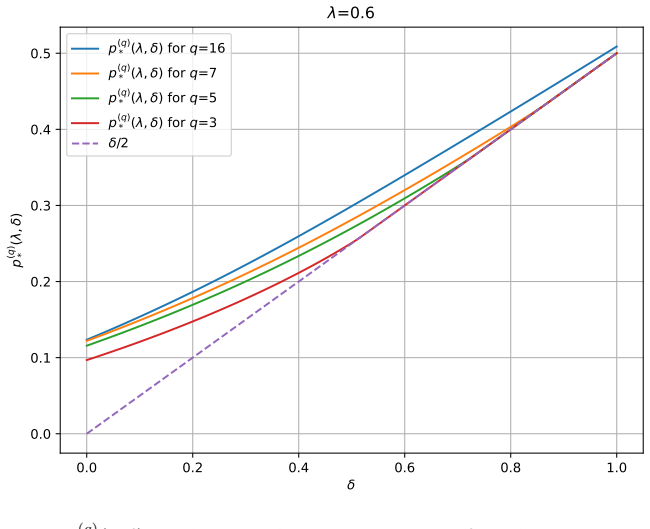
A q-ary code of relative distance delta has vanishing error probability on the symmetric channel up to the Johnson radius J_q(delta). This holds for general codes by bounding the weight distribution directly. For linear codes and q at least 4, the bound improves over a range of delta by using erasure properties to constrain the weight distribution via Samorodnitsky inequalities.
What carries the argument
Bounds on the code's weight distribution obtained from its erasure-channel performance and Samorodnitsky inequalities, which control the transition to good symmetric-channel behavior.
If this is right
- General codes, not just linear ones, connect their list-decoding radius to symmetric channel performance.
- Linear codes can exceed the Johnson radius for symmetric channel performance when q is at least 4.
- The erasure performance of a linear code implies tighter control over its weight distribution.
- Weight distribution serves as the key link between minimum distance and channel error probability.
Where Pith is reading between the lines
- Code constructions could prioritize erasure resilience to gain better noise tolerance beyond distance guarantees.
- The approach may apply to other channel models where weight distributions determine performance.
- Binary and ternary codes might not see the same improvement, highlighting the role of larger alphabets.
Load-bearing premise
The derived weight distribution bounds from erasure properties and Samorodnitsky inequalities are sufficiently accurate to push the performance threshold past the Johnson radius for linear codes with q at least 4.
What would settle it
Observe whether the block error probability of a linear code over an alphabet of size 4 with suitable relative distance goes to zero on the symmetric channel at noise rates exceeding the Johnson radius but within the improved range.
Figures




read the original abstract
We study relationships between worst-case and random-noise properties of error correcting codes. More concretely, we consider connections between minimum distance, list decoding radius, and block error probability on noisy channels. A recent result of Pernice, Sprumont, and Wootters established the tight connection between list decoding radius and symmetric channel performance for linear codes. We extend this result to general codes. The proof proceeds by directly bounding the weight distribution rather than by sharp threshold techniques. We then turn to the relation between minimum distance and symmetric channel performance. The results we just described imply that a $q$-ary code of relative distance $\delta$ has vanishing error probability on the symmetric channel up to the Johnson radius $J_q(\delta)$. We improve upon this bound in the case of linear codes, for a range $\delta$, for $q\ge 4$. In our proof we consider the \emph{erasure} properties of codes, and bound their weight distribution through inequalities introduced by Samorodnitsky. The latter part of the proof gives a more general technique that bounds the symmetric channel performance of a linear code with constant relative distance and good erasure channel performance.
Editorial analysis
A structured set of objections, weighed in public.
Referee Report
Summary. The manuscript studies relationships between minimum distance, list decoding radius, and block error probability on symmetric channels for q-ary error-correcting codes. It extends the tight connection between list decoding and symmetric channel performance (previously shown for linear codes by Pernice, Sprumont, and Wootters) to general codes via direct weight-distribution bounds rather than sharp-threshold arguments. This yields that any q-ary code of relative distance δ has vanishing error probability on the symmetric channel up to the Johnson radius J_q(δ). For linear codes with q ≥ 4 the authors improve the threshold for a range of δ by using the code's erasure-channel performance together with Samorodnitsky inequalities to bound the weight distribution; they also present a general technique for linear codes that possess both constant relative distance and good erasure performance.
Significance. If the weight-distribution bounds and their application to the symmetric channel are tight as stated, the work provides a direct combinatorial route from minimum distance to average-case performance that applies to both linear and nonlinear codes. The extension beyond the Johnson radius for linear codes with q ≥ 4, obtained without parameter fitting, and the reusable technique linking erasure and symmetric-channel behavior constitute a concrete advance in relating worst-case and probabilistic properties of codes.
major comments (2)
- [section deriving the improved bound for linear codes] The central claim that the Johnson-radius threshold is improved for linear codes when q ≥ 4 rests on the tightness of the weight-distribution bounds obtained from erasure properties via Samorodnitsky inequalities. The manuscript should supply the explicit inequality chain, the resulting error term, and at least one concrete numerical comparison (for a specific δ and q) demonstrating that the new threshold strictly exceeds J_q(δ).
- [section extending the result to general codes] The extension of the list-decoding-to-symmetric-channel equivalence from linear to general codes is achieved by directly bounding the weight distribution. The manuscript must exhibit the precise bounding argument (including any auxiliary lemmas) that replaces the sharp-threshold technique used in the linear case, so that the vanishing-error claim up to J_q(δ) can be verified without circular appeal to prior linear-code results.
minor comments (1)
- [Introduction / preliminaries] Notation for the Johnson radius J_q(δ) and the symmetric-channel crossover probability should be introduced once with a self-contained definition before being used in the main statements.
Simulated Author's Rebuttal
We thank the referee for the careful reading and constructive suggestions. We address the two major comments below and will revise the manuscript to supply the requested explicit details and arguments.
read point-by-point responses
-
Referee: [section deriving the improved bound for linear codes] The central claim that the Johnson-radius threshold is improved for linear codes when q ≥ 4 rests on the tightness of the weight-distribution bounds obtained from erasure properties via Samorodnitsky inequalities. The manuscript should supply the explicit inequality chain, the resulting error term, and at least one concrete numerical comparison (for a specific δ and q) demonstrating that the new threshold strictly exceeds J_q(δ).
Authors: We agree that the presentation would benefit from greater explicitness. In the revised version we will insert the full inequality chain obtained by applying the Samorodnitsky inequalities to the erasure-channel performance, state the resulting additive error term in the weight-distribution bound, and add a concrete numerical example (q=4, δ=0.15) that shows the new threshold strictly larger than J_4(δ). revision: yes
-
Referee: [section extending the result to general codes] The extension of the list-decoding-to-symmetric-channel equivalence from linear to general codes is achieved by directly bounding the weight distribution. The manuscript must exhibit the precise bounding argument (including any auxiliary lemmas) that replaces the sharp-threshold technique used in the linear case, so that the vanishing-error claim up to J_q(δ) can be verified without circular appeal to prior linear-code results.
Authors: We will expand the relevant section to display the direct combinatorial bounding argument for the weight distribution of arbitrary (possibly nonlinear) codes, together with the auxiliary lemmas that control the number of codewords of each weight. The argument is self-contained and does not invoke the linear-code sharp-threshold result, thereby establishing vanishing block error up to the Johnson radius for general codes. revision: yes
Circularity Check
No significant circularity detected
full rationale
The paper's derivation extends the Pernice-Sprumont-Wootters result to general codes by directly bounding weight distributions (a standard combinatorial technique) and improves the linear-code case via erasure-channel properties combined with external Samorodnitsky inequalities. Neither step reduces by construction to a fitted parameter, self-definition, or load-bearing self-citation; the cited prior work is by different authors and the inequalities are independent mathematical tools. The argument therefore remains self-contained against external benchmarks with no circular reduction of the claimed thresholds to the paper's own inputs.
Axiom & Free-Parameter Ledger
axioms (2)
- domain assumption Standard properties of q-ary codes and symmetric channels hold (alphabet size q, uniform symbol error probability).
- domain assumption Samorodnitsky inequalities apply to the weight distribution of linear codes with given erasure performance.
Reference graph
Works this paper leans on
-
[1]
Generalized S amorodnitsky noisy function inequalities, with applications to error-correcting codes
Olakunle Abawonse, Jan Hązła, and Ryan O'Donnell. Generalized S amorodnitsky noisy function inequalities, with applications to error-correcting codes. arXiv:2508.06940, 2025
-
[2]
A proof that R eed-- M uller codes achieve S hannon capacity on symmetric channels
Emmanuel Abbe and Colin Sandon. A proof that R eed-- M uller codes achieve S hannon capacity on symmetric channels. In Symposium on Foundations of Computer Science (FOCS) , pages 177--193. IEEE, 2023
work page 2023
-
[3]
Emmanuel Abbe and Colin Sandon. Reed-- M uller codes have vanishing bit-error probability below capacity: a simple tighter proof via camellia boosting. arXiv:2312.04329, 2023
-
[4]
Emmanuel Abbe, Ori Sberlo, Amir Shpilka, and Min Ye. Reed-- M uller codes. Foundations and Trends in Communications and Information Theory , 20(1--2):1--156, 01 2023
work page 2023
-
[5]
Stephen Boyd and Lieven Vandenberghe. Convex Optimization . Cambridge University Press, 2004
work page 2004
-
[6]
Algebraic geometry codes and some applications
Alain Couvreur and Hugues Randriambololona. Algebraic geometry codes and some applications. In Concise Encyclopedia of Coding Theory , pages 307--362. Chapman and Hall/CRC, 2021
work page 2021
-
[7]
On the number of error correcting codes
Dingding Dong, Nitya Mani, and Yufei Zhao. On the number of error correcting codes. Combinatorics, Probability and Computing , 32(5):819--832, 2023
work page 2023
-
[8]
Error-correcting codes for list decoding
Peter Elias. Error-correcting codes for list decoding. IEEE Transactions on Information Theory , 37(1):5--12, 1991
work page 1991
-
[9]
On the list-decodability of random linear codes
Venkatesan Guruswami, Johan Håstad, and Swastik Kopparty. On the list-decodability of random linear codes. In Symposium on Theory of Computing (STOC) , pages 409--416, 2010
work page 2010
-
[10]
Venkatesan Guruswami, Atri Rudra, and Madhu Sudan. Essential coding theory. Draft available at http://www. cse.buffalo.edu/faculty/atri/courses/coding-theory/book/ , 2025
work page 2025
-
[11]
Techniques of bounding the probability of decoding error for block coded modulation structures
Hanan Herzberg and Gregory Poltyrev. Techniques of bounding the probability of decoding error for block coded modulation structures. IEEE Transactions on Information Theory , 40(3):903--911, 1994
work page 1994
-
[12]
On codes decoding a constant fraction of errors on the BSC
Jan H a z a, Alex Samorodnitsky, and Ori Sberlo. On codes decoding a constant fraction of errors on the BSC . In Symposium on Theory of Computing (STOC) , pages 1479--1488, 2021
work page 2021
-
[13]
Some remarks on the number of rational points of algebraic curves over finite fields
Yasutaka Ihara. Some remarks on the number of rational points of algebraic curves over finite fields. Journal of the Faculty of Science, University of Tokyo , 28(3):721--724, 1981
work page 1981
-
[14]
A new upper bound for error-correcting codes
Selmer Johnson. A new upper bound for error-correcting codes. IRE Transactions on Information Theory , 8(3):203--207, 1962
work page 1962
-
[15]
Reed- M uller codes achieve capacity on erasure channels
Shrinivas Kudekar, Santhosh Kumar, Marco Mondelli, Henry D Pfister, Eren S a s o g lu, and R \"u diger Urbanke. Reed- M uller codes achieve capacity on erasure channels. In Symposium on Theory of Computing (STOC) , pages 658--669, 2016
work page 2016
-
[16]
Adaptive estimation of a quadratic functional by model selection
Beatrice Laurent and Pascal Massart. Adaptive estimation of a quadratic functional by model selection. Annals of Statistics , pages 1302--1338, 2000
work page 2000
-
[17]
Smoothing of binary codes, uniform distributions, and applications
Madhura Pathegama and Alexander Barg. Smoothing of binary codes, uniform distributions, and applications. Entropy , 25(11):1515, 2023
work page 2023
-
[18]
Binary codes with specified minimum distance
Morris Plotkin. Binary codes with specified minimum distance. IRE Transactions on Information Theory , 6(4):445--450, 1960
work page 1960
-
[19]
Bounds on the decoding error probability of binary linear codes via their spectra
Gregory Poltyrev. Bounds on the decoding error probability of binary linear codes via their spectra. IEEE Transactions on Information Theory , 40(4):1284--1292, 1994
work page 1994
-
[20]
List-decoding capacity implies capacity on the q-ary symmetric channel
Francisco Pernice, Oscar Sprumont, and Mary Wootters. List-decoding capacity implies capacity on the q-ary symmetric channel. In Symposium on Theory of Computing (STOC) , pages 855--866, 2025
work page 2025
-
[21]
From bit to block: D ecoding on erasure channels
Henry D Pfister, Oscar Sprumont, and Gilles Zémor. From bit to block: D ecoding on erasure channels. In International Symposium on Information Theory (ISIT) , pages 1--6, 2025
work page 2025
-
[22]
Galen Reeves and Henry D Pfister. Reed-- M uller codes on BMS channels achieve vanishing bit-error probability for all rates below capacity. IEEE Transactions on Information Theory , 70(2):920--949, 2023
work page 2023
-
[23]
Tom Richardson and Rüdiger Urbanke. Modern Coding Theory . Cambridge University Press, 2008
work page 2008
-
[24]
Atri Rudra and Steve Uurtamo. Two theorems on list decoding. In Approximation, Randomization, and Combinatorial Optimization (APPROX/RANDOM) , pages 696--709, 2010
work page 2010
-
[25]
An upper bound on _q norms of noisy functions
Alex Samorodnitsky. An upper bound on _q norms of noisy functions. IEEE Transactions on Information Theory , 66(2):742--748, 2019
work page 2019
-
[26]
An improved bound on _q norms of noisy functions
Alex Samorodnitsky. An improved bound on _q norms of noisy functions. arXiv:2010.02721, 2020
-
[27]
Performance analysis of linear codes under maximum-likelihood decoding: A tutorial
Igal Sason and Shlomo Shamai. Performance analysis of linear codes under maximum-likelihood decoding: A tutorial. Foundations and Trends in Communications and Information Theory , 3(1--2):1--222, 2006
work page 2006
-
[28]
Modular curves, S himura curves, and G oppa codes, better than V arshamov-- G ilbert bound
MA Tsfasman, SG Vl a duţ, and Th Zink. Modular curves, S himura curves, and G oppa codes, better than V arshamov-- G ilbert bound. Mathematische Nachrichten , 109(1):21--28, 1982
work page 1982
-
[29]
Discrete isoperimetric inequalities and the probability of a decoding error
Jean-Pierre Tillich and Gilles Z \'e mor. Discrete isoperimetric inequalities and the probability of a decoding error. Combinatorics, Probability and Computing , 9(5):465--479, 2000
work page 2000
discussion (0)
Sign in with ORCID, Apple, or X to comment. Anyone can read and Pith papers without signing in.