D-splitting methods: 2N -storage embedded explicit Runge-Kutta methods at any order using splitting methods
Pith reviewed 2026-05-13 18:03 UTC · model grok-4.3
The pith
D-splitting methods produce embedded explicit Runge-Kutta pairs at any order using only two storage registers.
A machine-rendered reading of the paper's core claim, the machinery that carries it, and where it could break.
Core claim
D-splitting methods are splitting methods on the extended phase space that serve as 2N-storage embedded explicit Runge-Kutta methods without a third storage register. They are pseudo-geometric methods that preserve some qualitative properties of the exact solution up to a higher order than the method order.
What carries the argument
D-splitting methods, which apply splitting methods to the extended phase space to produce embedded explicit Runge-Kutta pairs limited to two storage registers.
If this is right
- Embedded Runge-Kutta pairs become available at any order with strictly 2N storage and no third register.
- The resulting methods preserve qualitative properties beyond their formal order of accuracy.
- Analysis of the splitting properties allows construction of new tailored methods.
- The schemes apply directly to method-of-lines discretizations of time-dependent PDEs.
- Numerical tests confirm performance under the reduced memory constraint.
Where Pith is reading between the lines
- The same extended-phase-space splitting idea could apply to other families of integrators beyond explicit Runge-Kutta.
- Lower storage requirements may allow larger spatial grids on hardware with tight memory limits.
- Further links may exist between these pseudo-geometric features and classical geometric integration methods.
- Systematic tests on additional classes of equations could identify further practical advantages.
Load-bearing premise
That splitting methods applied in the extended phase space can be arranged to produce embedded Runge-Kutta pairs at arbitrary order while strictly limiting storage to two registers.
What would settle it
A concrete counterexample at some order p where no arrangement of the splitting in the extended phase space yields an embedded pair with only 2N storage while keeping the claimed higher-order qualitative preservation.
Figures

read the original abstract
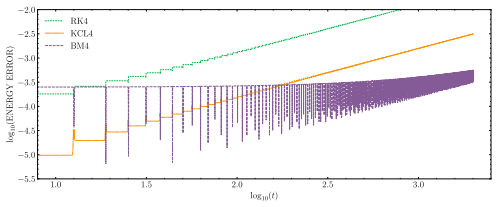
Low-storage explicit Runge-Kutta schemes are particularly popular for the numerical integration of time-dependent partial differential equations based on the method-of-lines due to their efficiency and their reduced memory requirements. We show that D-splitting methods, splitting methods on the extended phase space, can be used as high performance 2N-storage embedded explicit RK methods without a third storage register. They are pseudo-geometric methods preserving some of the qualitative properties of the exact solution up to a higher order than the order of the method. Some of their properties are analysed, to build new tailored methods, and are tested on numerical examples.
Editorial analysis
A structured set of objections, weighed in public.
Referee Report
Summary. The paper introduces D-splitting methods, defined as splitting methods applied on an extended phase space, and shows that they yield embedded explicit Runge-Kutta pairs of arbitrary order that require only two storage registers (2N storage) with no third register needed for the embedded solution. The methods are characterized as pseudo-geometric, preserving selected qualitative properties of the exact flow to an order higher than the method order itself. Properties of the methods are analyzed to construct tailored schemes, which are then tested numerically on selected examples.
Significance. If the central construction holds, the work supplies a systematic route to high-order embedded explicit RK methods with strictly minimal storage, which is directly relevant to method-of-lines discretizations of evolutionary PDEs where memory bandwidth is the limiting factor. The pseudo-geometric preservation property, if verified to the claimed order, would constitute an additional qualitative advantage over standard low-storage RK pairs. The approach extends classical splitting theory in a manner that could be reusable for other embedded or multi-rate constructions.
major comments (2)
- The explicit stage ordering and coefficient derivation that enforces strict two-register reuse (including for the embedded error estimate) must be shown in full; without the concrete Butcher tableau or register-assignment table it is impossible to confirm that no hidden third register is required at any stage.
- The order conditions for the pseudo-geometric property (preservation to order p+1 or higher) are stated only at the abstract level; the specific algebraic conditions on the splitting coefficients that produce this extra order must be derived and verified, ideally with a table of conditions up to order 5 or 6.
minor comments (2)
- The abstract claims that 'some of their properties are analysed'; the introduction should list the precise properties (e.g., symplecticity, volume preservation, or linear invariants) that are retained to higher order.
- Numerical examples should report both error versus step-size and wall-clock time versus error curves against at least one established 2N-storage embedded pair (e.g., the 5(4) pair of Kennedy & Carpenter) to quantify any practical gain.
Simulated Author's Rebuttal
We thank the referee for the positive assessment of the significance of the work and for the detailed comments. We address each major comment below and will revise the manuscript accordingly.
read point-by-point responses
-
Referee: The explicit stage ordering and coefficient derivation that enforces strict two-register reuse (including for the embedded error estimate) must be shown in full; without the concrete Butcher tableau or register-assignment table it is impossible to confirm that no hidden third register is required at any stage.
Authors: We agree that explicit verification of the two-register constraint is required. In the revised manuscript we will include the full Butcher tableaux for the D-splitting constructions together with a register-assignment table that tracks storage usage at every stage, including the embedded error estimate, thereby confirming that only two registers are needed throughout. revision: yes
-
Referee: The order conditions for the pseudo-geometric property (preservation to order p+1 or higher) are stated only at the abstract level; the specific algebraic conditions on the splitting coefficients that produce this extra order must be derived and verified, ideally with a table of conditions up to order 5 or 6.
Authors: The referee correctly notes that the order conditions are presented abstractly. We will derive the explicit algebraic conditions on the splitting coefficients that enforce the pseudo-geometric preservation property and add a table of these conditions up to order 6 in the revised manuscript. revision: yes
Circularity Check
No significant circularity in derivation chain
full rationale
The paper constructs D-splitting methods on extended phase space as 2N-storage embedded explicit Runge-Kutta pairs by applying standard splitting theory in a new coordinate setting. No load-bearing step reduces by the paper's own equations to a fitted parameter renamed as prediction, a self-definition, or a self-citation chain that forces the storage bound or order claim. The abstract and stated claims rest on explicit stage ordering and register reuse derived from splitting composition, which remains independent of the target result. This is the most common honest outcome for a construction paper that does not internally equate its performance metric to its inputs.
Axiom & Free-Parameter Ledger
axioms (1)
- standard math Standard consistency and order conditions for Runge-Kutta methods and splitting methods hold in the extended phase space.
invented entities (1)
-
D-splitting methods
no independent evidence
Reference graph
Works this paper leans on
-
[1]
A. Bazavov, 2N-storage Runge-Kutta methods: Order conditions, general properties and some analytic solu- tions, arXiv:2506.07359, 2025
-
[2]
Blanes, On the construction of symmetric second order methods for ODEs, App
S. Blanes, On the construction of symmetric second order methods for ODEs, App. Math. Lett. 98 (2019), 41-48
work page 2019
-
[3]
S. Blanes and F. Casas, A Concise Introduction to Geometric Numerical Integration, Second revised ed. CRC Press, Boca Raton, 2025
work page 2025
-
[4]
S. Blanes and P. C. Moan, Practical symplectic partitioned Runge–Kutta and Runge–Kutta–Nystrom methods, J. Comput. Appl. Math. 142 (2002), 313–330
work page 2002
- [5]
- [6]
- [7]
-
[8]
J.C. Butcher, Numerical Methods for Ordinary Differential Equations, Third revised ed., John Wiley & Sons, Chichester, 2016
work page 2016
- [9]
-
[10]
M.H. Carpenter and C.A. Kennedy, Fourth-order 2N-storage Runge-Kutta schemes, Technical Report NASA- TM-109112, NASA (1994)
work page 1994
- [11]
-
[12]
E. Hairer, S.P. Nørsett, and G. Wanner, Solving Ordinary Differential Equations I. Nonstiff Problems, 2nd ed., Springer-Verlag, 1993
work page 1993
-
[13]
I. Higueras, J.I. Montijano, L. Rández, Low-storage exponentially fitted explicit Runge-Kutta methods, Appl. Numer. Math. 217 (2025), 372-389
work page 2025
-
[14]
P.J. van der Howen, Construction of Integration Formulas for Initial Value Problems, North-Holland Pub., Ams- terdam, 1977
work page 1977
-
[15]
Iserles, A First Course in the Numerical Analysis of Differential Equations, 2nd ed
A. Iserles, A First Course in the Numerical Analysis of Differential Equations, 2nd ed. Cambridge University Press, Cambridge, 2008
work page 2008
-
[16]
C.A. Kennedy, M.H. Carpenter, and R.M. Lewis, Low-storage, explicit Runge–Kutta schemes for the compress- ible Navier–Stokes equations, Appl. Num. Math. 35 (2000), 177-219
work page 2000
-
[17]
Ketcheson, Runge-Kutta methods with minimum storage implementations, J.f Comput
D.I. Ketcheson, Runge-Kutta methods with minimum storage implementations, J.f Comput. Phys. 229(5), 1763–1773 (2010)
work page 2010
-
[18]
R.I. McLachlan, Runge–Kutta methods determined from extended phase space methods for Hamiltonian sys- tems, Numer. Alg. 100 (2025), 983-993
work page 2025
-
[19]
R. I. McLachlan and R. Quispel, Splitting methods, Acta Numerica 11 (2002), 341–434
work page 2002
-
[20]
J. M. Sanz-Serna and M. P. Calvo, Numerical Hamiltonian Problems, AMMC 7. Chapman & Hall, 1994
work page 1994
-
[21]
Trefethen,Spectral Methods in MATLAB, SIAM, 2000
L.N. Trefethen,Spectral Methods in MATLAB, SIAM, 2000
work page 2000
-
[22]
Yoshida, Construction of higher order symplectic integrators, Phys
H. Yoshida, Construction of higher order symplectic integrators, Phys. Lett. A 150 (1990), 262–268
work page 1990
-
[23]
Williamson, Low-storage Runge-Kutta schemes, J
J.H. Williamson, Low-storage Runge-Kutta schemes, J. Comput. Phys. 35 (1980), 48–56. 7
work page 1980
discussion (0)
Sign in with ORCID, Apple, or X to comment. Anyone can read and Pith papers without signing in.