Tschirnhausen bundles of sextic covers of mathbb{P}¹
Pith reviewed 2026-05-10 18:56 UTC · model grok-4.3
The pith
For degree 6 covers of the projective line the pushforward bundles are fully classified by algebra multiplication alone.
A machine-rendered reading of the paper's core claim, the machinery that carries it, and where it could break.
Core claim
A degree 6 cover f: C → ℙ¹ of a smooth irreducible curve C yields a rank 6 vector bundle E = f_* O_C on ℙ¹. The associated Tschirnhausen bundle is the quotient of E by its trivial summand O_ℙ¹. The possible splitting types of this bundle are completely determined by the conditions that E carries the structure of an algebra over O_ℙ¹ whose multiplication satisfies the natural compatibility relations coming from the cover. Every such algebraically admissible bundle arises from an actual geometric cover that admits a nontrivial proper subcover.
What carries the argument
The algebra structure on the pushforward bundle E = f_* O_C whose multiplication map encodes all the numerical constraints on the splitting type of the Tschirnhausen bundle.
If this is right
- The complete list of possible splitting types for sextic Tschirnhausen bundles is finite and explicitly describable.
- Every admissible bundle is realized by a cover that factors through a degree-2 or degree-3 subcover.
- No geometric constraints on the bundles exist beyond those imposed by the algebra structure for degree 6.
- The same algebra-based method supplies a concrete way to test admissibility for any candidate splitting type.
Where Pith is reading between the lines
- The result suggests that for degrees other than 6 the same algebra-multiplication test may give a practical first filter before geometric realization is checked.
- It raises the question of whether the subcover condition continues to hold for higher-degree covers or whether new indecomposable examples appear.
- One could look for an explicit deformation or moduli-space description that parametrizes all the realized bundles at once.
Load-bearing premise
That the algebra multiplication rules capture every constraint that can arise and that no further geometric obstructions exist beyond those already visible in the algebra.
What would settle it
A rank-5 vector bundle on ℙ¹ whose splitting type satisfies the algebra-multiplication conditions yet cannot be realized as the Tschirnhausen bundle of any smooth sextic cover, or a smooth sextic cover whose pushforward violates one of the predicted splitting types.
Figures
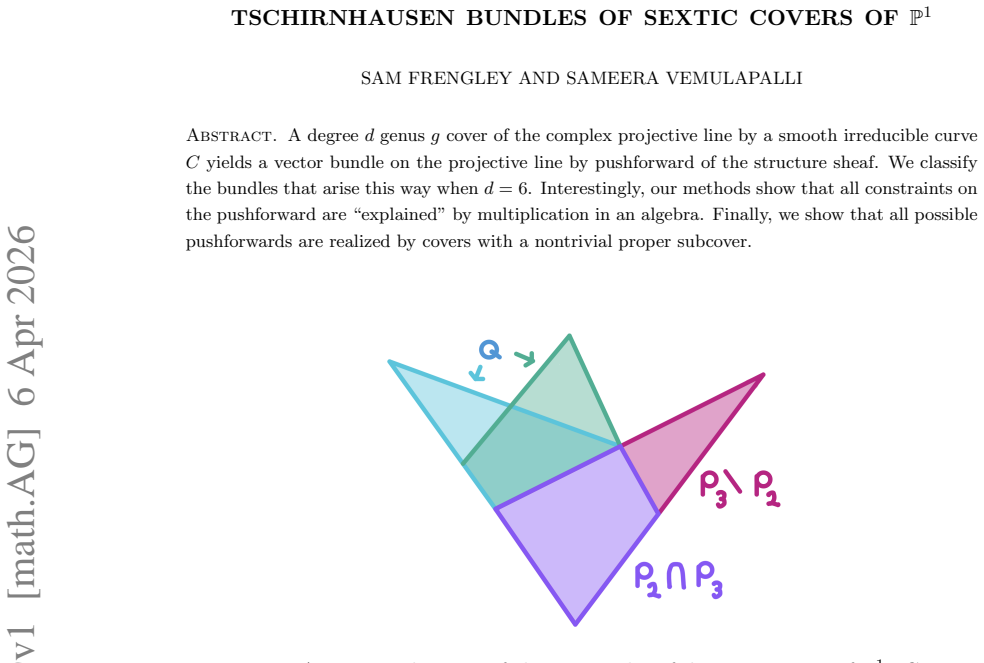
read the original abstract
A degree $d$ genus $g$ cover of the complex projective line by a smooth irreducible curve $C$ yields a vector bundle on the projective line by pushforward of the structure sheaf. We classify the bundles that arise this way when $d = 6$. Interestingly, our methods show that all constraints on the pushforward are ``explained'' by multiplication in an algebra. Finally, we show that all possible pushforwards are realized by covers with a nontrivial proper subcover.
Editorial analysis
A structured set of objections, weighed in public.
Referee Report
Summary. The manuscript classifies the Tschirnhausen bundles (pushforwards of the structure sheaf minus the trivial summand) arising from degree-6 covers of P^1 by smooth irreducible curves. It asserts that all constraints on the possible splitting types of these rank-5 bundles are accounted for by the existence of an O_{P^1}-algebra structure whose multiplication maps respect the degrees of the summands, and it constructs realizations of every admissible bundle via covers that factor through a nontrivial proper subcover.
Significance. If the classification is exhaustive and the algebra-multiplication explanation holds without additional geometric obstructions, the result supplies a complete list for d=6 together with a structural reason for the constraints. The realization statement via subcovers is a concrete contribution that may inform the study of Hurwitz spaces and moduli of covers in low degree.
major comments (2)
- [§3] §3 (algebra structure and constraints): The claim that multiplication in the algebra explains every constraint on the splitting type must be accompanied by an explicit argument that the resulting Spec(E) is automatically smooth and that the cover is irreducible and connected; the mere existence of degree-compatible multiplication maps between line-bundle summands does not a priori guarantee that the discriminant section has only simple zeros or that fibers are connected.
- [§5] §5 (realization via subcovers): The construction realizes all algebra-admissible bundles exclusively through covers with a nontrivial proper subcover. It is necessary to verify that this method does not omit any splitting types that satisfy the algebra condition but fail to arise from a subcover; otherwise the completeness statement is not fully supported.
minor comments (2)
- [Introduction] Introduction: The precise definition of the Tschirnhausen bundle E (including the exact quotient by the trivial summand) should be stated at the outset rather than deferred.
- [Notation] Notation: Ensure uniform notation for splitting types (e.g., consistent ordering of summands and use of O(k) versus O_{P^1}(k)) across all statements and tables.
Simulated Author's Rebuttal
We thank the referee for the careful reading and constructive comments on our manuscript classifying Tschirnhausen bundles for sextic covers of P¹. We address each major comment below and will revise the manuscript to incorporate clarifications where needed.
read point-by-point responses
-
Referee: [§3] §3 (algebra structure and constraints): The claim that multiplication in the algebra explains every constraint on the splitting type must be accompanied by an explicit argument that the resulting Spec(E) is automatically smooth and that the cover is irreducible and connected; the mere existence of degree-compatible multiplication maps between line-bundle summands does not a priori guarantee that the discriminant section has only simple zeros or that fibers are connected.
Authors: We agree that an explicit argument is required to confirm that algebra-admissible multiplication maps yield smooth irreducible covers. In the revision we will add a dedicated paragraph (or short subsection) in §3 that, for each admissible splitting type of the rank-5 bundle, computes the discriminant section explicitly via the norm map on the algebra and verifies that it has only simple zeros. Connectedness of the fibers follows because the algebra is a degree-6 extension of the function field of P¹ with no nontrivial idempotents (ensured by the splitting type and multiplication rules), so the generic fiber is a field. These verifications are case-by-case but finite for d=6; we will include them to make the geometric consequences of the algebra structure fully rigorous. revision: yes
-
Referee: [§5] §5 (realization via subcovers): The construction realizes all algebra-admissible bundles exclusively through covers with a nontrivial proper subcover. It is necessary to verify that this method does not omit any splitting types that satisfy the algebra condition but fail to arise from a subcover; otherwise the completeness statement is not fully supported.
Authors: The manuscript already proves that every algebra-admissible bundle arises from a cover with a nontrivial proper subcover (of degree 2 or 3). In §5 we give explicit constructions for each splitting type listed in §3 and show they exhaust the list. To address the referee’s concern directly, we will add a short lemma in §5 (or a remark at the end of §3) that cross-checks the two lists and confirms there are no algebra-admissible splitting types outside the subcover realizations. This makes the completeness statement explicit and removes any possibility of omitted types. revision: yes
Circularity Check
No circularity: classification derives from external algebraic constraints and explicit constructions
full rationale
The paper classifies Tschirnhausen bundles for sextic covers by showing that constraints on the pushforward bundle E arise from the existence of an O_{P^1}-algebra structure on E, with multiplication maps between summands. This is presented as an independent algebraic explanation rather than a tautology. Realizations are then constructed explicitly via covers with nontrivial proper subcovers, providing geometric verification separate from the algebraic constraints. No steps reduce by definition to fitted parameters, self-citations that bear the load, or renamings of known results; the derivation chain remains self-contained against the stated algebraic and geometric inputs.
Axiom & Free-Parameter Ledger
Reference graph
Works this paper leans on
-
[1]
D. L. Applegate, W. Cook, S. Dash, and D. G. Espinoza, https://doi.org/10.1016/j.orl.2006.12.010 Exact solutions to linear programming problems , Oper. Res. Lett. 35 (2007), no. 6, 693--699. 2361036
-
[2]
E. Ballico, https://doi.org/10.1016/S0022-4049(01)00023-8 Scrollar invariants of smooth projective curves , J. Pure Appl. Algebra 166 (2002), no. 3, 239--246. 1870618
-
[3]
M. Bhargava, A. Shankar, T. Taniguchi, F. Thorne, J. Tsimerman, and Y. Zhao, https://doi.org/10.1090/jams/945 Bounds on 2-torsion in class groups of number fields and integral points on elliptic curves , J. Amer. Math. Soc. 33 (2020), no. 4, 1087--1099. 4155220
-
[4]
Casnati, Covers of algebraic varieties
G. Casnati, Covers of algebraic varieties. II . C overs of degree 5 and construction of surfaces , J. Algebraic Geom. 5 (1996), no. 3, 461--477. 1382732
work page 1996
-
[5]
G. Casnati and T. Ekedahl, Covers of algebraic varieties I . A general structure theorem, covers of degree 3,4 and E nriques surfaces , J. Algebraic Geom. 5 (1996), no. 3, 439--460. 1382731
work page 1996
-
[6]
M. Coppens, http://projecteuclid.org/euclid.ojm/1200788879 Existence of pencils with prescribed scrollar invariants of some general type , Osaka J. Math. 36 (1999), no. 4, 1049--1057. 1745644
-
[7]
, https://seminariomatematico.polito.it/rendiconti/79-2/Coppens.pdf The scrollar invariants of k -gonal curves having a nodal model on a smooth quadric and nodes on few lines , Rend. Semin. Mat. Univ. Politec. Torino 79 (2021), no. 2, 45--53. 4489469
work page 2021
-
[8]
W. Castryck, F. Vermeulen, and Y. Zhao, https://doi.org/10.1515/crelle-2022-0088 Scrollar invariants, syzygies and representa- tions of the symmetric group , J. Reine Angew. Math. (2023), no. 796, 117--159
-
[9]
A. Deopurkar and A. Patel, https://doi.org/10.1017/fms.2022.19 Vector bundles and finite covers , Forum Math. Sigma 10 (2022), Paper No. e40, 30. 4436598
- [10]
-
[11]
S. Frengley and S. Vemulapalli, https://doi.org/10.48550/arXiv.2507.06942 Tschirnhausen bundles of quintic covers of P ^1 , 2025, arXiv:2507.06942
-
[12]
, https://github.com/SamFrengley/tschirnhausen-sextics.git SamFrengley/tschirnhausen-sextics : Article code , 2026, Version v1.0.0, https://github.com/SamFrengley/tschirnhausen-sextics.git, DOI : 10.5281/zenodo.19388088 https://www.doi.org/10.5281/zenodo.19388088, Code associated to `` T schirnhausen bundles of sextic covers of P ^1 ''
-
[13]
T. Kato and A. Ohbuchi, https://doi.org/10.1080/00927879308824818 Very ampleness of multiple of tetragonal linear systems , Comm. Algebra 21 (1993), no. 12, 4587--4597. 1242850
-
[14]
H. K. Larson, https://doi.org/10.1007/s40879-021-00493-6 Refined B rill- N oether theory for all trigonal curves , Eur. J. Math. 7 (2021), no. 4, 1524--1536. 4340946
- [15]
-
[16]
H. K. Larson and S. Vemulapalli, https://doi.org/10.48550/arXiv.2408.12678 Brill-- N oether theory of smooth curves in the plane and on H irzebruch surfaces , 2025, arXiv:2408.12678
-
[17]
Maroni, https://doi.org/10.1007/BF02418090 Le serie lineari speciali sulle curve trigonali , Ann
A. Maroni, https://doi.org/10.1007/BF02418090 Le serie lineari speciali sulle curve trigonali , Ann. Mat. Pura Appl. (4) 25 (1946), 343--354. 24182
-
[18]
A. Ohbuchi, https://www-math.st.tokushima-u.ac.jp/journal/1997/1997-2.pdf On some numerical relations of d-gonal linear systems , Journal of Mathematics, Tokushima University 31 (1997), 7--10
work page 1997
-
[19]
R. Redigolo, https://arxiv.org/pdf/2602.08902 The scrollar invariants of curves mapping to a H irzebruch surface , 2026, arXiv:2602.08902
-
[20]
A. Makhorin, https://www.gnu.org/software/glpk/ GNU L inear P rogramming K it , 2012, Version 5.0, https://www.gnu.org/software/glpk/, Accessed 30 March 2026
work page 2012
-
[21]
D. L. Applegate, W. Cook, S. Dash, and D. G. Espinoza, https://www.math.uwaterloo.ca/ bico/qsopt/ex/index.html QS opt\_ex , 2009, Version 2.5.10.3, https://www.math.uwaterloo.ca/ bico/qsopt/ex/index.html, Accessed 30 March 2026 from https://github.com/jonls/qsopt-ex.git
work page 2009
-
[22]
S. Vemulapalli, https://doi.org/10.48550/arXiv.2207.10522 Bounds on successive minima of orders in number fields and scrollar invariants of curves , 2022, arXiv:2207.10522
-
[23]
R. Vakil and S. Vemulapalli, https://arxiv.org/abs/2410.22531 Tschirnhausen bundles of covers of the projective line , 2024, arXiv:2410.22531, To appear in J. Reine Angew. Math
work page internal anchor Pith review arXiv 2024
-
[24]
M. Wood, https://doi.org/10.1515/crelle-2012-0058 Parametrization of ideal classes in rings associated to binary forms , J. Reine Angew. Math. 2014 (2014), no. 689, 169--199
discussion (0)
Sign in with ORCID, Apple, or X to comment. Anyone can read and Pith papers without signing in.