Bridging Data-Driven Reachability Analysis and Statistical Estimation via Constrained Matrix Convex Generators
Pith reviewed 2026-05-10 19:12 UTC · model grok-4.3
The pith
Constrained matrix convex generators coincide with maximum-likelihood ellipsoids for Gaussian disturbances in data-driven reachability.
A machine-rendered reading of the paper's core claim, the machinery that carries it, and where it could break.
Core claim
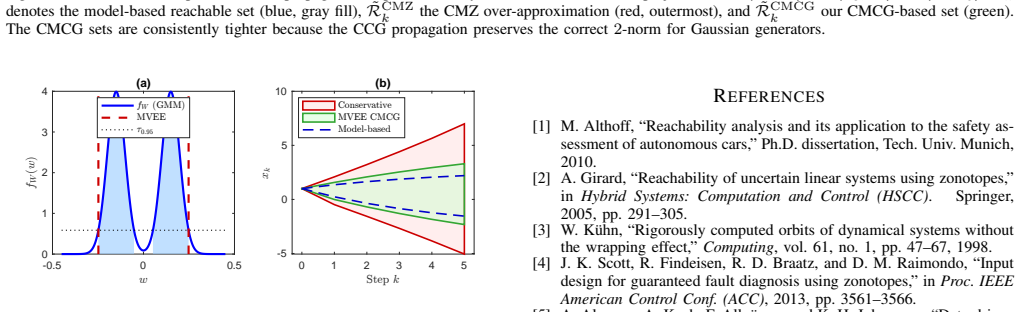
Constrained matrix convex generators (CMCG) at the parameter level, paired with constrained convex generators at the noise level, produce uncertainty sets whose highest-density region is exactly the maximum-likelihood confidence ellipsoid for Gaussian disturbances; the same construction remains strictly tighter than constrained matrix zonotopes for bounded-Gaussian mixtures and admits a minimum-volume enclosing ellipsoid surrogate for Gaussian-mixture noise while preserving containment.
What carries the argument
Constrained Matrix Convex Generator (CMCG), a matrix-valued extension of constrained convex generators that encloses consistent system matrices while ensuring the Minkowski product with the noise set is contained inside the reachable tube.
Load-bearing premise
The noise is Gaussian, a bounded-Gaussian mixture, or can be replaced by a minimum-volume enclosing ellipsoid without losing the containment guarantees required for reachability.
What would settle it
On a linear system driven by Gaussian noise, compute the volume of the one-step reachable set using the new CMCG representation versus the volume obtained from constrained matrix zonotopes and check whether the true state remains inside both sets with the claimed probability.
Figures


read the original abstract
Data-driven reachability analysis enables safety verification when first-principles models are unavailable. This requires constructing sets of system models consistent with measured trajectories and noise assumptions. Existing approaches rely on zonotopic or box-based approximations, which do not fit the geometry of common noise distributions such as Gaussian disturbances and can lead to significant conservatism, especially in high-dimensional settings. This paper builds on ellipsotope-based representations to introduce mixed-norm uncertainty sets for data-driven reachability. The highest-density region defines the exact minimum-volume noise confidence set, while Constrained Convex Generators (CCG) and their matrix counterpart (CMCG) provide compatible geometric representations at the noise and parameter level. We show that the resulting CMCG coincides with the maximum-likelihood confidence ellipsoid for Gaussian disturbances, while remaining strictly tighter than constrained matrix zonotopes for mixed bounded-Gaussian noise. For non-convex noise distributions such as Gaussian mixtures, a minimum-volume enclosing ellipsoid provides a tractable convex surrogate. We further prove containment of the CMCG times CCG product and bound the conservatism of the Gaussian-Gaussian interaction. Numerical examples demonstrate substantially tighter reachable sets compared to box-based approximations of Gaussian disturbances. These results enable less conservative safety verification and improve the accuracy of uncertainty-aware control design.
Editorial analysis
A structured set of objections, weighed in public.
Referee Report
Summary. The paper introduces Constrained Matrix Convex Generators (CMCG) to bridge data-driven reachability analysis with statistical estimation for systems with uncertain parameters and disturbances. It defines mixed-norm uncertainty sets based on Constrained Convex Generators (CCG) and their matrix counterparts, proving that the CMCG coincides exactly with the maximum-likelihood confidence ellipsoid for Gaussian noise while being strictly tighter than constrained matrix zonotopes for mixed bounded-Gaussian noise. The work establishes containment of the CMCG × CCG product, bounds the conservatism of a minimum-volume enclosing ellipsoid surrogate for Gaussian-mixture noise, and presents numerical examples showing reduced conservatism in reachable sets relative to box-based approximations.
Significance. If the central claims hold, the results meaningfully reduce conservatism in reachability-based safety verification by aligning geometric set representations with statistical confidence regions for common noise models. The explicit coincidence with maximum-likelihood ellipsoids, the strict tightness result over zonotopes, and the containment proofs are notable strengths that could support more accurate uncertainty-aware control design. The approach builds on ellipsotope representations in a way that preserves geometric compatibility at both noise and parameter levels.
minor comments (2)
- The abstract refers to 'constrained matrix zonotopes' while the title and body introduce 'Constrained Matrix Convex Generators'; ensure terminology is used consistently and that the relationship to prior zonotope work is clearly delineated in the introduction.
- The weakest assumption on replacing non-convex noise (e.g., Gaussian mixtures) by a minimum-volume enclosing ellipsoid should be stated more explicitly in the main text, including any conditions under which the containment guarantees remain intact.
Simulated Author's Rebuttal
We thank the referee for their positive and constructive review, which accurately summarizes the contributions of our work on Constrained Matrix Convex Generators. We appreciate the recognition of the alignment between geometric representations and statistical confidence regions, as well as the potential for reduced conservatism in safety verification. We address the report below.
Circularity Check
No significant circularity identified
full rationale
The paper defines CMCG via constrained matrix convex generators and mixed-norm sets derived from highest-density regions of the noise distribution. It then proves that this construction coincides with the external maximum-likelihood confidence ellipsoid under Gaussian noise and is strictly tighter than constrained matrix zonotopes under mixed bounded-Gaussian noise. These are shown equivalences and dominance results connecting independently motivated geometric and statistical objects rather than tautological reductions. No self-definitional steps, fitted inputs renamed as predictions, load-bearing self-citations, or smuggled ansatzes appear in the provided claims or abstract. The derivation chain remains self-contained against external benchmarks.
Axiom & Free-Parameter Ledger
free parameters (1)
- noise bound parameters
axioms (2)
- standard math Convexity of the uncertainty sets and containment under Minkowski sum and linear transformation.
- domain assumption Gaussian disturbances admit a maximum-likelihood confidence ellipsoid that is the minimum-volume set containing a given probability mass.
Reference graph
Works this paper leans on
-
[1]
Reachability analysis and its application to the safety as- sessment of autonomous cars,
M. Althoff, “Reachability analysis and its application to the safety as- sessment of autonomous cars,” Ph.D. dissertation, Tech. Univ. Munich, 2010
work page 2010
-
[2]
Reachability of uncertain linear systems using zonotopes,
A. Girard, “Reachability of uncertain linear systems using zonotopes,” inHybrid Systems: Computation and Control (HSCC). Springer, 2005, pp. 291–305
work page 2005
-
[3]
Rigorously computed orbits of dynamical systems without the wrapping effect,
W. Kühn, “Rigorously computed orbits of dynamical systems without the wrapping effect,”Computing, vol. 61, no. 1, pp. 47–67, 1998
work page 1998
-
[4]
Input design for guaranteed fault diagnosis using zonotopes,
J. K. Scott, R. Findeisen, R. D. Braatz, and D. M. Raimondo, “Input design for guaranteed fault diagnosis using zonotopes,” inProc. IEEE American Control Conf. (ACC), 2013, pp. 3561–3566
work page 2013
-
[5]
Data-driven reachability analysis from noisy data,
A. Alanwar, A. Koch, F. Allgöwer, and K. H. Johansson, “Data-driven reachability analysis from noisy data,”IEEE Trans. Autom. Control, vol. 68, no. 5, pp. 3054–3069, 2023
work page 2023
-
[6]
Data- driven set-based estimation using matrix zonotopes with set contain- ment guarantees,
A. Alanwar, A. Berndt, K. H. Johansson, and H. Sandberg, “Data- driven set-based estimation using matrix zonotopes with set contain- ment guarantees,” inProc. Eur. Control Conf. (ECC), 2022, pp. 875– 881
work page 2022
-
[7]
Enhancing data-driven reachability analysis using tempo- ral logic side information,
A. Alanwar, F. J. Jiang, M. Sharifi, D. V . Dimarogonas, and K. H. Johansson, “Enhancing data-driven reachability analysis using tempo- ral logic side information,” inProc. IEEE Int. Conf. Robot. Autom. (ICRA), 2022, pp. 6793–6799
work page 2022
-
[8]
M. Althoff, “An introduction to CORA 2015,” inProc. Workshop Appl. Verif. Continuous Hybrid Syst., 2015, pp. 120–151
work page 2015
-
[9]
Ellipsotopes: Uniting ellipsoids and zonotopes for reachability analysis and fault detection,
S. Kousik, A. Dai, and G. X. Gao, “Ellipsotopes: Uniting ellipsoids and zonotopes for reachability analysis and fault detection,”IEEE Trans. Autom. Control, vol. 68, no. 6, pp. 3440–3452, 2023
work page 2023
-
[10]
Computing and graphing highest density regions,
R. J. Hyndman, “Computing and graphing highest density regions,” Amer. Statist., vol. 50, no. 2, pp. 120–126, 1996
work page 1996
-
[11]
Constrained zonotopes: A new tool for set-based estimation and fault detection,
J. K. Scott, D. M. Raimondo, G. R. Marseglia, and R. D. Braatz, “Constrained zonotopes: A new tool for set-based estimation and fault detection,”Automatica, vol. 69, pp. 126–136, 2016
work page 2016
-
[12]
B. C. Csáji, M. C. Campi, and E. Weyer, “Sign-perturbed sums (SPS): A method for constructing exact finite-sample confidence regions for general linear systems,” inProc. IEEE Conf. Decision Control (CDC), 2012, pp. 7321–7326
work page 2012
-
[13]
M. Althoff, O. Stursberg, and M. Buss, “Safety assessment for stochastic linear systems using enclosing hulls of probability density functions,” inProc. Eur. Control Conf. (ECC), 2009, pp. 625–630
work page 2009
-
[14]
On the asymptotic distribution of thel ∞ estimator in linear regression,
K. Knight, “On the asymptotic distribution of thel ∞ estimator in linear regression,” Tech. Rep., Dept. Stat. Sci., Univ. Toronto, 2020
work page 2020
-
[15]
Non-asymptotic bounds for theℓ ∞ estimator in linear regression with uniform noise,
Y . Yi and M. Neykov, “Non-asymptotic bounds for theℓ ∞ estimator in linear regression with uniform noise,”Bernoulli, vol. 30, no. 1, pp. 534–553, 2024
work page 2024
discussion (0)
Sign in with ORCID, Apple, or X to comment. Anyone can read and Pith papers without signing in.