Improved error estimates of a new splitting scheme for charged-particle dynamics in strong magnetic field with maximal ordering
Pith reviewed 2026-05-10 16:14 UTC · model grok-4.3
The pith
A new splitting scheme for charged particles in strong magnetic fields achieves uniform second-order error bounds for position and parallel velocity.
A machine-rendered reading of the paper's core claim, the machinery that carries it, and where it could break.
Core claim
The authors introduce an explicit symmetric second-order splitting scheme that rigorously achieves a uniform second-order error bound for both position and parallel velocity under the maximal ordering assumption on the magnetic field in the strong-field regime.
What carries the argument
The explicit symmetric second-order splitting scheme, which decomposes the dynamics for exact sub-step solutions and applies error analysis under the maximal ordering of the magnetic field to obtain uniform bounds.
If this is right
- The scheme remains computationally efficient because every step is explicit.
- Symmetry of the integrator ensures near-conservation of energy over long times.
- Error bounds stay second-order uniform in the strong-field limit, so time steps need not shrink with increasing field strength.
- Numerical experiments confirm the optimal convergence rates and energy behavior.
Where Pith is reading between the lines
- The uniform bounds could permit reliable long-time simulations in applications with intense magnetic fields without prohibitive computational cost.
- The splitting and error-analysis approach might extend to other multi-scale Hamiltonian systems with strong forces.
- Further tests with spatially varying fields or in fully three-dimensional settings would check how far the uniformity carries beyond the analyzed cases.
Load-bearing premise
The magnetic field satisfies the maximal ordering assumption and the time step is chosen relative to the cyclotron frequency such that the strong-field regime holds throughout the simulation.
What would settle it
A direct computation of the position error that grows faster than second order as the magnetic field strength is increased while the time step is held fixed within the strong-field regime would disprove the uniform bound.
Figures





read the original abstract
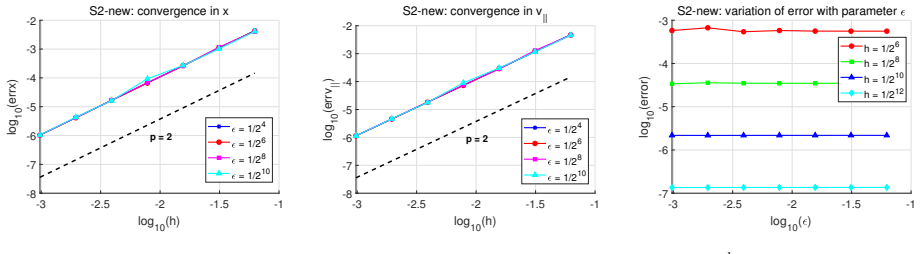
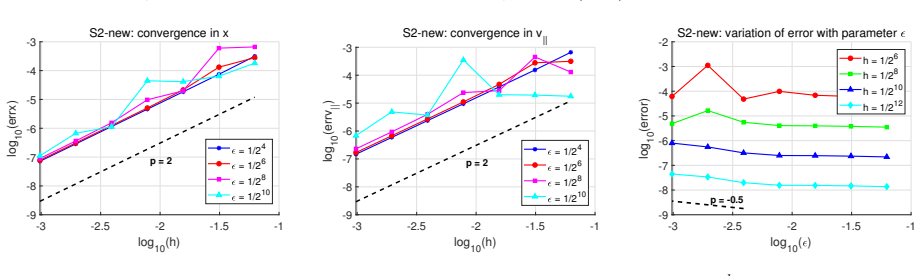
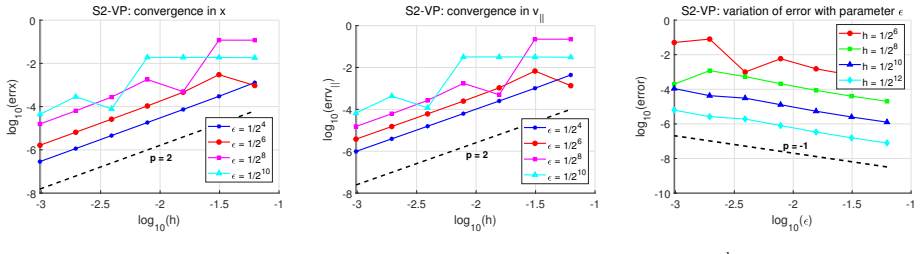
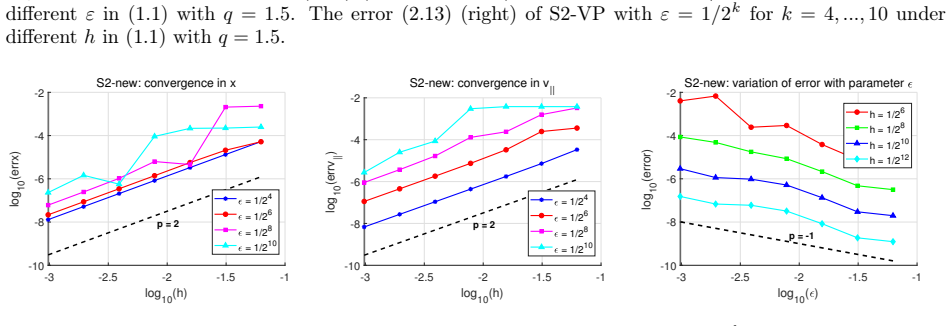
This paper introduces a novel second-order splitting scheme for charged-particle dynamics in strong magnetic fields characterized by the maximal ordering. The proposed scheme is explicit and symmetric, which respectively ensure the efficiency of the algorithm and its long-term near-conservation of energy. We rigorously prove that the scheme achieves improved error bounds for both the position and the velocity component parallel to the magnetic field, yielding a uniform second-order error bound under specific strong-field regimes. Numerical experiments confirm the optimal convergence rates and the long-term energy near conservation of the method.
Editorial analysis
A structured set of objections, weighed in public.
Referee Report
Summary. The paper introduces an explicit symmetric second-order splitting scheme for charged-particle dynamics under the maximal ordering assumption on the magnetic field. It claims a rigorous proof of improved, uniform second-order error bounds for both position and the parallel velocity component in strong-field regimes, along with long-term near-conservation of energy, supported by numerical experiments confirming optimal convergence rates.
Significance. If the central error analysis holds, the result would be significant for numerical methods in plasma physics and accelerator modeling, as it provides uniform second-order accuracy without order reduction in the strong-field limit while preserving symmetry and efficiency. The explicit construction and structure-exploiting proof represent a clear advance over prior splitting schemes that typically lose accuracy under maximal ordering.
minor comments (3)
- [§2.1] §2.1: The precise statement of the maximal ordering assumption on B(x) should include an explicit scaling with the cyclotron frequency to make the strong-field regime fully quantitative for readers.
- [Theorem 4.1] Theorem 4.1: The dependence of the error constant on the final time T is not stated explicitly; clarify whether the bound remains uniform for arbitrarily long T under the given assumptions.
- [Figure 5] Figure 5: The energy-error plot uses a log scale that compresses the long-time behavior; adding a linear-scale inset for t > 100 would improve readability of the near-conservation claim.
Simulated Author's Rebuttal
We thank the referee for the positive assessment of our manuscript, the accurate summary of its contributions, and the recommendation for minor revision. The significance noted aligns with our goals for advancing structure-preserving methods in plasma physics. No specific major comments were raised in the report.
Circularity Check
No significant circularity detected in derivation chain
full rationale
The manuscript defines an explicit symmetric splitting scheme for the charged-particle dynamics and then derives uniform second-order error bounds for position and parallel velocity via direct analysis under the maximal ordering assumption on the magnetic field. The proof exploits the splitting structure and strong-field scaling without any reduction to fitted parameters, self-definitional loops, or load-bearing self-citations. The central claims rest on independent mathematical estimates rather than renaming known results or smuggling ansatzes. Numerical experiments serve only as confirmation and do not enter the error analysis. The derivation is therefore self-contained against external benchmarks.
Axiom & Free-Parameter Ledger
axioms (2)
- domain assumption The underlying dynamics are governed by the charged-particle equations with Lorentz force in a strong magnetic field.
- domain assumption Maximal ordering holds, allowing separation of fast gyromotion and slow parallel motion.
Reference graph
Works this paper leans on
-
[1]
S. Possanner, Gyrokinetics from variational averaging: Existence and error bounds, Journal of Mathematical Physics 59 (8) (2018) 082702.doi:10.1063/1.5018354
-
[2]
G. Benettin, P. Sempio, Adiabatic invariants and trapping of a point charge in a strong nonuniform magnetic field, Nonlinearity 7 (1) (1994) 281.doi:10.1088/0951-7715/7/ 1/014
-
[3]
J. R. Cary, A. J. Brizard, Hamiltonian theory of guiding-center motion, Rev. Mod. Phys. 81 (2) (2009) 693–738.doi:10.1103/RevModPhys.81.693
-
[4]
T. G. Northrop, Adiabatic charged-particle motion, Reviews of Geophysics 1 (3) (1963) 283 – 304.doi:10.1029/RG001i003p00283
-
[5]
W. W. Lee, Gyrokinetic approach in particle simulation, The Physics of Fluids 26 (2) (1983) 556–562.doi:10.1063/1.864140
-
[6]
V. I. Arnold, V. V. Kozlov, A. I. Neishtadt, Mathematical aspects of classical and celestial mechanics, Springer-Verlag, Berlin, Heidelberg, 2007
work page 2007
-
[7]
P. Chartier, N. Crouseilles, X. Zhao, Numerical methods for the two-dimensional Vlasov- Poisson equation in the finite Larmor radius approximation regime, Journal of Compu- tational Physics 375 (2018) 619–640.doi:https://doi.org/10.1016/j.jcp.2018.09. 007. 25
-
[8]
N. Crouseilles, S. A. Hirstoaga, X. Zhao, Multiscale Particle-in-Cell methods and comparisons for the long-time two-dimensional Vlasov-Poisson equation with strong magnetic field, Computer Physics Communications 222 (2018) 136–151.doi:https: //doi.org/10.1016/j.cpc.2017.09.027
-
[10]
F. Filbet, L. M. Rodrigues, Asymptotically stable particle-in-cell methods for the vlasov- poisson system with a strong external magnetic field, SIAM Journal on Numerical Anal- ysis 54 (2) (2016) 1120–1146.doi:10.1137/15M104952X
-
[11]
F. Filbet, L. M. Rodrigues, Asymptotically preserving particle-in-cell methods for inho- mogeneous strongly magnetized plasmas, SIAM Journal on Numerical Analysis 55 (5) (2017) 2416–2443.doi:10.1137/17M1113229
-
[12]
F. Filbet, T. Xiong, E. Sonnendrücker, On the Vlasov-Maxwell system with a strong magnetic field, SIAM Journal on Applied Mathematics 78 (2) (2018) 1030–1055.doi: 10.1137/17M1112030
-
[13]
M. Kraus, K. Kormann, P. J. Morrison, E. Sonnendrücker, GEMPIC: Geometric electro- magnetic particle-in-cell methods, Journal of Plasma Physics 83 (4) (2017) 905830401. doi:10.1017/S002237781700040X
-
[14]
E. Frénod, S. A. Hirstoaga, M. Lutz, E. Sonnendrücker, Long time behaviour of an exponential integrator for a Vlasov-Poisson system with strong magnetic field, Commu- nications in Computational Physics 18 (2) (2015) 263–296.doi:10.4208/cicp.070214. 160115a
-
[15]
E. Frénod, F. Salvarani, E. Sonnendrücker, Long time simulation of a beam in a periodic focusing channel via a two-scale PIC-method, Mathematical Models and Methods in Applied Sciences 19 (02) (2009) 175–197.doi:10.1142/s0218202509003395
- [16]
-
[17]
J. P. Boris, Relativistic plasma simulation-optimization of a hybrid code, in: Proc. Fourth Conf. Num. Sim. Plasmas, 1970, pp. 3–67
work page 1970
-
[18]
H. Qin, S. Zhang, J. Xiao, J. Liu, Y. Sun, W. M. Tang, Why is Boris algorithm so good?, Physics of Plasmas 20 (8) (2013) 084503.doi:10.1063/1.4818428
-
[19]
R. Zhang, H. Qin, Y. Tang, J. Liu, Y. He, J. Xiao, Explicit symplectic algorithms based on generating functions for charged particle dynamics, Phys. Rev. E 94 (2016) 013205. doi:10.1103/PhysRevE.94.013205
-
[20]
Y. He, Z. Zhou, Y. Sun, J. Liu, H. Qin, Explicit K-symplectic algorithms for charged particle dynamics, Physics Letters A 381 (6) (2017) 568–573.doi:https://doi.org/ 10.1016/j.physleta.2016.12.031. 26
-
[21]
H. Qin, X. Guan, Variational symplectic integrator for long-time simulations of the guiding-center motion of charged particles in general magnetic fields, Phys. Rev. Lett. 100 (2008) 035006.doi:10.1103/PhysRevLett.100.035006
- [22]
-
[23]
C. Knapp, A. Kendl, A. Koskela, A. Ostermann, Splitting methods for time integration of trajectories in combined electric and magnetic fields, Phys. Rev. E 92 (2015) 063310. doi:10.1103/PhysRevE.92.063310
-
[24]
Y. He, Y. Sun, J. Liu, H. Qin, Volume-preserving algorithms for charged particle dy- namics, Journal of Computational Physics 281 (2015) 135–147.doi:https://doi.org/ 10.1016/j.jcp.2014.10.032
-
[25]
L. Brugnano, F. Iavernaro, R. Zhang, Arbitrarily high-order energy-preserving methods for simulating the gyrocenter dynamics of charged particles, Journal of Computational and Applied Mathematics 380 (2020) 112994.doi:https://doi.org/10.1016/j.cam. 2020.112994
-
[26]
L. Brugnano, J. I. Montijano, L. Rández, High-order energy-conserving line integral methods for charged particle dynamics, Journal of Computational Physics 396 (2019) 209–227.doi:https://doi.org/10.1016/j.jcp.2019.06.068
-
[27]
R. Zhang, T. Liu, B. Wang, J. Liu, Y. Tang, Structure-preserving algorithm and its error estimate for the relativistic charged-particle dynamics under the strong magnetic field, Journal of Scientific Computing 100 (2024) 70.doi:10.1007/s10915-024-02618-x
-
[28]
S. Huang, L. Huang, L. Mei, Fourth-order energy-preserving exponential integrator for charged-particle dynamics in a strong constant magnetic field, Phys. Rev. E 102 (2020) 043315.doi:10.1103/PhysRevE.102.043315
-
[29]
E. Hairer, C. Lubich, Long-term analysis of a variational integrator for charged-particle dynamics in a strong magnetic field, Numerische Mathematik 144 (2020) 699–728.doi: 10.1007/s00211-019-01093-z
-
[30]
P. Chartier, N. Crouseilles, M. Lemou, F. Méhats, X. Zhao, Uniformly accurate meth- ods for Vlasov equations with non-homogeneous strong magnetic field, Mathematics of Computation 88 (320) (2019) 2697–2736.doi:10.1090/mcom/3436
-
[31]
P. Chartier, N. Crouseilles, M. Lemou, F. Méhats, X. Zhao, Uniformly accurate meth- ods for three dimensional Vlasov equations under strong magnetic field with varying direction, SIAM Journal on Scientific Computing 42 (2) (2020) B520–B547.doi: 10.1137/19M127402X
-
[32]
N. Crouseilles, M. Lemou, F. Méhats, X. Zhao, Uniformly accurate particle-in-cell method for the long time solution of the two-dimensional Vlasov–Poisson equation with uniform strong magnetic field, Journal of Computational Physics 346 (2017) 172–190. doi:https://doi.org/10.1016/j.jcp.2017.06.011. 27
- [33]
- [34]
- [35]
-
[36]
B. Wang, X. Zhao, Error estimates of some splitting schemes for charged-particle dy- namics under strong magnetic field, SIAM Journal on Numerical Analysis 59 (4) (2021) 2075–2105.doi:https://doi.org/10.1137/20M1340101
-
[37]
R. Yin, Convergence of some conservative Strang splitting methods for charged-particle dynamics under a strong magnetic field, Journal of Computational and Applied Math- ematics 460 (2025) 116430.doi:https://doi.org/10.1016/j.cam.2024.116430. 28
discussion (0)
Sign in with ORCID, Apple, or X to comment. Anyone can read and Pith papers without signing in.