Starbursts at Cosmic Dawn: Formation of Globular Clusters, Ultra-Faint Dwarfs, and Population III star clusters at z > 6
Pith reviewed 2026-05-10 16:00 UTC · model grok-4.3
The pith
An analytical model of starbursts in low-mass halos predicts the formation of hundreds of ultra-faint dwarf galaxies and dozens of globular clusters at high redshifts.
A machine-rendered reading of the paper's core claim, the machinery that carries it, and where it could break.
Core claim
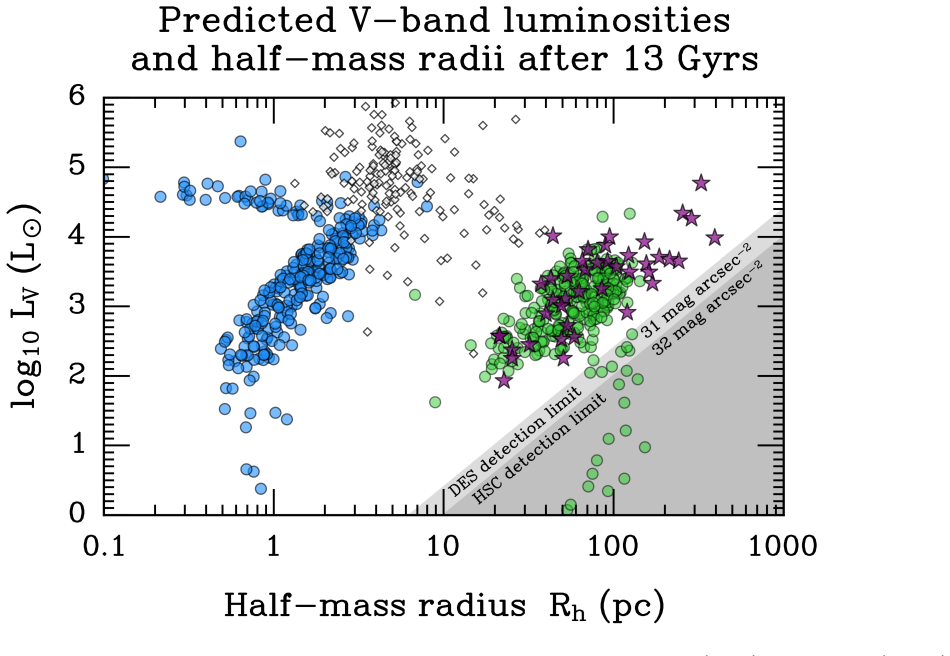
The Anaxagoras model applied to star formation at z > 6 in Milky Way satellite halos predicts hundreds of galaxies with luminosities, half-mass radii, mass-to-light ratios, and ages matching observed ultra-faint dwarfs, at least around 40 old globular cluster candidates with initial stellar masses between 10^5 and 10^6 solar masses, and between 1 and 500 Population III stars per minihalo at z > 6 depending on the assumed stellar mass and the presence of Lyman-Werner feedback.
What carries the argument
The Anaxagoras model, which is an analytical ab initio description of gas cooling, central gas accretion and disk formation, together with stellar feedback processes including direct radiation pressure, Ly-alpha scattering, IR photons, stellar winds, expanding H II regions, and supernovae.
If this is right
- Hundreds of galaxies form in low-mass halos with observed ultra-faint dwarf properties.
- At least 40 globular cluster candidates of 10^5-10^6 solar masses form at halo centers.
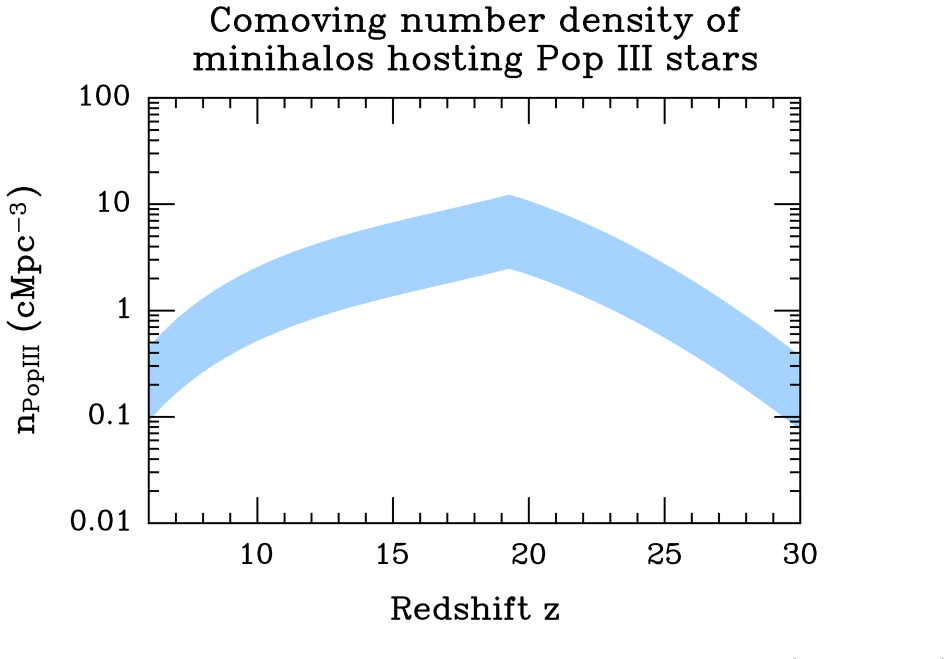
- Pop III star formation yields 1-30 stars per minihalo at z>20 or 10-500 at lower z if stars are 25 solar masses, or mostly one star if 140 solar masses.
- The timing of star formation is delayed by Lyman-Werner feedback until halos grow larger.
Where Pith is reading between the lines
- This approach could allow faster exploration of parameter space in feedback efficiencies compared to simulations.
- Predictions for the number of Pop III stars could inform models of early chemical enrichment and reionization.
- Extending the model to predict observable signatures at even higher redshifts might be testable with future telescopes.
- The success of the model in matching local dwarfs suggests that feedback processes dominate over other factors in shaping these small systems.
Load-bearing premise
The predictions rest on specific assumed efficiencies for each type of stellar feedback and on choosing fixed masses for the first stars, which determine how much gas is converted to stars and when.
What would settle it
A survey finding substantially different numbers of ultra-faint dwarf galaxies around the Milky Way than the predicted hundreds, or globular clusters with different initial masses, would falsify the specific predictions of the model.
Figures







read the original abstract
In the standard model of cosmology ($\Lambda$CDM) the first stars, star clusters, and galaxies are expected to have formed in low-mass dark matter halos at high redshifts ($z \sim 6 - 30$). Attempts to predict the properties and abundances of these objects have mainly relied on numerically expensive cosmological simulations, which often lack the sub-parsec resolution needed to resolve compact star clusters and/or neglect potentially important stellar feedback processes. Motivated by this, I introduce Anaxagoras, a detailed analytical ab initio model of starbursts in low-mass halos. The model includes gas cooling, central gas accretion and disk formation, and stellar feedback from direct radiation pressure, Ly$\alpha$ scattering and IR photons, stellar winds, expanding H II regions, and (crudely) supernovae. I apply Anaxagoras to star formation at $z > 6$ in satellite halos of the Milky Way, as well as to Population III (Pop III) star formation in minihalos. For the Milky Way setup, hundreds of galaxies are predicted to form with luminosities, half-mass radii, mass-to-light ratios, and ages in good agreement with the observed local population of Ultra-Faint Dwarfs. Furthermore, at least $\sim 40$ old globular cluster candidates with initial stellar masses $10^5 - 10^6\,M_\odot$ are predicted to form at the centers of low-mass halos. Finally, if Pop III stars are not overly massive ($25\,M_\odot$), between $\sim 1 - 30$ stars could form per minihalo at $z > 20$, increasing to $\sim 10 - 500$ at $z < 15$ as Lyman-Werner feedback delays star formation until halos reach larger masses; if Pop III stars are more massive ($140\,M_\odot$), most minihalos form just a single star.
Editorial analysis
A structured set of objections, weighed in public.
Referee Report
Summary. The manuscript introduces Anaxagoras, an analytical ab initio model of starbursts in low-mass dark matter halos at z>6. The model incorporates gas cooling, central accretion and disk formation, plus stellar feedback from direct radiation pressure, Lyα scattering, IR photons, winds, H II regions, and a crude supernova treatment. Applied to Milky Way satellite halos, it predicts hundreds of galaxies whose luminosities, half-mass radii, mass-to-light ratios, and ages match the observed ultra-faint dwarf population; at least ~40 old globular-cluster candidates with initial stellar masses 10^5–10^6 M_⊙; and, for Population III stars, 1–30 (or 10–500) stars per minihalo at z>20 (or z<15) when the stellar mass is taken as 25 M_⊙, versus mostly single stars when the mass is 140 M_⊙.
Significance. If the quantitative outputs survive scrutiny, the work supplies a computationally inexpensive, physically motivated framework that can be used to explore the formation of the first star clusters and galaxies and to interpret upcoming JWST and ELT observations of high-redshift compact objects. The explicit inclusion of multiple feedback channels is a methodological strength relative to many existing analytic prescriptions.
major comments (3)
- [Abstract and model-description section] Abstract and model-description section: the repeated claim that the model is 'ab initio' is undercut by the adoption of fixed Pop III stellar masses (25 or 140 M_⊙) and by the choice of feedback efficiencies for radiation pressure, Lyα scattering, IR photons, winds, H II regions, and supernovae. These parameters directly set the star-formation efficiency, gas-expulsion timing, and final stellar mass in every low-mass halo; the predicted UFD abundances, GC candidate counts, and Pop III multiplicity are therefore sensitive functions of the chosen values. A systematic sensitivity study or calibration against independent constraints is required to establish that the reported numbers are not simply re-statements of the input choices.
- [Results for ultra-faint dwarfs] Results for ultra-faint dwarfs: the statement that 'hundreds of galaxies are predicted to form with luminosities, half-mass radii, mass-to-light ratios, and ages in good agreement with the observed local population' is presented without tabulated comparisons to specific observational catalogs, without reported χ² or Kolmogorov-Smirnov statistics, and without error bars on the model predictions. Because the feedback efficiencies control the final stellar mass and radius, it is impossible to judge whether the agreement is robust or the result of parameter tuning.
- [Pop III star-formation section] Pop III star-formation section: the quantitative ranges (1–30 stars per minihalo at z>20 rising to 10–500 at z<15 for 25 M_⊙, versus mostly one star for 140 M_⊙) rest on an unspecified implementation of Lyman-Werner feedback and on the assumption that star formation is delayed until halos reach a critical mass. No derivation of the critical mass or of the LW optical-depth calculation is supplied, nor is there an assessment of how uncertainties in the LW background or in the escape fraction would propagate into the quoted ranges.
minor comments (2)
- The abstract and figure captions should explicitly define the symbols used for half-mass radius, mass-to-light ratio, and initial stellar mass so that readers can immediately compare the reported numbers with observational conventions.
- A short table summarizing the adopted feedback efficiencies, their physical motivation, and the range explored (if any) would improve readability and allow direct assessment of the parameter dependence highlighted in the major comments.
Simulated Author's Rebuttal
We thank the referee for the detailed and constructive report. We address each major comment below, indicating the revisions that will be incorporated to strengthen the manuscript.
read point-by-point responses
-
Referee: Abstract and model-description section: the repeated claim that the model is 'ab initio' is undercut by the adoption of fixed Pop III stellar masses (25 or 140 M_⊙) and by the choice of feedback efficiencies for radiation pressure, Lyα scattering, IR photons, winds, H II regions, and supernovae. These parameters directly set the star-formation efficiency, gas-expulsion timing, and final stellar mass in every low-mass halo; the predicted UFD abundances, GC candidate counts, and Pop III multiplicity are therefore sensitive functions of the chosen values. A systematic sensitivity study or calibration against independent constraints is required to establish that the reported numbers are not simply re-statements of the input choices.
Authors: We acknowledge that the term 'ab initio' benefits from clarification. In our usage, it denotes that the core processes (gas cooling, accretion, disk formation, and the listed feedback channels) are implemented via physical equations and rates drawn from the literature rather than being empirically tuned to match the specific UFD or GC observations presented. The Pop III masses are taken from the range of theoretical stellar-evolution predictions, and the feedback efficiencies are fixed at values motivated by radiation-hydrodynamics results. Nevertheless, we agree that a sensitivity analysis is warranted. In the revised manuscript we will add a dedicated subsection that varies each key parameter over its plausible range and quantifies the resulting spread in predicted abundances and properties. revision: yes
-
Referee: Results for ultra-faint dwarfs: the statement that 'hundreds of galaxies are predicted to form with luminosities, half-mass radii, mass-to-light ratios, and ages in good agreement with the observed local population' is presented without tabulated comparisons to specific observational catalogs, without reported χ² or Kolmogorov-Smirnov statistics, and without error bars on the model predictions. Because the feedback efficiencies control the final stellar mass and radius, it is impossible to judge whether the agreement is robust or the result of parameter tuning.
Authors: The comparisons appear as overlays in Figures 3–5 against data compiled from Simon (2019) and other UFD catalogs. We concur that quantitative metrics and uncertainty estimates would improve transparency. The revised version will therefore include (i) a summary table of median and quartile values for luminosity, half-mass radius, mass-to-light ratio, and age, (ii) Kolmogorov-Smirnov statistics for each distribution, and (iii) error bars on the model curves that reflect both the halo-mass-function uncertainty and modest variations in the feedback efficiencies. We will also state explicitly that the efficiencies were not adjusted to reproduce the UFD population but were held at literature values. revision: yes
-
Referee: Pop III star-formation section: the quantitative ranges (1–30 stars per minihalo at z>20 rising to 10–500 at z<15 for 25 M_⊙, versus mostly one star for 140 M_⊙) rest on an unspecified implementation of Lyman-Werner feedback and on the assumption that star formation is delayed until halos reach a critical mass. No derivation of the critical mass or of the LW optical-depth calculation is supplied, nor is there an assessment of how uncertainties in the LW background or in the escape fraction would propagate into the quoted ranges.
Authors: The Lyman-Werner optical-depth calculation and the critical-mass threshold (cooling time equal to free-fall time) are described in Section 3.3. We recognize, however, that the derivations and uncertainty propagation are not presented at the level of detail the referee requests. The revised manuscript will expand this section with explicit analytic expressions for the LW optical depth, the derivation of the critical mass, and a new sensitivity subsection that varies the LW background intensity and escape fraction (0.1–1) and shows the resulting range in stellar multiplicity. Additional figures will illustrate these dependencies. revision: yes
Circularity Check
No significant circularity in the Anaxagoras analytical model
full rationale
The paper introduces Anaxagoras as a new analytical ab initio model incorporating explicit physical prescriptions for gas cooling, central accretion, disk formation, and multiple stellar feedback channels (direct radiation pressure, Ly-alpha scattering, IR photons, winds, H II regions, and crude supernovae). It then applies the model to low-mass halos at z>6 to derive predicted abundances and properties of ultra-faint dwarfs, globular cluster candidates, and Pop III stars. These outputs are presented as consequences of the model's assumptions and parameter choices rather than tautological inputs. No equations, self-citations, or uniqueness theorems are quoted that would reduce the quantitative predictions to the inputs by construction. The reported agreement with observations is framed as a validation step, not a fitting procedure that forces the results. The derivation chain is therefore self-contained.
Axiom & Free-Parameter Ledger
free parameters (2)
- Pop III stellar mass =
25 or 140 solar masses
- Feedback efficiencies
axioms (2)
- standard math Standard Lambda CDM cosmology governs halo growth and gas accretion at z>6
- domain assumption Low-mass halos at high redshift undergo central gas cooling, accretion, and disk formation prior to starbursts
Reference graph
Works this paper leans on
-
[1]
Monthly Notices of the Royal Astronomical Society, 431(4), 3087–3102
The inhomogeneous reionization of the local intergalactic medium by metal-poor globular clusters. Monthly Notices of the Royal Astronomical Society, 431(4), 3087–3102. Griffen, Brendan F., Dooley, Gregory A., Ji, Alexander P., O’Shea, Brian W., Gómez, F acundo A., & Frebel, Anna . 2018. Tracing the first stars and galaxies of the Milky Way.Monthly Notices ...
-
[2]
Journal of Cosmology and Astroparticle Physics, 2019(3), 043
The local and distant Universe: stellar ages and H0. Journal of Cosmology and Astroparticle Physics, 2019(3), 043. Karlsson, Torgny, Bromm, Volker, & Bland-Hawthorn, Joss . 2013. Pregalactic metal enrich- ment: The chemical signatures of the first stars.Reviews of Modern Physics, 85(2), 809–848. Katz, Harley, & Ricotti, Massimo . 2014. Clues on the missing...
-
[3]
The Astrophysical Journal, 838(1), 8
Farthest Neighbor: The Distant Milky Way Satellite Eridanus II. The Astrophysical Journal, 838(1), 8. Liu, Boyuan, Schauer, Anna T. P., & Bromm, Volker . 2019. Constraining the non-gravitational scattering of baryons and dark matter with early cosmic structure formation.Monthly Notices of the Royal Astronomical Society, 487(4), 4711–4720. Lodato, Giuseppe...
work page 2019
-
[4]
The Halo Mass Function: High-Redshift Evolution and Universality.The Astrophysical Journal, 671(2), 1160–1181. 142 Ma, Xiangcheng, Hopkins, Philip F., Kasen, Daniel, Quataert, Eliot, F aucher-Giguère, Claude-André, Kereš, Dušan, Murray, Norman, & Strom, Allison . 2016. Binary stars can provide the ‘missing photons’ needed for reionization.Monthly Notices ...
-
[5]
Monthly Notices of the Royal Astronomical Society, 479(3), 2853–2870
The total satellite population of the Milky Way. Monthly Notices of the Royal Astronomical Society, 479(3), 2853–2870. Nishi, Ryoichi, & Susa, Hajime . 1999. Formation and Disruption of Cosmological Low-Mass Objects. The Astrophysical Journal, 523(2), L103–L107. Norman, Michael L., Smith, Britton D., & Bordner, James . 2018. Simulating the Cosmic Dawn Wit...
-
[6]
The halo mass function from the dark ages through the present day.Monthly Notices of the Royal Astronomical Society, 374(1), 2–15. Rees, M. J., & Ostriker, J. P. 1977. Cooling, dynamics and fragmentation of massive gas clouds: clues to the masses and radii of galaxies and clusters.Monthly Notices of the Royal Astronomical Society, 179(June), 541–559. Rena...
-
[7]
Monthly Notices of the Royal Astro- nomical Society, 442(3), 1942–1955
Statistical properties of dark matter mini-haloes at z≥ 15. Monthly Notices of the Royal Astro- nomical Society, 442(3), 1942–1955. Schaerer, D. 2002. On the properties of massive Population III stars and metal-free stellar populations. Astronomy and Astrophysics, 382(Jan.), 28–42. Schauer, Anna T. P., Regan, John, Glover, Simon C. O., & Klessen, Ralf S. ...
-
[8]
The Spectral Evolution of the First Galaxies. I. James Webb Space Telescope Detection Limits and Color Criteria for Population III Galaxies.The Astrophysical Journal, 740(1), 13. Zhang, Dong, & Davis, Shane W. 2017. Radiation Hydrodynamic Simulations of Dust-driven Winds. The Astrophysical Journal, 839(1), 54. Zhu, Qirong, Marinacci, Federico, Maji, Moupi...
work page 2017
discussion (0)
Sign in with ORCID, Apple, or X to comment. Anyone can read and Pith papers without signing in.