Quantum dynamics of coupled quasinormal modes and quantum emitters interacting via finite-delay propagating photons
Pith reviewed 2026-05-10 15:41 UTC · model grok-4.3
The pith
Retarded interactions between distant lossy cavities and quantum emitters reduce exactly to system-bath correlation functions.
A machine-rendered reading of the paper's core claim, the machinery that carries it, and where it could break.
Core claim
The retarded inter-cavity dynamics are fully described by system-bath correlation functions in which the emission from one cavity appears as the input field for another. The bath of traveling photons is represented by non-bosonic operators that remain orthogonal to the open-cavity quasinormal modes. When quantum emitters are included, both bath-mediated and quasinormal-mode-mediated interactions between emitters arise naturally within the same framework.
What carries the argument
System-bath correlation functions that encode the finite propagation delay between quantized quasinormal modes of separate cavities.
If this is right
- Emission from one cavity acts as the exact driving field for a second cavity after the light-travel time.
- Emitter interactions occur through two parallel channels: direct bath mediation and indirect quasinormal-mode mediation.
- The same correlation-function structure applies to arbitrary cavity shapes and separations in any homogeneous medium.
- Time-dependent quantum dynamics can be simulated without discretizing the entire propagation path between cavities.
Where Pith is reading between the lines
- The method could lower the computational cost of simulating extended quantum photonic networks by eliminating explicit propagation degrees of freedom.
- The correlation-function description may map onto existing input-output formalisms once finite delays are retained.
- Natural extensions include adding nonlinear cavity or emitter responses while preserving the same bath structure.
- Experimental signatures in nanophotonic circuits would appear as precise time-delayed correlations between detected photons from different cavities.
Load-bearing premise
The traveling photon bath can be modeled with operators that are orthogonal to the quasinormal modes of the open cavities.
What would settle it
A direct calculation or measurement of the time-dependent field correlation between two cavities that deviates from the predicted system-bath correlation functions would falsify the completeness of the description.
Figures





read the original abstract
A time-dependent theory for the interactions between spatially separated lossy cavities in a homogeneous background medium using quantized quasinormal modes (QNMs) is presented. The cavities interact via a bath of traveling photons, described by non-bosonic operators that are orthogonal to the open-cavity QNMs. The retarded (i.e., time-delayed) inter-cavity dynamics are fully described by system-bath correlation functions, in which the emission from one cavity appears as the input field for another. Coupling between quantum emitters (described as two-level systems), placed inside a cavity or embedded in an external medium, and the electromagnetic field (cavity modes and bath photons) is included in the theory, which gives rise to both bath-mediated and QNM-mediated interactions between the emitters.
Editorial analysis
A structured set of objections, weighed in public.
Referee Report
Summary. The manuscript develops a time-dependent quantum theory for interactions between spatially separated lossy cavities using quantized quasinormal modes (QNMs). Cavities couple through a bath of traveling photons modeled by non-bosonic operators orthogonal to the open-cavity QNMs. Retarded inter-cavity dynamics are encoded solely in system-bath correlation functions, with emission from one cavity acting as input to another. Coupling to quantum emitters (two-level systems) inside cavities or in the medium is included, producing both bath-mediated and QNM-mediated emitter interactions.
Significance. If the non-bosonic bath algebra is shown to be consistent, the framework would offer a useful extension of QNM quantization to multi-cavity systems with explicit finite-delay propagation. It could enable more accurate modeling of retardation effects in nanophotonic quantum optics without common approximations, with direct relevance to hybrid systems involving emitters.
major comments (2)
- [§3.1] §3.1, Eq. (10): the orthogonality projection defining the non-bosonic bath operators is used to remove direct QNM-bath overlap so that all retarded dynamics enter via correlations, but the resulting commutation relations are not explicitly derived or verified to preserve standard input-output relations and vacuum fluctuations once emitters are coupled; this is load-bearing for the central claim that correlations alone fully capture the dynamics.
- [§4.2] §4.2: the separation of emitter interactions into QNM-mediated and bath-mediated channels assumes the bath model introduces no residual terms, yet without shown consistency of the non-bosonic algebra this separation risks being incomplete when finite delays and emitters are both present.
minor comments (2)
- [Introduction] The introduction would benefit from a clearer contrast with prior bosonic input-output treatments of retardation to highlight the specific role of the non-bosonic construction.
- [Figure 1] Figure captions for the schematic of the multi-cavity setup could explicitly label the delay time τ to aid readability.
Simulated Author's Rebuttal
We thank the referee for their careful reading of the manuscript and for the constructive comments, which have helped us improve the presentation of the non-bosonic bath algebra. We address each major comment below and have revised the manuscript accordingly to provide the requested explicit derivations and consistency checks.
read point-by-point responses
-
Referee: [§3.1] §3.1, Eq. (10): the orthogonality projection defining the non-bosonic bath operators is used to remove direct QNM-bath overlap so that all retarded dynamics enter via correlations, but the resulting commutation relations are not explicitly derived or verified to preserve standard input-output relations and vacuum fluctuations once emitters are coupled; this is load-bearing for the central claim that correlations alone fully capture the dynamics.
Authors: We agree that an explicit derivation and verification of the commutation relations is necessary to substantiate the central claim. The orthogonality projection in Eq. (10) is introduced precisely to eliminate direct QNM-bath overlap, ensuring that all inter-cavity retardation appears through the system-bath correlation functions. In the revised manuscript we have added Appendix C, which derives the commutation relations for the projected non-bosonic bath operators and shows that they satisfy the required algebra while remaining orthogonal to the QNMs. We further verify that the standard input-output relations and vacuum fluctuations are preserved when the emitters are included, because the projection removes any direct overlap terms and the bath is taken in the vacuum state; the resulting Heisenberg-Langevin equations therefore contain no additional residual commutators beyond those already encoded in the correlation functions. revision: yes
-
Referee: [§4.2] §4.2: the separation of emitter interactions into QNM-mediated and bath-mediated channels assumes the bath model introduces no residual terms, yet without shown consistency of the non-bosonic algebra this separation risks being incomplete when finite delays and emitters are both present.
Authors: The decomposition into QNM-mediated and bath-mediated channels follows directly from the orthogonality condition of Eq. (10), which partitions the total electromagnetic field without overlap. We acknowledge that the consistency of this separation under simultaneous finite delays and emitter coupling requires explicit confirmation. The revised manuscript now includes a short verification subsection in §4.2 together with the new Appendix C. There we substitute the projected bath operators into the emitter equations of motion and confirm that no residual terms appear; the finite-delay propagation remains fully contained in the bath correlation functions, and the non-bosonic algebra is shown to be consistent with the separation for the parameter regimes considered. revision: yes
Circularity Check
No significant circularity; derivation self-contained via modeling assumptions
full rationale
The paper constructs a time-dependent theory for coupled QNMs interacting through a bath of traveling photons using non-bosonic operators defined to be orthogonal to the open-cavity QNMs. The central claim—that retarded inter-cavity dynamics are fully captured by system-bath correlation functions—is presented as following directly from this orthogonality choice and the input-output mapping, without reducing to fitted parameters, self-definitional loops, or load-bearing self-citations that presuppose the target result. No equations or steps in the abstract or description exhibit a prediction that is equivalent to its inputs by construction; the orthogonality is an explicit modeling assumption rather than a derived or renamed known result. The theory incorporates quantum emitters and both bath- and QNM-mediated interactions as extensions, remaining independent of any circular reduction.
Axiom & Free-Parameter Ledger
axioms (2)
- domain assumption Quantized quasinormal modes provide a valid basis for describing lossy open cavities.
- domain assumption Photon bath operators are non-bosonic and orthogonal to cavity QNMs.
Forward citations
Cited by 1 Pith paper
-
Quantum Optical Soliton Dynamics Beyond Linearization: An Open-System Approach
Two open-system approaches using Lanczos supermode expansion and Markovian master equation are developed to capture quantum-induced phase shifts and photon loss in χ^(3) solitons without linearization.
Reference graph
Works this paper leans on
-
[1]
General form In Sec. II, we discussed how the instantaneous (or di- rect) coupling between different QNM cavities is sup- pressed for cases with sufficient separation. As a result, the QNM Hamiltonian [Eq. (17)] contains no direct cou- pling between QNMs of separate cavitiesi̸=j. In a time- dependent theory, propagating photons transmit energy between the...
-
[2]
(37) al- lows for a perturbative treatment of the intercavity scat- tering
Perturbative intercavity coupling The form of the correlation function from Eq. (37) al- lows for a perturbative treatment of the intercavity scat- tering. Since instantaneous intercavity transfer is negligi- ble for well-separated cavities (cf. Sec. II C), only a finite number of intercavity scattering processes contribute sig- nificantly within a finite...
-
[3]
Coupled metal dimers To illustrate the calculation of the correlation function, we consider an example of two metal dimers in vacuum (nB = 1) serving as QNM cavities with one dominant QNM each (cf. Fig. 2). We consider the caseN≤1 as discussed above. In Fig. 5, we show the absolute value and real part of the QNM-QNM correlation function from Eq. (39) for ...
-
[4]
General form A TLS that transitions from the excited state to the ground state emits a photon into the surrounding medium, described in Eq. (17) by the coupling to the bath modes. The resulting bath photon can propa- gate through space and excite another system (such as a QNM cavity) elsewhere, leading to an effective interac- tion. In contrast to the QNM...
-
[5]
da ·E iν(ra, t′ −t) iℏ #∗ −Θ(t ′−t) X ν (δην ∂t+iχ∗ iηiµ)
Perturbative treatment of intercavity transfer For cavities with significant separation (P ij ≫0, c.f. Sec. II C), we treat the intercavity scattering pertur- batively and restrict the number of intercavity scattering processes toN≤1. Note, however, that the QNM-TLS couplingd a ·E jν(ra, t′ −t 1)/(iℏ) may also contain inter- cavity scattering terms if the...
-
[6]
We place a TLS in the gap of each dimer (see Fig
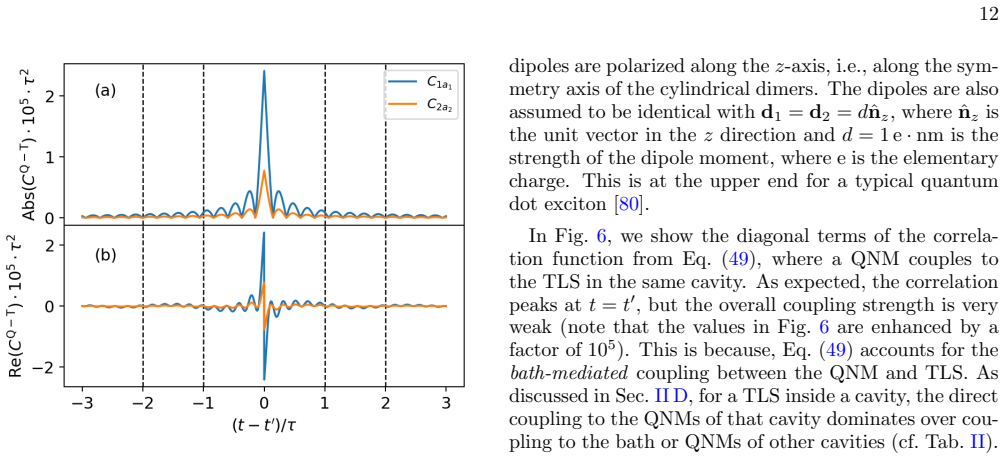
TLS coupled to a metal dimer We again use metal dimers as QNM cavities. We place a TLS in the gap of each dimer (see Fig. 2). The TLS dipoles are polarized along thez-axis, i.e., along the sym- metry axis of the cylindrical dimers. The dipoles are also assumed to be identical withd 1 =d 2 =d ˆnz, where ˆnz is the unit vector in thezdirection andd= 1 e·nm ...
-
[7]
da ·E iµ(ra, t−t 1) iℏ (δην ∂t2 −iχjηjν)KN iµjν(t1 −t 2) #
General form The photon emitted by a TLS can also excite another TLS (or re-excite the same TLS), leading to an effective TLS-TLS interaction mediated by propagating bath pho- tons. Using the Hamiltonian for the TLS-bath coupling from Eq. (46) and the results derived in the previous sec- tions, we derive the TLS-TLS correlation function (see Appendix C 3 ...
-
[8]
TLS coupling in the presence of metal dimer QNM cavities We again consider the case of two metal dimers serving as QNM cavities with TLSs in the dimer gaps from Fig. 2. We also takeN≤1 in Eq. (50) under the assumption of weak intercavity coupling, as in Eq. (49). For the full Green’s function, we use the expansion from Appendix D. In Fig. 8, we show the d...
-
[9]
(36) together with the initial scattering ˆCiµ(t) from Eq
Derivation of the QNM correlation function With the QNM-bath coupling Hamiltonian from Eq. (36) together with the initial scattering ˆCiµ(t) from Eq. (31), the correlation function from Eq. (25) becomes CQNM iµjν (t−t ′) = ∞X N=0 ∞X M=0 X k,l X η,κ X pq Z t t0 dt1 Z t′ t0 dt2KN iµkη(t−t 1) × Z ∞ 0 Z d3rgkη,p(r, ω)e−iω(t1−t0) ×tr B ˆcp(r, ω, t0)ˆc† q(r′, ω...
-
[10]
(36) and the Hamiltonian for TLS-bath coupling from Eq
Derivation of the QNM-TLS correlation function Using the Hamiltonian of QNM-bath coupling from Eq. (36) and the Hamiltonian for TLS-bath coupling from Eq. (46), the correlation function for the bath-mediated coupling between a QNM and TLS reads [cf. Eq. (25)] CQ−T iµa (t−t ′) = X j,ν ∞X N=0 Z t t0 dt1KN iµjν(t−t 1) × X p Z d3r Z ∞ 0 dωg∗ a,p(r, ω)eiω(t′−t...
-
[11]
Derivation of the TLS correlation function Using the Hamiltonian of the TLS-bath interaction from Eq. (46), the correlation function for the bath- mediated interaction between two TLSsaandbreads, CTLS ab (t−t ′) = X pq Z d3r Z ∞ 0 dωga,p(r, ω)e−iω(t−t0) ×tr B ˆcp(r, ω, t0)ˆc† q(r′, ω′, t0)ρB × Z d3r′ Z ∞ 0 dω′g∗ b,q(r′, ω′)eiω′(t′−t0) + X i,µ Z t t0 dt1 d...
-
[12]
Each dimer consists of two identical cylindrical nanorods
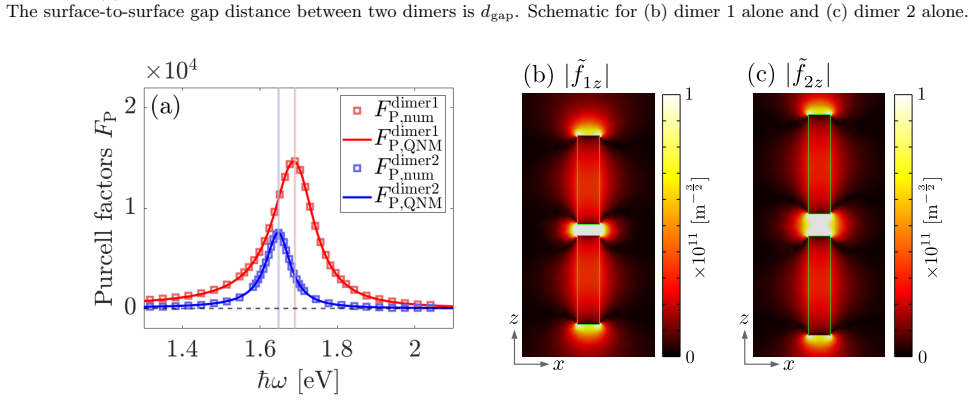
Model set up We consider two coupled metallic dimers placed in free space (ϵ B = 1), as shown in Fig.10 (a). Each dimer consists of two identical cylindrical nanorods. For the first dimer, the radius (length) of the nanorods isr 1 = 10 nm (L1 = 80 nm), and the surface-to-surface distance between two nanorods (along thezaxis direction) isd 1 = 10 nm. For t...
-
[13]
Bare QNMs First, we consider dimer 1 alone [see Fig. 10 (b)], a sin- gle QNM ˜f1 dominates in the frequency range of interest when the dipole is placed at the center of the gap, with an eigenfrequency ofℏ˜ω1 =ℏω 1 −iℏγ 1 = (1.6904−0.0652i) eV, and a quality factor ofQ 1 =ω 1/(2γ1)≈13. The distribution of the dominatedz−component| ˜f1z|of the mode is shown...
-
[14]
For the system, we consider [cf
Overlap matrix As shown in the main text, the overlap matrix Siµjη =δ ijSintra iµjη + (1−δ ij)Sinter iµjη ,(E7) contains intra-cavity contributionsS intra iµjη and inter-cavity contributionsS inter iµjη . For the system, we consider [cf. Fig. 10 (a)] only one QNM is dominating each cavity in the frequency regime of interest, so we simplify the notation:i ...
-
[15]
As a result,S intra 11 =S intra 11,nrad +S intra 11,rad = 0.9995 is close to unity
The far-field surface is a closed spherical surface in the very far-field region, and the angled grid is chosen to be very small, aroundπ/200, to achieve convergence of Sintra 11,rad. As a result,S intra 11 =S intra 11,nrad +S intra 11,rad = 0.9995 is close to unity. Similarly, for dimer 2 alone, we got Sintra 22 =S intra 22,nrad +S intra 22,rad = 0.3042 ...
work page 2000
-
[16]
(41) shows the retarded overlap matrix
Retarded overlap matrix Eq. (41) shows the retarded overlap matrix. We focus on the casei̸=j, which reads Siµ←jη = 1 2ϵ0 1 i(˜ωiµ −˜ω∗ jη) × I Sj dAs h ( ˜H′ iµ(s, ωiµ)× ˆns)· ˜F∗ jη(s, ωjη) +( ˜H∗ jη(s, ωjη)× ˆns)· ˜F′ iµ(s, ωiµ) i .(E13) SinceS j is the near field surface of resonator j, so the regularized QNMs ˜Fjη and ˜Hjη overS j could be ap- proxima...
work page 2000
-
[17]
QNMs and regularized QNMs at dipole location In the calculation of coupling strength, QNMs and reg- ularized QNMs at the dipole location are required.r a1 (ra2) is at gap center of the dimer 1 (dimer 2). For dimer 1 alone,z−component ˜f1z(ra1) of QNM at the gap center dimer 1 is shown in Table V, which won’t change with the gap distance, same for the QNM ...
-
[18]
( ˜F1z(ra2,˜ω∗ 1)) for dimer 2 (dimer 1) alone, at ther a1 (ra2) will change with the gap distance. Withd gap = 2000 nm, the regu- larized QNMs are obtained using NF2FF (the near field surface is a cuboid surface 50 nm away from the surface of dimer 1 or dimer 2) [70], as shown in Table V. Table V. Dipole locationr a1 (ra2) is fixed at the gap center of t...
work page 2000
-
[19]
Here they are shown with a gap distance ofd gap = 2000 nm
will change with the gap distance. Here they are shown with a gap distance ofd gap = 2000 nm. ra1 ˜f1z(ra1) (1.94×10 11 + 1.78×10 9i) [m]−3/2 ˜F2z(ra1,˜ω∗
work page 2000
-
[20]
(−2.12×10 7 −5.79×10 7i) [m]−3/2 ra2 ˜f2z(ra2) (1.05×10 11 + 6.67×10 8i) [m]−3/2 ˜F1z(ra2,˜ω∗
-
[21]
(3.72×10 6 −4.58×10 7i) [m]−3/2
-
[22]
H. Walther, B. T. Varcoe, B.-G. Englert, and T. Becker, Cavity quantum electrodynamics, Reports on Progress in Physics69, 1325 (2006)
work page 2006
-
[23]
H. J. Carmichael,Statistical methods in quantum optics 2: Non-classical fields(Springer Science & Business Me- dia, 2009)
work page 2009
-
[24]
E. M. Purcell, H. C. Torrey, and R. V. Pound, Resonance absorption by nuclear magnetic moments in a solid, Phys- ical review69, 37 (1946)
work page 1946
-
[25]
Purcell, Spontaneous emission probabilities at radio frequency, Phys
E. Purcell, Spontaneous emission probabilities at radio frequency, Phys. Pev.69, 681 (1946)
work page 1946
-
[26]
D. Meschede, H. Walther, and G. M¨ uller, One-atom maser, Physical Review Letters54, 551 (1985)
work page 1985
-
[27]
M. O. Scully, K. Wodkiewicz, M. Zubairy, J. Bergou, N. Lu, and J. M. Ter Vehn, Two-photon correlated– spontaneous-emission laser: quantum noise quenching and squeezing, Physical Review Letters60, 1832 (1988)
work page 1988
-
[28]
K. An, J. J. Childs, R. R. Dasari, and M. S. Feld, Mi- crolaser: A laser with one atom in an optical resonator, Physical Review Letters73, 3375 (1994)
work page 1994
-
[29]
A. Pscherer, M. Meierhofer, D. Wang, H. Kelkar, D. Mart´ ın-Cano, T. Utikal, S. G¨ otzinger, and V. San- doghdar, Single-molecule vacuum Rabi splitting: Four- wave mixing and optical switching at the single-photon level, Physical Review Letters127, 133603 (2021)
work page 2021
-
[30]
Y. Wang, X. Li, V. Nalla, H. Zeng, and H. Sun, Solution- processed low threshold vertical cavity surface emitting lasers from all-inorganic perovskite nanocrystals, Ad- vanced Functional Materials27, 1605088 (2017)
work page 2017
-
[31]
J. D. Rivero, M. Pan, K. G. Makris, L. Feng, and L. Ge, Non-Hermiticity-governed active photonic reso- nances, Physical Review Letters126, 163901 (2021)
work page 2021
-
[32]
D. J. Bergman and M. I. Stockman, Surface plasmon am- plification by stimulated emission of radiation: quantum generation of coherent surface plasmons in nanosystems, Physical Review Letters90, 027402 (2003)
work page 2003
-
[33]
M. Noginov, G. Zhu, A. Belgrave, R. Bakker, V. Sha- laev, E. Narimanov, S. Stout, E. Herz, T. Suteewong, and U. Wiesner, Demonstration of a spaser-based nanolaser, Nature460, 1110 (2009)
work page 2009
-
[34]
J. Y. Suh, C. H. Kim, W. Zhou, M. D. Huntington, D. T. Co, M. R. Wasielewski, and T. W. Odom, Plasmonic bowtie nanolaser arrays, Nano Letters12, 5769 (2012)
work page 2012
-
[35]
P. Song, J.-H. Wang, M. Zhang, F. Yang, H.-J. Lu, B. Kang, J.-J. Xu, and H.-Y. Chen, Three-level spaser for next-generation luminescent nanoprobe, Science ad- vances4, eaat0292 (2018)
work page 2018
-
[36]
Y.-H. Hsieh, B.-W. Hsu, K.-N. Peng, K.-W. Lee, C. W. Chu, S.-W. Chang, H.-W. Lin, T.-J. Yen, and Y.-J. Lu, Perovskite quantum dot lasing in a gap-plasmon nanocavity with ultralow threshold, ACS nano14, 11670 (2020)
work page 2020
-
[37]
I. Epstein, D. Alcaraz, Z. Huang, V.-V. Pusapati, J.-P. Hugonin, A. Kumar, X. M. Deputy, T. Khodkov, T. G. Rappoport, J.-Y. Hong,et al., Far-field excitation of single graphene plasmon cavities with ultracompressed mode volumes, Science368, 1219 (2020)
work page 2020
-
[38]
T. Pellizzari, S. A. Gardiner, J. I. Cirac, and P. Zoller, Decoherence, continuous observation, and quantum com- puting: A cavity QED model, Physical Review Letters 75, 3788 (1995)
work page 1995
-
[39]
J. I. Cirac, P. Zoller, H. J. Kimble, and H. Mabuchi, Quantum state transfer and entanglement distribution among distant nodes in a quantum network, Physical Re- view Letters78, 3221 (1997)
work page 1997
-
[40]
Pellizzari, Quantum networking with optical fibres, Physical Review Letters79, 5242 (1997)
T. Pellizzari, Quantum networking with optical fibres, Physical Review Letters79, 5242 (1997)
work page 1997
-
[41]
A. Imamo˘ glu, D. D. Awschalom, G. Burkard, D. P. Di- Vincenzo, D. Loss, M. Sherwin, and A. Small, Quantum information processing using quantum dot spins and cav- ity qed, Physical Review Letters83, 4204 (1999)
work page 1999
-
[42]
L.-M. Duan, M. D. Lukin, J. I. Cirac, and P. Zoller, Long- 27 distance quantum communication with atomic ensembles and linear optics, Nature414, 413 (2001)
work page 2001
-
[43]
A. Blais, R.-S. Huang, A. Wallraff, S. M. Girvin, and R. J. Schoelkopf, Cavity quantum electrodynamics for superconducting electrical circuits: An architecture for quantum computation, Physical Review A69, 062320 (2004)
work page 2004
- [44]
-
[45]
F. Borjans, X. Croot, X. Mi, M. Gullans, and J. Petta, Resonant microwave-mediated interactions between dis- tant electron spins, Nature577, 195 (2020)
work page 2020
- [46]
-
[47]
H. Pichler and P. Zoller, Photonic circuits with time delays and quantum feedback, Physical Review Letters 116, 093601 (2016)
work page 2016
-
[48]
S. Arranz Regidor, G. Crowder, H. Carmichael, and S. Hughes, Modeling quantum light-matter interactions in waveguide qed with retardation, nonlinear interac- tions, and a time-delayed feedback: Matrix product states versus a space-discretized waveguide model, Phys. Rev. Res.3, 023030 (2021)
work page 2021
-
[49]
M. Richter and S. Hughes, Enhanced TEMPO algorithm for quantum path integrals with off-diagonal system-bath coupling: Applications to photonic quantum networks, Phys. Rev. Lett.128, 167403 (2022)
work page 2022
-
[50]
M. Bundgaard-Nielsen, D. Englund, M. Heuck, and S. Krastanov, WaveguideQED.jl: An Efficient Frame- work for Simulating Non-Markovian Waveguide Quan- tum Electrodynamics, Quantum9, 1710 (2025)
work page 2025
- [51]
-
[52]
E. T. Jaynes and F. W. Cummings, Comparison of quan- tum and semiclassical radiation theories with applica- tion to the beam maser, Proceedings of the IEEE51, 89 (1963)
work page 1963
- [53]
- [54]
-
[55]
J. Ren, S. Franke, and S. Hughes, Connecting classical and quantum mode theories for coupled lossy cavity res- onators using quasinormal modes, ACS Photonics9, 138 (2022)
work page 2022
- [56]
-
[57]
E. A. Muljarov, W. Langbein, and R. Zimmermann, Brillouin-wigner perturbation theory in open electro- magnetic systems, EPL (Europhysics Letters)92, 50010 (2011)
work page 2011
-
[58]
P. T. Kristensen, C. Van Vlack, and S. Hughes, Gener- alized effective mode volume for leaky optical cavities, Optics Letters37, 1649 (2012)
work page 2012
-
[59]
C. Sauvan, J.-P. Hugonin, I. S. Maksymov, and P. Lalanne, Theory of the spontaneous optical emission of nanosize photonic and plasmon resonators, Physical Review Letters110, 237401 (2013)
work page 2013
-
[60]
P. Lalanne, W. Yan, K. Vynck, C. Sauvan, and J.-P. Hugonin, Light interaction with photonic and plasmonic resonances, Laser & Photonics Reviews12, 1700113 (2018)
work page 2018
-
[61]
P. T. Kristensen, K. Herrmann, F. Intravaia, and K. Busch, Modeling electromagnetic resonators using quasinormal modes, Advances in Optics and Photonics 12, 612 (2020)
work page 2020
-
[62]
A.-W. El-Sayed and S. Hughes, Quasinormal-mode the- ory of elastic Purcell factors and Fano resonances of op- tomechanical beams, Physical Review Research2, 043290 (2020)
work page 2020
-
[63]
J. Ren, S. Franke, and S. Hughes, Quasinormal modes, lo- cal density of states, and classical Purcell factors for cou- pled loss-gain resonators, Physical Review X11, 041020 (2021)
work page 2021
- [64]
- [65]
-
[66]
K. Ho, P. Leung, A. M. van den Brink, and K. Young, Second quantization of open systems using quasinormal modes, Physical Review E58, 2965 (1998)
work page 1998
-
[67]
R. Fuchs and M. Richter, Hierarchical equations of mo- tion analog for systems with delay: Application to in- tercavity photon propagation, Physical Review B107, 205301 (2023)
work page 2023
- [68]
- [69]
-
[70]
J. Yin, Y. Cao, Y.-H. Li, J.-G. Ren, S.-K. Liao, L. Zhang, W.-Q. Cai, W.-Y. Liu, B. Li, H. Dai,et al., Satellite- to-ground entanglement-based quantum key distribution, Physical Review Letters119, 200501 (2017)
work page 2017
-
[71]
J. Yin, Y. Cao, Y.-H. Li, S.-K. Liao, L. Zhang, J.-G. Ren, W.-Q. Cai, W.-Y. Liu, B. Li, H. Dai,et al., Satellite- based entanglement distribution over 1200 kilometers, Science356, 1140 (2017)
work page 2017
-
[72]
H.-P. Breuer and F. Petruccione,The theory of open quantum systems(Oxford University Press, USA, 2002)
work page 2002
-
[73]
Y. Tanimura, Numerically “exact” approach to open quantum dynamics: The hierarchical equations of mo- tion (heom), The Journal of chemical physics153, 020901 (2020)
work page 2020
-
[74]
H. T. Dung, L. Kn¨ oll, and D.-G. Welsch, Three- dimensional quantization of the electromagnetic field in dispersive and absorbing inhomogeneous dielectrics, Physical Review A57, 3931 (1998)
work page 1998
-
[75]
L. Suttorp and M. Wubs, Field quantization in inho- mogeneous absorptive dielectrics, Physical Review A70, 013816 (2004)
work page 2004
-
[76]
T. G. Philbin, Canonical quantization of macroscopic 28 electromagnetism, New Journal of Physics12, 123008 (2010)
work page 2010
- [77]
-
[78]
Matloob, Electromagnetic field quantization in an ab- sorbing medium, Phys
R. Matloob, Electromagnetic field quantization in an ab- sorbing medium, Phys. Rev. A60, 50 (1999)
work page 1999
-
[79]
T. Gruner and D.-G. Welsch, Green-function approach to the radiation-field quantization for homogeneous and inhomogeneous kramers-kronig dielectrics, Phys. Rev. A 53, 1818 (1996)
work page 1996
- [80]
discussion (0)
Sign in with ORCID, Apple, or X to comment. Anyone can read and Pith papers without signing in.