Coherent structures in axis-switching elliptical jets
Pith reviewed 2026-05-10 04:22 UTC · model grok-4.3
The pith
Axis switching transforms flapping modes into slower-growing wagging modes in elliptical jets
A machine-rendered reading of the paper's core claim, the machinery that carries it, and where it could break.
Core claim
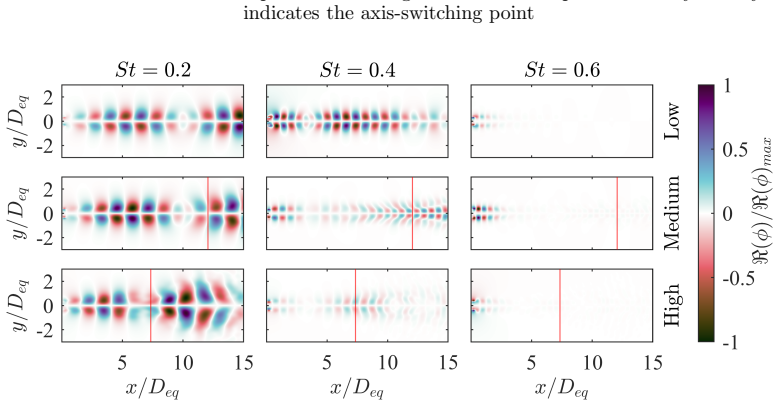
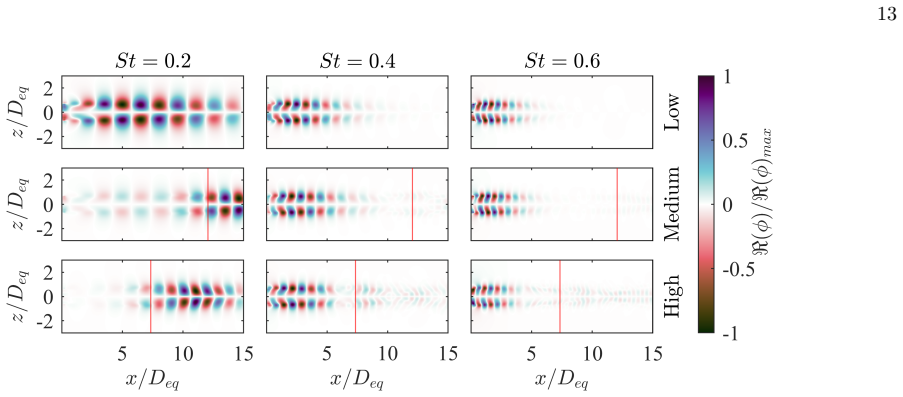
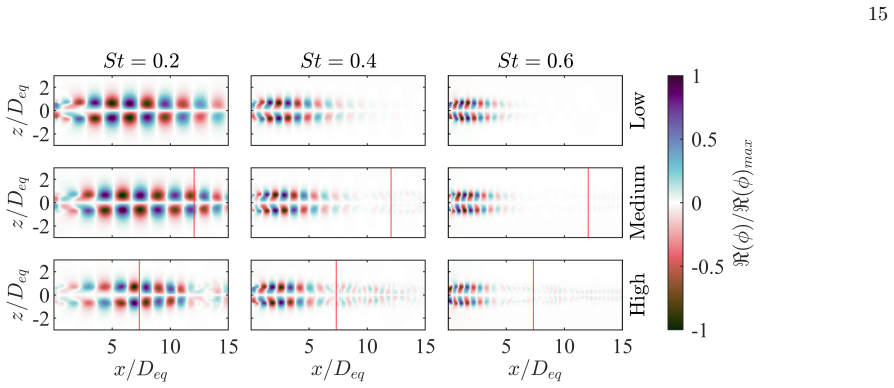
The axis-switching phenomenon causes the flapping mode to become a wagging mode relative to the new axis, lowering the growth rate of the structure. Two different coherent structures were found in the SA symmetry for the axis-switching cases: the wagging mode which was dominant in the pre-axis-switch region and a new flapping mode which is dominant in the post-axis-switch region. The new flapping mode was dominant in the low-frequency region of the full-field SPOD spectrum which was overtaken by the wagging mode at St≈0.2 for the medium-forcing case and at St≈0.4 for the high-forcing case. This new flapping mode is likely a flapping mode relative to the axis-switched mean flow, which arises
What carries the argument
Spectral proper orthogonal decomposition of DNS velocity fields, used to extract modes classified by the dihedral group D2 symmetry, showing how axis switching alters which mode is most energetic and its spatial growth.
If this is right
- Higher forcing levels cause the jet to axis-switch earlier in the streamwise direction.
- The flapping mode decays faster when axis switching occurs due to the reorientation effect.
- A new flapping mode appears and dominates the post-axis-switch region because of slower shear-layer growth along the original major axis.
- The frequency at which the wagging mode overtakes the new flapping mode increases with forcing level.
Where Pith is reading between the lines
- If axis switching reliably slows coherent structure growth, it could be engineered to reduce jet noise or enhance mixing in propulsion systems.
- The mode transformation might generalize to other jet shapes or forced flows where symmetry is broken downstream.
- Varying the jet aspect ratio in follow-up studies could reveal how the switch location affects the dominant frequency range.
Load-bearing premise
The extracted SPOD modes correspond to physically meaningful, distinct coherent structures rather than being contaminated by numerical artifacts or overlapping unrelated dynamics.
What would settle it
If a follow-up simulation with finer grid or an experiment measuring velocity fluctuations shows that the flapping mode continues to grow at the same rate after the axis switch location, or if no distinct new flapping mode appears in the post-switch region, the claimed mechanism would be falsified.
Figures








read the original abstract
Coherent structures in aspect ratio 2, axis-switching elliptical jets are studied using direct numerical simulation (DNS). Three different datasets are studied with varying near-nozzle forcing levels. Increasing the forcing level causes the jet to axis switch at an earlier streamwise location. Spectral proper orthogonal decomposition was applied to the dataset to extract the most-energetic coherent structures in the flow, and modes associated with the main symmetries of the flow were identified. The flapping mode was found to decay faster at the high forcing level, a feature that was linked to the axis-switching behavior. The axis-switching phenomenon causes the flapping mode to become a wagging mode relative to the new axis, lowering the growth rate of the structure. Two different coherent structures were found in the SA (dihedral group $D_2$) symmetry for the axis-switching cases: the wagging mode which was dominant in the pre-axis-switch region and a new flapping mode which is dominant in the post-axis-switch region. The new flapping mode was dominant in the low-frequency region of the full-field SPOD spectrum which was overtaken by the wagging mode at $St\approx 0.2$ for the medium-forcing case and at $St\approx 0.4$ for the high-forcing case. This new flapping mode is likely a flapping mode relative to the axis-switched mean flow, which develops due to the slower growth of the shear layer in the major axis.
Editorial analysis
A structured set of objections, weighed in public.
Referee Report
Summary. The manuscript investigates coherent structures in aspect-ratio-2 elliptical jets undergoing axis-switching using direct numerical simulations at three different near-nozzle forcing levels. Spectral proper orthogonal decomposition (SPOD) is employed to extract energetic modes respecting the flow symmetries, particularly the SA (D2 dihedral) symmetry. The key finding is that increasing forcing advances the axis-switch location, leading to faster decay of the flapping mode, which is attributed to its transformation into a wagging mode relative to the switched axis; additionally, a new flapping mode emerges post-switch that dominates at low Strouhal numbers, with crossover frequencies depending on forcing level.
Significance. Should the causal link between axis-switching and the observed mode transitions and growth-rate reductions be confirmed, the work would advance understanding of symmetry-breaking effects on coherent structures in non-circular jets. This has relevance for applications in jet propulsion and mixing enhancement. The multi-dataset approach with symmetry classification is a positive aspect, providing a basis for further linear stability analyses.
major comments (3)
- [Abstract] The assertion that axis-switching causes the flapping mode to become a wagging mode and lowers its growth rate is not supported by an isolation of the geometric effect; since forcing level simultaneously shifts the switch location and modifies the initial shear-layer development, the observed changes in dominant SA-symmetric structures and St-dependent crossovers could stem from base-flow alterations rather than axis rotation itself. A comparison at fixed forcing with axis-switching suppressed (e.g., via different initial conditions) is absent.
- [SPOD analysis and results] The manuscript reports consistent trends in mode dominance across forcing levels but provides no quantitative error bars on SPOD eigenvalues, no grid-resolution convergence checks for the DNS, and no validation against experimental data on elliptical jets, leaving the central mode-transition claim only partially supported.
- [Symmetry identification] The claim that the new post-axis-switch flapping mode is 'likely a flapping mode relative to the axis-switched mean flow' relies on the assumption that SPOD modes accurately isolate physically distinct structures without significant numerical artifacts or mode mixing; no sensitivity tests to SPOD parameters or checks for orthogonality with other modes are described.
minor comments (2)
- [Notation] The use of 'SA symmetry' and 'D2' should be defined more explicitly early in the text, including how the symmetry groups are applied to the velocity fields.
- [Figures] The SPOD mode visualizations would benefit from clearer labeling of pre- and post-switch regions and quantitative growth-rate comparisons.
Simulated Author's Rebuttal
We thank the referee for the careful and constructive review of our manuscript. Below we respond point by point to the major comments, indicating planned revisions where appropriate.
read point-by-point responses
-
Referee: [Abstract] The assertion that axis-switching causes the flapping mode to become a wagging mode and lowers its growth rate is not supported by an isolation of the geometric effect; since forcing level simultaneously shifts the switch location and modifies the initial shear-layer development, the observed changes in dominant SA-symmetric structures and St-dependent crossovers could stem from base-flow alterations rather than axis rotation itself. A comparison at fixed forcing with axis-switching suppressed (e.g., via different initial conditions) is absent.
Authors: We agree that the forcing level simultaneously influences the axis-switch location and the initial shear-layer development, so the geometric effect of axis rotation cannot be fully isolated with the present datasets. The observed correlations between earlier switching, faster flapping-mode decay, and the emergence of the post-switch mode are consistent across the three forcing cases. We will revise the abstract and relevant discussion sections to replace causal phrasing with language of association (e.g., “linked to” rather than “causes”), while explicitly noting the potential confounding role of base-flow modifications. A controlled comparison at fixed forcing with axis-switching suppressed would require new simulations and is therefore not feasible at this stage. revision: partial
-
Referee: [SPOD analysis and results] The manuscript reports consistent trends in mode dominance across forcing levels but provides no quantitative error bars on SPOD eigenvalues, no grid-resolution convergence checks for the DNS, and no validation against experimental data on elliptical jets, leaving the central mode-transition claim only partially supported.
Authors: We will add a short subsection on numerical validation: (i) SPOD eigenvalue variability estimated from data-subset comparisons to supply quantitative uncertainty measures; (ii) explicit statements on grid resolution criteria and the adequacy of the near-nozzle shear-layer resolution; and (iii) a concise note that the axis-switching location and dominant coherent structures are qualitatively consistent with prior experimental literature on elliptical jets (already cited in the manuscript). These additions will strengthen support for the reported trends without altering the central findings. revision: partial
-
Referee: [Symmetry identification] The claim that the new post-axis-switch flapping mode is 'likely a flapping mode relative to the axis-switched mean flow' relies on the assumption that SPOD modes accurately isolate physically distinct structures without significant numerical artifacts or mode mixing; no sensitivity tests to SPOD parameters or checks for orthogonality with other modes are described.
Authors: SPOD is performed strictly within the SA-symmetric subspace, guaranteeing orthogonality among the retained modes by construction of the decomposition. The post-switch mode is identified by its spatial structure aligned with the switched axes and its dominance at low Strouhal numbers. We used standard SPOD parameters (block length, overlap) drawn from the literature; explicit sensitivity tests were not performed. We will insert a brief clarifying paragraph on these points and retain the qualifier “likely” to reflect the interpretive nature of the identification. revision: partial
- A direct numerical comparison at fixed forcing with axis-switching deliberately suppressed (e.g., via altered initial conditions) to isolate the pure geometric effect of axis rotation.
Circularity Check
No significant circularity; claims extracted directly from DNS/SPOD data
full rationale
The paper reports observations from direct numerical simulations of elliptical jets at varying forcing levels, followed by standard SPOD decomposition to identify symmetric modes. The central statements—that the flapping mode decays faster with earlier axis-switching and transforms into a wagging mode—are interpretive links drawn from the extracted mode energies and frequencies in the simulation datasets. No derivation chain reduces a claimed result to a fitted parameter, self-citation, or ansatz by construction; the symmetry groups and St-dependent crossovers are read out from the computed spectra without intermediate equations that presuppose the conclusion. The analysis remains self-contained against the external benchmark of the DNS fields.
Axiom & Free-Parameter Ledger
axioms (2)
- domain assumption Direct numerical simulation faithfully reproduces the coherent structures and axis-switching dynamics of the elliptical jet.
- domain assumption Spectral proper orthogonal decomposition isolates the most energetic and dynamically relevant coherent structures.
Reference graph
Works this paper leans on
-
[1]
Edgington-Mitchell and Petrˆ onio A
Daniel M. Edgington-Mitchell and Petrˆ onio A. S. Nogueira were supported by the Australian Research Council through the Future Fellow scheme (FT220100679) and DECRA scheme (DE240100933), respectively. Appendix A: DNS verification In the absence of elliptical DNS studies in literature for direct comparison, following the approach of Freund [39], the turbu...
-
[2]
A. K. M. F. Hussain, Coherent structures and turbulence, Journal of Fluid Mechanics173, 303 (1986)
work page 1986
-
[3]
P. Jordan and T. Colonius, Wave Packets and Turbulent Jet Noise, Annual Review of Fluid Mechanics45, 173 (2013)
work page 2013
-
[4]
A. V. G. Cavalieri, P. Jordan, and L. Lesshafft, Wave-Packet Models for Jet Dynamics and Sound Radiation, Applied Mechanics Reviews71, 020802 (2019)
work page 2019
-
[5]
J. Bridges and C. Brown, Parametric Testing of Chevrons on Single Flow Hot Jets, in10th AIAA/CEAS Aeroacoustics Conference(American Institute of Aeronautics and Astronautics, Manchester, GREAT BRITAIN, 2004)
work page 2004
- [6]
- [7]
-
[8]
K. B. M. Q. Zaman, M. F. Reeder, and M. Samimy, Control of an axisymmetric jet using vortex generators, Physics of Fluids6, 778 (1994)
work page 1994
-
[9]
S. Aravindh Kumar and E. Rathakrishnan, Characteristics of a supersonic elliptic jet, The Aeronautical Journal120, 495 (2016)
work page 2016
-
[10]
F. Hussain and H. S. Husain, Elliptic jets. Part 1. Characteristics of unexcited and excited jets, Journal of Fluid Mechanics 208, 257 (1989)
work page 1989
- [11]
-
[12]
K. W. Kinzie and D. K. McLaughlin, Aeroacoustic properties of supersonic elliptic jets, Journal of Fluid Mechanics395, 1 (1999)
work page 1999
-
[13]
K. B. M. Q. Zaman, Spreading characteristics of compressible jets from nozzles of various geometries, Journal of Fluid 21 Mechanics383, 197 (1999)
work page 1999
-
[14]
P. M. Sforza, M. H. Steiger, and N. Trentacoste, Studies on three-dimensional viscous jets., AIAA Journal4, 800 (1966)
work page 1966
-
[15]
K. C. Schadow, E. Gutmark, S. Koshigoe, and K. J. Wilson, Combustion-related shear-flow dynamics in elliptic supersonic jets, AIAA Journal27, 1347 (1989)
work page 1989
-
[16]
E. J. Gutmark and F. F. Grinstein, Flow Control with Noncircular Jets, Annual Review of Fluid Mechanics31, 239 (1999)
work page 1999
-
[17]
D. M. Mitchell, D. R. Honnery, and J. Soria, Near-field structure of underexpanded elliptic jets, Experiments in Fluids54, 1578 (2013)
work page 2013
-
[18]
D. Edgington-Mitchell, D. R. Honnery, and J. Soria, Multimodal Instability in the Weakly Underexpanded Elliptic Jet, AIAA Journal53, 2739 (2015)
work page 2015
-
[19]
K. B. M. Q. Zaman, Axis switching and spreading of an asymmetric jet: The role of coherent structure dynamics, Journal of Fluid Mechanics316, 1 (1996)
work page 1996
-
[20]
E. Mollo-Christensen, Jet Noise and Shear Flow Instability Seen From an Experimenter’s Viewpoint, Journal of Applied Mechanics34, 1 (1967)
work page 1967
-
[21]
S. C. Crow and F. H. Champagne, Orderly structure in jet turbulence, Journal of Fluid Mechanics48, 547 (1971)
work page 1971
-
[22]
A. V. G. Cavalieri, P. Jordan, T. Colonius, and Y. Gervais, Axisymmetric superdirectivity in subsonic jets, Journal of Fluid Mechanics704, 388 (2012)
work page 2012
-
[23]
A. V. G. Cavalieri, D. Rodr´ ıguez, P. Jordan, T. Colonius, and Y. Gervais, Wavepackets in the velocity field of turbulent jets, Journal of Fluid Mechanics730, 559 (2013)
work page 2013
-
[24]
Michalke, Survey on jet instability theory, Progress in Aerospace Sciences21, 159 (1984)
A. Michalke, Survey on jet instability theory, Progress in Aerospace Sciences21, 159 (1984)
work page 1984
-
[25]
P. J. Morris, The Instability of High Speed Jets, International Journal of Aeroacoustics9, 1 (2010)
work page 2010
-
[26]
O. T. Schmidt, A. Towne, G. Rigas, T. Colonius, and G. A. Br` es, Spectral analysis of jet turbulence, Journal of Fluid Mechanics855, 953 (2018)
work page 2018
-
[27]
Herbert, Parabolized Stability Equations, Annual Review of Fluid Mechanics29, 245 (1997)
T. Herbert, Parabolized Stability Equations, Annual Review of Fluid Mechanics29, 245 (1997)
work page 1997
-
[28]
K. Gudmundsson and T. Colonius, Instability wave models for the near-field fluctuations of turbulent jets, Journal of Fluid Mechanics689, 97 (2011)
work page 2011
-
[29]
A. Towne and T. Colonius, One-way spatial integration of hyperbolic equations, Journal of Computational Physics300, 844 (2015)
work page 2015
-
[30]
D. G. Crighton, Instability of an elliptic jet, Journal of Fluid Mechanics59, 665 (1973)
work page 1973
-
[31]
P. J. Morris, Instability of elliptic jets, AIAA Journal26, 172 (1988)
work page 1988
-
[32]
P. J. Morris and T. R. S. Bhat, The spatial stability of compressible elliptic jets, Physics of Fluids7, 185 (1995)
work page 1995
- [33]
-
[34]
P. A. Nogueira, J. Weightman, and D. M. Edgington-Mitchell, Prediction of wavepackets in elliptical jets using 3D one- way Navier-Stokes equations, inAIAA AVIATION 2023 Forum(American Institute of Aeronautics and Astronautics, San Diego, CA and Online, 2023)
work page 2023
-
[35]
S. Mazharmanesh, P. A. Nogueira, J. Weightman, and D. Edgington-Mitchell, Manifestation of screech modes in non- axisymmetric jets, Journal of Fluid Mechanics1004, A7 (2025)
work page 2025
- [36]
-
[37]
K. J. Burns, G. M. Vasil, J. S. Oishi, D. Lecoanet, and B. P. Brown, Dedalus: A flexible framework for numerical simulations with spectral methods, Physical Review Research2, 023068 (2020)
work page 2020
-
[38]
A. V. Cavalieri, Non-linear Galerkin reduced-order models of a mixing layer, inAIAA AVIATION 2023 Forum(American Institute of Aeronautics and Astronautics, San Diego, CA and Online, 2023)
work page 2023
-
[39]
T. Colonius and J. B. Freund, Application of Lighthill’s Equation to a Mach 1.92 Turbulent Jet, AIAA Journal38, 368 (2000)
work page 2000
-
[40]
J. B. Freund, Noise sources in a low-Reynolds-number turbulent jet at Mach 0.9, Journal of Fluid Mechanics438, 277 (2001)
work page 2001
-
[41]
G. A. Br` es, P. Jordan, V. Jaunet, M. Le Rallic, A. V. G. Cavalieri, A. Towne, S. K. Lele, T. Colonius, and O. T. Schmidt, Importance of the nozzle-exit boundary-layer state in subsonic turbulent jets, Journal of Fluid Mechanics851, 83 (2018)
work page 2018
-
[42]
M. Chevalier, P. Schlatter, A. Lundbladh, and D. S. Henningson, SIMSON: A pseudo-spectral solver for incompressible boundary layer flows (2007)
work page 2007
-
[43]
P. Schlatter and R. ¨Orl¨ u, Turbulent boundary layers at moderate Reynolds numbers: Inflow length and tripping effects, Journal of Fluid Mechanics710, 5 (2012)
work page 2012
-
[44]
O. T. Schmidt and T. Colonius, Guide to Spectral Proper Orthogonal Decomposition, AIAA Journal58, 1023 (2020)
work page 2020
- [45]
-
[46]
J. L. Lumley,Stochastic Tools in Turbulence(Academic Press, New York, 1970)
work page 1970
-
[47]
G. Mengaldo and R. Maulik, Pyspod: A python package for spectral proper orthogonal decomposition (spod), Journal of Open Source Software6, 2862 (2021)
work page 2021
-
[48]
C. K. W. Tam and A. T. Thies, Instability of rectangular jets, Journal of Fluid Mechanics248, 425 (1993)
work page 1993
-
[49]
B. Yeung and O. T. Schmidt, Spectral dynamics of natural and forced supersonic twin-rectangular jet flow, Journal of Fluid Mechanics1018, A34 (2025), arXiv:2501.10894 [physics]. 22
-
[50]
D. Rodriguez, Wavepacket models for supersonic twin-jets, inAIAA AVIATION 2021 Forum(American Institute of Aeronautics and Astronautics, Virtual event, 2021)
work page 2021
-
[51]
E. Pickering, G. Rigas, P. A. S. Nogueira, A. V. G. Cavalieri, O. T. Schmidt, and T. Colonius, Lift-up, Kelvin–Helmholtz and Orr mechanisms in turbulent jets, Journal of Fluid Mechanics896, A2 (2020)
work page 2020
-
[52]
L. Heidt and T. Colonius, Optimal frequency resolution for spectral proper orthogonal decomposition (2024), arXiv:2402.15775 [physics]
- [53]
- [54]
-
[55]
D. Edgington-Mitchell, D. R. Honnery, and J. Soria, Staging Behaviour in Screeching Elliptical Jets, International Journal of Aeroacoustics14, 1005 (2015)
work page 2015
- [56]
-
[57]
A. Sano, L. I. Abreu, A. V. G. Cavalieri, and W. R. Wolf, Trailing-edge noise from the scattering of spanwise-coherent structures, Physical Review Fluids4, 094602 (2019)
work page 2019
-
[58]
O. T. Schmidt, Bispectral mode decomposition of nonlinear flows, Nonlinear Dynamics102, 2479 (2020)
work page 2020
discussion (0)
Sign in with ORCID, Apple, or X to comment. Anyone can read and Pith papers without signing in.