A Green-Integral-Constrained Neural Solver with Stochastic Physics-Informed Regularization
Pith reviewed 2026-05-09 22:16 UTC · model grok-4.3
The pith
Neural solver for the Helmholtz equation replaces PDE residuals with a Green-integral constraint to cut training cost by more than ten times and remove artificial boundary layers.
A machine-rendered reading of the paper's core claim, the machinery that carries it, and where it could break.
Core claim
Optimizing a neural network under the Green-integral loss for the acoustic Helmholtz equation functions as a spectrally tuned preconditioned iteration that converges in strongly heterogeneous media where the classical Born series diverges, while the FFT-based implementation of the integral kernel reduces memory usage and training time by more than an order of magnitude without requiring artificial absorbing boundaries.
What carries the argument
The Green-integral loss, which applies the nonlocal integral representation of the solution using the Green function kernel and evaluates it via FFT convolution on a regular grid.
If this is right
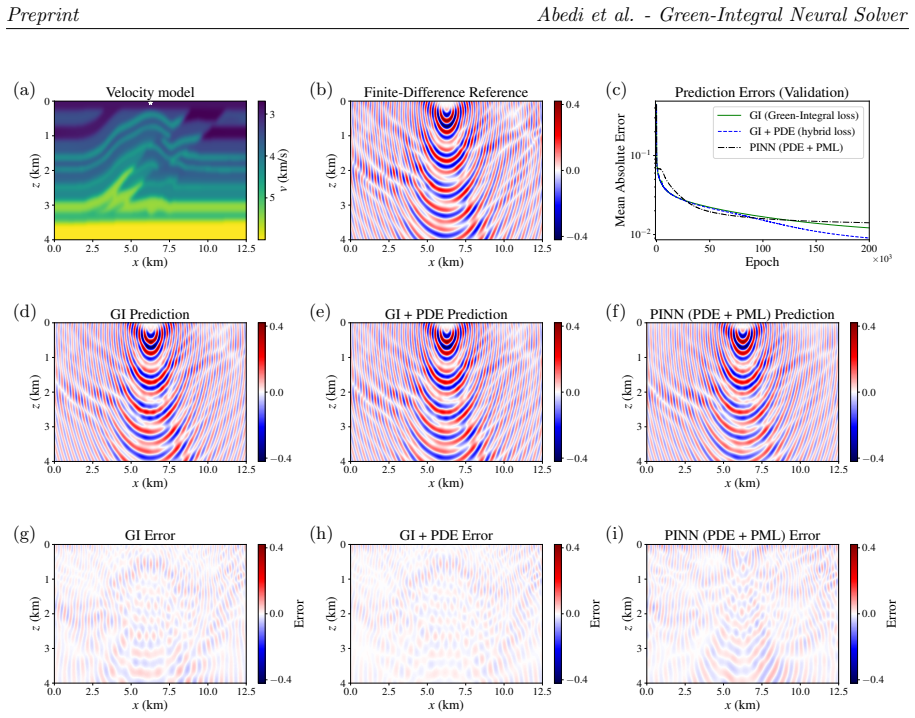
- GI-based training reduces computational cost by over a factor of ten relative to standard PDE-residual PINNs on seismic benchmark models.
- The hybrid GI+PDE loss produces the most accurate reconstructions precisely when scattering is localized.
- Outgoing radiation and oscillatory behavior are enforced without artificial absorbing boundary layers because they are built into the integral kernel.
- The formulation converges in regimes of strong contrast where the Born series diverges because it acts as a preconditioned iteration.
Where Pith is reading between the lines
- The fixed-grid FFT step could be combined with adaptive local refinement to restore fine-scale resolution in strong-scattering zones while retaining most of the speed gain.
- The same integral-constraint idea may transfer to other linear wave problems whose fundamental solutions are known, such as Maxwell or elastic equations, by swapping the kernel.
- Because the method already avoids second derivatives, it could be paired with graph or mesh-free networks to handle irregular domains without the usual PINN boundary-layer overhead.
Load-bearing premise
The Green-integral representation on a fixed regular grid encodes the correct outgoing radiation and oscillatory behavior in heterogeneous media without extra boundary corrections or grid-adaptation steps.
What would settle it
A test showing that the network output trained with the Green-integral loss violates the original Helmholtz PDE by more than the reported error tolerance at a dense set of interior points, or that the claimed factor-of-ten speedup disappears on the same seismic models when grid resolution is increased.
Figures



read the original abstract
Standard physics-informed neural networks (PINNs) struggle to simulate highly oscillatory Helmholtz solutions in heterogeneous media because pointwise minimization of second-order PDE residuals is computationally expensive, biased toward smooth solutions, and requires artificial absorbing boundary layers to restrict the solution. To overcome these challenges, we introduce a Green-Integral (GI) neural solver for the acoustic Helmholtz equation. It departs from the PDE-residual-based formulation by enforcing wave physics through an integral representation that imposes a nonlocal constraint. Oscillatory behavior and outgoing radiation are encoded directly through the integral kernel, eliminating second-order spatial derivatives and enforcing physical solutions without additional boundary layers. Theoretically, optimizing this GI loss via a neural network acts as a spectrally tuned preconditioned iteration, enabling convergence in heterogeneous media where the classical Born series diverges. By exploiting FFT-based convolution to accelerate the GI loss evaluation, our approach substantially reduces GPU memory usage and training time. However, this efficiency relies on a fixed regular grid, which can limit local resolution. To improve local accuracy in strong scattering regions, we also propose a hybrid GI+PDE loss, enforcing a lightweight Helmholtz residual at a small number of nonuniformly sampled collocation points. We evaluate our method on seismic benchmark models characterized by structural contrasts and subwavelength heterogeneity at frequencies up to 20Hz. GI-based training consistently outperforms PDE-based PINNs, reducing computational cost by over a factor of ten. In models with localized scattering, the hybrid loss yields the most accurate reconstructions, providing a stable, efficient, and physically grounded alternative.
Editorial analysis
A structured set of objections, weighed in public.
Referee Report
Summary. The manuscript introduces a Green-Integral (GI) neural solver for the acoustic Helmholtz equation in heterogeneous media. It replaces pointwise PDE residual minimization with a nonlocal integral constraint based on the Lippmann-Schwinger equation using the free-space Green's function, discretized via FFT convolution on a fixed regular grid. A hybrid GI+PDE loss is proposed to improve local accuracy in strong scattering regions. The approach is evaluated on seismic benchmark models with structural contrasts and subwavelength heterogeneity at frequencies up to 20 Hz, claiming consistent outperformance over PDE-based PINNs with over 10x reduction in computational cost, and best accuracy from the hybrid loss in localized scattering cases.
Significance. If the performance claims and physical fidelity hold, the work provides a potentially impactful alternative to standard PINNs for oscillatory wave problems in geophysics by directly encoding outgoing radiation conditions without artificial boundary layers and leveraging FFT acceleration for efficiency. The theoretical framing as a spectrally tuned preconditioned iteration is a notable conceptual contribution, though it requires stronger support.
major comments (3)
- [Method and discretization of GI loss] The core claim that GI-based training enforces wave physics accurately and outperforms PDE-PINNs relies on the FFT-discretized Lippmann-Schwinger integral being a faithful constraint. However, on a fixed regular grid this discretization can introduce aliasing or quadrature errors for subwavelength contrasts at up to 20 Hz, making the loss a perturbed rather than exact residual. This is load-bearing for the headline efficiency and accuracy results; please add grid-convergence studies, discretization-error bounds, or comparisons against a higher-resolution reference solver in the numerical experiments section.
- [Numerical experiments and results] The abstract asserts 'GI-based training consistently outperforms PDE-based PINNs, reducing computational cost by over a factor of ten' and that 'the hybrid loss yields the most accurate reconstructions,' yet the provided text supplies no quantitative error metrics, timing tables, or convergence plots. Without these, the central empirical claim cannot be verified; include explicit L2-error tables, wall-clock times, memory usage, and statistical significance tests across the seismic benchmarks.
- [Theoretical motivation] The statement that 'optimizing this GI loss via a neural network acts as a spectrally tuned preconditioned iteration, enabling convergence in heterogeneous media where the classical Born series diverges' is presented without a derivation or supporting analysis. This theoretical motivation is central to the departure from PDE-PINNs; provide a brief proof sketch or spectral analysis showing the preconditioning effect.
minor comments (2)
- [Abstract and introduction] The title references 'Stochastic Physics-Informed Regularization' but the abstract does not describe its implementation or role; clarify this component and its interaction with the GI loss.
- [Notation] Notation for the Green's function, integral operator, and collocation points should be defined once and used consistently; add a nomenclature table if the manuscript is long.
Simulated Author's Rebuttal
We thank the referee for the constructive and detailed feedback, which has helped us strengthen the manuscript. We address each major comment point by point below. Revisions have been made to incorporate additional analysis, data, and clarifications where the concerns are valid, without altering the core contributions.
read point-by-point responses
-
Referee: [Method and discretization of GI loss] The core claim that GI-based training enforces wave physics accurately and outperforms PDE-PINNs relies on the FFT-discretized Lippmann-Schwinger integral being a faithful constraint. However, on a fixed regular grid this discretization can introduce aliasing or quadrature errors for subwavelength contrasts at up to 20 Hz, making the loss a perturbed rather than exact residual. This is load-bearing for the headline efficiency and accuracy results; please add grid-convergence studies, discretization-error bounds, or comparisons against a higher-resolution reference solver in the numerical experiments section.
Authors: We agree that the FFT discretization on a fixed grid introduces a potential source of error that merits explicit quantification, particularly for subwavelength features. The original manuscript selected grid resolutions to satisfy the Nyquist criterion for the maximum frequency and heterogeneity scale (Section 3), but did not include dedicated convergence analysis. In the revised version, we have added grid-convergence studies in the numerical experiments section, reporting L2 errors on successively refined grids for representative benchmarks and demonstrating stabilization at the resolutions employed. We also include direct comparisons against a high-resolution finite-difference reference solver to bound the discretization error of the GI loss. revision: yes
-
Referee: [Numerical experiments and results] The abstract asserts 'GI-based training consistently outperforms PDE-based PINNs, reducing computational cost by over a factor of ten' and that 'the hybrid loss yields the most accurate reconstructions,' yet the provided text supplies no quantitative error metrics, timing tables, or convergence plots. Without these, the central empirical claim cannot be verified; include explicit L2-error tables, wall-clock times, memory usage, and statistical significance tests across the seismic benchmarks.
Authors: The full manuscript already contains L2-error tables and wall-clock timing comparisons in Section 4 for all seismic benchmarks, supporting the abstract claims. However, we acknowledge that these were not presented with sufficient prominence or additional detail (e.g., memory footprints and statistical tests). We have revised the section to expand the tables with explicit memory usage, add convergence plots versus training iterations, and include paired statistical significance tests across repeated runs with different random seeds. These changes make the empirical evidence fully verifiable. revision: yes
-
Referee: [Theoretical motivation] The statement that 'optimizing this GI loss via a neural network acts as a spectrally tuned preconditioned iteration, enabling convergence in heterogeneous media where the classical Born series diverges' is presented without a derivation or supporting analysis. This theoretical motivation is central to the departure from PDE-PINNs; provide a brief proof sketch or spectral analysis showing the preconditioning effect.
Authors: We recognize that the spectral-preconditioning interpretation was offered as conceptual motivation without a formal derivation in the original submission. This framing arises from viewing the GI operator as a compact perturbation of the identity whose spectrum is better conditioned than the differential operator. In the revised manuscript, we have inserted a concise proof sketch in Section 2 that analyzes the eigenvalues of the discretized Lippmann-Schwinger operator for a model heterogeneous medium and shows how gradient-based optimization of the GI loss effectively damps the divergent modes of the classical Born iteration. A short spectral plot for a 1-D contrast example is included to illustrate the effect. revision: yes
Circularity Check
No significant circularity; derivation and claims are self-contained
full rationale
The paper introduces a Green-integral loss for Helmholtz PINNs, justifies its properties from the Lippmann-Schwinger representation and FFT convolution (independent of the target performance numbers), and reports empirical speed/accuracy gains on seismic benchmarks. No equation or claim reduces by construction to a fitted parameter, renamed input, or self-citation chain; the hybrid loss is presented as an optional extension rather than a redefinition of the GI method. The grid-resolution caveat is acknowledged explicitly and does not render the core derivation tautological.
Axiom & Free-Parameter Ledger
axioms (1)
- domain assumption Green's integral representation holds and encodes outgoing radiation for the acoustic Helmholtz equation in heterogeneous media
Reference graph
Works this paper leans on
-
[1]
P-SV wave propagation in heterogeneous media: Velocity-stress finite-difference method , author=. Geophysics , volume=. 1986 , publisher=
work page 1986
-
[2]
Accuracy of finite-difference and finite-element modeling of the scalar and elastic wave equations , author=. Geophysics , volume=. 1984 , publisher=
work page 1984
- [3]
-
[4]
Dispersive and dissipative behaviour of high order discontinuous
Ainsworth, Mark , journal=. Dispersive and dissipative behaviour of high order discontinuous. 2004 , publisher=
work page 2004
-
[5]
Raissi, M. and Perdikaris, P. and Karniadakis, G. E. , title =. Journal of Computational Physics , volume =. 2019 , doi =
work page 2019
-
[6]
Tancik, M. and Srinivasan, P. P. and Mildenhall, B. and Fridovich-Keil, S. and Raghavan, N. and Singh, S. and Lindell, D. B. and Ng, R. , title =. Advances in Neural Information Processing Systems (NeurIPS) , year =
-
[7]
Lu, L. and Meng, X. and Mao, Z. and Karniadakis, G. E. , title =. SIAM Review , volume =. 2021 , doi =
work page 2021
-
[8]
Cyr, E. C. and Lan, Y. and Xu, J. , title =. SIAM Journal on Scientific Computing , volume =. 2020 , doi =
work page 2020
-
[9]
Digital acoustics: processing wave fields in space and time using
Pinto, Francisco and Kolund. Digital acoustics: processing wave fields in space and time using. APSIPA Transactions on Signal and Information Processing , volume=. 2014 , publisher=
work page 2014
-
[10]
Wavefield solutions from machine learned functions constrained by the
Alkhalifah, Tariq and Song, Chao and bin Waheed, Umair and Hao, Qi , journal=. Wavefield solutions from machine learned functions constrained by the. 2021 , publisher=
work page 2021
-
[11]
Physics-informed neural wavefields with Gabor basis functions , author=. Neural Networks , volume=. 2024 , publisher=
work page 2024
-
[12]
Journal of the Institution of Electrical Engineers - Part I: General , year=
Theory of communication , author=. Journal of the Institution of Electrical Engineers - Part I: General , year=
-
[13]
Vaswani, A. and Shazeer, N. and Parmar, N. and Uszkoreit, J. and Jones, L. and Gomez, A. N. and Kaiser,. Attention is all you need , year =. Proceedings of the 31st International Conference on Neural Information Processing Systems , pages =
-
[14]
SEG International Exposition and Annual Meeting , pages=
A modified physics-informed neural network with positional encoding , author=. SEG International Exposition and Annual Meeting , pages=. 2021 , organization=
work page 2021
-
[15]
Mathematische Annalen , volume=
On the partial difference equations of mathematical physics , author=. Mathematische Annalen , volume=
-
[16]
Seismic waveform inversion in the frequency domain, Part 1: Theory and verification in a physical scale model , author=. Geophysics , volume=. 1999 , publisher=
work page 1999
-
[17]
Efficient waveform inversion and imaging: A strategy for selecting temporal frequencies , author=. Geophysics , volume=. 2004 , publisher=
work page 2004
-
[18]
Wu, Zedong and Alkhalifah, Tariq , journal=. An efficient. 2018 , publisher=
work page 2018
-
[19]
Seismic inversion using artificial neural networks , author=. Geophysics , volume=
-
[20]
Stochastic seismic wavefield simulation using deep learning , author=. Geophysics , volume=
-
[21]
Geophysical Prospecting , volume=
Machine learning-based classification of seismic faults , author=. Geophysical Prospecting , volume=
-
[22]
Deep learning in seismic processing: Applications and challenges , author=. The Leading Edge , volume=
-
[23]
Geophysical Prospecting , volume=
Deep learning for wavefield propagation: Initial tests , author=. Geophysical Prospecting , volume=
-
[24]
Neural networks for acoustic wave propagation , author=. Geophysics , volume=
-
[25]
Gradient-optimized physics-informed neural networks (GO
Li, Jiaheng and Chen, Junchao and Li, Biao , journal=. Gradient-optimized physics-informed neural networks (GO. 2022 , publisher=
work page 2022
-
[26]
Journal of Machine Learning Research , volume=
Automatic differentiation in machine learning: A survey , author=. Journal of Machine Learning Research , volume=
-
[27]
Journal of Computational and Applied Mathematics , volume=
Constructive approximate interpolation by neural networks , author=. Journal of Computational and Applied Mathematics , volume=. 2006 , publisher=
work page 2006
-
[28]
Journal of Computational Physics , volume=
Parallel physics-informed neural networks via domain decomposition , author=. Journal of Computational Physics , volume=
-
[29]
Is it time to swish? Comparing activation functions in solving the
Al Safwan, Ali and Song, Chao and Waheed, U Bin , booktitle=. Is it time to swish? Comparing activation functions in solving the. 2021 , organization=
work page 2021
-
[30]
Journal of Computational Physics , volume=
Efficient physics-informed neural networks using hash encoding , author=. Journal of Computational Physics , volume=. 2024 , publisher=
work page 2024
-
[31]
Gabor functions for wavefield modeling , author=. Geophysics , volume=
-
[32]
Huang, Xinquan and Alkhalifah, Tariq , journal=. Gabor. 2023 , publisher=
work page 2023
-
[33]
A modern take on the bias-variance tradeoff in neural networks,
A modern take on the bias-variance tradeoff in neural networks , author=. arXiv preprint arXiv:1810.08591 , year=
-
[34]
Solving the frequency-domain acoustic
Song, Chao and Alkhalifah, Tariq and Waheed, Umair Bin , journal=. Solving the frequency-domain acoustic. 2021 , publisher=
work page 2021
-
[35]
Geophysical Journal International , volume=
Simulating seismic multifrequency wavefields with the Fourier feature physics-informed neural network , author=. Geophysical Journal International , volume=. 2023 , publisher=
work page 2023
-
[36]
Wu, Yanqi and Aghamiry, Hossein S and Operto, Stephane and Ma, Jianwei , journal=. 2023 , publisher=
work page 2023
-
[37]
Physics-informed neural networks (
Rasht-Behesht, Majid and Huber, Christian and Shukla, Khemraj and Karniadakis, George Em , journal=. Physics-informed neural networks (. 2022 , publisher=
work page 2022
-
[38]
Mathematical and Scientific Machine Learning , pages=
Robust training and initialization of deep neural networks: An adaptive basis viewpoint , author=. Mathematical and Scientific Machine Learning , pages=. 2020 , organization=
work page 2020
-
[39]
On the eigenvector bias of Fourier feature networks: From regression to solving multi-scale
Wang, Sifan and Wang, Hanwen and Perdikaris, Paris , journal=. On the eigenvector bias of Fourier feature networks: From regression to solving multi-scale. 2021 , publisher=
work page 2021
-
[40]
IEEE Transactions on Artificial Intelligence , volume=
Learning in sinusoidal spaces with physics-informed neural networks , author=. IEEE Transactions on Artificial Intelligence , volume=. 2022 , publisher=
work page 2022
-
[41]
Hybrid acceleration techniques for the physics-informed neural networks: a comparative analysis , author=. Machine Learning , volume=. 2024 , publisher=
work page 2024
-
[42]
Journal of computational physics , volume=
A perfectly matched layer for the absorption of electromagnetic waves , author=. Journal of computational physics , volume=. 1994 , publisher=
work page 1994
-
[43]
An optimal 9-point finite difference scheme for the
Chen, Zhongying and Cheng, Dongsheng and Feng, Wei and Wu, Tingting , journal=. An optimal 9-point finite difference scheme for the
-
[44]
A versatile framework to solve the
Song, Chao and Alkhalifah, Tariq and Waheed, Umair Bin , journal=. A versatile framework to solve the. 2022 , publisher=
work page 2022
-
[45]
Advances in neural information processing systems , volume=
Fourier features let networks learn high frequency functions in low dimensional domains , author=. Advances in neural information processing systems , volume=
-
[46]
IEEE Transactions on Geoscience and Remote Sensing , year=
Seismic traveltime simulation for variable velocity models using physics-informed Fourier neural operator , author=. IEEE Transactions on Geoscience and Remote Sensing , year=
-
[47]
Learning nonlinear operators via
Lu, Lu and Jin, Pengzhan and Pang, Guofei and Zhang, Zhongqiang and Karniadakis, George Em , journal=. Learning nonlinear operators via. 2021 , publisher=
work page 2021
-
[48]
Kronecker neural networks overcome spectral bias for
Waheed, Umair Bin , journal=. Kronecker neural networks overcome spectral bias for. 2022 , publisher=
work page 2022
-
[49]
Journal of Geophysical Research: Solid Earth , volume=
FWIGAN: Full-waveform inversion via a physics-informed generative adversarial network , author=. Journal of Geophysical Research: Solid Earth , volume=. 2023 , publisher=
work page 2023
-
[50]
IEEE Transactions on Geoscience and Remote Sensing , year=
Overcoming the spectral bias problem of physics-informed neural networks in solving the frequency-domain acoustic wave equation , author=. IEEE Transactions on Geoscience and Remote Sensing , year=
-
[51]
IEEE Transactions on Geoscience and Remote Sensing , year=
Seismic wavefields modeling with variable horizontally-layered velocity models via velocity-encoded PINN , author=. IEEE Transactions on Geoscience and Remote Sensing , year=
-
[52]
Gabor-Enhanced Physics-Informed Neural Networks for Fast Simulations of Acoustic Wavefields , author=. Neural Networks , volume =. 2026 , issn =
work page 2026
-
[53]
Versteeg, Roelof , journal=. The. 1994 , publisher=
work page 1994
-
[54]
Journal of Scientific Computing , volume=
Scientific machine learning through physics--informed neural networks: Where we are and what’s next , author=. Journal of Scientific Computing , volume=. 2022 , publisher=
work page 2022
-
[55]
Comparing numerical methods for
El-Sayed, Salah M and Kaya, Doǧan , journal=. Comparing numerical methods for. 2004 , publisher=
work page 2004
-
[56]
Sirgue, L and Etgen, JT and Albertin, U , booktitle=. 2008 , organization=
work page 2008
-
[57]
Gabor-wavelet-activation implicit neural learning for full waveform inversion , author=. Geophysics , volume=. 2025 , publisher=
work page 2025
-
[58]
A Helmholtz iterative solver for 3D seismic-imaging problems , author=. Geophysics , volume=. 2007 , publisher=
work page 2007
-
[59]
Surveys in Geophysics , pages=
Meta learning for improved neural network wavefield solutions , author=. Surveys in Geophysics , pages=. 2025 , publisher=
work page 2025
-
[60]
Integral equation methods in scattering theory , author=. 2013 , publisher=
work page 2013
-
[61]
Variational principles for scattering processes. I , author=. Physical Review , volume=. 1950 , publisher=
work page 1950
-
[62]
IEEE Transactions on Geoscience and Remote Sensing , year=
Physics-informed neural networks with Fourier features for seismic wavefield simulation in time-domain nonsmooth complex media , author=. IEEE Transactions on Geoscience and Remote Sensing , year=
-
[63]
Least-squares-embedded optimization for accelerated convergence of PINNs in high-frequency acoustic wavefield simulations , journal =. 2026 , url =
work page 2026
-
[64]
Computer Methods in Applied Mechanics and Engineering , volume=
A comprehensive study of non-adaptive and residual-based adaptive sampling for physics-informed neural networks , author=. Computer Methods in Applied Mechanics and Engineering , volume=. 2023 , publisher=
work page 2023
-
[65]
DeepXDE: A deep learning library for solving differential equations , author=. SIAM review , volume=. 2021 , publisher=
work page 2021
-
[66]
Computer-Aided Civil and Infrastructure Engineering , volume=
Efficient training of physics-informed neural networks via importance sampling , author=. Computer-Aided Civil and Infrastructure Engineering , volume=. 2021 , publisher=
work page 2021
-
[67]
Advances in neural information processing systems , volume=
Implicit neural representations with periodic activation functions , author=. Advances in neural information processing systems , volume=
-
[68]
Journal of computational physics , volume=
Efficient physics-informed neural networks using hash encoding , author=. Journal of computational physics , volume=. 2024 , publisher=
work page 2024
-
[69]
SIAM Journal on Scientific Computing , volume=
Understanding and mitigating gradient flow pathologies in physics-informed neural networks , author=. SIAM Journal on Scientific Computing , volume=. 2021 , publisher=
work page 2021
-
[70]
Artificial Intelligence Review , volume=
Physics-informed neural networks for PDE problems: A comprehensive review , author=. Artificial Intelligence Review , volume=. 2025 , publisher=
work page 2025
-
[71]
Proceedings of the Royal Society A: Mathematical, Physical and Engineering Sciences , volume=
Locally adaptive activation functions with slope recovery for deep and physics-informed neural networks , author=. Proceedings of the Royal Society A: Mathematical, Physical and Engineering Sciences , volume=. 2020 , publisher=
work page 2020
-
[72]
Computer Methods in Applied Mechanics and Engineering , volume=
hp-VPINNs: Variational physics-informed neural networks with domain decomposition , author=. Computer Methods in Applied Mechanics and Engineering , volume=. 2021 , publisher=
work page 2021
-
[73]
Advances in neural information processing systems , volume=
Characterizing possible failure modes in physics-informed neural networks , author=. Advances in neural information processing systems , volume=
-
[74]
ACM transactions on graphics (TOG) , volume=
Instant neural graphics primitives with a multiresolution hash encoding , author=. ACM transactions on graphics (TOG) , volume=. 2022 , publisher=
work page 2022
-
[75]
SEG/EAEG 3-D modeling project: 2nd update , author=. The Leading Edge , volume=. 1994 , publisher=
work page 1994
-
[76]
EAEG workshop-practical aspects of seismic data inversion , pages=
Marmousi, model and data , author=. EAEG workshop-practical aspects of seismic data inversion , pages=. 1990 , organization=
work page 1990
-
[77]
Advances in neural information processing systems , volume=
Neural tangent kernel: Convergence and generalization in neural networks , author=. Advances in neural information processing systems , volume=
-
[78]
Computer Methods in Applied Mechanics and Engineering , volume=
A nonlocal physics-informed deep learning framework using the peridynamic differential operator , author=. Computer Methods in Applied Mechanics and Engineering , volume=. 2021 , publisher=
work page 2021
-
[79]
Computers & Geosciences , volume=
PINNeik: Eikonal solution using physics-informed neural networks , author=. Computers & Geosciences , volume=. 2021 , publisher=
work page 2021
-
[80]
Computers & Mathematics with Applications , volume=
r-Adaptive deep learning method for solving partial differential equations , author=. Computers & Mathematics with Applications , volume=. 2024 , publisher=
work page 2024
discussion (0)
Sign in with ORCID, Apple, or X to comment. Anyone can read and Pith papers without signing in.