Field-driven phases in a three-dimensional twisted Kitaev model for CoNb₂O₆: Interplay of frustration and spin-orbit coupling
Pith reviewed 2026-05-08 14:13 UTC · model grok-4.3
The pith
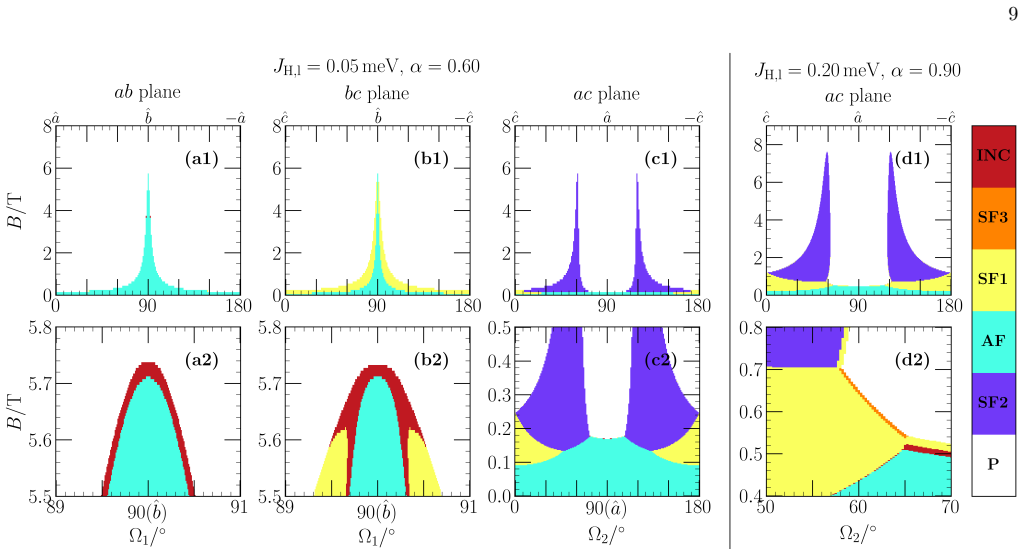
In the three-dimensional twisted Kitaev model for CoNb2O6, spin-orbit coupling renders the sequence of field-driven phases extremely sensitive to tiny changes in field direction.
A machine-rendered reading of the paper's core claim, the machinery that carries it, and where it could break.
Core claim
The three-dimensional twisted Kitaev model for CoNb2O6 exhibits a sequence of field-driven phases whose stability and character depend critically on the precise direction of the applied magnetic field because of spin-orbit coupling; semiclassical calculations map out commensurate and incommensurate inter-chain orders and yield static observables plus excitation spectra that can be compared with experiment.
What carries the argument
Semiclassical zero-temperature treatment of the three-dimensional twisted Kitaev Hamiltonian that includes both intra-chain Kitaev terms and frustrated inter-chain couplings, used to minimize energy for arbitrary field directions.
Load-bearing premise
The semiclassical approximation at zero temperature captures the sequence of field-driven phases without needing full quantum fluctuations.
What would settle it
Measure the magnetic order or transition fields in CoNb2O6 while rotating the applied field by a few degrees; if the observed phases and boundaries remain essentially unchanged, the claimed extreme angle sensitivity does not hold.
Figures




read the original abstract
The Ising chain in a transverse field stands out as a paradigmatic example for a quantum phase transition. CoNb$_2$O$_6$ has been discussed as a material realization of this physics, but it was later realized that its magnetic exchange couplings are more complicated, taking the form of twisted Kitaev chains. Here we study a three-dimensional model for CoNb$_2$O$_6$, taking into account both Kitaev physics and frustrated inter-chain coupling, in applied magnetic field. Using semiclassical techniques at zero temperature, we map out the sequence of field-driven phases for arbitrary field direction; these include phases with commensurate and incommensurate inter-chain order. As a result of spin-orbit coupling, the phase diagram is extremely sensitive to small changes in the field angle. We compute static observables as well as magnetic excitation spectra in the various phases and connect our results to existing experimental data.
Editorial analysis
A structured set of objections, weighed in public.
Referee Report
Summary. The manuscript studies a three-dimensional twisted Kitaev model for CoNb₂O₆ that incorporates frustrated inter-chain couplings and spin-orbit effects in an applied magnetic field. Using semiclassical zero-temperature energy minimization, it maps the sequence of field-driven phases for arbitrary field directions, identifying both commensurate and incommensurate inter-chain ordered phases, and reports that the phase diagram is extremely sensitive to small changes in field angle due to spin-orbit coupling. Static observables and magnetic excitation spectra are computed in the various phases and compared to existing experimental data on the material.
Significance. If the semiclassical approximation is reliable, the work supplies a concrete phase diagram that isolates the interplay between Kitaev frustration, inter-chain couplings, and spin-orbit coupling, offering a useful reference for interpreting field-angle-dependent measurements in CoNb₂O₆ and related quasi-one-dimensional spin-orbit-coupled magnets.
major comments (1)
- [Abstract] Abstract: the central claim that 'the phase diagram is extremely sensitive to small changes in the field angle' rests entirely on classical energy minimization of the 3D twisted Kitaev Hamiltonian. No estimate of quantum fluctuation corrections (e.g., spin-wave theory, 1/S expansion, or quantum Monte Carlo) is provided to test whether the reported angular sensitivity and the locations of incommensurate ordering vectors survive quantization, even though the Kitaev terms are intrinsically quantum and the model is frustrated.
minor comments (1)
- The abstract states that 'semiclassical techniques at zero temperature' are used but does not specify the precise minimization algorithm, the treatment of incommensurate wave-vectors, or any convergence checks; this information should be added to the methods section for reproducibility.
Simulated Author's Rebuttal
We thank the referee for their careful reading and constructive feedback on our manuscript. We address the major comment regarding the semiclassical approximation and quantum fluctuations below, and propose targeted revisions to the text.
read point-by-point responses
-
Referee: [Abstract] Abstract: the central claim that 'the phase diagram is extremely sensitive to small changes in the field angle' rests entirely on classical energy minimization of the 3D twisted Kitaev Hamiltonian. No estimate of quantum fluctuation corrections (e.g., spin-wave theory, 1/S expansion, or quantum Monte Carlo) is provided to test whether the reported angular sensitivity and the locations of incommensurate ordering vectors survive quantization, even though the Kitaev terms are intrinsically quantum and the model is frustrated.
Authors: We acknowledge that our analysis relies on semiclassical zero-temperature energy minimization, which is a standard and computationally tractable approach for exploring the rich phase space of this frustrated 3D model with spin-orbit coupling. The extreme angular sensitivity arises directly from the anisotropic Kitaev interactions in the Hamiltonian, a classical feature that we expect to remain qualitatively relevant in the quantum regime. While we agree that explicit estimates of quantum corrections (via spin-wave theory or otherwise) would be valuable to confirm the survival of incommensurate ordering vectors and the reported sensitivity, performing a full quantum treatment for the three-dimensional frustrated system lies beyond the scope of the present work. To address this point, we will revise the abstract for balance and add a dedicated paragraph in the discussion section that outlines the limitations of the semiclassical approximation, references prior semiclassical studies on related Kitaev materials, and provides a qualitative assessment of quantum effects based on linear spin-wave theory around representative classical states. This will clarify the status of our results as a useful reference for experiment while noting the need for future quantum calculations. revision: partial
Circularity Check
No circularity: phases obtained via independent semiclassical energy minimization of the input Hamiltonian.
full rationale
The derivation chain begins with the three-dimensional twisted Kitaev Hamiltonian (including spin-orbit terms) as an input model for CoNb2O6. Semiclassical zero-temperature minimization is then applied to this fixed energy functional to locate the sequence of commensurate and incommensurate phases as a function of field direction. This computational step produces the reported angle sensitivity as an output rather than presupposing it; no parameters are fitted to the target observables, no self-definitional loops exist, and no load-bearing self-citations or uniqueness theorems are invoked to force the result. The calculation remains self-contained and falsifiable against external experimental data.
Axiom & Free-Parameter Ledger
free parameters (2)
- twisted Kitaev and inter-chain exchange couplings
- magnetic field strength and direction
axioms (1)
- domain assumption Semiclassical approximation at zero temperature captures the essential ordering physics
Reference graph
Works this paper leans on
-
[1]
Sachdev,Quantum Phase Transitions, Cambridge Uni- versity Press, Cambridge (2011)
S. Sachdev,Quantum Phase Transitions, Cambridge Uni- versity Press, Cambridge (2011)
work page 2011
- [2]
-
[3]
I. Maartense, I. Yaeger, and B. M. Wanklyn, Solid State Commun.21, 93 (1977)
work page 1977
- [4]
-
[5]
Z. He, T. Taniyama, T. Kyomen, and M. Itoh, Phys. Rev. B72, 172403 (2005)
work page 2005
-
[6]
Z. Wang, T. Lorenz, D. I. Gorbunov, P. T. Cong, Y. Kohama, S. Niesen, O. Breunig, J. Engelmayer, A. Her- man, J. Wu, K. Kindo, J. Wosnitza, S. Zherlitsyn, and A. Loidl, Phys. Rev. Lett.120, 207205 (2018)
work page 2018
-
[7]
Y. Cui, H. Zou, N. Xi, Z. He, Y. X. Yang, L. Shu, G. H. Zhang, Z. Hu, T. Chen, R. Yu, J. Wu, and W. Yu, Phys. Rev. Lett.123, 067203 (2019)
work page 2019
-
[8]
H. M. Ronnow, R. Parthasarathy, J. Jensen, G. Aeppli, T. F. Rosenbaum, and D. F. McMorrow, Science308, 389 (2005)
work page 2005
- [9]
- [10]
-
[11]
A. W. Kinross, M. Fu, T. J. Munsie, H. A. Dabkowska, G. M. Luke, S. Sachdev, and T. Imai, Phys. Rev. X4, 031008 (2014)
work page 2014
- [12]
-
[13]
C. Heid, H. Weitzel, P. Burlet, M. Bonnet, W. Gon- schorek, T. Vogt, J. Norwig, and H. Fuess, J. Magn. Magn. Mater.151, 123 (1995)
work page 1995
-
[14]
C. Heid, H. Weitzel, P. Burlet, M. Winkelmann, H. Ehrenberg, and H. Fuess, Physica B234-236, 574 (1997)
work page 1997
-
[15]
C. M. Morris, N. Desai, J. Viirok, D. H¨ uvonen, U. Nagel, R. J. Cava, T. M. McQueen, S. M. Koohpayeh, R. K. Kaul, T. R˜ o˜ om, J. W. Krizan, and N. P. Armitage, Nat. Phys.17, 832 (2021)
work page 2021
- [16]
-
[17]
S. Lee, R. K. Kaul, and L. Balents, Nat. Phys.6, 702 (2010)
work page 2010
-
[18]
J. A. Ringler, A. I. Kolesnikov, and K. A. Ross, Phys. Rev. B105, 224421 (2022)
work page 2022
-
[19]
N. J. Robinson, F. H. L. Essler, I. Cabrera, and R. Coldea, Phys. Rev. B90, 174406 (2014)
work page 2014
-
[20]
I. Cabrera, J. D. Thompson, R. Coldea, D. Prabhakaran, R. I. Bewley, T. Guidi, J. A. Rodriguez-Rivera, and C. Stock, Phys. Rev. B90, 014418 (2014)
work page 2014
-
[21]
M. Fava, R. Coldea, and S. A. Parameswaran, Proc. Natl. Acad. Sci. U.S.A.117(41), 25219 (2020)
work page 2020
- [22]
-
[23]
L. Woodland, D. Macdougal, I. M. Cabrera, J. D. Thompson, D. Prabhakaran, R. I. Bewley, and R. Coldea, Phys. Rev. B108, 184416 (2023)
work page 2023
-
[24]
L. Woodland, I. Lovas, M. Telling, D. Prabhakaran, L. Balents, and R. Coldea, Phys. Rev. B108, 184417 (2023)
work page 2023
-
[25]
C. A. Gallegos and A. L. Chernyshev, Phys. Rev. B109, 014424 (2024)
work page 2024
- [26]
- [27]
-
[28]
A. A. Konieczna, D. A. S. Kaib, S. M. Winter, and R. Valent´ ı, npj Quantum Mater.10, 8 (2025)
work page 2025
-
[29]
P. W. C. Sarvezuk, E. J. Kinast, C. V. Colin, M. A. Gusm˜ ao, J. B. M. da Cunha, and O. Isnard, Phys. Rev. B83, 174412 (2011)
work page 2011
-
[30]
S. Kobayashi, S. Mitsuda, M. Ishikawa, K. Miyatani, and K. Kohn, Phys. Rev. B60, 3331 (1999)
work page 1999
- [31]
-
[32]
S. Kobayashi, H. Okano, T. Jogetsu, J. Miyamoto, and S. Mitsuda, Phys Rev. B69, 144430 (2004)
work page 2004
- [33]
- [34]
-
[35]
S. M. Winter, A. A Tsirlin, M. Daghofer, J. van den Brink, Y. Singh, P. Gegenwart, and R. Valent´ ı, J. Phys.: Condens. Matter29, 493002 (2017)
work page 2017
- [36]
-
[37]
H. Weitzel, H. Ehrenberg, C. Heid, H. Fuess, and P. Burlet, Phys. Rev. B62, 12146 (2000)
work page 2000
-
[38]
T. Kunimoto, K. Nagasaka, H. Nojiri, S. Luther, M. Mo- tokawa, H. Ohta, T. Goto, S. Okubo, and K. Kohn, J. Phys. Soc. Jpn.68, 1703 (1999)
work page 1999
-
[39]
We note that thegtensor in the first column of Table III slightly deviates from the one given in Eq. (18) of the Supplement of Ref. 28. The latter is asymmetric and the principal axis ˆYdoes not align with thebaxis; most likely due to a conversion or printing error
-
[40]
P. W. C. Sarvezuk, E. J. Kinast, C. V. Colin, M. A. Gusm˜ ao, J. B. M. da Cunha, and O. Isnard, J. Appl. Phys.109, 07E160 (2011). 16
work page 2011
-
[41]
The estimateJ H,l = 0.1 meV also appears roughly con- sistent with the fact that the zero-field N´ eel temperature isT AF = 1.97 K [13] if one assumesJ H,l ∼ 1 2 kBTAF
- [42]
-
[43]
E. R. Mucciolo, A. H. Castro Neto, and C. Chamon, Phys. Rev. B69, 214424 (2004)
work page 2004
-
[44]
A. G. DelMaestro and M. J. P. Gingras, J. Phys.: Con- dens. Matter16, 3339 (2004)
work page 2004
-
[45]
S. Mitsuda, K. Hosoya, T. Wada, H. Yoshizawa, T. Hanawa, M. Ishikawa, K. Miyatani, K. Saito, and K. Kohn, J. Phys. Soc. Jpn.63, 3568 (1994)
work page 1994
-
[46]
C. L. Sarkis, S. S¨ aubert, V. Williams, E. S. Choi, T. R. Reeder, H. S. Nair, and K. A. Ross, Phys. Rev. B104, 214424 (2021)
work page 2021
- [47]
-
[48]
C. M. Morris, R. V. Aguilar, A. Ghosh, S. M. Koohpayeh, J. Krizan, R. J. Cava, O. Tchernyshyov, T. M. McQueen, and N. P. Armitage, Phys. Rev. Lett.112, 137403 (2014)
work page 2014
- [49]
-
[50]
37 also predict that SF2 extends to large fields for intermediate directions in the acplane
The model calculations of Ref. 37 also predict that SF2 extends to large fields for intermediate directions in the acplane. Notably, their model is not based on pseu- dospins 1/2, but includes the effect of higher CEF levels which effectively contain the alternating Ising axes of the chains
- [51]
- [52]
- [53]
- [54]
-
[55]
J. A. Kj¨ all, F. Pollmann, and J. E. Moore, Phys. Rev. B 83, 020407 (2011)
work page 2011
-
[56]
P. M. Chaikin and T. C. Lubensky,Principles of Con- densed Matter Physics, Cambridge University Press, Cambridge (2000)
work page 2000
- [57]
- [58]
-
[59]
P. O. L¨ owdin, J. Chem. Phys.18, 365 (1950)
work page 1950
-
[60]
P. O. L¨ owdin, Adv. Quantum Chem.5, 185 (1970)
work page 1970
discussion (0)
Sign in with ORCID, Apple, or X to comment. Anyone can read and Pith papers without signing in.