Maximum Weight Independent Set in Hereditary Classes of Ordered Graphs
Pith reviewed 2026-05-08 01:31 UTC · model grok-4.3
The pith
For every ordered graph H, MWIS on H-free ordered graphs is polynomial, quasipolynomial, subexponential, or NP-hard, with subexponential time only for one specific family of H.
A machine-rendered reading of the paper's core claim, the machinery that carries it, and where it could break.
Core claim
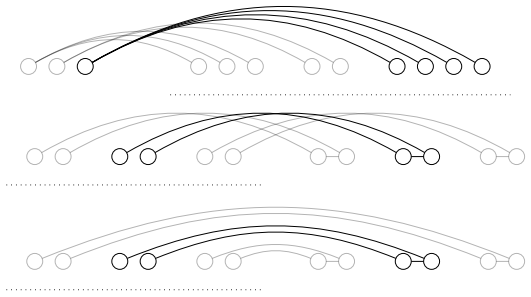
The authors prove that for every ordered graph H, the Maximum Weight Independent Set problem on ordered graphs excluding H as an induced subgraph is solvable in polynomial time, quasipolynomial time, subexponential time, or is NP-hard. The subexponential case arises only for one well-structured family of forbidden graphs H, namely those obtained from two nested edges by adding isolated vertices in a specific way. As a direct consequence, apart from this family the problem is either solvable in quasipolynomial time or NP-hard, yielding an almost complete complexity dichotomy for MWIS in hereditary classes of ordered graphs defined by a single forbidden induced subgraph.
What carries the argument
The forbidden ordered graph H, whose structural form (specifically membership in the two-nested-edges family with prescribed isolated vertices) determines whether MWIS is polynomial, quasipolynomial, subexponential, or NP-hard.
Load-bearing premise
The input consists of ordered graphs whose linear vertex ordering is fixed and given as part of the instance, and the hereditary class is defined by excluding exactly one ordered graph H as an induced subgraph.
What would settle it
An ordered graph H outside the two-nested-edges-plus-isolates family for which MWIS on H-free ordered graphs admits neither a quasipolynomial-time algorithm nor an NP-hardness proof, or conversely an H inside that family for which the problem requires super-quasipolynomial yet subexponential time.
Figures




read the original abstract
The complexity of classical computational problems in graph classes defined by forbidding induced subgraphs is one of the central topics of algorithmic graph theory. Recently, there has been a growing interest in the complexity of such problems in ordered graphs, i.e., graphs with a fixed linear ordering of vertices. Such an approach allows us to investigate the boundary of tractability more closely. However, most results so far concern coloring problems. In this paper, we focus on the complexity of the Maximum Weight Independent Set (MWIS) problem in classes of ordered graphs. For every ordered graph $H$, we classify the complexity of MWIS in ordered graphs that exclude $H$ as an induced subgraph into one of the following cases: (1) solvable in polynomial time, (2) solvable in quasipolynomial time, (3) solvable in subexponential time, (4) NP-hard. Notably, case (3) contains only one well-structured family of $H$ obtained from two nested edges by adding isolated vertices in a specific way. Thus, our results yield an almost complete complexity dichotomy for MWIS in classes of ordered graphs defined by a single forbidden induced subgraph into cases solvable in quasipolynomial time and those that are NP-hard.
Editorial analysis
A structured set of objections, weighed in public.
Referee Report
Summary. The manuscript classifies the complexity of Maximum Weight Independent Set (MWIS) on ordered graphs excluding a single ordered graph H as an induced subgraph. For every such H the problem falls into one of four regimes: polynomial-time solvable, quasipolynomial-time solvable, subexponential-time solvable (only for the specific family obtained from two nested edges by adding isolated vertices in a prescribed manner), or NP-hard. The result is presented as yielding an almost-complete dichotomy between the quasipolynomial and NP-hard cases.
Significance. If the classification is correct, the paper supplies a fine-grained complexity map for MWIS in hereditary classes of ordered graphs defined by a single forbidden induced ordered subgraph. This extends the existing literature on ordered graphs (previously focused mainly on coloring) and isolates the subexponential case to a single, explicitly described family, which is a structurally clean outcome. The work thereby sharpens the boundary between tractable and intractable regimes for this problem.
minor comments (3)
- [Abstract] Abstract, final sentence: the claim of a 'complete classification into four cases' is immediately followed by 'almost complete complexity dichotomy'; this tension should be resolved by a precise statement of what, if anything, remains open after the four-way partition.
- [Introduction] The formal definition of the 'two nested edges plus isolates' family (the sole subexponential case) appears only in the abstract; an early figure or a self-contained definition in Section 1 would improve readability for readers who wish to verify membership of a given H.
- [Preliminaries] Notation for ordered graphs and induced subgraphs is introduced gradually; a single consolidated notation paragraph or table at the beginning of the preliminaries would reduce cross-referencing.
Simulated Author's Rebuttal
We thank the referee for their positive assessment of the manuscript, including the summary of our classification results and the significance statement. The recommendation for minor revision is noted. No major comments were provided in the report.
Circularity Check
No significant circularity identified
full rationale
The paper presents a structural complexity classification of MWIS on ordered graphs excluding a single induced ordered subgraph H. The stated dichotomy (P, quasipolynomial, subexponential only for one explicit family of nested-edge-plus-isolates H, or NP-hard) is derived from case analysis on the structure of H rather than from any fitted parameter, self-defined quantity, or load-bearing self-citation that reduces the result to its own inputs. No equations, ansatzes, or predictions appear in the abstract or described claim; the classification is presented as a direct enumeration of cases. This matches the default expectation for a non-circular theoretical dichotomy in algorithmic graph theory.
Axiom & Free-Parameter Ledger
axioms (2)
- standard math Standard complexity-theoretic assumptions (P ≠ NP, subexponential time classes are distinct from polynomial and NP-hard regimes)
- domain assumption Ordered graphs are graphs with a fixed linear vertex ordering; induced subgraphs respect both edges and the ordering.
Reference graph
Works this paper leans on
-
[1]
Tara Abrishami, Maria Chudnovsky, Marcin Pilipczuk, Paweł Rzążewski, and Paul D. Seymour. Induced subgraphs of bounded treewidth and the container method.SIAM J. Comput., 53(3):624–647, 2024
work page 2024
-
[2]
Lima, Daniel Lokshtanov, Paweł Rzążewski, Saket Saurabh, and Roohani Sharma
Akanksha Agrawal, Paloma T. Lima, Daniel Lokshtanov, Paweł Rzążewski, Saket Saurabh, and Roohani Sharma. Odd Cycle Transversal onP 5-free graphs in polynomial time.ACM Trans. Algorithms, 21(2):16:1–16:14, 2025
work page 2025
- [3]
-
[4]
Chromatic number of ordered graphs with forbidden ordered subgraphs.Comb., 38(5):1021–1043, 2018
Maria Axenovich, Jonathan Rollin, and Torsten Ueckerdt. Chromatic number of ordered graphs with forbidden ordered subgraphs.Comb., 38(5):1021–1043, 2018
work page 2018
-
[5]
Gábor Bacsó, Daniel Lokshtanov, Dániel Marx, Marcin Pilipczuk, Zsolt Tuza, and Erik Jan van Leeuwen. Subexponential-time algorithms for maximum independent set inP t-free and broom-free graphs.Algorithmica, 81(2):421–438, 2019
work page 2019
-
[6]
Ramsey numbers of ordered graphs.Electron
Martin Balko, Josef Cibulka, Karel Král, and Jan Kyncl. Ramsey numbers of ordered graphs.Electron. J. Comb., 27(1):1, 2020
work page 2020
-
[7]
Frank R. Bernhart and Paul C. Kainen. The book thickness of a graph.Journal of Combinatorial Theory, Series B, 27(3):320–331, 1979
work page 1979
-
[8]
Saturation of ordered graphs.SIAM J
Vladimir Bošković and Balázs Keszegh. Saturation of ordered graphs.SIAM J. Discret. Math., 37(2):1118–1141, 2023
work page 2023
-
[9]
Maximum weight independent set forℓclaw-free graphs in polynomial time
Andreas Brandstädt and Raffaele Mosca. Maximum weight independent set forℓclaw-free graphs in polynomial time. Discret. Appl. Math., 237:57–64, 2018
work page 2018
-
[10]
Coloring ordered graphs with excluded induced ordered matchings
Marcin Briański, James Davies, and Bartosz Walczak. Coloring ordered graphs with excluded induced ordered matchings. Banff International Research Station. 22w5009: Extremal Combinatorics and Ge- ometry.https://www.birs.ca/events/2022/5-day-workshops/22w5009/videos/watch/ 202208161436-Walczak.html, 2022
work page 2022
-
[11]
Parinya Chalermsook, Marek Cygan, Guy Kortsarz, Bundit Laekhanukit, Pasin Manurangsi, Danupon Nanongkai, and Luca Trevisan. From Gap-Exponential Time Hypothesis to fixed parameter tractable inapproximability: Clique, dominating set, and more.SIAM J. Comput., 49(4):772–810, 2020. 32
work page 2020
-
[12]
Planar permutation graphs.Annales de l’institut Henri Poincaré, 6(4):433–438, 1967
Gary Chartrand and Frank Harary. Planar permutation graphs.Annales de l’institut Henri Poincaré, 6(4):433–438, 1967
work page 1967
-
[13]
Finding largeH-colorable subgraphs in hereditary graph classes.SIAM J
Maria Chudnovsky, Jason King, Michal Pilipczuk, Paweł Rzążewski, and Sophie Spirkl. Finding largeH-colorable subgraphs in hereditary graph classes.SIAM J. Discret. Math., 35(4):2357–2386, 2021
work page 2021
-
[14]
Sparse induced subgraphs inP 6-free graphs
Maria Chudnovsky, Rose McCarty, Marcin Pilipczuk, Michał Pilipczuk, and Paweł Rzążewski. Sparse induced subgraphs inP 6-free graphs. In David P. Woodruff, editor,Proceedings of the 2024 ACM-SIAM Symposium on Discrete Algorithms, SODA 2024, Alexandria, V A, USA, January 7-10, 2024, pages 5291–5299. SIAM, 2024
work page 2024
-
[15]
David Conlon, Jacob Fox, Choongbum Lee, and Benny Sudakov. Ordered Ramsey numbers.J. Comb. Theory B, 122:353– 383, 2017
work page 2017
-
[16]
Marek Cygan, Fedor V. Fomin, Lukasz Kowalik, Daniel Lokshtanov, Dániel Marx, Marcin Pilipczuk, Michal Pilipczuk, and Saket Saurabh.Parameterized Algorithms. Springer, 2015
work page 2015
-
[17]
Dabrowski, Carl Feghali, Matthew Johnson, Giacomo Paesani, Daniël Paulusma, and Paweł Rzążewski
Konrad K. Dabrowski, Carl Feghali, Matthew Johnson, Giacomo Paesani, Daniël Paulusma, and Paweł Rzążewski. On cycle transversals and their connected variants in the absence of a small linear forest.Algorithmica, 82(10):2841–2866, 2020
work page 2020
-
[18]
Faster 3-Coloring of small-diameter graphs.SIAM J
Michał Dębski, Marta Piecyk, and Paweł Rzążewski. Faster 3-Coloring of small-diameter graphs.SIAM J. Discret. Math., 36(3):2205–2224, 2022
work page 2022
-
[19]
Ordered unavoidable sub-structures in matchings and random matchings.Electron
Andrzej Dudek, Jarosław Grytczuk, and Andrzej Ruciński. Ordered unavoidable sub-structures in matchings and random matchings.Electron. J. Comb., 31(2), 2024
work page 2024
-
[20]
Lima, Andrea Munaro, and Amir Nikabadi
Esther Galby, Paloma T. Lima, Andrea Munaro, and Amir Nikabadi. Maximum Listr-Colorable Induced Subgraphs in kP3-free graphs. In Anne Benoit, Haim Kaplan, Sebastian Wild, and Grzegorz Herman, editors,33rd Annual European Symposium on Algorithms, ESA 2025, Warsaw, Poland, September 15-17, 2025, LIPIcs, pages 40:1–40:13. Schloss Dagstuhl - Leibniz-Zentrum f...
work page 2025
-
[21]
Michael R. Garey, David S. Johnson, and Larry J. Stockmeyer. Some simplified NP-complete graph problems.Theoretical Computer Science, 1(3):237–267, 1976
work page 1976
-
[22]
Independent set onP k-free graphs in quasi-polynomial time
Peter Gartland and Daniel Lokshtanov. Independent set onP k-free graphs in quasi-polynomial time. In Sandy Irani, editor,61st IEEE Annual Symposium on Foundations of Computer Science, FOCS 2020, Durham, NC, USA, November 16-19, 2020, pages 613–624. IEEE, 2020
work page 2020
-
[23]
Maxi- mum weight independent set in graphs with no long claws in quasi-polynomial time
Peter Gartland, Daniel Lokshtanov, Tomás Masařík, Marcin Pilipczuk, Michał Pilipczuk, and Paweł Rzążewski. Maxi- mum weight independent set in graphs with no long claws in quasi-polynomial time. In Bojan Mohar, Igor Shinkar, and Ryan O’Donnell, editors,Proceedings of the 56th Annual ACM Symposium on Theory of Computing, STOC 2024, Vancouver, BC, Canada, J...
work page 2024
-
[24]
Finding large induced sparse subgraphs inC >t-free graphs in quasipolynomial time
Peter Gartland, Daniel Lokshtanov, Marcin Pilipczuk, Michał Pilipczuk, and Paweł Rzążewski. Finding large induced sparse subgraphs inC >t-free graphs in quasipolynomial time. In Samir Khuller and Virginia Vassilevska Williams, editors,STOC ’21: 53rd Annual ACM SIGACT Symposium on Theory of Computing, Virtual Event, Italy, June 21-25, 2021, pages 330–341. ...
work page 2021
-
[25]
Fanica Gavril. Algorithms for minimum coloring, maximum clique, minimum covering by cliques, and maximum independent set of a chordal graph.SIAM J. Comput., 1(2):180–187, 1972
work page 1972
-
[26]
Golumbic.Algorithmic Graph Theory and Perfect Graphs, volume 57 ofAnnals of Discrete Mathematics
Martin C. Golumbic.Algorithmic Graph Theory and Perfect Graphs, volume 57 ofAnnals of Discrete Mathematics. Elsevier/North-Holland, 2nd edition, 2004
work page 2004
-
[27]
Polynomial-time algorithm for maximum weight independent set onP 6-free graphs.ACM Trans
Andrzej Grzesik, Tereza Klimošová, Marcin Pilipczuk, and Michał Pilipczuk. Polynomial-time algorithm for maximum weight independent set onP 6-free graphs.ACM Trans. Algorithms, 18(1):4:1–4:57, 2022
work page 2022
-
[28]
List-3-Coloring ordered graphs with a forbidden induced subgraph.SIAM J
Sepehr Hajebi, Yanjia Li, and Sophie Spirkl. List-3-Coloring ordered graphs with a forbidden induced subgraph.SIAM J. Discret. Math., 38(1):1158–1190, 2024
work page 2024
-
[29]
Clique is hard to approximate withinn (1−ε).Electron
Johan Håstad. Clique is hard to approximate withinn (1−ε).Electron. Colloquium Comput. Complex., TR97, 1997
work page 1997
- [30]
-
[31]
Lenwood S. Heath and Arnold L. Rosenberg. Laying out graphs using queues.SIAM J. Comput., 21(5):927–958, 1992
work page 1992
-
[32]
Which problems have strongly exponential complexity?J
Russell Impagliazzo, Ramamohan Paturi, and Francis Zane. Which problems have strongly exponential complexity?J. Comput. Syst. Sci., 63(4):512–530, 2001
work page 2001
-
[33]
Richard M. Karp. Reducibility among combinatorial problems. In Raymond E. Miller and James W. Thatcher, editors, Proceedings of a symposium on the Complexity of Computer Computations, held March 20-22, 1972, at the IBM Thomas J. Watson Research Center, Yorktown Heights, New York, USA, The IBM Research Symposia Series, pages 85–103. Plenum Press, New York, 1972
work page 1972
-
[34]
On the Turán number of ordered forests.J
Dániel Korándi, Gábor Tardos, István Tomon, and Craig Weidert. On the Turán number of ordered forests.J. Comb. Theory A, 165:32–43, 2019
work page 2019
-
[35]
Improved hardness of approximatingk-Clique under ETH
Bingkai Lin, Xuandi Ren, Yican Sun, and Xiuhan Wang. Improved hardness of approximatingk-Clique under ETH. In 64th IEEE Annual Symposium on Foundations of Computer Science, FOCS 2023, Santa Cruz, CA, USA, November 6-9, 2023, pages 285–306. IEEE, 2023
work page 2023
-
[36]
Plummer.Matching Theory, volume 121 ofNorth–Holland Mathematics Studies
László Lovász and Michael D. Plummer.Matching Theory, volume 121 ofNorth–Holland Mathematics Studies. North–Holland, Amsterdam – New York – Oxford – Tokyo, 1986
work page 1986
-
[37]
Vadim V. Lozin and Martin Milanič. A polynomial algorithm to find an independent set of maximum weight in a fork-free graph.J. Discrete Algorithms, 6(4):595–604, 2008
work page 2008
-
[38]
Erdős-Hajnal-type results for monotone paths.J
János Pach and István Tomon. Erdős-Hajnal-type results for monotone paths.J. Comb. Theory B, 151:21–37, 2021
work page 2021
-
[39]
János Pach and Gábor Tardos. Forbidden paths and cycles in ordered graphs and matrices.Israel Journal of Mathematics, 155(1):359–380, December 2006
work page 2006
-
[40]
Feedback Vertex Set and Even Cycle Transversal forH-free graphs: Finding large block graphs.SIAM J
Giacomo Paesani, Daniël Paulusma, and Paweł Rzążewski. Feedback Vertex Set and Even Cycle Transversal forH-free graphs: Finding large block graphs.SIAM J. Discret. Math., 36(4):2453–2472, 2022
work page 2022
-
[41]
List coloring ordered graphs with forbidden induced subgraphs
Marta Piecyk and Paweł Rzążewski. List coloring ordered graphs with forbidden induced subgraphs. In Meena Ma- hajan, Florin Manea, Annabelle McIver, and Kim Thang Nguyen, editors,43rd International Symposium on Theoretical Aspects of Computer Science, STACS 2026, Grenoble, France, March 9-13, 2026, LIPIcs, pages 74:1–74:17. Schloss Dagstuhl - Leibniz-Zent...
work page 2026
-
[42]
Marcin Pilipczuk, Michał Pilipczuk, and Paweł Rzą ˙ewski. Quasi-polynomial-time algorithm for independent set in Pt-free graphs via shrinking the space of induced paths. In Hung Viet Le and Valerie King, editors,4th Symposium on Simplicity in Algorithms, SOSA 2021, Virtual Conference, January 11-12, 2021, pages 204–209. SIAM, 2021
work page 2021
-
[43]
Svatopluk Poljak. A note on stable sets and colorings of graphs.Commentationes Mathematicae Universitatis Carolinae, 15:307–309, 1974
work page 1974
-
[44]
Alex Scott, Paul D. Seymour, and Sophie Spirkl. Pure pairs VI: Excluding an ordered tree.SIAM J. Discret. Math., 36(1):170–187, 2022
work page 2022
-
[45]
Extremal theory of vertex or edge ordered graphs
Gábor Tardos. Extremal theory of vertex or edge ordered graphs. In Allan Lo, Richard Mycroft, Guillem Perarnau, and Andrew Treglown, editors,Surveys in Combinatorics, 2019: Invited lectures from the 27th British Combinatorial Conference, Birmingham, UK, July 29 - August 2, 2019, pages 221–236. Cambridge University Press, 2019. 34
work page 2019
discussion (0)
Sign in with ORCID, Apple, or X to comment. Anyone can read and Pith papers without signing in.