Dimer models on astroidal zig-zag graphs
Pith reviewed 2026-05-07 13:53 UTC · model grok-4.3
The pith
For any minimal periodic planar bipartite graph, an (n-3)-dimensional family of astroidal zig-zag subgraphs admits an explicit inverse Kasteleyn matrix via double contour integrals on the spectral curve.
A machine-rendered reading of the paper's core claim, the machinery that carries it, and where it could break.
Core claim
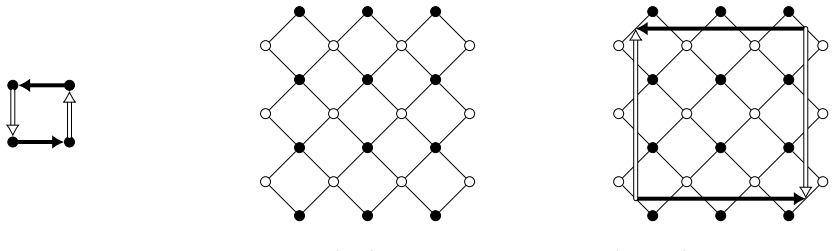
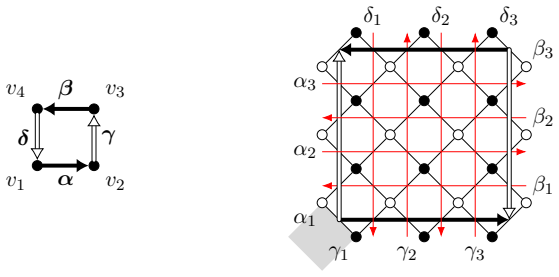
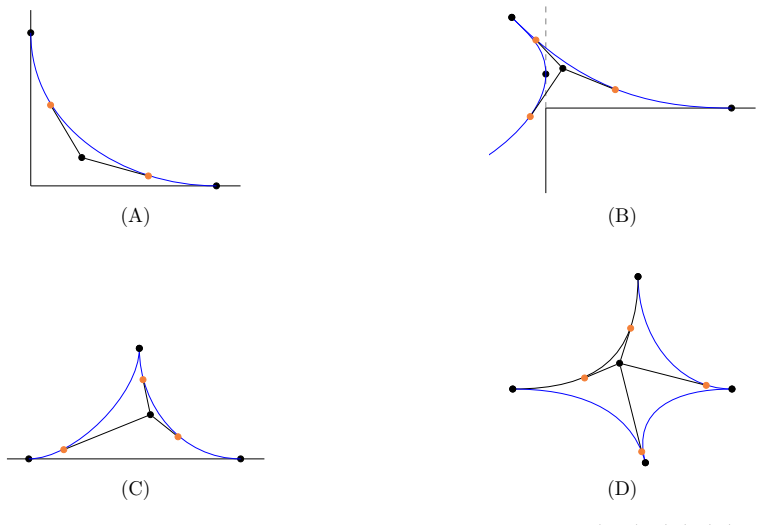
For any minimal periodic planar bipartite graph whose Newton polygon has n sides, the authors construct an (n-3)-dimensional family of finite subgraphs whose boundaries consist of zig-zag paths and whose overall shape resembles an astroid; they call these astroidal zig-zag graphs. The inverse Kasteleyn matrix on any such graph is given by a double contour integral on the spectral curve, for every Fock weighting. When the weighting is periodic, the resulting formulas yield an asymptotic phase diagram with frozen, rough and smooth regions, an explicit parametrization of the arctic curve, the deterministic limit shape of the height function, and convergence of local dimer statistics to the edge
What carries the argument
The astroidal zig-zag graph (AZ graph), a finite subgraph bounded by zig-zag paths in an astroid-like shape whose inverse Kasteleyn matrix is realized by a double contour integral over the spectral curve.
If this is right
- When the Newton polygon is the unit square the AZ graph reduces to the Aztec diamond of variable size.
- Large AZ graphs exhibit phase separation into asymptotically frozen, rough and smooth regions with an explicit arctic curve.
- The height function converges to a deterministic limit shape whose slope determines the local statistics.
- Local dimer correlations converge to the translation-invariant Gibbs measure of the slope predicted by the limit shape.
Where Pith is reading between the lines
- The construction supplies a systematic way to produce exactly solvable finite domains inside any minimal periodic dimer graph, not merely the triangular and quadrilateral cases treated earlier.
- Because the parameter count is n-3, the family grows with the complexity of the Newton polygon and may serve as a testing ground for conjectures about arctic curves in higher-genus or non-planar settings.
- The contour-integral representation may be useful for deriving similar explicit formulas in related models such as six-vertex or loop models on the same graphs.
Load-bearing premise
The underlying graph must be minimal and the edge weights must be Fock weights so that the inverse Kasteleyn matrix admits an expression by contour integrals on the spectral curve without extra obstructions.
What would settle it
For a concrete minimal periodic graph whose Newton polygon is a pentagon, compute the inverse Kasteleyn matrix of the corresponding AZ graph by direct linear algebra and check whether it equals the double contour integral formula; any mismatch falsifies the claim.
Figures










read the original abstract
On a finite weighted graph, the dimer model is a probability measure on its dimer covers, that assigns to any cover a probability proportional to the product of the weights of its edges. For planar bipartite graphs, dimer correlations are encoded by the inverse of the so-called Kasteleyn matrix; for a large graph, typically taken as a finite domain in a periodic graph, this inverse matrix is known explicitly only for a handful of examples. In all previously known examples, the Newton polygon -- a convex lattice polygon that classifies periodic graphs up to local moves -- is either a triangle or a quadrilateral. Our main results are the following. For any (minimal) periodic planar bipartite graph, we construct an $(n-3)$-dimensional family of finite subgraphs for which we obtain an explicit inverse Kasteleyn matrix; here $n$ is the number of sides of the Newton polygon. Their boundaries are formed by zig-zag paths and their overall shape is reminiscent of an astroid; we call them astroidal zig-zag graphs (AZ graphs). If the Newton polygon is the unit square then the corresponding AZ graph is the celebrated Aztec diamond with its size as the parameter. Our inverse Kasteleyn matrices are given by a double contour integral on the corresponding spectral curve for any Fock weighting of the graph. This includes, in particular, all periodic weightings. For periodic weightings, we asymptotically analyze the resulting inverse Kasteleyn matrices. We establish a phase separation in large AZ graphs into asymptotically frozen, rough (liquid), and smooth (gaseous) regions, and obtain an explicit parametrization of the `arctic curve'. We also compute the deterministic limit of the height function, known as the limit shape, and prove the convergence of the local dimer correlations to the translation-invariant Gibbs measure of the slope predicted by the limit shape.
Editorial analysis
A structured set of objections, weighed in public.
Referee Report
Summary. The paper constructs, for any minimal periodic planar bipartite graph with an n-sided Newton polygon, an (n-3)-dimensional family of finite 'astroidal zig-zag' (AZ) subgraphs whose boundaries consist of zig-zag paths. For Fock weightings (including all periodic ones), it gives an explicit formula for the inverse Kasteleyn matrix as a double contour integral over the spectral curve. Specializing to periodic weightings, it derives the phase diagram (frozen/liquid/gaseous regions), parametrizes the arctic curve, computes the limit shape of the height function, and proves local convergence to the corresponding translation-invariant Gibbs measure. The construction reduces to the Aztec diamond when n=4.
Significance. This result substantially enlarges the class of graphs for which dimer correlations are explicitly known, moving beyond the triangle and quadrilateral cases that have dominated the literature. The explicit contour-integral formula and the subsequent saddle-point analysis provide a template that could be applied to other models. The reduction to the Aztec diamond and the use of standard techniques for the asymptotics are reassuring.
major comments (2)
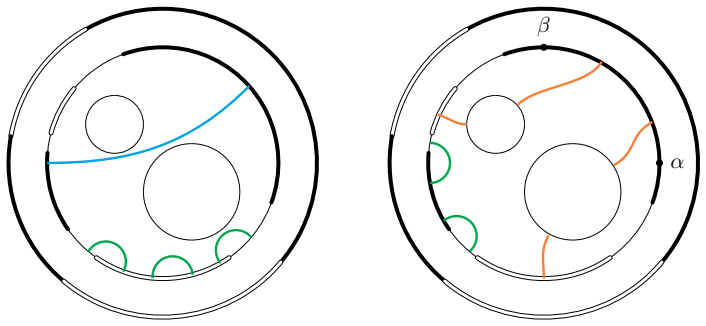
- The construction of the AZ graphs from the periodic graph via zig-zag paths is central; however, the manuscript should include a detailed check that the resulting finite graph remains bipartite and that the Kasteleyn orientation extends consistently from the periodic case.
- While the double contour integral is presented as the inverse, a direct verification that the integral expression satisfies K times the expression equals the identity (or appropriate delta) on the finite graph would strengthen the claim, especially since the contour choices rely on the minimality assumption and Fock weighting.
minor comments (2)
- The use of 'Fock weighting' should be defined or referenced at first appearance, as it is key to the contour-integral representation.
- The figures illustrating the AZ graphs for n>4 would benefit from clearer labeling of the zig-zag boundaries and the parameters.
Simulated Author's Rebuttal
We thank the referee for the positive assessment of our work and the recommendation for minor revision. The comments are constructive, and we have addressed them by incorporating additional verifications into the revised manuscript.
read point-by-point responses
-
Referee: The construction of the AZ graphs from the periodic graph via zig-zag paths is central; however, the manuscript should include a detailed check that the resulting finite graph remains bipartite and that the Kasteleyn orientation extends consistently from the periodic case.
Authors: We agree that an explicit verification strengthens the exposition. In the revised manuscript we have added a new subsection (now Section 3.2) that proves the AZ graphs remain bipartite: each zig-zag path alternates between the two color classes inherited from the underlying periodic bipartite graph, so the induced subgraph is bipartite. We further show that the Kasteleyn orientation, chosen periodically on the infinite graph according to the standard planar sign convention, extends without contradiction to the finite AZ graph; the boundary zig-zag paths are oriented so that the product of signs around any face is consistent with the global choice, which follows directly from the periodicity and the fact that the paths close after an even number of steps. revision: yes
-
Referee: While the double contour integral is presented as the inverse, a direct verification that the integral expression satisfies K times the expression equals the identity (or appropriate delta) on the finite graph would strengthen the claim, especially since the contour choices rely on the minimality assumption and Fock weighting.
Authors: We concur that a direct check is desirable. In the revised manuscript we have inserted a new subsection (Section 4.3) that carries out this verification explicitly. Using the residue theorem on the spectral curve, we deform the contours and show that, under the minimality assumption on the Newton polygon, all residues cancel except the simple pole that produces the Kronecker delta when the two vertices coincide; the Fock weighting ensures the required analytic continuation and absence of additional poles inside the contours. The argument is self-contained and does not rely on external results beyond the standard properties of the spectral curve. revision: yes
Circularity Check
No significant circularity; new construction with explicit formula
full rationale
The paper constructs a new (n-3)-dimensional family of finite AZ graphs for any minimal periodic planar bipartite graph, with boundaries formed by zig-zag paths, and derives the inverse Kasteleyn matrix directly as a double contour integral over the spectral curve for Fock weightings. This is a forward derivation from the periodic graph's spectral curve, reducing to the Aztec diamond only as a special case when the Newton polygon is the unit square. Asymptotics (phase separation, arctic curve, limit shape, Gibbs measure convergence) follow from standard saddle-point analysis on the explicit integral formula. No steps reduce by definition, fitted parameters renamed as predictions, or load-bearing self-citation chains; the minimality and Fock weighting assumptions enable the contour choices without circularity. The derivation is self-contained against external benchmarks in dimer theory.
Axiom & Free-Parameter Ledger
axioms (2)
- standard math Kasteleyn matrix encodes dimer correlations via its inverse for planar bipartite graphs
- domain assumption Spectral curve exists and supports contour-integral representation of the inverse for Fock/periodic weightings
invented entities (1)
-
Astroidal zig-zag graphs (AZ graphs)
no independent evidence
Reference graph
Works this paper leans on
-
[1]
Tacnode GUE-minor processes and double Aztec diamonds.Probab
Mark Adler, Sunil Chhita, Kurt Johansson, and Pierre van Moerbeke. Tacnode GUE-minor processes and double Aztec diamonds.Probab. Theory Related Fields, 162(1-2):275–325, 2015
2015
-
[2]
Tilings of non-convex polygons, skew- Young tableaux and determinantal processes.Comm
Mark Adler, Kurt Johansson, and Pierre van Moerbeke. Tilings of non-convex polygons, skew- Young tableaux and determinantal processes.Comm. Math. Phys., 364(1):287–342, 2018
2018
-
[3]
Arctic boundaries of the ice model on three-bundle domains.Invent
Amol Aggarwal. Arctic boundaries of the ice model on three-bundle domains.Invent. Math., 220(2):611–671, 2020
2020
-
[4]
Universality for lozenge tiling local statistics.Ann
Amol Aggarwal. Universality for lozenge tiling local statistics.Ann. of Math. (2), 198(3):881– 1012, 2023
2023
-
[5]
Gaussian unitary ensemble in random lozenge tilings
Amol Aggarwal and Vadim Gorin. Gaussian unitary ensemble in random lozenge tilings. Probab. Theory Related Fields, 184(3-4):1139–1166, 2022
2022
-
[6]
Edge statistics for lozenge tilings of polygons, II: Airy line ensemble.Forum Math
Amol Aggarwal and Jiaoyang Huang. Edge statistics for lozenge tilings of polygons, II: Airy line ensemble.Forum Math. Pi, 13:Paper No. e2, 60, 2025
2025
-
[7]
The octagon and the non-supersymmetric string landscape.Physics Letters B, 815:136153, 2021
Riccardo Argurio, Matteo Bertolini, Sebastián Franco, Eduardo García-Valdecasas, Shani Meynet, Antoine Pasternak, and Valdo Tatitscheff. The octagon and the non-supersymmetric string landscape.Physics Letters B, 815:136153, 2021
2021
-
[8]
Dimer Models and Conformal Struc- tures.Comm
Kari Astala, Erik Duse, István Prause, and Xiao Zhong. Dimer Models and Conformal Struc- tures.Comm. Pure Appl. Math., 79(2):340–446, 2025
2025
-
[9]
Asymptotics of multivariate sequences, part III: Quadratic points.Adv
Yuliy Baryshnikov and Robin Pemantle. Asymptotics of multivariate sequences, part III: Quadratic points.Adv. Math., 228(6):3127–3206, 2011
2011
-
[10]
Domino tilings of the Aztec diamond with doubly periodic weightings.Ann
Tomas Berggren. Domino tilings of the Aztec diamond with doubly periodic weightings.Ann. Probab., 49(4):1965–2011, 2021
1965
-
[11]
Crystallization of the Aztec diamond, 2024
Tomas Berggren and Alexei Borodin. Crystallization of the Aztec diamond, 2024. arXiv:2410.04187
-
[12]
Geometry of the doubly periodic Aztec dimer model
Tomas Berggren and Alexei Borodin. Geometry of the doubly periodic Aztec dimer model. Commun. Am. Math. Soc., 5:475–570, 2025. 93
2025
-
[13]
Tomas Berggren, Cédric Boutillier, Marianna Russkikh, and Béatrice de Tilière.In prepara- tion
-
[14]
Marked GUE-corners process in doubly periodic dimer models, 2026
Tomas Berggren and Nedialko Bradinoff. Marked GUE-corners process in doubly periodic dimer models, 2026. arXiv:2603.27906
-
[15]
Correlation functions for determinantal processes defined by infinite block Toeplitz minors.Adv
Tomas Berggren and Maurice Duits. Correlation functions for determinantal processes defined by infinite block Toeplitz minors.Adv. Math., 356:106766, 48, 2019
2019
-
[16]
Gaussian Free Field and Discrete Gaussians in Periodic Dimer Models, 2025
Tomas Berggren and Matthew Nicoletti. Gaussian Free Field and Discrete Gaussians in Periodic Dimer Models, 2025. arXiv:2502.07241
-
[17]
Perfect t-embeddings of uni- formlyweightedAztecdiamondsandtowergraphs.Int
Tomas Berggren, Matthew Nicoletti, and Marianna Russkikh. Perfect t-embeddings of uni- formlyweightedAztecdiamondsandtowergraphs.Int. Math. Res. Not. IMRN,(7):5963–6007, 2024
2024
-
[18]
Alexander I. Bobenko and Nikolai Bobenko. Dimers and M-Curves: Limit Shapes from Rie- mann Surfaces, 2024. arXiv:2407.19462. To appear in Duke Math. Journal
-
[19]
Bobenko, Nikolai Bobenko, and Yuri B
Alexander I. Bobenko, Nikolai Bobenko, and Yuri B. Suris. Dimers and M-curves. InThe Versatility of Integrability—In Memory of Igor Krichever, volume 823 ofContemp. Math., pages 1–45. American Mathematical Society, Providence, RI, 2025
2025
-
[20]
Biased2×2periodic Aztec diamond and an elliptic curve
Alexei Borodin and Maurice Duits. Biased2×2periodic Aztec diamond and an elliptic curve. Probab. Theory Related Fields, 187(1-2):259–315, 2023
2023
-
[21]
Alexei Borodin and Patrik L. Ferrari. Random tilings and Markov chains for interlacing particles.Markov Process. Related Fields, 24(3):419–451, 2018
2018
-
[22]
Rains.q-distributions on boxed plane partitions
Alexei Borodin, Vadim Gorin, and Eric M. Rains.q-distributions on boxed plane partitions. Selecta Math. (N.S.), 16(4):731–789, 2010
2010
-
[23]
Perfect matchings for the three-term Gale-Robinson sequences.Electron
Mireille Bousquet-Mélou, James Propp, and Julian West. Perfect matchings for the three-term Gale-Robinson sequences.Electron. J. Combin., 16(1):Research Paper 125, 37, 2009
2009
-
[24]
Isoradial immersions.J
Cédric Boutillier, David Cimasoni, and Béatrice de Tilière. Isoradial immersions.J. Graph Theory, 99(4):715–757, 2022
2022
-
[25]
Elliptic dimers on minimal graphs and genus 1 Harnack curves.Comm
Cédric Boutillier, David Cimasoni, and Béatrice de Tilière. Elliptic dimers on minimal graphs and genus 1 Harnack curves.Comm. Math. Phys., 400(2):1071–1136, 2023
2023
-
[26]
Minimal bipartite dimers and higher genus Harnack curves.Probab
Cédric Boutillier, David Cimasoni, and Béatrice de Tilière. Minimal bipartite dimers and higher genus Harnack curves.Probab. Math. Phys., 4(1):151–208, 2023
2023
-
[27]
Fock’s dimer model on the Aztec diamond.Ann
Cédric Boutillier and Béatrice de Tilière. Fock’s dimer model on the Aztec diamond.Ann. Inst. Henri Poincar’e Comb. Phys. Interact., 2026. Published online first
2026
-
[28]
Fock’s dimer model on Speyer graphs,
Cédric Boutillier, Béatrice de Tilière, and Bishal Deb. Fock’s dimer model on Speyer graphs,
-
[29]
Dimers on Rail Yard Graphs.Ann
Cédric Boutillier, Jérémie Bouttier, Guillaume Chapuy, Sylvie Corteel, and Sanjay Ramas- samy. Dimers on Rail Yard Graphs.Ann. Inst. Henri Poincaré Comb. Phys. Interact., 4(4):479–539, 2017
2017
-
[30]
The low-temperature expansion of the Wulff crystal in the 3D Ising model.Comm
Raphaël Cerf and Richard Kenyon. The low-temperature expansion of the Wulff crystal in the 3D Ising model.Comm. Math. Phys., 222(1):147–179, 2001
2001
-
[31]
Christophe Charlier, Maurice Duits, Arno B. J. Kuijlaars, and Jonatan Lenells. A peri- odic hexagon tiling model and non-Hermitian orthogonal polynomials.Comm. Math. Phys., 378(1):401–466, 2020
2020
-
[32]
Gale-Robinson quivers and principal coefficients, 2026
Qiyue Chen and Gregg Musiker. Gale-Robinson quivers and principal coefficients, 2026. arXiv:2602.19402
-
[33]
The Airy line ensemble at the rough- smooth boundary, 2026
Sunil Chhita, Duncan Dauvergne, and Thomas Finn. The Airy line ensemble at the rough- smooth boundary, 2026. arXiv:2602.24063
-
[34]
Domino statistics of the two-periodic Aztec diamond.Adv
Sunil Chhita and Kurt Johansson. Domino statistics of the two-periodic Aztec diamond.Adv. Math., 294:37–149, 2016
2016
-
[35]
Asymptotic domino statistics in the Aztec diamond.Ann
Sunil Chhita, Kurt Johansson, and Benjamin Young. Asymptotic domino statistics in the Aztec diamond.Ann. Appl. Probab., 25(3):1232–1278, 2015
2015
-
[36]
Coupling functions for domino tilings of Aztec diamonds
Sunil Chhita and Benjamin Young. Coupling functions for domino tilings of Aztec diamonds. Adv. Math., 259:173–251, 2014
2014
-
[37]
Minimal Matchings fordP3 Cluster Variables
Judy Hsin-Hui Chiang, Gregg Musiker, and Son Nguyen. Minimal Matchings fordP3 Cluster Variables. 2024. arXiv:2409.05803
-
[38]
A variational principle for domino tilings
Henry Cohn, Richard Kenyon, and James Propp. A variational principle for domino tilings. J. Amer. Math. Soc., 14(2):297–346, 2001
2001
-
[39]
Colomo and A
F. Colomo and A. Sportiello. Arctic curves of the six-vertex model on generic domains: the tangent method.J. Stat. Phys., 164(6):1488–1523, 2016
2016
-
[40]
Domino shuffling for the Del Pezzo 3 lattice, 2010
Cyndie Cottrell and Benjamin Young. Domino shuffling for the Del Pezzo 3 lattice, 2010. arXiv:1011.0045
-
[41]
Arctic curves for paths with arbitrary starting points: a tangent method approach.J
Philippe Di Francesco and Emmanuel Guitter. Arctic curves for paths with arbitrary starting points: a tangent method approach.J. Phys. A, 51(35):355201, 45, 2018
2018
-
[42]
The arctic curve for Aztec rectangles with defects via the tangent method.J
Philippe Di Francesco and Emmanuel Guitter. The arctic curve for Aztec rectangles with defects via the tangent method.J. Stat. Phys., 176(3):639–678, 2019
2019
-
[43]
Philippe Di Francesco and Matthew F. Lapa. Arctic curves in path models from the tangent method.J. Phys. A, 51(15):155202, 55, 2018
2018
-
[44]
Arctic curves of the octahedron equation
Philippe Di Francesco and Rodrigo Soto-Garrido. Arctic curves of the octahedron equation. J. Phys. A, 47(28):285204, 34, 2014
2014
-
[45]
Arctic curves of theT-system with slanted initial data.J
Philippe Di Francesco and Hieu Trung Vu. Arctic curves of theT-system with slanted initial data.J. Phys. A, 57(33):Paper No. 335201, 57, 2024. 95
2024
-
[46]
Dobrushin, R
R. Dobrushin, R. Kotecký, and S. Shlosman.Wulff construction, volume 104 ofTranslations of Mathematical Monographs. American Mathematical Society, Providence, RI, 1992. A global shape from local interaction, Translated from the Russian by the authors
1992
-
[47]
J. J. Duistermaat and J. A. C. Kolk.Multidimensional real analysis. I. Differentiation, vol- ume 86 ofCambridge Studies in Advanced Mathematics. Cambridge University Press, Cam- bridge, 2004. Translated from the Dutch by J. P. van Braam Houckgeest
2004
-
[48]
Maurice Duits and Arno B. J. Kuijlaars. The two-periodic Aztec diamond and matrix valued orthogonal polynomials.J. Eur. Math. Soc. (JEMS), 23(4):1075–1131, 2021
2021
-
[49]
Colored BPS pyramid partition functions, quivers and cluster transformations.J
Richard Eager and Sebastián Franco. Colored BPS pyramid partition functions, quivers and cluster transformations.J. High Energy Phys., (9):038, 2012. arXiv:1112.1132
-
[50]
Non-Archimedean amoebas and tropical varieties.J
Manfred Einsiedler, Mikhail Kapranov, and Douglas Lind. Non-Archimedean amoebas and tropical varieties.J. Reine Angew. Math., 601:139–157, 2006
2006
-
[51]
Fay.Theta functions on Riemann surfaces
John D. Fay.Theta functions on Riemann surfaces. Lecture Notes in Mathematics, Vol. 352. Springer-Verlag, Berlin-New York, 1973
1973
-
[52]
InversespectralproblemforGKintegrablesystem., 2015
VladimirV.Fock. InversespectralproblemforGKintegrablesystem., 2015. arXiv:1503.00289
-
[53]
Fock and Andrey Marshakov
Vladimir V. Fock and Andrey Marshakov. Loop groups, clusters, dimers and integrable sys- tems. InGeometry and quantization of moduli spaces, Adv. Courses Math. CRM Barcelona, pages 1–66. Birkhäuser/Springer, Cham, 2016
2016
-
[54]
Kennaway, David Vegh, and Brian Wecht
Sebastian Franco, Amihay Hanany, Kristian D. Kennaway, David Vegh, and Brian Wecht. Brane dimers and quiver gauge theories.J. High Energy Phys., (1):096, 2006
2006
-
[55]
Gauge theories from toric geometry and brane tilings.J
Sebastian Franco, Amihay Hanany, Dario Martelli, James Sparks, David Vegh, and Brian Wecht. Gauge theories from toric geometry and brane tilings.J. High Energy Phys., (1):128, 2006
2006
-
[56]
Pavel Galashin and Terrence George.In preparation
-
[57]
Toric mutations in thedP2 quiver and subgraphs of thedP2 brane tiling.Electron
Yibo Gao, Zhaoqi Li, Thuy-Duong Vuong, and Lisa Yang. Toric mutations in thedP2 quiver and subgraphs of thedP2 brane tiling.Electron. J. Combin., 26(2):Paper No. 2.19, 46, 2019
2019
-
[58]
Goncharov, and Richard Kenyon
Terrence George, Alexander B. Goncharov, and Richard Kenyon. The inverse spectral map for dimers.Math. Phys. Anal. Geom., 26(3):Paper No. 24, 51, 2023
2023
-
[59]
The cluster modular group of the dimer model
Terrence George and Giovanni Inchiostro. The cluster modular group of the dimer model. Ann. Inst. Henri Poincaré D, 11(1):147–198, 2024
2024
-
[60]
Discrete dynamics in cluster integrable systems from geometricR-matrix transformations.Comb
Terrence George and Sanjay Ramassamy. Discrete dynamics in cluster integrable systems from geometricR-matrix transformations.Comb. Theory, 3(2):Paper No. 12, 29, 2023
2023
-
[61]
Inverting the Kasteleyn matrix for holey hexagons, 2017
Tomack Gilmore. Inverting the Kasteleyn matrix for holey hexagons, 2017. arXiv:1701.07092
-
[62]
Goncharov and Richard Kenyon
Alexander B. Goncharov and Richard Kenyon. Dimers and cluster integrable systems.Ann. Sci. Éc. Norm. Supér. (4), 46(5):747–813, 2013. 96
2013
-
[63]
Bulk universality for random lozenge tilings near straight boundaries and for tensor products.Comm
Vadim Gorin. Bulk universality for random lozenge tilings near straight boundaries and for tensor products.Comm. Math. Phys., 354(1):317–344, 2017
2017
-
[64]
Cambridge University Press, Cambridge, 2021
Vadim Gorin.Lectures on random lozenge tilings, volume 193 ofCambridge Studies in Ad- vanced Mathematics. Cambridge University Press, Cambridge, 2021
2021
-
[65]
Edge Effects on Local Statistics in Lattice Dimers: A Study of the Aztec Diamond (Finite Case), 2000
Harald Helfgott. Edge Effects on Local Statistics in Lattice Dimers: A Study of the Aztec Diamond (Finite Case), 2000. arXiv:math/0007136
-
[66]
Edge statistics for lozenge tilings of polygons, I: concentration of height function on strip domains.Probab
Jiaoyang Huang. Edge statistics for lozenge tilings of polygons, I: concentration of height function on strip domains.Probab. Theory Related Fields, 188(1-2):337–485, 2024
2024
-
[67]
Pearcey universality at cusps of polygonal lozenge tilings.Comm
Jiaoyang Huang, Fan Yang, and Lingfu Zhang. Pearcey universality at cusps of polygonal lozenge tilings.Comm. Pure Appl. Math., 77(9):3708–3784, 2024
2024
-
[68]
Dimer models and the special McKay correspondence.Geom
Akira Ishii and Kazushi Ueda. Dimer models and the special McKay correspondence.Geom. Topol., 19(6):3405–3466, 2015
2015
-
[69]
Birkhäuser Verlag, Basel, second edition, 2009
Ilia Itenberg, Grigory Mikhalkin, and Eugenii Shustin.Tropical algebraic geometry, volume 35 ofOberwolfach Seminars. Birkhäuser Verlag, Basel, second edition, 2009
2009
-
[70]
Gale-Robinson sequences and brane tilings
In-Jee Jeong, Gregg Musiker, and Sicong Zhang. Gale-Robinson sequences and brane tilings. In25th International Conference on Formal Power Series and Algebraic Combinatorics (FP- SAC 2013), Discrete Math. Theor. Comput. Sci. Proc., AS, pages 707–718. Assoc. Discrete Math. Theor. Comput. Sci., Nancy, 2013
2013
-
[71]
Random Domino Tilings and the Arctic Circle Theorem
William Jockusch, James Propp, and Peter Shor. Random Domino Tilings and the Arctic Circle Theorem, 1998. arXiv:math/9801068
work page internal anchor Pith review Pith/arXiv arXiv 1998
-
[72]
Non-intersecting paths, random tilings and random matrices.Probab
Kurt Johansson. Non-intersecting paths, random tilings and random matrices.Probab. Theory Relat. Fields, 123(2):225–280, 2002
2002
-
[73]
The arctic circle boundary and the Airy process.Ann
Kurt Johansson. The arctic circle boundary and the Airy process.Ann. Probab., 33(1):1–30, 2005
2005
-
[74]
Eigenvalues of GUE Minors.Electron
Kurt Johansson and Eric Nordenstam. Eigenvalues of GUE Minors.Electron. J. Probab., 11(0):1342–1371, 2006
2006
-
[75]
Thestatisticsofdimersonalattice: I.thenumberofdimerarrangements on a quadratic lattice.Physica, 27:1209–1225, 1961
PieterW.Kasteleyn. Thestatisticsofdimersonalattice: I.thenumberofdimerarrangements on a quadratic lattice.Physica, 27:1209–1225, 1961
1961
-
[76]
Kasteleyn
Pieter W. Kasteleyn. Dimer statistics and phase transitions.J. Mathematical Phys., 4:287– 293, 1963
1963
-
[77]
Kennaway
Kristian D. Kennaway. Brane tilings.Int. J. Mod. Phys. A, 22(18):2977–3038, 2007
2007
-
[78]
R. Kenyon. The Laplacian and Dirac operators on critical planar graphs.Invent. Math., 150(2):409–439, 2002
2002
-
[79]
Local statistics of lattice dimers.Ann
Richard Kenyon. Local statistics of lattice dimers.Ann. Inst. H. Poincaré Probab. Statist., 33(5):591–618, 1997. 97
1997
-
[80]
Conformal invariance of domino tiling.Annals of Probability, 28:759–795, 1999
Richard Kenyon. Conformal invariance of domino tiling.Annals of Probability, 28:759–795, 1999
1999
discussion (0)
Sign in with ORCID, Apple, or X to comment. Anyone can read and Pith papers without signing in.