Quantum criticality beyond thermodynamic stability
Pith reviewed 2026-05-08 18:14 UTC · model grok-4.3
The pith
Quantum criticality applies to dynamically stable quadratic bosonic Hamiltonians even without a thermodynamic ground state.
A machine-rendered reading of the paper's core claim, the machinery that carries it, and where it could break.
Core claim
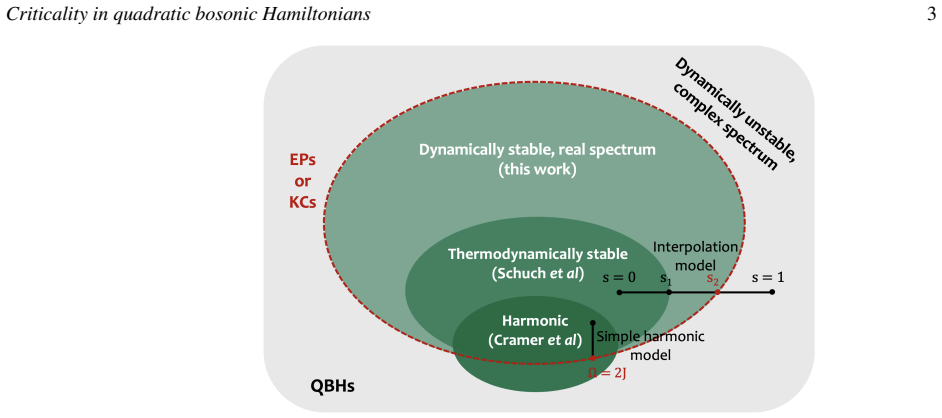
For the full class of dynamically stable quadratic bosonic Hamiltonians, the quasiparticle vacuum is the relevant state for quantum criticality; the Krein gap plays the role of the spectral gap, and criticality occurs when this gap closes at an exceptional point or a Krein collision, producing long-range correlations in the vacuum regardless of thermodynamic stability.
What carries the argument
The Krein gap, the minimal spectral separation between creation and annihilation operators in the Krein-space formulation of the Hamiltonian, which enforces uniqueness of the quasiparticle vacuum and exponential decay of its correlations when positive.
If this is right
- Long-range correlations appear in the quasiparticle vacuum precisely when the Krein gap closes.
- Scaling of entanglement entropy and information-geometry indicators detect criticality even in thermodynamically unstable cases.
- The boundary of dynamical stability coincides with the boundary of criticality or multicriticality.
- All dynamically stable quadratic bosonic Hamiltonians become accessible to critical-phenomena methods.
Where Pith is reading between the lines
- Platforms in photonics and magnonics can now be checked for critical scaling using the same entanglement and correlation diagnostics applied to thermodynamically stable systems.
- The framework suggests that Krein-gap closing could serve as a practical experimental signature for the onset of dynamical instabilities in driven bosonic devices.
- Information-geometry tools may provide quantitative comparisons between bosonic critical points and those in fermionic or spin systems.
Load-bearing premise
The quasiparticle vacuum is uniquely defined when the Krein gap is positive and correlations remain exponentially bounded unless the gap closes, based on the spectral properties of quadratic bosonic Hamiltonians in Krein space.
What would settle it
In a finite-range quadratic bosonic model, measure whether two-point correlations in the quasiparticle vacuum decay exponentially for all parameter values where the Krein gap is open and become long-range exactly when the gap closes at an exceptional point or Krein collision.
Figures


read the original abstract
For a many-body system in equilibrium, described by a thermodynamically stable Hamiltonian, quantum criticality is associated with structural changes of the many-body ground state. However, there exist physically relevant models, notably, certain quadratic bosonic Hamiltonians (QBHs), which fail to have a ground state. QBHs can be dynamically stable or unstable. We show the notion of criticality is meaningful for the entire class of QBHs that are dynamically stable or at the boundary of instability, regardless of thermodynamic stability, and that the key state for such QBHs is a naturally and unambiguously defined quasiparticle vacuum (QPV). This state is Gaussian, and coincides with the ground state if the QBH is thermodynamically stable. We identify a relevant spectral gap, the Krein gap, associated to the minimal spectral separation between creation and annihilation operators, and show that the QPV is unique when the Krein gap is positive. We prove that, for dynamically stable QBHs with finite-range couplings, correlations are exponentially bounded unless the Krein gap closes, which is associated with one of two spectral degeneracies: an exceptional point or a Krein collision. Consequently, long-range QPV correlations can ensue. Thus, the Krein gap takes the role of the spectral gap for dynamically stable QBHs, and the boundary of dynamical stability and criticality (associated to exceptional points) or multicriticality (associated to Krein collisions) are the same. We also find that bosonic critical behavior beyond thermodynamic stability is witnessed by the scaling of the entanglement entropy and other indicators of equilibrium criticality from information geometry. Our framework opens the door to investigating all dynamically stable QBHs through the lens of critical phenomena, including thermodynamically unstable ones from photonics, cavity-QED, and magnonics.
Editorial analysis
A structured set of objections, weighed in public.
Referee Report
Summary. The paper extends the concept of quantum criticality to the class of dynamically stable quadratic bosonic Hamiltonians (QBHs), including those that are thermodynamically unstable. It defines a quasiparticle vacuum (QPV) as the key Gaussian state (coinciding with the ground state when thermodynamically stable), introduces the Krein gap as the minimal spectral separation between creation and annihilation operators, proves uniqueness of the QPV for positive Krein gap, and shows that finite-range couplings imply exponentially bounded QPV correlations unless the gap closes at an exceptional point or Krein collision. The boundaries of dynamical stability and criticality (or multicriticality) coincide, and critical behavior is witnessed by entanglement entropy scaling and information-geometry indicators. The framework applies to systems in photonics, cavity-QED, and magnonics.
Significance. If the spectral-theory claims hold, the work meaningfully broadens quantum criticality beyond thermodynamic stability, providing a rigorous route to analyze critical phenomena in physically relevant unstable bosonic systems. The identification of the Krein gap as the direct analogue of the usual spectral gap, together with the uniqueness and exponential-decay results, supplies falsifiable predictions and a parameter-free structural link between dynamical stability boundaries and criticality. This could enable new studies of exceptional-point physics and long-range correlations in non-equilibrium settings.
major comments (3)
- [§4, Theorem on QPV uniqueness] §4 (spectral properties of QBHs in Krein space), Theorem on QPV uniqueness: the proof that a positive Krein gap implies a unique QPV rests on symplectic diagonalizability and the absence of Jordan blocks for real eigenvalues. The manuscript must explicitly state the precise conditions on the indefinite metric under which these hold for QBHs; if negative-norm modes can produce residual non-diagonalizable contributions, the uniqueness claim fails even for positive Krein gap.
- [§5, Eq. (bound on correlations)] §5 (exponential bounds), Eq. (bound on correlations): the exponential decay of QPV correlations for finite-range couplings is asserted to follow from the Krein gap unless it closes. The derivation should provide the explicit decay rate in terms of the gap size and verify that the finite-range assumption is used rigorously rather than heuristically; otherwise the identification of Krein-gap closure with the onset of long-range correlations is not secured.
- [§6, equivalence statement] §6 (equivalence of boundaries), statement that dynamical-stability boundary coincides with criticality: the argument equates exceptional points and Krein collisions with the loss of the Krein gap. A concrete counter-example or additional spectral condition is needed to rule out cases where the gap closes without triggering an exceptional point or collision, which would break the claimed equivalence.
minor comments (2)
- [§2] Notation for the Krein inner product and the definition of the QPV should be introduced with an explicit formula in the main text rather than deferred to an appendix.
- [Figure 2] Figure 2 (spectral diagram) would benefit from labeling the Krein gap explicitly on the plot and adding a caption sentence explaining how the gap size controls the correlation length.
Simulated Author's Rebuttal
We thank the referee for the careful reading and constructive comments, which help strengthen the rigor of our spectral analysis. We address each major comment point by point below, with revisions planned where appropriate to clarify conditions and derivations.
read point-by-point responses
-
Referee: §4 (spectral properties of QBHs in Krein space), Theorem on QPV uniqueness: the proof that a positive Krein gap implies a unique QPV rests on symplectic diagonalizability and the absence of Jordan blocks for real eigenvalues. The manuscript must explicitly state the precise conditions on the indefinite metric under which these hold for QBHs; if negative-norm modes can produce residual non-diagonalizable contributions, the uniqueness claim fails even for positive Krein gap.
Authors: We appreciate this request for explicit conditions. In our setup, QBHs carry the standard Krein-space structure induced by the bosonic commutation relations, with the Hamiltonian self-adjoint relative to the indefinite metric. Dynamical stability ensures a real spectrum, and the positive Krein gap separates positive- and negative-norm subspaces, precluding Jordan blocks. We will revise the theorem in §4 to state these metric conditions explicitly and confirm that negative-norm modes introduce no residual non-diagonalizable contributions when the gap is positive. revision: yes
-
Referee: §5 (exponential bounds), Eq. (bound on correlations): the exponential decay of QPV correlations for finite-range couplings is asserted to follow from the Krein gap unless it closes. The derivation should provide the explicit decay rate in terms of the gap size and verify that the finite-range assumption is used rigorously rather than heuristically; otherwise the identification of Krein-gap closure with the onset of long-range correlations is not secured.
Authors: We agree that an explicit rate improves clarity. Finite-range couplings render the Hamiltonian a banded operator, permitting rigorous application of resolvent estimates (Combes-Thomas type) in the complex plane. The correlations then decay as O(exp(−κ r)) with κ proportional to the Krein gap size (scaled by the bandwidth). We will update §5 to derive and state this rate explicitly, confirming the finite-range assumption is used to justify the analytic continuation and thereby secure the link to long-range correlations upon gap closure. revision: yes
-
Referee: §6 (equivalence of boundaries), statement that dynamical-stability boundary coincides with criticality: the argument equates exceptional points and Krein collisions with the loss of the Krein gap. A concrete counter-example or additional spectral condition is needed to rule out cases where the gap closes without triggering an exceptional point or collision, which would break the claimed equivalence.
Authors: By definition of the Krein gap for these operators—the minimal separation between positive and negative spectral branches in the Krein space—its closure requires either an exceptional point (loss of diagonalizability) or a Krein collision (real-axis degeneracy). This follows from spectral symmetry and self-adjointness in the indefinite metric; no other closure mechanism exists. We will add a clarifying remark in §6 with a reference to the relevant Krein-space result to make the equivalence explicit and rule out extraneous cases. revision: yes
Circularity Check
No circularity detected; derivation self-contained via Krein-space spectral theory
full rationale
The paper's central claims rest on proving that a positive Krein gap implies uniqueness of the quasiparticle vacuum (QPV) and that finite-range dynamically stable QBHs have exponentially bounded correlations unless the gap closes. These are presented as theorems derived from the spectral properties of quadratic bosonic operators in Krein space (symplectic diagonalizability, absence of Jordan blocks for real eigenvalues, and gap implying exponential decay). No self-definitional steps appear, no parameters are fitted to data and then relabeled as predictions, and no load-bearing self-citations reduce the argument to prior unverified work by the same authors. The framework extends standard notions of criticality and gaps without tautological reduction to its inputs. The provided abstract and description contain no equations or citations that exhibit the enumerated circular patterns.
Axiom & Free-Parameter Ledger
axioms (2)
- domain assumption Quadratic bosonic Hamiltonians admit a well-defined quasiparticle vacuum when dynamically stable
- standard math Krein-space spectral theory applies to the separation of creation and annihilation operators
invented entities (2)
-
Quasiparticle vacuum (QPV)
no independent evidence
-
Krein gap
no independent evidence
Forward citations
Cited by 1 Pith paper
-
Topologically protected long-range correlations in steady states of driven-dissipative bosonic chains
Non-Hermitian topology in quadratic Liouvillians is encoded in steady-state bosonic correlations, inducing disorder-robust long-range order and Gaussian spatial decay in topological phases versus exponential decay in ...
Reference graph
Works this paper leans on
-
[1]
Sachdev S 2023Quantum Phases of Matter(Cambridge University Press)
-
[2]
Eisert J and Prosen T 2010 Noise-driven quantum criticalityarXiv:1012.5013 [quant-ph]
work page Pith review arXiv 2010
-
[3]
Zhang Y and Barthel T 2022 Criticality and phase classification for quadratic open quantum many-body systemsPhys. Rev. Lett.129120401
2022
-
[4]
Sieberer L M, Buchhold M, Marino J and Diehl S 2025 Universality in driven open quantum matterRev. Mod. Phys.97025004
2025
-
[5]
Derezi ´nski J 2017 Bosonic quadratic HamiltoniansJ. Math. Phys.58121101
2017
-
[6]
Flynn V P, Cobanera E and Viola L 2020 Deconstructing effective non-Hermitian dynamics in quadratic bosonic HamiltoniansNew J. Phys. 22083004
2020
-
[7]
Blaizot J P and Ripka G 1986Quantum Theory of Finite Systems(Cambridge: MIT Press Cambridge)
-
[8]
Ozawa T, Price H M, Amo A, Goldman N, Hafezi M, Lu L, Rechtsman M C, Schuster D, Simon J, Zilberberg O and Carusotto I 2019 Topological photonicsRev. Mod. Phys.91015006
2019
-
[9]
Wang Y X and Clerk A A 2019 Non-Hermitian dynamics without dissipation in quantum systemsPhys. Rev. A99063834
2019
-
[10]
Harms J S, Yuan H Y and Duine R A 2024 AntimagnonicsAIP Adv.14025303
2024
-
[11]
Quantum Grav.43035018
Kamal Kharel P, Ghimire M, Khanal A, Pudasaini S, Khatri N, Bhandari S, Rai D, Adhikari K and Singh R 2026 Entanglement and particle production from cosmological perturbations: a quantum optical simulation approachClass. Quantum Grav.43035018
2026
-
[12]
Braunstein S L and van Loock P 2005 Quantum information with continuous variablesRev. Mod. Phys.77513
2005
-
[13]
Weedbrook C, Pirandola S, Garc ´ıa-Patr´on R, Cerf N J, Ralph T C, Shapiro J H and Lloyd S 2012 Gaussian quantum informationRev. Mod. Phys.84621
2012
-
[14]
Phys.871
Cramer M and Eisert J 2006 Correlations, spectral gap and entanglement in harmonic quantum systems on generic latticesNew J. Phys.871
2006
-
[15]
Audenaert K, Eisert J, Plenio M B and Werner R F 2002 Entanglement properties of the harmonic chainPhys. Rev. A66042327
2002
-
[16]
Plenio M B, Eisert J, Dreißig J and Cramer M 2005 Entropy, entanglement, and area: Analytical results for harmonic lattice systemsPhys. Rev. Lett.94060503
2005
-
[17]
Cramer M, Eisert J, Plenio M B and Dreissig J 2005 Entanglement-area law for general bosonic harmonic lattice systemsPhys. Rev. A73 12309
2005
-
[18]
Eisert J, Cramer M and Plenio M B 2010 Colloquium: Area laws for the entanglement entropyRev. Mod. Phys.82277
2010
-
[19]
Schuch N, Cirac J I and Wolf M M 2006 Quantum states on harmonic latticesCommun. Math. Phys.26765
2006
- [20]
- [21]
-
[22]
Lu Y K, Peng P, Cao Q T, Xu D, Wiersig J, Gong Q and Xiao Y F 2018 Spontaneoust-symmetry breaking and exceptional points in cavity quantum electrodynamics systemsScience Bulletin631096
2018
-
[23]
McDonald A, Pereg-Barnea T and Clerk A A 2018 Phase-dependent chiral transport and effective non-Hermitian dynamics in a bosonic Kitaev-Majorana chainPhys. Rev. X8041031
2018
-
[24]
Lee G, Jin T, Wang Y X, McDonald A and Clerk A 2024 Entanglement phase transition due to reciprocity breaking without measurement or postselectionPRX Quantum5010313
2024
-
[25]
Ughrelidze M, Flynn V P, Cobanera E and Viola L 2024 Interplay of finite- and infinite-size stability in quadratic bosonic LindbladiansPhys. Rev. A110032207
2024
-
[26]
Flynn V P, Cobanera E and Viola L 2021 Topology by Dissipation: Majorana Bosons in Metastable Quadratic Markovian DynamicsPhys. Rev. Lett.127245701
2021
- [27]
-
[28]
Slim J J, Wanjura C C, Brunelli M, del Pino J, Nunnenkamp A and Verhagen E 2024 Optomechanical realization of the bosonic Kitaev- Majorana chainNature627767
2024
-
[29]
Xu Q R, Flynn V P, Alase A, Cobanera E, Viola L and Ortiz G 2020 Squaring the fermion: The threefold way and the fate of zero modes Phys. Rev. B102125127
2020
-
[30]
Peano V , Brendel C, Schmidt M and Marquardt F 2015 Topological phases of sound and lightPhys. Rev. X5031011
2015
-
[31]
Gohberg I, Lancaster P and Rodman L 2005Indefinite Linear Algebra and Applications(Springer)
-
[32]
Gu S J 2010 Fidelity approach to quantum phase transitionsInt. J. Mod. Phys. B244371
2010
-
[33]
Zanardi P, Giorda P and Cozzini M 2007 Information-theoretic differential geometry of quantum phase transitionsPhys. Rev. Lett.99100603
2007
-
[34]
Flynn V P, Cobanera E and Viola L 2023 Topological zero modes and edge symmetries of metastable Markovian bosonic systemsPhys. Rev. B108214312
2023
-
[35]
Colpa J H P 1978Physica A93 327; 1986ibid.134377;ibid.134417
-
[36]
Yakubovich V A and Starzhinski ˘ı V M 1975Linear Differential Equations with Periodic Coefficients(New York: Wiley)
-
[37]
Giedke G and Cirac I J 2002 Characterization of Gaussian operations and distillation of Gaussian statesPhys. Rev. A66032316
2002
-
[38]
Barthel T and Zhang Y 2022 Solving quasi-free and quadratic Lindblad master equations for open fermionic and bosonic systemsJ. Stat. Mech.2022113101
2022
-
[39]
Simon R, Mukunda N and Dutta B 1994 Quantum-noise matrix for multimode systems: U(n) invariance, squeezing, and normal formsPhys. Rev. A491567
1994
-
[40]
Adesso G and Illuminati F 2010 Entanglement in continuous-variable systems: Recent advances and current perspectivesJ. Phys. A407821
2010
-
[42]
Kr ¨uger O 2006Quantum Information Theory with Gaussian SystemsPh.D. thesis
-
[43]
Osborne T J and Nielsen M A 2002 Entanglement in a simple quantum phase transitionPhys. Rev. A66032110
2002
-
[44]
Somma R, Ortiz G, Barnum H, Knill E and Viola L 2004 Nature and measure of entanglement in quantum phase transitionsPhys. Rev. A70 042311
2004
-
[45]
Srivastava A K, M ¨uller-Rigat G, Lewenstein M and Rajchel-Mieldzio´c G 2024Introduction to Quantum Entanglement in Many-Body Systems (Cham: Springer Nature Switzerland) pp 225–285
-
[46]
Braunstein S L and Caves C M 1994 Statistical distance and the geometry of quantum statesPhys. Rev. Lett.723439
1994
-
[47]
Vidal G and Werner R F 2002 Computable measure of entanglementPhys. Rev. A65032314
2002
-
[48]
Plenio M B 2005 Logarithmic negativity: A full entanglement monotone that is not convexPhys. Rev. Lett.95090503
2005
-
[49]
Adesso G, Serafini A and Illuminati F 2004 Extremal entanglement and mixedness in continuous variable systemsPhys. Rev. A70022318
2004
-
[50]
Cramer M, Eisert J and Plenio M B 2007 Statistics dependence of the entanglement entropyPhys. Rev. Lett.98220603
2007
-
[51]
Banchi L, Braunstein S L and Pirandola S 2015 Quantum fidelity for arbitrary Gaussian statesPhys. Rev. Lett.115260501
2015
-
[52]
Provost J P and Vallee G 1980 Riemannian structure on manifolds of quantum statesCommun. Math. Phys.76289
1980
-
[53]
Chen Ye C, Vleeshouwers W L, Heatley S, Gritsev V and Morais Smith C 2024 Quantum metric of non-Hermitian Su-Schrieffer-Heeger systemsPhys. Rev. Res.6023202
2024
- [54]
-
[55]
Zirnbauer M R 2021 Particle–hole symmetries in condensed matterJ. Math. Phys.62021101
2021
-
[56]
Broer H and Takens F 2010Dynamical Systems and ChaosApplied Mathematical Sciences (Springer New York)
-
[57]
Sachdev S 2011Quantum Phase Transitions2nd ed (Cambridge University Press)
-
[58]
Deng S, Ortiz G and Viola L 2009 Anomalous nonergodic scaling in adiabatic multicritical quantum quenchesPhys. Rev. B80241109
2009
-
[59]
Patra A, Mukherjee V and Dutta A 2011 Path-dependent scaling of geometric phase near a quantum multi-critical pointJ. Stat. Mech.2011 P03026
2011
-
[60]
Lett.131 40006
Flynn V P, Cobanera E and Viola L 2020 Restoring number conservation in quadratic bosonic Hamiltonians with dualitiesEurophys. Lett.131 40006
2020
-
[61]
Kraus B 2011 Compressed quantum simulation of the Ising modelPhys. Rev. Lett.107250503
2011
-
[62]
Zschetzsche L, Mansuroglu R and Schuch N 2026 Complexity of quadratic bosonic Hamiltonian simulation: BQP-completeness and PostBQP-hardnessarXiv:2603.26561 [quant-ph]
work page internal anchor Pith review Pith/arXiv arXiv 2026
-
[63]
Ughrelidze M, Viola L and Cobanera E 2026 The interplay between bosonic criticality and band topologyForthcoming
2026
-
[64]
Zhang Y , Flynn V P, Ughrelidze M, Cobanera E and Viola L 2026 Size-driven dynamical phase transition in quadratic bosonic Lindbladians Forthcoming
2026
-
[65]
Liu J, Yuan H, Lu X M and Wang X 2019 Quantum Fisher information matrix and multiparameter estimationJ. Phys. A53023001
2019
-
[66]
Commun.112454
Wiersig J 2020 Prospects and fundamental limits in exceptional point-based sensingNat. Commun.112454
2020
-
[67]
Rep.11341
Montenegro V , Mukhopadhyay C, Yousefjani R, Sarkar S, Mishra U, Paris M G and Bayat A 2025 Quantum metrology and sensing with many-body systemsPhys. Rep.11341
2025
-
[68]
Commun.102254
D ´ora B, Heyl M and Moessner R 2019 The Kibble-Zurek mechanism at exceptional pointsNat. Commun.102254
2019
-
[69]
Lee J M 2026 Enhanced dissipative criticality at an exceptional pointarXiv:2604.09892 [quant-ph]
work page internal anchor Pith review Pith/arXiv arXiv 2026
discussion (0)
Sign in with ORCID, Apple, or X to comment. Anyone can read and Pith papers without signing in.