Quantum Optical Soliton Dynamics Beyond Linearization: An Open-System Approach
Pith reviewed 2026-05-19 20:11 UTC · model grok-4.3
The pith
Two open-system approaches model the quantum dynamics of optical solitons beyond linearization.
A machine-rendered reading of the paper's core claim, the machinery that carries it, and where it could break.
Core claim
By projecting the underlying quantum field into system and residual reservoir components, the reservoir is treated either as a discrete Lanczos supermode expansion which localizes dynamics to a few-supermode basis, or as a non-local environment which can be traced out by deriving a Markovian master equation. Numerical simulations confirm both methods capture quantum-induced soliton phase shifts in a concise few-mode basis, and the Lanczos approach also captures photon loss from non-Markovian dispersive couplings. The work also shows that for higher-order dispersion with ultrashort pulses, both classical and master equation theory underestimate the actual dissipation due to dispersive-couping
What carries the argument
Projection of the quantum field into soliton system and reservoir, with reservoir handled by Lanczos supermode expansion or Markovian master equation derivation.
If this is right
- These methods provide tools to analyze complex non-Gaussian quantum dynamics of solitons in regimes where other methods fail.
- They confirm capture of quantum-induced phase shifts and photon loss in few-mode bases.
- They reveal underestimation of dissipation in the presence of higher-order dispersion.
Where Pith is reading between the lines
- This framework could be applied to study quantum effects in other nonlinear wave systems like Bose-Einstein condensates.
- Extending the master equation to include non-Markovian effects might improve accuracy for ultrashort pulses.
- These computational tools could enable design of quantum soliton-based devices by predicting stability beyond perturbative limits.
Load-bearing premise
The division of the quantum field into a soliton system component and a residual reservoir component remains valid and captures all essential dynamics without losing critical information or ignoring back-action.
What would settle it
A direct numerical simulation or experiment that measures the rate of photon loss for solitons with higher-order dispersion and compares it quantitatively to the master equation prediction would test whether the underestimation holds or if additional effects are at play.
Figures


read the original abstract
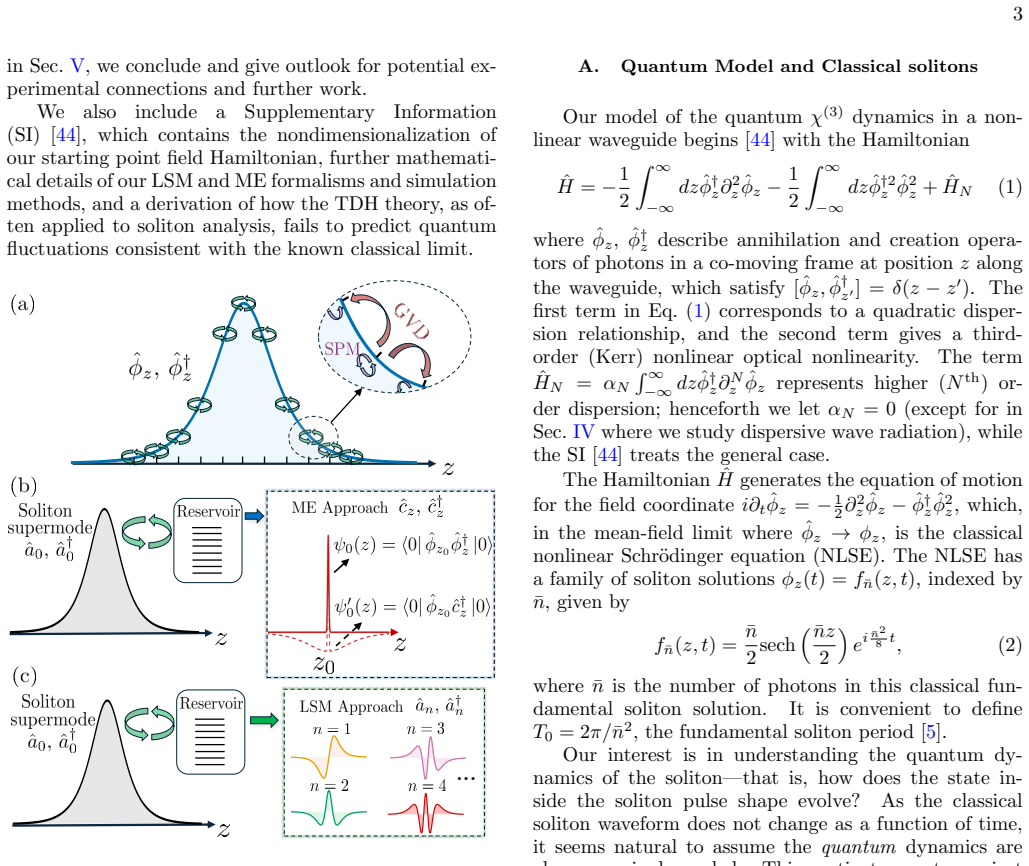
We introduce two approaches to modeling the quantum dynamics of optical $\chi^{(3)}$ solitons. Taking an open-system viewpoint, we project the underlying quantum field into system (soliton) and residual reservoir components. The reservoir is treated as either (i) a discrete ``Lanczos supermode'' (LSM) expansion which localizes dynamics to a few-supermode basis, or (ii) a non-local environment which can be traced out by deriving a Markovian master equation (ME). Using these methods, we analyze and identify the quantum structure of both the soliton's stability and its hierarchy of perturbations. Through numerical simulations, we confirm both methods effectively capture quantum-induced soliton phase shifts in a concise few-mode (single-mode for ME) basis, and the LSM approach also captures photon loss which arises from non-Markovian dispersive couplings. As neither method is limited to the linearized regime, our approaches provide powerful computational tools to analyze complex non-Gaussian quantum dynamics of solitons where other commonly-used methods fail, providing insight into such non-perturbative regimes. We also investigate radiation that occurs in the presence of higher-order dispersion with ultrashort pulses, deriving a ME that predicts photon loss consistent with classical theory, but find that both classical and ME theory dramatically underestimate the actual amount of dissipation, which we explain in terms of dispersive coupling-induced soliton broadening.
Editorial analysis
A structured set of objections, weighed in public.
Referee Report
Summary. The paper introduces two open-system methods for quantum dynamics of χ^(3) optical solitons by projecting the underlying quantum field into a soliton system component and a residual reservoir. The reservoir is handled either via a discrete Lanczos supermode (LSM) expansion that localizes dynamics to a few-supermode basis or via derivation of a Markovian master equation (ME) by tracing out a non-local environment. These are used to analyze soliton stability, perturbation hierarchy, quantum-induced phase shifts, and photon loss. Numerical simulations are presented to confirm that both methods capture phase shifts in a concise basis (few-mode for LSM, single-mode for ME), with LSM additionally capturing photon loss from non-Markovian dispersive couplings. The paper also derives an ME for radiation under higher-order dispersion with ultrashort pulses, finding that both classical and ME predictions underestimate dissipation, which is attributed to dispersive-coupling-induced soliton broadening. The central claim is that these approaches enable analysis of non-Gaussian, non-perturbative regimes where linearized methods fail.
Significance. If the system-reservoir projection and numerical validations hold, the work provides useful computational tools for non-perturbative quantum soliton dynamics in open systems, extending beyond standard linearized or perturbative treatments common in quantum optics. The explicit handling of non-Markovian effects via LSM and the qualitative explanation for ME discrepancies add value for studying stability and radiation in ultrashort-pulse regimes. Strengths include the cross-check against classical photon-loss expectations and the focus on falsifiable numerical predictions rather than purely analytic approximations.
major comments (2)
- [Abstract and numerical simulations section] Abstract and numerical simulations section: The claim that simulations confirm capture of phase shifts and photon loss is central to validating the non-Gaussian dynamics tools, yet the provided text lacks quantitative fit metrics, error bars, or details on data exclusion criteria. This makes it difficult to assess how well the few-mode or single-mode reductions reproduce the target non-perturbative effects.
- [Section on ME derivation and results] Section on ME derivation and results: The noted underestimation of dissipation in the ME (attributed to dispersive-coupling-induced broadening) directly tests the Markovian trace-out step. If this broadening feeds back into the system Hilbert space at higher photon numbers, it could systematically affect the non-Gaussian correlations the paper claims to access; a concrete additional simulation or bound quantifying the back-action on phase shifts or stability would be required to confirm the projection remains sufficient.
minor comments (2)
- Clarify the precise criterion used to select the number of Lanczos supermodes and how it scales with soliton photon number, as this is listed as a free parameter.
- The abstract states that the ME predicts photon loss 'consistent with classical theory' for higher-order dispersion; an explicit equation or table comparing the two would improve readability.
Simulated Author's Rebuttal
We thank the referee for the careful reading of our manuscript and the constructive comments. We address each major comment point by point below, indicating where revisions will be made to improve clarity and rigor.
read point-by-point responses
-
Referee: [Abstract and numerical simulations section] Abstract and numerical simulations section: The claim that simulations confirm capture of phase shifts and photon loss is central to validating the non-Gaussian dynamics tools, yet the provided text lacks quantitative fit metrics, error bars, or details on data exclusion criteria. This makes it difficult to assess how well the few-mode or single-mode reductions reproduce the target non-perturbative effects.
Authors: We agree that additional quantitative details would strengthen the presentation of the numerical results. In the revised manuscript we will add error bars to the simulation plots, include quantitative agreement metrics (such as relative error or overlap measures between the reduced-basis predictions and reference data), and specify any averaging or data-selection procedures used. These changes will make it easier to evaluate the accuracy of the few-mode LSM and single-mode ME reductions for the reported phase shifts and photon loss. revision: yes
-
Referee: [Section on ME derivation and results] Section on ME derivation and results: The noted underestimation of dissipation in the ME (attributed to dispersive-coupling-induced broadening) directly tests the Markovian trace-out step. If this broadening feeds back into the system Hilbert space at higher photon numbers, it could systematically affect the non-Gaussian correlations the paper claims to access; a concrete additional simulation or bound quantifying the back-action on phase shifts or stability would be required to confirm the projection remains sufficient.
Authors: The referee correctly identifies a potential limitation of the Markovian approximation when soliton broadening occurs. While the present simulations already demonstrate that the single-mode ME reproduces the leading phase-shift behavior, we acknowledge that an explicit bound on back-action would be useful. In the revision we will add a short numerical check or analytic estimate that quantifies the effect of the observed broadening on phase-shift accuracy and stability at the photon numbers employed, thereby confirming the range of validity of the projection. revision: yes
Circularity Check
No significant circularity; derivation follows standard open-system projection and master-equation techniques
full rationale
The paper's core methods rest on projecting the quantum field into soliton system plus reservoir, then either expanding the reservoir in a Lanczos supermode basis or tracing it out to obtain a Markovian master equation. These steps are derived from established open-quantum-system formalism rather than from any fitted parameter or self-referential definition of the target non-Gaussian dynamics. Numerical checks against classical photon-loss expectations are presented as validation, not as the source of the predictions themselves. No load-bearing step reduces by construction to its own inputs, and no uniqueness theorem or ansatz is imported solely via self-citation. The noted underestimation of dissipation by the ME is an explicit limitation acknowledged in the text, not a hidden circularity.
Axiom & Free-Parameter Ledger
free parameters (1)
- number of Lanczos supermodes
axioms (2)
- domain assumption The quantum field projection into soliton system and residual reservoir accurately separates the dynamics without essential loss of information.
- domain assumption The reservoir can be treated as Markovian for the master equation derivation.
Lean theorems connected to this paper
-
IndisputableMonolith/Cost/FunctionalEquation.leanwashburn_uniqueness_aczel unclear?
unclearRelation between the paper passage and the cited Recognition theorem.
project the underlying quantum field into system (soliton) and residual reservoir components... Lanczos supermode (LSM) expansion... Markovian master equation (ME)
-
IndisputableMonolith/Foundation/AlphaCoordinateFixation.leanJ_uniquely_calibrated_via_higher_derivative unclear?
unclearRelation between the paper passage and the cited Recognition theorem.
effective single-supermode Hamiltonian Heff = H0 + Hfluc
What do these tags mean?
- matches
- The paper's claim is directly supported by a theorem in the formal canon.
- supports
- The theorem supports part of the paper's argument, but the paper may add assumptions or extra steps.
- extends
- The paper goes beyond the formal theorem; the theorem is a base layer rather than the whole result.
- uses
- The paper appears to rely on the theorem as machinery.
- contradicts
- The paper's claim conflicts with a theorem or certificate in the canon.
- unclear
- Pith found a possible connection, but the passage is too broad, indirect, or ambiguous to say the theorem truly supports the claim.
Reference graph
Works this paper leans on
-
[1]
Low-photon number regime We first investigate the low-photon number regime, where we perform full quantum simulations with a stan- dard numerical package [73]. We use the LSM method with various finite truncations of number of supermodes, as well as the full ME given by the dissipator in Eq. (8), and these results are compared to a numerically-exact simul...
-
[2]
High-photon number regime Next, we move to a regime with larger ¯n, where the soliton becomes asymptotically closer to its stable clas- sical solution, and we can employ a nonlinear Gaussian approximation to solve for the quantum mean-field and covariances [44]. For these large ¯nsimulations, we use the effective Hamiltonian form of the ME given by ˆHeff ...
-
[3]
R. Hirota and J. Satsuma,N-Soliton Solutions of Model Equations for Shallow Water Waves, J. Phys. Soc. Jpn. 40, 611 (1976)
work page 1976
-
[4]
L. Khaykovich, F. Schreck, G. Ferrari, T. Bourdel, J. Cu- bizolles, L. D. Carr, Y. Castin, and C. Salomon, Forma- tion of a Matter-Wave Bright Soliton, Science296, 1290 (2002)
work page 2002
-
[5]
K. E. Lonngren, Soliton experiments in plasmas, Plasma Phys.25, 943 (1983)
work page 1983
-
[6]
V. Belinski and E. Verdaguer,Gravitational Solitons (Cambridge University Press, 2001)
work page 2001
-
[7]
Y. S. Kivshar and G. P. Agrawal,Optical Solitons(Aca- demic Press, 2003)
work page 2003
-
[8]
G. McDonald, C. Kuhn, K. Hardman, S. Bennetts, P. Everitt, P. Altin, J. Debs, J. Close, and N. Robins, Bright Solitonic Matter-Wave Interferometer, Phys. Rev. Lett.113, 013002 (2014)
work page 2014
-
[9]
D. V. Tsarev, S. M. Arakelian, Y.-L. Chuang, R.-K. Lee, and A. P. Alodjants, Quantum metrology beyond Heisen- berg limitwith entangled matter wave solitons, Opt. Ex- press26, 19583 (2018)
work page 2018
-
[10]
P. Marin-Palomo, J. N. Kemal, M. Karpov, A. Kordts, J. Pfeifle, M. H. P. Pfeiffer, P. Trocha, S. Wolf, V. Brasch, M. H. Anderson, R. Rosenberger, K. Vijayan, W. Freude, T. J. Kippenberg, and C. Koos, Microresonator-based solitons for massively parallel coherent optical communi- cations, Nature546, 274 (2017)
work page 2017
-
[11]
E. R. Andresen, P. Berto, and H. Rigneault, Stimulated Raman scattering microscopy by spectral focusing and fiber-generated soliton as Stokes pulse, Opt. Lett.36, 2387 (2011)
work page 2011
-
[12]
B. Shen, L. Chang, J. Liu, H. Wang, Q.-F. Yang, C. Xi- ang, R. N. Wang, J. He, T. Liu, W. Xie, J. Guo, D. Kinghorn, L. Wu, Q.-X. Ji, T. J. Kippenberg, K. Va- hala, and J. E. Bowers, Integrated turnkey soliton micro- combs, Nature582, 365 (2020)
work page 2020
-
[13]
E. J. Weinberg,Classical Solutions in Quantum Field Theory(Cambridge University Press, 2012)
work page 2012
-
[14]
Jackiw, Quantum meaning of classical field theory, Rev
R. Jackiw, Quantum meaning of classical field theory, Rev. Mod. Phys.49, 681 (1977)
work page 1977
-
[15]
J. N. Maki and T. Kodama, Phenomenological Quantiza- tion Scheme in a Nonlinear Schr¨ odinger Equation, Phys. Rev. Lett.57, 2097 (1986)
work page 2097
-
[16]
P. D. Drummond, R. M. Shelby, S. R. Friberg, and Y. Ya- mamoto, Quantum solitons in optical fibres, Nature365, 307 (1993)
work page 1993
-
[17]
J. P. Gordon and H. A. Haus, Random walk of coherently amplified solitons in optical fiber transmission, Opt. Lett. 11, 665 (1986)
work page 1986
-
[18]
S. J. Carter, P. D. Drummond, M. D. Reid, and R. M. Shelby, Squeezing of quantum solitons, Phys. Rev. Lett. 58, 1841 (1987)
work page 1987
-
[19]
M. Rosenbluh and R. M. Shelby, Squeezed Optical Soli- tons, Phys. Rev. Lett.66, 153 (1990)
work page 1990
-
[20]
L. Di Mauro Villari, D. Faccio, F. Biancalana, and C. Conti, Quantum soliton evaporation, Phys. Rev. A 98, 043859 (2018)
work page 2018
-
[21]
N. Korolkova, R. Loudon, G. Gardavsky, M. W. Hamil- ton, and G. Leuchs, Time evolution of a quantum soliton in a Kerr medium, J. Mod. Opt.48, 1339 (2001)
work page 2001
-
[22]
R. Yanagimoto, T. Onodera, E. Ng, L. G. Wright, P. L. McMahon, and H. Mabuchi, Engineering a Kerr-Based Deterministic Cubic Phase Gate via Gaussian Opera- tions, Phys. Rev. Lett.124, 240503 (2020)
work page 2020
-
[23]
R. Yanagimoto, E. Ng, L. G. Wright, L. G. Wright, T. Onodera, T. Onodera, and H. Mabuchi, Efficient sim- ulation of ultrafast quantum nonlinear optics with matrix product states, Optica8, 1306 (2021)
work page 2021
-
[24]
M. Tsang, Quantum Temporal Correlations and Entan- glement via Adiabatic Control of Vector Solitons, Phys. Rev. Lett.97, 023902 (2006)
work page 2006
- [25]
- [26]
-
[27]
K. Jia, X. Wang, D. Kwon, J. Wang, E. Tsao, H. Liu, X. Ni, J. Guo, M. Yang, X. Jiang, J. Kim, S. Zhu, Z. Xie, and S.-W. Huang, Photonic Flywheel in a Monolithic Fiber Resonator, Phys. Rev. Lett.125, 143902 (2020)
work page 2020
-
[28]
Erkintalo, Got the quantum jitters, Nat
M. Erkintalo, Got the quantum jitters, Nat. Phys.17, 432 (2021)
work page 2021
-
[29]
E. W. Wright, Quantum theory of soliton propagation in an optical fiber using the Hartree approximation, Phys. Rev. A43, 3836 (1991)
work page 1991
-
[30]
Yao, Quantum fluctuations of optical solitons in fibers, Phys
D. Yao, Quantum fluctuations of optical solitons in fibers, Phys. Rev. A52, 4871 (1995)
work page 1995
-
[31]
F. X. K¨ artner and H. A. Haus, Quantum-mechanical sta- bility of solitons and the correspondence principle, Phys. Rev. A48, 2361 (1993)
work page 1993
-
[32]
S. Ward, R. Allahverdi, and A. Mafi, Quantum decay of an optical soliton, Phys. Rev. A107, 053513 (2023)
work page 2023
-
[33]
L. D. M. Villari, D. Faccio, F. Biancalana, and C. Conti, Quantum soliton evaporation, Phys. Rev. A98, 043859 (2018)
work page 2018
-
[34]
S.-S. Baak and F. K¨ onig, Quantum backreaction effect in optical solitons, New J. Phys.27, 015001 (2025)
work page 2025
-
[35]
L. G. Helt and N. Quesada, Degenerate squeezing in waveguides: a unified theoretical approach, J. Phys. Pho- ton.2, 035001 (2020)
work page 2020
-
[36]
H. A. Haus and Y. Lai, Quantum theory of soliton squeez- ing: a linearized approach, J. Opt. Soc. Am. B7, 386 (1990)
work page 1990
-
[37]
A. B. Matsko and L. Maleki, On timing jitter of mode locked Kerrfrequency combs, Opt. Express21, 28862 (2013)
work page 2013
-
[38]
Olivares, Quantum optics in the phase space: A tu- torial on Gaussian states, Eur
S. Olivares, Quantum optics in the phase space: A tu- torial on Gaussian states, Eur. Phys. J. Special Topics 203, 3 (2012)
work page 2012
-
[39]
S. L. Braunstein and P. van Loock, Quantum informa- tion with continuous variables, Rev. Mod. Phys.77, 513 (2005)
work page 2005
-
[40]
B. Yoon and J. W. Negele, Time-dependent Hartree ap- proximation for a one-dimensional system of bosons with attractiveδ-function interactions, Phys. Rev. A16, 1451 (1977)
work page 1977
-
[41]
F. Calogero and A. Degasperis, Comparison between the exact and Hartree solutions of a one-dimensional many- body problem, Phys. Rev. A11, 265 (1975). 13
work page 1975
-
[42]
A. Haus and Y. Lai, Quantum theory of solitons in optical fibers. I. Time-dependent Hartree approximation, Phys. Rev. A40, 844 (1989)
work page 1989
- [43]
- [44]
-
[45]
J. R. Schrieffer and P. A. Wolff, Exact Analysis of an Interacting Bose Gas. I. The General Solution and the Ground State, Phys. Rev.130, 1605 (1963)
work page 1963
-
[46]
(See Supplemental Material at [URL will be inserted by publisher] for more detailed information.)
- [47]
-
[48]
Yao, Quantum coherence of optical solitons in fibers, Phys
D. Yao, Quantum coherence of optical solitons in fibers, Phys. Rev. A52, 1574 (1995)
work page 1995
-
[49]
F. X. K¨ artner and L. Boivin, Quantum noise of the fun- damental soliton, Phys. Rev. A53, 454 (1996)
work page 1996
-
[50]
R. Yanagimoto, E. Ng, M. Jankowski, R. Nehra, T. P. McKenna, T. Onodera, L. G. Wright, R. Hamerly, A. Marandi, M. M. Fejer, and H. Mabuchi, Mesoscopic ultrafast nonlinear optics—the emergence of multimode quantum non-Gaussian physics, Optica11, 896 (2024)
work page 2024
-
[51]
M. Jankowski, R. Yanagimoto, E. Ng, R. Hamerly, T. P. McKenna, H. Mabuchi, and M. M. Fejer, Ultrafast second-order nonlinear photonics—from classical physics to non-gaussian quantum dynamics: a tutorial, Adv. Opt. Photon.16, 347 (2024)
work page 2024
- [52]
- [53]
-
[54]
T. Onodera, E. Ng, C. Gustin, N. L¨ orch, A. Yama- mura, R. Hamerly, P. L. McMahon, A. Marandi, and H. Mabuchi, Nonlinear quantum behavior of ultrashort- pulse optical parametric oscillators, Phys. Rev. A105, 033508 (2022)
work page 2022
- [55]
-
[56]
C. Lanczos, An iteration method for the solution of the eigenvalue problem of linear differential and integral op- erators, J. Res. Natl. Bur. Stand.45, 255 (1950)
work page 1950
- [57]
-
[58]
R. M. Fuchs, J. Ren, S. Franke, S. Hughes, and M. Richter, Quantum dynamics of coupled quasinormal modes and quantum emitters interacting via finite-delay propagating photons (2026), arXiv:2604.12605 [cond- mat.mes-hall]
work page internal anchor Pith review Pith/arXiv arXiv 2026
- [59]
-
[60]
A. Garg, J. N. Onuchic, and V. Ambegaokar, Effect of friction on electron transfer in biomolecules, J. Chem. Phys.83, 4491 (1985)
work page 1985
-
[61]
M. Shubrook, J. Iles-Smith, and A. Nazir, Non- Markovian quantum heat statistics with the reaction co- ordinate mapping, Quantum Sci. Technol.10, 025063 (2025)
work page 2025
-
[62]
N. Anto-Sztrikacs and D. Segal, Capturing non- Markovian dynamics with the reaction coordinate method, Phys. Rev. A104, 052617 (2021)
work page 2021
-
[63]
K. H. Hughes, C. D. Christ, and I. Burghardt, Effective- mode representation of non-Markovian dynamics: A hi- erarchical approximation of the spectral density. I. Ap- plication to single surface dynamics, J. Chem. Phys.131, 024109 (2009)
work page 2009
-
[64]
Imamo˘ glu, Stochastic wave-function approach to non- Markovian systems, Phys
A. Imamo˘ glu, Stochastic wave-function approach to non- Markovian systems, Phys. Rev. A50, 3650 (1994)
work page 1994
-
[65]
B. M. Garraway, Nonperturbative decay of an atomic sys- tem in a cavity, Phys. Rev. A55, 2290 (1997)
work page 1997
-
[66]
B. J. Dalton, S. M. Barnett, and B. M. Garraway, Theory of pseudomodes in quantum optical processes, Phys. Rev. A64, 053813 (2001)
work page 2001
-
[67]
G. Pleasance, B. M. Garraway, and F. Petruccione, Gen- eralized theory of pseudomodes for exact descriptions of non-Markovian quantum processes, Phys. Rev. Res.2, 043058 (2020)
work page 2020
-
[68]
N. Lambert, S. Ahmed, M. Cirio, and F. Nori, Mod- elling the ultra-strongly coupled spin-boson model with unphysical modes, Nat. Commun.10, 1 (2019)
work page 2019
- [69]
-
[70]
T. J. Park and J. C. Light, Unitary quantum time evolu- tion by iterative Lanczos reduction, J. Chem. Phys.85, 5870 (1986)
work page 1986
-
[71]
C. Cohen-Tannoudji, J. Dupont-Roc, and G. Grynberg, Photons and Atoms: Introduction to Quantum Electro- dynamics(Wiley-VCH, Weinheim, 1997)
work page 1997
-
[72]
H.-P. Breuer and F. Petruccione,The Theory of Open Quantum Systems(Oxford University Press on Demand, 2002)
work page 2002
-
[73]
F. Nathan and M. S. Rudner, Universal Lindblad equa- tion for open quantum systems, Phys. Rev. B102, 115109 (2020)
work page 2020
- [74]
-
[75]
S. Kr¨ amer, D. Plankensteiner, L. Ostermann, and H. Ritsch, QuantumOptics.jl: A Julia framework for sim- ulating open quantum systems, Comput. Phys. Commun 227, 109 (2018)
work page 2018
-
[76]
N. Akhmediev and M. Karlsson, Cherenkov radiation emitted by solitons in optical fibers, Phys. Rev. A51, 2602 (1995)
work page 1995
-
[77]
V. I. Kruglov and H. Triki, Periodic and solitary waves in an inhomogeneous optical waveguide with third-order dispersion and self-steepening nonlinearity, Phys. Rev. A 103, 013521 (2021)
work page 2021
-
[78]
D. T. H. Tan, K. Ikeda, P. C. Sun, and Y. Fainman, Group velocity dispersion and self phase modulation in 14 silicon nitride waveguides, Applied Physics Letters96, 061101 (2010)
work page 2010
-
[79]
A. V. Buryak, P. D. Trapani, D. V. Skryabin, and S. Trillo, Optical solitons due to quadratic nonlinearities: from basic physics to futuristic applications, Physics Re- ports370, 63 (2002)
work page 2002
-
[80]
D. D. Hickstein, D. R. Carlson, H. Mundoor, J. B. Khur- gin, K. Srinivasan, D. Westly, A. Kowligy, I. I. Smalyukh, S. A. Diddams, and S. B. Papp, Self-organized nonlinear gratings for ultrafast nanophotonics, Nat. Photonics13, 494 (2019)
work page 2019
discussion (0)
Sign in with ORCID, Apple, or X to comment. Anyone can read and Pith papers without signing in.