Traversable Wormholes with Non-Exotic Matter: The Role of Higher Curvature Corrections
Pith reviewed 2026-05-20 09:09 UTC · model grok-4.3
The pith
Higher-derivative corrections in f(R, □R) gravity can support traversable wormholes without exotic matter.
A machine-rendered reading of the paper's core claim, the machinery that carries it, and where it could break.
Core claim
In f(R, □R) gravity the higher-order terms modify the effective stress-energy tensor so that, for suitable choices of the function f and the wormhole shape function, the null energy condition holds at the throat and the wormhole can be supported without exotic matter.
What carries the argument
The effective stress-energy tensor generated by varying the higher-derivative f(R, □R) action, which augments the Einstein tensor and can cancel the usual exotic-matter requirements at the wormhole throat.
If this is right
- The quantity of exotic matter required at the throat can be reduced or eliminated for appropriate f.
- Classical energy conditions can be satisfied while still permitting traversable wormhole geometries.
- Both analytical arguments and numerical integration confirm the existence of such solutions.
Where Pith is reading between the lines
- Quantum corrections to gravity could therefore make wormhole-like structures more plausible without invoking new matter fields.
- The same higher-derivative mechanism might relax energy-condition violations in other exotic spacetimes such as warp drives.
- Observational searches for gravitational-wave echoes or lensing signatures could test whether such corrections are active.
Load-bearing premise
The chosen functional form of f(R, □R) together with the assumed static spherical metric ansatz produces an effective stress-energy tensor that obeys the null energy condition at the throat.
What would settle it
Demonstrating that no choice of f(R, □R) and no wormhole shape function ever yields an effective null energy condition that holds at the throat would falsify the central claim.
Figures



read the original abstract
In this paper, we explore wormhole solutions in a higher-derivative theory of gravity where the action depends not only on the Ricci scalar \(R\), but also on its d'Alembertian, \(\Box R\). Such \(f(R,\Box R)\) models are motivated by quantum corrections to general relativity and naturally extend the space of possible gravitational geometries. Our goal is to examine whether traversable wormholes can exist in this framework and to understand the role of higher-order curvature terms in supporting them. We derive the field equations for a static, spherically symmetric wormhole and study their solutions using both analytical arguments and numerical methods. Particular attention is given to the classical energy conditions, which are usually violated in wormhole physics. We find that the higher-derivative corrections can effectively contribute to the stress-energy tensor, reducing the amount of exotic matter required at the throat, and in some cases eliminating the need for it altogether.
Editorial analysis
A structured set of objections, weighed in public.
Referee Report
Summary. The manuscript investigates traversable wormhole solutions in f(R, □R) gravity. The authors derive the field equations for a static spherically symmetric metric ansatz and employ analytical arguments together with numerical methods to obtain solutions. They report that the higher-derivative corrections contribute to an effective stress-energy tensor that can reduce the amount of exotic matter required at the throat and, for certain choices, allow the null energy condition to be satisfied with ordinary matter alone.
Significance. If the explicit solutions and numerical evidence confirm that the effective NEC can be satisfied at the throat without exotic matter, the result would be significant for modified-gravity approaches to wormhole physics. It would demonstrate a concrete mechanism by which quantum-motivated higher-curvature terms can support exotic geometries, extending earlier f(R) studies and providing a falsifiable link between effective field theory corrections and classical energy conditions.
major comments (2)
- [Field-equation derivation and throat analysis] The central claim that higher-derivative terms can eliminate the need for exotic matter rests on the specific functional form of f(R, □R) and the chosen static spherically symmetric ansatz (shape and redshift functions). The manuscript should demonstrate whether the effective stress-energy tensor satisfies ρ + p_r ≥ 0 at the throat only for this choice or more generally; without such a check the result remains tied to the particular model and ansatz.
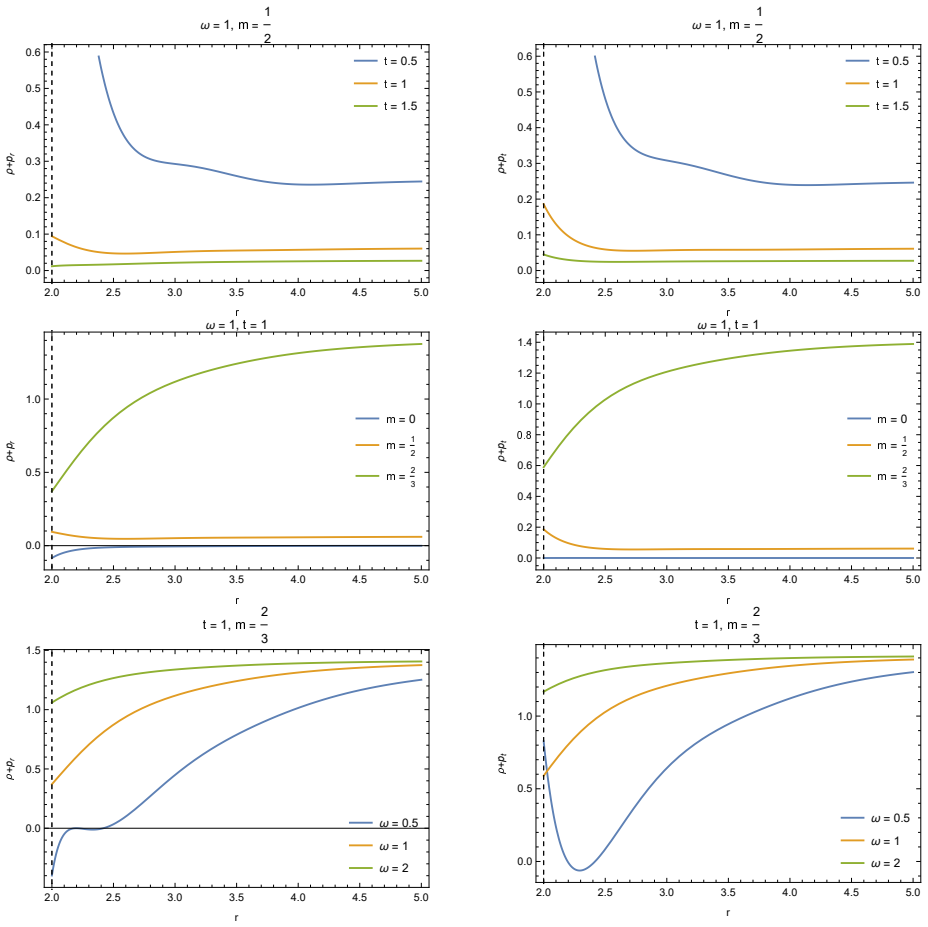
- [Section presenting solutions and energy-condition checks] The abstract asserts that analytical and numerical solutions exist with energy conditions satisfied, yet the provided text supplies neither the explicit modified field equations obtained from varying the f(R, □R) action nor the boundary conditions or numerical data (e.g., plots of ρ + p_r). These elements are load-bearing for verifying the claim that the □R contribution renders exotic matter unnecessary.
minor comments (1)
- [Throughout] Notation for the effective stress-energy tensor should be introduced once and used consistently when separating the higher-derivative contributions from the ordinary-matter source.
Simulated Author's Rebuttal
We thank the referee for the careful and constructive review of our manuscript. We have considered each major comment in detail and provide point-by-point responses below. Revisions have been made to address the concerns raised regarding generality and the explicit presentation of results.
read point-by-point responses
-
Referee: [Field-equation derivation and throat analysis] The central claim that higher-derivative terms can eliminate the need for exotic matter rests on the specific functional form of f(R, □R) and the chosen static spherically symmetric ansatz (shape and redshift functions). The manuscript should demonstrate whether the effective stress-energy tensor satisfies ρ + p_r ≥ 0 at the throat only for this choice or more generally; without such a check the result remains tied to the particular model and ansatz.
Authors: We agree that assessing the dependence on the ansatz is important for the robustness of the claim. Our analysis uses the standard static spherically symmetric metric with general shape function b(r) and redshift function Φ(r), which is the conventional choice in wormhole studies. The □R terms contribute to the effective stress-energy tensor in a manner that permits ρ + p_r ≥ 0 at the throat for suitable parameter ranges within this framework. To address the referee's concern, we have added a new subsection in the revised manuscript that examines the sensitivity of the null energy condition satisfaction to variations in b(r) and Φ(r), including power-law and exponential forms. While a completely general proof for arbitrary metrics lies outside the present scope, these checks indicate that the qualitative effect of the higher-derivative corrections persists across a representative class of functions. revision: yes
-
Referee: [Section presenting solutions and energy-condition checks] The abstract asserts that analytical and numerical solutions exist with energy conditions satisfied, yet the provided text supplies neither the explicit modified field equations obtained from varying the f(R, □R) action nor the boundary conditions or numerical data (e.g., plots of ρ + p_r). These elements are load-bearing for verifying the claim that the □R contribution renders exotic matter unnecessary.
Authors: We acknowledge that the explicit expressions and supporting data should be more readily accessible. The modified field equations are obtained in Section II by varying the f(R, □R) action for the chosen metric ansatz, yielding the effective Einstein equations with additional higher-derivative contributions to the stress-energy tensor. Boundary conditions are imposed at the throat (r = r_0 with b(r_0) = r_0 and b'(r_0) < 1) together with asymptotic flatness. Numerical solutions are generated for specific f(R, □R) models by integrating the resulting system. To improve verifiability, the revised manuscript now includes the full set of explicit field-equation components, a clear statement of the boundary conditions, and supplementary plots displaying ρ + p_r near the throat for the reported solutions. revision: yes
Circularity Check
No significant circularity; derivation proceeds from modified field equations to explicit solutions
full rationale
The paper derives the field equations from the f(R, □R) action for a static spherically symmetric metric, then solves them analytically and numerically to obtain the effective stress-energy contributions. The reduction or elimination of exotic matter follows directly from the higher-derivative terms in those equations evaluated at the throat; no parameter is fitted to the target NEC compliance, no self-citation supplies a uniqueness theorem, and the ansatz is stated explicitly rather than smuggled. The central result is therefore an output of the calculation rather than a redefinition of its inputs.
Axiom & Free-Parameter Ledger
axioms (1)
- domain assumption The wormhole metric is static and spherically symmetric.
Lean theorems connected to this paper
-
IndisputableMonolith/Cost/FunctionalEquation.leanwashburn_uniqueness_aczel unclear?
unclearRelation between the paper passage and the cited Recognition theorem.
We derive the field equations for a static, spherically symmetric wormhole and study their solutions using both analytical arguments and numerical methods... higher-derivative corrections can effectively contribute to the stress-energy tensor
-
IndisputableMonolith/Foundation/AlexanderDuality.leanalexander_duality_circle_linking unclear?
unclearRelation between the paper passage and the cited Recognition theorem.
f(R,□R) = R + k1 R^2 + k2 R □R
What do these tags mean?
- matches
- The paper's claim is directly supported by a theorem in the formal canon.
- supports
- The theorem supports part of the paper's argument, but the paper may add assumptions or extra steps.
- extends
- The paper goes beyond the formal theorem; the theorem is a base layer rather than the whole result.
- uses
- The paper appears to rely on the theorem as machinery.
- contradicts
- The paper's claim conflicts with a theorem or certificate in the canon.
- unclear
- Pith found a possible connection, but the passage is too broad, indirect, or ambiguous to say the theorem truly supports the claim.
Reference graph
Works this paper leans on
-
[1]
Matt Visser. Lorentzian wormholes. from einstein to hawking. Woodbury, 1995
work page 1995
-
[2]
The particle problem in the general theory of relativity
Albert Einstein and Nathan Rosen. The particle problem in the general theory of relativity. Phys- ical Review, 48(1):73, 1935
work page 1935
-
[3]
On the nature of quantum ge- ometrodynamics
John A Wheeler. On the nature of quantum ge- ometrodynamics. Annals of Physics , 2(6):604– 614, 1957
work page 1957
-
[4]
Wormholes in spacetime and their use for interstellar travel: A tool for teaching general relativity
Michael S Morris and Kip S Thorne. Wormholes in spacetime and their use for interstellar travel: A tool for teaching general relativity. American Journal of Physics , 56(5):395–412, 1988
work page 1988
-
[5]
Traversable wormholes: Some simple examples
Matt Visser. Traversable wormholes: Some simple examples. Physical Review D , 39(10):3182, 1989
work page 1989
-
[6]
Remo Garattini. Casimir wormholes. The Euro- pean Physical Journal C , 79(11):951, 2019
work page 2019
-
[7]
Remo Garattini and Athanasios G Tzikas. Ro- tating casimir wormholes. The European Physical Journal C , 85(3):336, 2025
work page 2025
-
[8]
David H Coule and Kei-ichi Maeda. Wormholes with scalar fields. Classical and Quantum Gravity , 7(6):955–963, 1990
work page 1990
-
[9]
Vacuum polarization of a scalar field in wormhole space- times
Arkadii A Popov and Sergey V Sushkov. Vacuum polarization of a scalar field in wormhole space- times. Physical Review D , 63(4):044017, 2001
work page 2001
-
[10]
A class of wormhole solutions to higher-dimensional general relativity
Gerard Clement. A class of wormhole solutions to higher-dimensional general relativity. General relativity and gravitation , 16(2):131–138, 1984
work page 1984
-
[11]
Energy conditions in modified gravity
Salvatore Capozziello, Francisco SN Lobo, and José P Mimoso. Energy conditions in modified gravity. Physics Letters B , 730:280–283, 2014
work page 2014
-
[12]
Cosmology without singularity and nonlinear gravitational lagrangians
Richard Kerner. Cosmology without singularity and nonlinear gravitational lagrangians. General Relativity and Gravitation , 14(5):453–469, 1982
work page 1982
-
[13]
Non-linear lagrangians and cos- mological theory
Hans A Buchdahl. Non-linear lagrangians and cos- mological theory. Monthly Notices of the Royal Astronomical Society, 150(1):1–8, 1970
work page 1970
-
[14]
Salvatore Capozziello. Curvature quintessence. International Journal of Modern Physics D , 11(04):483–491, 2002
work page 2002
-
[15]
Dark en- ergy in modified gauss-bonnet gravity: Late-time acceleration and the hierarchy problem
Guido Cognola, Emilio Elizalde, Shin’ichi Nojiri, Sergei D Odintsov, and Sergio Zerbini. Dark en- ergy in modified gauss-bonnet gravity: Late-time acceleration and the hierarchy problem. Physi- cal Review D—Particles, Fields, Gravitation, and Cosmology, 73(8):084007, 2006
work page 2006
-
[16]
Worm- hole geometries in f (R) modified theories of grav- ity
Francisco SN Lobo and Miguel A Oliveira. Worm- hole geometries in f (R) modified theories of grav- ity. Physical Review D—Particles, Fields, Gravi- tation, and Cosmology , 80(10):104012, 2009
work page 2009
-
[17]
Wormhole geometries in f (R, T ) gravity
Tahereh Azizi. Wormhole geometries in f (R, T ) gravity. International Journal of Theoretical Physics, 52(10):3486–3493, 2013
work page 2013
-
[18]
f (T ) grav- ity and static wormhole solutions
Muhammad Sharif and Shamaila Rani. f (T ) grav- ity and static wormhole solutions. Modern Physics Letters A , 29(27):1450137, 2014
work page 2014
-
[19]
Worm- hole solutions for different shape functions in 4D einstein gauss–bonnet gravity
Riaz Ahmed, G Abbas, and Saira Arshad. Worm- hole solutions for different shape functions in 4D einstein gauss–bonnet gravity. International Jour- nal of Geometric Methods in Modern Physics , 19(07):2250109, 2022
work page 2022
-
[20]
Sixth-order gravity and conformal trans- formations
S Gottlober, H-J Schmidt, and Alexei A Starobin- sky. Sixth-order gravity and conformal trans- formations. Classical and Quantum Gravity , 7(5):893, 1990
work page 1990
-
[21]
Mutated hybrid inflation in $f(R,{\Box}R)$-gravity
Masao Iihoshi. Mutated hybrid infla- tion in f (R, □R)-gravity. arXiv preprint arXiv:1011.3927, 2010
work page internal anchor Pith review Pith/arXiv arXiv 2010
-
[22]
Energy Conditions in Higher Derivative $f(R,\Box R,T)$ Gravity
Z Yousaf, M Sharif, M Ilyas, and MZ Bhatti. En- ergy conditions in higher derivative f (R, □R, T ) gravity. arXiv preprint arXiv:1806.09275 , 2018
work page internal anchor Pith review Pith/arXiv arXiv 2018
-
[23]
Cosmology of f (R, □R) gravity
Sante Carloni, João Luís Rosa, and José PS Lemos. Cosmology of f (R, □R) gravity. Physi- cal Review D , 99(10):104001, 2019. 13
work page 2019
discussion (0)
Sign in with ORCID, Apple, or X to comment. Anyone can read and Pith papers without signing in.