Topologically protected long-range correlations in steady states of driven-dissipative bosonic chains
Pith reviewed 2026-05-20 11:04 UTC · model grok-4.3
The pith
Non-Hermitian topology appears directly in the long-range correlations of steady states in driven-dissipative bosonic chains.
A machine-rendered reading of the paper's core claim, the machinery that carries it, and where it could break.
Core claim
We develop a general framework that links topological phases in driven-dissipative systems to bosonic correlations via the singular value decomposition. Non-Hermitian topology in quadratic Liouvillians is directly encoded in steady-state correlations, providing an intrinsic characterization of topology without external probes. Topological amplification induces disorder-robust long-range order in steady-state correlations at fixed frequency. We introduce a vector-valued topological invariant that captures the total number of singular-value gap closings across the frequency axis. The spatial structure of equal-time correlations encodes global topological information, manifested as Gaussian sp
What carries the argument
Singular value decomposition applied to quadratic Liouvillians, which defines a vector-valued topological invariant by counting singular-value gap closings along the frequency axis and directly shapes the spatial form of steady-state bosonic correlations.
If this is right
- Topological phases produce long-range order in frequency-resolved steady-state correlations that resists disorder.
- Equal-time correlations decay Gaussianly with distance inside topological regimes but exponentially inside trivial regimes.
- Frequency-resolved correlations function as direct signatures of non-Hermitian topological phases.
- The vector-valued invariant classifies quadratic Liouvillians by extending adiabatic deformation to dissipative systems.
Where Pith is reading between the lines
- Correlation measurements alone could suffice to detect topology in quantum simulators such as trapped-ion or circuit platforms.
- The same decay signatures might appear in fermionic or spin-based driven-dissipative lattices.
- Robust long-range correlations engineered via topology could improve signal-to-noise ratios in quantum sensing tasks.
- Extensions to higher-dimensional lattices or weakly interacting regimes could be tested by the same SVD-based diagnostic.
Load-bearing premise
The spatial structure of equal-time correlations encodes global topological information, appearing specifically as Gaussian decay with distance in the topological phase versus exponential decay in trivial phases.
What would settle it
Measure the spatial decay profile of equal-time correlations in a driven-dissipative bosonic chain and check whether the functional form switches from exponential to Gaussian exactly when parameters cross a singular-value gap closing that defines the topological transition.
Figures




read the original abstract
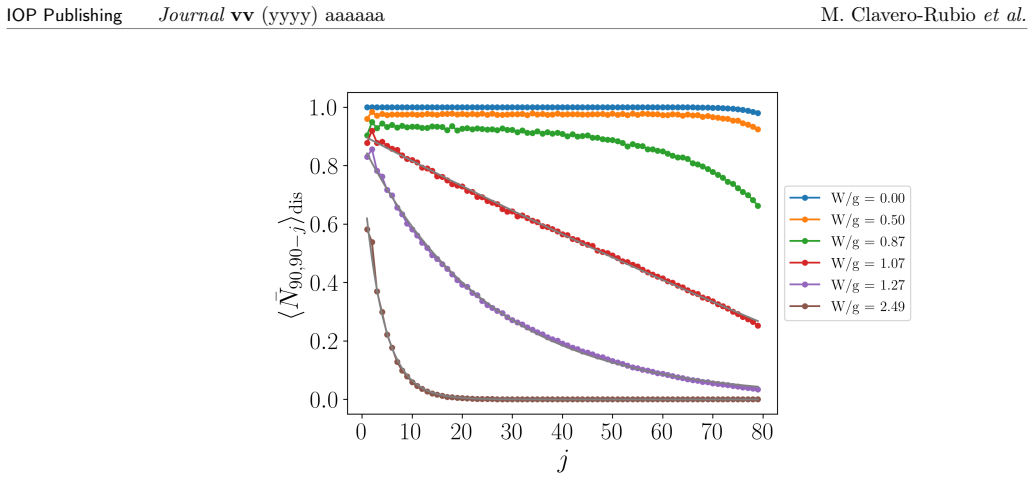
Driven-dissipative quantum systems can exhibit robust transport and amplification in topological regimes, yet the connection between topology and the extent of correlations remains largely unexplored. In this work, we develop a general framework that links topological phases in driven-dissipative systems to bosonic correlations via the singular value decomposition (SVD). In essence, we claim that non-Hermitian topology in quadratic Liouvillians is directly encoded in steady-state correlations, providing an intrinsic characterization of topology without external probes. We show that topological amplification induces disorder-robust long-range order (LRO) in steady-state correlations at fixed frequency, establishing frequency-resolved correlations as direct signatures of non-Hermitian topological phases. We introduce a vector-valued topological invariant that captures the total number of singular-value gap closings across the frequency axis, extending the concept of adiabatic deformation from topological insulators to the case of topological phases of quadratic Liouvillians. Within this framework, we further demonstrate that the spatial structure of equal-time correlations encodes global topological information, manifested as a Gaussian spatial decay with distance in the topological phase, in contrast to the exponential decay characteristic of trivial phases. These findings open new avenues for quantum sensing and correlation engineering in non-Hermitian systems, with feasible implementations in platforms such as trapped ions and superconducting circuits.
Editorial analysis
A structured set of objections, weighed in public.
Referee Report
Summary. The manuscript develops a general framework linking non-Hermitian topology in quadratic Liouvillians of driven-dissipative bosonic chains to steady-state bosonic correlations via the singular value decomposition (SVD). It claims that this topology is intrinsically encoded in the correlations, yielding disorder-robust long-range order at fixed frequency in topological phases. A vector-valued topological invariant is introduced that counts the total number of singular-value gap closings across the frequency axis. The paper further asserts that the spatial structure of equal-time correlations encodes global topological information, appearing as Gaussian decay with distance in the topological phase and exponential decay in trivial phases.
Significance. If the central claims are established with explicit derivations, the work would provide an intrinsic, probe-free characterization of non-Hermitian topological phases through steady-state correlations. This could enable new approaches to quantum sensing and correlation engineering in platforms such as trapped ions and superconducting circuits, while extending adiabatic-deformation ideas from closed topological insulators to open quadratic Liouvillians.
major comments (1)
- [Abstract and associated derivation sections] The central claim that equal-time correlations exhibit Gaussian spatial decay in the topological phase (contrasted with exponential decay in trivial phases) is not supported by a general derivation. Equal-time correlations are obtained by integrating frequency-resolved correlators over all frequencies; without an explicit analytic step (e.g., contour integration or residue analysis tied to the singular-value gap closings identified by the SVD), the specific Gaussian functional form is not guaranteed by the topology alone and could arise from other spectral features.
minor comments (2)
- Clarify the precise definition and normalization of the vector-valued topological invariant when it is first introduced.
- Ensure consistent notation for the Liouvillian and its SVD decomposition across all sections and figures.
Simulated Author's Rebuttal
We thank the referee for their thorough review and insightful comments, which have helped us identify areas for clarification in the manuscript. We address the major comment point by point below and outline the revisions we will make.
read point-by-point responses
-
Referee: [Abstract and associated derivation sections] The central claim that equal-time correlations exhibit Gaussian spatial decay in the topological phase (contrasted with exponential decay in trivial phases) is not supported by a general derivation. Equal-time correlations are obtained by integrating frequency-resolved correlators over all frequencies; without an explicit analytic step (e.g., contour integration or residue analysis tied to the singular-value gap closings identified by the SVD), the specific Gaussian functional form is not guaranteed by the topology alone and could arise from other spectral features.
Authors: We appreciate the referee highlighting the need for an explicit link between the SVD-based topological invariant and the functional form of the equal-time correlations. In our framework, the frequency-resolved correlators are constructed directly from the SVD of the quadratic Liouvillian, with the vector-valued invariant counting the net number of singular-value gap closings along the frequency axis. The equal-time correlator is the integral of these over all frequencies. While we connect the long-range order at fixed frequency to the topology, we agree that the manuscript does not contain a fully explicit contour-integration argument showing why the integrated spatial decay is Gaussian (rather than, e.g., power-law or exponential) precisely when gap closings are present. Such an analysis would involve deforming the integration contour around the branch cuts or poles whose locations are fixed by the SVD gaps, yielding a Gaussian envelope from the saddle-point contribution in the topological phase and exponential decay when the gaps remain open. We will add this derivation as a new subsection (or appendix) in the revised manuscript, including the residue analysis tied to the SVD and a direct comparison between topological and trivial cases. This will make the claim rigorous and address the possibility that other spectral features could produce the same decay. revision: yes
Circularity Check
Framework links topology to correlations via SVD without evident reduction to inputs by construction
full rationale
The paper develops a general framework connecting non-Hermitian topology in quadratic Liouvillians to bosonic steady-state correlations using singular value decomposition and a vector-valued invariant for singular-value gap closings. Claims of Gaussian spatial decay in equal-time correlations for topological phases (versus exponential in trivial phases) are presented as demonstrations within this structure, derived from integrating frequency-resolved correlators. No quoted steps reduce predictions to fitted parameters, self-definitions, or unverified self-citations by construction. The derivation chain remains self-contained with independent content from the SVD-based mapping and adiabatic deformation extension, consistent with external benchmarks for such models.
Axiom & Free-Parameter Ledger
axioms (1)
- domain assumption The driven-dissipative bosonic chains are described by quadratic Liouvillians
invented entities (1)
-
vector-valued topological invariant
no independent evidence
Lean theorems connected to this paper
-
IndisputableMonolith/Foundation/AlexanderDuality.leanalexander_duality_circle_linking unclear?
unclearRelation between the paper passage and the cited Recognition theorem.
We introduce a vector-valued topological invariant that captures the total number of singular-value gap closings across the frequency axis... manifested as a Gaussian spatial decay with distance in the topological phase, in contrast to the exponential decay characteristic of trivial phases.
-
IndisputableMonolith/Cost/FunctionalEquation.leanwashburn_uniqueness_aczel unclear?
unclearRelation between the paper passage and the cited Recognition theorem.
Nlj ≈ γc (γ−2)/2π eλ0(l+j) √(π/2(l+j)) exp(−(l−j)²/2(l+j))
What do these tags mean?
- matches
- The paper's claim is directly supported by a theorem in the formal canon.
- supports
- The theorem supports part of the paper's argument, but the paper may add assumptions or extra steps.
- extends
- The paper goes beyond the formal theorem; the theorem is a base layer rather than the whole result.
- uses
- The paper appears to rely on the theorem as machinery.
- contradicts
- The paper's claim conflicts with a theorem or certificate in the canon.
- unclear
- Pith found a possible connection, but the passage is too broad, indirect, or ambiguous to say the theorem truly supports the claim.
Reference graph
Works this paper leans on
-
[1]
von Klitzing K, Dorda G and Pepper M 1980Phys. Rev. Lett.45494
-
[2]
Hasan M Z and Kane C L 2010Rev. Mod. Phys.823045–3067
-
[3]
Qi X L and Zhang S C 2011Rev. Mod. Phys.831057
- [4]
-
[5]
Koch F and Budich J C 2022Phys. Rev. Res.4013113
-
[6]
Slim J J, Wanjura C C, Brunelli M, Del Pino J, Nunnenkamp A and Verhagen E 2024Nature 627767–771
-
[7]
Clavero-Rubio M, Ramos T and Porras D 2025Phys. Rev. Res.7043218
-
[8]
Porras D and Fernández-Lorenzo S 2019Phys. Rev. Lett.122143901
- [9]
-
[10]
Parra-Rodriguez A, Clavero-Rubio M, Gigon P, Ramos T, Gómez-León Á and Porras D 2025 (Preprint2512.08880)
work page internal anchor Pith review Pith/arXiv arXiv 2025
-
[11]
Bardyn C E, Baranov M A, Kraus C V, Rico E, İmamoğlu A, Zoller P and Diehl S 2013New J. Phys.15085001
-
[12]
Pernet N, St-Jean P, Solnyshkov D D, Malpuech G, Carlon Zambon N, Fontaine Q, Real B, Jamadi O, Lemaître A, Morassi Met al.2022Nat. Phys.18678–684
-
[13]
Villa G, Del Pino J, Dumont V, Rastelli G, Michałek M, Eichler A and Zilberberg O 2025Sci. Adv.11eadt9311
-
[14]
Kawabata K, Shiozaki K, Ueda M and Sato M 2019Phys. Rev. X9041015
- [15]
-
[16]
Okuma N and Sato M 2023Annu. Rev. Condens. Matter Phys.1483–107
-
[17]
Okuma N, Kawabata K, Shiozaki K and Sato M 2020Phys. Rev. Lett.124086801
-
[18]
Yokomizo K and Murakami S 2019Phys. Rev. Lett.123066404
-
[19]
Peano V, Houde M, Marquardt F and Clerk A A 2016Phys. Rev. X6041026
-
[20]
Brunelli M, Wanjura C C and Nunnenkamp A 2023SciPost Physics15173
-
[21]
Gómez-León Á, Ramos T, González-Tudela A and Porras D 2022Phys. Rev. A106L011501
-
[22]
Gomez-Leon A, Ramos T, Gonzalez-Tudela A and Porras D 2023Quantum71016
-
[23]
Herviou L, Bardarson J H and Regnault N 2019Phys. Rev. A99052118
-
[24]
Flynn V P, Cobanera E and Viola L 2021Phys. Rev. Lett.127245701
-
[25]
Flynn V P, Cobanera E and Viola L 2023Phys. Rev. B108214312
- [26]
-
[27]
Gu D, Fu Z and Wang Z 2026 Nonreciprocity-enriched steady phases in open quantum systems (Preprint2605.00101)
work page internal anchor Pith review Pith/arXiv arXiv 2026
-
[28]
Ramos T, García-Ripoll J J and Porras D 2021Phys. Rev. A103033513
-
[29]
McDonald A, Hanai R and Clerk A A 2022Phys. Rev. B105064302
-
[30]
Ughrelidze M, Flynn V P, Cobanera E and Viola L 2026 Quantum criticality beyond thermodynamic stability (Preprint2605.04153)
work page internal anchor Pith review Pith/arXiv arXiv 2026
-
[31]
McDonald A, Pereg-Barnea T and Clerk A 2018Phys. Rev. X8041031 21 IOP PublishingJournalvv(yyyy) aaaaaa M. Clavero-Rubioet al
- [32]
-
[33]
Feinberg J and Zee A 1997Nucl. Phys. B504579–608
-
[34]
Asbóth J K, Oroszlány L and Pályi A 2016Lecture notes in Physics919
-
[35]
Horn R A and Johnson C R 2012Matrix Analysis2nd ed (Cambridge: Cambridge University Press) ISBN 9780521548236
-
[36]
Rassaert L, Ramos T, Roscilde T and Porras D 2025Phys. Rev. Lett.135203603
-
[37]
Dalfovo F, Giorgini S, Pitaevskii L P and Stringari S 1999Reviews of modern physics71463
-
[38]
Bansil A, Lin H and Das T 2016Rev. Mod. Phys.88021004
-
[39]
Yao S and Wang Z 2018Phys. Rev. Lett.121086803
-
[40]
Graß T 2019Phys. Rev. A99043607
-
[41]
Roccati F, Purkayastha A, Palma G M and Ciccarello F 2023Eur. Phys. J. Spec. Top.232 1783–1788
-
[42]
Moustaj A, Eek L and Morais Smith C 2022Phys. Rev. B105L180503 A Symmetry constraints on the dynamical matrix A.1 Particle-hole symmetry of the dynamical matrix The non-Hermitian dynamical matrixHhas a remarkable particle-hole symmetry, defined in terms of the antiunitary symmetry operatorΞ =CK, whereC=1 N ⊗σ x, andKis complex conjugation, ΞHΞ =CH ∗C=−H.(...
discussion (0)
Sign in with ORCID, Apple, or X to comment. Anyone can read and Pith papers without signing in.