GRB 260310A/SN 2026fgk: Photometric and Spectroscopic Evolution of a Nearby GRB-Supernova and an Exceptionally Bright Afterglow at z=0.153
Pith reviewed 2026-05-20 08:00 UTC · model grok-4.3
The pith
Spectroscopy confirms GRB 260310A's supernova as a Type Ic-BL half as luminous as SN 1998bw with a 15 kpc offset.
A machine-rendered reading of the paper's core claim, the machinery that carries it, and where it could break.
Core claim
The paper establishes that GRB 260310A is associated with SN 2026fgk, identified as a Type Ic-BL supernova through broad absorption features in spectra taken more than two weeks after explosion. Modeling of the multi-band lightcurve scaled from the SN 1998bw template with luminosity factor k_98bw of 0.4-0.6 yields M_Ni of 0.4-0.5 solar masses, M_ej of 4-6 solar masses, and E_K of (3-8) x 10^51 erg. The 15 kpc offset arises from the host's extended light profile rather than an isolated location, as shown by the nebular emission bridge and the sub-solar metallicity at the explosion site compared to near-solar in the host core.
What carries the argument
Late-time spectral identification of broad absorption features combined with multi-wavelength lightcurve modeling that scales the supernova component from the SN 1998bw template using a single luminosity scaling factor k_98bw.
If this is right
- This event increases the number of spectroscopically confirmed GRB-supernovae within 1 Gpc to 12, enabling tighter comparisons of explosion parameters across the class.
- The derived ejecta properties place SN 2026fgk on the lower-luminosity end of GRB-associated supernovae while remaining consistent with typical kinetic energies.
- The large offset and connecting nebular emission demonstrate that GRB progenitors can occur in the outer disks of galaxies with sub-solar metallicity.
- The exceptionally bright afterglow at low redshift provides a high-quality dataset for testing afterglow emission models without significant distance-related uncertainties.
Where Pith is reading between the lines
- If similar large-offset events prove common, targeted searches in galactic outskirts may increase the detection rate of GRB-supernovae.
- Future inclusion of viewing-angle corrections in lightcurve fits could narrow or shift the reported range of kinetic energies.
- The metallicity gradient and emission bridge suggest that resolved studies of other GRB hosts could test whether outer-disk star formation preferentially produces such explosions.
Load-bearing premise
The supernova lightcurve can be modeled by scaling the SN 1998bw template with a single luminosity factor without substantial extra uncertainties from viewing angle, host extinction, or non-standard nickel distribution.
What would settle it
New spectroscopy that lacks the reported broad absorption features or multi-band photometry that deviates from the scaled 1998bw template by more than the modeled uncertainties would falsify the supernova classification and parameter estimates.
Figures



read the original abstract
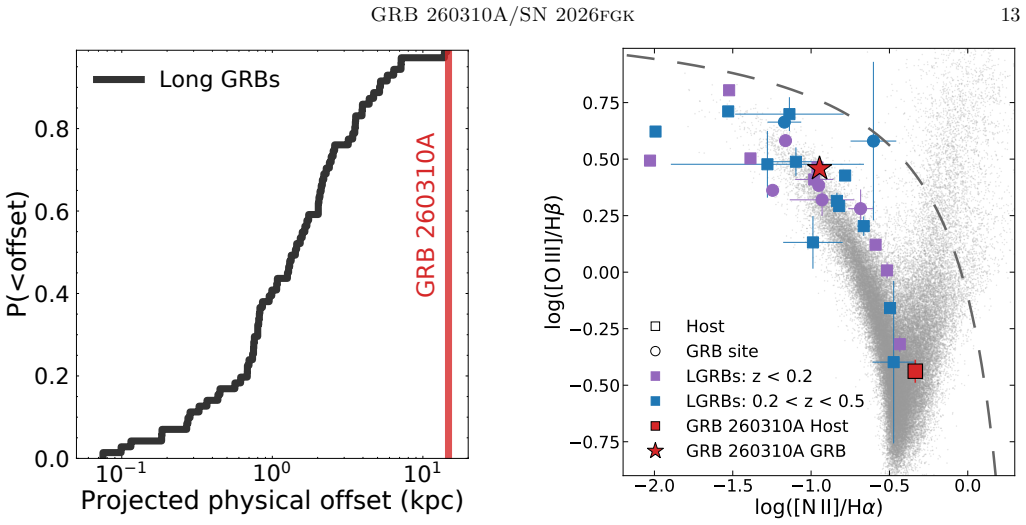
The association of broad-lined Type Ic supernovae with long-duration gamma-ray bursts (GRBs) has been known for 28 years. However, only about seventy gamma-ray burst supernovae (GRB-SNe) have been identified, of which only half have spectroscopic classifications. At $z=0.153$, GRB 260310A is the 12th spectroscopically confirmed GRB-SN discovered within 1 Gpc, offering a critical opportunity to follow one of these rare supernovae in detail. We present optical to near-infrared imaging and spectroscopy of GRB 260310A and SN 2026fgk out to 65 d after discovery. The optical afterglow is among the brightest ever observed from a GRB. Spectra obtained more than two weeks after the explosion reveal broad absorption features that securely identify SN 2026fgk as a Type Ic-BL supernova. Modeling of the multi-wavelength ($grizJK_s$) lightcurve shows that the supernova is approximately half the luminosity ($k_\textrm{98bw}=0.4-0.6$) of the canonical GRB-SN 1998bw. We derive a nickel mass of $M_\textrm{Ni}=0.4-0.5$ $M_\odot$ with a total ejected mass of $M_\textrm{ej}\approx4-6 $ $M_\odot$ and kinetic energy $E_\textrm{K}=(3-8)\times10^{51}$ erg. The GRB exploded at an extremely large offset of 15 kpc from its host galaxy. Long-slit spectra reveal a ``bridge'' of nebular emission extending along the galaxy's disk to the GRB location, which has a sub-solar metallicity ($\sim$\,$0.4Z_\odot$), compared to a near solar metallicity for the host galaxy. This indicates that the large offset arises from the galaxy's extended light profile rather than an isolated environment.
Editorial analysis
A structured set of objections, weighed in public.
Referee Report
Summary. The manuscript reports observations of GRB 260310A and associated SN 2026fgk at z=0.153, with optical-to-NIR imaging and spectroscopy out to 65 days. Spectra more than two weeks post-explosion show broad absorption features that classify SN 2026fgk as a Type Ic-BL supernova. After subtracting the bright afterglow, multi-wavelength (grizJK_s) lightcurve modeling scales the SN 1998bw template by a single factor k_98bw=0.4-0.6, yielding M_Ni=0.4-0.5 M_⊙, M_ej≈4-6 M_⊙, and E_K=(3-8)×10^51 erg. The GRB site lies at a 15 kpc offset with sub-solar metallicity (~0.4 Z_⊙) connected by a nebular emission bridge.
Significance. If the modeling is robust, the work enlarges the small sample of spectroscopically confirmed nearby GRB-SNe and supplies quantitative explosion parameters together with environmental context at large offset. The exceptionally bright afterglow and metallicity measurement add useful constraints on progenitor channels and host-galaxy structure.
major comments (1)
- [lightcurve modeling] Lightcurve modeling (abstract and associated section): the reported values M_Ni=0.4-0.5 M_⊙, M_ej≈4-6 M_⊙, E_K=(3-8)×10^51 erg are obtained by applying a single multiplicative scaling k_98bw=0.4-0.6 to the SN 1998bw template after afterglow subtraction. Because GRB-SNe are known to be aspherical, the absence of explicit treatment of viewing-angle mismatch, line-of-sight extinction, or nickel-distribution differences introduces systematics that can shift the inferred bolometric luminosity and therefore the derived masses and energy by factors comparable to the quoted ranges.
minor comments (1)
- [abstract] Abstract: the phrase 'more than two weeks after the explosion' for the spectra could be replaced by the precise rest-frame or observer-frame epoch to improve clarity.
Simulated Author's Rebuttal
We thank the referee for their careful and constructive review of our manuscript. We address the single major comment on lightcurve modeling below, providing a point-by-point response while maintaining the integrity of our analysis.
read point-by-point responses
-
Referee: Lightcurve modeling (abstract and associated section): the reported values M_Ni=0.4-0.5 M_⊙, M_ej≈4-6 M_⊙, E_K=(3-8)×10^51 erg are obtained by applying a single multiplicative scaling k_98bw=0.4-0.6 to the SN 1998bw template after afterglow subtraction. Because GRB-SNe are known to be aspherical, the absence of explicit treatment of viewing-angle mismatch, line-of-sight extinction, or nickel-distribution differences introduces systematics that can shift the inferred bolometric luminosity and therefore the derived masses and energy by factors comparable to the quoted ranges.
Authors: We agree that the template-scaling approach carries inherent systematics due to the aspherical nature of GRB-SNe, potential viewing-angle effects, and variations in nickel distribution or extinction. This method is nevertheless the standard technique applied to the majority of spectroscopically confirmed GRB-SNe in the literature when full spectroscopic time series are unavailable (as is the case here after +14 d). The broad ranges we quote for M_Ni, M_ej, and E_K already reflect the dominant uncertainty from the scaling factor k_98bw itself. To strengthen the manuscript we will add a dedicated paragraph in the modeling section that explicitly discusses these limitations, references comparable analyses of other GRB-SNe, and notes that the reported parameter ranges should be interpreted as approximate rather than precise. We do not believe a full re-derivation with 3-D models is justified by the existing data quality, but the added discussion will make the caveats transparent. revision: partial
Circularity Check
Template scaling from external SN 1998bw observations introduces no circularity
full rationale
The paper's central quantitative claims follow from fitting a single multiplicative scaling factor k_98bw=0.4-0.6 to the observed grizJK_s lightcurve after afterglow subtraction, then applying standard relations to obtain M_Ni, M_ej and E_K. This uses an external template (SN 1998bw) whose photometry and properties are independent of the present dataset. Spectroscopic classification as Type Ic-BL rests on directly observed broad absorption features more than two weeks post-explosion. No load-bearing step reduces by construction to a fitted input, self-citation chain, or ansatz imported from the authors' prior work; the derivation remains self-contained against external benchmarks.
Axiom & Free-Parameter Ledger
free parameters (2)
- k_98bw luminosity scaling factor
- nickel mass M_Ni
axioms (1)
- domain assumption Broad absorption features in spectra more than two weeks post-explosion securely identify Type Ic-BL classification.
Lean theorems connected to this paper
-
IndisputableMonolith/Cost/FunctionalEquation.leanwashburn_uniqueness_aczel unclear?
unclearRelation between the paper passage and the cited Recognition theorem.
Modeling of the multi-wavelength (grizJKs) lightcurve shows that the supernova is approximately half the luminosity (k_98bw=0.4-0.6) of the canonical GRB-SN 1998bw. We derive a nickel mass of M_Ni=0.4-0.5 M_⊙ ...
-
IndisputableMonolith/Foundation/RealityFromDistinction.leanreality_from_one_distinction unclear?
unclearRelation between the paper passage and the cited Recognition theorem.
We performed a simultaneous multi-wavelength ... fit ... using models supplied in the redback software package ... powerlaw+SN 1998bw and powerlaw+Arnett
What do these tags mean?
- matches
- The paper's claim is directly supported by a theorem in the formal canon.
- supports
- The theorem supports part of the paper's argument, but the paper may add assumptions or extra steps.
- extends
- The paper goes beyond the formal theorem; the theorem is a base layer rather than the whole result.
- uses
- The paper appears to rely on the theorem as machinery.
- contradicts
- The paper's claim conflicts with a theorem or certificate in the canon.
- unclear
- Pith found a possible connection, but the passage is too broad, indirect, or ambiguous to say the theorem truly supports the claim.
Reference graph
Works this paper leans on
-
[1]
J.168(2), 58 (2024), doi:10.3847/1538-3881/ad3217
Adame, A. G., et al. 2024, Astron. J., 168, 58, doi: 10.3847/1538-3881/ad3217
-
[2]
2011, ApJS, 193, 29, doi: 10.1088/0067-0049/193/2/29
Aihara, H., Allende Prieto, C., An, D., et al. 2011, ApJS, 193, 29, doi: 10.1088/0067-0049/193/2/29
-
[3]
2007, , 374, 1413, 10.1111/j.1365-2966.2006.11246.x
Amati, L. 2006, MNRAS, 372, 233, doi: 10.1111/j.1365-2966.2006.10840.x
-
[4]
2002, A&A, 390, 81, doi: 10.1051/0004-6361:20020722
Amati, L., Frontera, F., Tavani, M., et al. 2002, A&A, 390, 81, doi: 10.1051/0004-6361:20020722
-
[5]
Arnett, W. D. 1982, ApJ, 253, 785, doi: 10.1086/159681
-
[6]
Ashall, C., Mazzali, P. A., Pian, E., et al. 2019, MNRAS, 487, 5824, doi: 10.1093/mnras/stz1588
-
[7]
Ashton, G., H¨ ubner, M., Lasky, P. D., et al. 2019, ApJS, 241, 27, doi: 10.3847/1538-4365/ab06fc Astropy Collaboration, Price-Whelan, A. M., Sip˝ ocz, B. M., et al. 2018, AJ, 156, 123, doi: 10.3847/1538-3881/aabc4f Astropy Collaboration, Price-Whelan, A. M., Lim, P. L., et al. 2022, ApJ, 935, 167, doi: 10.3847/1538-4357/ac7c74
-
[8]
2026, GRB Coordinates Network, 43981, 1
Atteia, J.-L., Moreno M´ endez, E., Lincetto, M., et al. 2026, GRB Coordinates Network, 43981, 1
work page 2026
-
[9]
Baldwin, J. A., Phillips, M. M., & Terlevich, R. 1981, PASP, 93, 5, doi: 10.1086/130766
-
[10]
2016,, Astrophysics Source Code Library, record ascl:1611.017 http://ascl.net/1611.017
Barbary, K., Barclay, T., Biswas, R., et al. 2016,, Astrophysics Source Code Library, record ascl:1611.017 http://ascl.net/1611.017
work page 2016
-
[11]
2026, GRB Coordinates Network, 44043, 1
Belkin, S., & Shrestha, M. 2026, GRB Coordinates Network, 44043, 1
work page 2026
-
[12]
Berger, E., Kulkarni, S. R., Pooley, G., et al. 2003, Nature, 426, 154, doi: 10.1038/nature01998
-
[13]
2006, in Astronomical Society of the Pacific Conference Series, Vol
Bertin, E. 2006, in Astronomical Society of the Pacific Conference Series, Vol. 351, Astronomical Data Analysis Software and Systems XV, ed. C. Gabriel, C. Arviset, D. Ponz, & S. Enrique, 112
work page 2006
- [14]
-
[15]
1996a, A&AS, 117, 393, doi: 10.1051/aas:1996164 —
Bertin, E., & Arnouts, S. 1996, A&AS, 117, 393, doi: 10.1051/aas:1996164
-
[16]
2002, in Astronomical Society of the Pacific Conference Series, Vol
Bertin, E., Mellier, Y., Radovich, M., et al. 2002, in Astronomical Society of the Pacific Conference Series, Vol. 281, Astronomical Data Analysis Software and Systems XI, ed. D. A. Bohlender, D. Durand, & T. H. Handley, 228
work page 2002
-
[17]
Bhirombhakdi, K., Fruchter, A. S., Levan, A. J., et al. 2024, ApJ, 977, 256, doi: 10.3847/1538-4357/ad8dd8 Bj¨ ornsson, C.-I., & Fransson, C. 2004, ApJ, 605, 823, doi: 10.1086/382584 GRB 260310A/SN 2026fgk17 T able 2.Log of spectroscopic observations of GRB 260310A/SN 2026fgk. Start Date (UTC)δt(days) Telescope Instrument Grating Exposure (s) 2026-03-14 1...
-
[18]
Blanchard, P. K., Berger, E., & Fong, W.-f. 2016, ApJ, 817, 144, doi: 10.3847/0004-637X/817/2/144
-
[19]
Blanchard, P. K., Villar, V. A., Chornock, R., et al. 2024, Nature Astronomy, 8, 774, doi: 10.1038/s41550-024-02237-4
-
[20]
Bloom, J. S., Kulkarni, S. R., & Djorgovski, S. G. 2002, AJ, 123, 1111, doi: 10.1086/338893
-
[21]
Bloom, J. S., Kulkarni, S. R., Djorgovski, S. G., et al. 1999, Nature, 401, 453, doi: 10.1038/46744
-
[22]
2024, astropy/photutils: 2.0.2, 2.0.2, Zenodo, doi: 10.5281/zenodo.13989456
Bradley, L., Sip˝ ocz, B., Robitaille, T., et al. 2024,, 2.0.2 Zenodo, doi: 10.5281/zenodo.13989456
-
[23]
2026, GRB Coordinates Network, 44004, 1
Brivio, R., Malesani, D., Izzo, L., et al. 2026, GRB Coordinates Network, 44004, 1
work page 2026
-
[24]
2012, ApJ, 753, 67, doi: 10.1088/0004-637X/753/1/67
Bufano, F., Pian, E., Sollerman, J., et al. 2012, ApJ, 753, 67, doi: 10.1088/0004-637X/753/1/67
-
[25]
2025, arXiv e-prints, arXiv:2503.14588, doi: 10.48550/arXiv.2503.14588
Busmann, M., O’Connor, B., Sommer, J., et al. 2025, arXiv e-prints, arXiv:2503.14588, doi: 10.48550/arXiv.2503.14588
-
[26]
Campana, S., Mangano, V., Blustin, A. J., et al. 2006, Nature, 442, 1008, doi: 10.1038/nature04892
-
[27]
2013, MNRAS, 434, 1098, doi: 10.1093/mnras/stt1048
Cano, Z. 2013, MNRAS, 434, 1098, doi: 10.1093/mnras/stt1048
-
[28]
2017a, Advances in Astronomy, 2017, 8929054, doi: 10.1155/2017/8929054
Cano, Z., Wang, S.-Q., Dai, Z.-G., & Wu, X.-F. 2017a, Advances in Astronomy, 2017, 8929054, doi: 10.1155/2017/8929054
-
[29]
2011, ApJ, 740, 41, doi: 10.1088/0004-637X/740/1/41
Cano, Z., Bersier, D., Guidorzi, C., et al. 2011, ApJ, 740, 41, doi: 10.1088/0004-637X/740/1/41
-
[30]
2017b, A&A, 605, A107, doi: 10.1051/0004-6361/201731005
Cano, Z., Izzo, L., de Ugarte Postigo, A., et al. 2017b, A&A, 605, A107, doi: 10.1051/0004-6361/201731005
-
[31]
2012,, Astrophysics Source Code Library, record ascl:1210.002 http://ascl.net/1210.002
Cappellari, M. 2012,, Astrophysics Source Code Library, record ascl:1210.002 http://ascl.net/1210.002
work page 2012
-
[32]
, archivePrefix = "arXiv", eprint =
Cappellari, M. 2017, MNRAS, 466, 798, doi: 10.1093/mnras/stw3020
work page internal anchor Pith review doi:10.1093/mnras/stw3020 2017
-
[33]
Cappellari, M., & Emsellem, E. 2004, PASP, 116, 138, doi: 10.1086/381875
-
[34]
2003, , 115, 763, 10.1086/376392
Chabrier, G. 2003, PASP, 115, 763, doi: 10.1086/376392
work page internal anchor Pith review doi:10.1086/376392 2003
-
[35]
Chambers, K. C., Magnier, E. A., Metcalfe, N., et al. 2016, arXiv e-prints, arXiv:1612.05560. https://arxiv.org/abs/1612.05560
work page internal anchor Pith review Pith/arXiv arXiv 2016
-
[36]
Chevalier, R. A. 1982, ApJ, 259, 302, doi: 10.1086/160167
-
[37]
Chevalier, R. A., & Fransson, C. 2006, ApJ, 651, 381, doi: 10.1086/507606
-
[38]
Chonis, T. S., Hill, G. J., Lee, H., Tuttle, S. E., & Vattiat, B. L. 2014, in Society of Photo-Optical Instrumentation Engineers (SPIE) Conference Series, Vol. 9147, Ground-based and Airborne Instrumentation for Astronomy V, ed. S. K. Ramsay, I. S. McLean, & H. Takami, 91470A, doi: 10.1117/12.2056005
-
[39]
Chonis, T. S., Hill, G. J., Lee, H., et al. 2016, in Society of Photo-Optical Instrumentation Engineers (SPIE) Conference Series, Vol. 9908, Ground-based and Airborne Instrumentation for Astronomy VI, ed. C. J. Evans, L. Simard, & H. Takami, 99084C, doi: 10.1117/12.2232209
-
[40]
Chornock, R., Berger, E., Levesque, E. M., et al. 2010, arXiv e-prints, arXiv:1004.2262, doi: 10.48550/arXiv.1004.2262
work page internal anchor Pith review Pith/arXiv arXiv doi:10.48550/arxiv.1004.2262 2010
-
[41]
Christensen, L., Vreeswijk, P. M., Sollerman, J., et al. 2008, A&A, 490, 45, doi: 10.1051/0004-6361:200809896
-
[42]
Christy, C. T., Laskar, T., Alexander, K. D., et al. 2026, arXiv e-prints, arXiv:2604.27480. https://arxiv.org/abs/2604.27480
work page internal anchor Pith review Pith/arXiv arXiv 2026
-
[43]
B., Covarrubias, R., & Candia, P
Clocchiatti, A., Suntzeff, N. B., Covarrubias, R., & Candia, P. 2011, AJ, 141, 163, doi: 10.1088/0004-6256/141/5/163
-
[44]
2026, GRB Coordinates Network, 44105, 1 de Ugarte Postigo, A., Th¨ one, C
Corcoran, G., Martin-Carrillo, A., Izzo, L., et al. 2026, GRB Coordinates Network, 44105, 1 de Ugarte Postigo, A., Th¨ one, C. C., Bensch, K., et al. 2018, A&A, 620, A190, doi: 10.1051/0004-6361/201833636 de Ugarte Postigo, A., Th¨ one, C. C., Mart´ ın, S., et al. 2020, A&A, 633, A68, doi: 10.1051/0004-6361/201936668 18O’Connor et al. 101 Time since T0 (d...
-
[45]
The DESI Experiment Part II: Instrument Design
Nomoto, K. 2005, ApJ, 624, 898, doi: 10.1086/429284 DESI Collaboration, Aghamousa, A., Aguilar, J., et al. 2016, arXiv, doi: 10.48550/arXiv.1611.00037 DESI Collaboration, Abdul-Karim, M., Adame, A. G., et al. 2025a, arXiv, doi: 10.48550/arXiv.2503.14745 DESI Collaboration, Abdul-Karim, M., Aguilar, J., et al. 2025b, https://arxiv.org/abs/2503.14738v2
work page internal anchor Pith review Pith/arXiv arXiv doi:10.1086/429284 2005
- [46]
-
[47]
2011, ApJ, 726, 32, doi: 10.1088/0004-637X/726/1/32 GRB 260310A/SN 2026fgk19 Fermi GBM Team
Fan, Y.-Z., Zhang, B.-B., Xu, D., Liang, E.-W., & Zhang, B. 2011, ApJ, 726, 32, doi: 10.1088/0004-637X/726/1/32 GRB 260310A/SN 2026fgk19 Fermi GBM Team. 2026, GRB Coordinates Network, 43951, 1
-
[48]
Ferrero, P., Kann, D. A., Zeh, A., et al. 2006, A&A, 457, 857, doi: 10.1051/0004-6361:20065530
-
[49]
Filippenko, A. V. 1982, PASP, 94, 715, doi: 10.1086/131052
-
[50]
2025, Astronomy and Computing, 52, 100954, doi: 10.1016/j.ascom.2025.100954
Finneran, G., Cotter, L., & Martin-Carrillo, A. 2025, Astronomy and Computing, 52, 100954, doi: 10.1016/j.ascom.2025.100954
-
[51]
Fruchter, A. S., Levan, A. J., Strolger, L., et al. 2006, Nature, 441, 463, doi: 10.1038/nature04787
-
[52]
Fulton, M. D., Smartt, S. J., Rhodes, L., et al. 2023, ApJL, 946, L22, doi: 10.3847/2041-8213/acc101
-
[53]
Galama, T. J., Vreeswijk, P. M., van Paradijs, J., et al. 1998, Nature, 395, 670, doi: 10.1038/27150
-
[54]
Galama, T. J., Vreeswijk, P. M., van Paradijs, J., et al. 1999, A&AS, 138, 465, doi: 10.1051/aas:1999311
-
[55]
2004, The Astrophysical Journal, 611, 1005, doi: 10.1086/422091
Gehrels, N., Chincarini, G., Giommi, P., et al. 2004, ApJ, 611, 1005, doi: 10.1086/422091
-
[56]
2026, GRB Coordinates Network, 44045, 1 G¨ ossl, C
Giarratana, S., Giroletti, M., Ghirlanda, G., et al. 2026, GRB Coordinates Network, 44045, 1 G¨ ossl, C. A., & Riffeser, A. 2002, A&A, 381, 1095, doi: 10.1051/0004-6361:20011522
-
[57]
Granot, J., Panaitescu, A., Kumar, P., & Woosley, S. E. 2002, ApJL, 570, L61, doi: 10.1086/340991
-
[58]
2002, ApJ, 568, 820, doi: 10.1086/338966
Granot, J., & Sari, R. 2002, ApJ, 568, 820, doi: 10.1086/338966
-
[59]
Greiner, J., Mazzali, P. A., Kann, D. A., et al. 2015, Nature, 523, 189, doi: 10.1038/nature14579
-
[60]
2023, AJ, 165, 144, doi: 10.3847/1538-3881/acb212
Guy, J., Bailey, S., Kremin, A., et al. 2023, The Astronomical Journal, 165, 144, doi: 10.3847/1538-3881/acb212
-
[61]
J., Palmese, A., O’Connor, B., et al
Hall, X. J., Palmese, A., O’Connor, B., et al. 2025, arXiv e-prints, arXiv:2510.23723, doi: 10.48550/arXiv.2510.23723
-
[62]
J., Palmese, A., BenZvi, S., et al
Hall, X. J., Palmese, A., BenZvi, S., et al. 2026, arXiv e-prints, arXiv:2601.12611, doi: 10.48550/arXiv.2601.12611
-
[63]
2026, GRB Coordinates Network, 43975, 1
Hamburg, R., & Meegan, C. 2026, GRB Coordinates Network, 43975, 1
work page 2026
-
[64]
Han, X. H., Hammer, F., Liang, Y. C., et al. 2010, A&A, 514, A24, doi: 10.1051/0004-6361/200912475
-
[65]
E., Malesani, D., Wiersema, K., et al
Heintz, K. E., Malesani, D., Wiersema, K., et al. 2018, MNRAS, 474, 2738, doi: 10.1093/mnras/stx2895
-
[66]
Hill, G. J., Lee, H., MacQueen, P. J., et al. 2021, AJ, 162, 298, doi: 10.3847/1538-3881/ac2c02
-
[67]
Hinds, K., Hall, X. J., Perley, D. A., et al. 2026, Transient Name Server AstroNote, 65, 1
work page 2026
- [68]
-
[69]
Hjorth, J. 2013, Philosophical Transactions of the Royal Society of London Series A, 371, 20120275, doi: 10.1098/rsta.2012.0275
-
[70]
Hjorth, J., & Bloom, J. S. 2012, in Chapter 9 in ”Gamma-Ray Bursts, ed. C. Kouveliotou, R. A. M. J. Wijers, & S. Woosley, 169–190, doi: 10.48550/arXiv.1104.2274
work page internal anchor Pith review Pith/arXiv arXiv doi:10.48550/arxiv.1104.2274 2012
-
[71]
2003, Nature, 423, 847, doi: 10.1038/nature01750
Hjorth, J., Sollerman, J., Møller, P., et al. 2003, Nature, 423, 847, doi: 10.1038/nature01750
-
[72]
2014, in Society of Photo-Optical Instrumentation Engineers (SPIE) Conference Series, Vol
Hopp, U., Bender, R., Grupp, F., et al. 2014, in Society of Photo-Optical Instrumentation Engineers (SPIE) Conference Series, Vol. 9145, Ground-based and Airborne Telescopes V, ed. L. M. Stepp, R. Gilmozzi, & H. J. Hall, 91452D, doi: 10.1117/12.2054498
-
[73]
2026, GRB Coordinates Network, 43986, 1
Hsu, B., Shrestha, M., Andrews, J., et al. 2026, GRB Coordinates Network, 43986, 1
work page 2026
-
[75]
2022, The Astrophysical Journal, 936, 157, doi: 10.3847/1538-4357/ac7394
Hu, L., Wang, L., Chen, X., & Yang, J. 2022, The Astrophysical Journal, 936, 157, doi: 10.3847/1538-4357/ac7394
-
[76]
Hu, Y.-D., Castro-Tirado, A. J., Kumar, A., et al. 2021, A&A, 646, A50, doi: 10.1051/0004-6361/202039349
-
[77]
Iwamoto, K., Mazzali, P. A., Nomoto, K., et al. 1998, Nature, 395, 672, doi: 10.1038/27155
-
[78]
Izzo, L., Th¨ one, C. C., Schulze, S., et al. 2017, MNRAS, 472, 4480, doi: 10.1093/mnras/stx2244
-
[79]
2019, Nature, 565, 324, doi: 10.1038/s41586-018-0826-3
Izzo, L., de Ugarte Postigo, A., Maeda, K., et al. 2019, Nature, 565, 324, doi: 10.1038/s41586-018-0826-3
- [80]
-
[81]
Kann, D. A., Klose, S., & Zeh, A. 2006, ApJ, 641, 993, doi: 10.1086/500652
discussion (0)
Sign in with ORCID, Apple, or X to comment. Anyone can read and Pith papers without signing in.