Post-Newtonian orbital mechanics around a black hole in modified gravity
Pith reviewed 2026-05-21 04:48 UTC · model grok-4.3
The pith
Modified gravity changes S-star orbits around the galactic black hole in ways distinguishable from general relativity and possibly confusable with dark matter.
A machine-rendered reading of the paper's core claim, the machinery that carries it, and where it could break.
Core claim
We numerically integrated the first post-Newtonian equations of motion for S-stars within the MOG framework, considering contributions from the space-time geometry and the fifth force. We found that MOG significantly alters the orbital precession, particularly for higher values of the MOG parameter alpha. For sufficiently large alpha or long observational baselines, the deviations in the observables can reach amplitudes comparable to current observational precision. Furthermore, we demonstrate that MOG effects can mimic those of a dark matter distribution, particularly in the argument of pericentre, and we reveal an unexplored connection between MOG and GR with electromagnetism.
What carries the argument
The first post-Newtonian equations of motion in the MOG framework that add the fifth-force term to the usual space-time geometry contributions.
If this is right
- Orbital precession increases noticeably with larger values of the MOG parameter alpha.
- Deviations appear in right ascension, declination, and radial velocity at levels reachable by current precision over long baselines.
- MOG signatures in the argument of pericentre can overlap with those produced by a dark matter distribution.
- The overall pattern of changes remains distinct from pure general relativity and can be tested directly with S-star data.
Where Pith is reading between the lines
- If MOG effects are confirmed, models of the galactic center could reduce reliance on dark matter to explain stellar dynamics.
- Joint fits that include both MOG parameters and a possible dark matter density profile may become necessary to avoid misinterpretation.
- Similar post-Newtonian integrations could be applied to other stars or pulsars near black holes to search for the same fifth-force signature.
- The connection to electromagnetism mentioned in the paper suggests possible cross-checks with charged-particle orbits if such data become available.
Load-bearing premise
The first post-Newtonian approximation remains accurate for S-star orbits once the MOG fifth-force term is included, and the MOG parameter alpha can be large enough that the resulting deviations exceed measurement noise within realistic observing times.
What would settle it
A multi-year astrometric and spectroscopic campaign on S-stars that finds no excess precession or no matching pattern in sky positions and radial velocities beyond general relativity predictions, for the range of alpha values considered, would show the claimed deviations are not present.
Figures


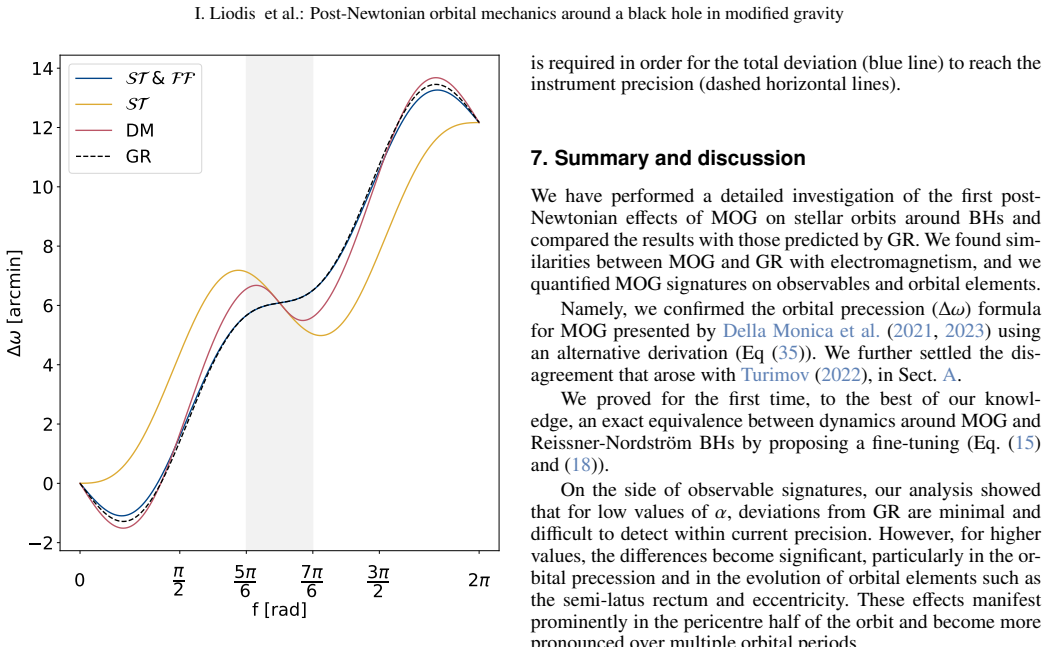

read the original abstract
Scalar-tensor-vector gravity, also known as modified gravity (MOG), has emerged as an alternative to General Relativity (GR). It aims to explain astrophysical phenomena without invoking dark matter. The S-stars orbiting the supermassive black hole at the Galactic centre provide a unique opportunity to test the predictions of MOG because the orbital measurements are highly precise. We investigate the perturbations in the orbits of S-stars under MOG, focusing on the effects on orbital elements, observables such as right ascension, declination, and radial velocity, and the potential degeneracy with dark matter scenarios. We numerically integrated the first post-Newtonian equations of motion for S-stars within the MOG framework, considering contributions from the space-time geometry and the fifth force. We analysed the time evolution of orbital elements and projected the orbits onto the plane of the sky to assess deviations from GR. Furthermore, we compared the MOG-induced effects with those expected from a dark matter distribution. We found that MOG significantly alters the orbital precession, particularly for higher values of the MOG parameter $\alpha$. For sufficiently large $\alpha$ or long observational baselines, the deviations in the observables can reach amplitudes comparable to current observational precision. Furthermore, we demonstrate that MOG effects can mimic those of a dark matter distribution, particularly in the argument of pericentre, and we reveal an unexplored connection between MOG and GR with electromagnetism. The effects of MOG on stellar orbits are distinct from those predicted by GR and can be tested with precise astrometric and spectroscopic measurements of the S-stars. However, a potential degeneracy with dark matter signatures necessitates careful interpretation of observational data.
Editorial analysis
A structured set of objections, weighed in public.
Referee Report
Summary. The manuscript numerically integrates the first post-Newtonian equations of motion for S-stars orbiting the Galactic-center black hole in scalar-tensor-vector gravity (MOG). It includes both the modified spacetime geometry and an additional fifth-force term controlled by the free parameter α, tracks the evolution of orbital elements, projects the orbits onto the sky plane, and compares the resulting astrometric and radial-velocity signatures to pure GR and to a dark-matter distribution. The central claim is that MOG produces distinct precession and observable deviations whose amplitude can reach current measurement precision for sufficiently large α or long baselines, while also exhibiting a degeneracy with dark-matter-induced effects, particularly in the argument of pericentre.
Significance. If the first-PN treatment remains valid, the work supplies a concrete, observationally oriented framework for constraining the MOG parameter α with existing and forthcoming S-star data and correctly flags the degeneracy with dark-matter models that must be disentangled in any interpretation. The direct mapping from integrated trajectories to sky-plane and spectroscopic observables is a practical strength.
major comments (2)
- [§3] §3 (numerical integration of the first post-Newtonian equations): The distinguishability claim rests on the assumption that the first-PN integration (GR geometry plus MOG fifth force) captures the leading observable deviations. For S2 (e ≈ 0.88) and a long-range fifth force, the paper neither derives nor bounds the second-PN corrections that would arise from the modified field equations, nor does it report truncation-error estimates over the multi-year baselines required for detectable precession. If those corrections shift the argument-of-pericentre or sky-plane residuals by more than the claimed observational amplitude, the separation from GR and the degeneracy analysis no longer hold.
- [§4] §4 (comparison with dark matter): The degeneracy analysis is presented only for the argument of pericentre; no quantitative assessment is given for how the MOG fifth-force term affects the full set of observables (RA, Dec, radial velocity) relative to a Navarro-Frenk-White or other DM profile at the same level of precision.
minor comments (2)
- [Abstract] The abstract states that an 'unexplored connection between MOG and GR with electromagnetism' is revealed, but this connection is not developed or referenced in the main text or discussion.
- [Figures] Figure captions and axis labels should explicitly state the value of α used in each panel and the integration time span in years.
Simulated Author's Rebuttal
We thank the referee for the constructive and detailed comments, which help improve the robustness of our analysis. We address each major comment point by point below.
read point-by-point responses
-
Referee: [§3] The distinguishability claim rests on the assumption that the first-PN integration (GR geometry plus MOG fifth force) captures the leading observable deviations. For S2 (e ≈ 0.88) and a long-range fifth force, the paper neither derives nor bounds the second-PN corrections that would arise from the modified field equations, nor does it report truncation-error estimates over the multi-year baselines required for detectable precession. If those corrections shift the argument-of-pericentre or sky-plane residuals by more than the claimed observational amplitude, the separation from GR and the degeneracy analysis no longer hold.
Authors: We agree that a quantitative bound on second post-Newtonian corrections would strengthen the validity of the 1PN results, particularly for the high-eccentricity orbit of S2. Our current analysis focuses on the leading 1PN contributions from the modified MOG geometry and fifth-force term, which are the dominant effects for the α range and baselines considered. In the revised manuscript we will add an order-of-magnitude estimate of the 2PN terms derived from the MOG field equations together with truncation-error estimates for the numerical integrator over the relevant multi-year intervals. These estimates will show that the 2PN contributions remain below the claimed observational amplitudes for the parameter values examined, thereby supporting the distinguishability and degeneracy conclusions. revision: yes
-
Referee: [§4] The degeneracy analysis is presented only for the argument of pericentre; no quantitative assessment is given for how the MOG fifth-force term affects the full set of observables (RA, Dec, radial velocity) relative to a Navarro-Frenk-White or other DM profile at the same level of precision.
Authors: We concur that extending the degeneracy comparison beyond the argument of pericentre would provide a more complete picture. The revised manuscript will include quantitative assessments of the MOG fifth-force effects on right ascension, declination, and radial velocity, performed at the same precision level used for the pericentre analysis and directly compared against a Navarro-Frenk-White dark-matter profile. This addition will clarify the extent of the degeneracy across the full set of observables. revision: yes
Circularity Check
No circularity: derivation follows from MOG field equations and numerical integration
full rationale
The paper derives post-Newtonian equations of motion from the MOG framework (space-time geometry plus fifth force), numerically integrates them for S-star orbits, evolves orbital elements, projects observables, and compares deviations to GR and dark-matter cases as functions of the free parameter α. No step reduces a prediction to a fitted input by construction, no self-citation bears the central load, and no ansatz or uniqueness theorem is smuggled in. The results are computed outputs from the modified dynamics; the degeneracy analysis is an explicit comparison rather than a tautology. The chain is self-contained against external PN benchmarks.
Axiom & Free-Parameter Ledger
free parameters (1)
- MOG parameter α
axioms (1)
- domain assumption First post-Newtonian expansion remains valid for S-star orbits when MOG fifth-force term is added
invented entities (1)
-
Fifth force arising from MOG vector/scalar fields
no independent evidence
Lean theorems connected to this paper
-
IndisputableMonolith/Cost/FunctionalEquation.leanwashburn_uniqueness_aczel unclear?
unclearRelation between the paper passage and the cited Recognition theorem.
We numerically integrated the first post-Newtonian equations of motion for S-stars within the MOG framework, considering contributions from the space-time geometry and the fifth force.
-
IndisputableMonolith/Foundation/RealityFromDistinction.leanreality_from_one_distinction unclear?
unclearRelation between the paper passage and the cited Recognition theorem.
MOG significantly alters the orbital precession, particularly for higher values of the MOG parameter α.
What do these tags mean?
- matches
- The paper's claim is directly supported by a theorem in the formal canon.
- supports
- The theorem supports part of the paper's argument, but the paper may add assumptions or extra steps.
- extends
- The paper goes beyond the formal theorem; the theorem is a base layer rather than the whole result.
- uses
- The paper appears to rely on the theorem as machinery.
- contradicts
- The paper's claim conflicts with a theorem or certificate in the canon.
- unclear
- Pith found a possible connection, but the passage is too broad, indirect, or ambiguous to say the theorem truly supports the claim.
Reference graph
Works this paper leans on
-
[1]
Borka and Zakharov, A.F , title="
Borka, D and Jovanović, P and Jovanović, V. Borka and Zakharov, A.F , title=". JCAP , year=. doi:10.1088/1475-7516/2013/11/050 , number=
-
[2]
Orbital precession of the S2 star in Scalar–Tensor–Vector Gravity , volume=
Della Monica, Riccardo and de Martino, Ivan and de Laurentis, Mariafelicia , year=. Orbital precession of the S2 star in Scalar–Tensor–Vector Gravity , volume=. MNRAS , publisher=. doi:10.1093/mnras/stab3727 , number=
-
[3]
Constraining nonlocal gravity by S2 star orbits , author =. PRD , volume =. 2019 , month =. doi:10.1103/PhysRevD.99.044053 , url =
-
[4]
Astrophysical signatures of black holes in generalized Proca theories. PRD , keywords =. doi:10.1103/PhysRevD.99.024052 , primaryClass =
-
[5]
Constraints on alternative theories of gravity with observations of the Galactic Center , volume=
Zakharov, Alexander , editor=. Constraints on alternative theories of gravity with observations of the Galactic Center , volume=. 2018 , pages=. doi:10.1051/epjconf/201819101010 , journal=
-
[6]
doi:10.1051/0004-6361/202142114 , journal =
The dark mass signature in the orbit of S2 , url =. doi:10.1051/0004-6361/202142114 , journal =
-
[7]
Lechien, T. and Heißel, G. and Grover, J. and Izzo, D. , year=. Dark matter reconstruction from stellar orbits in the Galactic centre , volume=. doi:10.1051/0004-6361/202347738 , journal=
-
[8]
Yuan, Guan-Wen and Shen, Zhao-Qiang and Tsai, Yue-Lin Sming and Yuan, Qiang and Fan, Yi-Zhong , year=. Constraining ultralight bosonic dark matter with Keck observations of S2’s orbit and kinematics , volume=. PRD , publisher=. doi:10.1103/physrevd.106.103024 , number=
-
[9]
Gainutdinov, R. I. , year=. PPN Motion of S-Stars Around Sgr A* , volume=. Astrophysics , publisher=. doi:10.1007/s10511-020-09651-2 , number=
-
[10]
doi:10.1051/0004-6361/202452814 , journal =
Future prospects for measuring 1PPN parameters using observations of S2 and S62 at the Galactic center , url =. doi:10.1051/0004-6361/202452814 , journal =
-
[11]
1983, ApJ, 270, 365, https://doi.org/10.1086/161130
A modification of the Newtonian dynamics as a possible alternative to the hidden mass hypothesis. APJ , year = 1983, month = jul, volume =. doi:10.1086/161130 , adsurl =
-
[12]
J.W. Moffat , title =. 2024 , month =. doi:10.1088/1475-7516/2024/05/079 , url =
-
[13]
Moffat, J. W. and Rahvar, S. , year=. The MOG weak field approximation and observational test of galaxy rotation curves , volume=. MNRAS , publisher=. doi:10.1093/mnras/stt1670 , number=
-
[14]
J. R. Brownstein and J. W. Moffat , title =. 2006 , month =. doi:10.1086/498208 , url =
-
[15]
Moffat, J. W. and Rahvar, S. , year=. The MOG weak field approximation – II. Observational test of Chandra X-ray clusters , volume=. MNRAS , publisher=. doi:10.1093/mnras/stu855 , number=
-
[16]
Davari, Zahra and Rahvar, Sohrab , year=. Testing MOdified Gravity (MOG) theory and dark matter model in Milky Way using the local observables , volume=. MNRAS , publisher=. doi:10.1093/mnras/staa1660 , number=
-
[17]
Moffat, John W and Toth, Viktor T , title = ". MNRAS , volume =. 2023 , month =. doi:10.1093/mnras/stad3400 , url =
-
[18]
Modified Gravity (MOG) fits to observed radial acceleration of SPARC galaxies , journal =. 2019 , issn =. doi:https://doi.org/10.1016/j.dark.2019.100323 , url =
-
[19]
Moffat, J.W. and Toth, V.T. , year=. Rotational velocity curves in the Milky Way as a test of modified gravity , volume=. PRD , publisher=. doi:10.1103/physrevd.91.043004 , number=
-
[20]
Israel, Norman and Moffat, John , year=. The Train Wreck Cluster Abell 520 and the Bullet Cluster 1E0657-558 in a Generalized Theory of Gravitation , volume=. Galaxies , publisher=. doi:10.3390/galaxies6020041 , number=
-
[21]
Brownstein, J. R. and Moffat, J. W. , year=. The Bullet Cluster 1E0657-558 evidence shows modified gravity in the absence of dark matter , volume=. MNRAS , publisher=. doi:10.1111/j.1365-2966.2007.12275.x , number=
-
[22]
Applying modified gravity to the lensing and Einstein ring in Abell 3827 , author =. PRD , volume =. 2021 , month =. doi:10.1103/PhysRevD.103.044045 , url =
- [23]
-
[24]
STVG-MOG Cluster Dynamics and the Cosmological $1/r^2$ Force Law from Pairwise kSZ Data
Moffat, John W. STVG-MOG Cluster Dynamics and the Cosmological 1/r^2 Force Law from Pairwise kSZ Data. 2026. arXiv:2604.23440
work page internal anchor Pith review Pith/arXiv arXiv 2026
-
[25]
MOG cosmology without dark matter and the cosmological constant , volume=
Davari, Zahra and Rahvar, Sohrab , year=. MOG cosmology without dark matter and the cosmological constant , volume=. MNRAS , publisher=. doi:10.1093/mnras/stab2350 , number=
-
[26]
Gravitational theory of cosmology, galaxies and galaxy clusters. EPJ C , keywords =. doi:10.1140/epjc/s10052-020-08482-x , primaryClass =
-
[27]
Lobos, Nikko John Leo S. and Rodulfo, Emmanuel T. Breathing Black Hole Shadows in Modified Gravity (MOG). 2026. arXiv:2602.21432
-
[28]
Moffat, J.W. , year=. Modified gravity (MOG), cosmology and black holes , volume=. JCAP , publisher=. doi:10.1088/1475-7516/2021/02/017 , number=
-
[29]
Scalar–tensor–vector gravity theory , volume=
Moffat, J W , year=. Scalar–tensor–vector gravity theory , volume=. JCAP , publisher=. doi:10.1088/1475-7516/2006/03/004 , number=
-
[30]
Moffat, J. W. , year=. Black holes in modified gravity (MOG) , volume=. EPJ C , publisher=. doi:10.1140/epjc/s10052-015-3405-x , number=
-
[31]
Fundamental parameter-free solutions in modified gravity , volume=
Moffat, J W and Toth, V T , year=. Fundamental parameter-free solutions in modified gravity , volume=. CQG , publisher=. doi:10.1088/0264-9381/26/8/085002 , number=
-
[32]
Reissner, H. , title =. AdP , volume =. doi:https://doi.org/10.1002/andp.19163550905 , url =. https://onlinelibrary.wiley.com/doi/pdf/10.1002/andp.19163550905 , year =
-
[33]
KNAW Proceedings , year = 1918, month = jan, volume =
On the Energy of the Gravitation field in Einstein's Theory. KNAW Proceedings , year = 1918, month = jan, volume =
work page 1918
-
[34]
J.R. Morris , keywords =. Effects of a modified Reissner-Nordström spacetime , journal =. 2023 , issn =. doi:https://doi.org/10.1016/j.physletb.2023.138325 , url =
- [35]
-
[36]
Constraining the Yukawa gravity with the post-Newtonian approximation using S-star orbits around the supermassive black hole in our Galactic Center , author =. PRD , volume =. 2024 , month =. doi:10.1103/PhysRevD.109.044047 , url =
-
[37]
Poisson, Eric and Will, Clifford M. , date-added =. Gravity: Newtonian, Post-Newtonian, Relativistic , year =. doi:10.1017/CBO9781139507486 , place =
-
[38]
Dynamics and evolution of galactic nuclei , year =
Merritt, David , date-added =. Dynamics and evolution of galactic nuclei , year =
-
[39]
Explanation of the Perihelion Motion of Mercury from the General Theory of Relativity
Einstein, Albert. Explanation of the Perihelion Motion of Mercury from the General Theory of Relativity. Sitzungsber. Preuss. Akad. Wiss. Berlin (Math. Phys. ). 1915
work page 1915
-
[40]
Della Monica, Riccardo and de Martino, Ivan and de Laurentis, Mariafelicia , title = ". MNRAS , volume =. 2023 , month =. doi:10.1093/mnras/stad579 , url =
-
[41]
Turimov, Bobur V , title = ". MNRAS , volume =. 2022 , month =. doi:10.1093/mnras/stac2113 , url =
-
[42]
Misner, Charles W. and Thorne, K. S. and Wheeler, J. A. Gravitation. 1973
work page 1973
-
[43]
A. M. Ghez and S. Salim and N. N. Weinberg and J. R. Lu and T. Do and J. K. Dunn and K. Matthews and M. R. Morris and S. Yelda and E. E. Becklin and T. Kremenek and M. Milosavljevic and J. Naiman , date-added =. Measuring Distance and Properties of the Milky Way's Central Supermassive Black Hole with Stellar Orbits , url =. doi:10.1086/592738 , journal =
-
[44]
S. Gillessen and F. Eisenhauer and S. Trippe and T. Alexander and R. Genzel and F. Martins and T. Ott , date-added =. doi:10.1088/0004-637x/692/2/1075 , journal =
-
[45]
doi:10.1051/0004-6361/202142465 , journal =
Mass distribution in the Galactic Center based on interferometric astrometry of multiple stellar orbits , url =. doi:10.1051/0004-6361/202142465 , journal =
-
[46]
2018, , 615, L15, 10.1051/0004-6361/201833718
Detection of the gravitational redshift in the orbit of the star S2 near the Galactic centre massive black hole , url =. doi:10.1051/0004-6361/201833718 , journal =
-
[47]
doi:10.1051/0004-6361/202037813 , journal =
-
[48]
Do, Tuan and Hees, Aurelien and Ghez, Andrea and Martinez, Gregory D. and Chu, Devin S. and Jia, Siyao and Sakai, Shoko and Lu, Jessica R. and Gautam, Abhimat K. and O. Relativistic redshift of the star S0-2 orbiting the Galactic Center supermassive black hole , url =. Science , number =. 2019 , bdsk-url-1 =. doi:10.1126/science.aav8137 , eprint =
-
[49]
Saida, Hiromi and Nishiyama, Shogo and Ohgami, Takayuki and Takamori, Yohsuke and Takahashi, Masaaki and Minowa, Yosuke and Najarro, Francisco and Hamano, Satoshi and Omiya, Masashi and Iwamatsu, Atsushi and Takahashi, Mizuki and Gorin, Haruka and Kara, Tomohiro and Koyama, Akinori and Ohashi, Yosuke and Tamura, Motohide and Nagatomo, Schun and Zenko, Tet...
-
[50]
Chan, Man Ho and Lee, Chak Man and Yu, Chi Wai , date =. Investigating the nature of mass distribution surrounding the Galactic supermassive black hole , url =. Scientific Reports , number =. 2022 , bdsk-url-1 =. doi:10.1038/s41598-022-18946-7 , id =
-
[51]
Della Monica, Riccardo and de Martino, Ivan , journal =. Bounding the mass of ultralight bosonic dark matter particles with the motion of the S2 star around Sgr. 2023 , month =. doi:10.1103/PhysRevD.108.L101303 , url =
-
[52]
f(R) gravity after the detection of the orbital precession of the S2 star around the Galactic Center massive black hole , author =. PRD , volume =. 2021 , month =. doi:10.1103/PhysRevD.104.L101502 , url =
-
[53]
Constraining MOdified Gravity with the S2 Star , url =
Della Monica, Riccardo and de Martino, Ivan and de Laurentis, Mariafelicia , doi =. Constraining MOdified Gravity with the S2 Star , url =. Universe , number =. 2022 , bdsk-url-1 =
work page 2022
-
[54]
Della Monica, R and de Martino, I and Vernieri, D and de Laurentis, M , title =. MNRAS , volume =. 2022 , month =. doi:10.1093/mnras/stac3648 , url =
-
[55]
Abd El Dayem, K. and others. Exploring the presence of a fifth force at the Galactic Center. A&A. 2025. doi:10.1051/0004-6361/202554676. arXiv:2504.02908
-
[56]
M. J. Reid and A. Brunthaler , date-added =. The Proper Motion of Sagittarius A. doi:10.3847/1538-4357/ab76cd , journal =
-
[57]
doi:10.1051/0004-6361/201730838 , eid =. arXiv , author =:1705.02345 , journal =
work page internal anchor Pith review Pith/arXiv arXiv doi:10.1051/0004-6361/201730838
-
[58]
Eisenhauer, F. and Genzel, R. and Alexander, T. and Abuter, R. and Paumard, T. and Ott, T. and Gilbert, A. and Gillessen, S. and Horrobin, M. and Trippe, S. and Bonnet, H. and Dumas, C. and Hubin, N. and Kaufer, A. and Kissler-Patig, M. and Monnet, G. and Str. SINFONI in the Galactic Center: Young Stars and Infrared Flares in the Central Light-Month* , ur...
-
[59]
The Enhanced Resolution Imager and Spectrograph for the VLT , url =. doi:10.1051/0004-6361/202346559 , journal =
-
[60]
On the problem of distribution in globular star clusters. MNRAS , year = 1911, month =. doi:10.1093/mnras/71.5.460 , adsurl =
- [61]
-
[62]
Lopez Armengol, Federico G. and Romero, Gustavo E. , year=. Effects of Scalar-Tensor-Vector Gravity on relativistic jets , volume=. Ap&SS , publisher=. doi:10.1007/s10509-017-3197-6 , number=
-
[63]
Srednicki, M. Quantum field theory. 2007. doi:10.1017/CBO9780511813917
-
[64]
Peskin, Michael E. and Schroeder, Daniel V. An Introduction to quantum field theory. 1995. doi:10.1201/9780429503559
-
[65]
Charged particles in curved space-time. JTAP , keywords =. doi:10.1007/s40094-015-0200-x , adsurl =
discussion (0)
Sign in with ORCID, Apple, or X to comment. Anyone can read and Pith papers without signing in.