Conditional Entropy of Heat Diffusion on Temporal Networks
Pith reviewed 2026-05-22 01:11 UTC · model grok-4.3
The pith
Conditional entropy of heat diffusion is monotone in time on temporal networks.
A machine-rendered reading of the paper's core claim, the machinery that carries it, and where it could break.
Core claim
The conditional entropy of heat diffusion on temporal networks is monotone non-decreasing in time. This yields an information-theoretic analog of the second law of thermodynamics for inhomogeneous diffusion processes. Deviations from the upper bound are explained by the presence of asymmetric temporal paths.
What carries the argument
Conditional entropy of heat diffusion, extended to time-dependent networks to measure uncertainty in the diffusion process.
If this is right
- The quantity supplies a time-dependent bound on uncertainty growth during diffusion.
- The local version produces a usable signal for locating change points in continuous-time temporal networks.
- Change points identified this way allow community detection to focus on specific sub-intervals with higher quality.
- Asymmetric temporal paths account for any shortfall from the theoretical upper bound.
Where Pith is reading between the lines
- The same monotonicity pattern may appear in other information measures applied to dynamic systems.
- The approach could be tested for phase-shift detection in biological or transportation networks.
- Varying the window size in the local version might affect how sharply change points are resolved.
Load-bearing premise
The definition of conditional entropy extends from static graphs to temporal networks in a way that preserves monotonicity in time.
What would settle it
A temporal network example where the conditional entropy decreases over some positive time interval would disprove the monotonicity result.
Figures


read the original abstract
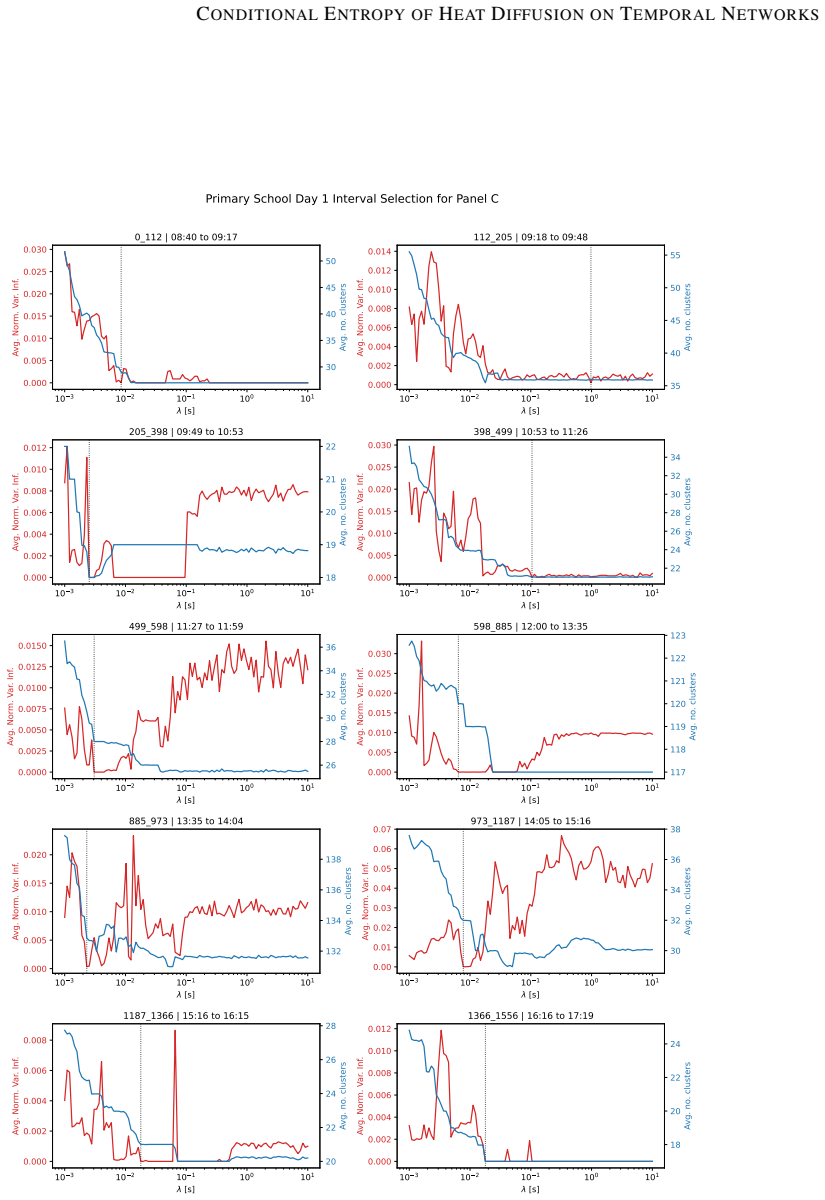
Many complex systems can be modeled by temporal networks, whose organization often evolves through distinct structural phases. Detecting the change points that delimit these phases is both important and challenging. In this work, we extend the conditional entropy of heat diffusion from static graphs to temporal networks and study its properties. We provide an upper bound and explain how discrepancies from it arise from the presence of asymmetric temporal paths. Moreover, we show that this quantity is monotone in time, yielding an information-theoretic analog of the second law of thermodynamics for inhomogeneous diffusion on temporal networks. We then introduce a local version of conditional entropy, designed to probe diffusion over finite temporal windows, and show that it provides an informative signal for change-point detection in continuous-time temporal networks. We evaluate the proposed methodology on synthetic benchmarks, including comparative experiments with existing nonparametric baselines in the snapshot setting, and then apply it to a real-world temporal contact network from a French primary school. Finally, we show how to use detected change points to perform community detection on targeted sub-intervals, improving the quality and interpretability of the clustering results.
Editorial analysis
A structured set of objections, weighed in public.
Referee Report
Summary. The paper extends the conditional entropy of heat diffusion from static graphs to temporal networks. It derives an upper bound on this quantity and attributes discrepancies to asymmetric temporal paths. The authors claim to prove that the conditional entropy is monotone in time, providing an information-theoretic analog of the second law of thermodynamics for inhomogeneous diffusion. They introduce a local version for finite temporal windows and demonstrate its use for change-point detection, with evaluations on synthetic benchmarks (including comparisons to nonparametric baselines) and a real French primary school contact network; detected change points are then used to improve community detection on sub-intervals.
Significance. If the monotonicity result and the utility of the local conditional entropy for change-point detection hold under the stated conditions, the work offers a principled information-theoretic approach to analyzing structural phases in temporal networks, with direct applications to downstream tasks such as community detection. The combination of theoretical claims (upper bound and monotonicity) with empirical validation on both synthetic and real data adds practical value.
major comments (2)
- [Monotonicity section / proof of monotonicity] The monotonicity claim for conditional entropy under time-inhomogeneous diffusion (central to the second-law analogy) requires explicit handling of discontinuities in the diffusion operator. When the temporal network is defined via discrete contact events or snapshot switches, the master equation or heat kernel can jump; the standard log-sum or data-processing arguments from the static-graph case do not automatically guarantee that the instantaneous entropy production remains non-negative across such jumps. The manuscript should provide the precise derivation (including any continuity or piecewise assumptions) and verify the sign of the discrete difference at change points.
- [Definition and upper-bound section] The extension of the conditional-entropy definition from static to temporal networks must be stated with sufficient detail to confirm that monotonicity is derived rather than obtained by construction. The abstract notes an upper bound and explains discrepancies via asymmetric temporal paths, but the load-bearing step is whether the time derivative (or difference) of the defined quantity is provably non-negative without additional fitted parameters.
minor comments (2)
- [Experimental evaluation section] Add error bars, exact exclusion rules for synthetic benchmarks, and full reproducibility details (code or parameter settings) for the comparative experiments with nonparametric baselines.
- [Local version section] Clarify notation for the local conditional entropy (e.g., window size, normalization) to make the change-point detection procedure fully reproducible from the text alone.
Simulated Author's Rebuttal
We thank the referee for their careful reading and constructive comments on our manuscript. We address each major comment below and indicate where we will revise the text to improve clarity and rigor.
read point-by-point responses
-
Referee: [Monotonicity section / proof of monotonicity] The monotonicity claim for conditional entropy under time-inhomogeneous diffusion (central to the second-law analogy) requires explicit handling of discontinuities in the diffusion operator. When the temporal network is defined via discrete contact events or snapshot switches, the master equation or heat kernel can jump; the standard log-sum or data-processing arguments from the static-graph case do not automatically guarantee that the instantaneous entropy production remains non-negative across such jumps. The manuscript should provide the precise derivation (including any continuity or piecewise assumptions) and verify the sign of the discrete difference at change points.
Authors: We thank the referee for this observation. In the manuscript the diffusion operator is piecewise continuous: between contact events the master equation evolves continuously and the standard entropy-production argument applies directly, yielding a non-negative time derivative. At discrete event times the heat kernel undergoes a jump; we compute the change in conditional entropy explicitly by comparing the kernels immediately before and after the event and show that the jump is non-positive because the post-event kernel is a convex combination that cannot increase the conditional entropy. We will add this piecewise derivation, state the continuity assumptions, and include the explicit verification of the discrete difference in the revised monotonicity section. revision: yes
-
Referee: [Definition and upper-bound section] The extension of the conditional-entropy definition from static to temporal networks must be stated with sufficient detail to confirm that monotonicity is derived rather than obtained by construction. The abstract notes an upper bound and explains discrepancies via asymmetric temporal paths, but the load-bearing step is whether the time derivative (or difference) of the defined quantity is provably non-negative without additional fitted parameters.
Authors: We agree that the definition section would benefit from greater explicitness. The conditional entropy on a temporal network is defined via the time-dependent heat kernel of the inhomogeneous diffusion process; the upper bound follows from the data-processing inequality applied to the Markov chain induced by the kernel, with the gap from the bound arising exactly from the asymmetry of temporal paths. The non-negativity of the time derivative is obtained directly from the convexity of negative entropy and the form of the master equation, without any auxiliary parameters. We will expand the definition to display these derivation steps in full so that monotonicity is seen to follow from the construction rather than being imposed. revision: yes
Circularity Check
Derivation of monotonicity extends standard entropy arguments to time-inhomogeneous diffusion without reduction to inputs or self-citation
full rationale
The paper extends conditional entropy of heat diffusion to temporal networks and derives its monotonicity in time as an information-theoretic second-law analog. This follows from adapting data-processing and entropy-production inequalities to the time-varying case, with an explicit upper bound and accounting for asymmetric paths. No equations reduce the claimed monotonicity to a fitted parameter, a renamed definition, or a self-citation chain; the local-window version for change-point detection is introduced as a separate application. The derivation remains self-contained against the static-graph baseline and general Markov-process theory.
Axiom & Free-Parameter Ledger
axioms (1)
- domain assumption Conditional entropy and heat diffusion properties extend from static graphs to temporal networks while preserving key inequalities and monotonicity.
Lean theorems connected to this paper
-
IndisputableMonolith/Foundation/ArrowOfTime.leanentropy_monotone echoes?
echoesECHOES: this paper passage has the same mathematical shape or conceptual pattern as the Recognition theorem, but is not a direct formal dependency.
we show that this quantity is monotone in time, yielding an information-theoretic analog of the second law of thermodynamics for inhomogeneous diffusion on temporal networks
-
IndisputableMonolith/Foundation/ArrowOfTime.leanz_monotone_absolute echoes?
echoesECHOES: this paper passage has the same mathematical shape or conceptual pattern as the Recognition theorem, but is not a direct formal dependency.
The data processing inequality (Equation (2.10)) states that, over time, the rows of the transition matrix diverge less and less from π. The conditional entropy averages the behavior of each row, resulting in aggregate monotonicity
What do these tags mean?
- matches
- The paper's claim is directly supported by a theorem in the formal canon.
- supports
- The theorem supports part of the paper's argument, but the paper may add assumptions or extra steps.
- extends
- The paper goes beyond the formal theorem; the theorem is a base layer rather than the whole result.
- uses
- The paper appears to rely on the theorem as machinery.
- contradicts
- The paper's claim conflicts with a theorem or certificate in the canon.
- unclear
- Pith found a possible connection, but the passage is too broad, indirect, or ambiguous to say the theorem truly supports the claim.
Reference graph
Works this paper leans on
- [1]
-
[2]
The structure and function of complex networks,
M. E. J. Newman, “The structure and function of complex networks,”SIAM Review, vol. 45, no. 2, pp. 167–256, 2003
work page 2003
-
[3]
R. Lambiotte and M. T. Schaub,Modularity and dynamics on complex networks. Cambridge University Press, 2021
work page 2021
-
[4]
Random walks and diffusion on networks,
N. Masuda, M. A. Porter, and R. Lambiotte, “Random walks and diffusion on networks,”Random walks and diffusion on networks, vol. 716-717, pp. 1–58, Nov. 2017. 17 CONDITIONALENTROPY OFHEATDIFFUSION ONTEMPORALNETWORKS 0 10 20 30 40 0.45 0.50 0.55 0.60 0.65 0.70Entropy 0 10 20 30 40 1.35 1.40 1.45 1.50Frobenius Score 10 20 30 40 snapshot index 0.001 0.000 0....
work page 2017
-
[5]
Laplacian paths in complex networks: Information core emerges from entropic transitions,
P. Villegas, A. Gabrielli, F. Santucci, G. Caldarelli, and T. Gili, “Laplacian paths in complex networks: Information core emerges from entropic transitions,”Phys. Rev. Res., vol. 4, p. 033196, Sept. 2022
work page 2022
-
[6]
Stability of graph communities across time scales,
J.-C. Delvenne, S. N. Yaliraki, and M. Barahona, “Stability of graph communities across time scales,” Proceedings of the National Academy of Sciences, vol. 107, no. 29, pp. 12755–12760, 2010. _eprint: https://www.pnas.org/doi/pdf/10.1073/pnas.0903215107
-
[7]
M. T. Schaub, J.-C. Delvenne, S. N. Yaliraki, and M. Barahona, “Markov Dynamics as a Zooming Lens for Multiscale Community Detection: Non Clique-Like Communities and the Field-of-View Limit,”PLOS ONE, vol. 7, p. e32210, Feb. 2012
work page 2012
-
[8]
Random Walks, Markov Processes and the Multiscale Modular Organization of Complex Networks,
R. Lambiotte, J.-C. Delvenne, and M. Barahona, “Random Walks, Markov Processes and the Multiscale Modular Organization of Complex Networks,”IEEE Transactions on Network Science and Engineering, vol. 1, pp. 76–90, July 2014. Conference Name: IEEE Transactions on Network Science and Engineering
work page 2014
-
[9]
Unified formalism for entropy production and fluctuation relations,
Y .-J. Yang and H. Qian, “Unified formalism for entropy production and fluctuation relations,”Phys. Rev. E, vol. 101, p. 022129, Feb. 2020
work page 2020
-
[10]
Network theory of microscopic and macroscopic behavior of master equation systems,
J. Schnakenberg, “Network theory of microscopic and macroscopic behavior of master equation systems,”Reviews of Modern Physics, vol. 48, no. 4, pp. 571–585, 1976
work page 1976
-
[11]
Broken detailed balance and entropy production in directed networks,
R. Nartallo-Kaluarachchi, M. Asllani, G. Deco, M. L. Kringelbach, A. Goriely, and R. Lambiotte, “Broken detailed balance and entropy production in directed networks,”Physical Review E, vol. 110, p. 034313, Sept. 2024
work page 2024
-
[12]
Entropy rate of diffusion processes on complex networks,
J. Gómez-Gardeñes and V . Latora, “Entropy rate of diffusion processes on complex networks,”Phys. Rev. E, vol. 78, p. 065102, Dec. 2008
work page 2008
-
[13]
Spectral Entropies as Information-Theoretic Tools for Complex Network Comparison,
M. De Domenico and J. Biamonte, “Spectral Entropies as Information-Theoretic Tools for Complex Network Comparison,”Phys. Rev. X, vol. 6, p. 041062, Dec. 2016
work page 2016
-
[14]
Statistical physics of complex information dynamics,
A. Ghavasieh, C. Nicolini, and M. De Domenico, “Statistical physics of complex information dynamics,”Physical Review E, vol. 102, p. 052304, Nov. 2020
work page 2020
-
[15]
Evolution of Conditional Entropy for Diffusion Dynamics on Graphs,
S. Koovely and A. Bovet, “Evolution of Conditional Entropy for Diffusion Dynamics on Graphs,” 2025. https://arxiv.org/abs/2510.19441. 18 CONDITIONALENTROPY OFHEATDIFFUSION ONTEMPORALNETWORKS 10 3 10 2 10 1 100 101 [s] 0.000 0.005 0.010 0.015 0.020 0.025 0.030Avg. Norm. Var. Inf. 0_112 | 08:40 to 09:17 10 3 10 2 10 1 100 101 [s] 0.000 0.002 0.004 0.006 0.0...
-
[16]
P. Holme and J. Saramäki, “Temporal networks,”Physics Reports, vol. 519, pp. 97–125, Oct. 2012
work page 2012
-
[17]
N. Masuda and R. Lambiotte,A Guide To Temporal Networks. World Scientific Publishing Company, 2016
work page 2016
-
[18]
Flow stability for dynamic community detection,
A. Bovet, J.-C. Delvenne, and R. Lambiotte, “Flow stability for dynamic community detection,”Science Advances, vol. 8, no. 19, p. eabj3063, 2022. _eprint: https://www.science.org/doi/pdf/10.1126/sciadv.abj3063
-
[19]
Scalar embedding of temporal network trajectories,
L. Lacasa, F. J. Marín-Rodríguez, N. Masuda, and L. Arola-Fernández, “Scalar embedding of temporal network trajectories,” Nov. 2024. arXiv:2412.02715 [physics]
-
[20]
Laplacian Change Point Detection for Dynamic Graphs,
S. Huang, Y . Hitti, G. Rabusseau, and R. Rabbany, “Laplacian Change Point Detection for Dynamic Graphs,” inProceedings of the 26th ACM SIGKDD International Conference on Knowledge Discovery & Data Mining, (Virtual Event CA USA), pp. 349–358, ACM, Aug. 2020
work page 2020
-
[21]
N. Lanchier,Stochastic Modeling. Universitext, Cham: Springer International Publishing, 2017
work page 2017
-
[22]
Stream graphs and link streams for the modeling of interactions over time,
M. Latapy, T. Viard, and C. Magnien, “Stream graphs and link streams for the modeling of interactions over time,” Social Network Analysis and Mining, vol. 8, p. 61, Oct. 2018
work page 2018
-
[23]
T. M. Cover and J. A. Thomas,ELEMENTS OF INFORMATION THEORY. Wiley-Interscience, 2006
work page 2006
-
[24]
Laplacian renormalization group for heterogeneous networks,
P. Villegas, T. Gili, G. Caldarelli, and A. Gabrielli, “Laplacian renormalization group for heterogeneous networks,” Nature Physics, vol. 19, pp. 445–450, Mar. 2023
work page 2023
-
[25]
Challenges in Community Discovery on Temporal Networks,
R. Cazabet and G. Rossetti, “Challenges in Community Discovery on Temporal Networks,” inTemporal Network Theory(P. Holme and J. Saramäki, eds.), pp. 185–202, Cham: Springer International Publishing, 2023
work page 2023
-
[26]
Fast Change Point Detection on Dynamic Social Net- works,
Y . Wang, A. Chakrabarti, D. Sivakoff, and S. Parthasarathy, “Fast Change Point Detection on Dynamic Social Net- works,” inProceedings of the Twenty-Sixth International Joint Conference on Artificial Intelligence, (Melbourne, Australia), pp. 2992–2998, International Joint Conferences on Artificial Intelligence Organization, Aug. 2017
work page 2017
-
[27]
Laplacian Change Point Detection for Single and Multi-view Dynamic Graphs,
S. Huang, S. Coulombe, Y . Hitti, R. Rabbany, and G. Rabusseau, “Laplacian Change Point Detection for Single and Multi-view Dynamic Graphs,”ACM Trans. Knowl. Discov. Data, vol. 18, pp. 63:1–63:32, Jan. 2024
work page 2024
-
[28]
Random walk based snapshot clustering for detecting community dynamics in temporal networks,
F. Blaškovi´c, T. O. F. Conrad, S. Klus, and N. Djurdjevac Conrad, “Random walk based snapshot clustering for detecting community dynamics in temporal networks,”Scientific Reports, vol. 15, p. 24414, July 2025
work page 2025
-
[29]
Selective review of offline change point detection methods,
C. Truong, L. Oudre, and N. Vayatis, “Selective review of offline change point detection methods,”Signal Processing, vol. 167, p. 107299, Feb. 2020
work page 2020
-
[30]
Consistencies and rates of convergence of jump-penalized least squares estimators,
L. Boysen, A. Kempe, V . Liebscher, A. Munk, and O. Wittich, “Consistencies and rates of convergence of jump-penalized least squares estimators,”The Annals of Statistics, vol. 37, pp. 157–183, Feb. 2009
work page 2009
-
[31]
Multiple Change-Point Estimation With a Total Variation Penalty,
Z. Harchaoui and C. Lévy-Leduc, “Multiple Change-Point Estimation With a Total Variation Penalty,”Journal of the American Statistical Association, vol. 105, no. 492, pp. 1480–1493, 2010
work page 2010
-
[32]
Generating temporal networks with the Ascona model,
S. Koovely, “Generating temporal networks with the Ascona model,” 2025. https://arxiv.org/abs/2512.16972
-
[33]
Community Detection and Stochastic Block Models: Recent Developments,
E. Abbe, “Community Detection and Stochastic Block Models: Recent Developments,”Journal of Machine Learning Research, vol. 18, no. 177, pp. 1–86, 2018
work page 2018
-
[34]
Change Point Estimation in a Dynamic Stochastic Block Model,
M. Bhattacharjee, M. Banerjee, and G. Michailidis, “Change Point Estimation in a Dynamic Stochastic Block Model,”Journal of Machine Learning Research, vol. 21, no. 107, pp. 1–59, 2020
work page 2020
-
[35]
Graph similarity learning for change-point detection in dynamic networks,
D. Sulem, H. Kenlay, M. Cucuringu, and X. Dong, “Graph similarity learning for change-point detection in dynamic networks,”Machine Learning, vol. 113, pp. 1–44, Jan. 2024
work page 2024
-
[36]
Anomaly detection in dynamic networks: a survey,
S. Ranshous, S. Shen, D. Koutra, S. Harenberg, C. Faloutsos, and N. F. Samatova, “Anomaly detection in dynamic networks: a survey,”WIREs Computational Statistics, vol. 7, no. 3, pp. 223–247, 2015. _eprint: https://onlinelibrary.wiley.com/doi/pdf/10.1002/wics.1347
-
[37]
Change Point Detection in Correlation Networks,
I. Barnett and J.-P. Onnela, “Change Point Detection in Correlation Networks,”Scientific Reports, vol. 6, p. 18893, Jan. 2016
work page 2016
-
[38]
High-Resolution Measurements of Face-to-Face Contact Patterns in a Primary School,
J. Stehlé, N. V oirin, A. Barrat, C. Cattuto, L. Isella, J.-F. Pinton, M. Quaggiotto, W. v. d. Broeck, C. Régis, B. Lina, and P. Vanhems, “High-Resolution Measurements of Face-to-Face Contact Patterns in a Primary School,”PLoS ONE, vol. 6, 2011
work page 2011
-
[39]
C. Matias and V . Miele, “Statistical clustering of temporal networks through a dynamic stochastic block model,” Journal of the Royal Statistical Society: Series B (Statistical Methodology), vol. 79, no. 4, pp. 1119–1141, 2017. _eprint: https://rss.onlinelibrary.wiley.com/doi/pdf/10.1111/rssb.12200
-
[40]
Analysing Multiscale Clusterings with Persistent Homology,
J. Schindler and M. Barahona, “Analysing Multiscale Clusterings with Persistent Homology,” Apr. 2025. https://arxiv.org/abs/2305.04281. 20 CONDITIONALENTROPY OFHEATDIFFUSION ONTEMPORALNETWORKS
-
[41]
Maps of random walks on complex networks reveal community structure,
M. Rosvall and C. T. Bergstrom, “Maps of random walks on complex networks reveal community structure,” Proceedings of the National Academy of Sciences, vol. 105, pp. 1118–1123, Jan. 2008
work page 2008
-
[42]
Learning Heat Diffusion Graphs,
D. Thanou, X. Dong, D. Kressner, and P. Frossard, “Learning Heat Diffusion Graphs,”IEEE Transactions on Signal and Information Processing over Networks, vol. 3, pp. 484–499, Sept. 2017
work page 2017
-
[43]
Graph convolutional networks using heat kernel for semi- supervised learning,
B. Xu, H. Shen, Q. Cao, K. Cen, and X. Cheng, “Graph convolutional networks using heat kernel for semi- supervised learning,” inProceedings of the 28th International Joint Conference on Artificial Intelligence, IJCAI’19, p. 1928–1934, AAAI Press, 2019
work page 1928
-
[44]
Kolmogorov-Sinai Entropy Rate versus Physical Entropy,
V . Latora and M. Baranger, “Kolmogorov-Sinai Entropy Rate versus Physical Entropy,”Phys. Rev. Lett., vol. 82, pp. 520–523, Jan. 1999
work page 1999
-
[45]
Neural networks and physical systems with emergent collective computational abilities.,
J. J. Hopfield, “Neural networks and physical systems with emergent collective computational abilities.,”Proceed- ings of the National Academy of Sciences, vol. 79, pp. 2554–2558, Apr. 1982
work page 1982
-
[46]
Nobel Lecture: Physics is a point of view,
J. J. Hopfield, “Nobel Lecture: Physics is a point of view,”Reviews of Modern Physics, vol. 97, p. 030501, Aug. 2025
work page 2025
-
[47]
A learning algorithm for boltzmann machines,
D. H. Ackley, G. E. Hinton, and T. J. Sejnowski, “A learning algorithm for boltzmann machines,”Cognitive Science, vol. 9, pp. 147–169, Jan. 1985
work page 1985
-
[48]
Nobel Lecture: Boltzmann machines,
G. Hinton, “Nobel Lecture: Boltzmann machines,”Reviews of Modern Physics, vol. 97, p. 030502, Aug. 2025
work page 2025
-
[49]
Negative Entropy and Information in Quantum Mechanics,
N. J. Cerf and C. Adami, “Negative Entropy and Information in Quantum Mechanics,”Phys. Rev. Lett., vol. 79, pp. 5194–5197, Dec. 1997
work page 1997
-
[50]
Quantum extension of conditional probability,
N. J. Cerf and C. Adami, “Quantum extension of conditional probability,”Phys. Rev. A, vol. 60, pp. 893–897, Aug. 1999
work page 1999
-
[51]
Multi-scale Laplacian community detection in heterogeneous networks,
P. Villegas, A. Gabrielli, A. Poggialini, and T. Gili, “Multi-scale Laplacian community detection in heterogeneous networks,”Physical Review Research, vol. 7, p. 013065, Jan. 2025
work page 2025
-
[52]
Entropy Measures for Transition Matrices in Random Systems,
Z. Chen, R. Meyer, and Z.-Y . Xian, “Entropy Measures for Transition Matrices in Random Systems,” Aug. 2025. https://arxiv.org/abs/2508.09261. 21
discussion (0)
Sign in with ORCID, Apple, or X to comment. Anyone can read and Pith papers without signing in.