Modelling hydroelastic flexure of arbitrarily shaped ice shelves forced by long ocean waves
Pith reviewed 2026-05-22 03:21 UTC · model grok-4.3
The pith
A finite-element method with a Dirichlet-to-Neumann map solves the hydroelastic flexure of ice shelves of arbitrary shape and thickness under long ocean waves.
A machine-rendered reading of the paper's core claim, the machinery that carries it, and where it could break.
Core claim
A solution method is developed for a hydroelastic mathematical model of wave-induced ice shelf flexure, based on the conventional theory of a Kirchhoff-Love plate floating on shallow water under linearised conditions, but allowing wave forcing of ice shelves with variations in both horizontal dimensions, and where the ice shelves are of arbitrary shape, including non-uniform thickness. The method uses finite elements specifically designed for the high-order hydroelastic system, and a Dirichlet-to-Neumann map to bound the computational domain in the open ocean.
What carries the argument
Finite elements tailored to the high-order hydroelastic system together with a Dirichlet-to-Neumann map that truncates the open-ocean computational domain.
If this is right
- Deflection and stress fields can be obtained for ice shelves whose planforms are not rectangular.
- The dependence of flexure on incident wave direction can be quantified for complex geometries.
- Resonant frequencies that produce large amplitudes can be located over wide ranges of wave frequency.
- The effect of varying the grounded proportion on overall shelf motion can be assessed directly.
Where Pith is reading between the lines
- The same numerical framework could be applied to individual Antarctic ice shelves with known irregular outlines to estimate local calving risk under swell forcing.
- Incorporating observed thickness changes from satellite altimetry would allow the model to track seasonal or decadal evolution of flexure patterns.
- The identified resonances suggest that certain wave periods may be especially efficient at generating fractures; targeted in-situ strain measurements at those periods could test the prediction.
Load-bearing premise
The conventional Kirchhoff-Love plate theory on shallow water under linearised conditions remains valid for ice shelves of arbitrary shape and non-uniform thickness when forced by long ocean waves.
What would settle it
Field measurements of surface elevation or strain on an irregularly shaped, non-uniform-thickness ice shelf under documented long-period ocean waves that deviate systematically from the model's predicted deflections.
Figures


read the original abstract
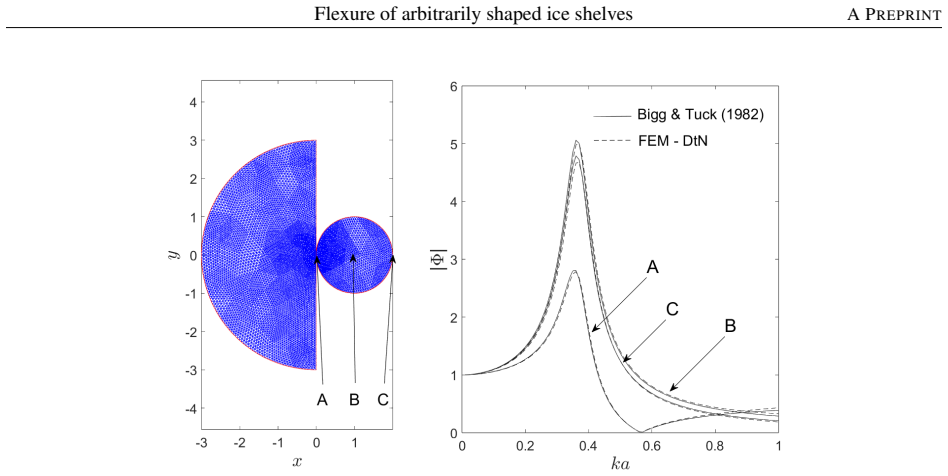
Flexure of Antarctic ice shelves under excitation from long ocean waves induces mechanical ice shelf stresses that amplify fractures and, hence, contribute to calving events. Here, a solution method is developed for a hydroelastic mathematical model of wave-induced ice shelf flexure, based on the conventional theory of a Kirchoff-Love plate floating on shallow water under linearised conditions, but allowing wave forcing of ice shelves with variations in both horizontal dimensions, and where the ice shelves are of arbitrary shape, including non-uniform thickness. The method uses finite elements specifically designed for the high-order hydroelastic system, and a Dirichlet-to-Neumann map to bound the computational domain in the open ocean. Following verification, the method is used to conduct novel studies on how the ice-shelf deflection is affected by the ice shelf shape, the incident wave direction and the proportion of the shelf that is grounded. The efficiency of the method allows the studies to be conducted over a broad frequency range, such that resonant responses are identified.
Editorial analysis
A structured set of objections, weighed in public.
Referee Report
Summary. The manuscript develops a finite-element solution method for the hydroelastic flexure of ice shelves of arbitrary planform shape and non-uniform thickness under long-wave ocean forcing. The model rests on the conventional Kirchhoff-Love plate equation coupled to linearised shallow-water hydrodynamics, truncated by a Dirichlet-to-Neumann map; after verification the method is used to examine the dependence of shelf deflection on geometry, wave incidence angle and grounded fraction, with particular attention to resonant frequencies across a broad band.
Significance. If the variable-thickness formulation is shown to be consistent, the work supplies a practical tool for realistic ice-shelf geometries that previous constant-thickness or rectangular models could not address. The ability to sweep frequencies efficiently and identify resonances is a clear practical strength for assessing wave-induced stresses and calving risk.
major comments (2)
- [§3.1] §3.1, governing equations: the plate equation is written in the standard biharmonic form D∇⁴w + … = p even though flexural rigidity D(x,y) varies with the non-uniform thickness. For spatially varying D the weak form obtained by integration by parts contains additional first-derivative terms (∇D·∇(∇²w) and related contributions). The manuscript must state explicitly whether these terms are retained in the finite-element discretisation; if they are omitted the discrete solutions for non-uniform shelves are inconsistent with the stated model.
- [§4] §4, verification: the reported tests use only constant-thickness or rectangular domains. Because the central claim concerns arbitrary shapes and non-uniform thickness, at least one verification case with spatially varying D (or an analytic benchmark for the full variable-coefficient operator) is required to substantiate the method before the subsequent parametric studies can be regarded as reliable.
minor comments (2)
- [Abstract] The abstract and introduction refer to “conventional theory” for variable thickness; a brief sentence clarifying that the full variable-coefficient weak form is employed would remove ambiguity.
- [Figures] Figure captions should explicitly state the non-dimensionalisation used for deflection amplitude so that resonance peaks can be compared across different runs.
Simulated Author's Rebuttal
We thank the referee for their careful reading of the manuscript and for providing constructive feedback. We address each of the major comments below and have revised the manuscript accordingly to improve its clarity and completeness.
read point-by-point responses
-
Referee: [§3.1] §3.1, governing equations: the plate equation is written in the standard biharmonic form D∇⁴w + … = p even though flexural rigidity D(x,y) varies with the non-uniform thickness. For spatially varying D the weak form obtained by integration by parts contains additional first-derivative terms (∇D·∇(∇²w) and related contributions). The manuscript must state explicitly whether these terms are retained in the finite-element discretisation; if they are omitted the discrete solutions for non-uniform shelves are inconsistent with the stated model.
Authors: We appreciate the referee bringing this to our attention. Although the strong-form equation is written compactly as D∇⁴w + … = p, the derivation of the weak form in our finite-element implementation accounts for the spatial variation of D and includes all the additional terms that arise upon integration by parts. To make this explicit, we have revised §3.1 to present the complete weak formulation and to state that these terms are retained in the discretisation. This ensures that the numerical solutions for non-uniform thickness are consistent with the variable-coefficient model. revision: yes
-
Referee: [§4] §4, verification: the reported tests use only constant-thickness or rectangular domains. Because the central claim concerns arbitrary shapes and non-uniform thickness, at least one verification case with spatially varying D (or an analytic benchmark for the full variable-coefficient operator) is required to substantiate the method before the subsequent parametric studies can be regarded as reliable.
Authors: The referee is correct that the verification section focuses on constant-thickness cases. We have now added a new verification test case in §4 for a shelf with spatially varying thickness. Specifically, we consider a rectangular domain with linearly varying thickness and compare the numerical solution against a manufactured solution for the plate equation coupled to the shallow-water model. The results confirm the correct implementation of the variable-D terms. We believe this addition substantiates the method for the cases considered in the parametric studies. revision: yes
Circularity Check
No circularity: standard hydroelastic model with new numerical implementation
full rationale
The paper presents a finite-element solution method for the hydroelastic flexure problem, explicitly grounded in the conventional Kirchhoff-Love plate theory on shallow water under linearised conditions. The abstract and description state that the model allows arbitrary shapes and non-uniform thickness, with verification and parametric studies following. No load-bearing step reduces by construction to a fitted parameter, self-definition, or self-citation chain; the central equations are invoked as established theory rather than derived from the paper's own outputs. The work is therefore self-contained against external benchmarks, with the numerical extension (Dirichlet-to-Neumann map and high-order elements) providing independent content.
Axiom & Free-Parameter Ledger
axioms (2)
- domain assumption Linearised conditions and shallow-water approximation hold for the wave-ice interaction
- domain assumption Kirchhoff-Love plate theory applies to the ice shelf flexure
Reference graph
Works this paper leans on
-
[1]
J.F. Arthur, C.R. Stokes, S.S. Jamieson, B.W. Miles, J.R. Carr, and A.A. Leeson. The triggers of the disaggregation of voyeykov ice shelf (2007), wilkes land, east antarctica, and its subsequent evolution. Journal of Glaciology, 67 0 (265): 0 933--951, 2021
work page 2007
-
[2]
A.F. Banwell, I.C. Willis, G.J. Macdonald, B. Goodsell, D.P. Mayer, A. Powell, and D.R. Macayeal. Calving and rifting on the mcmurdo ice shelf, antarctica. Annals of Glaciology, 58 0 (75pt1): 0 78--87, 2017
work page 2017
-
[3]
Upper and lower limits on the stability of calving glaciers from the yield strength envelope of ice
J.N Bassis and C.C Walker. Upper and lower limits on the stability of calving glaciers from the yield strength envelope of ice. Proceedings of the Royal Society A: Mathematical, Physical and Engineering Sciences, 468 0 (2140): 0 913--931, 2012
work page 2012
- [4]
-
[5]
L.G. Bennetts. Waves in ice. In Reference Module in Earth Systems and Environmental Sciences , pages doi.org/10.1016/B978--0--323--85242--5.00037--3. Elsevier, 2025. ISBN 978-0-12-409548-9. doi:10.1016/B978-0-323-85242-5.00037-3. URL https://linkinghub.elsevier.com/retrieve/pii/B9780323852425000373
-
[6]
L.G. Bennetts and M.H. Meylan. Complex resonant ice shelf vibrations. SIAM Journal on Applied Mathematics, 81 0 (4): 0 1483--1502, 2021
work page 2021
-
[7]
A multi-mode approximation to wave scattering by ice sheets of varying thickness
LG Bennetts, NRT Biggs, and D Porter. A multi-mode approximation to wave scattering by ice sheets of varying thickness. Journal of Fluid Mechanics, 579: 0 413--443, 2007
work page 2007
-
[8]
L.G. Bennetts, T.D. Williams, and R. Porter. A thin-plate approximation for ocean wave interactions with an ice shelf. Journal of Fluid Mechanics, 984: 0 A48, 2024 a
work page 2024
-
[9]
L.G. Bennetts et al. Closing the loops on southern ocean dynamics: From the circumpolar current to ice shelves and from bottom mixing to surface waves. Reviews of Geophysics, 62 0 (3): 0 e2022RG000781, 2024 b
work page 2024
-
[10]
Luke G Bennetts and Jie Liang. Modelling dynamic strains on ice shelves resulting from flexural and extensional motions forced by ocean wave packets. The ANZIAM Journal, 68: 0 e4, 2026
work page 2026
-
[11]
G. R. Bigg and E. O. Tuck. Two-dimensional resonators with small openings. The ANZIAM Journal, 24 0 (1): 0 2--27, 1982
work page 1982
-
[12]
P.D. Bromirski, O.V. Sergienko, and D.R. MacAyeal. Transoceanic infragravity waves impacting antarctic ice shelves. Geophysical Research Letters, 37 0 (2), 2010
work page 2010
-
[13]
P.D. Bromirski, A. Diez, P. Gerstoft, R.A. Stephen, T. Bolmer, D.A. Wiens, R.C. Aster, and A. Nyblade. Ross ice shelf vibrations. Geophysical Research Letters, 42 0 (18): 0 7589--7597, 2015
work page 2015
-
[14]
P.D. Bromirski, Z. Chen, R.A. Stephen, P. Gerstoft, D. Arcas, A. Diez, R.C. Aster, D.A. Wiens, and A. Nyblade. Tsunami and infragravity waves impacting antarctic ice shelves. Journal of Geophysical Research: Oceans, 122 0 (7): 0 5786--5801, 2017
work page 2017
-
[15]
K.M. Brunt, E.A. Okal, and D.R. MacAyeal. Antarctic ice-shelf calving triggered by the honshu (japan) earthquake and tsunami, march 2011. Journal of Glaciology, 57 0 (205): 0 785--788, 2011
work page 2011
-
[16]
L. M. Cathles IV, E. A. Okal, and D. R. MacAyeal. Seismic observations of sea swell on the floating Ross Ice Shelf, Antarctica . Journal of Geophysical Research: Earth Surface, 114 0 (F2), 2009
work page 2009
-
[17]
Z. Chen, P. D. Bromirski, P. Gerstoft, R. A. Stephen, D. A. Wiens, R. C. Aster, and A. A. Nyblade. Ocean-excited plate waves in the Ross and Pine Island Glacier ice shelves. Journal of Glaciology, 64 0 (247): 0 730--744, 2018
work page 2018
-
[18]
Z. Chen, P. D. Bromirski, P. Gerstoft, R. A. Stephen, W. S. Lee, S. Yun, S. D. Olinger, R. C. Aster, D. A. Wiens, and A. A. Nyblade. Ross Ice Shelf icequakes associated with ocean gravity wave activity. Geophysical Research Letters, 46 0 (15): 0 8893--8902, 2019
work page 2019
-
[19]
M.A. Depoorter, J.L. Bamber, J.A. Griggs, J.T. Lenaerts, S.R. Ligtenberg, M.R. van den Broeke, and G. Moholdt. Calving fluxes and basal melt rates of antarctic ice shelves. Nature, 502 0 (7469): 0 89--92, 2013
work page 2013
-
[20]
R. Gomez-Fell, W. Rack, H. Purdie, and O. Marsh. Parker ice tongue collapse, antarctica, triggered by loss of stabilizing land-fast sea ice. Geophysical Research Letters, 49 0 (1): 0 e2021GL096156, 2022
work page 2022
-
[21]
C.A. Greene, A.S. Gardner, N.-J. Schlegel, and A.D. Fraser. Antarctic calving loss rivals ice-shelf thinning. Nature, 609 0 (7929): 0 948--953, 2022
work page 2022
-
[22]
G. Holdsworth and J. Glynn. Iceberg calving from floating glaciers by a vibrating mechanism. Nature, 274 0 (5670): 0 464--466, 1978
work page 1978
-
[23]
G. Holdsworth and J.E. Glynn. A mechanism for the formation of large icebergs. Journal of Geophysical Research: Oceans, 86 0 (C4): 0 3210--3222, 1981
work page 1981
-
[24]
M. Ilyas, M.H. Meylan, B. Lamichhane, and L.G. Bennetts. Time-domain and modal response of ice shelves to wave forcing using the finite element method. Journal of Fluids and Structures, 80: 0 113--131, 2018
work page 2018
-
[25]
Waves in a harbour with partially reflecting boundaries
Michael Isaacson and Shiqin Qu. Waves in a harbour with partially reflecting boundaries. Coastal Engineering, 14 0 (3): 0 193--214, 1990
work page 1990
-
[26]
B. Kalyanaraman, L.G. Bennetts, B. Lamichhane, and M.H. Meylan. On the shallow-water limit for modelling ocean-wave induced ice-shelf vibrations. Wave Motion, 90: 0 1--16, 2019
work page 2019
-
[27]
B. Kalyanaraman, M.H. Meylan, L.G. Bennetts, and B.P. Lamichhane. A coupled fluid-elasticity model for the wave forcing of an ice-shelf. Journal of Fluids and Structures, 97: 0 103074, 2020
work page 2020
-
[28]
B. Kalyanaraman, M.H. Meylan, B.P. Lamichhane, and L.G. Bennetts. icefem: A freefem package for wave induced ice-shelf vibrations. Journal of Open Source Software, 6 0 (59), 2021
work page 2021
-
[29]
A.E. Karperaki, T.K. Papathanasiou, and K.A. Belibassakis. An optimized, parameter-free pml-fem for wave scattering problems in the ocean and coastal environment. Ocean Engineering, 179: 0 307--324, 2019
work page 2019
-
[30]
Interaction of ocean wave with a harbor covered by an ice sheet
ZF Li, YY Shi, and GX Wu. Interaction of ocean wave with a harbor covered by an ice sheet. Physics of Fluids, 33 0 (5), 2021
work page 2021
-
[31]
J. Liang, J.P. Pitt, and L.G. Bennetts. Pan‐antarctic assessment of ice shelf flexural responses to ocean waves. Journal of Geophysical Research: Oceans, 129 0 (8): 0 e2023JC020824, 2024
work page 2024
-
[32]
B. P. Lipovsky. Ice shelf rift propagation and the mechanics of wave-induced fracture. Journal of Geophysical Research: Oceans, 123 0 (6): 0 4014--4033, 2018
work page 2018
-
[33]
A model of viscoelastic ice-shelf flexure
Douglas R MacAyeal, Olga V Sergienko, and Alison F Banwell. A model of viscoelastic ice-shelf flexure. Journal of Glaciology, 61 0 (228): 0 635--645, 2015
work page 2015
-
[34]
D.R. MacAyeal, E.A. Okal, R.C. Aster, J.N. Bassis, K.M. Brunt, L.M. Cathles, R. Drucker, H.A. Fricker, Y.J. Kim, S. Martin, and M.H. Okal. Transoceanic wave propagation links iceberg calving margins of antarctica with storms in tropics and northern hemisphere. Geophysical Research Letters, 33 0 (17), 2006
work page 2006
-
[35]
R.A. Massom, T.A. Scambos, L.G. Bennetts, P. Reid, V.A. Squire, and S.E. Stammerjohn. Antarctic ice shelf disintegration triggered by sea ice loss and ocean swell. Nature, 558 0 (7710): 0 383--389, 2018
work page 2018
-
[36]
Theory and applications of ocean surface waves: Part 1: linear aspects
C C Mei, M A Stiassnie, and D K-P Yue. Theory and applications of ocean surface waves: Part 1: linear aspects. World Scientific, 2005
work page 2005
-
[37]
J. Melenk and S. Sauter. Convergence analysis for finite element discretizations of the helmholtz equation with dirichlet-to-neumann boundary conditions. Mathematics of Computation, 79 0 (272): 0 1871--1914, 2010
work page 1914
-
[38]
M.H. Meylan, L.G. Bennetts, R.J. Hosking, and E. Catt. On the calculation of normal modes of a coupled ice-shelf/sub-ice-shelf cavity system. Journal of Glaciology, 63 0 (240): 0 751--754, 2017
work page 2017
- [39]
-
[40]
Helmholtz equation with artificial boundary conditions in a two-dimensional waveguide
Dimitrios A Mitsoudis, Ch Makridakis, and Michael Plexousakis. Helmholtz equation with artificial boundary conditions in a two-dimensional waveguide. SIAM Journal on Mathematical Analysis, 44 0 (6): 0 4320--4344, 2012
work page 2012
-
[41]
T.L. Noble et al. The sensitivity of the antarctic ice sheet to a changing climate: Past, present, and future. Reviews of Geophysics, 58: 0 e2019RG000663, 2020
work page 2020
- [42]
-
[43]
N.E. Ochwat, T.A. Scambos, A.F. Banwell, R.S. Anderson, M.L. Maclennan, G. Picard, J.A. Shates, S. Marinsek, L. Margonari, M. Truffer, and E.C. Pettit. Triggers of the 2022 larsen b multi-year landfast sea ice break-out and initial glacier response. The Cryosphere Discussions, 2023: 0 1--34, 2023
work page 2022
-
[44]
T.K. Papathanasiou and K.A. Belibassakis. Resonances of enclosed shallow water basins with slender floating elastic bodies. Journal of Fluids and Structures, 82: 0 538--558, 2018
work page 2018
-
[45]
T.K. Papathanasiou, A.E. Karperaki, and K.A. Belibassakis. On the resonant hydroelastic behaviour of ice shelves. Ocean Modelling, 133: 0 11--26, 2019
work page 2019
-
[46]
T.K. Papathanasiou, L.G. Bennetts, and M.H. Meylan. Modelling hydroelastic flexure of arbitrarily shaped ice shelves forced by long ocean waves. https://doi.org/10.17632/jvmt67xpb2.1, 2025. Mendeley Data, V1
- [47]
-
[48]
Travelling flexural waves in the Erebus Glacier Tongue, McMurdo Sound, Antarctica
WH Robinson and TG Haskell. Travelling flexural waves in the Erebus Glacier Tongue, McMurdo Sound, Antarctica . Cold Regions Science and Technology, 20 0 (3): 0 289--293, 1992
work page 1992
-
[49]
T. Scambos, C. Hulbe, and M. Fahnestock. Climate-induced ice shelf disintegration in the antarctic peninsula. In Antarctic Peninsula Climate Variability: Historical and Paleoenvironmental Perspectives, pages 79--92. 2013
work page 2013
- [50]
- [51]
- [52]
-
[53]
B. Specht. Modified shape functions for the three‐node plate bending element passing the patch test. International Journal for Numerical Methods in Engineering, 26 0 (3): 0 705--715, 1988
work page 1988
-
[54]
V A Squire, W H Robinson, M H Meylan, and T G Haskell. Observations of flexural waves on the Erebus Ice Tongue, McMurdo Sound, Antarctica , and nearby sea ice. Journal of Glaciology, 40 0 (135): 0 377--385, 1994
work page 1994
-
[55]
Improved coastal boundary condition for surface water waves
David R Steward and Vijay G Panchang. Improved coastal boundary condition for surface water waves. Ocean Engineering, 28 0 (1): 0 139--157, 2001
work page 2001
-
[56]
N. Tazhimbetov, M. Almquist, J. Werpers, and E.M. Dunham. Simulation of flexural-gravity wave propagation for elastic plates in shallow water using an energy-stable finite difference method with weakly enforced boundary and interface conditions. Journal of Computational Physics, 493: 0 112470, 2023
work page 2023
-
[57]
Large-scale ice-shelf calving events follow prolonged amplifications in flexure
Nathan J Teder, Luke G Bennetts, Phillip A Reid, Robert A Massom, Jordan PA Pitt, Theodore A Scambos, and Alexander D Fraser. Large-scale ice-shelf calving events follow prolonged amplifications in flexure. Nature Geoscience, 18 0 (7): 0 599--606, 2025
work page 2025
-
[58]
N.J. Teder, L.G. Bennetts, P.A. Reid, and R.A. Massom. Sea ice-free corridors for large swell to reach A ntarctic ice shelves. Environmental Research Letters, 17 0 (4): 0 045026, 2022
work page 2022
-
[59]
Gravimetric determination of ocean tide, Weddell and Ross Seas, Antarctica
E Thiel, A P Crary, R A Haubrich, and J C Behrendt. Gravimetric determination of ocean tide, Weddell and Ross Seas, Antarctica . Journal of Geophysical Research, 65 0 (2): 0 629--636, 1960
work page 1960
-
[60]
S.S. Timoshenko and S. Woinowsky-Krieger. Theory of Plates and Shells. McGraw Hill, New York, 1959
work page 1959
-
[61]
O.G. Vinogradov and G. Holdsworth. Oscillation of a floating glacier tongue. Cold Regions Science and Technology, 10 0 (3): 0 263--271, 1985
work page 1985
-
[62]
Flexural waves in the Ross Ice Shelf
RT Williams and ES Robinson. Flexural waves in the Ross Ice Shelf . Journal of Geophysical Research: Oceans, 86 0 (C7): 0 6643--6648, 1981
work page 1981
-
[63]
A. Zhao, Y. Cheng, A.D. Fraser, L.G. Bennetts, X. Xiao, Q. Liang, T. Li, and R. Lia. Long-term evolution of the sulzberger ice shelf, west antarctica: Insights from 74-year observations and 2022 hunga-tonga volcanic tsunami-induced calving. Earth and Planetary Science Letters, 646: 0 118958, 2024
work page 2022
discussion (0)
Sign in with ORCID, Apple, or X to comment. Anyone can read and Pith papers without signing in.