Hostless extragalactic transients in Fink: Results from the ELEPHANT pipeline
Pith reviewed 2026-05-22 02:07 UTC · model grok-4.3
The pith
The ELEPHANT pipeline identifies 67 confirmed hostless extragalactic transients from 877 flagged events in Fink alerts with 0.84 accuracy.
A machine-rendered reading of the paper's core claim, the machinery that carries it, and where it could break.
Core claim
The ELEPHANT pipeline successfully identifies a high-purity sample of 67 genuinely hostless extragalactic transients out of 877 flagged events in the Fink broker. These events show no host galaxy in existing catalogs or imaging, with inferred host absolute magnitudes extending below typical dwarf galaxy luminosities. The pipeline, which relies on stamps and light-curve and astrometric checks, has an accuracy of 0.84 and primarily detects Type Ia supernovae.
What carries the argument
The ELEPHANT pipeline, which processes image stamps to flag hostless candidates and refines classifications using catalog cross-matches, archival imaging, light-curve evolution, and astrometric consistency.
If this is right
- Most confirmed hostless events are Type Ia supernovae, with superluminous supernovae as the next most common.
- 51 additional events show visually identifiable hosts missing from catalogs and stamps.
- The sample enables study of transients with very faint or absent hosts.
- The pipeline has been adapted to process the Rubin alert stream since February 2026.
Where Pith is reading between the lines
- This approach could reveal transients occurring in low-luminosity or isolated environments not captured by standard catalogs.
- Extending such filters to future large surveys may improve real-time identification of unusual transients.
- Further deep imaging of the confirmed sample could test if any hosts are detectable with more sensitive observations.
Load-bearing premise
That the combination of catalog cross-matching, archival imaging, light-curve behavior, and astrometric consistency is enough to confirm events as truly hostless rather than having undetected faint hosts or being contaminants.
What would settle it
Deep follow-up imaging that reveals host galaxies for a substantial portion of the 67 confirmed hostless candidates would indicate that the classification overestimates true hostlessness.
Figures




read the original abstract
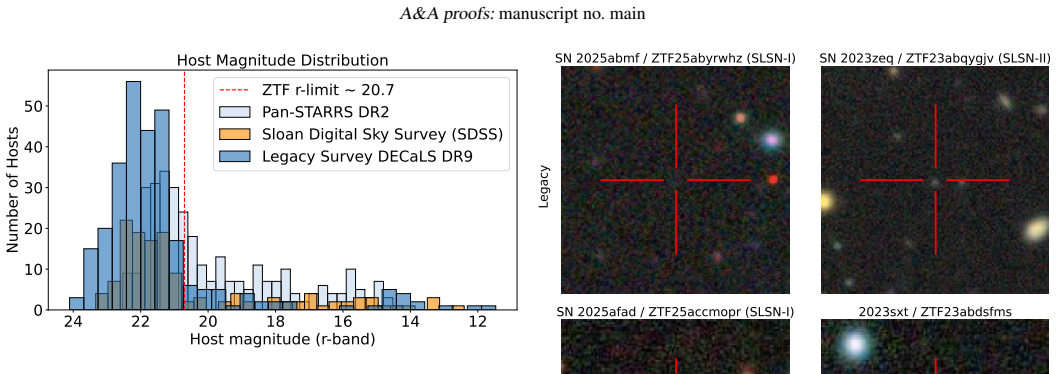
The ExtragaLactic alErt Pipeline for Hostless AstroNomical Transients (ELEPHANT), has been developed as a framework for filtering hostless candidates, in real time alert systems, and implemented as a filter in the Fink broker. ELEPHANT works on stamps and requires minimal information, thus allowing for fast identification of extragalactic transient events. In this work we evaluate the performance of the ELEPHANT pipeline by systematically analyzing flagged hostless candidates identified between 1 September 2023 and 31 December 2025. Our goal is to quantifying its accuracy and identify dominant sources of contamination. For each flagged candidate we collected additional information from multiple catalogues and archival repositories. We further examined their light-curve evolution and astrometric consistency (coordinate dispersion over time) to refine source classification. Results. Out of 877 flagged events, 67 are confidently confirmed as genuinely hostless candidates, with no detectable host galaxy in either existing catalogues or archival imaging, representing a high-purity sample of intrinsically faint or absent hosts. Additional 51 events are linked to visually identifiable hosts that are entirely absent from both catalogues and ZTF stamps. For the confirmed hostless subset, the inferred upper limits on host-galaxy absolute magnitudes extend well below the luminosity range of typical dwarf galaxies. The pipeline showed an overall accuracy of 0.84, with the majority of the classified flagged events being Type Ia supernovae, and the second most detected class being Type I superluminous supernova. ELEPHANT has been adapted to deal with the Rubin alert stream and has been processing its alerts since February 2026.
Editorial analysis
A structured set of objections, weighed in public.
Referee Report
Summary. The manuscript introduces the ELEPHANT pipeline, implemented as a real-time filter in the Fink broker, for identifying hostless extragalactic transients from alert stamps with minimal information. It reports a systematic analysis of 877 flagged candidates observed between 1 September 2023 and 31 December 2025, confirming 67 as genuinely hostless (no detectable host in catalogs or archival imaging) after cross-matching, light-curve evolution, and astrometric consistency checks; an additional 51 events show visually identifiable but uncatalogued hosts. The work claims an overall classification accuracy of 0.84, identifies Type Ia supernovae as the dominant class among flagged events, and notes adaptation of the pipeline to the Rubin alert stream since February 2026.
Significance. If the non-detection classifications and purity claims hold, the work delivers a practical, low-information filter for hostless transients that could be valuable for upcoming wide-field surveys such as LSST. The reported sample of 67 high-purity candidates with absolute-magnitude upper limits below typical dwarf-galaxy luminosities would provide a useful resource for studying rare or intrinsically faint-host populations, and the explicit adaptation to Rubin data strengthens its operational relevance.
major comments (2)
- [Results section, paragraph on confirmed hostless candidates] Results section (analysis of the 67 confirmed hostless candidates): the claim that inferred upper limits on host-galaxy absolute magnitudes 'extend well below the luminosity range of typical dwarf galaxies' requires explicit verification against the actual limiting magnitudes, depth, and footprint of the specific archival datasets (ZTF, Pan-STARRS, etc.) at the redshifts of each transient. Without a quantitative depth assessment or coverage map per candidate, the distinction between truly hostless events and low-luminosity hosts below the imaging threshold remains unverified and directly affects the purity interpretation.
- [Validation and accuracy subsection] Methods or validation subsection describing the accuracy metric: the reported overall accuracy of 0.84 is presented without error bars, a clear definition of the validation procedure (e.g., fraction of events with spectroscopic confirmation versus visual classification), or a breakdown by contaminant class. This makes it difficult to assess whether the figure robustly supports the pipeline's performance claims for the full 877-event sample.
minor comments (2)
- [Abstract and introduction] The abstract states the time range as '1 September 2023 and 31 December 2025' but the full text should confirm whether this is inclusive and note any data gaps or alert-stream changes during the period.
- [Results] Notation for the 51 events with visually identifiable but uncatalogued hosts should be made consistent with the 67 confirmed hostless sample to avoid reader confusion between the two categories.
Simulated Author's Rebuttal
We thank the referee for their constructive and detailed review of our manuscript. Their comments have helped us identify areas where additional clarification and quantitative support will strengthen the presentation of our results. We address each major comment below and indicate the revisions we will make.
read point-by-point responses
-
Referee: [Results section, paragraph on confirmed hostless candidates] Results section (analysis of the 67 confirmed hostless candidates): the claim that inferred upper limits on host-galaxy absolute magnitudes 'extend well below the luminosity range of typical dwarf galaxies' requires explicit verification against the actual limiting magnitudes, depth, and footprint of the specific archival datasets (ZTF, Pan-STARRS, etc.) at the redshifts of each transient. Without a quantitative depth assessment or coverage map per candidate, the distinction between truly hostless events and low-luminosity hosts below the imaging threshold remains unverified and directly affects the purity interpretation.
Authors: We agree that a more explicit quantitative assessment of the imaging depths is needed to support this claim robustly. In the revised manuscript we will add a dedicated paragraph (and, if space permits, a supplementary table) that reports the 5-sigma limiting magnitudes of the archival datasets (ZTF, Pan-STARRS, and any other surveys consulted) at the positions and approximate redshifts of the 67 confirmed hostless candidates. We will also summarise the sky-coverage fraction and note any regions where shallower data may affect the limits. These additions will allow readers to verify that the derived absolute-magnitude upper limits indeed lie below the typical dwarf-galaxy luminosity range (M_r ≳ −14 to −15) and will clarify the distinction from undetected low-luminosity hosts. revision: yes
-
Referee: [Validation and accuracy subsection] Methods or validation subsection describing the accuracy metric: the reported overall accuracy of 0.84 is presented without error bars, a clear definition of the validation procedure (e.g., fraction of events with spectroscopic confirmation versus visual classification), or a breakdown by contaminant class. This makes it difficult to assess whether the figure robustly supports the pipeline's performance claims for the full 877-event sample.
Authors: We thank the referee for pointing out the lack of supporting detail for the accuracy figure. In the revised Methods section we will explicitly define the validation procedure: the 0.84 accuracy was obtained by combining spectroscopic classifications (available for approximately 25 % of the 877 events) with visual classification by the team for the remainder, using light-curve shape, colour evolution, and astrometric consistency as additional discriminants. We will report binomial or bootstrap-derived error bars on the overall accuracy and will include a per-class breakdown (e.g., accuracy for Type Ia supernovae versus other classes) together with a small confusion-matrix summary. These additions will be placed in a new validation subsection and will be accompanied by a short discussion of the dominant sources of contamination. revision: yes
Circularity Check
No circularity: classification rests on external catalogs and imaging
full rationale
The paper describes an observational pipeline that flags candidates and then verifies hostless status via cross-matches to independent catalogs, archival imaging from ZTF/Pan-STARRS/etc., light-curve evolution, and astrometric dispersion. No equations, fitted parameters renamed as predictions, self-definitional loops, or load-bearing self-citations appear in the reported chain. The 67 confirmed hostless events and 0.84 accuracy are direct empirical outcomes from external data sources rather than reductions to the pipeline inputs by construction.
Axiom & Free-Parameter Ledger
axioms (1)
- domain assumption Absence from catalogs and ZTF stamps combined with light-curve and astrometric analysis suffices to confirm genuine hostless nature.
Reference graph
Works this paper leans on
-
[1]
Alam, S., Albareti, F. D., Allende Prieto, C., et al. 2015, ApJS, 219, 12
work page 2015
-
[2]
Anderson, J. P., James, P. A., Habergham, S. M., Galbany, L., & Kuncarayakti, H. 2015, Publications of the Astronomical Society of Australia, 32, e019
work page 2015
-
[3]
Bellm, E. C., Kulkarni, S. R., Graham, M. J., et al. 2019, PASP, 131, 018002
work page 2019
- [4]
-
[5]
Bianco, F. B., Ivezi´c, Ž., Jones, R. L., et al. 2022, ApJS, 258, 1
work page 2022
-
[6]
Cabrera-Vives, G., Moreno-Cartagena, D., Astorga, N., et al. 2024, A&A, 689, A289
work page 2024
-
[7]
Chakraborty, S., Sadler, B., Hoeflich, P., et al. 2024, ApJ, 969, 80
work page 2024
-
[8]
Chambers, K. C., Magnier, E. A., Metcalfe, N., et al. 2016, arXiv e-prints, arXiv:1612.05560
work page internal anchor Pith review Pith/arXiv arXiv 2016
-
[9]
H., Yan, L., Kangas, T., et al
Chen, Z. H., Yan, L., Kangas, T., et al. 2023, ApJ, 943, 41
work page 2023
- [10]
-
[11]
Conroy, C. & Bullock, J. S. 2015, ApJ, 805, L2 Dálya, G., Díaz, R., Bouchet, F. R., et al. 2022, MNRAS, 514, 1403 de Soto, K. M., Villar, V . A., Berger, E., et al. 2024, ApJ, 974, 169 Della Valle, M. & Izzo, L. 2020, A&A Rev., 28, 3
work page 2015
- [12]
-
[13]
Duncan, K. J. 2022, Monthly Notices of the Royal Astronomical Society, 512, 3662
work page 2022
-
[14]
Durgesh, R., Pessi, P., Ishida, E. E. O., et al. 2025, Transient Name Server As- troNote, 159, 1
work page 2025
-
[15]
Durgesh, R., Pessi, P., Ishida, E. E. O., & Peloton, J. 2026, Transient Name Server AstroNote, 49, 1
work page 2026
-
[16]
Fitzpatrick, E. L. 1999, PASP, 111, 63 Förster, F., Cabrera-Vives, G., Castillo-Navarrete, E., et al. 2021, AJ, 161, 242
work page 1999
-
[17]
Fremling, C., Miller, A. A., Sharma, Y ., et al. 2020, ApJ, 895, 32
work page 2020
-
[18]
Gagliano, A., de Soto, K., Boesky, A., & Manning, T. A. 2025, alexander- gagliano/Prost: v1.2.11 Gaia Collaboration, Brown, A. G. A., Vallenari, A., et al. 2018, A&A, 616, A1 Gaia Collaboration, Prusti, T., de Bruijne, J. H. J., et al. 2016, A&A, 595, A1
work page 2025
-
[19]
Gal-Yam, A., Maoz, D., Guhathakurta, P., & Filippenko, A. V . 2003, AJ, 125, 1087
work page 2003
-
[20]
Gomez, S., Nicholl, M., Berger, E., et al. 2024, MNRAS, 535, 471
work page 2024
-
[21]
Graham, M. L., Sand, D. J., Zaritsky, D., & Pritchet, C. J. 2015, ApJ, 807, 83
work page 2015
-
[22]
Greenstein, J. L. & Arp, H. 1969, Astrophys. Lett., 3, 149
work page 1969
-
[23]
2026, Transient Name Server Classification Report, 2026- 1048, 1
Jacobson-Galan, W. 2026, Transient Name Server Classification Report, 2026- 1048, 1
work page 2026
-
[24]
2024, Transient Name Server Classification Report, 2024-732, 1
Johansson, J., Hammerstein, E., Covarrubias, S., et al. 2024, Transient Name Server Classification Report, 2024-732, 1
work page 2024
-
[25]
Jones, D. O., McGill, P., Manning, T. A., et al. 2024, arXiv e-prints, arXiv:2410.17322
-
[26]
Khan, R., Stanek, K. Z., Stoll, R., & Prieto, J. L. 2011, ApJ, 737, L24
work page 2011
-
[27]
A., de Souza, R., Castro-Ginard, A., et al
Kuhn, M. A., de Souza, R., Castro-Ginard, A., et al. 2021, in American Astro- nomical Society Meeting Abstracts, V ol. 237, American Astronomical Soci- ety Meeting Abstracts #237, 329.01
work page 2021
-
[28]
Lasker, B. M., Lattanzi, M. G., McLean, B. J., et al. 2008, AJ, 136, 735
work page 2008
-
[29]
Leoni, M., Ishida, E. E. O., Peloton, J., & Möller, A. 2022, A&A, 663, A13 Article number, page 10 of 13 Durgesh et al.: Hostless extragalactic transients in Fink Fig. 11: Screen shot from the Fink Rubin Portal, showing two of the reported Rubin transients from our pipeline: the top panel shows 31383145835292266420and the bottom one, 313928194567700757 21...
work page 2022
-
[30]
LSST Science Book, Version 2.0
Lin, C.-L., Huang, L.-C., Hou, W.-J., Hsiao, H.-Y ., & Ip, W.-H. 2025, AJ, 170, 297 LSST Science Collaboration, Abell, P. A., Allison, J., et al. 2009, arXiv e-prints, arXiv:0912.0201
work page internal anchor Pith review Pith/arXiv arXiv 2025
- [31]
-
[32]
Lunnan, R., Perley, D. A., Wise, J., et al. 2025, Transient Name Server As- troNote, 179, 1
work page 2025
-
[33]
2003, A&A, 405, 23 Möller, A., Peloton, J., Ishida, E
Matteucci, F., Renda, A., Pipino, A., & Della Valle, M. 2003, A&A, 405, 23 Möller, A., Peloton, J., Ishida, E. E. O., et al. 2021, MNRAS, 501, 3272
work page 2003
-
[34]
Onken, C. A., Wolf, C., Bessell, M. S., et al. 2024, PASA, 41, e061
work page 2024
-
[35]
Perets, H. B. & Šubr, L. 2012, ApJ, 751, 133
work page 2012
-
[36]
Perley, D., Fremling, C., & Laz, T. D. 2025, Transient Name Server Discovery Report, 2025-1783, 1
work page 2025
-
[37]
A., Fremling, C., Sollerman, J., et al
Perley, D. A., Fremling, C., Sollerman, J., et al. 2020, ApJ, 904, 35
work page 2020
-
[38]
J., Durgesh, R., Nakazono, L., et al
Pessi, P. J., Durgesh, R., Nakazono, L., et al. 2024, A&A, 691, A181
work page 2024
-
[39]
Phillips, M. M., Ashall, C., Burns, C. R., et al. 2022, ApJ, 938, 47
work page 2022
-
[40]
Piller, M. 1990, The Best of Both Worlds, Part II, Television episode,Star Trek: The Next Generation, season 4, episode 1, production code 175, original air date 24 September 1990
work page 1990
-
[41]
Pruzhinskaya, M. V ., Novinskaya, A. K., Pauna, N., & Rosnet, P. 2020, MNRAS, 499, 5121
work page 2020
-
[42]
Pruzhinskaya, M. V ., Pauna, N., Novinskaya, A. K., & Rosnet, P. 2021, Astron- omy Reports, 65, 1015
work page 2021
-
[43]
Przybilla, N., Fernanda Nieva, M., Heber, U., & Butler, K. 2008, ApJ, 684, L103
work page 2008
-
[44]
Qin, Y .-J., Zabludoff, A., Arcavi, I., et al. 2024, MNRAS, 530, 4695
work page 2024
-
[45]
2022, The Astrophysical Journal Sup- plement Series, 259, 13
Qin, Y .-J., Zabludoff, A., Kisley, M., et al. 2022, The Astrophysical Journal Sup- plement Series, 259, 13
work page 2022
-
[46]
Rehemtulla, N., Miller, A. A., Jegou Du Laz, T., et al. 2024, ApJ, 972, 7
work page 2024
-
[47]
Richardson, D., Jenkins, III, R. L., Wright, J., & Maddox, L. 2014, AJ, 147, 118
work page 2014
-
[48]
Sales, L. V ., Wetzel, A., & Fattahi, A. 2022, Nature Astronomy, 6, 897 Sánchez-Sáez, P., Reyes, I., Valenzuela, C., et al. 2021, AJ, 161, 141
work page 2022
-
[49]
Schlafly, E. F. & Finkbeiner, D. P. 2011, ApJ, 737, 103
work page 2011
-
[50]
Schlegel, D. J., Finkbeiner, D. P., & Davis, M. 1998, ApJ, 500, 525
work page 1998
-
[51]
Scholz, R.-D., Lodieu, N., & McCaughrean, M. J. 2004, A&A, 428, L25
work page 2004
-
[52]
2023, Transient Name Server As- troNote, 352, 1
Schweyer, T., Barmentloo, S., Pessi, P., et al. 2023, Transient Name Server As- troNote, 352, 1
work page 2023
-
[53]
Shara, M. M. 2000, New A Rev., 44, 87
work page 2000
- [54]
- [55]
-
[56]
Sollerman, J., Jaimes, J. C., Chu, M., & Fremling, C. 2026, Transient Name Server Classification Report, 2026-115, 1
work page 2026
-
[57]
D., Dong, Y ., Nugent, A., et al
Soto, K. D., Dong, Y ., Nugent, A., et al. 2026, Transient Name Server AstroNote, 50, 1
work page 2026
-
[58]
Strolger, L.-G., Bovill, M. S., Perlman, E., et al. 2025, ApJ, 988, 278
work page 2025
-
[59]
Taddia, F., Stritzinger, M. D., Bersten, M., et al. 2018, A&A, 609, A136
work page 2018
-
[60]
Torra, F., Castañeda, J., Fabricius, C., et al. 2021, A&A, 649, A10
work page 2021
- [61]
-
[62]
Villar, V . A., Davis, K. W., Dong, Y ., & Foley, R. J. 2026, Transient Name Server AstroNote, 72, 1
work page 2026
- [63]
-
[64]
White, D. J., Daw, E. J., & Dhillon, V . S. 2011, Class. Quant. Grav., 28, 085016
work page 2011
-
[65]
2025, Transient Name Server Classification Report, 2025-3816, 1
Wise, J., Perley, D., Hinds, K., et al. 2025, Transient Name Server Classification Report, 2025-3816, 1
work page 2025
-
[66]
2024, Transient Name Server Discovery Report, 2024-2899, 1
Xu, J., Zhang, M., & Gao, X. 2024, Transient Name Server Discovery Report, 2024-2899, 1
work page 2024
-
[67]
Young, D. 2023, Sherlock. Contextual classification of astronomical transient sources
work page 2023
-
[68]
2024, Transient Name Server Discovery Re- port, 2024-56, 1
Zhang, M., Gao, X., Sun, G., et al. 2024, Transient Name Server Discovery Re- port, 2024-56, 1
work page 2024
-
[69]
Zinn, P.-C., Grunden, P., & Bomans, D. J. 2011, A&A, 536, A103
work page 2011
-
[70]
Zinn, P.-C., Stritzinger, M., Braithwaite, J., et al. 2012, A&A, 538, A30 Article number, page 12 of 13 Durgesh et al.: Hostless extragalactic transients in Fink Appendix A: Fink alert filters The ELEPHANT pipeline processes alerts that have any of the following classifications, which are added within the Fink bro- ker. Fink classifiers are added using ma...
work page 2012
discussion (0)
Sign in with ORCID, Apple, or X to comment. Anyone can read and Pith papers without signing in.