Pith. sign in

REVIEW 2 major objections 2 minor 1 cited by

Configuration of the $\xi$ Tau system constrained by multi-technique observations

T0 review · 2 major / 2 minor · reviewed 2026-05-22 · grok-4.3

Pith's one-line read The ξ Tau system is best explained by a five-component hierarchical model that includes tidal dissipation in the inner binary with a time lag of about 100 seconds.

desk verdict New data tightens ξ Tau masses to 1% but five-component model lacks comparison tests. read the letter →

arxiv 2605.22545 v1 pith:QUZVJ37O submitted 2026-05-21 astro-ph.SR

classification astro-ph.SR
keywords multiplestellarsystemsξTauorbitaldynamicstidaldissipationeclipsingbinarieshierarchicaltriplesmassesradialvelocities
verification ladder T0 review T1 audit T2 compute T3 formal

The pith

A machine-rendered reading of the paper's core claim, the machinery that carries it, and where it could break.

The reading

This paper uses new photometry from TESS and MOST along with spectroscopy to refine the understanding of the compact multiple star system ξ Tau at 67 parsecs. It shows that the system follows a specific hierarchical structure with three main stellar components and an outer binary. The observations reveal oscillations in orbital elements on various timescales from days to decades. The model that fits all data best incorporates tidal friction in the close pair and treats the outermost component as a binary itself. This matters for accurately determining stellar masses and predicting long-term stability in such tight multiple systems.

What carries the argument

Hierarchical three-orbit model of the ((Aa+Ab)+B)+C system with tidal dissipation applied to the inner binary.

What would settle it

A direct resolution of component C into two separate stars via high-resolution astrometry or interferometry at the predicted 600 mas separation, or the absence of the expected long-term radial velocity trend if C is not binary, would confirm or refute the five-component model.

Watch

Extended reading notes

Core claim

Given the hierarchical architecture of ξ Tau, ((Aa+Ab)+B)+C, the orbital evolution is detected on all time scales with short-period oscillations in eccentricity and inclination changes over about 7000 days affecting eclipse depths. There is also a long-term trend from the outer orbit with period about 18900 days. The mutual inclinations are about 0.5 and 71 degrees, and stability is ensured by fast precession suppressing Kozai oscillations. The best model requires tidal dissipation in the inner binary with time lag of about 100 seconds and five components where component C is a binary Ca+Cb, constraining the masses of the three main components to 2.27, 2.15, and 3.78 solar masses within 1%.

Load-bearing premise

The hierarchical architecture ((Aa+Ab)+B)+C is taken as given and the outer component C is modeled as an unresolved binary to fit the long-term radial-velocity trend and astrometric offset.

Editorial extensions

If this is right

  • The inclination of the inner eclipsing pair varies between 86.1 and 87.1 degrees, changing the observed eclipse depths over time.
  • Eccentricities oscillate with small amplitudes on orbital timescales.
  • The outer component C shows a perihelion passage bump in radial velocities.
  • Long-term stability is maintained despite the large mutual inclination of 71 degrees due to rapid apsidal precession.
  • The suspected binary nature of C at 600 mas offset requires further characterization.

Reading between the lines

Editorial extensions of the paper, not claims the author makes directly.

  • If the tidal time lag is indeed around 100 seconds, it could indicate the viscous dissipation properties inside the stars of the inner binary.
  • Better characterization of the Ca+Cb pair might reveal whether the system has even more components as hinted.
  • The constrained masses could be used to test theoretical models of stellar structure and evolution for stars of these masses.
  • Ongoing observations could detect any additional dwarf or exoplanetary companions through continued monitoring.
Share X Bluesky LinkedIn Reddit HN

Editorial analysis

A structured set of objections, weighed in public.

Desk editor's note, referee report, simulated authors' rebuttal, and a circularity audit.

Referee Report

2 major / 2 minor

Summary. The manuscript analyzes the ξ Tau stellar system using combined photometric data from TESS and MOST, spectroscopic observations from CTIO, and astrometric data from WDS. Assuming a hierarchical architecture ((Aa+Ab)+B)+C with C as an unresolved binary (Ca+Cb), it models orbital evolution across different timescales, including short-term oscillations in eccentricity and inclination, secular changes, and a long-term trend from the outer orbit with period ~18900 days. The analysis concludes that tidal dissipation in the inner binary with a time lag of ~100 s is required, and constrains the masses of the three main components to within 1%.

Significance. The combination of multiple independent observational techniques (photometry, spectroscopy, and astrometry) is a strength that enables constraints on both short-term orbital variations and longer-term dynamical effects such as inclination changes affecting eclipse depths. If validated, the work contributes to understanding tidal dissipation and stability in compact hierarchical multiples by reporting specific parameter values and noting the suppression of Kozai cycles via fast precession.

major comments (2)
  1. [Abstract] Abstract: The central claim that 'the best model requires tidal dissipation in the inner binary (with the time lag of ∼100 s) and five components, where component C is a binary (Ca+Cb)' and that masses are constrained to within 1% rests on attributing the long-term RV trend and 600 mas astrometric offset to an outer orbit (P3 ≃ 18900 d) without reported statistical model comparison. No Δχ², BIC, AIC, or nested-model F-test results are provided to demonstrate that a single-C 4-body model fails to reproduce the CTIO RV data and WDS astrometry at the stated precision; this makes the necessity of the Ca+Cb split and the resulting mass precisions dependent on an untested architectural choice rather than an independent test.
  2. [Model fitting section] Model fitting section: Orbital elements (including e1, e2, i1, Ω) and the tidal time lag are fitted directly to the same photometric and spectroscopic time series used to detect the long-term trend. This introduces potential circularity, as the conclusion that the model 'requires' five components and a specific dissipation timescale depends on the chosen parameterization; explicit tests of alternative architectures (e.g., single C vs. binary C) or parameterizations should be shown to establish that the 1% mass constraints are robust rather than prior-dependent.
minor comments (2)
  1. [Abstract] Abstract: The periods are denoted P1, P2, P3 and eccentricities e1, e2 without an explicit introductory definition or reference to the corresponding orbital planes, which may reduce clarity for readers.
  2. The manuscript would benefit from a dedicated table summarizing the best-fit parameters with uncertainties, covariance information, and reduced χ² values for the adopted model.

Simulated Author's Rebuttal

2 responses · 0 unresolved

We thank the referee for the constructive comments on our manuscript analyzing the ξ Tau system. We address each major comment below and will make revisions to strengthen the statistical support for our model choices.

read point-by-point responses
  1. Referee: [Abstract] The central claim that 'the best model requires tidal dissipation in the inner binary (with the time lag of ∼100 s) and five components, where component C is a binary (Ca+Cb)' and that masses are constrained to within 1% rests on attributing the long-term RV trend and 600 mas astrometric offset to an outer orbit (P3 ≃ 18900 d) without reported statistical model comparison. No Δχ², BIC, AIC, or nested-model F-test results are provided to demonstrate that a single-C 4-body model fails to reproduce the CTIO RV data and WDS astrometry at the stated precision.

    Authors: We agree that explicit statistical comparisons were not reported in the original manuscript. The choice of a five-component model with C as a binary (Ca+Cb) is based on the 600 mas astrometric offset observed in WDS data and the long-term radial velocity trend in CTIO observations, which align with an outer period of ~18900 days. To address this, we will add BIC and AIC comparisons between the 4-body and 5-body models in the revised version, demonstrating the improved fit and justifying the mass constraints to within 1%. revision: yes

  2. Referee: [Model fitting section] Orbital elements (including e1, e2, i1, Ω) and the tidal time lag are fitted directly to the same photometric and spectroscopic time series used to detect the long-term trend. This introduces potential circularity, as the conclusion that the model 'requires' five components and a specific dissipation timescale depends on the chosen parameterization; explicit tests of alternative architectures (e.g., single C vs. binary C) or parameterizations should be shown to establish that the 1% mass constraints are robust rather than prior-dependent.

    Authors: We acknowledge the potential for circularity in fitting parameters to data that also exhibits the long-term trend. The short-term orbital oscillations are primarily constrained by the photometric data from TESS and MOST, while the long-term aspects come from spectroscopy and astrometry. In the revision, we will present explicit tests of alternative architectures, including single C versus binary C, and report the fit statistics to show that the 1% mass precision and the tidal time lag of ~100 s are robust. revision: yes

Circularity Check

0 steps flagged · score 0.0 of 10

No significant circularity; results are direct observational fits

full rationale

The paper constrains the ξ Tau configuration by fitting orbital elements, tidal time lag, and component masses directly to photometric, spectroscopic, and astrometric time series under an assumed hierarchical architecture ((Aa+Ab)+B)+C. No derivation chain claims an independent prediction or first-principles result that reduces by construction to the fitted inputs; the 'best model requires' statement is the outcome of the fit itself rather than a separate prediction. No self-citation load-bearing steps, uniqueness theorems, or ansatzes smuggled via prior work are present in the abstract or described methods. The analysis is self-contained against the external data sets.

Assumptions & free parameters 2 free parameters · 1 assumptions · 1 invented entities

The model rests on a pre-assumed hierarchical architecture, a fitted tidal lag, and an ad-hoc binary interpretation for component C; these are not independently verified outside the fit.

free parameters (2)
  • tidal time lag = ~100 s
    Introduced to reproduce observed orbital evolution; value ∼100 s is stated as required by the best model.
  • component masses = 2.27, 2.15, 3.78 solar masses
    Reported as constrained to 1% but obtained by fitting the combined dataset.
assumptions (1)
  • domain assumption Hierarchical architecture ((Aa+Ab)+B)+C
    Invoked at the start of the modeling section to organize the observed periods and mutual inclinations.
invented entities (1)
  • Ca+Cb binary
    purpose: To account for the 600 mas offset and long-term radial-velocity trend of component C
    Postulated to improve the fit; no independent detection or mass ratio is provided.

how reviews work

0 comments
Cite this review

Pith. "Pith review of Configuration of the $\xi$ Tau system constrained by multi-technique observations." pith.science (2026). https://pith.science/paper/QUZVJ37O

@misc{pith2026260522545,
  author       = {Pith},
  title        = {Pith review of: Configuration of the $\xi$ Tau system constrained by multi-technique observations},
  year         = {2026},
  howpublished = {\url{https://pith.science/paper/QUZVJ37O}},
  note         = {Machine review of arXiv:2605.22545}
}
abstract

$\xi$ Tau is one of the most compact multiple stellar systems, which is sufficiently close (67 pc) to be constrained by all kinds of observations. To better constrain its current configuration, we utilized new observational data: (i) photometry from TESS and astrometry from WDS, and (ii) our own photometry from the MOST spacecraft and spectroscopy from the CTIO observatory. [...] Given the hierarchical architecture of $\xi$ Tau, ((Aa+Ab)+B)+C, we detected the orbital evolution on all time scales. Oscillations of periods $P$ occur on the shortest, orbital time scales ($P_1$, $P_2$); the variation of eccentricity $e_1$ is from 0 to 0.008, and of $e_2$ from 0.202 to 0.207, respectively. Oscillations of projected $i$, $\Omega$ are coupled, and occur on the secular time scale of about 7000 d. The inclination $i_1$ of the inner, eclipsing pair (Aa+Ab) changes from $86.1^\circ$ to $87.1^\circ$, which is clearly manifested in eclipse depths. There is also a long-term trend due to the outer orbit ($P_3 \doteq 18900\,{\rm d}$), with a perihelion passage (a `bump') of component C, which is manifested in radial velocities. The mutual inclinations between the three orbital planes, ${\simeq}\,0.5^\circ$ and $71^\circ$, are very different. Long-term stability is ensured by suppressing Kozai oscillations due to the fast precession rate $\dot\omega_2$. The best model requires tidal dissipation in the inner binary (with the time lag of ${\sim}100\,{\rm s}$) and five components, where component C is a binary (Ca+Cb). Although the masses of the three components ($2.27$, $2.15$, $3.78\,M_\odot$) are now constrained to within 1%, the suspected binary (Ca+Cb), offset by $600\,{\rm mas}$, should be better characterized. A key question remains whether this bright stellar system contains additional dwarf or exoplanetary components with low masses. Continuing monitoring of $\xi$ Tau is highly desirable.

Figures

Figures reproduced from arXiv: 2605.22545 by the authors.

Figure 1
Figure 1. Rectification of a CTIO/CHIRON echelle spectrum (ktc00027) in the region of the Hα line (6563 Å), using the resimplex3 method. Top: Synthetic spectra were computed from our model in [PITH_FULL_IMAGE:figures/full_fig_p003_1.png] view at source ↗
Figure 2
Figure 2. The reference model of ξ Tau, showing ETVs (top), eclipse durations (middle), perturbations with respect to a 2- body ephemeris (bottom), MOST and TESS observations (blue), model (gray), residuals (red), and for reference, also observed minima (green). The total χ 2 = 1553 (see [PITH_FULL_IMAGE:figures/full_fig_p004_2.png] view at source ↗
Figure 3
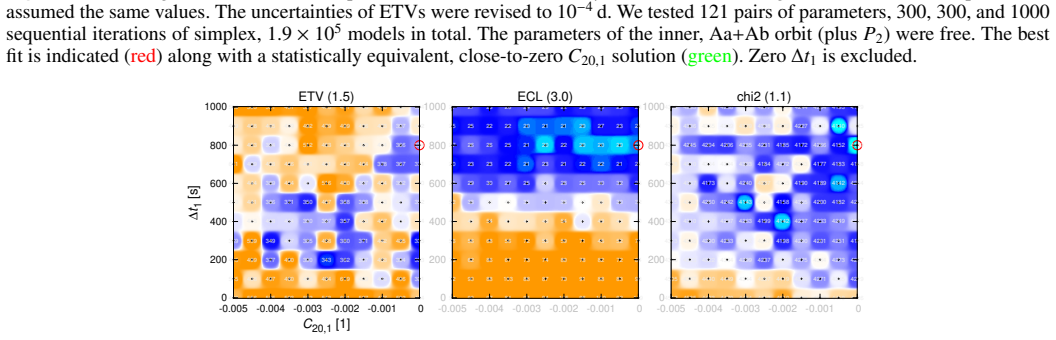
Figure 3. Best-fit models of ξ Tau constrained by multi-technique observations for two fixed parameters, the total mass msum and the distance d. The χ 2 values (colours) indicate best fit (cyan), good fits (blue), poor fits (orange); overall best fit (red) has χ 2 = 1661 (unreduced). We tested 121 pairs of parameters, 3000 sequential iterations of simplex, 3.6 × 10⁵ models in total, other dynamical parameters (except msum, d)… view at source ↗
Figures from the paper (10 more)
Figure 4
Figure 4. Figure 4: The best-fit model from [PITH_FULL_IMAGE:figures/full_fig_p007_4.png]
Figure 5
Figure 5. Figure 5: Same as [PITH_FULL_IMAGE:figures/full_fig_p009_5.png]
Figure 6
Figure 6. Figure 6: The best-fit model from [PITH_FULL_IMAGE:figures/full_fig_p010_6.png]
Figure 7
Figure 7. Figure 7: Same as [PITH_FULL_IMAGE:figures/full_fig_p011_7.png]
Figure 8
Figure 8. Figure 8: Same as [PITH_FULL_IMAGE:figures/full_fig_p011_8.png]
Figure 9
Figure 9. Figure 9: Same as [PITH_FULL_IMAGE:figures/full_fig_p011_9.png]
Figure 10
Figure 10. Figure 10: Angular momentum vectors of the ξ Tau subsystems (Aa+Ab, B, C) and their long-term evolution. The coordinates were rotated to the Laplace reference frame, with the z-axis along the total angular momentum Lsum of the whole ξ Tau sys￾tem (in absence of external torques …
Figure 12
Figure 12. Figure 12: Osculating orbital elements of ξ Tau in the course of time, for the model with χ 2 = 3639180. The angular elements are expressed in the observer’s reference frame. See the description in the main text. -500 -400 -300 -200 -100 0 100 200 300 400 500 -700 -600 -500 -400…
Figure 13
Figure 13. Figure 13: Photocentre motion of the ξ Tau system and its influence on parallax measuments. We plot the orbital motion of individual components Aa, Ab, B, C in the barycentric frame (light gray or coloured, if within the observational timespan of Gaia), the photocentre motion (b…
Figure 14
Figure 14. Figure 14: Periodogram of ξ Tau from the TESS (top) and MOST 2012 (bottom) light curves. We removed eclipses and computed five Fourier transforms (Lenz & Breger 2005), with fitting of fre￾quencies, amplitudes and phases, and subtracting the respective model, P i Ai sin[2π(fi t +…

Discussion (0). Continue with ORCID to comment.

Lean theorems connected to this paper

Citations machine-checked in the Pith Canon. Every link opens the source theorem in the public Lean library.

What do these tags mean?
matches
The paper's claim is directly supported by a theorem in the formal canon.
supports
The theorem supports part of the paper's argument, but the paper may add assumptions or extra steps.
extends
The paper goes beyond the formal theorem; the theorem is a base layer rather than the whole result.
uses
The paper appears to rely on the theorem as machinery.
contradicts
The paper's claim conflicts with a theorem or certificate in the canon.
unclear
Pith found a possible connection, but the passage is too broad, indirect, or ambiguous to say the theorem truly supports the claim.

Forward citations

Cited by 1 Pith paper

Reviewed papers in the Pith corpus that reference this work. Sorted by Pith novelty score. Full citation record

  1. Refined reduction and standardisation of 53 years of UBV photometry at Hvar

    astro-ph.SR 2026-07 conditional novelty 6.0 of 10

    Re-reduced 53-year Hvar UBV photometry achieves 0.008–0.016 mag accuracy and classifies 59 Be stars into five variability types, finding LTE and LTC variability are nearly mutually exclusive.

Reference graph

Works this paper leans on

298 extracted references · 298 canonical work pages · cited by 1 Pith paper

  1. [1]

    Applications of satellites to geodesy

    Theory of satellite geodesy. Applications of satellites to geodesy

  2. [2]

    and Vecchio, A

    Improved equations for eccentricity generation in hierarchical triple systems. , keywords =. doi:10.1111/j.1365-2966.2008.14143.x , archivePrefix =. 0811.1146 , primaryClass =

  3. [3]

    2005, title The three-point function in large-scale structure: redshift distortions and galaxy bias , , 361, 824, 10.1111/j.1365-2966.2005.09234.x

    Eccentricity generation in hierarchical triple systems: the planetary regime. , keywords =. doi:10.1111/j.1365-2966.2005.09888.x , archivePrefix =. 1408.6263 , primaryClass =

  4. [4]

    doi:10.1046/j.1365-8711.2003.06504.x , keywords =

    Eccentricity evolution in hierarchical triple systems with eccentric outer binaries. , keywords =. doi:10.1046/j.1365-8711.2003.06942.x , archivePrefix =. 1408.5890 , primaryClass =

  5. [5]

    , keywords =

    Secular motion in a hierarchic triple stellar system. , keywords =. doi:10.1093/mnras/stv361 , adsurl =

  6. [6]

    1981 , journal =

    Bidirectional reflectance spectroscopy. I - Theory. , keywords =. doi:10.1029/JB086iB04p03039 , adsurl =

  7. [7]

    New determination of the size and bulk density of the binary asteroid 22 Kalliope from observations of mutual eclipses

    New determination of the size and bulk density of the binary Asteroid 22 Kalliope from observations of mutual eclipses. , keywords =. doi:10.1016/j.icarus.2008.03.014 , archivePrefix =. 0710.1471 , primaryClass =

  8. [8]

    Disk-resolved photometry of small bodies

Show all 298 references
  1. [9]

    , keywords =

    M-type (22) Kalliope: A tiny Mercury. , keywords =. doi:10.1051/0004-6361/202243200 , adsurl =

  2. [10]

    , keywords =

    Discovery of an asteroid family linked to (22) Kalliope and its moon Linus. , keywords =. doi:10.1051/0004-6361/202243628 , archivePrefix =. 2205.15736 , primaryClass =

  3. [11]

    Comm.\ ACM , year = 1992, volume =

    A generic solution to polygon clipping. Comm.\ ACM , year = 1992, volume =

  4. [12]

    Physics Of Eclipsing Binaries. II. Toward the Increased Model Fidelity. , keywords =. doi:10.3847/1538-4365/227/2/29 , archivePrefix =. 1609.08135 , primaryClass =

  5. [14]

    Gaia DR2 documentation

  6. [15]

    Astronomicheskii Vestnik , keywords =

    UBV photometry of the M-type asteroids 16 Psyche and 22 Kalliope. Astronomicheskii Vestnik , keywords =

  7. [16]

    Summary of the contents and survey properties

    Gaia Data Release 2. Summary of the contents and survey properties. , keywords =. doi:10.1051/0004-6361/201833051 , archivePrefix =. 1804.09365 , primaryClass =

  8. [17]

    Astrometric measurements of visual binaries in 2015-2016

    Speckle observations with PISCO in Calern (France): I. Astrometric measurements of visual binaries in 2015-2016. Astronomische Nachrichten , keywords =. doi:10.1002/asna.201913642 , adsurl =

  9. [18]

    , keywords =

    DAMIT: a database of asteroid models. , keywords =. doi:10.1051/0004-6361/200912693 , adsurl =

  10. [19]

    , keywords =

    Precise astrometry and diameters of asteroids from occultations - a data set of observations and their interpretation. , keywords =. doi:10.1093/mnras/staa3077 , archivePrefix =. 2010.06086 , primaryClass =

  11. [20]

    SOFA: Standards of Fundamental Astronomy

  12. [21]

    Additional Light-Curves

    Photometric Studies of Asteroids.IX. Additional Light-Curves. , year = 1962, month = may, volume =. doi:10.1086/147334 , adsurl =

  13. [22]

    , keywords =

    Lightcurves, Phase Function and Pole of the Asteroid 22 Kalliope. , keywords =. doi:10.1016/0019-1035(78)90129-X , adsurl =

  14. [23]

    , keywords =

    Expressions for the Precession Quantities Based upon the IAU (1976) System of Astronomical Constants. , keywords =

  15. [24]

    Geophysical Journal , keywords =

    The forced nutations of an elliptical, rotating, elastic and oceanless earth. Geophysical Journal , keywords =. doi:10.1111/j.1365-246X.1981.tb02691.x , adsurl =

  16. [25]

    Astronomická příručka

  17. [26]

    , keywords =

    Photoelectric photometry of 22 Kalliope during the 1985 opposition and determination of its pole orientation - The 'magnitude-aspect' relations revisited. , keywords =

  18. [27]

    Ground-based and Airborne Telescopes VII , year = 2018, editor =

    SPECULOOS: a network of robotic telescopes to hunt for terrestrial planets around the nearest ultracool dwarfs. Ground-based and Airborne Telescopes VII , year = 2018, editor =. doi:10.1117/12.2312475 , archivePrefix =. 1806.11205 , primaryClass =

  19. [28]

    , keywords =

    An advanced multipole model for (216) Kleopatra triple system. , keywords =. doi:10.1051/0004-6361/202140901 , archivePrefix =. 2105.09134 , primaryClass =

  20. [29]

    , keywords =

    Observed tidal evolution of Kleopatra's outer satellite. , keywords =. doi:10.1051/0004-6361/202142055 , archivePrefix =. 2110.12702 , primaryClass =

  21. [30]

    , year = 2006, month = may, volume = 182, pages =

    Yarkovsky footprints in the Eos family. , year = 2006, month = may, volume = 182, pages =. doi:10.1016/j.icarus.2005.12.011 , adsurl =

  22. [31]

    , archivePrefix = "arXiv", eprint =

    The size distributions of asteroid families in the SDSS Moving Object Catalog 4. , archivePrefix = "arXiv", eprint =. doi:10.1016/j.icarus.2008.07.002 , adsurl =

  23. [32]

    Main Belt Asteroids with WISE/NEOWISE. I. Preliminary Albedos and Diameters. , archivePrefix = "arXiv", eprint =. doi:10.1088/0004-637X/741/2/68 , adsurl =

  24. [33]

    , year = 2009, month = jul, volume = 202, pages =

    An extension of the Bus asteroid taxonomy into the near-infrared. , year = 2009, month = jul, volume = 202, pages =. doi:10.1016/j.icarus.2009.02.005 , adsurl =

  25. [34]

    , year = 2005, month = may, volume = 435, pages =

    Chaotic capture of Jupiter's Trojan asteroids in the early Solar System. , year = 2005, month = may, volume = 435, pages =. doi:10.1038/nature03540 , adsurl =

  26. [35]

    , year = 1995, month = aug, volume = 116, pages =

    Asteroid families: Search of a 12,487-asteroid sample using two different clustering techniques. , year = 1995, month = aug, volume = 116, pages =. doi:10.1006/icar.1995.1127 , adsurl =

  27. [36]

    , keywords =

    The long-term dynamical behavior of short-period comets. , keywords =. doi:10.1006/icar.1994.1039 , adsurl =

  28. [37]

    Celestial Mechanics and Dynamical Astronomy , eprint =

    High order symplectic integrators for perturbed Hamiltonian systems. Celestial Mechanics and Dynamical Astronomy , eprint =

  29. [38]

    , year = 2004, month = dec, volume = 172, pages =

    The YORP effect with finite thermal conductivity. , year = 2004, month = dec, volume = 172, pages =. doi:10.1016/j.icarus.2004.07.003 , adsurl =

  30. [39]

    , archivePrefix = "arXiv", eprint =

    Did the Hilda collisional family form during the late heavy bombardment?. , archivePrefix = "arXiv", eprint =. doi:10.1111/j.1365-2966.2011.18587.x , adsurl =

  31. [40]

    , archivePrefix = "arXiv", eprint =

    A study of asteroid pole-latitude distribution based on an extended set of shape models derived by the lightcurve inversion method. , archivePrefix = "arXiv", eprint =. doi:10.1051/0004-6361/201116738 , adsurl =

  32. [41]

    , year = 1998, month = apr, volume = 132, pages =

    Meteorite Delivery via Yarkovsky Orbital Drift. , year = 1998, month = apr, volume = 132, pages =. doi:10.1006/icar.1997.5872 , adsurl =

  33. [42]

    PhD Thesis, Charles Univ

    Yarkovsky Effect and the Dynamics of the Solar System. PhD Thesis, Charles Univ. , year = 2006, pages =

  34. [43]

    Celestial Mechanics and Dynamical Astronomy , keywords =

    Frequency modified Fourier transform and its applications to asteroids. Celestial Mechanics and Dynamical Astronomy , keywords =. doi:10.1007/BF00048443 , adsurl =

  35. [44]

    , year = 2000, month = may, volume = 145, pages =

    Fugitives from the Eos Family: First Spectroscopic Confirmation. , year = 2000, month = may, volume = 145, pages =. doi:10.1006/icar.2000.6349 , adsurl =

  36. [45]

    , year = 1999, month = sep, volume = 141, pages =

    The Velocity-Size Relationship for Members of Asteroid Families and Implications for the Physics of Catastrophic Collisions. , year = 1999, month = sep, volume = 141, pages =. doi:10.1006/icar.1999.6149 , adsurl =

  37. [46]

    , keywords =

    Asteroid proper elements and secular resonances. , keywords =. doi:10.1016/0019-1035(92)90091-K , adsurl =

  38. [47]

    , keywords =

    A frequency approach to identifying asteroid families. , keywords =. doi:10.1051/0004-6361:20077689 , adsurl =

  39. [48]

    A frequency approach to identifying asteroid families. II. Families interacting with nonlinear secular resonances and low-order mean-motion resonances. , keywords =. doi:10.1051/0004-6361:200809852 , adsurl =

  40. [49]

    , keywords =

    The (not so) peculiar case of the Padua family. , keywords =. doi:10.1111/j.1365-2966.2009.14523.x , adsurl =

  41. [50]

    Asteroids, Comets, Meteors 2014 , year = 2014, editor =

    Recent disruption of an asteroid from the Eos family. Asteroids, Comets, Meteors 2014 , year = 2014, editor =

  42. [51]

    , archivePrefix = "arXiv", eprint =

    The Eos family halo. , archivePrefix = "arXiv", eprint =. doi:10.1016/j.icarus.2013.02.002 , adsurl =

  43. [52]

    Asteroids IV , year = 2015, editor =

    Identification and Dynamical Properties of Asteroid Families. Asteroids IV , year = 2015, editor =. doi:10.2458/azu_uapress_9780816532131-ch016 , publisher =

  44. [53]

    , year = 2008, month = may, volume = 195, pages =

    Mineralogical analysis of the Eos family from near-infrared spectra. , year = 2008, month = may, volume = 195, pages =. doi:10.1016/j.icarus.2007.12.005 , adsurl =

  45. [54]

    , year = 1918, month = oct, volume = 31, pages =

    Groups of asteroids probably of common origin. , year = 1918, month = oct, volume = 31, pages =. doi:10.1086/104299 , adsurl =

  46. [55]

    Diurnal Yarkovsky effect as a source of mobility of meter-sized asteroidal fragments. I. Linear theory. , keywords =

  47. [56]

    , keywords =

    The Yarkovsky Seasonal Effect on Asteroidal Fragments: A Nonlinearized Theory for Spherical Bodies. , keywords =. doi:10.1086/301138 , adsurl =

  48. [57]

    , year = 2000, month = nov, volume = 148, pages =

    Fast and Slow Rotation of Asteroids. , year = 2000, month = nov, volume = 148, pages =. doi:10.1006/icar.2000.6482 , adsurl =

  49. [58]

    , keywords =

    A three million year integration of the earth's orbit. , keywords =. doi:10.1086/115850 , adsurl =

  50. [59]

    , archivePrefix = "arXiv", eprint =

    Asteroids were born big. , archivePrefix = "arXiv", eprint =. doi:10.1016/j.icarus.2009.07.011 , adsurl =

  51. [60]

    , keywords =

    Size-frequency distributions of fragments from SPH/ N-body simulations of asteroid impacts: Comparison with observed asteroid families. , keywords =. doi:10.1016/j.icarus.2006.09.013 , adsurl =

  52. [61]

    , archivePrefix = "arXiv", eprint =

    Distribution of spin-axes longitudes and shape elongations of main-belt asteroids. , archivePrefix = "arXiv", eprint =. doi:10.1051/0004-6361/201629192 , adsurl =

  53. [62]

    , archivePrefix = "arXiv", eprint =

    Spin states of asteroids in the Eos collisional family. , archivePrefix = "arXiv", eprint =. doi:10.1016/j.icarus.2017.07.007 , adsurl =

  54. [63]

    , keywords =

    SPH/N-Body simulations of small ( D = 10 \,km) asteroidal breakups and improved parametric relations for Monte-Carlo collisional models. , keywords =. doi:10.1016/j.icarus.2017.06.021 , adsurl =

  55. [64]

    , eprint =

    Catastrophic Disruptions Revisited. , eprint =. doi:10.1006/icar.1999.6204 , adsurl =

  56. [65]

    , year = 2005, month = dec, volume = 179, pages =

    Linking the collisional history of the main asteroid belt to its dynamical excitation and depletion. , year = 2005, month = dec, volume = 179, pages =. doi:10.1016/j.icarus.2005.05.017 , adsurl =

  57. [66]

    , year = 2018, month = apr, volume = 304, pages =

    Reconstructing the size distribution of the primordial Main Belt. , year = 2018, month = apr, volume = 304, pages =

  58. [67]

    , keywords =

    Proper element catalogs and asteroid families. , keywords =. doi:10.1051/0004-6361:20030475 , adsurl =

  59. [68]

    , archivePrefix = "arXiv", eprint =

    Evolution of eccentricity and inclination of hot protoplanets embedded in radiative discs. , archivePrefix = "arXiv", eprint =. doi:10.1093/mnras/stx856 , adsurl =

  60. [69]

    , archivePrefix = "arXiv", eprint =

    Eccentricity excitation and merging of planetary embryos heated by pebble accretion. , archivePrefix = "arXiv", eprint =. doi:10.1051/0004-6361/201731033 , adsurl =

  61. [70]

    , archivePrefix = "arXiv", eprint =

    On the formation of compact planetary systems via concurrent core accretion and migration. , archivePrefix = "arXiv", eprint =. doi:10.1093/mnras/stw149 , adsurl =

  62. [71]

    Three-dimensional Interaction between a Planet and an Isothermal Gaseous Disk. II. Eccentricity Waves and Bending Waves. , keywords =. doi:10.1086/380992 , adsurl =

  63. [72]

    , eprint =

    Using FU Orionis outbursts to constrain self-regulated protostellar disk models. , eprint =. doi:10.1086/174206 , adsurl =

  64. [73]

    , archivePrefix = "arXiv", eprint =

    Reduced gas accretion on super-Earths and ice giants. , archivePrefix = "arXiv", eprint =. doi:10.1051/0004-6361/201731014 , adsurl =

  65. [74]

    , archivePrefix = "arXiv", eprint =

    Rapid growth of gas-giant cores by pebble accretion. , archivePrefix = "arXiv", eprint =. doi:10.1051/0004-6361/201219127 , adsurl =

  66. [75]

    , archivePrefix = "arXiv", eprint =

    Runaway gas accretion and gap opening versus type I migration. , archivePrefix = "arXiv", eprint =. doi:10.1016/j.icarus.2016.10.017 , adsurl =

  67. [76]

    II - Self-consistent nonlinear interaction

    On the tidal interaction between protoplanets and the primordial solar nebula. II - Self-consistent nonlinear interaction. , keywords =. doi:10.1086/164426 , adsurl =

  68. [77]

    , archivePrefix = "arXiv", eprint =

    Linear and non-linear evolution of the vertical shear instability in accretion discs. , archivePrefix = "arXiv", eprint =. doi:10.1093/mnras/stt1475 , adsurl =

  69. [78]

    , eprint =

    Turbulence in Accretion Disks: Vorticity Generation and Angular Momentum Transport via the Global Baroclinic Instability. , eprint =. doi:10.1086/344743 , adsurl =

  70. [79]

    I - Linear analysis

    A powerful local shear instability in weakly magnetized disks. I - Linear analysis. II - Nonlinear evolution. , keywords =. doi:10.1086/170270 , adsurl =

  71. [80]

    Protostars and Planets VI , archivePrefix = "arXiv", eprint =

    Transport and Accretion in Planet-Forming Disks. Protostars and Planets VI , archivePrefix = "arXiv", eprint =. doi:10.2458/azu_uapress_9780816531240-ch018 , adsurl =

  72. [81]

    The Spiral Wave Instability Induced by a Giant Planet. I. Particle Stirring in the Inner Regions of Protoplanetary Disks. , archivePrefix = "arXiv", eprint =. doi:10.3847/1538-4357/833/2/126 , adsurl =

  73. [82]

    Observational appearance

    Black holes in binary systems. Observational appearance. , year = 1973, volume = 24, pages =

  74. [83]

    Protostars and Planets VI , archivePrefix = "arXiv", eprint =

    An Observational Perspective of Transitional Disks. Protostars and Planets VI , archivePrefix = "arXiv", eprint =. doi:10.2458/azu_uapress_9780816531240-ch022 , adsurl =

  75. [84]

    , archivePrefix = "arXiv", eprint =

    Modules for Experiments in Stellar Astrophysics (MESA): Binaries, Pulsations, and Explosions. , archivePrefix = "arXiv", eprint =. doi:10.1088/0067-0049/220/1/15 , adsurl =

  76. [85]

    , archivePrefix = "arXiv", eprint =

    Accretion Rates for T Tauri Stars Using Nearly Simultaneous Ultraviolet and Optical Spectra. , archivePrefix = "arXiv", eprint =. doi:10.1088/0004-637X/767/2/112 , adsurl =

  77. [86]

    1: A generalized model

    Magnetocentrifugally driven flows from young stars and disks. 1: A generalized model. , keywords =. doi:10.1086/174363 , adsurl =

  78. [87]

    Astronomische Nachrichten , archivePrefix = "arXiv", eprint =

    Accretion, winds and outflows in young stars. Astronomische Nachrichten , archivePrefix = "arXiv", eprint =. doi:10.1002/asna.201211770 , adsurl =

  79. [88]

    Star-Disk Interaction in Young Stars , year = 2007, series =

    The nature of stellar winds in the star-disk interaction. Star-Disk Interaction in Young Stars , year = 2007, series =. doi:10.1017/S1743921307009659 , adsurl =. arXiv:0707.0306 , editor =

  80. [89]

    The Structure of Magnetocentrifugal Winds. I. Steady Mass Loading. , eprint =. doi:10.1086/432040 , adsurl =

  81. [90]

    , archivePrefix = "arXiv", eprint =

    Magneto-thermal Disk Winds from Protoplanetary Disks. , archivePrefix = "arXiv", eprint =. doi:10.3847/0004-637X/818/2/152 , adsurl =

  82. [91]

    , archivePrefix = "arXiv", eprint =

    3D simulations of disc winds extending radially self-similar MHD models. , archivePrefix = "arXiv", eprint =. doi:10.1093/mnras/stu214 , adsurl =

  83. [92]

    , eprint =

    FARGO: A fast eulerian transport algorithm for differentially rotating disks. , eprint =. doi:10.1051/aas:2000116 , adsurl =

  84. [93]

    Effects of diffusion

    A torque formula for non-isothermal Type I planetary migration - II. Effects of diffusion. , archivePrefix = "arXiv", eprint =. doi:10.1111/j.1365-2966.2010.17442.x , adsurl =

  85. [94]

    , archivePrefix = "arXiv", eprint =

    Protoplanetary disc evolution and dispersal: the implications of X-ray photoevaporation. , archivePrefix = "arXiv", eprint =. doi:10.1111/j.1365-2966.2010.17818.x , adsurl =

  86. [95]

    , archivePrefix = "arXiv", eprint =

    Pebble-isolation mass: Scaling law and implications for the formation of super-Earths and gas giants. , archivePrefix = "arXiv", eprint =. doi:10.1051/0004-6361/201731931 , adsurl =

  87. [96]

    , year = 1996, month = nov, volume = 124, pages =

    Formation of the Giant Planets by Concurrent Accretion of Solids and Gas. , year = 1996, month = nov, volume = 124, pages =. doi:10.1006/icar.1996.0190 , adsurl =

  88. [97]

    , archivePrefix = "arXiv", eprint =

    Fast migration of low-mass planets in radiative discs. , archivePrefix = "arXiv", eprint =. doi:10.1093/mnras/stv2024 , adsurl =

  89. [98]

    , archivePrefix = "arXiv", eprint =

    Growing the gas-giant planets by the gradual accumulation of pebbles. , archivePrefix = "arXiv", eprint =. doi:10.1038/nature14675 , adsurl =

  90. [99]

    , archivePrefix = "arXiv", eprint =

    Migration of accreting planets in radiative discs from dynamical torques. , archivePrefix = "arXiv", eprint =. doi:10.1093/mnras/stw1904 , adsurl =

  91. [100]

    , archivePrefix = "arXiv", eprint =

    Transit Timing Variations for Planets Co-orbiting in the Horseshoe Regime. , archivePrefix = "arXiv", eprint =. doi:10.1088/0004-637X/791/1/6 , adsurl =

  92. [101]

    Progress of Theoretical Physics Supplement , year = 1981, volume = 70, pages =

    Structure of the Solar Nebula, Growth and Decay of Magnetic Fields and Effects of Magnetic and Turbulent Viscosities on the Nebula. Progress of Theoretical Physics Supplement , year = 1981, volume = 70, pages =. doi:10.1143/PTPS.70.35 , adsurl =

  93. [102]

    , keywords =

    Cavity opening by a giant planet in a protoplanetary disc and effects on planetary migration. , keywords =. doi:10.1111/j.1365-2966.2007.11704.x , adsurl =

  94. [103]

    , keywords =

    Mass flow and accretion through gaps in accretion discs. , keywords =. doi:10.1046/j.1365-8711.1999.02198.x , adsurl =

  95. [104]

    I - Numerical methods

    Radiation hydrodynamics of the boundary layer in accretion disks. I - Numerical methods. , keywords =

  96. [105]

    New York: Oxford University Press, 1984 , year = 1984, publisher =

    Foundations of radiation hydrodynamics. New York: Oxford University Press, 1984 , year = 1984, publisher =

  97. [106]

    , keywords =

    Vertical structure of accretion disks - A simplified analytical model. , keywords =. doi:10.1086/168501 , adsurl =

  98. [107]

    , keywords =

    Spectral Energy Distributions of T Tauri Stars with Passive Circumstellar Disks. , keywords =. doi:10.1086/304869 , adsurl =

  99. [108]

    3D-radiation hydro simulations of disk-planet interactions. I. Numerical algorithm and test cases. , keywords =. doi:10.1051/0004-6361:20053238 , adsurl =

  100. [109]

    , year = 2006, month = feb, volume = 447, pages =

    Disk eccentricity and embedded planets. , year = 2006, month = feb, volume = 447, pages =. doi:10.1051/0004-6361:20053914 , adsurl =

  101. [110]

    Stellar irradiated discs and implications on migration of embedded planets. I. Equilibrium discs. , archivePrefix = "arXiv", eprint =. doi:10.1051/0004-6361/201220159 , adsurl =

  102. [111]

    Stellar irradiated discs and implications on migration of embedded planets. II. Accreting-discs. , keywords =. 2014. doi:10.1051/0004-6361/201323007 , archivePrefix =. 1401.1334 , primaryClass =

  103. [112]

    , archivePrefix = "arXiv", eprint =

    Capture of planets into mean-motion resonances and the origins of extrasolar orbital architectures. , archivePrefix = "arXiv", eprint =. doi:10.1093/mnras/stv1063 , adsurl =

  104. [113]

    , archivePrefix = "arXiv", eprint =

    Challenges in Forming the Solar System's Giant Planet Cores via Pebble Accretion. , archivePrefix = "arXiv", eprint =. doi:10.1088/0004-6256/148/6/109 , adsurl =

  105. [114]

    , archivePrefix = "arXiv", eprint =

    Forming the cores of giant planets from the radial pebble flux in protoplanetary discs. , archivePrefix = "arXiv", eprint =. doi:10.1051/0004-6361/201424343 , adsurl =

  106. [115]

    , archivePrefix = "arXiv", eprint =

    The minimum mass of detectable planets in protoplanetary discs and the derivation of planetary masses from high-resolution observations. , archivePrefix = "arXiv", eprint =. doi:10.1093/mnras/stw691 , adsurl =

  107. [116]

    , archivePrefix = "arXiv", eprint =

    The Measured Compositions of Uranus and Neptune from their Formation on the CO Ice Line. , archivePrefix = "arXiv", eprint =. doi:10.1088/0004-637X/793/1/9 , adsurl =

  108. [117]

    , archivePrefix = "arXiv", eprint =

    Accretion of Uranus and Neptune from inward-migrating planetary embryos blocked by Jupiter and Saturn. , archivePrefix = "arXiv", eprint =. doi:10.1051/0004-6361/201425525 , adsurl =

  109. [118]

    , year = 2013, month = jan, volume = 222, pages =

    Lunar-forming impacts: High-resolution SPH and AMR-CTH simulations. , year = 2013, month = jan, volume = 222, pages =. doi:10.1016/j.icarus.2012.10.011 , adsurl =

  110. [119]

    Philosophical Transactions of the Royal Society of London Series A , year = 2014, month = aug, volume = 372, pages =

    Lunar-forming impacts: processes and alternatives. Philosophical Transactions of the Royal Society of London Series A , year = 2014, month = aug, volume = 372, pages =. doi:10.1098/rsta.2013.0175 , adsurl =

  111. [120]

    , archivePrefix = "arXiv", eprint =

    Challenges in Forming Planets by Gravitational Instability: Disk Irradiation and Clump Migration, Accretion, and Tidal Destruction. , archivePrefix = "arXiv", eprint =. doi:10.1088/0004-637X/746/1/110 , adsurl =

  112. [121]

    , archivePrefix = "arXiv", eprint =

    Fossilized condensation lines in the Solar System protoplanetary disk. , archivePrefix = "arXiv", eprint =. doi:10.1016/j.icarus.2015.11.027 , adsurl =

  113. [122]

    , eprint =

    Rosseland and Planck mean opacities for protoplanetary discs. , eprint =. doi:10.1051/0004-6361:20031279 , adsurl =

  114. [123]

    , archivePrefix = "arXiv", eprint =

    Mean gas opacity for circumstellar environments and equilibrium temperature degeneracy. , archivePrefix = "arXiv", eprint =. doi:10.1051/0004-6361/201423768 , adsurl =

  115. [124]

    Proceedings of the National Academy of Science , archivePrefix = "arXiv", eprint =

    Growing the terrestrial planets from the gradual accumulation of sub-meter sized objects. Proceedings of the National Academy of Science , archivePrefix = "arXiv", eprint =. doi:10.1073/pnas.1513364112 , adsurl =

  116. [125]

    , archivePrefix = "arXiv", eprint =

    The Delivery of Water During Terrestrial Planet Formation. , archivePrefix = "arXiv", eprint =. doi:10.1007/s11214-018-0475-8 , adsurl =

  117. [126]

    , archivePrefix = "arXiv", eprint =

    Dynamics of multiple protoplanets embedded in gas and pebble discs and its dependence on and parameters. , archivePrefix = "arXiv", eprint =. doi:10.1051/0004-6361/201833855 , adsurl =

  118. [127]

    , archivePrefix = "arXiv", eprint =

    3D Radiation Nonideal Magnetohydrodynamical Simulations of the Inner Rim in Protoplanetary Disks. , archivePrefix = "arXiv", eprint =. doi:10.3847/1538-4357/835/2/230 , adsurl =

  119. [128]

    , keywords =

    Composition and radiative properties of grains in molecular clouds and accretion disks. , keywords =. doi:10.1086/173677 , adsurl =

  120. [129]

    Science , year = 2014, month = jun, volume = 344, pages =

    Dehydration melting at the top of the lower mantle. Science , year = 2014, month = jun, volume = 344, pages =. doi:10.1126/science.1253358 , adsurl =

  121. [130]

    , year = 1997, month = mar, volume = 126, pages =

    Loss of Water on the Young Venus: The Effect of a Strong Primitive Solar Wind. , year = 1997, month = mar, volume = 126, pages =. doi:10.1006/icar.1997.5677 , adsurl =

  122. [131]

    Science , year = 2012, month = nov, volume = 338, pages =

    Making the Moon from a Fast-Spinning Earth: A Giant Impact Followed by Resonant Despinning. Science , year = 2012, month = nov, volume = 338, pages =. doi:10.1126/science.1225542 , adsurl =

  123. [132]

    Nature Geoscience , year = 2014, month = aug, volume = 7, pages =

    Mercury and other iron-rich planetary bodies as relics of inefficient accretion. Nature Geoscience , year = 2014, month = aug, volume = 7, pages =. doi:10.1038/ngeo2189 , adsurl =

  124. [133]

    , year = 2011, month = oct, volume = 478, pages =

    Ocean-like water in the Jupiter-family comet 103P/Hartley 2. , year = 2011, month = oct, volume = 478, pages =. doi:10.1038/nature10519 , adsurl =

  125. [134]

    Philosophical Transactions of the Royal Society of London Series A , year = 2017, month = apr, volume = 375, eid =

    D/H ratios of the inner Solar System. Philosophical Transactions of the Royal Society of London Series A , year = 2017, month = apr, volume = 375, eid =. doi:10.1098/rsta.2015.0390 , adsurl =

  126. [135]

    Science , keywords =

    Venus was wet - A measurement of the ratio of deuterium to hydrogen. Science , keywords =. doi:10.1126/science.216.4546.630 , adsurl =

  127. [136]

    , year = 2012, month = may, volume = 485, pages =

    An Archaean heavy bombardment from a destabilized extension of the asteroid belt. , year = 2012, month = may, volume = 485, pages =. doi:10.1038/nature10967 , adsurl =

  128. [137]

    , archivePrefix = "arXiv", eprint =

    A low mass for Mars from Jupiter's early gas-driven migration. , archivePrefix = "arXiv", eprint =. doi:10.1038/nature10201 , adsurl =

  129. [138]

    , archivePrefix = "arXiv", eprint =

    A simple model for the evolution of the dust population in protoplanetary disks. , archivePrefix = "arXiv", eprint =. doi:10.1051/0004-6361/201118136 , adsurl =

  130. [139]

    , archivePrefix = "arXiv", eprint =

    Neptune's Orbital Migration Was Grainy, Not Smooth. , archivePrefix = "arXiv", eprint =. doi:10.3847/0004-637X/825/2/94 , adsurl =

  131. [140]

    , keywords =

    Mercury's low-degree geoid and topography controlled by insolation-driven elastic deformation. , keywords =. doi:10.1002/2015GL065314 , adsurl =

  132. [141]

    , archivePrefix = "arXiv", eprint =

    Chemistry in an Evolving Protoplanetary Disk: Effects on Terrestrial Planet Composition. , archivePrefix = "arXiv", eprint =. doi:10.1088/0004-637X/787/1/81 , adsurl =

  133. [142]

    An Introduction

    From Disks to Planets: The Making of Planets and Their Early Atmospheres. An Introduction. , keywords =. doi:10.1007/s11214-017-0433-x , adsurl =

  134. [143]

    , archivePrefix = "arXiv", eprint =

    Rapid planetesimal formation in turbulent circumstellar disks. , archivePrefix = "arXiv", eprint =. doi:10.1038/nature06086 , adsurl =

  135. [144]

    , archivePrefix = "arXiv", eprint =

    Particle Clumping and Planetesimal Formation Depend Strongly on Metallicity. , archivePrefix = "arXiv", eprint =. doi:10.1088/0004-637X/704/2/L75 , adsurl =

  136. [145]

    Asteroids IV , year = 2015, editor_ =

    New Paradigms for Asteroid Formation. Asteroids IV , year = 2015, editor_ =. doi:10.2458/azu_uapress_9780816532131-ch025 , adsurl =

  137. [146]

    , year = 2007, month = dec, volume = 450, pages =

    Late formation and prolonged differentiation of the Moon inferred from W isotopes in lunar metals. , year = 2007, month = dec, volume = 450, pages =. doi:10.1038/nature06428 , adsurl =

  138. [147]

    , year = 2009, month = feb, volume = 199, pages =

    Tungsten isotopes in ferroan anorthosites: Implications for the age of the Moon and lifetime of its magma ocean. , year = 2009, month = feb, volume = 199, pages =. doi:10.1016/j.icarus.2008.11.018 , adsurl =

  139. [148]

    Solar system dynamics by C.D

    Solar system dynamics. Solar system dynamics by C.D. Murray and S.F. McDermott. (Cambridge, UK: Cambridge University Press), ISBN 0-521-57295-9 (hc.), ISBN 0-521-57297-4 (pbk.). , publisher =

  140. [149]

    , eprint =

    Reversing type II migration: resonance trapping of a lighter giant protoplanet. , eprint =. doi:10.1046/j.1365-8711.2001.04159.x , adsurl =

  141. [150]

    , archivePrefix = "arXiv", eprint =

    IAS15: a fast, adaptive, high-order integrator for gravitational dynamics, accurate to machine precision over a billion orbits. , archivePrefix = "arXiv", eprint =. doi:10.1093/mnras/stu2164 , adsurl =

  142. [151]

    , archivePrefix = "arXiv", eprint =

    Torques Induced by Scattered Pebble-flow in Protoplanetary Disks. , archivePrefix = "arXiv", eprint =. doi:10.3847/2041-8213/aab2ae , adsurl =

  143. [152]

    Analytical expressions for the accretion of small bodies in laminar disks

    The effect of gas drag on the growth of protoplanets. Analytical expressions for the accretion of small bodies in laminar disks. , archivePrefix = "arXiv", eprint =. doi:10.1051/0004-6361/201014903 , adsurl =

  144. [153]

    The radial dependence of pebble accretion rates: A source of diversity in planetary systems. I. Analytical formulation. , archivePrefix = "arXiv", eprint =. doi:10.1051/0004-6361/201628099 , adsurl =

  145. [154]

    , keywords =

    Secular evolution of the solar system over 10 million years. , keywords =

  146. [155]

    , archivePrefix = "arXiv", eprint =

    Radiation Hydrodynamics Models of the Inner Rim in Protoplanetary Disks. , archivePrefix = "arXiv", eprint =. doi:10.3847/0004-637X/827/2/144 , adsurl =

  147. [156]

    Earth and Planetary Science Letters , archivePrefix = "arXiv", eprint =

    Formation, stratification, and mixing of the cores of Earth and Venus. Earth and Planetary Science Letters , archivePrefix = "arXiv", eprint =. doi:10.1016/j.epsl.2017.06.023 , adsurl =

  148. [157]

    , year = 1998, month = dec, volume = 136, pages =

    Making the Terrestrial Planets: N-Body Integrations of Planetary Embryos in Three Dimensions. , year = 1998, month = dec, volume = 136, pages =. doi:10.1006/icar.1998.6007 , adsurl =

  149. [158]

    , archivePrefix = "arXiv", eprint =

    The structure of protoplanetary discs around evolving young stars. , archivePrefix = "arXiv", eprint =. doi:10.1051/0004-6361/201424964 , adsurl =

  150. [159]

    , archivePrefix = "arXiv", eprint =

    Formation of the Terrestrial Planets from a Narrow Annulus. , archivePrefix = "arXiv", eprint =. doi:10.1088/0004-637X/703/1/1131 , adsurl =

  151. [160]

    Proceedings of the National Academy of Science , archivePrefix = "arXiv", eprint =

    Tracing the ingredients for a habitable earth from interstellar space through planet formation. Proceedings of the National Academy of Science , archivePrefix = "arXiv", eprint =. doi:10.1073/pnas.1500954112 , adsurl =

  152. [161]

    , archivePrefix = "arXiv", eprint =

    Planet heating prevents inward migration of planetary cores. , archivePrefix = "arXiv", eprint =. doi:10.1038/nature14277 , adsurl =

  153. [162]

    , keywords =

    A Multiple Time Step Symplectic Algorithm for Integrating Close Encounters. , keywords =. doi:10.1086/300541 , adsurl =

  154. [163]

    , archivePrefix = "arXiv", eprint =

    The Importance of Disk Structure in Stalling Type I Migration. , archivePrefix = "arXiv", eprint =. doi:10.1088/0004-637X/755/1/74 , adsurl =

  155. [164]

    , archivePrefix = "arXiv", eprint =

    On the corotation torque for low-mass eccentric planets. , archivePrefix = "arXiv", eprint =. doi:10.1093/mnras/stt1867 , adsurl =

  156. [165]

    , archivePrefix = "arXiv", eprint =

    Three-dimensional simulations of multiple protoplanets embedded in a protostellar disc. , archivePrefix = "arXiv", eprint =. doi:10.1051/0004-6361:20079178 , adsurl =

  157. [166]

    New Views of the Moon II , year = 2019, pages =

    Origin of the Earth and Moon. New Views of the Moon II , year = 2019, pages =

  158. [167]

    Annual Review of Earth and Planetary Sciences , year = 2012, month = may, volume = 40, pages =

    Magma Oceans in the Inner Solar System. Annual Review of Earth and Planetary Sciences , year = 2012, month = may, volume = 40, pages =. doi:10.1146/annurev-earth-042711-105503 , adsurl =

  159. [168]

    Science Advances , archivePrefix = "arXiv", eprint =

    Growth of asteroids, planetary embryos, and Kuiper belt objects by chondrule accretion. Science Advances , archivePrefix = "arXiv", eprint =. doi:10.1126/sciadv.1500109 , adsurl =

  160. [169]

    Annual Review of Earth and Planetary Sciences , year = 2017, month = aug, volume = 45, pages =

    Forming Planets via Pebble Accretion. Annual Review of Earth and Planetary Sciences , year = 2017, month = aug, volume = 45, pages =. doi:10.1146/annurev-earth-063016-020226 , adsurl =

  161. [170]

    Journal of Geophysical Research (Planets) , keywords =

    Origin of Earth's Water: Chondritic Inheritance Plus Nebular Ingassing and Storage of Hydrogen in the Core. Journal of Geophysical Research (Planets) , keywords =. doi:10.1029/2018JE005698 , adsurl =

  162. [171]

    2017", month =

    Nebular ingassing as a source of volatiles to the Terrestrial planets. Chemical Geology , year = "2017", month = "Jan", volume =. doi:10.1016/j.chemgeo.2016.11.018 , adsurl =

  163. [172]

    Living Reviews in Solar Physics , archivePrefix = "arXiv", eprint =

    The Sun in Time: Activity and Environment. Living Reviews in Solar Physics , archivePrefix = "arXiv", eprint =. doi:10.12942/lrsp-2007-3 , adsurl =

  164. [173]

    Journal of Geophysical Research (Planets) , keywords =

    The curious case of Mercury's internal structure. Journal of Geophysical Research (Planets) , keywords =. doi:10.1002/jgre.20091 , adsurl =

  165. [174]

    AAS/Division of Dynamical Astronomy Meeting , year = 2018, series =

    Terrestrial Planet Formation from an Annulus -- Revisited. AAS/Division of Dynamical Astronomy Meeting , year = 2018, series =

  166. [175]

    Annual Review of Earth and Planetary Sciences , keywords =

    Formation of the earth. Annual Review of Earth and Planetary Sciences , keywords =. doi:10.1146/annurev.ea.18.050190.001225 , adsurl =

  167. [176]

    , keywords =

    Energy Dissipation in Large Collisions No Change in Planet Formation Outcomes. , keywords =. 2019. doi:10.3847/1538-4357/ab16e1 , adsurl =

  168. [177]

    , keywords =

    Density waves in the solar nebula - Differential Lindblad torque. , keywords =. doi:10.1016/0019-1035(86)90182-X , adsurl =

  169. [178]

    , archivePrefix = "arXiv", eprint =

    Protoplanetary Disks and Their Evolution. , archivePrefix = "arXiv", eprint =. doi:10.1146/annurev-astro-081710-102548 , adsurl =

  170. [179]

    , keywords =

    Jumping Jupiter Can Explain Mercury s Orbit. , keywords =. 2016. doi:10.3847/2041-8205/820/2/L30 , archivePrefix =. 1603.02502 , primaryClass =

  171. [180]

    , keywords =

    On the Migration of Jupiter and Saturn: Constraints from Linear Models of Secular Resonant Coupling with the Terrestrial Planets. , keywords =. 2012. doi:10.1088/0004-637X/745/2/143 , archivePrefix =. 1110.5042 , primaryClass =

  172. [181]

    Mercury, The View After Messenger , year = 2018, editor_ =

    The Chemical Composition of Mercury. Mercury, The View After Messenger , year = 2018, editor_ =

  173. [182]

    , keywords =

    Chlorine on the surface of Mercury: MESSENGER gamma-ray measurements and implications for the planet's formation and evolution. , keywords =. 2015. doi:10.1016/j.icarus.2015.04.039 , adsurl =

  174. [183]

    , archivePrefix = "arXiv", eprint =

    Origin of water in the inner Solar System: Planetesimals scattered inward during Jupiter and Saturn's rapid gas accretion. , archivePrefix = "arXiv", eprint =. doi:10.1016/j.icarus.2017.06.030 , adsurl =

  175. [184]

    , keywords =

    Water in the Earth's Interior: Distribution and Origin. , keywords =. doi:10.1007/s11214-017-0387-z , adsurl =

  176. [185]

    Handbook of Exoplanets , year = 2018, eid =

    Space Missions for Exoplanet Science: Kepler/K2. Handbook of Exoplanets , year = 2018, eid =. doi:10.1007/978-3-319-55333-7_80 , adsurl =

  177. [186]

    Proceedings of the National Academy of Science , keywords =

    Age of Jupiter inferred from the distinct genetics and formation times of meteorites. Proceedings of the National Academy of Science , keywords =. doi:10.1073/pnas.1704461114 , adsurl =

  178. [187]

    , archivePrefix = "arXiv", eprint =

    Separating gas-giant and ice-giant planets by halting pebble accretion. , archivePrefix = "arXiv", eprint =. doi:10.1051/0004-6361/201423814 , adsurl =

  179. [188]

    , archivePrefix = "arXiv", eprint =

    Formation of short-period planets by disc migration. , archivePrefix = "arXiv", eprint =. doi:10.1093/mnras/stz974 , adsurl =

  180. [189]

    , archivePrefix = "arXiv", eprint =

    Formation of the terrestrial planets in the solar system around 1 au via radial concentration of planetesimals. , archivePrefix = "arXiv", eprint =. doi:10.1051/0004-6361/201832654 , adsurl =

  181. [190]

    , archivePrefix = "arXiv", eprint =

    Formation of close-in super-Earths in evolving protoplanetary disks due to disk winds. , archivePrefix = "arXiv", eprint =. doi:10.1051/0004-6361/201832720 , adsurl =

  182. [191]

    Earth and Planetary Science Letters , keywords =

    Effects of core formation on the Hf-W isotopic composition of the Earth and dating of the Moon-forming impact. Earth and Planetary Science Letters , keywords =. 2018. doi:10.1016/j.epsl.2018.07.030 , adsurl =

  183. [192]

    , keywords =

    New polarimetric and spectroscopic evidence of anomalous enrichment in spinel-bearing calcium-aluminium-rich inclusions among L-type asteroids. , keywords =. 2018. doi:10.1016/j.icarus.2017.12.026 , archivePrefix =. 1802.06975 , primaryClass =

  184. [193]

    2019", month =

    Planetesimals to terrestrial planets: Collisional evolution amidst a dissipating gas disk. , year = "2019", month = "Sep", volume =. doi:10.1016/j.icarus.2019.03.031 , adsurl =

  185. [194]

    Journal of Physics Conference Series , year = "2018", series =

    Low mass planet migration in Hall-affected disks. Journal of Physics Conference Series , year = "2018", series =. doi:10.1088/1742-6596/1031/1/012007 , archivePrefix =. 1806.06960 , primaryClass =

  186. [195]

    , keywords =

    Mars' growth stunted by an early giant planet instability. , keywords =. 2018. doi:10.1016/j.icarus.2018.04.008 , archivePrefix =. 1804.04233 , primaryClass =

  187. [196]

    2011", month =

    Hf-W-Th evidence for rapid growth of Mars and its status as a planetary embryo. , year = "2011", month = "May", volume =. doi:10.1038/nature10077 , adsurl =

  188. [197]

    Earth and Planetary Science Letters , keywords =

    Evidence for multiple magma ocean outgassing and atmospheric loss episodes from mantle noble gases. Earth and Planetary Science Letters , keywords =. 2014. doi:10.1016/j.epsl.2014.02.050 , archivePrefix =. 1403.0806 , primaryClass =

  189. [198]

    Journal of Geophysical Research (Planets) , keywords =

    Inference on the nature and the mass of Earth's late veneer from noble metals and gases. Journal of Geophysical Research (Planets) , keywords =. 2002. doi:10.1029/2001JE001617 , archivePrefix =. astro-ph/0109309 , primaryClass =

  190. [199]

    2011", month =

    Fast accretion of the Earth with a late Moon-forming giant impact. Proceedings of the National Academy of Science , year = "2011", month = "Oct", volume =. doi:10.1073/pnas.1108544108 , adsurl =

  191. [200]

    , keywords =

    Origin and evolution of the atmospheres of early Venus, Earth and Mars. , keywords =. 2018. doi:10.1007/s00159-018-0108-y , adsurl =

  192. [201]

    2017", month =

    The isotopic nature of the Earth s accreting material through time. , year = "2017", month = "Jan", volume =. doi:10.1038/nature20830 , adsurl =

  193. [202]

    2002", month =

    Rapid accretion and early core formation on asteroids and the terrestrial planets from Hf-W chronometry. , year = "2002", month = "Aug", volume =. doi:10.1038/nature00982 , adsurl =

  194. [203]

    2005", month =

    The Hf-W Isotopic System and the Origin of the Earth and Moon. Annual Review of Earth and Planetary Sciences , year = "2005", month = "Jan", volume =. doi:10.1146/annurev.earth.33.092203.122614 , adsurl =

  195. [204]

    2015", month =

    Tungsten isotopic evidence for disproportional late accretion to the Earth and Moon. , year = "2015", month = "Apr", volume =. doi:10.1038/nature14355 , adsurl =

  196. [205]

    2019", month =

    Nature Geoscience , year = "2019", month = "", volume =

  197. [206]

    2015", month =

    Lunar tungsten isotopic evidence for the late veneer. Nature , year = "2015", month = "", volume =

  198. [207]

    2020 , doi =

    Schiller, Martin and Bizzarro, Martin and Siebert, Julien , title =. 2020 , doi =. https://advances.sciencemag.org/content/6/7/eaay7604.full.pdf , journal =

  199. [208]

    Nature Geoscience , year = 2019, month = jul, volume =

    Early Moon formation inferred from hafnium-tungsten systematics. Nature Geoscience , year = 2019, month = jul, volume =. doi:10.1038/s41561-019-0398-3 , adsurl =

  200. [209]

    OpenSPH: Astrophysical SPH and N-body simulations and interactive visualization tools. 2019

  201. [210]

    2020", month =

    A basin-free spherical shape as an outcome of a giant impact on asteroid Hygiea. Nature Astronomy , year = "2020", month = "Feb", volume =. doi:10.1038/s41550-019-0915-8 , adsurl =

  202. [211]

    , keywords =

    Impacts into rotating targets: angular momentum draining and efficient formation of synthetic families. , keywords =. 2019. doi:10.1051/0004-6361/201935690 , archivePrefix =. 1908.03248 , primaryClass =

  203. [212]

    , year = 2019, volume =

    New satellite around (31) Euphrosyne. , year = 2019, volume =

  204. [213]

    , keywords =

    An Advanced N-body Model for Interacting Multiple Stellar Systems. , keywords =. doi:10.3847/1538-4365/aa7207 , archivePrefix =. 1706.04469 , primaryClass =

  205. [214]

    , keywords =

    Tauri: a unique laboratory to study the dynamic interaction in a compact hierarchical quadruple system. , keywords =. doi:10.1051/0004-6361/201628860 , adsurl =

  206. [215]

    Praha: Academia, 1993 , year = 1993, publisher =

    Dynamika um e l\' y ch dru z ic v t\' i hov\' e m poli Zem e. Praha: Academia, 1993 , year = 1993, publisher =

  207. [216]

    Available at

    TetGen -- A quality tetrahedral mesh generator and three-dimensional Delaunay triangulator. Available at

  208. [217]

    , keywords =

    A revised shape model of asteroid (216) Kleopatra. , keywords =. doi:10.1016/j.icarus.2018.04.002 , adsurl =

  209. [218]

    , keywords =

    Analysis of Asteroid (216) Kleopatra Using Dynamical and Structural Constraints. , keywords =. doi:10.1088/0004-637X/780/2/160 , archivePrefix =. 1312.4976 , primaryClass =

  210. [219]

    , keywords =

    The Gemini NICI Planet-Finding Campaign: The Companion Detection Pipeline. , keywords =. doi:10.1088/0004-637X/779/1/80 , archivePrefix =. 1310.4172 , primaryClass =

  211. [220]

    , keywords =

    Triplicity and physical characteristics of Asteroid (216) Kleopatra. , keywords =. doi:10.1016/j.icarus.2010.11.016 , archivePrefix =. 1011.5263 , primaryClass =

  212. [221]

    AAS/Division for Planetary Sciences Meeting Abstracts \#28 , year = 1996, series =

    JPL's On-Line Solar System Data Service. AAS/Division for Planetary Sciences Meeting Abstracts \#28 , year = 1996, series =

  213. [222]

    2018 , Bdsk-Url-1 =

    , Keywords =. 2018 , Bdsk-Url-1 =. doi:10.1016/j.icarus.2018.03.003 , Eprint =

  214. [223]

    arXiv , Author =:1603.04435 , Journal =

    doi:10.3847/2041-8205/820/2/L35 , Eid =. arXiv , Author =:1603.04435 , Journal =

  215. [224]

    arXiv , Author =:1901.01890 , Journal =

    doi:10.1051/0004-6361/201833898 , Eid =. arXiv , Author =:1901.01890 , Journal =

  216. [225]

    S. J. doi:10.1126/science.288.5467.836 , Journal =

  217. [226]

    Beobachtungen auf der k. k. Sternwarte zu Pola. Astronomische Nachrichten , year = 1880, month = oct, volume =. doi:10.1002/asna.18800980902 , adsurl =

  218. [227]

    doi:10.1007/978-94-010-0233-2 , publisher =

    Physics of the Solar System --- Dynamics and Evolution, Space Physics, and Spacetime Structure. doi:10.1007/978-94-010-0233-2 , publisher =

  219. [228]

    Nelder, J. A. and Mead, R. A Simplex Method for Function Minimization. The Computer Journal. 1965. doi:10.1093/comjnl

  220. [229]

    , keywords =

    SPHERE: the exoplanet imager for the Very Large Telescope. , keywords =. doi:10.1051/0004-6361/201935251 , archivePrefix =. 1902.04080 , primaryClass =

  221. [230]

    , keywords =

    The size, shape, density and ring of the dwarf planet Haumea from a stellar occultation. , keywords =. doi:10.1038/nature24051 , archivePrefix =. 2006.03113 , primaryClass =

  222. [231]

    , keywords =

    Haumea s Shape, Composition, and Internal Structure. , keywords =. doi:10.3847/1538-4357/ab13b3 , archivePrefix =. 1904.00522 , primaryClass =

  223. [232]

    , keywords =

    Rotational fission of trans-Neptunian objects: the case of Haumea. , keywords =. doi:10.1111/j.1365-2966.2011.19876.x , archivePrefix =. 1110.3637 , primaryClass =

  224. [233]

    , year = 2007, month = mar, volume =

    A collisional family of icy objects in the Kuiper belt. , year = 2007, month = mar, volume =. doi:10.1038/nature05619 , adsurl =

  225. [234]

    , keywords =

    The Formation of the Collisional Family Around the Dwarf Planet Haumea. , keywords =. doi:10.1088/0004-637X/714/2/1789 , archivePrefix =. 1003.5822 , primaryClass =

  226. [235]

    The Evolution of the Lunar Orbit Revisited. I. Moon and Planets , keywords =. doi:10.1007/BF00907581 , adsurl =

  227. [236]

    , keywords =

    The binary near-Earth Asteroid (175706) 1996 FG _ 3 - An observational constraint on its orbital evolution. , keywords =. doi:10.1016/j.icarus.2014.09.023 , archivePrefix =. 1406.4677 , primaryClass =

  228. [237]

    , year = 2019, month = mar, volume =

    Tidal dissipation in rubble-pile asteroids. , year = 2019, month = mar, volume =. doi:10.1016/j.icarus.2018.12.012 , adsurl =

  229. [238]

    , keywords =

    Tidal rigidity of phobos. , keywords =. doi:10.1016/0019-1035(82)90040-9 , adsurl =

  230. [239]

    , keywords =

    A satellite orbit drift in binary near-Earth asteroids (66391) 1999 KW4 and (88710) 2001 SL9 - Indication of the BYORP effect. , keywords =. doi:10.1016/j.icarus.2021.114321 , adsurl =

  231. [241]

    , year = 2021, volume =

    An advanced multipole model for (216) Kleopatra triple system. , year = 2021, volume =

  232. [242]

    arXiv e-prints , keywords =

    An advanced multipole model for (216) Kleopatra triple system. arXiv e-prints , keywords =

  233. [243]

    , keywords =

    (216) Kleopatra, a low density critically rotating M-type asteroid. , keywords =. doi:10.1051/0004-6361/202140874 , archivePrefix =. 2108.07207 , primaryClass =

  234. [244]

    , keywords =

    On the long term evolution of the spin of the Earth. , keywords =

  235. [245]

    , keywords =

    The Orbits and Masses of the Martian Satellites and the Libration of Phobos. , keywords =. doi:10.1088/0004-6256/139/2/668 , adsurl =

  236. [246]

    Journal of Geophysical Research (Planets) , keywords =

    Physics of bodily tides in terrestrial planets and the appropriate scales of dynamical evolution. Journal of Geophysical Research (Planets) , keywords =. doi:10.1029/2007JE002908 , archivePrefix =. 0709.1995 , primaryClass =

  237. [247]

    Applicability Limitations of a Popular Formula for the Tidal Torque

    Tidal Friction and Tidal Lagging. Applicability Limitations of a Popular Formula for the Tidal Torque. , keywords =. doi:10.1088/0004-637X/764/1/26 , archivePrefix =. 1209.1615 , primaryClass =

  238. [248]

    Celestial Mechanics and Dynamical Astronomy , keywords =

    Quantification of tidal parameters from Solar System data. Celestial Mechanics and Dynamical Astronomy , keywords =. doi:10.1007/s10569-016-9695-y , archivePrefix =. 1604.04184 , primaryClass =

  239. [249]

    Journal of Geophysical Research (Planets) , keywords =

    The JPL lunar gravity field to spherical harmonic degree 660 from the GRAIL Primary Mission. Journal of Geophysical Research (Planets) , keywords =. doi:10.1002/jgre.20097 , adsurl =

  240. [250]

    , keywords =

    The origin of the Martian moons revisited. , keywords =. doi:10.1007/s00159-011-0044-6 , adsurl =

  241. [251]

    , year = 2005, month = aug, volume =

    Effects of thermal radiation on the dynamics of binary NEAs. , year = 2005, month = aug, volume =. doi:10.1016/j.icarus.2005.02.001 , adsurl =

  242. [252]

    , year = 2010, month = oct, volume =

    Detailed prediction for the BYORP effect on binary near-Earth Asteroid (66391) 1999 KW4 and implications for the binary population. , year = 2010, month = oct, volume =. doi:10.1016/j.icarus.2010.05.016 , adsurl =

  243. [253]

    Science , keywords =

    Melting of Io by Tidal Dissipation. Science , keywords =. doi:10.1126/science.203.4383.892 , adsurl =

  244. [254]

    Science , keywords =

    Discovery of Currently Active Extraterrestrial Volcanism. Science , keywords =. doi:10.1126/science.204.4396.972 , adsurl =

  245. [255]

    , keywords =

    Pumping the Eccentricity of Exoplanets by Tidal Effect. , keywords =. doi:10.1088/2041-8205/744/2/L23 , archivePrefix =. 1111.5486 , primaryClass =

  246. [256]

    , year = 1961, month = jan, volume =

    The effect of tidal friction on eccentricity and inclination. , year = 1961, month = jan, volume =. doi:10.1093/mnras/122.4.339 , adsurl =

  247. [257]

    , year = 1963, month = jan, volume =

    On the eccentricity of satellite orbits in the solar system. , year = 1963, month = jan, volume =. doi:10.1093/mnras/126.3.257 , adsurl =

  248. [258]

    , year = 1965, month = feb, volume =

    Inclination of satellite orbits about an oblate precessing planet. , year = 1965, month = feb, volume =. doi:10.1086/109673 , adsurl =

  249. [259]

    , year = 1966, month = jan, volume =

    Q in the Solar System. , year = 1966, month = jan, volume =. doi:10.1016/0019-1035(66)90051-0 , adsurl =

  250. [260]

    , keywords =

    Tidal Evolution of Rubble Piles. , keywords =. doi:10.1088/0004-637X/691/1/54 , archivePrefix =. 0712.0446 , primaryClass =

  251. [261]

    Minor Planet Bulletin , month = apr, number =

  252. [262]

    arXiv , author =:1609.02759 , journal =

    doi:10.1051/0004-6361/201629059 , eid =. arXiv , author =:1609.02759 , journal =

  253. [263]

    arXiv , author =:2001.05822 , journal =

    doi:10.3847/1538-4365/ab64f0 , eid =. arXiv , author =:2001.05822 , journal =

  254. [264]

    , keywords =

    Main belt binary asteroidal systems with circular mutual orbits. , keywords =. doi:10.1016/j.icarus.2008.03.007 , archivePrefix =. 0804.1383 , primaryClass =

  255. [265]

    , keywords =

    Main belt binary asteroidal systems with eccentric mutual orbits. , keywords =. doi:10.1016/j.icarus.2007.12.010 , archivePrefix =. 0804.1385 , primaryClass =

  256. [266]

    Saturn from Cassini-Huygens , year = 2009, editor =

    Origin and Evolution of Saturn's Ring System. Saturn from Cassini-Huygens , year = 2009, editor =. doi:10.1007/978-1-4020-9217-6\_17 , adsurl =

  257. [267]

    Nature Astronomy , year = 2019, month = sep, volume =

    Are Saturn's rings actually young?. Nature Astronomy , year = 2019, month = sep, volume =. doi:10.1038/s41550-019-0876-y , adsurl =

  258. [268]

    , keywords =

    ADAM: a general method for using various data types in asteroid reconstruction. , keywords =. doi:10.1051/0004-6361/201425259 , archivePrefix =. 1501.05958 , primaryClass =

  259. [269]

    √ 3-subdivision , journal = "

  260. [270]

    , keywords =

    Preimpact Mutual Orbit of the DART Target Binary Asteroid (65803) Didymos Derived from Observations of Mutual Events in 2003-2021. , keywords =. doi:10.3847/PSJ/ac7233 , adsurl =

  261. [271]

    , keywords =

    Orbits and Masses of the Satellites of the Dwarf Planet Haumea (2003 EL61). , keywords =. doi:10.1088/0004-6256/137/6/476610.48550/arXiv.0903.4213 , archivePrefix =. 0903.4213 , primaryClass =

  262. [272]

    , keywords =

    Multiband Photometry of a Patroclus-Menoetius Mutual Event: Constraints on Surface Heterogeneity. , keywords =. doi:10.3847/1538-3881/ab18f410.48550/arXiv.1904.06379 , archivePrefix =. 1904.06379 , primaryClass =

  263. [273]

    , keywords =

    AIDA DART asteroid deflection test: Planetary defense and science objectives. , keywords =. doi:10.1016/j.pss.2018.02.015 , adsurl =

  264. [274]

    , keywords =

    After DART: Using the First Full-scale Test of a Kinetic Impactor to Inform a Future Planetary Defense Mission. , keywords =. doi:10.3847/PSJ/ac94c110.48550/arXiv.2209.11873 , archivePrefix =. 2209.11873 , primaryClass =

  265. [275]

    , keywords =

    The ESA Hera Mission: Detailed Characterization of the DART Impact Outcome and of the Binary Asteroid (65803) Didymos. , keywords =. doi:10.3847/PSJ/ac6f52 , adsurl =

  266. [276]

    , year = 1997, month = jun, volume =

    Two-Period Lightcurve of 1994 AW _ 1 : Indication of a Binary Asteroid?. , year = 1997, month = jun, volume =. doi:10.1006/icar.1997.5703 , adsurl =

  267. [277]

    Advances in Space Research , keywords =

    OWL-Net: A global network of robotic telescopes for satellite observation. Advances in Space Research , keywords =. doi:10.1016/j.asr.2018.04.008 , adsurl =

  268. [278]

    , year = 2008, month = aug, volume =

    KASINICS: Near Infrared Camera System for the BOAO 1.8m Telescope. , year = 2008, month = aug, volume =. doi:10.1093/pasj/60.4.849 , adsurl =

  269. [279]

    The Messenger , year = 2011, month = sep, volume =

    TRAPPIST: TRAnsiting Planets and PlanetesImals Small Telescope. The Messenger , year = 2011, month = sep, volume =

  270. [280]

    , keywords =

    Shape models of asteroids based on lightcurve observations with BlueEye600 robotic observatory. , keywords =. doi:10.1016/j.icarus.2017.07.00510.48550/arXiv.1707.03637 , archivePrefix =. 1707.03637 , primaryClass =

  271. [281]

    , keywords =

    New and updated convex shape models of asteroids based on optical data from a large collaboration network. , keywords =. doi:10.1051/0004-6361/201527441 , archivePrefix =. 1510.07422 , primaryClass =

  272. [282]

    , keywords =

    VLT/SPHERE imaging survey of the largest main-belt asteroids: Final results and synthesis. , keywords =. doi:10.1051/0004-6361/202141781 , adsurl =

  273. [283]

    Publication of Korean Astronomical Society , year = 2012, month = jul, volume =

    보현산천문대 1.8 m 망원경 제어시스템 현황 및 개선방안보현산천문대 1.8 m 망원경 제어시스템 현황 및 개선방안The Status and Improvement Plan of 1.8 m Telescope Control System at BOAO. Publication of Korean Astronomical Society , year = 2012, month = jul, volume =. doi:10.5303/PKAS.2012.27.3.095 , adsurl =

  274. [284]

    Asteroids IV , year = 2015, pages =

    Asteroid Photometry. Asteroids IV , year = 2015, pages =. doi:10.2458/azu_uapress_9780816532131-ch007 , adsurl =

  275. [285]

    Functional Stability Analysis of Numerical Algorithms

  276. [286]

    Towards a consistent model of the hot quadruple system HD 93206 = QZ Carin . II. N-body model. , keywords =. doi:10.1051/0004-6361/202243596 , archivePrefix =. 2206.12160 , primaryClass =

  277. [287]

    , keywords =

    CHIRON A Fiber Fed Spectrometer for Precise Radial Velocities. , keywords =. doi:10.1086/674012 , archivePrefix =. 1309.3971 , primaryClass =

  278. [288]

    , year = 1998, month = jul, volume = 335, pages =

    A reliable transformation of HIPPARCOS H\_p magnitudes into Johnson V and B magnitudes. , year = 1998, month = jul, volume = 335, pages =

  279. [289]

    The HIPPARCOS and TYCHO catalogues

  280. [290]

    , year = 1994, month = apr, volume = 104, pages =

    Reliable photometric reductions to the standard UBV (or uvby) system and accurate UBV magnitudes of bright standard stars from the northern part of the international Be program. , year = 1994, month = apr, volume = 104, pages =

  281. [291]

    Communications of the Lunar and Planetary Laboratory , year = 1966, volume = 4, pages =

    UBVRIJKL photometry of the bright stars. Communications of the Lunar and Planetary Laboratory , year = 1966, volume = 4, pages =

  282. [292]

    Central European Astrophysical Bulletin , keywords =

    An Unusual Quadruple System Tauri. Central European Astrophysical Bulletin , keywords =

  283. [293]

    Journal of Astronomical Telescopes, Instruments, and Systems , year = 2015, month = jan, volume =

    Transiting Exoplanet Survey Satellite (TESS). Journal of Astronomical Telescopes, Instruments, and Systems , year = 2015, month = jan, volume =. doi:10.1117/1.JATIS.1.1.014003 , adsurl =

  284. [294]

    Refined reduction and standardisation of 52 years of UBV photometry at Hvar. I. Evolution of hot emission-line stars and binaries

  285. [295]

    , keywords =

    The compact triply eclipsing triple star TIC 209409435 discovered with TESS. , keywords =. doi:10.1093/mnras/staa1817 , archivePrefix =. 2006.10449 , primaryClass =

  286. [296]

    Galaxies , keywords =

    Eclipsing Binaries in Dynamically Interacting Close, Multiple Systems. Galaxies , keywords =. doi:10.3390/galaxies10010009 , archivePrefix =. 2201.01243 , primaryClass =

  287. [297]

    , keywords =

    Orbital parallax of binary systems compared to Gaia DR3 and the parallax zero-point offset at bright magnitudes. , keywords =. doi:10.1051/0004-6361/202244479 , archivePrefix =. 2210.14734 , primaryClass =

  288. [298]

    An atmospheric radiation model for Cerro Paranal. I. The optical spectral range. , keywords =. doi:10.1051/0004-6361/201219040 , archivePrefix =. 1205.2003 , primaryClass =

  289. [299]

    , keywords =

    An advanced scattered moonlight model for Cerro Paranal. , keywords =. doi:10.1051/0004-6361/201322433 , archivePrefix =. 1310.7030 , primaryClass =

  290. [300]

    2021 occultations and transits of Linus orbiting (22) Kalliope. I. Polygonal and cliptracing algorithms. , keywords =. doi:10.1051/0004-6361/202346326 , archivePrefix =. 2306.04768 , primaryClass =

Pith tools

Reviewed May 22, 2026 · model on record in the stance chip above.