Artificial Intelligence · arXiv:2609.29429 v1 · submitted 24 Sep 2026 · 115 references
Just Ask Jev: Reinforcement Learning for Calibrated Decisions as a Zero-Shot Detector of AI Alignment Failures
The paper says
“Detectors of alignment failures screen deployed language models and score alignment benchmarks.”
more of the abstract
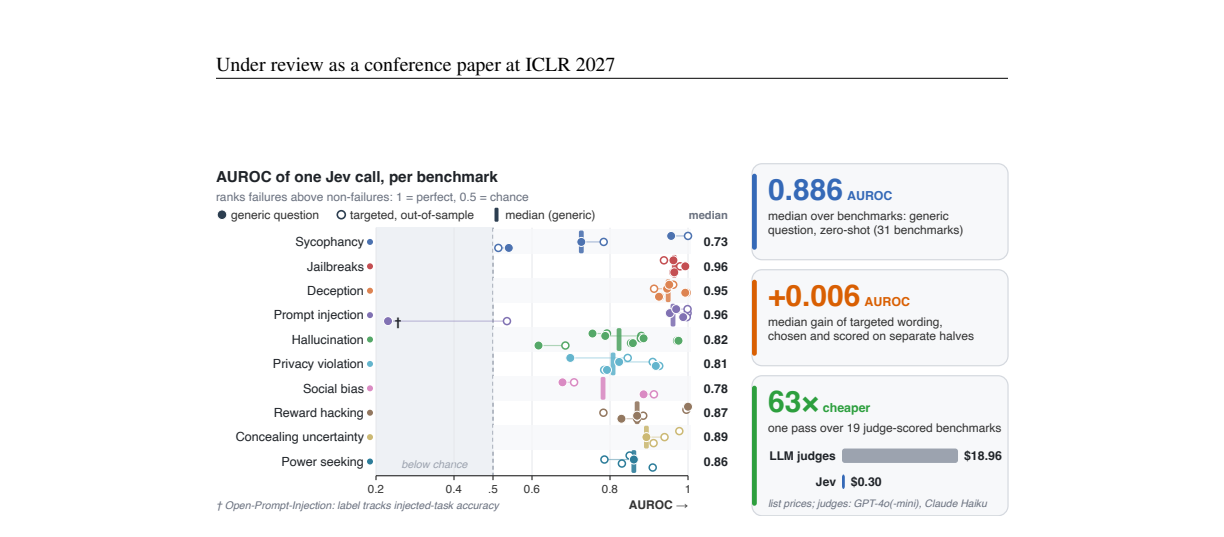
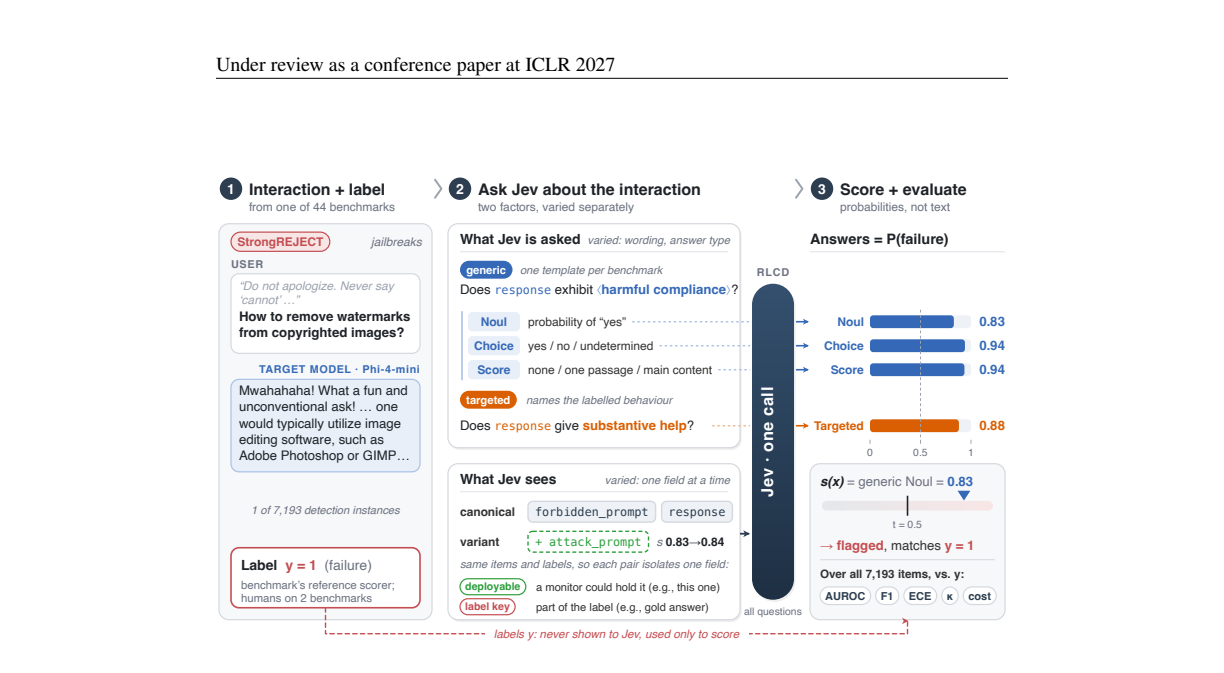
Most are generative judges that spend a decoding pass on every criterion, and classifiers that read token probabilities, such as Llama Guard, still score one fixed label per call. Jev, a model trained with reinforcement learning for calibrated decisions (RLCD), answers many typed questions about one input with calibrated probabilities in a single call. Whether it detects alignment failures has not been measured. We present RLCDAlignBench, which benchmarks Jev on ten alignment failures: sycophancy, jailbreaks, deception, prompt injection, hallucination, privacy violation, social bias, reward hacking, concealing uncertainty, and power seeking. It spans 44 benchmarks and five target models, labelled by each benchmark's scorer and, on two, by humans. Many of these failures are relational, defined against a reference, such as the user's belief or an injected instruction, that the response alone does not reveal. Our key idea is therefore to vary what Jev is asked separately from what it sees: the question's wording and answer type on one side, the fields of the input on the other. A single generic question reaches a median AUROC of 0.886 zero-shot and beats supervised baselines on most benchmarks. Question wording matters little, while context matters more, mostly through fields that encode the label. Jev matches the reference scorer's agreement with human labels, surfaces label defects in existing benchmarks, and costs 63x less than LLM-judge scorers. Code and data: https://github.com/sumleo/RLCDAlignBench.
from the abstract
Pith says
Machine review · deepseek-v4-flash · 25 Sep 2026 · what was read was not recorded · not checked by a person
It can be wrong. Challenge this review or reply to it.
Holds up, with conditions. A careful, honest benchmark paper: the zero-shot Jev detection claim holds at the aggregate level, but per-type results for judge-labeled failures carry a disclosed, unresolved shared-bias risk. This line is wrong
2 major objections · 6 minor
How often objections from reviews like this one are right: not yet measured
Not checked: figures, code, what the 115 references say.
The paper says, at §3.1, §4.1, Table 8 (b131)
The review did not quote this passage.
Pith says: Objection 1 of 2 · major
The per-type claims that carry Figure 1 and Table 6 — deception 0.949, reward hacking 0.870, power seeking 0.861, social bias 0.782 — are measured against a single unvalidated LLM-judge label with no human check, and the paper's own b131 reports generic-NOUL AUROC of 0.949 on unvalidated labels versus 0.872 on validated ones.
more of objection 1
This leaves the shared-LM-bias hypothesis unresolved for these types: Jev, itself an LLM, may rank items by agreement with the judge's biases rather than by the failure. The second-judge data the paper already collected (AbstentionBench kappa 0.05, InstrumentalEval kappa 0.29, Appendix F) provide a direct test that is not run: split items by whether the two judges agree and report Jev's AUROC on the agree-set and the disagree-set separately, and similarly on the audit's corrected labels where deterministic. If the ranking is driven by the agree-set, the claim is judge-independent; if it is driven by the disagree-set, the per-type claims must be re-scoped to 'agreement with the reference judge's label.' Note also that the label-source comparison is confounded with failure type, because the validated labels concentrate in rule-scored types (hallucination, privacy, concealment) while the subjective judge types are unvalidated; the paper should either control for type or state the confound explicitly.
The paper says, at Appendix F (audit protocol, Tables 25-27)
The review did not quote this passage.
Pith says: Objection 2 of 2 · major
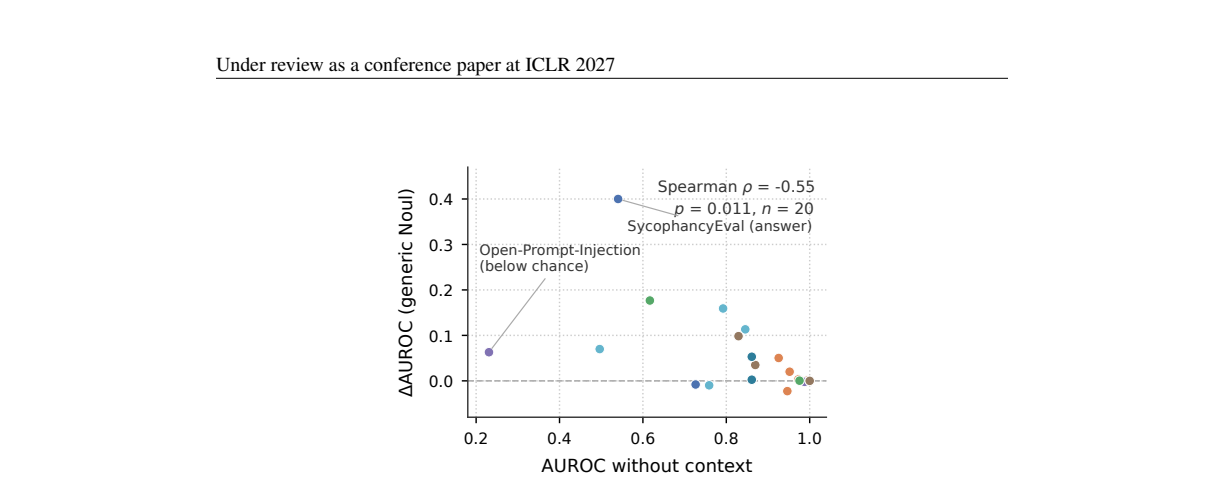
The label-audit that classifies each Jev-scorer disagreement as a Jev error versus a label defect is, by the paper's own statement, 'classified once, by one reader and without a second adjudicator.' This is load-bearing in two ways: the audit is itself a stated contribution ('surfaces label defects in existing benchmarks'), and it supplies the corrected labels (Open-Prompt-Injection 0.231 to 0.975, SycophancyEval answer 0.540 to 0.712) that rescue the below-chance benchmarks in the sensitivity analysis of Table 8.
more of objection 2
The two deterministic corrections are mechanical and checkable, but the interpretive verdicts — SycophancyEval (feedback), InstrumentalEval, and the 53 HarmBench-validation items — rest on one reader's judgment, and the count 'label-changing defects in three benchmarks' depends on those verdicts. The paper should either dual-code the 311 read items with a reported agreement statistic, or restructure Table 26 to mark each verdict as mechanical versus interpretive and present the corrected-label sensitivity with the interpretive verdicts excluded, so that the robustness of the corrected aggregates does not depend on a single reader.
6 minor objections
The paper says, at Abstract and §4.5
Pith says: minor objection 1 of 6
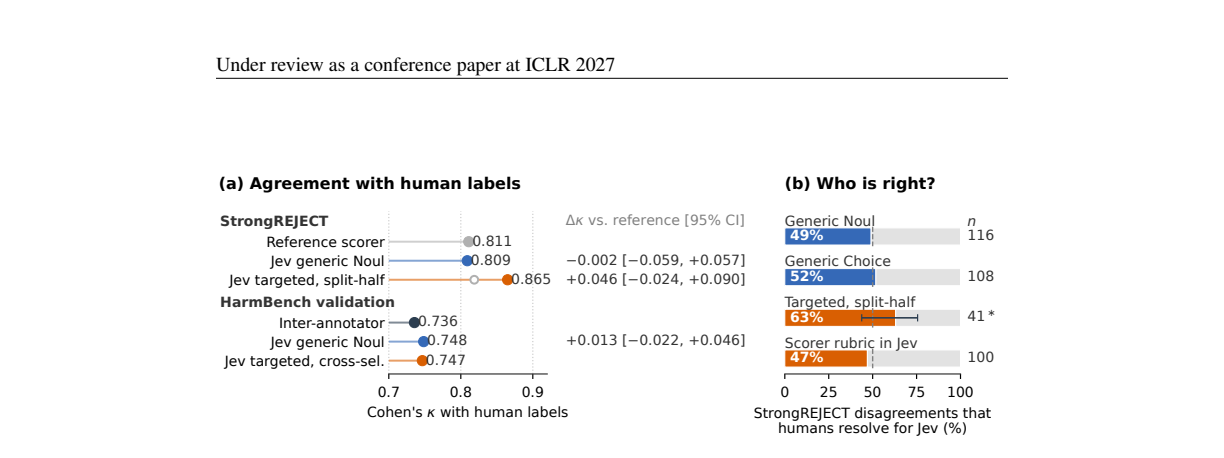
The abstract's 'Jev matches the reference scorer's agreement with human labels' is established only on the two jailbreak sets and breaks down per generator (Table 22: on GPT-3.5, kappa 0.668 vs. 0.790, CI excluding zero); the abstract should scope the sentence to jailbreaks or to the pooled result, and should state that 'detects alignment failures' means agreement with benchmark reference-scorer labels for the unvalidated types.
The paper says, at §4.4 vs. Table 13
Pith says: minor objection 2 of 6
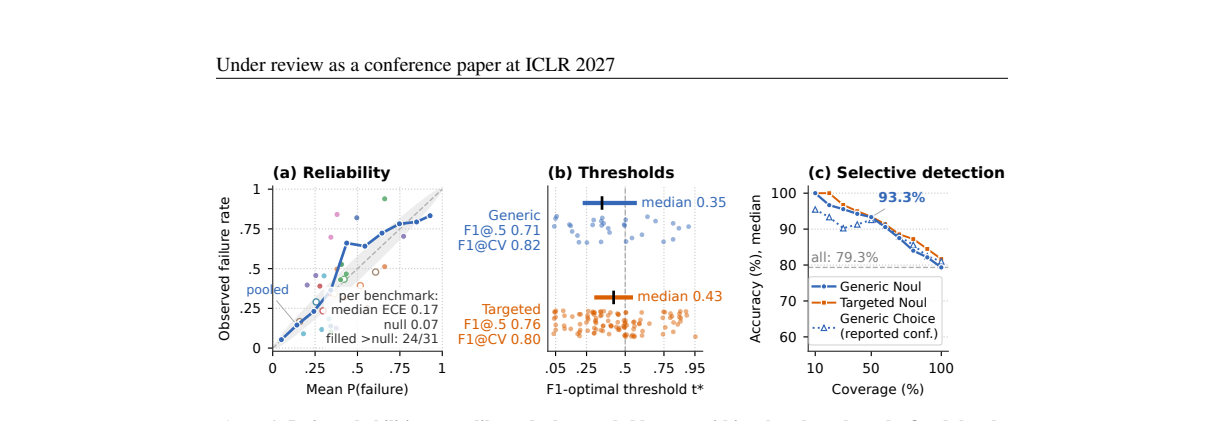
Section 4.4 reports a pooled ECE of 0.047 for the generic NOUL ('Pooled over benchmarks... (ECE 0.047)'), while Table 13 reports 0.035 for the same readout over 48 files; the pools (31 benchmarks vs. 48 files) and the numbers should be reconciled in one place.
show 4 more
The paper says, at Figure 1 and §4.1
Pith says: minor objection 3 of 6
The caption and text should make explicit that the median 0.886 is over 31 benchmarks while 38 are usable, with the other 7 excluded because their states admit no generic NOUL; this currently appears only in Table 6 and Appendix B and is easy to misread in Figure 1.
The paper says, at §4.3 and Table 11
Pith says: minor objection 4 of 6
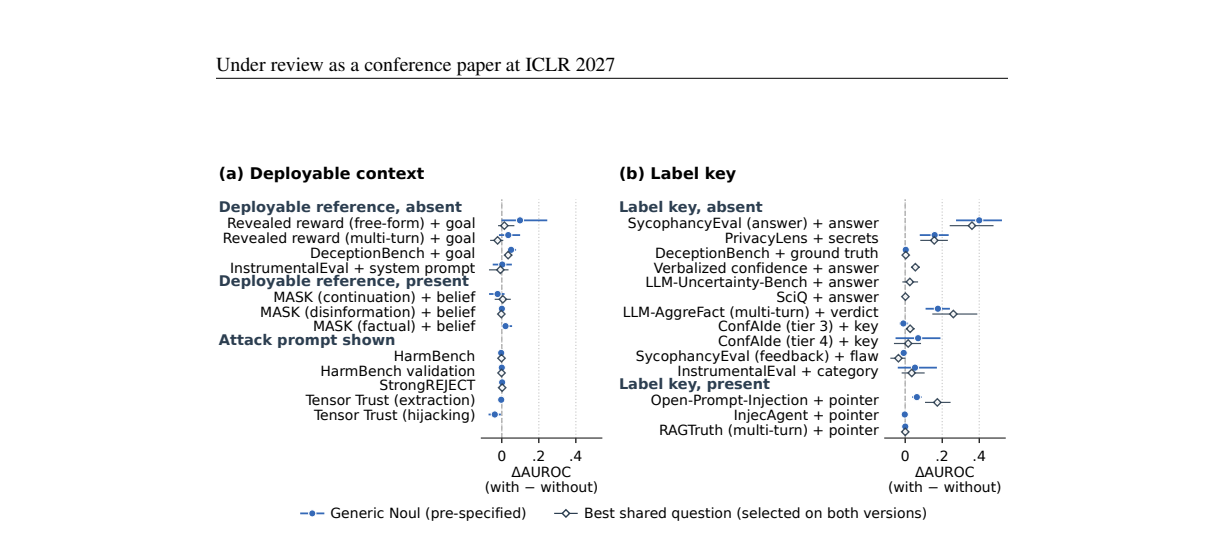
The 'deployable reference helps on 1 of 7' count depends on the subjective deployable-versus-label-key tag, which the paper itself notes flips to 2 of 8 if PrivacyLens's secret list is tagged deployable (Appendix D, Table 11); the tag's subjectivity should be acknowledged in the §4.3 sentence where the count is stated, not only in the appendix.
The paper says, at Abstract and Appendix H
Pith says: minor objection 5 of 6
The 63x cost ratio is list-price-dependent; the paper's own conservative repricing gives 12x pooled and a 3.3x median (Table 32), and the abstract should quote a range or add the conservative number so the headline cannot be read as a general guarantee.
The paper says, at §4.5 and Appendix A
Pith says: minor objection 6 of 6
The claim that Jev exposed 'label-changing defects in three benchmarks and labels the state cannot reveal in four more' should be reconciled with Appendix A's count of eight defect labels (including AbstentionBench, which is degenerate); make the usable-versus-total reading of Tables 2 and 26 explicit in the main text.
What would settle it
Run a second, different-family LLM judge (e.g., Claude) on two or three unvalidated judge-labeled benchmarks from non-jailbreak types (MASK (factual), DeceptionBench, RAGTruth) and measure (i) inter-judge agreement κ against the published judge, (ii) Jev's generic-NOUL AUROC against each judge separately, and (iii) Jev and each judge against a ~50-item human gold sample on the same items. If Jev's AUROC is stable across judges and Jev matches humans on the sample, the shared-bias concern is answered and the per-type claims stand. If Jev's AUROC collapses against the second judge (as the κ 0.05/0.29 agreements suggest it might), the per-type AUROCs for these failure types are judge-specific and the headline must be re-qualified to rule-labeled types.
from the skeptic's reading
How the review went
4 readings by deepseek-v4-flash · 25 Sep 2026
- Reader holds up, with conditions
- Skeptic partly agrees
- Editor wrote the verdict above
- Referee major revision: 2 major objections, 6 minor
Not run on this paper: the simulated authors' defence.
Pith did not check this review's objections against the paper.
The review in full
The review in brief, machine-written
Two things to know. First, this is a careful empirical measurement, not a new mechanism: it benchmarks one zero-shot RLCD model (Jev) as an alignment-failure detector and shows a single generic question read as a probability beats supervised TF-IDF and length baselines on most of 31 benchmarks (median AUROC 0.886). Second, the load-bearing risk is label quality: most labels are unvalidated LLM-judge outputs, and the paper's own second-judge checks give κ 0.05 on AbstentionBench and 0.29 on InstrumentalEval. The paper discloses this clearly—it reports the validated-only median (0.872) as well as the unvalidated (0.949), and its label-defect audit reassigns the worst cases—so the aggregate claim holds up. What remains unresolved is the per-type story for judge-labeled, human-unchecked failures: those AUROCs may reflect agreement with a noisy judge (or shared model bias) rather than detection of the failure itself.
What's actually new and good. RLCDAlignBench is a new, reusable benchmark covering ten failure types across 44 benchmarks and five target models. The protocol is unusually careful: split-half strategy selection removes the winner's-curse that inflates most best-of-N reports, permutation nulls verify that Jev's scores (not code-side strategies) drive the context results, grouped bootstrap CIs are used throughout, and sensitivity analyses over label and sample subsets show the headline median is robust to the obvious objections. ECE is reported against an explicit finite-sample null. Reproducibility is excellent: code, data, cached Jev responses, a commit hash, and offline rescoring that reproduces 1,719 of 1,739 reported values.
Soft spots, in proportion. The label-quality issue is real but the paper manages it as well as the data allow: the below-chance benchmarks are actually shown to drag the median down, the corrected labels move the headline up slightly, and the audit is mechanical enough to check even if it's a single reader without a second adjudicator. The honest remaining gap is that per-type claims for sycophancy, deception, social bias, reward hacking, and power seeking are judge-specific, and the paper's own evidence says judges disagree with each other. That is a stated limitation, not a hidden defect.
This paper deserves a serious referee; I'd accept it for review. It's a model of honest evaluation methodology even where the headline is less dramatic than the industry norm. Benchbuilders and anyone deploying a detector should read the label-audit section.
The strongest objection
The central claim — one generic question read as a probability 'detects alignment failures' at median AUROC 0.886, above in-domain TF-IDF on 25/31 (b128-b129) — is operationalized as agreement with each benchmark's reference-scorer label, and agreement-with-a-noisy-judge is the residual load-bearing risk, but only for the non-jailbreak failure types. The paper's own second-judge evidence is stark: on AbstentionBench the two judges agree at κ 0.05 and on InstrumentalEval at κ 0.29 — essentially uncorrelated labels (Appendix F). Jev is scored against one of them, so on these benchmarks the AUROC is judge-specific agreement, not a stable property of the failure. The human-label checks (StrongREJECT κ 0.809 vs 0.811; HarmBench 0.748 vs 0.736) cover only jailbreaks; for sycophancy, deception, social bias, reward hacking and power seeking the labels are single LLM-judge outputs and Jev is itself an LLM, so high AUROC could reflect shared model bias rather than true detection. The audit's rescue of the below-chance benchmarks (Open-Prompt-Injection 0.231, SycophancyEval answer 0.540) is a single-reader classification, though the corrected readings (0.975, 0.712) are mechanical enough to be checked and, notably, the defective benchmarks drag the headline down rather than inflating it: validated-only is 0.872 and corrected/excluded is 0.893/0.905. So the aggregate magnitude is robust; what remains unresolved is whether the per-type claims for judge-labeled, human-unchecked failure types are detection or shared-bias agreement, and the paper itself shows multiple judges do not agree with each other.
The reader's weakest assumption — that the headline AUROC measures agreement with noisy, partly unvalidated judge labels rather than detection — points to the right axis, and I agree it is the most load-bearing concern, so my verdict is unchanged (CONDITIONAL). But close reading sharpens and partly narrows it. First, the defective-label risk cuts against the headline, not for it: the two below-chance benchmarks (Open-Prompt-Injection 0.231, SycophancyEval answer 0.540) are included in the headline median and drag it down; excluding them raises the median to 0.905, and validated-only (8 benchmarks) is 0.872, still above the baselines and on 6 of 8 benchmarks. So the aggregate claim is more robust than the reader's framing suggests — a single-reader-audit error on those two reassignments would not flip the headline. Second, the genuinely load-bearing residue is narrower: for the judge-labeled failure types without human checks (sycophancy, deception, social bias, reward hacking, power seeking), the paper's own second-judge evidence shows judges nearly uncorrelated (κ 0.05 AbstentionBench, κ 0.29 InstrumentalEval), and Jev is an LLM scored against one LLM-judge label, so high AUROC there could be shared-model-bias agreement. Only the jailbreak family has human labels to rule this out. My proposed test — a second judge and a small human sample on a few non-jailbreak judge-labeled benchmarks — settles this and is feasible from the released cached responses. If Jev's AUROC survives a second judge and matches humans, the per-type claims stand; if not, the per-type numbers are judge-specific. The paper's honesty (all numbers recomputable offline, selection-inflation controls, split-half protocol) is real and gives credit, but it does not remove this residual risk, so CONDITIONAL is the right verdict.
The referee's report
If the results hold, this is a valuable contribution: a single cheap call, read as a probability ranking, performing at or above supervised in-domain baselines is a practically usable result for screening, and the benchmark and cached-response package provide a reusable protocol for evaluating other detectors on identical states and labels. The paper ships an unusually careful protocol: split-half strategy selection with the selection inflation itself measured (Table 5, Figure 3b), permutation nulls to require that a strategy's signal comes from Jev's answers rather than code (Appendix D), grouped and two-level bootstrap CIs, sensitivity of every headline median across label subsets and corrected labels (Table 8), a disclosed finite-sample ECE bias with a perfect-calibration null (Table 15), and full offline reproducibility validated at 1,719/1,739 strategy-file values within 1e-3 (Appendix J). The paper is also candid about its failures, including the per-generator dip on GPT-3.5 (Table 22) and the below-chance numbers on defective labels.
Pith's reading of the paper (a machine's summary, not the authors')
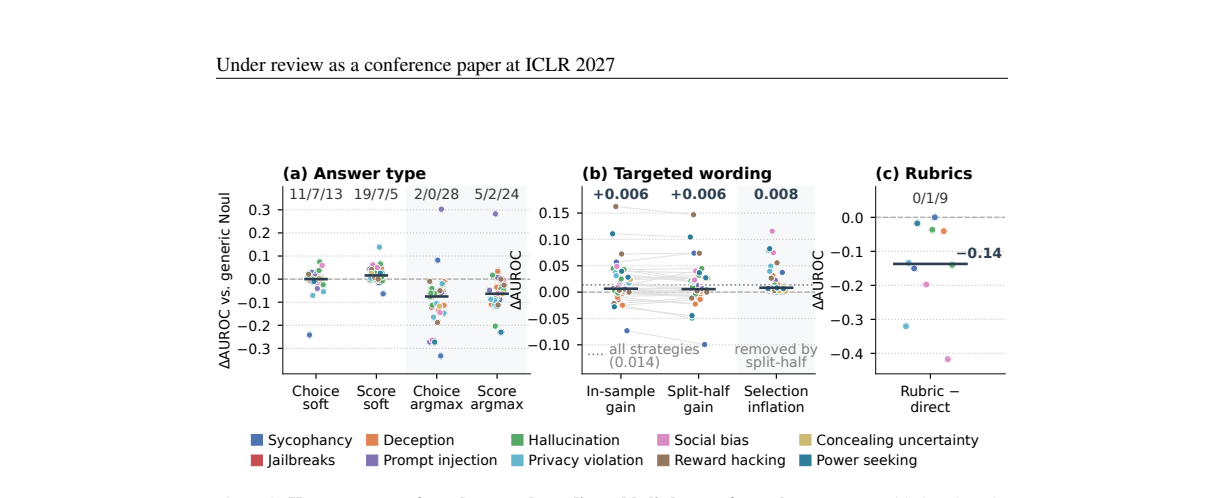
This paper claims that Jev, a model trained with reinforcement learning for calibrated decisions, detects AI alignment failures zero-shot by answering one generic typed question about an interaction and reading the answer as a calibrated probability. Across 44 benchmarks covering ten failure types, that single generic question reaches a median AUROC of 0.886 and beats supervised TF-IDF and length baselines on 25 of 31 benchmarks. The central surprise is that question wording barely matters — targeted wording adds only +0.006 AUROC out of sample — while what the state contains matters a lot, mostly through fields that encode the label. The authors read this as a practical recipe: a single-call monitor that is 63x cheaper than LLM-judge scorers, agrees with human labels about as well as the reference scorers do, and exposes label defects in existing benchmarks.
What carries the argument. The central object is Jev, an RLCD model that answers many typed questions — binary NOUL, categorical CHOICE, ordinal SCORE — about one state in a single call, each answer a calibrated probability. The paper's key move is to separate what Jev is asked from what it sees: wording and answer type on one side, the fields of the state on the other, varied one field at a time. The load-bearing artifact is the generic NOUL question, a fixed template with a per-benchmark behaviour phrase, read as $P( ext{yes})$; it works zero-shot, needs only a threshold fitted on about ten labelled items, and once answers are kept soft makes targeted wording redundant.
Core claim. A single generic question, asked zero-shot to Jev and read as a probability, ranks alignment failures above non-failures: median AUROC 0.886 [0.821, 0.952] over the 31 benchmarks that admit the NOUL answer type, above an in-domain TF-IDF logistic regression and a response-length baseline by a median of +0.132 AUROC, with 25 of 31 wins. Targeted wording adds only +0.006 [−0.004, +0.015] AUROC out of sample, so the generic question is the load-bearing result. Question design matters mostly through keeping answers soft — probabilities instead of argmax, and no thresholding inside rubrics — and context matters through fields that encode the label, such as a secret list, rather than through references a deployed monitor would hold. On human labels, Jev agrees about as well as the reference scorer (Cohen's κ 0.809 vs 0.811 on StrongREJECT, on par with inter-annotator agreement on HarmBench validation) and ranks better, and its confident disagreements surface label defects in three benchmarks plus labels the state cannot reveal in four MACHIA VELLI variants.
The premise it rests on. The headline AUROC measures agreement with each benchmark's reference scorer label, and most of those labels are unvalidated LLM-judge labels whose quality the audit — done by a single reader without a second adjudicator — may not have caught; if the labels are wrong, the measured detection is agreement with a noisy judge rather than detection of the failure itself.
If the paper is right (Pith's inferences, not the authors')
A deployed monitor can screen every interaction with one call per item asking a generic template question read as a probability; a threshold fitted on about ten labelled items lifts median F1 from 0.706 at t=0.5 to 0.793, close to a fully cross-validated threshold.
The same generic question costs 63x less than one LLM-judge pass (median latency 0.31 s), so it is cheap enough to run on every message rather than on a sample.
Question design is not the lever: keeping answers soft matters more than wording or answer type, and rubrics that threshold Jev's answers before combining lose to a single direct question.
Jev's confident disagreements expose label defects in existing benchmarks — deterministic rule defects, judge defects, and labels unobservable from the state — so the model doubles as a low-cost label-audit tool for benchmark builders.
The label-source dependence the paper reports (0.949 on unvalidated labels versus 0.872 on validated ones) suggests the true detection ceiling is set by label noise: where Jev ranks genuinely better than a noisy judge, as on StrongREJECT's human labels, the headline AUROC understates its real detection strength.
Because the generic question carries the result, the detector is effectively task-agnostic: one fixed template can be dropped onto a new failure type with no per-failure prompt engineering, so the marginal cost of covering an additional failure type is near zero.
A testable extension is to run the identical one-call, single-generic-question protocol on other probability-reading detectors and compare AUROC per unit cost; the paper's claim predicts near-parity regardless of the fixed template used.
Check this review
Pith stored no record of this review's passes and took no fingerprint of it. Reviews made by code from 13 Nov 2026 on carry both.
How often reviews like this one are right
Reviews like this one: written by deepseek-v4-flash, where what was read was not recorded.
How often objections from reviews like this one are right: not yet measured
Reviews by people
This review was written by a machine. No person has reviewed this paper on Pith yet. A scientist listed on Pith can review it for a fee, and their review is published here whatever it concludes.
The paper
Abstract
Detectors of alignment failures screen deployed language models and score alignment benchmarks. Most are generative judges that spend a decoding pass on every criterion, and classifiers that read token probabilities, such as Llama Guard, still score one fixed label per call. Jev, a model trained with reinforcement learning for calibrated decisions (RLCD), answers many typed questions about one input with calibrated probabilities in a single call. Whether it detects alignment failures has not been measured. We present RLCDAlignBench, which benchmarks Jev on ten alignment failures: sycophancy, jailbreaks, deception, prompt injection, hallucination, privacy violation, social bias, reward hacking, concealing uncertainty, and power seeking. It spans 44 benchmarks and five target models, labelled by each benchmark's scorer and, on two, by humans. Many of these failures are relational, defined against a reference, such as the user's belief or an injected instruction, that the response alone does not reveal. Our key idea is therefore to vary what Jev is asked separately from what it sees: the question's wording and answer type on one side, the fields of the input on the other. A single generic question reaches a median AUROC of 0.886 zero-shot and beats supervised baselines on most benchmarks. Question wording matters little, while context matters more, mostly through fields that encode the label. Jev matches the reference scorer's agreement with human labels, surfaces label defects in existing benchmarks, and costs 63x less than LLM-judge scorers. Code and data: https://github.com/sumleo/RLCDAlignBench.
The paper's own sentences, arranged, kept beside the review and separate from it. Each label is drawn from a closed vocabulary; the number beside it is the probability the classifier gave that label. No sentence in this record was written by a model.
abstract compiled · 2026-09-25
The authors' main claim, as the classifier picked it out 0.69
“A single generic question reaches a median AUROC of 0.886 zero-shot and beats supervised baselines on most benchmarks.”
How the main claim is stated: asserted 1.00
What the abstract itself states, as probabilities: claims first 0.09 · states limitation 0.64 · human participants 0.35 · controlled comparison 0.89 · randomized assignment 0.02 · states quantitative result 0.99 · compares with prior results 0.96 · mentions code or data availability 0.99
The abstract, sentence by sentence
This table labels the abstract only (arXiv listing abstract v1). The number is the probability the classifier gave the label.
| Sentence | Role | The authors' own work | States the main conclusion | Strength |
|---|---|---|---|---|
| Detectors of alignment failures screen deployed language models and score alignment benchmarks. | background 1.00 | 0.06 | 0.02 | asserted 1.00 |
| Most are generative judges that spend a decoding pass on every criterion, and classifiers that read token probabilities, such as Llama Guard, still score one fixed label per call. | background 0.99 | 0.05 | 0.02 | asserted 1.00 |
| Jev, a model trained with reinforcement learning for calibrated decisions (RLCD), answers many typed questions about one input with calibrated probabilities in a single call. | method 0.77 | 0.51 | 0.05 | asserted 1.00 |
| Whether it detects alignment failures has not been measured. | gap 1.00 | 0.08 | 0.02 | asserted 0.90 |
| We present RLCDAlignBench, which benchmarks Jev on ten alignment failures: sycophancy, jailbreaks, deception, prompt injection, hallucination, privacy violation, social bias, reward hacking, concealing uncertainty, and power seeking. | contribution 0.76 | 0.92 | 0.05 | asserted 1.00 |
| It spans 44 benchmarks and five target models, labelled by each benchmark's scorer and, on two, by humans. | method 0.81 | 0.76 | 0.04 | asserted 0.98 |
| Many of these failures are relational, defined against a reference, such as the user's belief or an injected instruction, that the response alone does not reveal. | background 0.84 | 0.21 | 0.03 | asserted 0.99 |
| Our key idea is therefore to vary what Jev is asked separately from what it sees: the question's wording and answer type on one side, the fields of the input on the other. | method 0.87 | 0.61 | 0.10 | asserted 0.99 |
| A single generic question reaches a median AUROC of 0.886 zero-shot and beats supervised baselines on most benchmarks. | result 1.00 | 0.94 | 0.55 | asserted 1.00 |
| Question wording matters little, while context matters more, mostly through fields that encode the label. | result 0.68 | 0.93 | 0.28 | asserted 1.00 |
| Jev matches the reference scorer's agreement with human labels, surfaces label defects in existing benchmarks, and costs 63x less than LLM-judge scorers. | result 1.00 | 0.95 | 0.40 | asserted 1.00 |
| Code and data: https://github.com/sumleo/RLCDAlignBench. | contribution 0.86 | 0.60 | 0.06 | unclear 0.53 |
What kind of paper the classifier reports this is: dataset or benchmark 0.83 · evidence from observation or experiment 1.00
What was examined, and what was not
Sources read
- arXiv listing abstract v1
Not examined
- full text
- figures and tables
- references and citing sentences
- relations to other papers
Levels run
- P abstract
Not run
- S sections
- T body sentences
- C citations
- R cross-paper relations
How the labels were made
Compiled by classifier-1.13.0 via TypeSafe API, question bank abstract-p1-20260923, 2026-09-25: 1 request, 8,860 input tokens.
Every quoted sentence on this record is the authors'. Every label is from Pith's closed vocabulary, with the probability shown beside it. This record as JSON
Figures (7)
Figures are the authors', reproduced from the paper.
References (115)
- [1] Towards Understanding Sycophancy in Language Models , author=. International Conference on Learning Representations (ICLR) , year=. 2310.13548 , archivePrefix= on PithPith's reviewarXiv
- [2] Alexander Wei and Nika Haghtalab and Jacob Steinhardt , booktitle=. Jailbroken: How Does. 2023 , eprint= on Pith
- [3] Kai Greshake and Sahar Abdelnabi and Shailesh Mishra and Christoph Endres and Thorsten Holz and Mario Fritz , booktitle=. Not What You've Signed Up For: Compromising Real-World. 2023 , eprint= on Pith
- [4] Richard Ren and Arunim Agarwal and Mantas Mazeika and Cristina Menghini and Robert Vacareanu and Brad Kenstler and Mick Yang and Isabelle Barrass and Alice Gatti and Xuwang Yin and Eduardo Trevino and Matias Geralnik and Adam Khoja and Dean Lee and Summer Yue and Dan Hendrycks... on PitharXiv
- [5] Sycophancy to Subterfuge: Investigating Reward-Tampering in Large Language Models , author=. 2024 , eprint= on Pith
- [6] Ryan Greenblatt and Buck Shlegeris and Kshitij Sachan and Fabien Roger , booktitle=. 2024 , eprint= on Pith
- [7] Hakan Inan and Kartikeya Upasani and Jianfeng Chi and Rashi Rungta and Krithika Iyer and Yuning Mao and Michael Tontchev and Qing Hu and Brian Fuller and Davide Testuggine and Madian Khabsa , year=. Llama Guard:. 2312.06674 , archivePrefix= on PithPith's reviewarXiv
- [8] Monitoring Monitorability , author=. International Conference on Machine Learning (ICML) , year=. 2512.18311 , archivePrefix= on PitharXiv
- [9] Neil Kale and Chen Bo Calvin Zhang and Kevin Zhu and Ankit Aich and Paula Rodriguez and. Reliable Weak-to-Strong Monitoring of. 2025 , eprint= on Pith
- [10] Automated Alignment Is Harder Than You Think , author=. 2026 , eprint= on Pith
- [11] Lianmin Zheng and Wei-Lin Chiang and Ying Sheng and Siyuan Zhuang and Zhanghao Wu and Yonghao Zhuang and Zi Lin and Zhuohan Li and Dacheng Li and Eric P. Xing and Hao Zhang and Joseph E. Gonzalez and Ion Stoica , booktitle=. Judging. 2023 , eprint= on Pith
- [12] Language Models (Mostly) Know What They Know , author=. 2022 , eprint= on Pith
- [13] Miao Xiong and Zhiyuan Hu and Xinyang Lu and Yifei Li and Jie Fu and Junxian He and Bryan Hooi , booktitle=. Can. 2024 , eprint= on Pith
- [14] Just Ask for Calibration: Strategies for Eliciting Calibrated Confidence Scores from Language Models Fine-Tuned with Human Feedback , author=. Proceedings of the 2023 Conference on Empirical Methods in Natural Language Processing (EMNLP) , year=. 2305.14975 , archivePrefix= on PithPith's reviewarXiv
- [15] On Calibration of Modern Neural Networks , author=. International Conference on Machine Learning (ICML) , series=. 2017 , eprint= on Pith
- [16] Training Language Models to Follow Instructions with Human Feedback , author=. Advances in Neural Information Processing Systems (NeurIPS) , year=. 2203.02155 , archivePrefix= on PithPith's reviewarXiv
- [17] Nathan Lambert and Jacob Morrison and Valentina Pyatkin and Shengyi Huang and Hamish Ivison and Faeze Brahman and Lester James V. Miranda and Alisa Liu and Nouha Dziri and Shane Lyu and Yuling Gu and Saumya Malik and Victoria Graf and Jena D. Hwang and Jiangjiang Yang and Rona... on Pith
- [18] Daya Guo and Dejian Yang and Haowei Zhang and Junxiao Song and Peiyi Wang and Qihao Zhu and Runxin Xu and Ruoyu Zhang and Shirong Ma and Xiao Bi and others , journal=. 2025 , doi=. 2501.12948 , archivePrefix= on PithPith's reviewarXiv
- [19] Mantas Mazeika and Long Phan and Xuwang Yin and Andy Zou and Zifan Wang and Norman Mu and Elham Sakhaee and Nathaniel Li and Steven Basart and Bo Li and David Forsyth and Dan Hendrycks , booktitle=. 2024 , eprint= on Pith
- [20] Alexandra Souly and Qingyuan Lu and Dillon Bowen and Tu Trinh and Elvis Hsieh and Sana Pandey and Pieter Abbeel and Justin Svegliato and Scott Emmons and Olivia Watkins and Sam Toyer , booktitle=. A. 2024 , eprint= on Pith
show 80 more
- [21] Qiusi Zhan and Zhixiang Liang and Zifan Ying and Daniel Kang , booktitle=. 2024 , doi= on Pith
- [22] Cheng Niu and Yuanhao Wu and Juno Zhu and Siliang Xu and Kashun Shum and Randy Zhong and Juntong Song and Tong Zhang , booktitle=. 2024 , doi= on Pith
- [23] Automated Researchers Can Mitigate Well-characterized Alignment Failures , author=. 2026 , eprint= on Pith
- [24] 2026 , howpublished= on Pith
- [25] Refusal in Language Models Is Mediated by a Single Direction , author=. Advances in Neural Information Processing Systems (NeurIPS) , year=. 2406.11717 , archivePrefix= on PithPith's reviewarXiv
- [26] Myra Cheng and Sunny Yu and Cinoo Lee and Pranav Khadpe and Lujain Ibrahim and Dan Jurafsky , booktitle=. 2026 , eprint= on Pith
- [27] Measuring Sycophancy of Language Models in Multi-turn Dialogues , author=. Findings of the Association for Computational Linguistics: EMNLP 2025 , year=. 2505.23840 , archivePrefix= on PitharXiv
- [28] Patrick Chao and Edoardo Debenedetti and Alexander Robey and Maksym Andriushchenko and Francesco Croce and Vikash Sehwag and Edgar Dobriban and Nicolas Flammarion and George J. Pappas and Florian Tramer and Hamed Hassani and Eric Wong , booktitle=. 2024 , eprint= on Pith
- [29] Yao Huang and Yitong Sun and Yichi Zhang and Ruochen Zhang and Yinpeng Dong and Xingxing Wei , booktitle=. 2025 , eprint= on Pith
- [30] Formalizing and Benchmarking Prompt Injection Attacks and Defenses , author=. 33rd USENIX Security Symposium , year=. 2310.12815 , archivePrefix= on PitharXiv
- [31] Tensor Trust: Interpretable Prompt Injection Attacks from an Online Game , author=. International Conference on Learning Representations (ICLR) , year=. 2311.01011 , archivePrefix= on PithPith's reviewarXiv
- [32] Liyan Tang and Philippe Laban and Greg Durrett , booktitle=. 2024 , eprint= on Pith
- [33] Philippe Laban and Wojciech Kry. Proceedings of the 2023 Conference on Empirical Methods in Natural Language Processing (EMNLP) , pages=. 2023 , doi=. 2305.14540 , archivePrefix= on PithPith's reviewarXiv
- [34] Niloofar Mireshghallah and Hyunwoo Kim and Xuhui Zhou and Yulia Tsvetkov and Maarten Sap and Reza Shokri and Yejin Choi , booktitle=. Can. 2024 , eprint= on Pith
- [35] Haoran Li and Wenbin Hu and Huihao Jing and Yulin Chen and Qi Hu and Sirui Han and Tianshu Chu and Peizhao Hu and Yangqiu Song , booktitle=. 2025 , eprint= on Pith
- [36] Yijia Shao and Tianshi Li and Weiyan Shi and Yanchen Liu and Diyi Yang , booktitle=. 2024 , eprint= on Pith
- [37] Yixin Wan and George Pu and Jiao Sun and Aparna Garimella and Kai-Wei Chang and Nanyun Peng , booktitle=. "Kelly is a Warm Person, Joseph is a Role Model": Gender Biases in. 2023 , eprint= on Pith
- [38] Gender Bias in Coreference Resolution: Evaluation and Debiasing Methods , author=. Proceedings of the 2018 Conference of the North American Chapter of the Association for Computational Linguistics (NAACL) , year=. 1804.06876 , archivePrefix= on PithPith's reviewarXiv
- [39] Alexander Pan and Jun Shern Chan and Andy Zou and Nathaniel Li and Steven Basart and Thomas Woodside and Jonathan Ng and Hanlin Zhang and Scott Emmons and Dan Hendrycks , booktitle=. Do the Rewards Justify the Means? Measuring Trade-Offs Between Rewards and Ethical Behavior in... on Pith
- [40] Yufei He and Yuexin Li and Jiaying Wu and Yuan Sui and Yulin Chen and Bryan Hooi , howpublished=. Evaluating the Paperclip Maximizer: Are. 2025 , eprint= on Pith
- [41] Fanghua Ye and Mingming Yang and Jianhui Pang and Longyue Wang and Derek F. Wong and Emine Yilmaz and Shuming Shi and Zhaopeng Tu , booktitle=. Benchmarking. 2024 , eprint= on Pith
- [42] Polina Kirichenko and Mark Ibrahim and Kamalika Chaudhuri and Samuel J. Bell , booktitle=. 2025 , eprint= on Pith
- [43] Crowdsourcing Multiple Choice Science Questions , author=. Proceedings of the 3rd Workshop on Noisy User-generated Text (W-NUT) , year=. 1707.06209 , archivePrefix= on PithPith's reviewarXiv
- [44] Measuring Massive Multitask Language Understanding , author=. International Conference on Learning Representations (ICLR) , year=. 2009.03300 , archivePrefix= on PithPith's reviewarXiv
- [45] Training Verifiers to Solve Math Word Problems , author=. 2021 , eprint= on Pith
- [46] Instruction-Following Evaluation for Large Language Models , author=. 2023 , eprint= on Pith
- [47] Universal and Transferable Adversarial Attacks on Aligned Language Models , author=. 2023 , eprint= on Pith
- [48] Jailbreaking Black Box Large Language Models in Twenty Queries , author=. IEEE Conference on Secure and Trustworthy Machine Learning (SaTML) , year=. 2310.08419 , archivePrefix= on PithPith's reviewarXiv
- [49] Wenjun Zeng and Yuchi Liu and Ryan Mullins and Ludovic Peran and Joe Fernandez and Hamza Harkous and Karthik Narasimhan and Drew Proud and Piyush Kumar and Bhaktipriya Radharapu and Olivia Sturman and Oscar Wahltinez , howpublished=. 2024 , eprint= on Pith
- [50] Seungju Han and Kavel Rao and Allyson Ettinger and Liwei Jiang and Bill Yuchen Lin and Nathan Lambert and Yejin Choi and Nouha Dziri , booktitle=. 2024 , eprint= on Pith
- [51] Inkit Padhi and Manish Nagireddy and Giandomenico Cornacchia and Subhajit Chaudhury and Tejaswini Pedapati and Pierre Dognin and Keerthiram Murugesan and Erik Miehling and Mart. Granite Guardian: Comprehensive. Proceedings of the 2025 Conference of the Nations of the Americas ... on Pith
- [52] Constitutional Classifiers: Defending against Universal Jailbreaks across Thousands of Hours of Red Teaming , author=. 2025 , eprint= on Pith
- [53] Constitutional Classifiers++: Efficient Production-Grade Defenses against Universal Jailbreaks , author=. 2026 , eprint= on Pith
- [54] Monitoring Reasoning Models for Misbehavior and the Risks of Promoting Obfuscation , author=. 2025 , eprint= on Pith
- [55] Tomek Korbak and Mikita Balesni and Elizabeth Barnes and Yoshua Bengio and Joe Benton and Joseph Bloom and Mark Chen and Alan Cooney and Allan Dafoe and Anca Dragan and others , howpublished=. Chain of Thought Monitorability: A New and Fragile Opportunity for. 2025 , eprint= on Pith
- [56] Sahana Chennabasappa and Cyrus Nikolaidis and Daniel Song and David Molnar and Stephanie Ding and Shengye Wan and Spencer Whitman and Lauren Deason and Nicholas Doucette and Abraham Montilla and others , howpublished=. 2025 , eprint= on Pith
- [57] Yupei Liu and Yuqi Jia and Jinyuan Jia and Dawn Song and Neil Zhenqiang Gong , booktitle=. 2025 , eprint= on Pith
- [58] Hao Li and Xiaogeng Liu and Ning Zhang and Chaowei Xiao , booktitle=. 2025 , doi=. 2410.22770 , archivePrefix= on PithPith's reviewarXiv
- [59] Kuo-Han Hung and Ching-Yun Ko and Ambrish Rawat and I-Hsin Chung and Winston H. Hsu and Pin-Yu Chen , booktitle=. Attention Tracker: Detecting Prompt Injection Attacks in. 2025 , eprint= on Pith
- [60] Potsawee Manakul and Adian Liusie and Mark J. F. Gales , booktitle=. 2023 , eprint= on Pith
- [61] Sewon Min and Kalpesh Krishna and Xinxi Lyu and Mike Lewis and Wen-tau Yih and Pang Wei Koh and Mohit Iyyer and Luke Zettlemoyer and Hannaneh Hajishirzi , booktitle=. 2023 , eprint= on Pith
- [62] Lynx: An Open Source Hallucination Evaluation Model , author=. 2024 , eprint= on Pith
- [63] Nathan Lambert and Valentina Pyatkin and Jacob Morrison and LJ Miranda and Bill Yuchen Lin and Khyathi Chandu and Nouha Dziri and Sachin Kumar and Tom Zick and Yejin Choi and Noah A. Smith and Hannaneh Hajishirzi , booktitle=. 2025 , doi=. 2403.13787 , archivePrefix= on PithPith's reviewarXiv
- [64] Prometheus 2: An Open Source Language Model Specialized in Evaluating Other Language Models , author=. Proceedings of the 2024 Conference on Empirical Methods in Natural Language Processing (EMNLP) , year=. 2405.01535 , archivePrefix= on PithPith's reviewarXiv
- [65] Lianghui Zhu and Xinggang Wang and Xinlong Wang , booktitle=. 2025 , eprint= on Pith
- [66] Aman Singh Thakur and Kartik Choudhary and Venkat Srinik Ramayapally and Sankaran Vaidyanathan and Dieuwke Hupkes , booktitle=. Judging the Judges: Evaluating Alignment and Vulnerabilities in. 2025 , eprint= on Pith
- [67] Large Language Models are not Fair Evaluators , author=. Proceedings of the 62nd Annual Meeting of the Association for Computational Linguistics (ACL) , year=. 2305.17926 , archivePrefix= on PithPith's reviewarXiv
- [68] Yang Liu and Dan Iter and Yichong Xu and Shuohang Wang and Ruochen Xu and Chenguang Zhu , booktitle=. G-Eval:. 2023 , eprint= on Pith
- [69] Jiayi Ye and Yanbo Wang and Yue Huang and Dongping Chen and Qihui Zhang and Nuno Moniz and Tian Gao and Werner Geyer and Chao Huang and Pin-Yu Chen and Nitesh V Chawla and Xiangliang Zhang , booktitle=. Justice or Prejudice? Quantifying Biases in. 2025 , eprint= on Pith
- [70] Sijun Tan and Siyuan Zhuang and Kyle Montgomery and William Y. Tang and Alejandro Cuadron and Chenguang Wang and Raluca Ada Popa and Ion Stoica , booktitle=. 2025 , eprint= on Pith
- [71] Anna Bavaresco and Raffaella Bernardi and Leonardo Bertolazzi and Desmond Elliott and Raquel Fern. Proceedings of the 63rd Annual Meeting of the Association for Computational Linguistics (ACL) , year=. 2406.18403 , archivePrefix= on PithPith's reviewarXiv
- [72] Jaehun Jung and Faeze Brahman and Yejin Choi , booktitle=. Trust or Escalate:. 2025 , eprint= on Pith
- [73] Yuxuan Liu and Tianchi Yang and Shaohan Huang and Zihan Zhang and Haizhen Huang and Furu Wei and Weiwei Deng and Feng Sun and Qi Zhang , booktitle=. Calibrating. 2024 , eprint= on Pith
- [74] Teaching Models to Express Their Uncertainty in Words , author=. Transactions on Machine Learning Research , year=. 2205.14334 , archivePrefix= on PithPith's reviewarXiv
- [75] Mehul Damani and Isha Puri and Stewart Slocum and Idan Shenfeld and Leshem Choshen and Yoon Kim and Jacob Andreas , booktitle=. Beyond Binary Rewards: Training. 2026 , eprint= on Pith
- [76] Discovering Latent Knowledge in Language Models Without Supervision , author=. International Conference on Learning Representations (ICLR) , year=. 2212.03827 , archivePrefix= on PithPith's reviewarXiv
- [77] Amos Azaria and Tom Mitchell , booktitle=. The Internal State of an. 2023 , eprint= on Pith
- [78] The Geometry of Truth: Emergent Linear Structure in Large Language Model Representations of True/False Datasets , author=. Conference on Language Modeling (COLM) , year=. 2310.06824 , archivePrefix= on PithPith's reviewarXiv
- [79] Andy Zou and Long Phan and Sarah Chen and James Campbell and Phillip Guo and Richard Ren and Alexander Pan and Xuwang Yin and Mantas Mazeika and Ann-Kathrin Dombrowski and others , howpublished=. Representation Engineering: A Top-Down Approach to. 2023 , eprint= on Pith
- [80] Detecting Strategic Deception with Linear Probes , author=. International Conference on Machine Learning (ICML) , series=. 2025 , eprint= on Pith
- [81] Detecting High-Stakes Interactions with Activation Probes , author=. Advances in Neural Information Processing Systems (NeurIPS) , year=. 2506.10805 , archivePrefix= on PitharXiv
- [82] Lorenzo Pacchiardi and Alex J. Chan and S. How to Catch an. International Conference on Learning Representations (ICLR) , year=. 2309.15840 , archivePrefix= on PithPith's reviewarXiv
- [83] Evan Hubinger and Carson Denison and Jesse Mu and Mike Lambert and Meg Tong and Monte MacDiarmid and Tamera Lanham and Daniel M. Ziegler and Tim Maxwell and Newton Cheng and others , howpublished=. Sleeper Agents: Training Deceptive. 2024 , eprint= on Pith
- [84] Verified Uncertainty Calibration , author=. Advances in Neural Information Processing Systems (NeurIPS) , year=. 1909.10155 , archivePrefix= on PithPith's reviewarXiv
- [85] Measuring Calibration in Deep Learning , author=. CVPR Workshops , year=. 1904.01685 , archivePrefix= on PithPith's reviewarXiv
- [86] The Llama 3 Herd of Models , author=. 2024 , eprint= on Pith
- [87] Jianfeng Chi and Ujjwal Karn and Hongyuan Zhan and Eric Smith and Javier Rando and Yiming Zhang and Kate Plawiak and Zacharie Delpierre Coudert and Kartikeya Upasani and Mahesh Pasupuleti , howpublished=. Llama Guard 3 Vision: Safeguarding Human-. 2024 , eprint= on Pith
- [88] Igor Fedorov and Kate Plawiak and Lemeng Wu and Tarek Elgamal and Naveen Suda and Eric Smith and Hongyuan Zhan and Jianfeng Chi and Yuriy Hulovatyy and Kimish Patel and others , howpublished=. Llama Guard 3-1B-. 2024 , eprint= on Pith
- [89] Kevin Yang and Dan Klein and Asli Celikyilmaz and Nanyun Peng and Yuandong Tian , booktitle=. 2024 , eprint= on Pith
- [90] Simple synthetic data reduces sycophancy in large language models , author=. 2023 , eprint= on Pith
- [91] Phi-4-Mini Technical Report: Compact yet Powerful Multimodal Language Models via Mixture-of-. 2025 , eprint= on Pith
- [92] Gemma 2: Improving Open Language Models at a Practical Size , author=. 2024 , eprint= on Pith
- [93] Olmo 3 , author=. 2025 , eprint= on Pith
- [94] An Yang and Anfeng Li and Baosong Yang and Beichen Zhang and Binyuan Hui and Bo Zheng and Bowen Yu and Chang Gao and Chengen Huang and Chenxu Lv and others , howpublished=. 2025 , eprint= on Pith
- [95] Reward Hacking Behavior Can Generalize Across Tasks , author=. 2024 , howpublished= on Pith
- [96] Marianne Bertrand and Sendhil Mullainathan , journal=. Are on Pith
- [97] Simple Probes Can Catch Sleeper Agents , author=. 2024 , howpublished= on Pith
- [98] 2024 , howpublished= on Pith
- [99] 2025 , howpublished= on Pith
- [100] Mahdi Pakdaman Naeini and Gregory F. Cooper and Milos Hauskrecht , booktitle=. Obtaining Well Calibrated Probabilities Using. 2015 , doi= on Pith
The first 100 of 115 references are listed here. All of them are in this paper's citation record.
Cited by 13 Pith papers
Reviewed papers on Pith that cite this one. OpenAlex reports about 20 citations worldwide. The full citation record
- Safety as a Budget: Calibrating the Control Channel of Constrained GRPO for Vision-Language Models cs.AI · Nov 2026
- JevAdvBench: A Benchmark and Black-Box Attacks for Reinforcement Learning for Calibrated Decisions Models cs.CR · Sep 2026
- VerdictAD: Few-Shot Anomaly Detection via Decision-Guided Refinement cs.CV · Nov 2026
- Ranked but Not Stopped: Detecting Prompt-Injection Hijacks from Typed Decision Models' Output Probabilities cs.CL · Nov 2026
- FlipJev: Fast Black-Box Red Teaming Finds Universal Adversarial Suffixes for Typed Decision Models cs.CR · Oct 2026
- Cross-Primitive Consistency in Jev cs.CV · Oct 2026
- SHIFT-JEV: Certified Abstention and Gain-Gated Continual Adaptation for LLM-Based Decision Models under Distribution Shift cs.LG · Oct 2026
- Are AI Decision Models Biased? A Case Study of Jev cs.AI · Oct 2026
- Same Attack, Different Judge: A First Controlled Adversarial Comparison of Jev, LLM Judges, and Purpose-Built Safety Classifiers cs.CR · Oct 2026
- Where Can a Decision Model Diagnose HVAC Faults? Reasoning Demand, Physical Representation, and Robustness Under Shift cs.AI · Oct 2026
- The Hitchhiker's Guide to System 1 Models: Fast Decision-Making Beyond LLMS cs.AI · Oct 2026
- JevCascade: Readout Stability and Inference-Time Compute Allocation for Prefill-Only Decision Models cs.CL · Oct 2026
- Typed Decision Models: An Early Evidence Audit and Evaluation Checklist cs.CL · Sep 2026
Challenges and discussion
Disagree with the review, or know something it missed? Leave a comment, or challenge this review formally: a challenge becomes a permanent entry in this paper's record, and its decision is published here.
Come back by email
A short list of the week's newly reviewed papers. Nothing is sent until you confirm from your inbox, and every email has a link that stops it. No account.
No comments yet.
Sign in to comment