Robotics · arXiv:2610.02204 v1 · submitted 1 Oct 2026 · 30 references
Reconstruct, Practice, Go Real: Guided Self-Improvement for Embodied Agents
The paper says
“Building reliable robot capabilities across diverse tasks requires substantial human effort to develop and maintain skills, design rewards, and integrate perception with control.”
more of the abstract
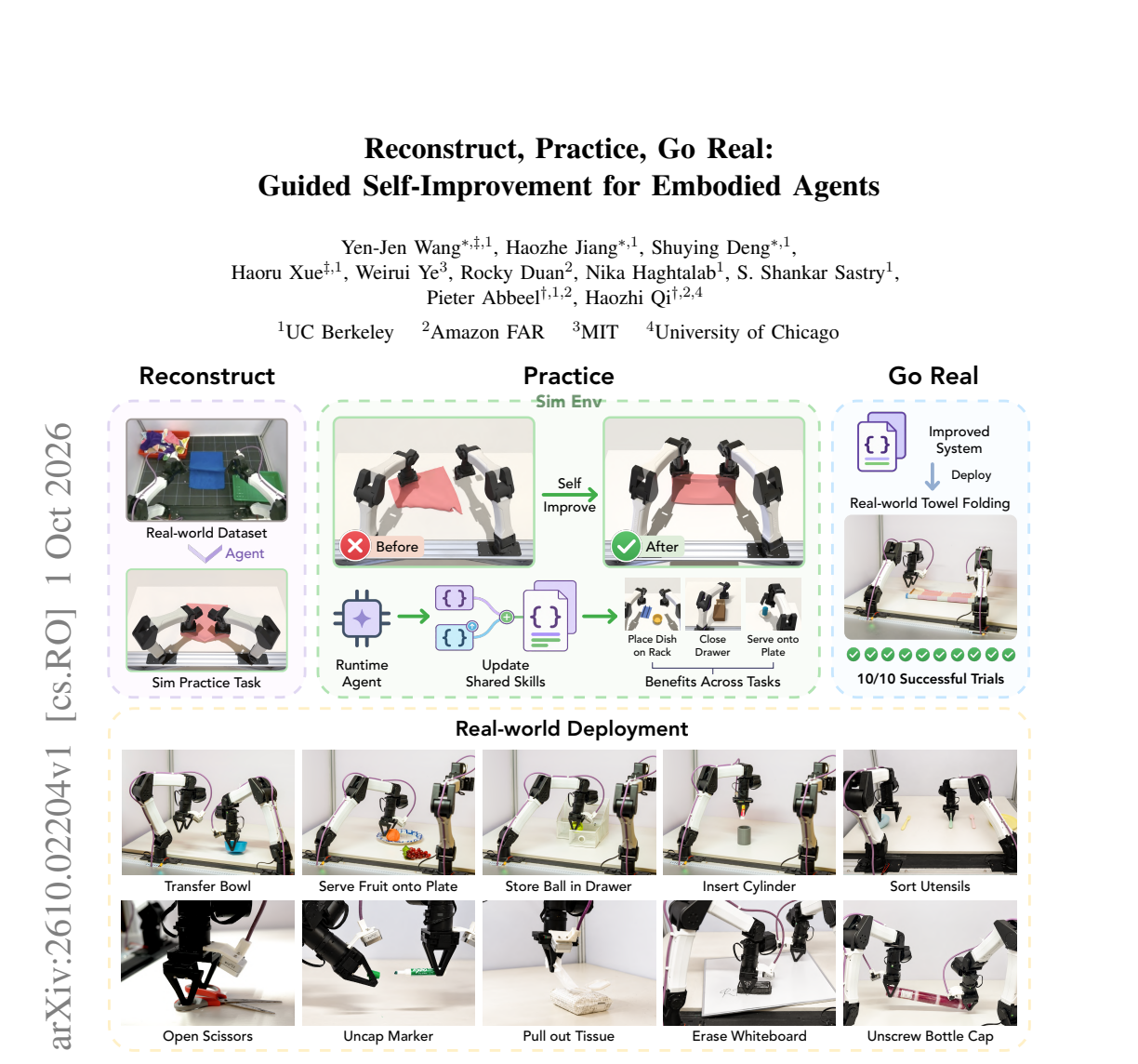
We present Reconstruct, Practice, Go Real (RPG), a framework for autonomous improvement of robot execution systems without updating model weights. RPG identifies manipulation capabilities in an offline dataset and constructs related practice tasks in simulation. During practice, RPG uses execution feedback, privileged simulator state, and available dataset videos to diagnose failures. It develops new reusable symbolic skills, refines existing skills, and revises the system prompt based on these diagnoses. Cross-task evaluation tests individual candidate changes and merged revisions before they are retained for reuse. At test time, a multimodal LLM uses the resulting system prompt and skill library to coordinate perception and robot control. On held-out initializations of 22 manipulation tasks, RPG improves task success from 28.6% after the first practice round to 95.0% after 15 rounds, outperforming all evaluated baselines, including ASPIRE (75.5%) and CaP-Agent0 powered by GPT-6 Astra Pro (60.0%). After a common calibration and hardware-adaptation procedure, the frozen system succeeds in all 30 physical trials, with ten trials on each of three tasks. Project Website: https://rpg-robot.github.io/
from the abstract
Pith says
Machine review · deepseek-v4-flash · 2 Oct 2026 · what was read was not recorded · not checked by a person
It can be wrong. Challenge this review or reply to it.
Holds up, with conditions. Solid empirical robotics work whose headline gain is measured and honestly reported, with the one real caveat being that the 28.6 to 95.0 curve is a single unreplicated improvement run past round 5. This line is wrong
3 major objections · 5 minor
How often objections from reviews like this one are right: not yet measured
Not checked: figures, code, what the 30 references say.
The paper says, at Sec. IV-B, Fig. 4
The review did not quote this passage.
Pith says: Objection 1 of 3 · major
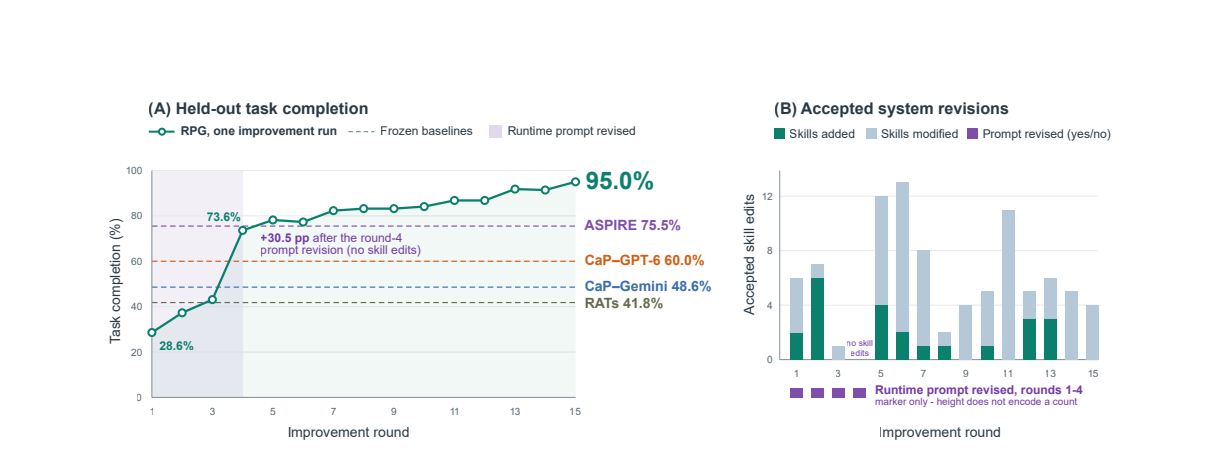
The headline improvement from 28.6% (63/220) to 95.0% (209/220) rests on a single improvement trajectory, as the Fig. 4 caption itself states ('The curve represents one improvement run'), and every step of that trajectory is stochastic: Fable 5.1 generates candidate revisions, the Merger resolves file conflicts with an LLM (Appendix A-e), and the acceptance gate of Eq.
more of objection 1
(2) uses n=5 episodes per task. The paper provides no run-to-run variance for rounds 5-15, and the largest unreplicated segment is the +21.4pp skill-only gain in those rounds, which is precisely the portion that supports the claim that library revisions drive improvement. The two indirect stability checks (the full-RPG ablation endpoint of 172/220 = 78.2% in Table III matching the round-5 value in Table VI, and the disclosed round-4 prompt revision) cover only rounds 1-5. I request a second full improvement run, or, failing that, a clearly scoped statement that the headline figure is a single-sample observation, together with a binomial confidence interval on the 209/220 count.
The paper says, at Eq. (2), Sec. III-D, Appendix A-d/e
The review did not quote this passage.
Pith says: Objection 2 of 3 · major
The gate of Eq. (2) permits any individual task to drop up to 20 percentage points per accepted change (for example, 5/5 to 4/5 or 1/5 to 0/5), and the same five fixed development seeds per task are reused every round (Sec.
more of objection 2
III-D, Appendix A-d), so after 15 rounds of greedy merging (Appendix A-e) with 66 skill modifications, the selection pressure against those five seeds is unquantified. The paper's own held-out data confirm the risk is real: the round-by-round curve decreases at rounds 6 and 14 (Table VI, overall row), meaning accepted revisions that passed the five-seed gate reduced held-out success, and the library-only comparison in Sec. IV-D reports a local regression on ABC sorting (5/6 after versus 6/6 before). I ask for a per-round comparison of development-seed success against held-out-seed success to quantify dev-seed overfitting, and a sensitivity analysis of the final figure to the gate tolerance.
The paper says, at Sec. IV-A, Appendix D
The review did not quote this passage.
Pith says: Objection 3 of 3 · major
The abstract and introduction claim that skill and prompt revisions 'can benefit other tasks that reuse them,' but development and evaluation draw from the same fixed 22-task distributions (Sec. IV-A), so the 95.0% figure is proficiency on the practiced suite rather than evidence of capability on new tasks.
more of objection 3
The transfer evidence in Appendix D is mixed: no-feedback tasks such as Serve onto plate, Two-arm handover, Transfer object, and Close sunglasses case improve, but the separate Grasp plate task reaches 10/10 in rounds 10-11 and then declines to 6/10 in rounds 12-15 (Table VII). The paper acknowledges this in Appendix D and in the conclusion, which is to its credit, but the abstract's scope should explicitly state that the headline improvement is on the practiced 22-task suite, or the authors should add held-out task distributions to substantiate the transfer framing.
5 minor objections
The paper says, at Sec. IV-A
Pith says: minor objection 1 of 5
Because development and evaluation use the same 22 tasks, the term 'held-out' refers to initializations, not tasks; define this distinction at first use in Sec. IV-A so the abstract's phrasing is not misread as task-level generalization.
The paper says, at Fig. 4B
Pith says: minor objection 2 of 5
The purple squares whose height does not encode a count are visually confusable with the stacked skill-edit bars; consider a distinct marker style or a separate annotation panel.
show 3 more
The paper says, at Table V
Pith says: minor objection 3 of 5
With ten trials per physical task, the 30/30 total is a feasibility demonstration; report a binomial confidence interval or explicitly label the small-n scope so the result is not over-interpreted.
The paper says, at Sec. IV-B, Table II
Pith says: minor objection 4 of 5
RATs is reported with its native any-time success criterion while the other baselines use episode-completion success; state this difference explicitly in the Table II caption so the comparison is not misread as apples-to-apples.
The paper says, at Eq. (1) and Eq. (3)
Pith says: minor objection 5 of 5
Equations (1) and (3) define the same quantities in the main text and appendix; cite once and refer back, and check that the J and q notation is consistent with the surrounding text.
What would settle it
Run the complete 15-round improvement loop a second time from the same initial system S0 (the 15-skill library of Sec. IV-C), with fresh stochastic draws throughout: re-seed Fable 5.1's candidate generation, the Video Analyzer's diagnoses, and the merge/conflict resolution. In a second variant, also re-sample the five development seeds per task (new initial-state draws) so candidate acceptance is not pegged to the same fixed seeds used in the reported run. Freeze each round-end system and evaluate on the same ten held-out seeds per task (220 episodes). If the fresh-seed re-run's round-15 held-out success is within roughly 5pp of 95%, the single-trajectory concern is resolved; if it lands near 75–80%, the headline overstates the reproducibility of the claimed gain and should be re-stated as a range.
from the skeptic's reading
How the review went
4 readings by deepseek-v4-flash · 2 Oct 2026
- Reader holds up, with conditions
- Skeptic partly agrees
- Editor wrote the verdict above
- Referee major revision: 3 major objections, 5 minor
Not run on this paper: the simulated authors' defence.
Pith did not check this review's objections against the paper.
The review in full
The review in brief, machine-written
Two things before you read it. First, this is a genuinely solid piece of empirical robotics work: the held-out-seed protocol, the separate dev/eval split, the ablations, the library-only control, and the physical deployment all hang together, and the paper reports its weaknesses instead of burying them. Second, the one caveat that matters: the 28.6-to-95.0 learning curve is a single improvement run, and everything past round 5 is unreplicated.
What's actually new is the diagnosis mechanism. Running a Runtime Agent and a Privileged Agent with simulator state on matched episodes and diffing their traces to attribute failures is a real twist on the established self-improving-agents program (ASPIRE, RATs, SHAPER, HERO, ENPIRE, RHO, GRASP are all cited, by the way; the related-work picture is complete). The cross-task candidate and merged-validation gate is a sensible answer to the shared-skill regression problem. And the library-only experiment — 26/40 to 37/40, and 19/40 to 39/40 with a privileged scripted caller — is exactly the right control to isolate skill code from prompt effects, which is the load-bearing causal claim.
The paper earns credit on honesty. It states outright that the Fig. 4 curve is one improvement run, that the +30.5pp round 3-to-4 jump is a deliberate prompt revision about budget use, that Fold towel plateaus at 5/10 with a tightened hard variant at 0/10, and that the physical folding criterion is defined independently of sim with table support permitted for bowl transfer. None of these are hidden.
Soft spots, in proportion. The single-run issue is real but partially mitigated: the 5-round ablation endpoint (172/220 = 78.2%) matches the main curve's round-5 value (78%), suggesting stability through round 5; what has no replication evidence is the +21.4pp skill-only gain in rounds 5-15. The n=5 gate tolerates a 20pp single-task drop and can accumulate regressions under greedy merging. The physical 100% is a best case under permissive criteria. And the 95% reflects proficiency on the practiced suite — dev and eval sample the same fixed distributions — so the framework's value as a route to new-task capability is the weaker claim, and the paper's own Appendix D data is genuinely mixed (Grasp plate hits 10/10 then falls to 6/10). None of this is fatal: nothing is fitted to the target, comparisons are against external baselines on shared seeds, and the library-only controls anchor the claim that skill revisions, not a lucky LLM draw, drive improvement.
For anyone working on LLM-driven skill libraries or self-improving embodied agents, this warrants a careful read and a real referee. The right request is repeated improvement runs with variance reporting and a stricter or disclosed gate. As submitted, it clears the bar for peer review.
The strongest objection
The central empirical claim — that autonomous practice, driven by privileged-state diagnosis and gated shared-skill revisions, raises held-out success from 28.6% to 95.0% — rests on a single improvement trajectory. The Fig. 4 caption honestly states 'The curve represents one improvement run,' but the paper gives no estimate of run-to-run variance, and the mechanism is stochastic at every step: candidate revisions are generated by an LLM (Fable 5.1), merged greedily by a coding agent with LLM-based conflict resolution (Appendix A-e), and accepted through the permissive n=5 gate of Eq. (2), which permits any single task to drop a full 20 percentage points (e.g., 5/5→4/5, or 1/5→0/5) per accepted change. Across 15 rounds, 23 new skills and 66 skill modifications were accepted, all validated against the same five fixed development seeds per task, reused every round (Sec. IV-A, Appendix A-d). Selection pressure against those five seeds is unquantified, and the gate's 20pp tolerance can accumulate regressions under greedy merging. Two pieces of evidence partially soften this: the 5-round ablation's full-RPG endpoint (172/220 = 78.2%, Table III) exactly matches the main curve's round-5 value (Table VI), suggesting modest run-to-run stability through round 5; and the +30.5pp round-3→4 jump is a deliberate system-prompt revision about budget use, disclosed in Sec. IV-B. What remains completely unreplicated is the +21.4pp skill-only gain accrued in rounds 5–15, which is precisely the regime where the paper claims shared-skill repairs drive improvement. If a second 15-round trajectory plateaus near 75–80%, the causal claim that gated skill revisions — rather than a favorable single draw of LLM output — produce the headline gain is unsupported.
The reader's weakest_assumption was generalization beyond the practiced suite, with the single-run/no-variance issue listed as one of three secondary conditions. I agree the transfer evidence is thin: Appendix D shows Grasp plate improving to 10/10 then regressing to 6/10, and the four feedback-held-out tasks remain inside the cross-task regression pool, exactly as the paper itself states. But I judge reproducibility of the practiced-suite gain to be the more fundamental load-bearing assumption. The central claim asserted in the abstract, Sec. I, and Sec. IV-B is that practice produces the 28.6→95.0 gain on the suite, and that gain is a single realized trajectory of stochastic LLM action. If it is not reproducible, the generalization question is moot; if it is reproducible, the framework's core claim survives even with limited transfer. The paper deserves credit for disclosing the single run (Fig. 4 caption), the permissive physical criteria (Sec. IV-E: folding criterion 'defined independently' and 'not intended to match' simulation difficulty), and the round-4 prompt-revision attribution. Its 5-round ablation partially replicates the early curve, which I count as real evidence. What is unresolved is variance in the unreplicated tail (rounds 5–15, +21.4pp from skill modifications), which is precisely the regime claimed to be driven by shared-skill repairs. My proposed single check — a full 15-round re-run with fresh stochastic draws and fresh development seeds — would settle whether the headline is a stable property of the mechanism or one favorable draw. This sharpens rather than moves the reader's CONDITIONAL verdict: the required condition is demonstrated run-to-run reproducibility, with generalization evidence as a secondary ask.
The referee's report
If the headline result holds, RPG is a valuable contribution to self-improving robot systems: it demonstrates that privileged-state-guided diagnosis plus gated, cross-task-validated skill and prompt revisions can drive large gains on a 22-task simulation suite and transfer to a physical robot without weight updates. Strengths of the empirical core: (i) clean separation of fixed development seeds from held-out evaluation seeds, with retrospective evaluation after freezing; (ii) a controlled library-only comparison (Table IV), including a scripted privileged caller, that isolates executable-skill improvement from prompting effects; (iii) honest reporting of non-monotonicity, the disclosed round-4 prompt revision, and the towel-folding failure mode; (iv) an external-baseline comparison (ASPIRE, RATs, CaP-Agent0) with no free parameter fitted to the target. The weak point is that the headline 95.0% figure rests on a single stochastic improvement run with no run-to-run variance estimate, leaving the core 'self-improvement improves' claim under-quantified. With variance evidence, or a clearly scoped single-run statement, this would be a strong systems contribution.
Pith's reading of the paper (a machine's summary, not the authors')
This paper claims that a robot control system can improve itself without retraining, by practicing in simulation and revising its own shared skill code and system prompt while leaving model weights untouched. The framework builds practice tasks from an offline manipulation dataset, diagnoses failures by comparing runtime executions against a version of the agent that sees simulator state, and accepts or rejects each change by testing it across the whole task suite for regressions. The paper reports that this cycle raises success on 22 held-out manipulation tasks from 28.6% after the first round to 95.0% after 15, beating the best evaluated baselines, and that the frozen system then completes all 30 physical trials across three tasks after only common calibration. The claim matters because it offers a route to robot capability that scales with simulation and language-model reasoning rather than human reward design and dataset collection.
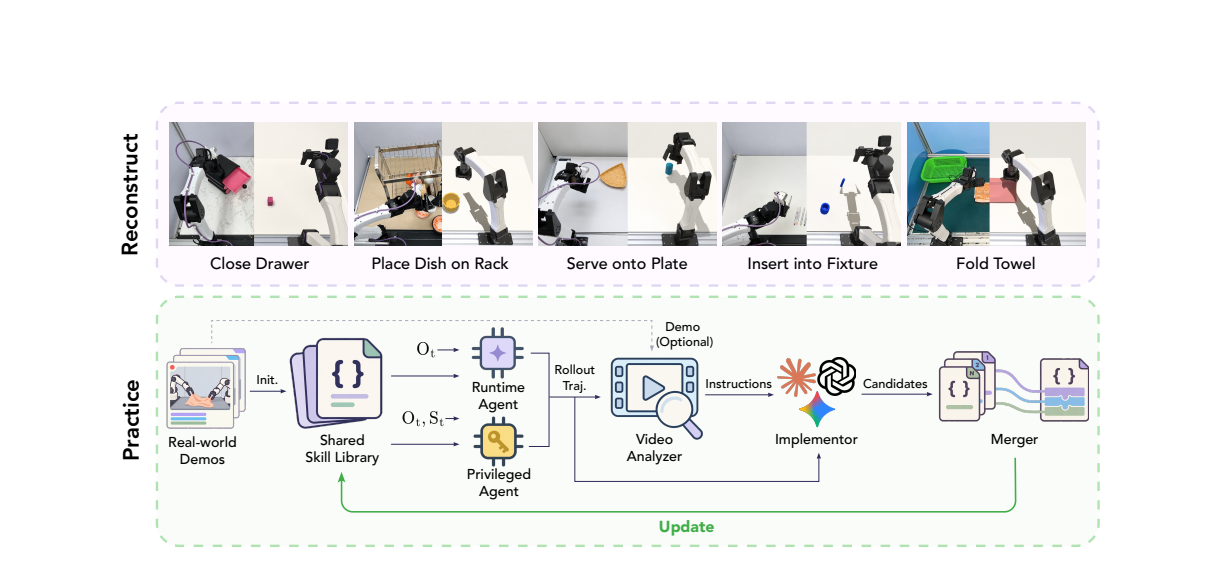
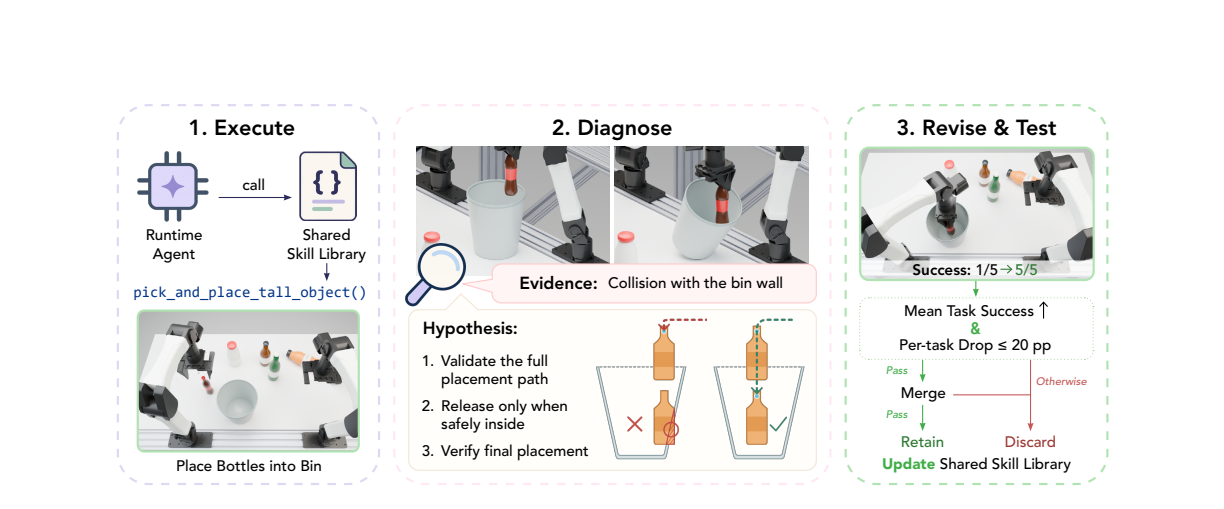
What carries the argument. The load-bearing object is the execution system $S_r = (L_r, \rho_r)$: a shared skill library plus a system prompt telling a multimodal coding agent how to compose skills. Practice runs two parallel executions from matched initial states, the Runtime Agent restricted to deployment observations and the Privileged Agent additionally receiving simulator state (object poses, sizes, velocities, cloth-corner positions). A Video Analyzer compares both traces with dataset videos to diagnose the first failure, an Implementor proposes at most one revision per struggling task, and the acceptance gate of Eq. (2) requires mean success to increase while no task's five-seed success drops by more than one success, applied first to individual candidates and again to the greedily merged system. The gate is what lets a shared-skill change help one task without silently regressing others, and the persistent skill-and-prompt library is what makes improvements survive across episodes and tasks.
Core claim. RPG claims that a robot execution system, a multimodal coding agent directing a shared library of symbolic manipulation skills, can improve itself without any weight update by practicing tasks reconstructed in simulation from an offline dataset. Each round runs two matched executions: the Runtime Agent sees only deployment observations, while a Privileged Agent additionally receives simulator state. A Video Analyzer attributes the first failure of each rollout, an Implementor writes new skills, repairs existing ones, and revises the system prompt, and every candidate must pass a cross-task gate requiring mean success to rise while no single task drops by more than one success out of five; merged revisions are retested before retention. The paper reports that this cycle raises held-out task success from 28.6% (63/220) after round 1 to 95.0% (209/220) after round 15, outperforming ASPIRE (75.5%) and CaP-Agent0 with GPT-6 Astra Pro (60.0%), and that the frozen system, after common calibration and hardware adaptation only, succeeds in all 30 physical trials across three tasks.
The premise it rests on. The headline gains generalize beyond the tasks the system explicitly practiced: development and evaluation draw from the same fixed 22-task distributions, and the paper's own transfer evidence beyond that suite is mixed, with the extra Grasp plate task regressing from 10/10 to 6/10.
If the paper is right (Pith's inferences, not the authors')
Improvement need not touch model weights: skills and prompt are the learnable substrate, so the runtime model could in principle be swapped after practice and the gains would persist.
Cross-task transfer through the shared library: four feedback-held-out tasks that never generate their own revisions still improve, e.g. Two-arm handover from 3/10 in round 1 to 10/10 in round 15.
The system prompt can be the single largest lever: the rounds 3 to 4 prompt revision, with no skill edit, accounts for a 30.5-percentage-point gain by introducing a bounded perception-action loop and interaction-budget tracking.
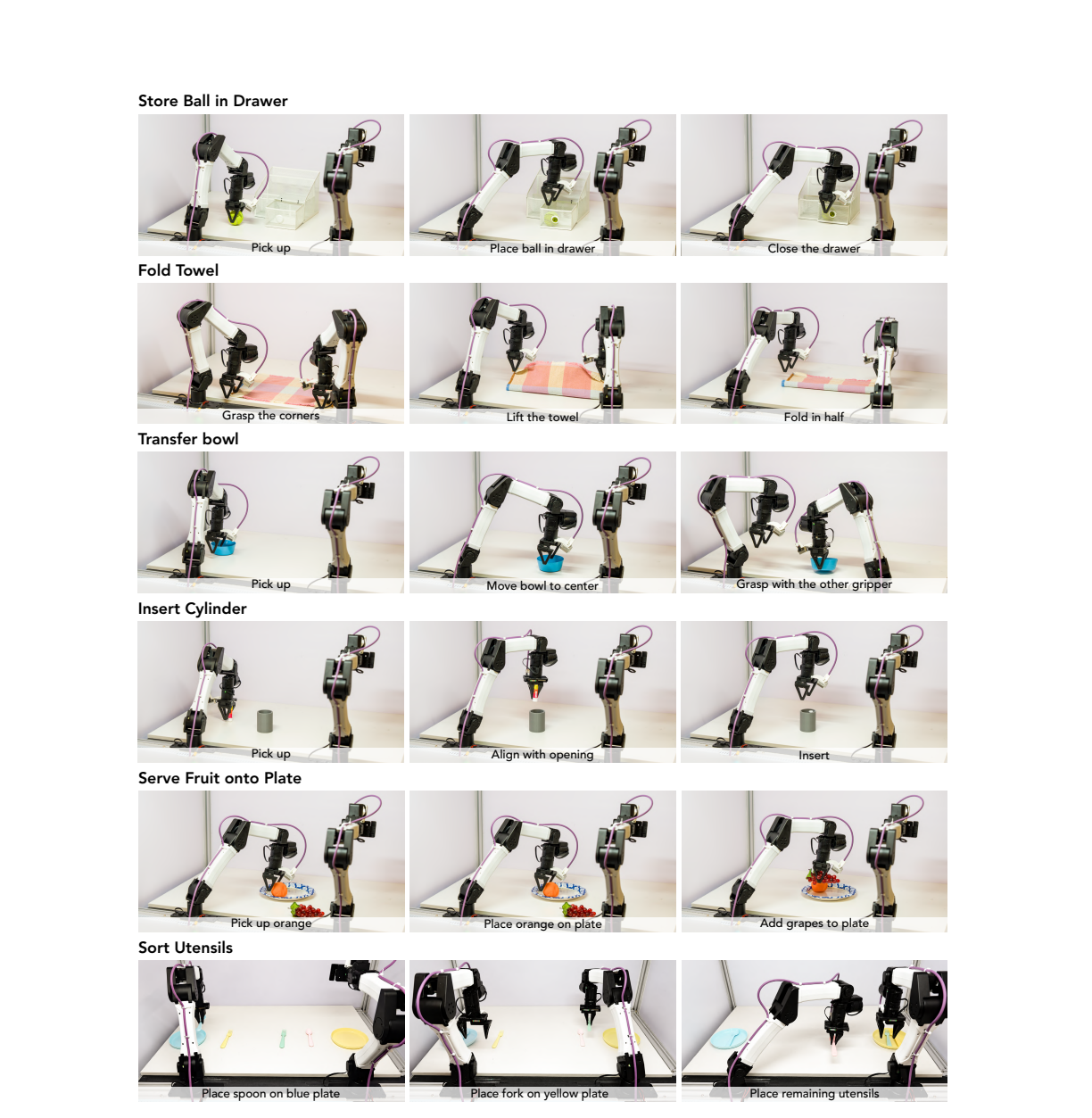
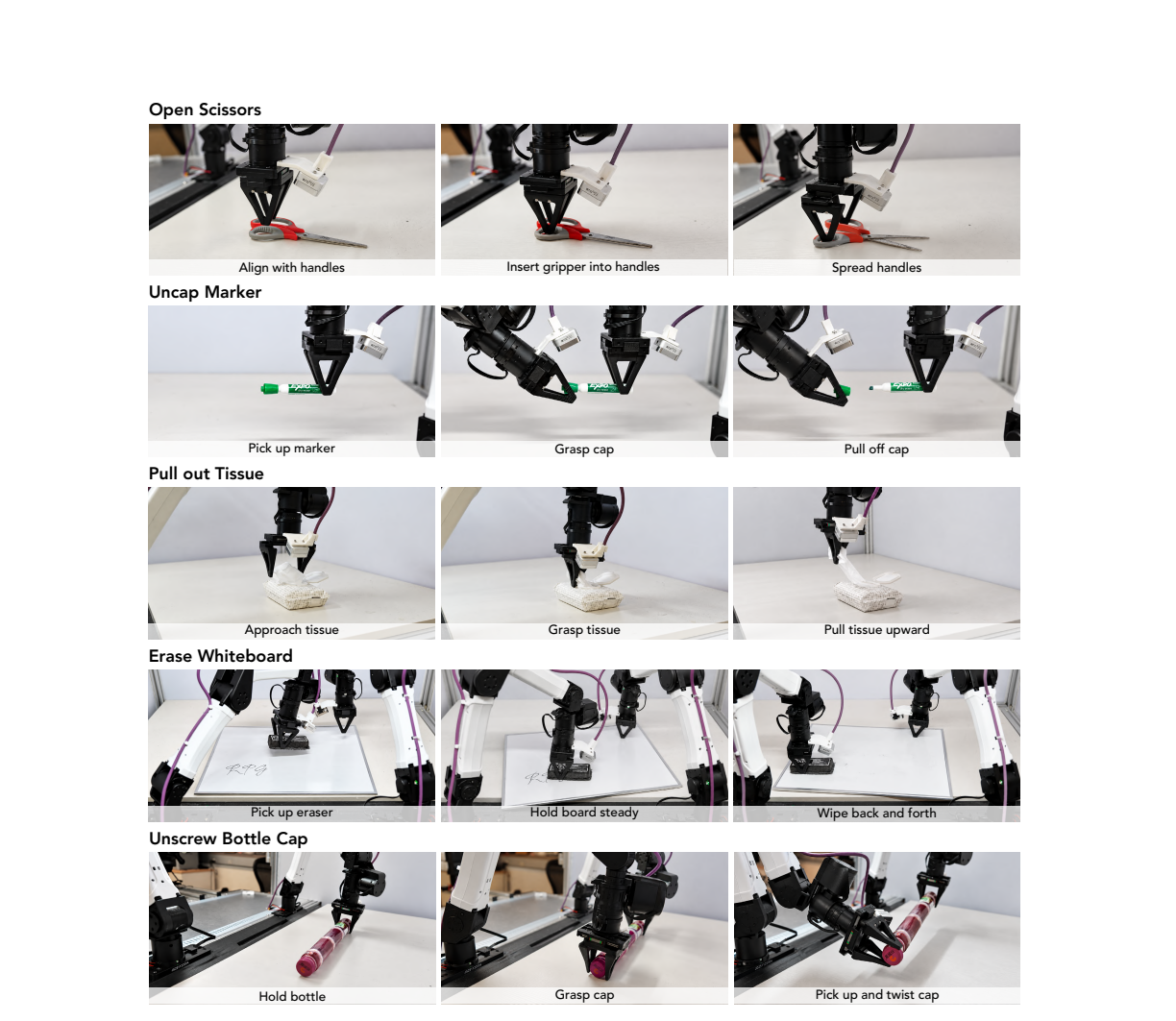
Physical transfer after common calibration: the frozen system completes 30/30 trials, with its advantage over CaP-Agent0 largest on the two multi-stage tasks (drawer closure and bowl handover).
Practice is not monotonic: held-out success dips at rounds 6 and 14, so even gated revisions can trade one capability for another on unseen seeds.
The untested part is capability on genuinely new task distributions: development and evaluation sample the same fixed 22-task suite, and the paper's own extra transfer check, Grasp plate, reaches 10/10 then falls to 6/10, so a cleaner experiment would practice on one suite and freeze-test an untouched suite built from different source trajectories.
The 20-percentage-point per-task drop tolerance is a coarse safety filter; the non-monotonic round-by-round curves suggest that per-round acceptance can silently erode an unpracticed capability, and re-scoring accepted systems on more seeds would tighten the gate.
Deformable manipulation is a hard boundary the paper isolates: towel folding peaks at 5/10 and its hard variant stays at 0/10 for all 15 rounds, implying the procedural-guard strategy transfers to rigid objects but not to cloth layering and contact state.
The protocol's cost is substantial, roughly 15 rounds of 110 development episodes per candidate plus merge retests on top of full-suite evaluations, so scaling to hundreds of tasks would need the quota-aware rollout scheduling and dependency-aware merging that the paper lists as limitations.
Check this review
Pith stored no record of this review's passes and took no fingerprint of it. Reviews made by code from 13 Nov 2026 on carry both.
How often reviews like this one are right
Reviews like this one: written by deepseek-v4-flash, where what was read was not recorded.
How often objections from reviews like this one are right: not yet measured
Reviews by people
This review was written by a machine. No person has reviewed this paper on Pith yet. A scientist listed on Pith can review it for a fee, and their review is published here whatever it concludes.
The paper
Abstract
Building reliable robot capabilities across diverse tasks requires substantial human effort to develop and maintain skills, design rewards, and integrate perception with control. We present Reconstruct, Practice, Go Real (RPG), a framework for autonomous improvement of robot execution systems without updating model weights. RPG identifies manipulation capabilities in an offline dataset and constructs related practice tasks in simulation. During practice, RPG uses execution feedback, privileged simulator state, and available dataset videos to diagnose failures. It develops new reusable symbolic skills, refines existing skills, and revises the system prompt based on these diagnoses. Cross-task evaluation tests individual candidate changes and merged revisions before they are retained for reuse. At test time, a multimodal LLM uses the resulting system prompt and skill library to coordinate perception and robot control. On held-out initializations of 22 manipulation tasks, RPG improves task success from 28.6% after the first practice round to 95.0% after 15 rounds, outperforming all evaluated baselines, including ASPIRE (75.5%) and CaP-Agent0 powered by GPT-6 Astra Pro (60.0%). After a common calibration and hardware-adaptation procedure, the frozen system succeeds in all 30 physical trials, with ten trials on each of three tasks. Project Website: https://rpg-robot.github.io/
The paper's own sentences, arranged, kept beside the review and separate from it. Each label is drawn from a closed vocabulary; the number beside it is the probability the classifier gave that label. No sentence in this record was written by a model.
abstract compiled · 2026-10-02
The authors' main claim, as the classifier picked it out 0.99
“On held-out initializations of 22 manipulation tasks, RPG improves task success from 28.6% after the first practice round to 95.0% after 15 rounds, outperforming all evaluated baselines, including ASPIRE (75.5%) and CaP-Agent0 powered by GPT-6 Astra Pro (60.0%).”
How the main claim is stated: asserted 1.00
What the abstract itself states, as probabilities: claims first 0.05 · states limitation 0.20 · human participants 0.08 · controlled comparison 0.94 · randomized assignment 0.02 · states quantitative result 0.99 · compares with prior results 0.99 · mentions code or data availability 0.47
The abstract, sentence by sentence
This table labels the abstract only (arXiv listing abstract v1). The number is the probability the classifier gave the label.
| Sentence | Role | The authors' own work | States the main conclusion | Strength |
|---|---|---|---|---|
| Building reliable robot capabilities across diverse tasks requires substantial human effort to develop and maintain skills, design rewards, and integrate perception with control. | background 0.99 | 0.06 | 0.02 | asserted 1.00 |
| We present Reconstruct, Practice, Go Real (RPG), a framework for autonomous improvement of robot execution systems without updating model weights. | contribution 1.00 | 0.90 | 0.08 | asserted 1.00 |
| RPG identifies manipulation capabilities in an offline dataset and constructs related practice tasks in simulation. | method 0.98 | 0.86 | 0.02 | asserted 1.00 |
| During practice, RPG uses execution feedback, privileged simulator state, and available dataset videos to diagnose failures. | method 1.00 | 0.85 | 0.02 | asserted 1.00 |
| It develops new reusable symbolic skills, refines existing skills, and revises the system prompt based on these diagnoses. | method 0.99 | 0.87 | 0.04 | asserted 1.00 |
| Cross-task evaluation tests individual candidate changes and merged revisions before they are retained for reuse. | method 1.00 | 0.90 | 0.03 | asserted 0.99 |
| At test time, a multimodal LLM uses the resulting system prompt and skill library to coordinate perception and robot control. | method 1.00 | 0.69 | 0.05 | asserted 1.00 |
| On held-out initializations of 22 manipulation tasks, RPG improves task success from 28.6% after the first practice round to 95.0% after 15 rounds, outperforming all evaluated baselines, including ASPIRE (75.5%) and CaP-Agent0 powered by GPT-6 Astra Pro (60.0%). | result 1.00 | 0.96 | 0.64 | asserted 1.00 |
| After a common calibration and hardware-adaptation procedure, the frozen system succeeds in all 30 physical trials, with ten trials on each of three tasks. | result 1.00 | 0.95 | 0.17 | asserted 1.00 |
| Project Website: https://rpg-robot.github.io/ | future work 0.53 | 0.27 | 0.02 | unclear 0.97 |
What kind of paper the classifier reports this is: method or tool 1.00 · evidence from observation or experiment 0.97
What was examined, and what was not
Sources read
- arXiv listing abstract v1
Not examined
- full text
- figures and tables
- references and citing sentences
- relations to other papers
Levels run
- P abstract
Not run
- S sections
- T body sentences
- C citations
- R cross-paper relations
How the labels were made
Compiled by classifier-1.13.0 via TypeSafe API, question bank abstract-p1-20260923, 2026-10-02: 1 request, 7,519 input tokens.
Every quoted sentence on this record is the authors'. Every label is from Pith's closed vocabulary, with the probability shown beside it. This record as JSON
Figures (6)
Figures are the authors', reproduced from the paper.
References (30)
- [1] D. Driess, F. Xia, M. S. M. Sajjadi, C. Lynch, A. Chowdhery, B. Ichter, A. Wahid, J. Tompson, Q. Vuong, T. Yu, W. Huang, Y . Chebotar, P. Sermanet, D. Duckworth, S. Levine, V . Vanhoucke, K. Hausman, M. Toussaint, K. Greff, A. Zeng, I. Mordatch, and P. Florence, “PaLM- E: An e... on Pith
- [2] X. Wang, Y . Chen, L. Yuan, Y . Zhang, Y . Li, H. Peng, and H. Ji, “Executable code actions elicit better LLM agents,” inICML, 2024 on Pith
- [3] N. Shinn, F. Cassano, A. Gopinath, K. Narasimhan, and S. Yao, “Reflexion: Language agents with verbal reinforcement learning,” in NeurIPS, 2023 on Pith
- [4] G. Tziafas and H. Kasaei, “Lifelong robot library learning: Bootstrap- ping composable and generalizable skills for embodied control with language models,” inICRA, 2024 on Pith
- [5] R. Lu, Y . Wu, E. Kou, L. Fu, W. Xiao, A. Mandlekar, Y . Xu, G. Shi, K. Goldberg, A. Chen, M. Chowdhury, Y . Zhu, L. J. Fan, and G. Wang, “ASPIRE: Agentic/skills discovery for robotics,”arXiv:2607.00272, 2026 on PithPith's reviewarXiv
- [6] J. Zhang, J. Ge, H. Yoo, L. Fu, Z. Yang, Y . Liu, R. Saravanan, S. Yin, J. Yu, D. Niu, Z. Wang, R. Herzig, K. Goldberg, Y . Bai, D. M. Chan, I. Stoica, A. Kanazawa, J. Lei, H. Feng, and T. Darrell, “Playful agentic robot learning,” inCoRL, 2026 on Pith
- [7] J. Liang, W. Huang, F. Xia, P. Xu, K. Hausman, B. Ichter, P. Florence, and A. Zeng, “Code as policies: Language model programs for embodied control,” inICRA, 2023 on Pith
- [8] I. Singh, V . Blukis, A. Mousavian, A. Goyal, D. Xu, J. Tremblay, D. Fox, J. Thomason, and A. Garg, “ProgPrompt: Generating situated robot task plans using large language models,” inICRA, 2023 on Pith
- [9] L. Fu, J. Yu, K. El-Refai, E. Kou, H. Xue, H. Huang, W. Xiao, G. Wang, D. Niu, F.-F. Li, G. Shi, J. Wu, S. Sastry, Y . Zhu, K. Goldberg, and L. J. Fan, “CaP-X: A framework for benchmarking and improving coding agents for robot manipulation,” inICML, 2026 on Pith
- [10] A. Allshire, H. G. Singh, R. Singh, A. Rashid, H. Choi, D. McAllister, J. Yu, Y . Chen, H. Huang, P. Abbeel, X. Chen, R. Duan, P. Isola, J. Malik, F. Shentu, G. Shi, P. Wu, and A. Kanazawa, “Scalable behavior cloning with open data, training, and evaluation,” inCoRL, 2026 on Pith
- [11] Y .-J. Wang, B. Zhang, J. Chen, and K. Sreenath, “Prompt a robot to walk with large language models,” inCDC, 2024 on Pith
- [12] M. Ahn, A. Brohan, N. Brown, Y . Chebotar, O. Cortes, B. David, C. Finn, C. Fu, K. Gopalakrishnan, K. Hausman, A. Herzog, D. Ho, J. Hsu, J. Ibarz, B. Ichter, A. Irpan, E. Jang, R. J. Ruano, K. Jeffrey, S. Jesmonth, N. J. Joshi, R. Julian, D. Kalashnikov, Y . Kuang, K.-H. Lee, ... on Pith
- [13] W. Huang, C. Wang, R. Zhang, Y . Li, J. Wu, and L. Fei-Fei, “V oxPoser: Composable 3D value maps for robotic manipulation with language models,” inCoRL, 2023 on Pith
- [14] W. Huang, F. Xia, T. Xiao, H. Chan, J. Liang, P. Florence, A. Zeng, J. Tompson, I. Mordatch, Y . Chebotar, P. Sermanet, N. Brown, T. Jack- son, L. Luu, S. Levine, K. Hausman, and B. Ichter, “Inner monologue: Embodied reasoning through planning with language models,” in CoRL, 2022 on Pith
- [15] Z. Liu, A. Bahety, and S. Song, “REFLECT: Summarizing robot experiences for failure explanation and correction,” inCoRL, 2023 on Pith
- [16] G. Wang, Y . Xie, Y . Jiang, A. Mandlekar, C. Xiao, Y . Zhu, L. Fan, and A. Anandkumar, “V oyager: An open-ended embodied agent with large language models,”TMLR, 2024 on Pith
- [17] K. Elmaaroufi, J. Svegliato, S. Kalade, G. Schelle, S. A. Seshia, and M. Zaharia, “RHO: Your coding agent is secretly a roboticist,” arXiv:2606.16458, 2026 on PitharXiv
- [18] W. Xiao, J. Xie, T. Zhang, H. Lin, L. Fu, H. Xue, J. Lu, Y . Yang, C. Dai, Z. Wang, J. Wu, G. Wang, S. S. Sastry, K. Goldberg, L. Fan, Y . Zhu, and G. Shi, “ENPIRE: Agentic robot policy self-improvement in the real world,” inCoRL, 2026 on Pith
- [19] P. Wang, Z. Ma, Y . Chang, X. Luo, X. Yang, S. Feng, Y . Yang, and D. Li, “Self-evolving embodied agents via skill-harness evolution,” arXiv preprint arXiv:2608.11350, 2026 on PithPith's reviewarXiv
- [20] J. Li, Y . Wang, H. Li, G. Zhang, Y . Ye, Q. Liu, H. Liang, and W. Lian, “Practice makes policies: Bootstrapping and consolidating robotic capabilities from zero human demonstrations,”arXiv preprint arXiv:2607.26809, 2026 on PithPith's reviewarXiv
show 10 more
- [21] J. Moll, J.-P. Corbeil, J. Pan, M. Hadamitzky, D. Rueckert, L. Adams, and K. Bressem, “Grasp: Gated regression-aware skill proposer for self-improving llm agents,”arXiv preprint arXiv:2605.29668, 2026 on PithPith's reviewarXiv
- [22] Y . Wang, G. Gonzalez-Pumariega, Y . Sharma, and S. Choudhury, “Demo2Code: From summarizing demonstrations to synthesizing code via extended chain-of-thought,” inNeurIPS, 2023 on Pith
- [23] S. Xie, Y . Zhang, R. Wang, and X. Chen, “Uni-Skill: Building self- evolving skill repository for generalizable robotic manipulation,” in ICRA, 2026 on Pith
- [24] A. Mandlekar, S. Nasiriany, B. Wen, I. Akinola, Y . Narang, L. Fan, Y . Zhu, and D. Fox, “MimicGen: A data generation system for scalable robot learning using human demonstrations,” inCoRL, 2023 on Pith
- [25] X. Han, J. Yu, M. Liu, Y . Chen, X. Lyu, Y . Tian, B. Wang, W. Zhang, and J. Pang, “Re3Sim: Generating high-fidelity simulation data via 3d- photorealistic real-to-sim for robotic manipulation,” inICRA, 2026 on Pith
- [26] Y . J. Ma, W. Liang, G. Wang, D.-A. Huang, O. Bastani, D. Jayaraman, Y . Zhu, L. Fan, and A. Anandkumar, “Eureka: Human-level reward design via coding large language models,” inICLR, 2024 on Pith
- [27] L. Wang, Y . Ling, Z. Yuan, M. Shridhar, C. Bao, Y . Qin, B. Wang, H. Xu, and X. Wang, “GenSim: Generating robotic simulation tasks via large language models,” inICLR, 2024 on Pith
- [28] P. Hua, M. Liu, A. Macaluso, Y . Lin, W. Zhang, H. Xu, and L. Wang, “GenSim2: Scaling robot data generation with multi-modal and reasoning llms,” inCoRL, 2024 on Pith
- [29] E. Todorov, T. Erez, and Y . Tassa, “MuJoCo: A physics engine for model-based control,” inIROS, 2012 on Pith
- [30] L. Pinto, M. Andrychowicz, P. Welinder, W. Zaremba, and P. Abbeel, “Asymmetric actor critic for image-based robot learning,” inRSS, 2018. APPENDIX A. Self-Improvement Protocol RPG improves a persistent execution system over succes- sive practice rounds. We denote the system us... on Pith
Cited by 10 Pith papers
Reviewed papers on Pith that cite this one. The full citation record
- RoboAuto: Autonomous Robot Program Search through Multi-Level Physical Understanding cs.RO · Oct 2026
- Closing the Dynamics Gap through Self-Directed Robotic Interaction cs.RO · Nov 2026
- Recursive Self-Improvement in Physical AI: Mechanisms, Evidence, and Evaluation cs.RO · Oct 2026
- Pretraining Knows What, Simulation Teaches How: Compositional Generalization in a Sim-Trained Robot Agent cs.RO · Oct 2026
- Toward Recursive Self-Improvement in Physical AI cs.RO · Oct 2026
- AdaRSI: On-Demand Recursive Self-Improvement for Embodied Agents cs.CL · Oct 2026
- RoboSimStudio: An Interactive Toolkit for Human and Agent Rapid Real2Sim of Robot Manipulation Tasks cs.RO · Oct 2026
- SEAR: Self-Evolving Agentic Robotics cs.RO · Oct 2026
- RoboACE: Adversarial Co-Evolution for Robot Self-Improvement cs.RO · Nov 2026
- PyRUA-REAL: Robot Exploration and Adaptive Learning through RSI in the Real World cs.RO · Nov 2026
Challenges and discussion
Disagree with the review, or know something it missed? Leave a comment, or challenge this review formally: a challenge becomes a permanent entry in this paper's record, and its decision is published here.
Come back by email
A short list of the week's newly reviewed papers. Nothing is sent until you confirm from your inbox, and every email has a link that stops it. No account.
No comments yet.
Sign in to comment