Data Structures and Algorithms · arXiv:2610.06783 v1 · submitted 5 Oct 2026 · 102 references
Truly Subquadratic 3SUM and Truly Subcubic APSP via Triangles in Sparse Lopsided Graphs
The paper says
“We give the first polynomial improvements over the textbook algorithms for 3SUM and All-Pairs Shortest Paths (APSP): we show how to deterministically solve 3SUM on n integers of polynomial size in O(n1.9992) time and APSP on directed n-vertex graphs with polynomially bounded integer weights in O(n2.9995) time.”
more of the abstract
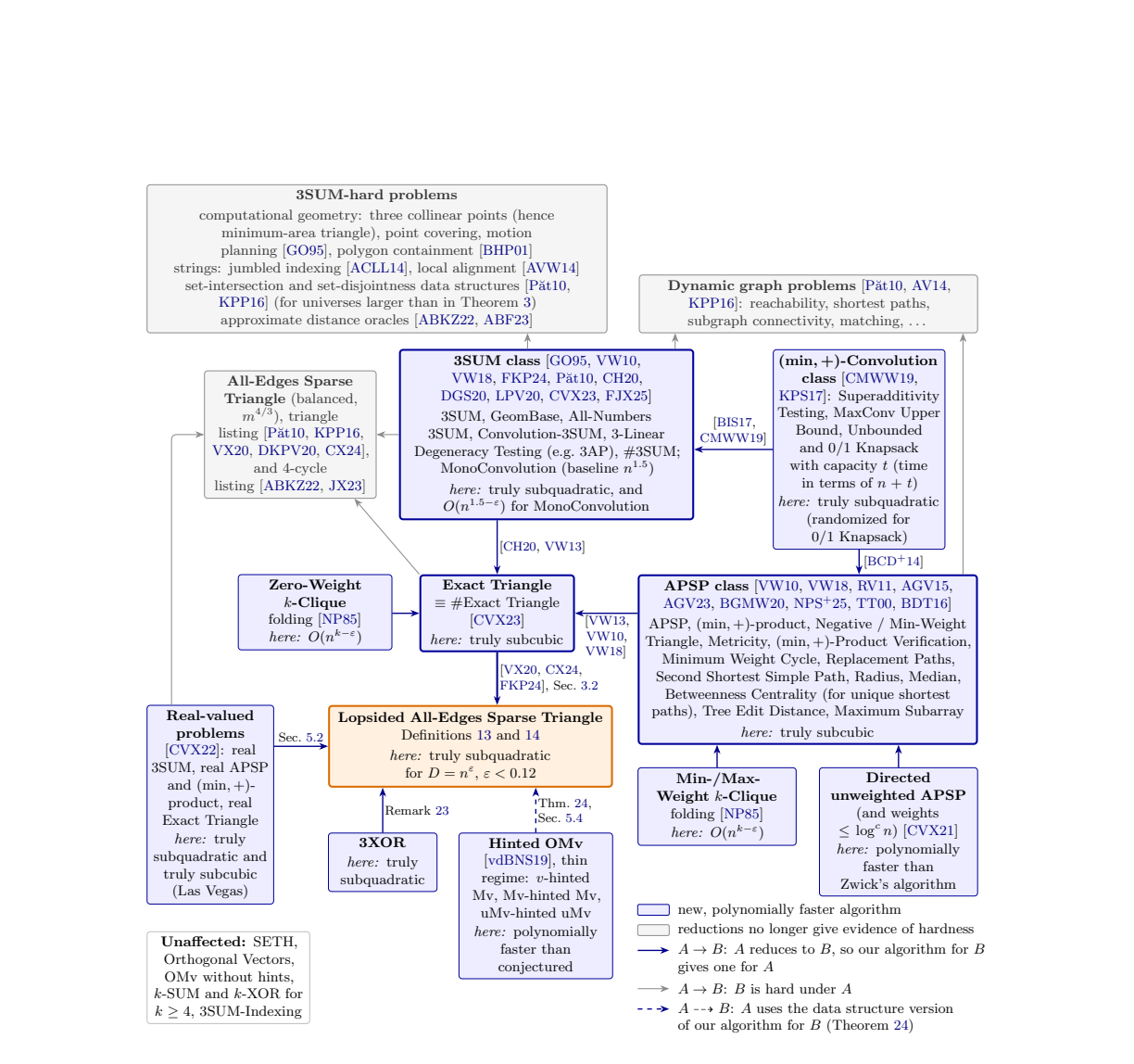
This refutes the 3SUM and APSP hypotheses. Using known reductions, we also refute the real-valued versions of the 3SUM and APSP hypotheses, the Exact Triangle hypothesis, the Zero-Weight k-Clique hypotheses, and the three rectangular hinted Online Matrix–Vector conjectures of van den Brand, Nanongkai, and Saranurak, and we give polynomial speedups for a variety of other problems. All of these results follow from a single new algorithm for thin matrix products. Let X be an N × D integer matrix and Y a D × N integer matrix with D ≤ N1/18, and let W be any set of at most N2/√D positions. We compute the entries (XY)[I,J], (I,J) ∈ W, in O(N2/D0.063) operations, which is polynomially less than the time needed to write down XY or to compute N2/√D inner products one by one. We design this algorithm by modifying a variant of Coppersmith's rectangular matrix multiplication algorithm, built from a ten-multiplication identity of Schönhage, to perform only the operations needed for the entries in W, and show that few operations are needed. Interpreted as a graph algorithm, this solves the All-Edges Sparse Triangle problem in truly subquadratic time on sparse lopsided tripartite graphs where two parts have n vertices but one part has nε vertices for ε < 0.12. By known reductions, Exact Triangle, and hence 3SUM and APSP, reduce to this problem. We also give a data structure version that answers queries for single entries of XY, not known in advance.
from the abstract
Pith says
Machine review · deepseek-v4-flash · 6 Oct 2026 · what was read was not recorded · not checked by a person
It can be wrong. Challenge this review or reply to it.
Holds up, with conditions. A genuine new technique — pruning Schönhage/Coppersmith recursion down to the leaves a sparse wanted set needs — that breaks the n2/n3 barriers for 3SUM and APSP; the algebra in the text holds up by hand, and the only real gap is the unshipped Lean 4 artifact behind the verification claim. This line is wrong
1 major objection · 3 minor
How often objections from reviews like this one are right: not yet measured
Not checked: figures, code, what the 102 references say.
The paper says, at Abstract; Section 4.4, proof of Corollary 26, inequality (10)
The review did not quote this passage.
Pith says: Objection 1 of 1 · major
The abstract states that 'Claude also verified this paper's main results using the Lean 4 proof assistant with the Mathlib library', and it refers to an 'Acknowledgments and Methodology' section for provenance details. In the copy of the manuscript I received, no Lean code, repository identifier, or commit is provided, and the promised section does not appear, so the machine-verification claim cannot be independently checked by a reader.
more of objection 1
This deserves attention because the decisive exponents rest on tight constant-factor comparisons, namely 72*(9/8)^9 < 208 in the proof of Lemma 11 (Section 2.4.3) and Lambda ~ 4.198 x 10^10 < 4^18 with margin about 1.63 in inequality (10) of the proof of Corollary 26 (Section 4.4), which is exactly the kind of arithmetic a mechanical check would settle. I weighed this against the hand proofs, which are present in full and which I verified, so my recommendation does not rest on this claim; however, before acceptance the authors should either ship the formalization as a citable artifact or rephrase the abstract so that it does not assert verification that the submission does not substantiate. In addition, please confirm that the final submission contains the promised 'Acknowledgments and Methodology' section and the bibliography, both of which are missing from my copy.
This objection may describe the copy Pith gave the reviewer, not the paper.
3 minor objections
The paper says, at Throughout (typesetting)
Pith says: minor objection 1 of 3
In the copy I reviewed, inline exponents are frequently not rendered as superscripts, for example 'N0 := 3L-m and D := 4m' in Section 2.3.2, 'n3/2+o(1)' in Theorem 21, and '10L' where 10^L is meant in Section 2.4; the expression '3L-m' is momentarily ambiguous. If this is an artifact of the text extraction, please disregard this comment; otherwise a careful typesetting pass over the inline mathematics is needed.
This objection may describe the copy Pith gave the reviewer, not the paper.
The paper says, at Section 5.1 (Theorem 33)
Pith says: minor objection 2 of 3
The new deterministic version of Zwick's reduction is a substantial piece of new material and is presented rather densely. The proof is coherent (I checked the level structure t_i = min{R^i, n}, the bridge-construction budget, and the cost split across the three regimes of s), but readers would benefit from a few sentences explaining intuitively why the factor R = n^gamma is needed and how the O(1/gamma) levels absorb the extra costs.
more of objection 2
The sentence 'we believe that this is likely what Yuster and Zwick had in mind' is not a mathematical statement and could be removed without loss.
show 1 more
The paper says, at Section 6 (completeness of the submission)
Pith says: minor objection 3 of 3
The conclusion appears to be truncated mid-sentence at the end of the first paragraph in the copy I received (it ends at 'These'), and the references and the promised 'Acknowledgments and Methodology' section were not included in my copy; please ensure that the submitted file is complete before the editorial process continues.
This objection may describe the copy Pith gave the reviewer, not the paper.
What would settle it
Obtain the Lean 4/Mathlib formalization artifact claimed in the abstract and run it, confirming that Lemma 11 and Corollary 26 (the D^{1/18} leaf bound and the D^{0.063}/D^{0.437} preprocessing/query exponents) are among the formally proved statements; if no artifact is provided, directly re-evaluate the two decisive constant-factor inequalities by numerical computation: (i) 72·(9/8)^9 < 208 as used in Lemma 11's split at d = m/9, and (ii) Lambda = 10^21·(20/9)^{1/9} / ((21^{21}/20^{20})^{1/2}·3^20) < 4^18 together with the m >= 60 threshold in Corollary 26's proof, since a violation of either would invert the corresponding savings exponent.
from the skeptic's reading
How the review went
4 readings by deepseek-v4-flash · 6 Oct 2026
- Reader holds up, with conditions
- Skeptic partly agrees
- Editor wrote the verdict above
- Referee minor revision: 1 major objection, 3 minor
Not run on this paper: the simulated authors' defence.
Pith did not check this review's objections against the paper.
The review in full
The review in brief, machine-written
Two things to know before you read it. First, this is a real result, not a hallucination. The core technique — pruning the recursion tree of a Schönhage/Coppersmith rectangular multiplication so that only the leaves needed by a sparse wanted set are visited — is genuinely new, and the hard combinatorial parts check out by hand. I re-derived the critical leaf counts: the geometric decay βd/βd−1 ≤ 9m/(18m+1) < 1/2, the min{|U|αd, βd} split at d = m/9 that yields |Leaves(U)| ≤ 2−m/9(2m|U| + 2M), and the constant comparisons behind (6) and (10). All hold, including the tight ones, with roughly the margins the paper claims. The box decomposition of Section 4 (Lemmas 27–29) is coherent, and the parameters (L/m, t, γ) are chosen for the argument, not fitted to anything, so there's no circularity worry. I found no mathematical error in the pruned-recursion core.
Second, the paper's abstract says Claude verified the main results in Lean 4 with Mathlib, but no artifact, file list, or commit is shipped. That is the one place to push. The decisive inequalities are tight constant-factor comparisons — the 0.08% margin on 72·(9/8)9 < 208, the 1.63:1 margin on Λ < 418 — precisely the arithmetic where a mechanical check settles things and a human rewrite can slip. The stress-test note went through Section 2.4 line by line and found it sound; that is real evidence, but it is not a machine-checked file a referee can open.
What else is solid: the deterministic reduction from Exact Triangle to the lopsided sparse-triangle problem (hashing mod a prime with FKP-style false-positive counting) is carefully constructed, and the 3SUM/APSP-to-Exact-Triangle steps are cited rather than re-derived, which is standard and not a flaw. The real-valued versions inherit the thin regime through CVX22 and are honestly marked Las Vegas. The authors state their own limits plainly: impractical constants, thin regime ε < 0.1204, no combinatorial version, k-SUM for k ≥ 4 untouched. That honesty counts for something.
The reader's CONDITIONAL verdict is the right one: the gap is verification-level, not a defect in the mathematics as presented. Send this to a serious referee — their job is exactly to stress the parameter arithmetic and the Section 4 box-counting while the formal artifact is still pending. Bring it to reading group; anyone working in fine-grained complexity should have this technique on their radar.
The strongest objection
The central claim stands or falls on the leaf-count of Lemma 11 (Section 2.4.3) and its Section 4 box generalization. I re-derived both by hand. The geometric-decay ratio (5), beta_d/beta_{d-1} = 9(m-d+1)/(L-m+d) <= 9m/(18m+1) < 1/2 at L = 19m, is exact. The min{|U| alpha_d, beta_d} split at d = m/9 correctly yields |Leaves(U)| <= 2^{-m/9}(2^m|U| + 2M), since 72·(9/8)^9 ≈ 207.83 < 208 and hence < 256 = 2^8. Inequality (6) holds because 10^19·2^{1/9}/3^18 ≈ 2.8×10^10 < 4^18 ≈ 6.9×10^10, and Corollary 26's inequality (10) holds because Lambda ≈ 4.20×10^10 < 4^18 with margin 1.63 for m >= 60. Lemma 27's uniqueness argument (V = Z padded from below in the box rule), Lemma 29's box count (m+1) sum_{d>=t} beta_d, and the exponent arithmetic of Theorem 19 (D = n^{1/18}, g = D^{0.0315}, epsilon' = 0.00175), Theorem 22 (epsilon'/2 and epsilon'/3 transfers), and Corollary 40 all compose consistently. So I found no mathematical error in the pruned-recursion core. The genuine load-bearing concern is verification-level: the abstract asserts 'Claude also verified this paper's main results using the Lean 4 proof assistant with the Mathlib library', but no artifact, file list, or commit is shipped, and the decisive margins are tight constant-factor comparisons (the 0.08% margin in 72·(9/8)^9 < 208; the 1.63:1 margin in Lambda < 4^18) of exactly the kind a mechanical check would settle. The authors' own acknowledged limitations (impractical constants, regime epsilon < 0.1204) are honest scope statements, not defects.
The paper's central claim — the thin matrix product theorem (Theorem 1, Theorem 5, Corollary 26) — was checked at the level of its algebra and combinatorial counts. The geometric-decay inequality (5) is arithmetically correct; the min-bound of Lemma 11 is sound; the constant-factor thresholds 72·(9/8)^9 < 208, 10^19·2^{1/9}/3^18 < 4^18, and Lambda ≈ 4.20×10^10 < 4^18 all hold with the margins the paper claims, and the m >= 60 regime for Corollary 26 checks out. I also traced the box construction of Section 4.2 (Lemmas 27–29): the 'Z padded from below' uniqueness argument is correct, the query/preprocessing split at the switching order t is consistent, and the exponent arithmetic driving Theorem 19, Theorem 22, and Corollary 40 composes correctly. No internal inconsistency or parameter-regime violation surfaced. The single load-bearing concern that remains is therefore not a mathematical error found in the text: the abstract's assertion of a Lean 4/Mathlib machine-checked verification is unverifiable as shipped, and the decisive exponents rest on exactly the kind of tight constant-factor comparisons (0.08% margin in the 208 threshold; 1.63:1 in the 4^18 comparison) that the claimed formalization would pin down. The reduction chain is cited to published sources ([CH20, VW13, VW10, VW18, VX20, CX24, FKP24]) and used within their stated parameter regimes, so per the review rules I do not attack it. The authors' acknowledged limitations — enormous hidden constants and the regime epsilon < 0.1204 — are honest scope statements. The reader's weakest assumption (Lemma 11's decay plus N >= D^18) survives my hand-check, so I agree only partially with where the reader placed the load: the condition on the verdict should remain 'release the formalization and confirm the cited reduction parameters,' which is exactly what CONDITIONAL requires. Hence UNCHANGED.
The referee's report
If the results are correct, and I found the core algebra to check out by hand, this is a landmark contribution to fine-grained complexity: the first polynomial improvements over the textbook algorithms for 3SUM and APSP, refuting two of the field's central hypotheses and, through the accumulated web of reductions, turning one new matrix-product technique into speedups for a large family of problems. The technical core is genuinely new: exploiting output sparsity inside a recursive bilinear identity by pruning and by precomputing shared box sums, with an explicit parameter trade-off (epsilon*, gamma, q; Tables 1 and 2). Three strengths deserve explicit credit. First, the internal proofs are unusually complete: the load-bearing inequalities are stated with exact numbers and are verifiable by hand, namely the geometric decay (5), the bound 72*(9/8)^9 < 208 in Lemma 11, and the comparison Lambda ~ 4.198 x 10^10 < 4^18 in inequality (10) in the proof of Corollary 26. Second, the reduction layer mostly applies published theorems as black boxes, with only one genuinely new reduction (Theorem 17), whose prime hashing, false-positive counting, and witness-scan budget I also checked.
Pith's reading of the paper (a machine's summary, not the authors')
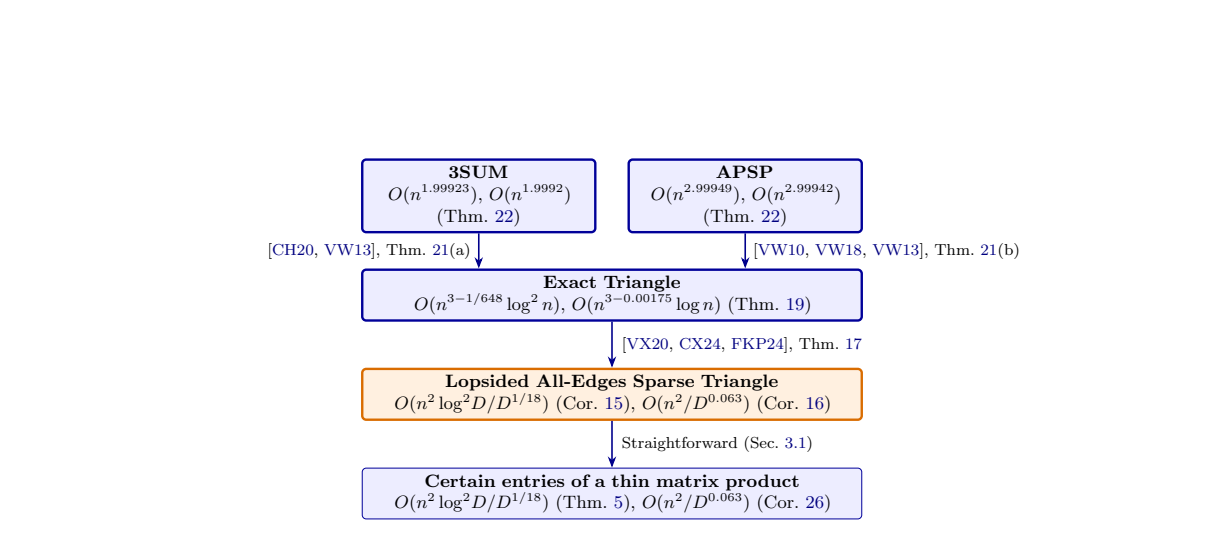
This paper claims the first polynomial improvements over the textbook algorithms for two central problems of fine-grained complexity: 3SUM on $n$ integers of polynomial size in deterministic $O(n^{1.9992})$ time, and APSP on directed $n$-vertex graphs with polynomially bounded integer weights in deterministic $O(n^{2.9995})$ time. Such improvements are exactly what the 3SUM and APSP hypotheses of fine-grained complexity rule out, so the paper claims to refute both hypotheses. The engine is a single routine: for $N\times D$ and $D\times N$ integer matrices with $D\le N^{1/18}$ and any set $W$ of at most $N^2/\sqrt{D}$ positions, it computes the product's entries at $W$ in $O(N^2/D^{0.063})$ operations, polynomially fewer than the $N^2$ operations needed just to write the product down. In graph language this counts triangles through prescribed pairs of outer vertices in a sparse lopsided tripartite graph whose third part has $n^\varepsilon$ vertices for $\varepsilon<0.12$, and by known fine-grained reductions Exact Triangle, hence 3SUM and APSP, reduce to that counting problem.
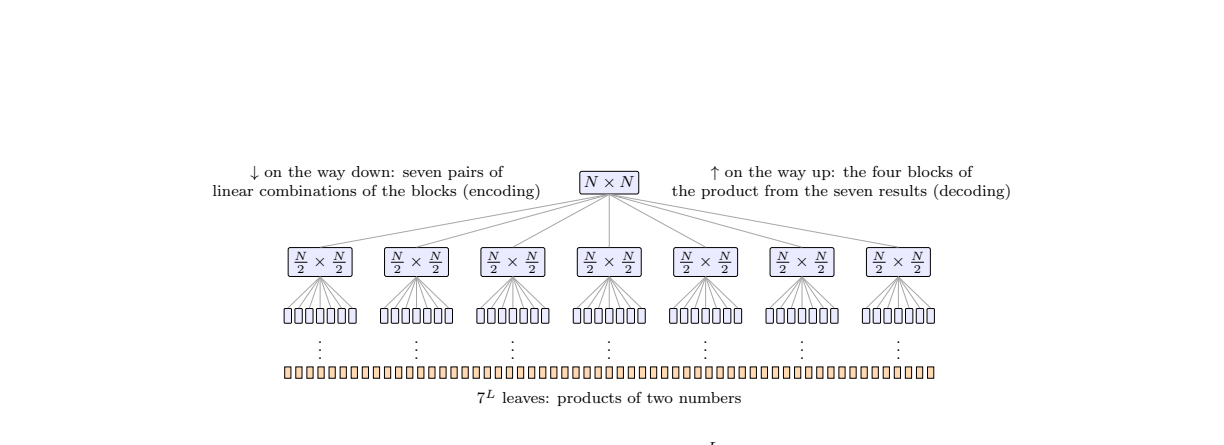
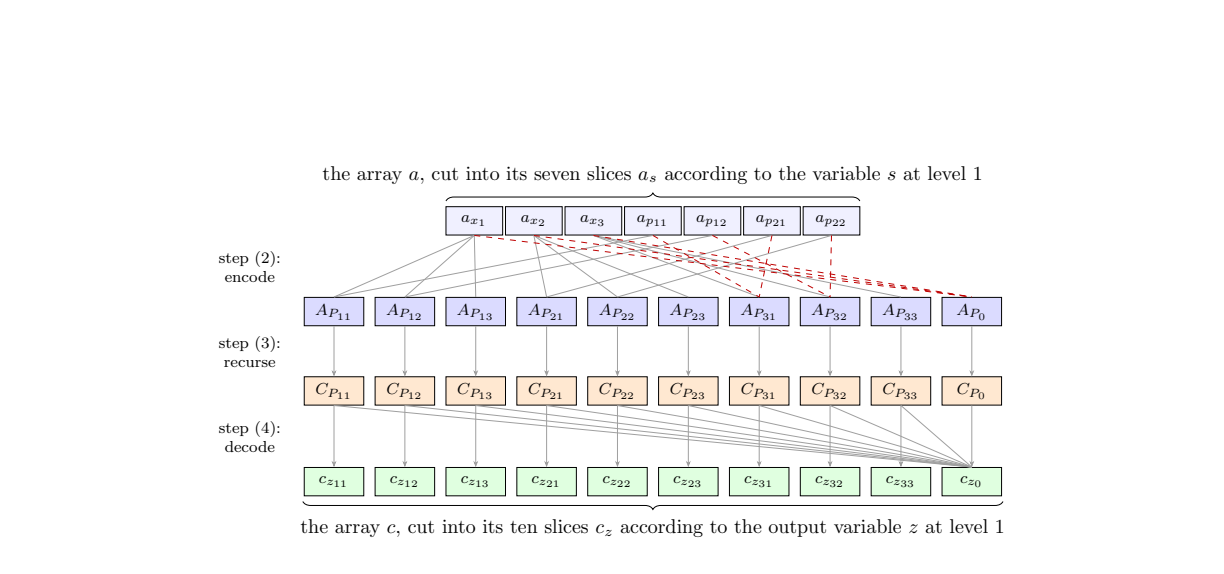
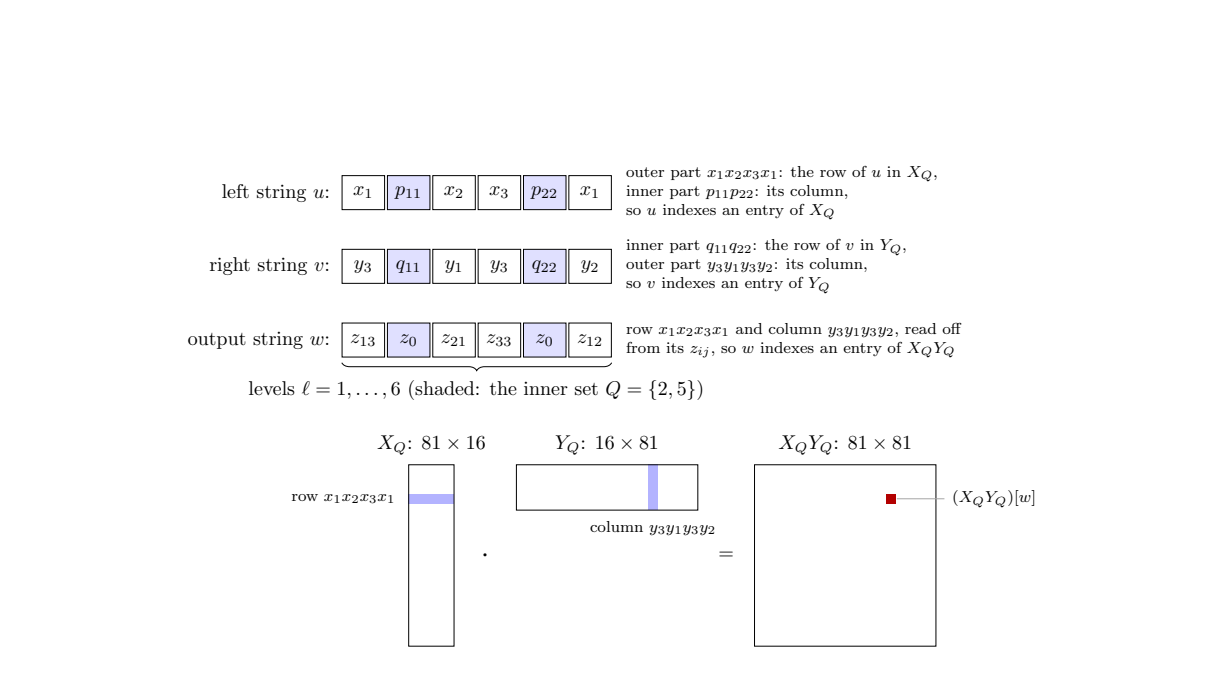
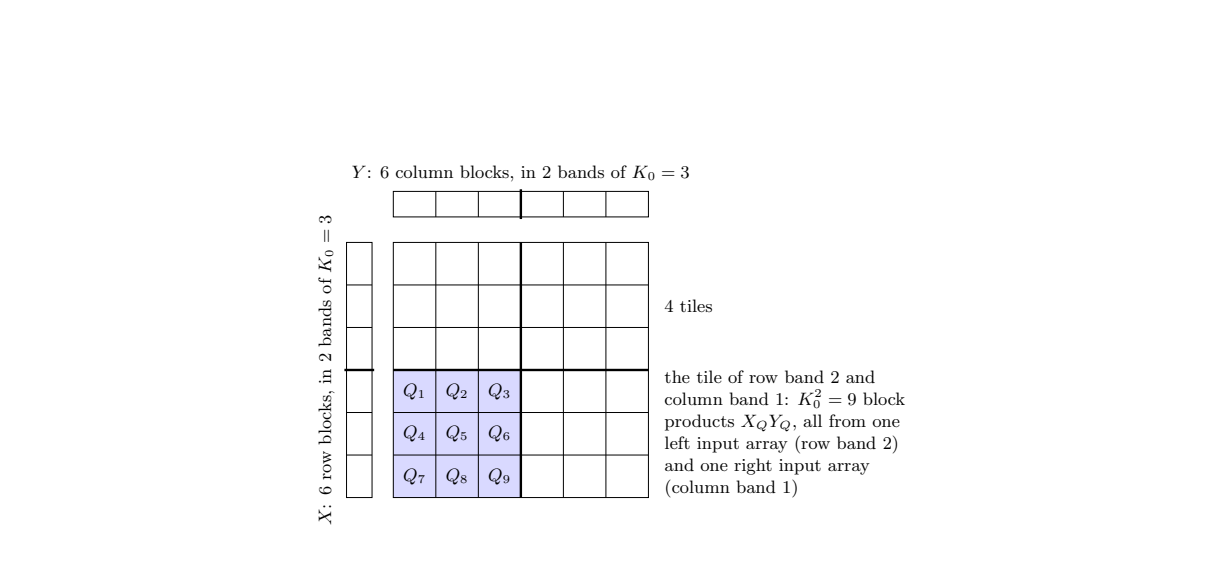
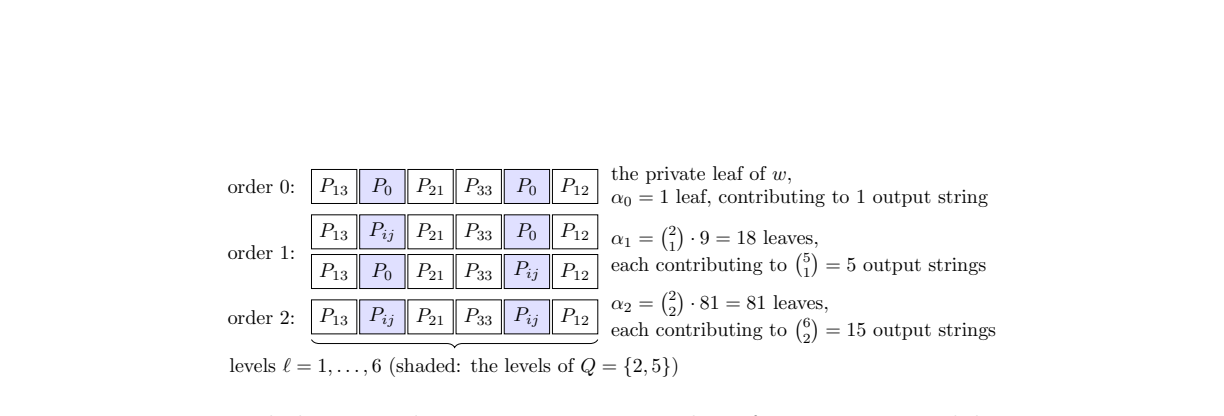
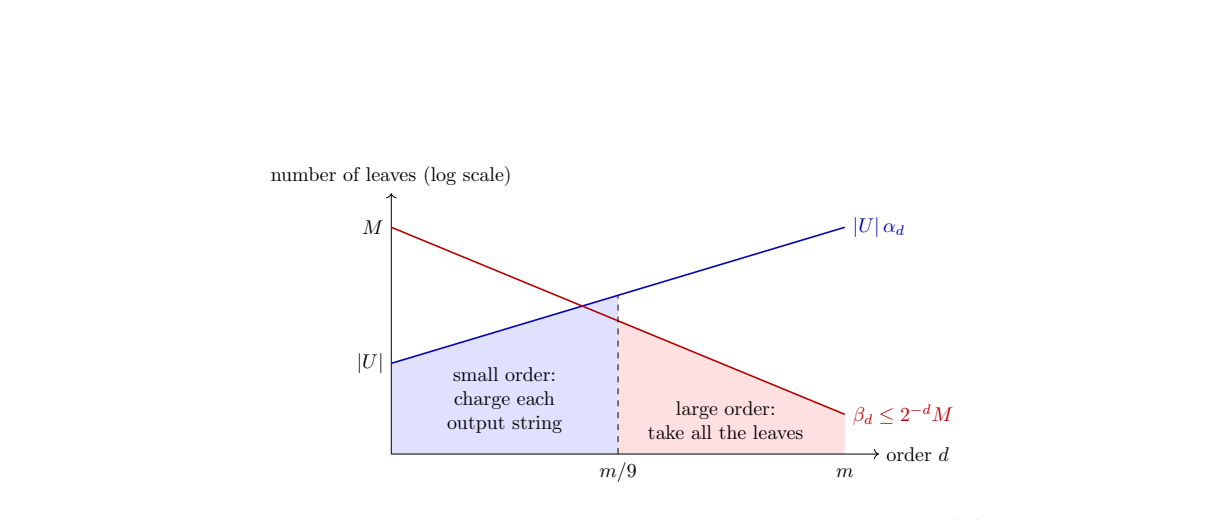
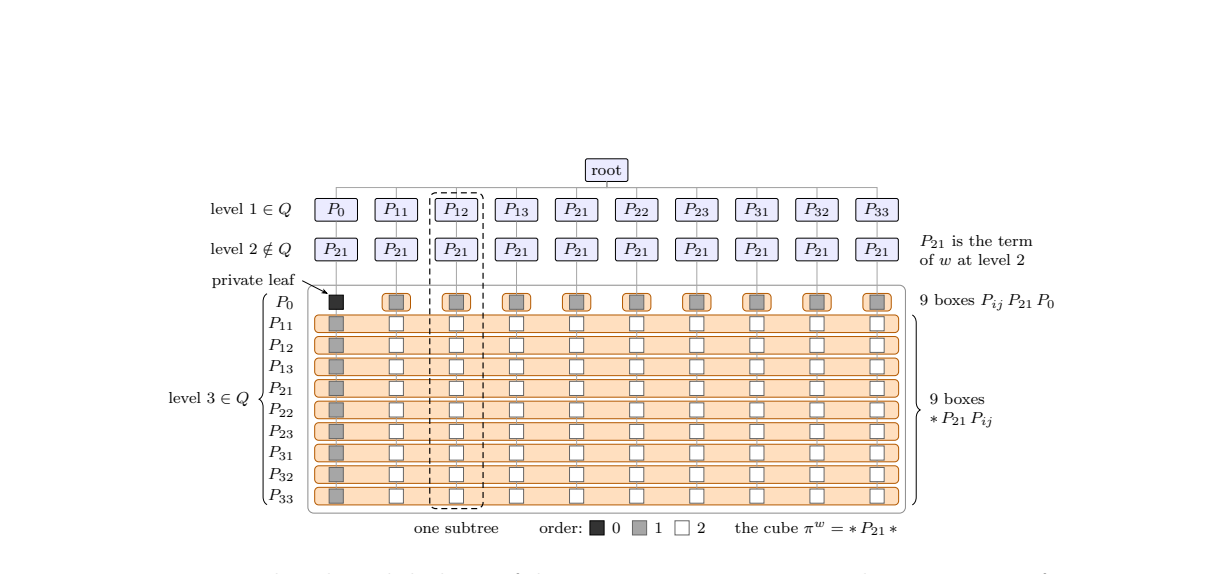
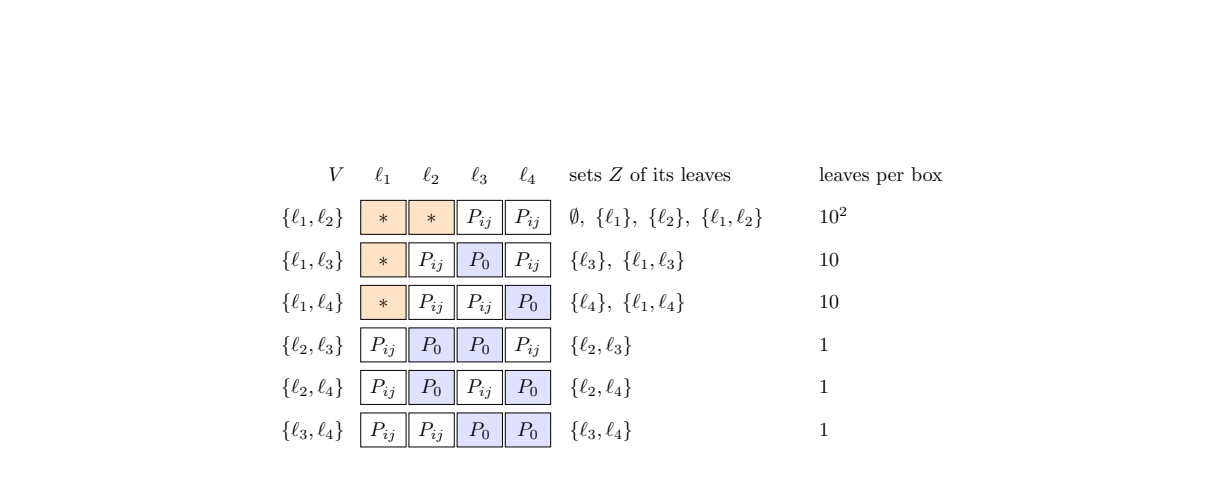
What carries the argument. The recursion iterates a ten-multiplication identity of Schonhage [Sch81] that simultaneously computes an inner product of two 4-vectors and an outer product of two 3-vectors; this is the sparsity-friendly identity the paper exploits, in place of the Coppersmith–Winograd style tensors that earlier attempts found unsuited to pruning. Applied over $L$ levels the identity computes $2^L$ matrix products at once, and with $L=19m$ each tile holds $K$ products of shape $N_0\times D\times N_0$ with $D=4^m$ and $N_0=3^{L-m}$. The paper's new move is to prune the recursion, making a recursive call only when one of its outputs is wanted: each wanted output string has a private leaf that no other string needs, but all its other leaves are shared among many output strings, and the analysis counts the union of the needed leaves rather than the sum. The crucial estimate (Lemma 11) classifies a leaf by its order — $m$ minus the number of levels where it picks the term $P_0$ that serves only the inner product — and shows with $L=19m$ that the counts $\beta_d$ of order-$d$ leaves decay geometrically, $\beta_d/\beta_{d-1}\le 9m/(18m+1)<1/2$, so that a tile with $M/\sqrt{D}$ wanted entries touches only $O(M/D^{1/18})$ leaves: each leaf is shared many times and there are fewer high-order leaves in all. The companion assumption $N\ge D^{18}$ keeps the shared encodings cheap, and the general parameterization of Section 4 (ratio $c=L/m>10$, switching order $t=\theta m$) turns this into a family of trade-offs whose best saving is $D^{0.063}$ for products with $D\le n^{0.1204}$.
Core claim. On the paper's own terms the central claim is the thin matrix product theorem (Theorem 1, sharpened as Corollary 26): for $N\ge D^{18}$, given $X\in\mathbb{Z}^{N\times D}$ and $Y\in\mathbb{Z}^{D\times N}$ with entries of magnitude $N^{O(1)}$ and any set $W$ of at most $N^2/\sqrt{D}$ positions, the entries $(XY)[I,J]$ for $(I,J)\in W$ are computed deterministically in $O(N^2/D^{0.063})$ operations on $O(\log N)$-bit integers. A data structure version preprocesses the pair $(X,Y)$ in the same $O(N^2/D^{0.063})$ time — less than the size of the product — and afterwards answers any single-entry query in $O(D^{0.437})$ time. Pipelined through known reductions the paper derives deterministic Exact Triangle in $O(n^{2.9983})$, 3SUM in $O(n^{1.9992})$, and APSP and the $(\min,+)$-product in $O(n^{2.9995})$, and with randomized (Las Vegas) algorithms over reals, 3SUM in $O(n^{1.998})$ and APSP in $O(n^{2.998})$ expected time using only comparisons, additions, and subtractions of real numbers. These are read by the authors as refuting the 3SUM and APSP hypotheses, the Exact Triangle hypothesis, the Zero-Weight $k$-Clique hypotheses, the $(\min,+)$-convolution hypothesis, and the hinted Online Matrix–Vector conjectures in the thin regime, with CNF-SAT and Orthogonal Vectors explicitly left untouched.
The premise it rests on. Everything rests on the geometric decay of the leaf counts produced by the hand-chosen recursion shape $L=19m$: if the count $\beta_d$ of order-$d$ leaves did not shrink by a factor below $1/2$ at each order, the pruned recursion would visit as many leaves as brute force and the polynomial saving over $N^2$ would vanish, and the companion condition $N\ge D^{18}$ is what keeps the shared encoding phase cheap enough for the saving to count.
If the paper is right (Pith's inferences, not the authors')
The 3SUM and APSP hypotheses are deterministically refuted: 3SUM in $O(n^{1.9992})$, and APSP together with the $(\min,+)$-product in $O(n^{2.9995})$.
Every problem equivalent to APSP or 3SUM under fine-grained reductions inherits the speedup: Negative Triangle, Replacement Paths, Minimum Weight Cycle, Tree Edit Distance, the $(\min,+)$-convolution class, Knapsack-type problems, and MonoConvolution all gain their first truly subquadratic or truly subcubic algorithms.
The Exact Triangle hypothesis falls, and with it, via the Nešetřil–Poljak folding, the Zero-, Min-, and Max-Weight $k$-Clique hypotheses ($O(n^{k-\varepsilon})$), as well as the real-valued versions of 3SUM and APSP in the Las Vegas sense.
Directed Unweighted APSP is solved in $O(n^{2+\mu-\varepsilon''})$, the first improvement over Zwick's algorithm that does not come from faster rectangular matrix multiplication.
The three hinted Online Matrix–Vector conjectures of van den Brand–Nanongkai–Saranurak are refuted in the thin-hint regime ($t=n^\tau$, $\tau<1/18$), and the data structure gives online Set Disjointness with preprocessing under $n^2$ and queries under $\sqrt{D}$ for $D\le n^{0.12}$.
The saving is parameterized and improvable: the exponent $0.063$ is an artifact of the chosen identity and recursion shape, and any identity with better leaf-sharing properties, or sharper bounds on the union of needed leaves, would raise $\gamma$ and extend the thin regime beyond $D\le n^{0.1204}$; the authors state the exponents can certainly be improved.
The recipe is a general one for sparse outputs of Kronecker-power-style computations — share encodings, visit only needed leaves, and bound the leaf union — and the paper notes its kinship with FFT pruning and trimmed Möbius inversion; one could test whether the same pruning applies to other recursive tensor decompositions beyond Schonhage's identity.
Balanced All-Edges Sparse Triangle (the $m^{4/3}$ baseline), sparse matrix multiplication, CNF-SAT, Orthogonal Vectors, and $k$-SUM for $k\ge 4$ are not touched by these techniques, so the paper's refutations do not extend to those hypotheses, and the balanced-$m^{4/3}$ version remains a natural candidate replacement hypothesis.
The algorithmic frame is reduction-as-algorithm: hypotheses built to explain why 3SUM and APSP were hard are converted into the mechanism of their speedup; if the construction is right, the same web of reductions makes a single algorithm the source of many results at once.
Check this review
Pith stored no record of this review's passes and took no fingerprint of it. Reviews made by code from 13 Nov 2026 on carry both.
How often reviews like this one are right
Reviews like this one: written by deepseek-v4-flash, where what was read was not recorded.
How often objections from reviews like this one are right: not yet measured
Reviews by people
This review was written by a machine. No person has reviewed this paper on Pith yet. A scientist listed on Pith can review it for a fee, and their review is published here whatever it concludes.
The paper
Abstract
We give the first polynomial improvements over the textbook algorithms for 3SUM and All-Pairs Shortest Paths (APSP): we show how to deterministically solve 3SUM on n integers of polynomial size in O(n1.9992) time and APSP on directed n-vertex graphs with polynomially bounded integer weights in O(n2.9995) time. This refutes the 3SUM and APSP hypotheses. Using known reductions, we also refute the real-valued versions of the 3SUM and APSP hypotheses, the Exact Triangle hypothesis, the Zero-Weight k-Clique hypotheses, and the three rectangular hinted Online Matrix–Vector conjectures of van den Brand, Nanongkai, and Saranurak, and we give polynomial speedups for a variety of other problems. All of these results follow from a single new algorithm for thin matrix products. Let X be an N × D integer matrix and Y a D × N integer matrix with D ≤ N1/18, and let W be any set of at most N2/√D positions. We compute the entries (XY)[I,J], (I,J) ∈ W, in O(N2/D0.063) operations, which is polynomially less than the time needed to write down XY or to compute N2/√D inner products one by one. We design this algorithm by modifying a variant of Coppersmith's rectangular matrix multiplication algorithm, built from a ten-multiplication identity of Schönhage, to perform only the operations needed for the entries in W, and show that few operations are needed. Interpreted as a graph algorithm, this solves the All-Edges Sparse Triangle problem in truly subquadratic time on sparse lopsided tripartite graphs where two parts have n vertices but one part has nε vertices for ε < 0.12. By known reductions, Exact Triangle, and hence 3SUM and APSP, reduce to this problem. We also give a data structure version that answers queries for single entries of XY, not known in advance.
The paper's own sentences, arranged, kept beside the review and separate from it. Each label is drawn from a closed vocabulary; the number beside it is the probability the classifier gave that label. No sentence in this record was written by a model.
abstract compiled · 2026-10-06
The authors' main claim, as the classifier picked it out 0.79
“We give the first polynomial improvements over the textbook algorithms for $3$SUM and All-Pairs Shortest Paths (APSP): we show how to deterministically solve $3$SUM on $n$ integers of polynomial size in $O(n^{1.9992})$ time and APSP on directed $n$-vertex graphs with polynomially bounded integer weights in $O(n^{2.9995})$ time.”
How the main claim is stated: asserted 1.00
What the abstract itself states, as probabilities: claims first 0.94 · states limitation 0.37 · human participants 0.01 · controlled comparison 0.05 · randomized assignment 0.01 · states quantitative result 0.99 · compares with prior results 0.88 · mentions code or data availability 0.02
The abstract, sentence by sentence
This table labels the abstract only (arXiv listing abstract v1). The number is the probability the classifier gave the label.
| Sentence | Role | The authors' own work | States the main conclusion | Strength |
|---|---|---|---|---|
| We give the first polynomial improvements over the textbook algorithms for $3$SUM and All-Pairs Shortest Paths (APSP): we show how to deterministically solve $3$SUM on $n$ integers of polynomial size in $O(n^{1.9992})$ time and APSP on directed $n$-vertex graphs with polynomially bounded integer weights in $O(n^{2.9995})$ time. | contribution 0.53 | 0.97 | 0.82 | asserted 1.00 |
| This refutes the $3$SUM and APSP hypotheses. | interpretation 0.97 | 0.74 | 0.43 | asserted 1.00 |
| Using known reductions, we also refute the real-valued versions of the $3$SUM and APSP hypotheses, the Exact Triangle hypothesis, the Zero-Weight $k$-Clique hypotheses, and the three rectangular hinted Online Matrix--Vector conjectures of van den Brand, Nanongkai, and Saranurak, and we give polynomial speedups for a variety of other problems. | interpretation 0.50 | 0.88 | 0.18 | asserted 1.00 |
| All of these results follow from a single new algorithm for thin matrix products. | contribution 0.58 | 0.86 | 0.12 | asserted 1.00 |
| Let $X$ be an $N\times D$ integer matrix and $Y$ a $D\times N$ integer matrix with $D\le N^{1/18}$, and let $W$ be any set of at most $N^2/\sqrt D$ positions. | method 0.56 | 0.36 | 0.03 | asserted 0.57 |
| We compute the entries $(XY)[I,J]$, $(I,J)\in W$, in $O(N^2/D^{0.063})$ operations, which is polynomially less than the time needed to write down $XY$ or to compute $N^2/\sqrt D$ inner products one by one. | result 0.70 | 0.96 | 0.11 | asserted 1.00 |
| We design this algorithm by modifying a variant of Coppersmith's rectangular matrix multiplication algorithm, built from a ten-multiplication identity of Sch\"onhage, to perform only the operations needed for the entries in $W$, and show that few operations are needed. | method 0.98 | 0.92 | 0.03 | asserted 1.00 |
| Interpreted as a graph algorithm, this solves the All-Edges Sparse Triangle problem in truly subquadratic time on sparse lopsided tripartite graphs where two parts have $n$ vertices but one part has $n^{\varepsilon}$ vertices for $\varepsilon<0.12$. | interpretation 0.80 | 0.92 | 0.12 | asserted 1.00 |
| By known reductions, Exact Triangle, and hence $3$SUM and APSP, reduce to this problem. | interpretation 0.32 | 0.21 | 0.09 | asserted 1.00 |
| We also give a data structure version that answers queries for single entries of $XY$, not known in advance. | contribution 0.92 | 0.95 | 0.03 | asserted 1.00 |
What kind of paper the classifier reports this is: theoretical result 0.53 · evidence from proof or derivation 1.00
What was examined, and what was not
Sources read
- arXiv listing abstract v1
Not examined
- full text
- figures and tables
- references and citing sentences
- relations to other papers
Levels run
- P abstract
Not run
- S sections
- T body sentences
- C citations
- R cross-paper relations
How the labels were made
Compiled by classifier-1.13.0 via TypeSafe API, question bank abstract-p1-20260923, 2026-10-06: 1 request, 8,154 input tokens.
Every quoted sentence on this record is the authors'. Every label is from Pith's closed vocabulary, with the probability shown beside it. This record as JSON
Figures (10)
Figures are the authors', reproduced from the paper.
References (102)
- [1] [ABF23] Amir Abboud, Karl Bringmann, and Nick Fischer. Stronger 3-SUM lower bounds for approximate distance oracles via additive combinatorics. InProc. 55th ACM Symposium on Theory of Computing (STOC 2023), pages 391–404, on Pith
- [6] [ACLL14] Amihood Amir, Timothy M. Chan, Moshe Lewenstein, and Noa Lewenstein. On hardness of jumbled indexing. InProc. 41st International Colloquium on Automata, Languages, and Programming (ICALP 2014), volume 8572 ofLNCS, pages 114–125, on Pith
- [11] [AFW20] Amir Abboud, Shon Feller, and Oren Weimann. On the fine-grained complexity of parity problems. InProc. 47th International Colloquium on Automata, Languages, and Programming (ICALP 2020), volume 168 ofLIPIcs, pages 5:1–5:19, on Pith
- [15] [AL13] Amir Abboud and Kevin Lewi. Exact weight subgraphs and the k-sum conjecture. InProc. 40th International Colloquium on Automata, Languages, and Programming (ICALP 2013), volume 7965 ofLNCS, pages 1–12, on Pith
- [17] arXiv:2509.14489. [ALW14] Amir Abboud, Kevin Lewi, and Ryan Williams. Losing weight by gaining edges. InProc. 22nd European Symposium on Algorithms (ESA 2014), volume 8737 of LNCS, pages 1–12, on PitharXiv
- [20] [AVW14] Amir Abboud, Virginia Vassilevska Williams, and Oren Weimann. Consequences of faster alignment of sequences. InProc. 41st International Colloquium on Automata, Languages, and Programming (ICALP 2014), volume 8572 ofLNCS, pages 39–51, on Pith
- [21] 65 [AVY15] Amir Abboud, Virginia Vassilevska Williams, and Huacheng Yu. Matching triangles and basing hardness on an extremely popular conjecture. InProc. 47th ACM Symposium on Theory of Computing (STOC 2015), pages 41–50, on Pith
- [23] [AWY15] Amir Abboud, Ryan Williams, and Huacheng Yu. More applications of the polyno- mial method to algorithm design. InProc. 26th ACM-SIAM Symposium on Discrete Algorithms (SODA 2015), pages 218–230, on Pith
- [24] [AY25] Josh Alman and Hantao Yu. Improving the leading constant of matrix multiplication. InProc. 36th ACM-SIAM Symposium on Discrete Algorithms (SODA 2025), pages 1933–1971, on Pith
- [25] [BB15] Austin R. Benson and Grey Ballard. A framework for practical parallel fast matrix multiplication. InProc. 20th ACM SIGPLAN Symposium on Principles and Practice of Parallel Programming (PPoPP 2015), pages 42–53, on Pith
- [27] [BFN26] Karl Bringmann, Nick Fischer, and Vasileios Nakos. Robustifying sparse matrix multiplication. InProc. 34th European Symposium on Algorithms (ESA 2026), volume 388 ofLIPIcs, pages 157:1–157:25, on Pith
- [29] Full version: arXiv:2508.10250. [BGMW20] Karl Bringmann, Pawe l Gawrychowski, Shay Mozes, and Oren Weimann. Tree edit distance cannot be computed in strongly subcubic time (unless APSP can).ACM Transactions on Algorithms, 16(4):48:1–48:22, on PithPith's reviewarXiv
- [34] [BS19] Gal Beniamini and Oded Schwartz. Faster matrix multiplication via sparse de- composition. InProc. 31st ACM Symposium on Parallelism in Algorithms and Architectures (SPAA 2019), pages 11–22, on Pith
- [35] [BW09] Nikhil Bansal and Ryan Williams. Regularity lemmas and combinatorial algorithms. InProc. 50th IEEE Symposium on Foundations of Computer Science (FOCS 2009), pages 745–754, on Pith
- [36] [CGI+16] Marco L. Carmosino, Jiawei Gao, Russell Impagliazzo, Ivan Mihajlin, Ramamohan Paturi, and Stefan Schneider. Nondeterministic extensions of the strong exponential time hypothesis and consequences for non-reducibility. InProc. 7th ACM Conference on Innovations in Theore... on Pith
- [37] [CH20] Timothy M. Chan and Qizheng He. Reducing 3SUM to convolution-3SUM. InProc. 3rd SIAM Symposium on Simplicity in Algorithms (SOSA 2020), pages 1–7, on Pith
- [38] [Cha10] Timothy M. Chan. More algorithms for all-pairs shortest paths in weighted graphs. SIAM Journal on Computing, 39(5):2075–2089, on Pith
- [41] [CIP10] Chris Calabro, Russell Impagliazzo, and Ramamohan Paturi. On the exact com- plexity of evaluating quantified k-CNF. InProc. 5th International Symposium on Parameterized and Exact Computation (IPEC 2010), volume 6478 ofLNCS, pages 50–59, on Pith
- [44] Full version: arXiv:2102.06181, whose numbering we follow. [CVX22] Timothy M. Chan, Virginia Vassilevska Williams, and Yinzhan Xu. Hardness for triangle problems under even more believable hypotheses: Reductions from real APSP, real 3SUM, and OV. InProc. 54th ACM Symposium on ... on PithPith's reviewarXiv
- [45] Full version: arXiv:2203.08356, whose numbering we follow. 68 [CVX23] Timothy M. Chan, Virginia Vassilevska Williams, and Yinzhan Xu. Fredman’s trick meets dominance product: Fine-grained complexity of unweighted APSP, 3SUM counting, and more. InProc. 55th ACM Symposium on The... on PithPith's reviewarXiv
show 80 more
- [46] [CX24] Timothy M. Chan and Yinzhan Xu. Simpler reductions from exact triangle. In Proc. 7th SIAM Symposium on Simplicity in Algorithms (SOSA 2024), pages 28–38, on Pith
- [47] [DEK+26] Emilien Dupont, Marvin Eisenberger, Borislav Kozlovskii, Abbas Mehrabian, Fran- cisco J. R. Ruiz, Abigail See, Renfei Zhou, Josh Alman, Virginia Vassilevska Williams, and Matej Balog. Improving the matrix multiplication exponent with modern optimization and AlphaEvolv... on PithPith's reviewarXiv
- [48] [DGS20] Bart lomiej Dudek, Pawe l Gawrychowski, and Tatiana Starikovskaya. All non-trivial variants of 3-LDT are equivalent. InProc. 52nd ACM Symposium on Theory of Computing (STOC 2020), pages 974–981, on Pith
- [51] [Eri99] Jeff Erickson. Lower bounds for linear satisfiability problems.Chicago Journal of Theoretical Computer Science, 1999(8), on Pith
- [53] [Fis26] Nick Fischer. Universe reduction for APSP: Equivalence of three fine-grained hypotheses. InProc. 58th ACM Symposium on Theory of Computing (STOC 2026), pages 922–932, on Pith
- [54] [FJX25] Nick Fischer, Ce Jin, and Yinzhan Xu. New applications of 3SUM-counting in fine- grained complexity and pattern matching. InProc. 36th ACM-SIAM Symposium on Discrete Algorithms (SODA 2025), pages 4547–4595, on Pith
- [55] [FKP24] Nick Fischer, Piotr Kaliciak, and Adam Polak. Deterministic 3SUM-hardness. In Proc. 15th Innovations in Theoretical Computer Science Conference (ITCS 2024), volume 287 ofLIPIcs, pages 49:1–49:24, on Pith
- [56] Full version: arXiv:2310.12913, whose numbering we follow. [Flo62] Robert W. Floyd. Algorithm 97: Shortest path.Communications of the ACM, 5(6):345, on PithPith's reviewarXiv
- [59] [GKLP17] Isaac Goldstein, Tsvi Kopelowitz, Moshe Lewenstein, and Ely Porat. Conditional lower bounds for space/time tradeoffs. InProc. 15th Algorithms and Data Structures Symposium (WADS 2017), volume 10389 ofLNCS, pages 421–436, on Pith
- [60] [GLP19] Isaac Goldstein, Moshe Lewenstein, and Ely Porat. On the hardness of set dis- jointness and set intersection with bounded universe. InProc. 30th International Symposium on Algorithms and Computation (ISAAC 2019), volume 149 ofLIPIcs, pages 7:1–7:22, on Pith
- [62] [GS17] Omer Gold and Micha Sharir. Improved bounds for 3SUM, k-SUM, and linear de- generacy. InProc. 25th European Symposium on Algorithms (ESA 2017), volume 87 ofLIPIcs, pages 42:1–42:13, on Pith
- [63] [HKNS15] Monika Henzinger, Sebastian Krinninger, Danupon Nanongkai, and Thatchaphol Saranurak. Unifying and strengthening hardness for dynamic problems via the online matrix-vector multiplication conjecture. InProc. 47th ACM Symposium on Theory of Computing (STOC 2015), pages 21–30, on Pith
- [64] [HLS24] Bernhard Haeupler, Yaowei Long, and Thatchaphol Saranurak. Dynamic deter- ministic constant-approximate distance oracles with nϵ worst-case update time. In Proc. 65th IEEE Symposium on Foundations of Computer Science (FOCS 2024), pages 2033–2044, on Pith
- [66] [JX23] Ce Jin and Yinzhan Xu. Removing additive structure in 3SUM-based reductions. In Proc. 55th ACM Symposium on Theory of Computing (STOC 2023), pages 405–418, on Pith
- [67] [KM23] Manuel Kauers and Jakob Moosbauer. Flip graphs for matrix multiplication. InProc. 48th International Symposium on Symbolic and Algebraic Computation (ISSAC 2023), pages 381–388, on Pith
- [68] [KP19] Tsvi Kopelowitz and Ely Porat. The strong 3SUM-INDEXING conjecture is false. arXiv:1907.11206, on PithPith's reviewarXiv
- [69] [KPP16] Tsvi Kopelowitz, Seth Pettie, and Ely Porat. Higher lower bounds from the 3SUM conjecture. InProc. 27th ACM-SIAM Symposium on Discrete Algorithms (SODA 2016), pages 1272–1287, on Pith
- [70] [KPS17] Marvin K¨ unnemann, Ramamohan Paturi, and Stefan Schneider. On the fine-grained complexity of one-dimensional dynamic programming. InProc. 44th International Colloquium on Automata, Languages, and Programming (ICALP 2017), volume 80 ofLIPIcs, pages 21:1–21:15, on Pith
- [71] [KV20] Tsvi Kopelowitz and Virginia Vassilevska Williams. Towards optimal set-disjointness and set-intersection data structures. InProc. 47th International Colloquium on Automata, Languages, and Programming (ICALP 2020), volume 168 ofLIPIcs, pages 74:1–74:16, on Pith
- [72] [LG12] Fran¸ cois Le Gall. Faster algorithms for rectangular matrix multiplication. InProc. 53rd IEEE Symposium on Foundations of Computer Science (FOCS 2012), pages 514–523, on Pith
- [75] Full version: arXiv:2009.14479, whose statement of Theorem 8 we follow. [LU18] Fran¸ cois Le Gall and Florent Urrutia. Improved rectangular matrix multiplication using powers of the Coppersmith–Winograd tensor. InProc. 29th ACM-SIAM Symposium on Discrete Algorithms (SODA 2018)... on PithPith's reviewarXiv
- [76] [LVW18] Andrea Lincoln, Virginia Vassilevska Williams, and R. Ryan Williams. Tight hardness for shortest cycles and paths in sparse graphs. InProc. 29th ACM-SIAM Symposium on Discrete Algorithms (SODA 2018), pages 1236–1252, on Pith
- [77] [LVWW16] Andrea Lincoln, Virginia Vassilevska Williams, Joshua R. Wang, and R. Ryan Williams. Deterministic time-space trade-offs fork-SUM. InProc. 43rd International Colloquium on Automata, Languages, and Programming (ICALP 2016), volume 55 ofLIPIcs, pages 58:1–58:14, on Pith
- [78] [Mao21] Xiao Mao. Breaking the cubic barrier for (unweighted) tree edit distance. InProc. 62nd IEEE Symposium on Foundations of Computer Science (FOCS 2021), pages 792–803, on Pith
- [80] [NPS+25] Jakob Nogler, Adam Polak, Barna Saha, Virginia Vassilevska Williams, Yinzhan Xu, and Christopher Ye. Faster weighted and unweighted tree edit distance and APSP equivalence. InProc. 57th ACM Symposium on Theory of Computing (STOC 2025), pages 2167–2178, on Pith
- [81] [NVE+25] Alexander Novikov, Ngˆ an V˜ u, Marvin Eisenberger, Emilien Dupont, Po-Sen Huang, Adam Zsolt Wagner, Sergey Shirobokov, Borislav Kozlovskii, Francisco J. R. Ruiz, 73 Abbas Mehrabian, M. Pawan Kumar, Abigail See, Swarat Chaudhuri, George Holland, Alex Davies, Sebastian... on PithPith's reviewarXiv
- [82] [P˘ at10] Mihai P˘ atra¸ scu. Towards polynomial lower bounds for dynamic problems. InProc. 42nd ACM Symposium on Theory of Computing (STOC 2010), pages 603–610, on Pith
- [83] [PS14] Rasmus Pagh and Morten St¨ ockel. The input/output complexity of sparse matrix multiplication. InProc. 22nd European Symposium on Algorithms (ESA 2014), volume 8737 ofLNCS, pages 750–761, on Pith
- [84] [RV11] Liam Roditty and Virginia Vassilevska Williams. Minimum weight cycles and trian- gles: Equivalences and algorithms. InProc. 52nd IEEE Symposium on Foundations of Computer Science (FOCS 2011), pages 180–189, on Pith
- [86] [RZ04] Liam Roditty and Uri Zwick. On dynamic shortest paths problems. InProc. 12th European Symposium on Algorithms (ESA 2004), volume 3221 ofLNCS, pages 580–591, on Pith
- [87] [San04] Piotr Sankowski. Dynamic transitive closure via dynamic matrix inverse. InProc. 45th IEEE Symposium on Foundations of Computer Science (FOCS 2004), pages 509–517, on Pith
- [91] [Tak04] Tadao Takaoka. A faster algorithm for the all-pairs shortest path problem and its application. InProc. 10th International Computing and Combinatorics Conference (COCOON 2004), volume 3106 ofLNCS, pages 278–289, on Pith
- [93] [vdBNS19] Jan van den Brand, Danupon Nanongkai, and Thatchaphol Saranurak. Dynamic matrix inverse: Improved algorithms and matching conditional lower bounds. In Proc. 60th IEEE Symposium on Foundations of Computer Science (FOCS 2019), pages 456–480, on Pith
- [94] Full version: arXiv:1905.05067. [vdBSZ24] Jan van den Brand, Zhao Song, and Tianyi Zhou. Algorithm and hardness for dynamic attention maintenance in large language models. InProc. 41st International Conference on Machine Learning (ICML 2024), volume 235 ofPMLR, pages 49008– 49028, on PithPith's reviewarXiv
- [95] [VW10] Virginia Vassilevska Williams and Ryan Williams. Subcubic equivalences between path, matrix and triangle problems. InProc. 51st IEEE Symposium on Foundations of Computer Science (FOCS 2010), pages 645–654, on Pith
- [96] [VX20] Virginia Vassilevska Williams and Yinzhan Xu. Monochromatic triangles, triangle listing and APSP. InProc. 61st IEEE Symposium on Foundations of Computer Science (FOCS 2020), pages 786–797, on Pith
- [97] Full version: arXiv:2007.09318, whose numbering we follow. 75 [VXXZ24] Virginia Vassilevska Williams, Yinzhan Xu, Zixuan Xu, and Renfei Zhou. New bounds for matrix multiplication: From alpha to omega. InProc. 35th ACM-SIAM Symposium on Discrete Algorithms (SODA 2024), pages 3792–3835, on PithPith's reviewarXiv
- [98] [Wil14] R. Ryan Williams. The polynomial method in circuit complexity applied to algorithm design (invited talk). InProc. 34th International Conference on Foundation of Software Technology and Theoretical Computer Science (FSTTCS 2014), volume 29 ofLIPIcs, pages 47–60, on Pith
- [99] [Wil16] R. Ryan Williams. Strong ETH breaks with Merlin and Arthur: Short non- interactive proofs of batch evaluation. InProc. 31st Computational Complexity Conference (CCC 2016), volume 50 ofLIPIcs, pages 2:1–2:17, on Pith
- [100] [Wil18] R. Ryan Williams. Faster all-pairs shortest paths via circuit complexity.SIAM Journal on Computing, 47(5):1965–1985, on Pith
- [101] [Wil24] R. Ryan Williams. The orthogonal vectors conjecture and non-uniform circuit lower bounds. InProc. 65th IEEE Symposium on Foundations of Computer Science (FOCS 2024), pages 1372–1387, on Pith
- [102] [YZ05a] Raphael Yuster and Uri Zwick. Answering distance queries in directed graphs using fast matrix multiplication. InProc. 46th IEEE Symposium on Foundations of Computer Science (FOCS 2005), pages 389–396, on Pith
- [666] In Proc. SIAM Conference on Applied and Computational Discrete Algorithms (ACDA 2025), pages 47–60, on Pith
- [1962] [FM71] Michael J. Fischer and Albert R. Meyer. Boolean matrix multiplication and transitive closure. InProc. 12th Symposium on Switching and Automata Theory (SWAT 1971), pages 129–131, on Pith
- [1965] [CVX21] Timothy M. Chan, Virginia Vassilevska Williams, and Yinzhan Xu. Algorithms, reductions and equivalences for small weight variants of all-pairs shortest paths. InProc. 48th International Colloquium on Automata, Languages, and Program- ming (ICALP 2021), volume 198 ofLIP... on Pith
- [1970] [ADV+25] Josh Alman, Ran Duan, Virginia Vassilevska Williams, Yinzhan Xu, Zixuan Xu, and Renfei Zhou. More asymmetry yields faster matrix multiplication. InProc. 36th ACM-SIAM Symposium on Discrete Algorithms (SODA 2025), pages 2005–2039, on Pith
- [1973] [SVX27] Nathan Sheffield, Virginia Vassilevska Williams, and Zoe Xi. The limits of black-box reductions for all-pairs triangle detection. InProc. 38th ACM-SIAM Symposium on Discrete Algorithms (SODA 2027), on Pith
- [1974] [AHY25] Josh Alman, Yizhi Huang, and Kevin Yeo. Fine-grained complexity in a world without cryptography. InAdvances in Cryptology – EUROCRYPT 2025, Part VII, volume 15607 ofLNCS, pages 375–405, on Pith
- [1975] [LPV20] Andrea Lincoln, Adam Polak, and Virginia Vassilevska Williams. Monochromatic triangles, intermediate matrix products, and convolutions. InProc. 11th Innovations in Theoretical Computer Science Conference (ITCS 2020), volume 151 ofLIPIcs, pages 53:1–53:18, on Pith
- [1976] [GGH+20] Alexander Golovnev, Siyao Guo, Thibaut Horel, Sunoo Park, and Vinod Vaikun- tanathan. Data structures meet cryptography: 3SUM with preprocessing. InProc. 52nd ACM Symposium on Theory of Computing (STOC 2020), pages 294–307, on Pith
- [1978] [Jin24] Ce Jin. 0-1 knapsack in nearly quadratic time. InProc. 56th ACM Symposium on Theory of Computing (STOC 2024), pages 271–282, on Pith
- [1979] [CIO16] Jean Cardinal, John Iacono, and Aur´ elien Ooms. Solvingk-SUM using few linear queries. InProc. 24th European Symposium on Algorithms (ESA 2016), volume 57 ofLIPIcs, pages 25:1–25:17, on Pith
- [1980] [BIS17] Arturs Backurs, Piotr Indyk, and Ludwig Schmidt. Better approximations for tree sparsity in nearly-linear time. InProc. 28th ACM-SIAM Symposium on Discrete Algorithms (SODA 2017), pages 2215–2229, on Pith
- [1981] [Sch99] Uwe Sch¨ oning. A probabilistic algorithm for k-SAT and constraint satisfaction problems. InProc. 40th IEEE Symposium on Foundations of Computer Science (FOCS 1999), pages 410–414, on Pith
- [1985] [Coo71] Stephen A. Cook. The complexity of theorem-proving procedures. InProc. 3rd ACM Symposium on Theory of Computing (STOC 1971), pages 151–158, on Pith
- [1990] [DSW18] Martin Dietzfelbinger, Philipp Schlag, and Stefan Walzer. A subquadratic algorithm for 3XOR. InProc. 43rd International Symposium on Mathematical Foundations of Computer Science (MFCS 2018), volume 117 ofLIPIcs, pages 59:1–59:15, on Pith
- [1992] [AGV15] Amir Abboud, Fabrizio Grandoni, and Virginia Vassilevska Williams. Subcubic equivalences between graph centrality problems, APSP and diameter. InProc. 26th ACM-SIAM Symposium on Discrete Algorithms (SODA 2015), pages 1681–1697, on Pith
- [1996] [AP09] Rasmus Resen Amossen and Rasmus Pagh. Faster join-projects and sparse matrix multiplications. InProc. 12th International Conference on Database Theory (ICDT 2009), pages 121–126, on Pith
- [1997] 64 [AGMN92] Noga Alon, Zvi Galil, Oded Margalit, and Moni Naor. Witnesses for Boolean matrix multiplication and for shortest paths. InProc. 33rd IEEE Symposium on Foundations of Computer Science (FOCS 1992), pages 417–426, on Pith
- [1998] [Vas18] Virginia Vassilevska Williams. On some fine-grained questions in algorithms and complexity. InProceedings of the International Congress of Mathematicians (ICM 2018), pages 3447–3487. World Scientific, on Pith
- [1999] [ES17] Esther Ezra and Micha Sharir. A nearly quadratic bound for the decision tree complexity of k-SUM. InProc. 33rd International Symposium on Computational Geometry (SoCG 2017), volume 77 ofLIPIcs, pages 41:1–41:15, on Pith
- [2005] [ACJ+22] Shyan Akmal, Lijie Chen, Ce Jin, Malvika Raj, and Ryan Williams. Improved Merlin–Arthur protocols for central problems in fine-grained complexity. InProc. 13th Innovations in Theoretical Computer Science Conference (ITCS 2022), volume 215 ofLIPIcs, pages 3:1–3:25, on Pith
- [2008] [BDT16] Arturs Backurs, Nishanth Dikkala, and Christos Tzamos. Tight hardness results for maximum weight rectangles. InProc. 43rd International Colloquium on Automata, Languages, and Programming (ICALP 2016), volume 55 ofLIPIcs, pages 81:1–81:13, on Pith
- [2009] [AV14] Amir Abboud and Virginia Vassilevska Williams. Popular conjectures imply strong lower bounds for dynamic problems. InProc. 55th IEEE Symposium on Foundations of Computer Science (FOCS 2014), pages 434–443, on Pith
- [2010] [Cha15] Timothy M. Chan. Speeding up the four Russians algorithm by about one more logarithmic factor. InProc. 26th ACM-SIAM Symposium on Discrete Algorithms (SODA 2015), pages 212–217, on Pith
- [2011] [RV12] Liam Roditty and Virginia Vassilevska Williams. Subquadratic time approxima- tion algorithms for the girth. InProc. 23rd ACM-SIAM Symposium on Discrete Algorithms (SODA 2012), pages 833–845, on Pith
- [2012] [LLV19] Rio LaVigne, Andrea Lincoln, and Virginia Vassilevska Williams. Public-key cryptography in the fine-grained setting. InAdvances in Cryptology – CRYPTO 2019, Part III, volume 11694 ofLNCS, pages 605–635, on Pith
- [2013] [AL25] Josh Alman and Baitian Li. Kronecker powers, orthogonal vectors, and the asymp- totic spectrum. InProc. 66th IEEE Symposium on Foundations of Computer Science (FOCS 2025), pages 1411–1441, on Pith
- [2014] [ACW16] Josh Alman, Timothy M. Chan, and Ryan Williams. Polynomial representations of threshold functions and algorithmic applications. InProc. 57th IEEE Symposium on Foundations of Computer Science (FOCS 2016), pages 467–476, on Pith
- [2015] [AW15] Josh Alman and Ryan Williams. Probabilistic polynomials and Hamming nearest neighbors. InProc. 56th IEEE Symposium on Foundations of Computer Science (FOCS 2015), pages 136–150, on Pith
- [2016] [ACW20] Josh Alman, Timothy M. Chan, and R. Ryan Williams. Faster deterministic and Las Vegas algorithms for offline approximate nearest neighbors in high dimensions. InProc. 31st ACM-SIAM Symposium on Discrete Algorithms (SODA 2020), pages 637–649, on Pith
- [2017] [BN21] Karl Bringmann and Vasileios Nakos. A fine-grained perspective on approximating subset sum and partition. InProc. 32nd ACM-SIAM Symposium on Discrete Algorithms (SODA 2021), pages 1797–1815, on Pith
- [2018] [Gra26] Omar Graia. Optimal deterministic fully sparse matrix multiplication. arXiv:2608.18496, on PithPith's reviewarXiv
- [2019] [Bri24] Karl Bringmann. Knapsack with small items in near-quadratic time. InProc. 56th ACM Symposium on Theory of Computing (STOC 2024), pages 259–270, on Pith
- [2020] [DKPV20] Lech Duraj, Krzysztof Kleiner, Adam Polak, and Virginia Vassilevska Williams. Equivalences between triangle and range query problems. InProc. 31st ACM-SIAM Symposium on Discrete Algorithms (SODA 2020), pages 30–47, on Pith
- [2021] [Bri19] Karl Bringmann. Fine-grained complexity theory (tutorial). InProc. 36th Inter- national Symposium on Theoretical Aspects of Computer Science (STACS 2019), volume 126 ofLIPIcs, pages 4:1–4:7, on Pith
- [2022] Full version: arXiv:2204.10465. [AC05] Nir Ailon and Bernard Chazelle. Lower bounds for linear degeneracy testing.Journal of the ACM, 52(2):157–171, on PithPith's reviewarXiv
- [2023] [ABFK24] Amir Abboud, Karl Bringmann, Nick Fischer, and Marvin K¨ unnemann. The time complexity of fully sparse matrix multiplication. InProc. 35th ACM-SIAM Symposium on Discrete Algorithms (SODA 2024), pages 4670–4703, on Pith
- [2024] 63 [ABKZ22] Amir Abboud, Karl Bringmann, Seri Khoury, and Or Zamir. Hardness of approxi- mation in P via short cycle removal: Cycle detection, distance oracles, and beyond. InProc. 54th ACM Symposium on Theory of Computing (STOC 2022), pages 1487–1500, on Pith
- [2025] [AFK+24] Amir Abboud, Nick Fischer, Zander Kelley, Shachar Lovett, and Raghu Meka. New graph decompositions and combinatorial Boolean matrix multiplication algorithms. InProc. 56th ACM Symposium on Theory of Computing (STOC 2024), pages 935–943, on Pith
The first 100 of 102 references are listed here. All of them are in this paper's citation record.
Cited by 21 Pith papers
Reviewed papers on Pith that cite this one. The full citation record
- Tight Algorithms for Conservative Finite-Valued CSPs Parameterized by Treewidth cs.DS · Nov 2026
- Precedence Constraint Scheduling on a Fixed Number of Machines cs.DS · Nov 2026
- Real-to-Integer Reduction for All-Pairs Shortest Paths cs.DS · Nov 2026
- 3SUM Made Simpler (Without Matrix Multiplication), $k$-SUM Hypothesis Refuted for Odd $k$, and Real 3SUM/APSP Derandomized cs.DS · Oct 2026
- Range Queries for Permutation Pattern Matching: Separations, Equivalences, and Applications cs.DS · Oct 2026
- Simplified and Faster Algorithms for the Directed Single/Dual-Failure Replacement Paths via Modulo-Layer Hitting Sets cs.DS · Oct 2026
- Preprocessed 3SUM: From Reals to Integers cs.DS · Oct 2026
- Breaking Two Barriers for Dynamic Planar Reachability cs.DS · Oct 2026
- Amortized Cell-Probe Lower Bounds for Dynamic Boolean Problems cs.DS · Nov 2026
- Discovering formally verified quantum programs with AI quant-ph · Nov 2026
- The k-Clique hypothesis is dead, for good cs.DS · Nov 2026
- The 3-Uniform Hyperclique Hypothesis is False cs.DS · Nov 2026
- Exhaustive Search Is Hard to Beat in Constant Depth for Hyperclique and Orthogonal Vectors cs.CC · Nov 2026
- The Power of Bidegeneracy for Hypergraph Data Structures cs.DS · Nov 2026
- First Near-Additive All-Pairs Approximate Shortest Paths in Decremental Weighted Graphs cs.DS · Nov 2026
- Thin matrix products up to D <= N^0.172 and lossless reductions for 3SUM, Exact Triangle and APSP, with 3SUM over abelian groups and a dichotomy for coordinatewise problems cs.DS · Oct 2026
- Barely Monotone (min,+)-Convolution in Truly Subquadratic Time cs.DS · Oct 2026
- Truly Sub-$3^n$ Min-Sum Subset Convolution and Join Ordering cs.DS · Oct 2026
- Faster Deterministic All-Pairs Shortest Paths with Real Edge Weights cs.DS · Nov 2026
- Bounded Knapsack in Truly Subquadratic Time cs.DS · Nov 2026
- Simple, Faster (min, +) Matrix Multiplication and APSP cs.DS · Oct 2026
Challenges and discussion
Disagree with the review, or know something it missed? Leave a comment, or challenge this review formally: a challenge becomes a permanent entry in this paper's record, and its decision is published here.
Come back by email
A short list of the week's newly reviewed papers. Nothing is sent until you confirm from your inbox, and every email has a link that stops it. No account.
No comments yet.
Sign in to comment