Computer Vision and Pattern Recognition · arXiv:2610.10013 v1 · submitted 7 Oct 2026 · 73 references
Scalable Patch-Level Self-Supervised Learning
The paper says
“Self-supervised learning (SSL) at scale produces powerful visual representations. However, most scalable SSL methods rely on ad hoc combinations of multiple objectives and stabilization mechanisms.”
more of the abstract
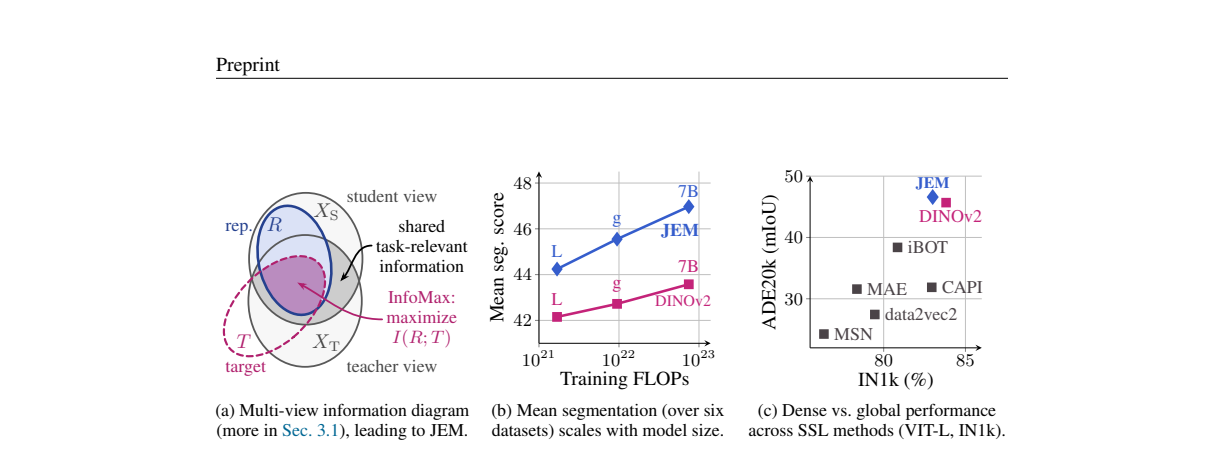
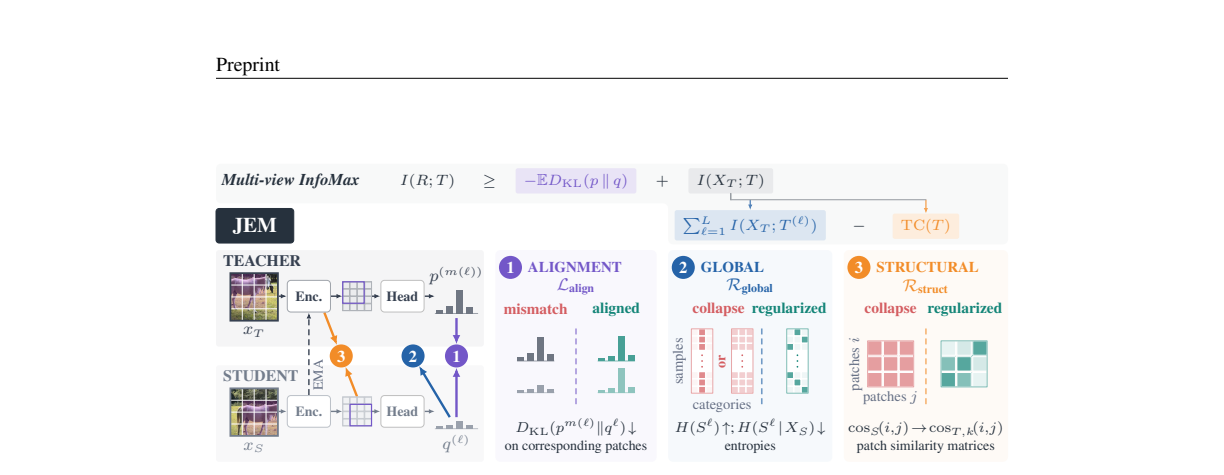
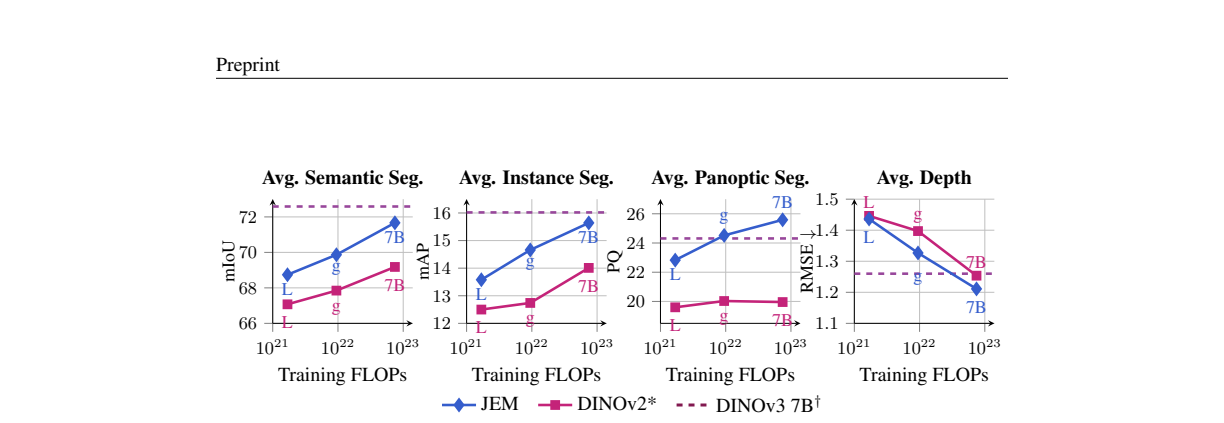
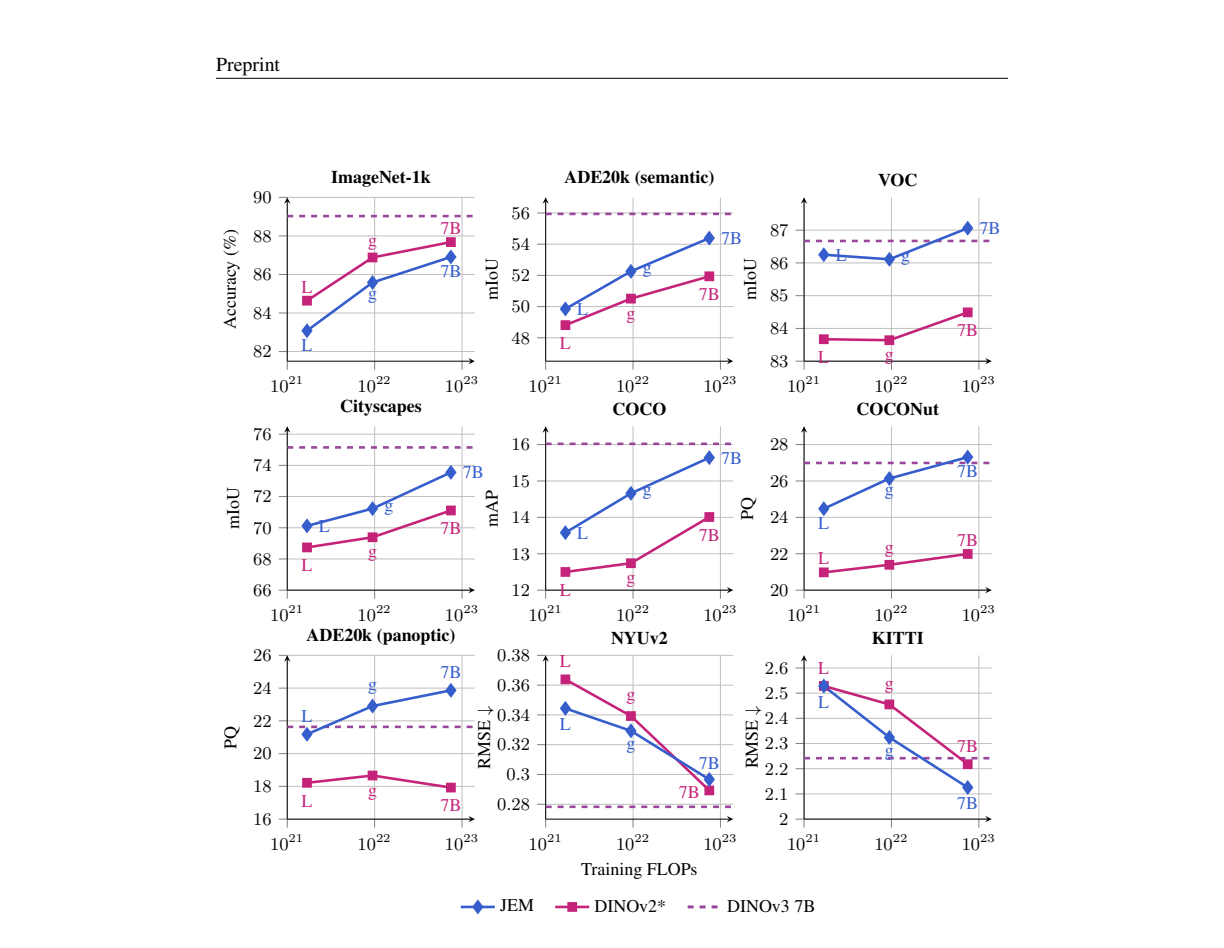
Taking a step back, we ask if we can design a high-performing, yet principled SSL algorithm. Starting from the multi-view assumption, stipulating that task-relevant content is captured by the information common to different views, we construct an information-theoretic objective decomposing into interpretable terms. This derivation yields JEM, a student-teacher method that learns by aligning corresponding patch representations across views, explicitly regularized by information and structure preservation losses. JEM trains stably from 300M to 7B parameters, and, to our knowledge, is the first latent-space patch-level method demonstrated at 7B scale. Across all scales, JEM reaches strong performance on both global and dense probing tasks, on segmentation benchmarks consistently surpassing the DINOv2 algorithm, an influential foundation for today's strongest visual SSL methods. Notably, at 7B parameters, it exceeds the performance of DINOv3 on panoptic segmentation, despite being trained on 12 × less data without refinement stages. These results demonstrate that we can indeed design an SSL algorithm that learns strong representations, is principled and stable.
from the abstract
Pith says
Machine review · deepseek-v4-flash · 8 Oct 2026 · what was read was not recorded · not checked by a person
It can be wrong. Challenge this review or reply to it.
Holds up, with conditions. A well-executed, honestly-hedged patch-level SSL paper with a genuine 7B result; the DINOv2 comparison uses an adapted re-implementation, but the dense-task direction is corroborated by the official checkpoint row. This line is wrong
2 major objections · 5 minor
How often objections from reviews like this one are right: not yet measured
Not checked: figures, code, what the 73 references say.
The paper says, at Sec. 4.3; Table 2; Table 8; Sec. A.3.3
The review did not quote this passage.
Pith says: Objection 1 of 2 · major
The headline claim that JEM 'consistently surpasses the DINOv2 algorithm' is carried by the DINOv2* rows in Table 2, but DINOv2* is not established as a faithful stand-in for the published DINOv2 method. Section 4.3 says DINOv2* is retrained 'using the same setup as JEM,' and Sec.
more of objection 1
A.3.3 describes it as 'a version of DINOv3 without gram anchoring and high-resolution refinement stages.' The shared backbone in Table 5(a) omits the class token, even though the DINO global loss in the published DINOv2 recipe is defined on the class token; the paper never specifies how that global loss is applied in the class-token-free DINOv2* architecture. Table 8 further shows that DINOv2* shares the crop sizes, register tokens, and general training framework of the JEM setup, rather than the exact published DINOv2 configuration. Because the dense-task margins over DINOv2* are the main evidence for the 'surpasses DINOv2 algorithm' claim, the comparison needs either (i) a faithful class-token DINOv2 control trained with the original DINOv2 view construction and schedules, or (ii) a qualification of the abstract and Sec. 4.3 wording so that the claim refers to the re-implementation actually used, together with an explanation of why the official DINOv2 checkpoint row in Table 2, which differs in data, patch size, and high-resolution fine-tuning, is not relied on for the comparison.
The paper says, at Table 2; Fig. 6
The review did not quote this passage.
Pith says: Objection 2 of 2 · major
The quantitative margins behind the 'consistently surpasses' and scaling claims are sometimes very small—for example, 0.3 PQ on COCONut at 7B and 0.2-1.9 PQ on other panoptic benchmarks—and every result in Tables 1-2 and Figs. 4-6 appears to be a single run with no error bars or seed information.
more of objection 2
For a claim of consistent superiority across a suite of benchmarks, this precision is insufficient: a few tenths of PQ or mIoU can be within training-run noise for large-scale SSL. Please either add repeated-run statistics for at least the controlled DINOv2* comparisons, or explicitly state that the comparisons are single runs and soften the 'consistently' language accordingly.
5 minor objections
The paper says, at Sec. 3.2.2, Eq. (5)
Pith says: minor objection 1 of 5
The double negative in the conditional-entropy term of Eq. (5) is mathematically correct but difficult to parse; defining the conditional entropy estimate separately before writing the mutual information would improve readability.
The paper says, at Sec. 4.2
Pith says: minor objection 2 of 5
The sentence 'we find JEM to be robustness to individual changes' should read 'robust to individual changes.'
show 3 more
The paper says, at Sec. 3.2.2-3.2.3 and abstract
Pith says: minor objection 3 of 5
Because R_global optimizes I(XS;S) rather than I(XT;T) and R_struct uses cosine-similarity structure as a proxy for total correlation, the word 'principled' in the abstract should be understood as 'derived from the InfoMax bound and then instantiated with disclosed proxies.' A one-sentence clarification in the abstract or conclusion would prevent over-reading of the derivation.
The paper says, at Sec. A.5.1
Pith says: minor objection 4 of 5
For semantic segmentation, the reported mIoU is described as the best probe over all hyperparameter configurations and evaluation steps; please state explicitly whether the selection is made on the validation split for each benchmark independently, since this selection procedure is part of the reported numbers.
The paper says, at Fig. 4
Pith says: minor objection 5 of 5
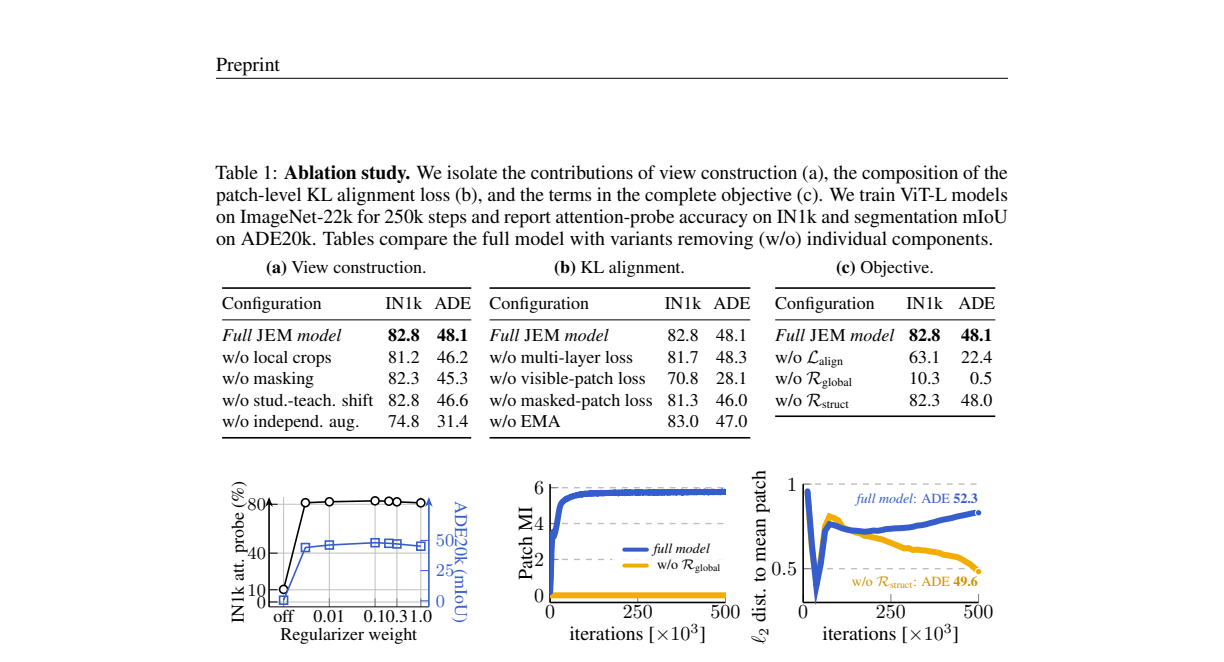
The x-axis label 'off' is ambiguous; specify that it corresponds to a regularization weight of zero.
What would settle it
Train a DINOv2 baseline faithful to the published algorithm on A140M for the same 500k steps: include the class token, apply the global DINO loss to it, and use DINOv2's original local-crop scale, mask sampling, loss weights, and teacher-temperature schedule instead of JEM's shared schedule. Evaluate it with the exact probe code of Sec. A.5 on the six segmentation benchmarks (ADE20k, VOC, Cityscapes, COCO, COCONut, ADE-Panoptic). If the per-benchmark margins over this faithful baseline are no longer consistently positive, or fall materially below the reported DINOv2* margins, the headline comparison should be re-scoped to a JEM-style DINOv2 variant rather than the DINOv2 algorithm.
from the skeptic's reading
How the review went
4 readings by deepseek-v4-flash · 8 Oct 2026
- Reader holds up, with conditions
- Skeptic agrees
- Editor wrote the verdict above
- Referee major revision: 2 major objections, 5 minor
Not run on this paper: the simulated authors' defence.
Pith did not check this review's objections against the paper.
The review in full
The review in brief, machine-written
You should know two things. First, this is a serious paper: honest derivation, genuinely informative ablations, and a 7B patch-level scaling result that, to my knowledge, has no precedent. Second, the "consistently surpasses the DINOv2 algorithm" headline rests on a retrained baseline (DINOv2*) that is not the published algorithm — no class token, JEM's view construction and mask ratios — described honestly in Sec. 4.3 as "DINOv3 without gram and high-resolution finetuning." The question is how much that matters. My answer: less than the stress-test suggests.
The new thing is the integration, not the parts. One patch-level KL term on overlapping views, plus two explicit anti-collapse regularizers: per-patch-position marginal/conditional entropy, and a structural term matching pairwise cosine similarities to early-to-middle teacher layers. Every component has a cited precedent (TWIST, IMSAT, SERE, DINOv3 gram anchoring), and the appendix maps each one instead of burying it. The variational bound in Eqs. (1)-(3) is standard Barber-Agakov and checks out. The proxy steps are disclosed: R_global maximizes I(XS;S), not I(XT;T), and cosine similarities stand in for total correlation. Take the "principled" framing as motivated design, which is how the paper itself presents it. The ablations earn their keep: removing R_global is catastrophic; R_struct is nearly inert at ViT-L but arrests the spatial collapse shown in Fig. 5 at scale.
On the DINOv2 comparison, two points. First, the missing class token most plausibly handicaps the global/classification side — and DINOv2* still beats JEM on IN1k at every scale (83.8 vs 82.8 at L, 86.5 vs 85.5 at g, 87.7 vs 86.9 at 7B). Second, the dense-task direction is not riding on DINOv2* alone: against the official DINOv2 checkpoint, which saw more training tokens and included high-resolution fine-tuning, JEM wins on all eight dense benchmarks in Table 2. Neither comparison is clean, but they point the same way, and the abstract scopes the claim to segmentation, where it holds.
Genuine weaknesses, in order: single runs with no error bars anywhere — the 0.3 PQ COCONut margin over DINOv3 is noise-adjacent; code and the A140M dataset are not released, so the 7B result cannot be independently reproduced; and the DINOv2* fidelity issue deserves a class-token control before the controlled comparison is settled. All fixable in revision, none fatal.
This paper is for anyone designing or scaling SSL objectives. Send it to a serious referee.
The strongest objection
The abstract and conclusion claim that JEM 'consistently surpasses the DINOv2 algorithm' on segmentation benchmarks. The evidence for this is the controlled baseline DINOv2*, defined in Sec. 4.3 as DINOv2 retrained 'using the same setup as JEM' and described in Sec. A.3.3 as 'a version of DINOv3 without gram anchoring and high-resolution refinement stages.' That is not the published DINOv2 algorithm: the shared architecture in Table 5(a) omits the class token (Sec. 4.1), while DINOv2's global DINO loss is designed around the class token. DINOv2* also inherits JEM's shifted, masked view construction, with only loss-specific hyperparameters listed in Table 8; it therefore does not isolate DINOv2's own view/mask/temperature schedule. If the class token or the original view schedule is load-bearing for the global and iBOT losses, a modified baseline could create part of JEM's dense-task margin. The official DINOv2 checkpoint row in Table 2 is favorable to JEM on dense tasks but cannot settle the question because it differs in data (LVD-142M vs A140M), patch size (14 vs 16), and high-resolution fine-tuning. This is not an accusation of cherry-picking; controlled comparisons routinely adapt baselines. But the most load-bearing condition behind the abstract's wording—that DINOv2* faithfully represents the DINOv2 algorithm—is not established.
The reader's weakest assumption identifies the same load-bearing issue, and I agree with it. The empirical claim that one patch-only objective plus two regularizers replaces the multi-objective DINOv2 recipe is exactly what makes the paper important; if the baseline is a modified variant embedded in JEM's architecture and view pipeline, the abstract's wording overstates what the controlled comparison shows. The official DINOv2 comparison in Table 2 is suggestive but confounded by data, patch size, and refinement stages, so it cannot repair the baseline-faithfulness problem. I would keep the CONDITIONAL verdict: the method is well documented, the ablations identify the load-bearing components, and the DINOv3 7B comparison uses an official checkpoint with the same patch size and probe, so it is less vulnerable. The remaining blockers are the modified DINOv2* baseline, the absence of released code/checkpoints and A140M, and the lack of error bars around the reported margins.
The referee's report
If the empirical comparisons hold, this is a significant result: JEM would show that a single patch-level objective with two explicitly designed regularizers can replace the multi-objective DINOv2 recipe, train stably from 300M to 7B parameters, and match or exceed strong dense-task baselines. The variational derivation in Sec. 3.1 and Appendix A.4 is correct, the ablation study is thorough, and the authors are transparent about the places where the implemented losses are proxies rather than direct estimates of the derived quantities. The three-scale controlled comparison is a useful contribution even independently of the headline claim. The main unresolved issue is the fidelity of the DINOv2* baseline to the published DINOv2 algorithm, on which the abstract's central 'consistently surpasses the DINOv2 algorithm' claim rests.
Pith's reading of the paper (a machine's summary, not the authors')
The paper claims that the multi-objective recipes behind today's strongest self-supervised vision models are unnecessary: one patch-level objective, derived rather than assembled, can do the same job. Starting from the multi-view assumption that task-relevant image content is exactly what different views of an image share, the authors derive a variational InfoMax bound whose two terms are interpretable as cross-view alignment and protection against collapse. This yields JEM, which aligns per-patch categorical targets between a student and an EMA teacher and adds two explicit regularizers: one keeping patch predictions informative, one preserving the spatial similarity structure encoded in early teacher layers. The paper reports that JEM trains stably from 300M to 7B parameters, consistently beats a same-setup DINOv2 baseline on semantic, instance, and panoptic segmentation, and at 7B exceeds DINOv3's panoptic segmentation despite 12× less data and no refinement stages. If the comparisons hold, principled patch-level objectives can replace the layered DINO-family recipe without losing dense-task quality.
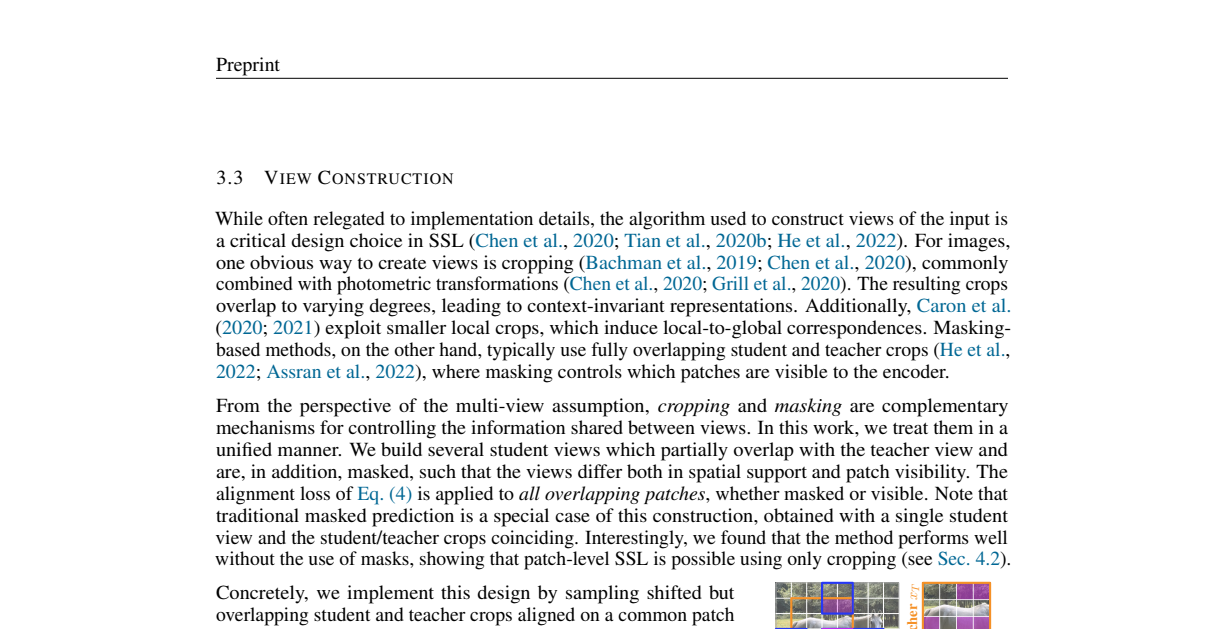
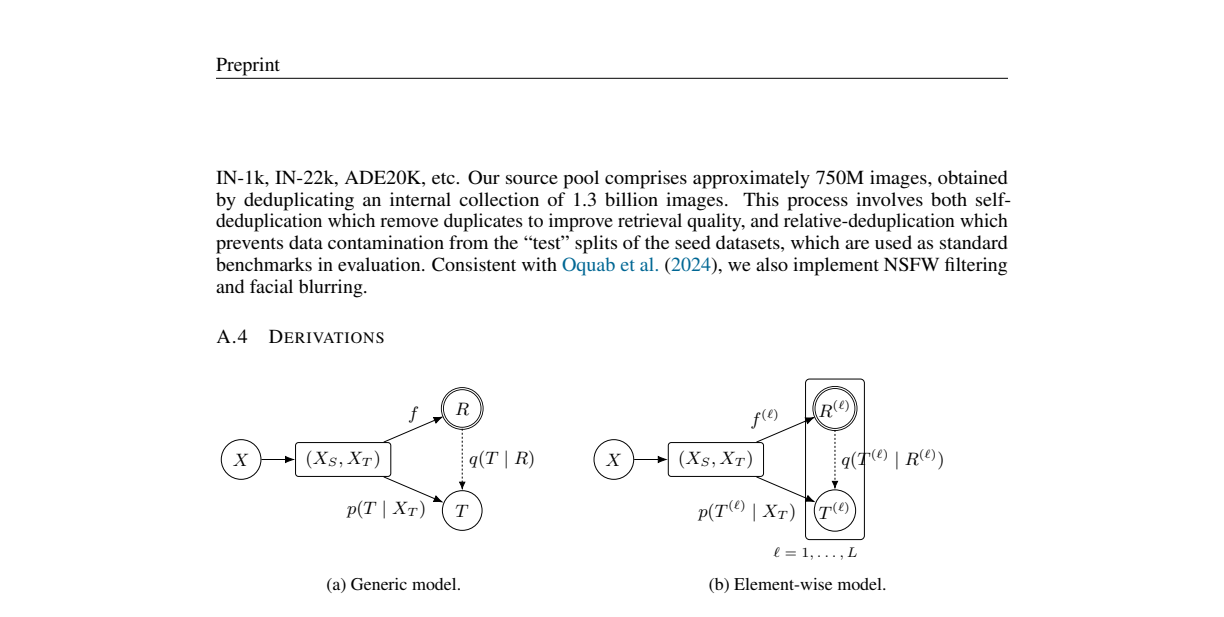
What carries the argument. The machinery is the variational lower bound on the multi-view InfoMax objective (Eqs. 1–3). Maximizing the information $I(R;T)$ that a student representation retains about teacher targets is lower-bounded by an anti-collapse term $I(X_T;T)$, the information targets carry about the teacher's view, minus a KL alignment term measuring how well the student's predictions match the teacher's distributions. That anti-collapse term then splits into a sum of per-element mutual informations minus the total correlation among target elements, which is what motivates the two regularizers: $R_{\mathrm{global}}$ maximizes the per-patch mutual information of a categorical prediction head, and $R_{\mathrm{struct}}$ addresses the redundancy term by matching, after a learned projection, the pairwise cosine similarities of final student patch representations to those of early-to-mid teacher layers. The remaining design piece is view construction: student and teacher crops are sampled on a shared patch grid so overlapping patches correspond one-to-one, with masking and local crops used to modulate how much information the views share. Each term of the bound therefore maps to exactly one loss, which is the sense in which the objective is derived rather than assembled.
Core claim. The central claim is that a student-teacher objective obtained by maximizing a lower bound on multi-view mutual information, rather than a hand-composed sum of losses, produces state-of-the-art dense visual features and scales. The paper derives the bound $I(R;T) \ge I(X_T;T) - \mathbb{E}[D_{\mathrm{KL}}(p(T|X_T)\,\|\,q(T|X_S))]$, in which the first term demands informative, non-collapsed targets and the second demands that the student's patch-level prediction distributions match the teacher's. Decomposing the anti-collapse term element-wise into per-patch information minus a redundancy (total-correlation) term yields the method's two regularizers: $R_{\mathrm{global}}$, which estimates and maximizes per-patch mutual information through marginal and conditional entropies of a 4096-class categorical head, and $R_{\mathrm{struct}}$, which keeps the final patch features able to reconstruct the pairwise cosine-similarity structure of early-to-mid teacher layers after a learned projection. The paper claims that with this objective applied only to patch tokens, with no class token, and with masks and crops treated as complementary ways of controlling shared information, JEM trains without collapse from 300M to 7B parameters, outperforms a same-setup DINOv2 baseline on six of nine dense benchmarks at each scale, and at 7B beats DINOv3 on panoptic segmentation with far less data.
The premise it rests on. The headline comparisons stand on the premise that DINOv2*, the DINOv2 algorithm re-trained with JEM's architecture (which drops the class token) and JEM's view construction and mask ratios, is a faithful stand-in for the published DINOv2, because a handicapped re-implementation would shrink the reported dense-task advantage.
If the paper is right (Pith's inferences, not the authors')
A single patch-level objective with explicit anti-collapse regularizers can replace the DINOv2 recipe of separate global and local losses, separate heads, KoLeo, Sinkhorn/centering, teacher temperature schedules, and prototype freezing.
The class token is not needed for strong global or dense features: classification remains competitive using attention-probe evaluation on patch tokens alone.
Masking is an ingredient, not a requirement: JEM performs well on cropping-based views, and removing visible-patch alignment (rather than masked-patch alignment) is what costs roughly 20 points on ADE20k.
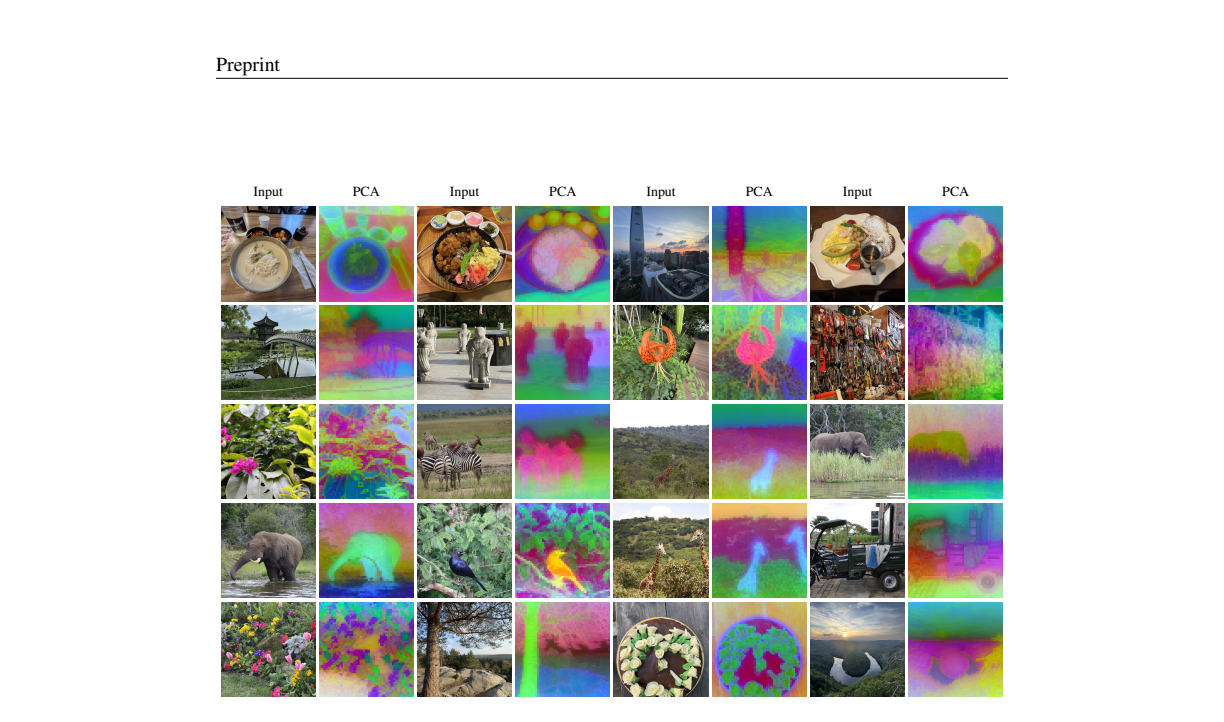
Dense-feature quality at scale depends on the structural regularizer: without $R_{\mathrm{struct}}$, patch representations lose spatial distinctiveness after about 250k iterations, and the effect grows with model size.
If the 7B result is robust, refinement stages such as DINOv3's gram anchoring and high-resolution fine-tuning are not necessary for strong panoptic segmentation.
A testable extension the paper does not run: nothing in the derivation restricts the target format, so a continuous-embedding JEM with the same two regularizers would separate the InfoMax principle from the categorical-head implementation.
The derivation suggests a concrete scaling prediction: $R_{\mathrm{struct}}$'s target layers should move deeper as models grow (the paper uses layers [0,8,16] at 24 layers and [0,10,20,30] at 40 layers), and a sweep over target-layer depth at 7B would test whether anchoring depth, not just its presence, drives the scaling gain.
The ablation cost of removing photometric augmentations (about 8 points on ImageNet-1k and 17 points on ADE20k) shows the multi-view principle alone does not force semantic features; the invariance imposed by color distortions carries much of that load, marking the boundary of what the InfoMax derivation explains.
My reading of the controlled comparison: until a DINOv2 trained with its own published hyperparameters, class token, and view schedule is run on A140M at the same budget, the honest formulation is that JEM beats the DINOv2 algorithm when both are trained under JEM's setup.
Check this review
Pith stored no record of this review's passes and took no fingerprint of it. Reviews made by code from 13 Nov 2026 on carry both.
How often reviews like this one are right
Reviews like this one: written by deepseek-v4-flash, where what was read was not recorded.
How often objections from reviews like this one are right: not yet measured
Reviews by people
This review was written by a machine. No person has reviewed this paper on Pith yet. A scientist listed on Pith can review it for a fee, and their review is published here whatever it concludes.
The paper
Abstract
Self-supervised learning (SSL) at scale produces powerful visual representations. However, most scalable SSL methods rely on ad hoc combinations of multiple objectives and stabilization mechanisms. Taking a step back, we ask if we can design a high-performing, yet principled SSL algorithm. Starting from the multi-view assumption, stipulating that task-relevant content is captured by the information common to different views, we construct an information-theoretic objective decomposing into interpretable terms. This derivation yields JEM, a student-teacher method that learns by aligning corresponding patch representations across views, explicitly regularized by information and structure preservation losses. JEM trains stably from 300M to 7B parameters, and, to our knowledge, is the first latent-space patch-level method demonstrated at 7B scale. Across all scales, JEM reaches strong performance on both global and dense probing tasks, on segmentation benchmarks consistently surpassing the DINOv2 algorithm, an influential foundation for today's strongest visual SSL methods. Notably, at 7B parameters, it exceeds the performance of DINOv3 on panoptic segmentation, despite being trained on 12 × less data without refinement stages. These results demonstrate that we can indeed design an SSL algorithm that learns strong representations, is principled and stable.
The paper's own sentences, arranged, kept beside the review and separate from it. Each label is drawn from a closed vocabulary; the number beside it is the probability the classifier gave that label. No sentence in this record was written by a model.
abstract compiled · 2026-10-08
The authors' main claim, as the classifier picked it out 1.00
“These results demonstrate that we can indeed design an SSL algorithm that learns strong representations, is principled and stable.”
How the main claim is stated: asserted 0.99
What the abstract itself states, as probabilities: claims first 0.89 · states limitation 0.11 · human participants 0.02 · controlled comparison 0.79 · randomized assignment 0.01 · states quantitative result 0.97 · compares with prior results 0.98 · mentions code or data availability 0.03
The abstract, sentence by sentence
This table labels the abstract only (arXiv listing abstract v1). The number is the probability the classifier gave the label.
| Sentence | Role | The authors' own work | States the main conclusion | Strength |
|---|---|---|---|---|
| Self-supervised learning (SSL) at scale produces powerful visual representations. | background 1.00 | 0.11 | 0.05 | asserted 1.00 |
| However, most scalable SSL methods rely on ad hoc combinations of multiple objectives and stabilization mechanisms. | gap 0.62 | 0.08 | 0.02 | asserted 1.00 |
| Taking a step back, we ask if we can design a high-performing, yet principled SSL algorithm. | gap 0.71 | 0.29 | 0.04 | hedged possibility 0.59 |
| Starting from the multi-view assumption, stipulating that task-relevant content is captured by the information common to different views, we construct an information-theoretic objective decomposing into interpretable terms. | method 0.86 | 0.90 | 0.06 | asserted 0.92 |
| This derivation yields JEM, a student-teacher method that learns by aligning corresponding patch representations across views, explicitly regularized by information and structure preservation losses. | method 0.88 | 0.95 | 0.13 | asserted 1.00 |
| JEM trains stably from 300M to 7B parameters, and, to our knowledge, is the first latent-space patch-level method demonstrated at 7B scale. | result 0.84 | 0.95 | 0.13 | asserted 1.00 |
| Across all scales, JEM reaches strong performance on both global and dense probing tasks, on segmentation benchmarks consistently surpassing the DINOv2 algorithm, an influential foundation for today's strongest visual SSL methods. | result 1.00 | 0.92 | 0.20 | asserted 1.00 |
| Notably, at 7B parameters, it exceeds the performance of DINOv3 on panoptic segmentation, despite being trained on $12\times$ less data without refinement stages. | result 1.00 | 0.92 | 0.12 | asserted 1.00 |
| These results demonstrate that we can indeed design an SSL algorithm that learns strong representations, is principled and stable. | interpretation 0.99 | 0.87 | 0.88 | asserted 0.99 |
What kind of paper the classifier reports this is: method or tool 1.00 · evidence from observation or experiment 0.92
What was examined, and what was not
Sources read
- arXiv listing abstract v1
Not examined
- full text
- figures and tables
- references and citing sentences
- relations to other papers
Levels run
- P abstract
Not run
- S sections
- T body sentences
- C citations
- R cross-paper relations
How the labels were made
Compiled by classifier-1.13.0 via TypeSafe API, question bank abstract-p1-20260923, 2026-10-08: 1 request, 6,935 input tokens.
Every quoted sentence on this record is the authors'. Every label is from Pith's closed vocabulary, with the probability shown beside it. This record as JSON
Figures (10)
Showing 9 of the paper's 10 figures. Figures are the authors', reproduced from the paper.
References (73)
- [1] Alexander A. Alemi, Ian Fischer, Joshua V. Dillon, and Kevin Murphy. Deep variational information bottleneck. In ICLR, 2017. URL https://openreview.net/forum?id=HyxQzBceg on Pith
- [2] Mahmoud Assran, Mathilde Caron, Ishan Misra, Piotr Bojanowski, Florian Bordes, Pascal Vincent, Armand Joulin, Michael Rabbat, and Nicolas Ballas. Masked siamese networks for label-efficient learning. In ECCV, pp.\ 456--473, 2022. doi:10.1007/978-3-031-19821-2_26. URL https://l... on Pithdoi:10.1007/978-3-031-19821-2_26
- [3] Mahmoud Assran, Quentin Duval, Ishan Misra, Piotr Bojanowski, Pascal Vincent, Michael Rabbat, Yann LeCun, and Nicolas Ballas. Self-supervised learning from images with a joint-embedding predictive architecture. In CVPR, pp.\ 15619--15629, 2023. doi:10.1109/CVPR52729.2023.01499... on Pithdoi:10.1109/cvpr52729.2023.01499
- [4] Philip Bachman, R. Devon Hjelm, and William Buchwalter. Learning representations by maximizing mutual information across views. In NeurIPS, 2019. URL https://proceedings.neurips.cc/paper_files/paper/2019/hash/ddf354219aac374f1d40b7e760ee5bb7-Abstract.html on Pith
- [5] Alexei Baevski, Wei-Ning Hsu, Qiantong Xu, Arun Babu, Jiatao Gu, and Michael Auli. data2vec : A general framework for self-supervised learning in speech, vision and language. In ICML, pp.\ 1298--1312, 2022. URL https://proceedings.mlr.press/v162/baevski22a.html on Pith
- [6] Alexei Baevski, Arun Babu, Wei-Ning Hsu, and Michael Auli. Efficient self-supervised learning with contextualized target representations for vision, speech and language. In ICML, pp.\ 1416--1429, 2023. URL https://proceedings.mlr.press/v202/baevski23a.html on Pith
- [7] Randall Balestriero and Yann LeCun. LeJEPA : Provable and scalable self-supervised learning without the heuristics, 2025. URL https://arxiv.org/abs/2511.08544 on PithPith's reviewarXiv
- [8] David Barber and Felix V. Agakov. Information maximization in noisy channels: A variational approach. In NeurIPS, 2003. URL https://proceedings.neurips.cc/paper_files/paper/2003/hash/a6ea8471c120fe8cc35a2954c9b9c595-Abstract.html on Pith
- [9] Adrien Bardes, Jean Ponce, and Yann LeCun. VICReg : Variance-invariance-covariance regularization for self-supervised learning. In ICLR, 2022 a . URL https://openreview.net/forum?id=xm6YD62D1Ub on Pith
- [10] Adrien Bardes, Jean Ponce, and Yann LeCun. VICRegL : Self-supervised learning of local visual features. In NeurIPS, pp.\ 8799--8810, 2022 b . doi:10.52202/068431-0640. URL https://proceedings.neurips.cc/paper_files/paper/2022/hash/39cee562b91611c16ac0b100f0bc1ea1-Abstract-Conf... on Pithdoi:10.52202/068431-0640
- [11] John S. Bridle, Anthony J. R. Heading, and David J. C. MacKay. Unsupervised classifiers, mutual information and `phantom targets'. In NeurIPS, pp.\ 1096--1101, 1991. URL https://proceedings.neurips.cc/paper_files/paper/1991/hash/a8abb4bb284b5b27aa7cb790dc20f80b-Abstract.html on Pith
- [12] Mathilde Caron, Ishan Misra, Julien Mairal, Priya Goyal, Piotr Bojanowski, and Armand Joulin. Unsupervised learning of visual features by contrasting cluster assignments. In NeurIPS, 2020. URL https://proceedings.neurips.cc/paper_files/paper/2020/hash/70feb62b69f16e0238f741fab... on Pith
- [13] Mathilde Caron, Hugo Touvron, Ishan Misra, Herv \'e J \'e gou, Julien Mairal, Piotr Bojanowski, and Armand Joulin. Emerging properties in self-supervised vision transformers. In ICCV, pp.\ 9650--9660, 2021. doi:10.1109/ICCV48922.2021.00951. URL https://openaccess.thecvf.com/co... on Pithdoi:10.1109/iccv48922.2021.00951
- [14] Mathilde Caron, Neil Houlsby, and Cordelia Schmid. Location-aware self-supervised transformers for semantic segmentation. In WACV, pp.\ 116--126, 2024. doi:10.1109/WACV57701.2024.00019. URL https://openaccess.thecvf.com/content/WACV2024/html/Caron_Location-Aware_Self-Supervise... on Pithdoi:10.1109/wacv57701.2024.00019
- [15] Ting Chen, Simon Kornblith, Mohammad Norouzi, and Geoffrey Hinton. A simple framework for contrastive learning of visual representations. In ICML, pp.\ 1597--1607, 2020. URL https://proceedings.mlr.press/v119/chen20j.html on Pith
- [16] Bowen Cheng, Alex Schwing, and Alexander Kirillov. Per-pixel classification is not all you need for semantic segmentation. NeurIPS, 34: 0 17864--17875, 2021 on Pith
- [17] Marius Cordts, Mohamed Omran, Sebastian Ramos, Timo Rehfeld, Markus Enzweiler, Rodrigo Benenson, Uwe Franke, Stefan Roth, and Bernt Schiele. The Cityscapes dataset for semantic urban scene understanding. In CVPR, pp.\ 3213--3223, 2016. doi:10.1109/CVPR.2016.350. URL https://op... on Pithdoi:10.1109/cvpr.2016.350
- [18] Timoth \'e e Darcet, Maxime Oquab, Julien Mairal, and Piotr Bojanowski. Vision transformers need registers. In ICLR, 2024. URL https://openreview.net/forum?id=2dnO3LLiJ1 on Pith
- [19] Timoth \'e e Darcet, Federico Baldassarre, Maxime Oquab, Julien Mairal, and Piotr Bojanowski. Cluster and predict latent patches for improved masked image modeling. TMLR, 2025. URL https://openreview.net/forum?id=Ycmz7qJxUQ on Pith
- [20] Jia Deng, Wei Dong, Richard Socher, Li-Jia Li, Kai Li, and Li Fei-Fei. ImageNet : A large-scale hierarchical image database. In CVPR, pp.\ 248--255, 2009. doi:10.1109/CVPR.2009.5206848. URL https://doi.org/10.1109/CVPR.2009.5206848 on Pithdoi:10.1109/cvpr.2009.5206848
show 53 more
- [21] Xueqing Deng, Qihang Yu, Peng Wang, Xiaohui Shen, and Liang-Chieh Chen. COCONut : Modernizing COCO segmentation. In CVPR, pp.\ 21863--21873, 2024. doi:10.1109/CVPR52733.2024.02065. URL https://openaccess.thecvf.com/content/CVPR2024/html/Deng_COCONut_Modernizing_COCO_Segmentati... on Pithdoi:10.1109/cvpr52733.2024.02065
- [22] Alexey Dosovitskiy, Lucas Beyer, Alexander Kolesnikov, Dirk Weissenborn, Xiaohua Zhai, Thomas Unterthiner, Mostafa Dehghani, Matthias Minderer, Georg Heigold, Sylvain Gelly, Jakob Uszkoreit, and Neil Houlsby. An image is worth 16x16 words: Transformers for image recognition at... on Pith
- [23] David Eigen, Christian Puhrsch, and Rob Fergus. Depth map prediction from a single image using a multi-scale deep network. NeurIPS, 27, 2014 on Pith
- [24] Mark Everingham, Luc Van Gool, Christopher K. I. Williams, John Winn, and Andrew Zisserman. The PASCAL visual object classes ( VOC ) challenge. IJCV, 88 0 (2): 0 303--338, 2010. doi:10.1007/s11263-009-0275-4. URL https://link.springer.com/article/10.1007/s11263-009-0275-4 on Pithdoi:10.1007/s11263-009-0275-4
- [25] David Fan, Shengbang Tong, Jiachen Zhu, Koustuv Sinha, Zhuang Liu, Xinlei Chen, Michael Rabbat, Nicolas Ballas, Yann LeCun, Amir Bar, and Saining Xie. Scaling language-free visual representation learning. In ICCV, 2025. URL https://arxiv.org/abs/2504.01017 on PithPith's reviewarXiv
- [26] Marco Federici, Anjan Dutta, Patrick Forr \'e , Nate Kushman, and Zeynep Akata. Learning robust representations via multi-view information bottleneck. In ICLR, 2020. URL https://openreview.net/forum?id=B1xwcyHFDr on Pith
- [27] Zelin Fu, Bin Tan, Changjiang Sun, Shaohui Liu, Kecheng Zheng, Yinghao Xu, Xing Zhu, Yujun Shen, and Nan Xue. Vision pretraining for dense spatial perception, 2026. URL https://arxiv.org/abs/2607.05247 on PithPith's reviewarXiv
- [28] Andreas Geiger, Philip Lenz, and Raquel Urtasun. Are we ready for autonomous driving? the KITTI vision benchmark suite. In CVPR, pp.\ 3354--3361, 2012. doi:10.1109/CVPR.2012.6248074. URL https://doi.org/10.1109/CVPR.2012.6248074 on Pithdoi:10.1109/cvpr.2012.6248074
- [29] Ryan Gomes, Andreas Krause, and Pietro Perona. Discriminative clustering by regularized information maximization. In NeurIPS, pp.\ 775--783, 2010. URL https://proceedings.neurips.cc/paper_files/paper/2010/hash/42998cf32d552343bc8e460416382dca-Abstract.html on Pith
- [30] Jean-Bastien Grill, Florian Strub, Florent Altch \'e , Corentin Tallec, Pierre H. Richemond, Elena Buchatskaya, Carl Doersch, Bernardo Avila Pires, Zhaohan Daniel Guo, Mohammad Gheshlaghi Azar, Bilal Piot, Koray Kavukcuoglu, R \'e mi Munos, and Michal Valko. Bootstrap your own... on Pith
- [31] Kaiming He, Haoqi Fan, Yuxin Wu, Saining Xie, and Ross Girshick. Momentum contrast for unsupervised visual representation learning. In CVPR, pp.\ 9729--9738, 2020. doi:10.1109/CVPR42600.2020.00975. URL https://openaccess.thecvf.com/content_CVPR_2020/html/He_Momentum_Contrast_f... on Pithdoi:10.1109/cvpr42600.2020.00975
- [32] Kaiming He, Xinlei Chen, Saining Xie, Yanghao Li, Piotr Doll \'a r, and Ross Girshick. Masked autoencoders are scalable vision learners. In CVPR, pp.\ 16000--16009, 2022. doi:10.1109/CVPR52688.2022.01553. URL https://openaccess.thecvf.com/content/CVPR2022/html/He_Masked_Autoen... on Pithdoi:10.1109/cvpr52688.2022.01553
- [33] Olivier Henaff. Data-efficient image recognition with contrastive predictive coding. In ICML, pp.\ 4182--4192. PMLR, 2020. URL https://proceedings.mlr.press/v119/henaff20a.html on Pith
- [34] R. Devon Hjelm, Alex Fedorov, Samuel Lavoie-Marchildon, Karan Grewal, Phil Bachman, Adam Trischler, and Yoshua Bengio. Learning deep representations by mutual information estimation and maximization. In ICLR, 2019. URL https://openreview.net/forum?id=Bklr3j0cKX on Pith
- [35] Weihua Hu, Takeru Miyato, Seiya Tokui, Eiichi Matsumoto, and Masashi Sugiyama. Learning discrete representations via information maximizing self-augmented training. In ICML, pp.\ 1558--1567, 2017. URL https://proceedings.mlr.press/v70/hu17b.html on Pith
- [36] Xu Ji, Jo \ a o F. Henriques, and Andrea Vedaldi. Invariant information clustering for unsupervised image classification and segmentation. In ICCV, pp.\ 9864--9873, 2019. doi:10.1109/ICCV.2019.00996. URL https://openaccess.thecvf.com/content_ICCV_2019/html/Ji_Invariant_Informa... on Pithdoi:10.1109/iccv.2019.00996
- [37] Alexander Kirillov, Kaiming He, Ross Girshick, Carsten Rother, and Piotr Doll \'a r. Panoptic segmentation. In CVPR, pp.\ 9396--9405. IEEE, 2019 on Pith
- [38] Chen-Yu Lee, Saining Xie, Patrick Gallagher, Zhengyou Zhang, and Zhuowen Tu. Deeply-supervised nets. In AISTATS, pp.\ 562--570, 2015. URL https://proceedings.mlr.press/v38/lee15a.html on Pith
- [39] Yihao Li, Saeed Salehi, Lyle Ungar, and Konrad P. Kording. Does object binding naturally emerge in large pretrained vision transformers? In NeurIPS, 2025. URL https://proceedings.neurips.cc/paper_files/paper/2025/hash/050b8ff31bee2dfea65b731e71baccd5-Abstract-Conference.html on Pith
- [40] Zhong-Yu Li, Shanghua Gao, and Ming-Ming Cheng. SERE : Exploring feature self-relation for self-supervised transformer. IEEE TPAMI, 45 0 (12): 0 15619--15631, 2023. doi:10.1109/TPAMI.2023.3309979. URL https://ieeexplore.ieee.org/document/10234504 on Pithdoi:10.1109/tpami.2023.3309979
- [41] Tsung-Yi Lin, Michael Maire, Serge Belongie, James Hays, Pietro Perona, Deva Ramanan, Piotr Doll \'a r, and C. Lawrence Zitnick. Microsoft COCO : Common objects in context. In ECCV, pp.\ 740--755, 2014. doi:10.1007/978-3-319-10602-1_48. URL https://link.springer.com/chapter/10... on Pithdoi:10.1007/978-3-319-10602-1_48
- [42] Ralph Linsker. Self-organization in a perceptual network. IEEE Computer, 21 0 (3): 0 105--117, 1988. doi:10.1109/2.36. URL https://ieeexplore.ieee.org/document/36 on Pithdoi:10.1109/2.36
- [43] Scott C. Lowe, Anthony Fuller, Sageev Oore, Evan Shelhamer, and Graham W. Taylor. Self-distillation of hidden layers for self-supervised representation learning, 2026. URL https://arxiv.org/abs/2603.15553 on PithPith's reviewarXiv
- [44] Lorenzo Mur-Labadia, Matthew Muckley, Amir Bar, Mido Assran, Koustuv Sinha, Mike Rabbat, Yann LeCun, Nicolas Ballas, and Adrien Bardes. V-JEPA 2.1 : Unlocking dense features in video self-supervised learning. In ECCV, 2026. URL https://arxiv.org/abs/2603.14482 on PithPith's reviewarXiv
- [45] Maxime Oquab, Timoth \'e e Darcet, Th \'e o Moutakanni, Huy Vo, Marc Szafraniec, Vasil Khalidov, Pierre Fernandez, Daniel Haziza, Francisco Massa, Alaaeldin El-Nouby, Mahmoud Assran, Nicolas Ballas, Wojciech Galuba, Russell Howes, Po-Yao Huang, Shang-Wen Li, Ishan Misra, Micha... on Pith
- [46] Pedro O. Pinheiro, Amjad Almahairi, Ryan Y. Benmalek, Florian Golemo, and Aaron Courville. Unsupervised learning of dense visual representations. In NeurIPS, pp.\ 4489--4500, 2020. URL https://proceedings.neurips.cc/paper_files/paper/2020/hash/3000311ca56a1cb93397bc676c0b7fff-... on Pith
- [47] Sucheng Ren, Fangyun Wei, Samuel Albanie, Zheng Zhang, and Han Hu. DeepMIM : Deep supervision for masked image modeling. In WACV, pp.\ 879--888, 2025. doi:10.1109/WACV61041.2025.00095. URL https://openaccess.thecvf.com/content/WACV2025/html/Ren_DeepMIM_Deep_Supervision_for_Mas... on Pithdoi:10.1109/wacv61041.2025.00095
- [48] Adriana Romero, Nicolas Ballas, Samira Ebrahimi Kahou, Antoine Chassang, Carlo Gatta, and Yoshua Bengio. FitNets : Hints for thin deep nets. In ICLR, 2015. URL https://arxiv.org/abs/1412.6550 on PithPith's reviewarXiv
- [49] Olga Russakovsky, Jia Deng, Hao Su, Jonathan Krause, Sanjeev Satheesh, Sean Ma, Zhiheng Huang, Andrej Karpathy, Aditya Khosla, Michael Bernstein, Alexander C. Berg, and Li Fei-Fei. ImageNet large scale visual recognition challenge. IJCV, 115 0 (3): 0 211--252, 2015. doi:10.100... on Pithdoi:10.1007/s11263-015-0816-y
- [50] Alexandre Sablayrolles, Matthijs Douze, Cordelia Schmid, and Herv \'e J \'e gou. Spreading vectors for similarity search. In ICLR, 2019 on Pith
- [51] Ravid Shwartz-Ziv and Yann LeCun. To compress or not to compress---self-supervised learning and information theory: A review. Entropy, 26 0 (3): 0 252, 2024. doi:10.3390/e26030252. URL https://www.mdpi.com/1099-4300/26/3/252 on Pithdoi:10.3390/e26030252
- [52] Nathan Silberman, Derek Hoiem, Pushmeet Kohli, and Rob Fergus. Indoor segmentation and support inference from RGB-D images. In ECCV, pp.\ 746--760, 2012. doi:10.1007/978-3-642-33715-4_54. URL https://link.springer.com/chapter/10.1007/978-3-642-33715-4_54 on Pithdoi:10.1007/978-3-642-33715-4_54
- [53] Oriane Sim \'e oni, Huy V. Vo, Maximilian Seitzer, Federico Baldassarre, Maxime Oquab, Cijo Jose, Vasil Khalidov, Marc Szafraniec, Seungeun Yi, Micha \"e l Ramamonjisoa, Francisco Massa, Daniel Haziza, Luca Wehrstedt, Jianyuan Wang, Timoth \'e e Darcet, Th \'e o Moutakanni, Le... on Pith
- [54] Karthik Sridharan and Sham M. Kakade. An information theoretic framework for multi-view learning. In Conference on Learning Theory, pp.\ 403--414. Omnipress, 2008. URL https://dblp.org/rec/conf/colt/SridharanK08 on Pith
- [55] Thomas Stegm \"u ller, Tim Lebailly, Behzad Bozorgtabar, Tinne Tuytelaars, and Jean-Philippe Thiran. CrOC : Cross-view online clustering for dense visual representation learning. In CVPR, pp.\ 7000--7009, 2023. doi:10.1109/CVPR52729.2023.00676. URL https://openaccess.thecvf.co... on Pithdoi:10.1109/cvpr52729.2023.00676
- [56] Chenxin Tao, Xizhou Zhu, Weijie Su, Gao Huang, Bin Li, Jie Zhou, Yu Qiao, Xiaogang Wang, and Jifeng Dai. Siamese image modeling for self-supervised vision representation learning. In CVPR, pp.\ 2132--2141, 2023. doi:10.1109/CVPR52729.2023.00212. URL https://openaccess.thecvf.c... on Pithdoi:10.1109/cvpr52729.2023.00212
- [57] Yonglong Tian, Dilip Krishnan, and Phillip Isola. Contrastive multiview coding. In ECCV, pp.\ 776--794, 2020 a . doi:10.1007/978-3-030-58621-8_45. URL https://link.springer.com/chapter/10.1007/978-3-030-58621-8_45 on Pithdoi:10.1007/978-3-030-58621-8_45
- [58] Yonglong Tian, Chen Sun, Ben Poole, Dilip Krishnan, Cordelia Schmid, and Phillip Isola. What makes for good views for contrastive learning? In NeurIPS, 2020 b . URL https://proceedings.neurips.cc/paper_files/paper/2020/hash/4c2e5eaae9152079b9e95845750bb9ab-Abstract.html on Pith
- [59] Naftali Tishby, Fernando C. Pereira, and William Bialek. The information bottleneck method. In Allerton Conf. on Communication, Control, and Computing, pp.\ 368--377, 1999. URL https://arxiv.org/abs/physics/0004057 on PithPith's reviewarXiv
- [60] Yao-Hung Hubert Tsai, Yue Wu, Ruslan Salakhutdinov, and Louis-Philippe Morency. Self-supervised learning from a multi-view perspective. In ICLR, 2021. URL https://openreview.net/forum?id=-bdp_8Itjwp on Pith
- [61] Michael Tschannen, Josip Djolonga, Paul K. Rubenstein, Sylvain Gelly, and Mario Lucic. On mutual information maximization for representation learning. In ICLR, 2020. URL https://openreview.net/forum?id=rkxoh24FPH on Pith
- [62] Aaron van den Oord, Yazhe Li, and Oriol Vinyals. Representation learning with contrastive predictive coding, 2018. URL https://arxiv.org/abs/1807.03748 on PithPith's reviewarXiv
- [63] Wouter Van Gansbeke, Simon Vandenhende, Stamatios Georgoulis, Marc Proesmans, and Luc Van Gool. SCAN : Learning to classify images without labels. In ECCV, pp.\ 268--285, 2020. doi:10.1007/978-3-030-58607-2_16. URL https://link.springer.com/chapter/10.1007/978-3-030-58607-2_16 on Pithdoi:10.1007/978-3-030-58607-2_16
- [64] Shashanka Venkataramanan, Valentinos Pariza, Mohammadreza Salehi, Lukas Knobel, Elias Ramzi, Spyros Gidaris, Andrei Bursuc, and Yuki M. Asano. Franca: Nested matryoshka clustering for scalable visual representation learning. In CVPR, pp.\ 10533--10544, 2026. URL https://openac... on Pith
- [65] Feng Wang, Tao Kong, Rufeng Zhang, Huaping Liu, and Hang Li. Self-supervised learning by estimating twin class distributions. IEEE Transactions on Image Processing, 2023 a . URL https://arxiv.org/abs/2110.07402 on PithPith's reviewarXiv
- [66] Haoqing Wang, Yehui Tang, Yunhe Wang, Jianyuan Guo, Zhi-Hong Deng, and Kai Han. Masked image modeling with local multi-scale reconstruction. In CVPR, pp.\ 2122--2131, 2023 b . doi:10.1109/CVPR52729.2023.00211. URL https://openaccess.thecvf.com/content/CVPR2023/html/Wang_Masked... on Pithdoi:10.1109/cvpr52729.2023.00211
- [67] Xin Wen, Bingchen Zhao, Anlin Zheng, Xiangyu Zhang, and Xiaojuan Qi. Self-supervised visual representation learning with semantic grouping. In NeurIPS, pp.\ 16423--16438, 2022. doi:10.52202/068431-1195. URL https://proceedings.neurips.cc/paper_files/paper/2022/hash/6818dcc65fd... on Pithdoi:10.52202/068431-1195
- [68] Ziyang Wu, Jingyuan Zhang, Druv Pai, Xudong Wang, Chandan Singh, Jianwei Yang, Jianfeng Gao, and Yi Ma. Simplifying DINO via coding rate regularization. In ICML, pp.\ 68036--68059, 2025. URL https://proceedings.mlr.press/v267/wu25ar.html on Pith
- [69] Zhenda Xie, Yutong Lin, Zheng Zhang, Yue Cao, Stephen Lin, and Han Hu. Propagate yourself: Exploring pixel-level consistency for unsupervised visual representation learning. In CVPR, pp.\ 16684--16693, 2021. doi:10.1109/CVPR46437.2021.01641. URL https://openaccess.thecvf.com/c... on Pithdoi:10.1109/cvpr46437.2021.01641
- [70] Jure Zbontar, Li Jing, Ishan Misra, Yann LeCun, and St \'e phane Deny. Barlow twins: Self-supervised learning via redundancy reduction. In ICML, pp.\ 12310--12320, 2021. URL https://proceedings.mlr.press/v139/zbontar21a.html on Pith
- [71] Bolei Zhou, Hang Zhao, Xavier Puig, Tete Xiao, Sanja Fidler, Adela Barriuso, and Antonio Torralba. Semantic understanding of scenes through the ADE20K dataset. IJCV, 127 0 (3): 0 302--321, 2019. doi:10.1007/s11263-018-1140-0. URL https://link.springer.com/article/10.1007/s1126... on Pithdoi:10.1007/s11263-018-1140-0
- [72] Jinghao Zhou, Chen Wei, Huiyu Wang, Wei Shen, Cihang Xie, Alan Yuille, and Tao Kong. iBOT : Image BERT pre-training with online tokenizer. In ICLR, 2022. URL https://openreview.net/forum?id=ydopy-e6Dg on Pith
- [73] Adrian Ziegler and Yuki M. Asano. Self-supervised learning of object parts for semantic segmentation. In CVPR, pp.\ 14502--14511, 2022. doi:10.1109/CVPR52688.2022.01410. URL https://openaccess.thecvf.com/content/CVPR2022/html/Ziegler_Self-Supervised_Learning_of_Object_Parts_fo... on Pithdoi:10.1109/cvpr52688.2022.01410
Challenges and discussion
Disagree with the review, or know something it missed? Leave a comment, or challenge this review formally: a challenge becomes a permanent entry in this paper's record, and its decision is published here.
Come back by email
A short list of the week's newly reviewed papers. Nothing is sent until you confirm from your inbox, and every email has a link that stops it. No account.
No comments yet.
Sign in to comment