Quantum Physics · arXiv:2610.12454 v1 · submitted 8 Oct 2026 · 60 references
On PPT entanglement distillation
The paper says
“We study entanglement distillation under operations that remain completely positive under partial-transpose conjugation, a.k.a. PPT channels, in the standard quantum Shannon theory regime of asymptotically vanishing but non-zero error.”
more of the abstract
Our main results are: (a) a regularised formula for the PPT distillable entanglement in terms of a measured-relative-entropy-like quantity; and (b) two different single-letter converses, one based on operator quadratic forms and the other on Hirschman's strengthening of the Hadamard three-line theorem. As an immediate application of (b), we show that the PPT distillable entanglement can be strictly smaller than the regularised Rains bound, thereby resolving an open problem in the theory of entanglement manipulation [Regula et al., NJP 21:103017, 2019]. A gap appears already for 3 × 3 Werner states: at antisymmetric weight 25/26, a certified upper bound of 0.62107 ebits lies below the (regularised) Rains bound, which equals 25/26log25−log23 ≈ 0.64766 ebits. On a different note, (a) implies a faithful lower bound on the PPT distillable entanglement in terms of the entanglement negativity, which provides a quantitative counterpart to the qualitatively known fact that any NPT state is PPT distillable [Eggeling et al., PRL 87:257902, 2001].
from the abstract
Pith says
Machine review · deepseek-v4-flash · 9 Oct 2026 · what was read was not recorded · not checked by a person
It can be wrong. Challenge this review or reply to it.
A major result for PPT distillation: an exact regularized formula, two new converse techniques, and a certified counterexample to the Rains-bound conjecture; the remaining risk is in the numerical certificates. This line is wrong
This review says the paper's mathematics is wrong. Pith did not check that against the paper's source.
1 major objection · 4 minor
How often objections from reviews like this one are right: not yet measured
Not checked: figures, code, what the 60 references say.
The paper says, at §VI.B, Theorem 4, Appendices E–F
The review did not quote this passage.
Pith says: Objection 1 of 1 · major
The displayed sharp endpoints in Theorem 4, in particular the lower bound 0.5836 and the upper bound 0.6211/0.62107, are certified by external companion files whose contents are not reproduced in the paper and which I did not execute. Since these numbers are load-bearing for the exact statement of Theorem 4, the published version should ensure that the certificate files, the exact verification command, and the environment are part of the archival record.
more of objection 1
If any certificate or quadrature bound fails, the affected endpoints must be updated. I stress that the qualitative separation from the regularized Rains bound is independent of this point, because the proof that U(ρ_25/26) < R^∞ is self-contained in the main text.
This review says the paper's mathematics is wrong. Pith did not check that against the paper's source.
4 minor objections
The paper says, at Abstract and §II.C, Theorem 4
Pith says: minor objection 1 of 4
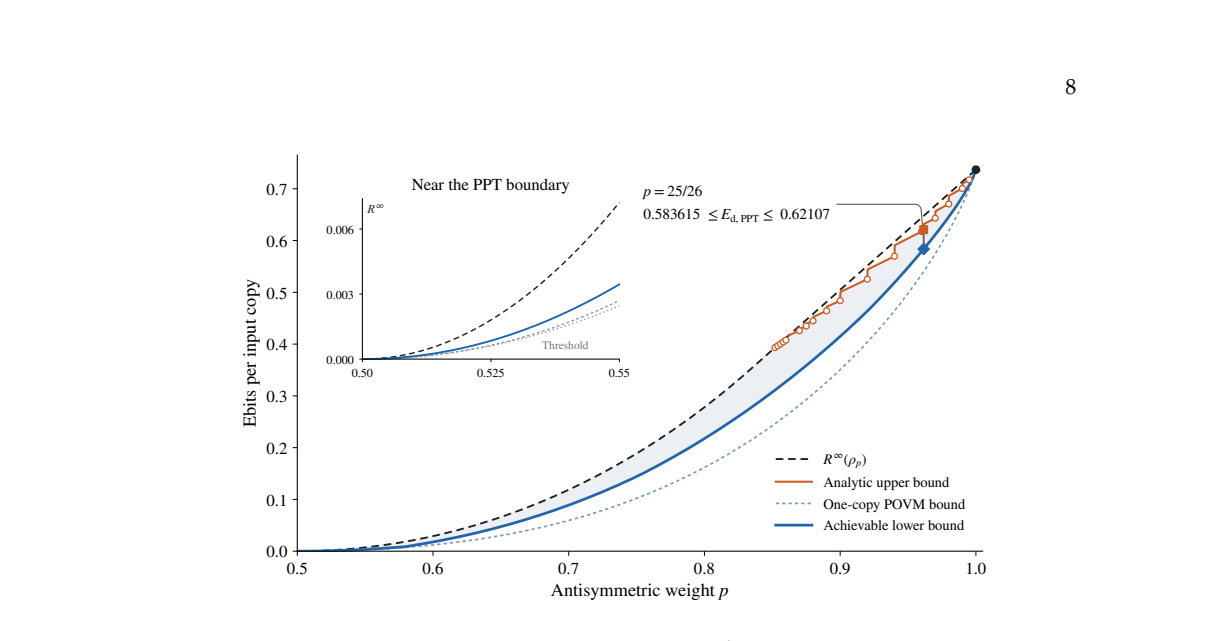
The abstract states a certified upper bound of 0.62107 ebits, Theorem 4 states ≤ 0.6211, and Figure 1 uses both 0.62107 and 0.6211. These presentations should be aligned so that the theorem statement, abstract, and figure refer to the same certified value.
The paper says, at Figure 1 captions
Pith says: minor objection 2 of 4
There are two nearly identical captions for Figure 1 with inconsistent internal references: one refers to "V_3(p) in (17)" while Eq. (17) is the definition of β_θ, and the other refers to the one-copy bound eL(ρ_p) in (126). The caption and equation numbering should be corrected and a single caption used.
show 2 more
The paper says, at §I.C, Eq. (6)
Pith says: minor objection 3 of 4
The sentence says the converses "upgrade the best available (computable) upper bounds" to the minimum in Eq. (6). It is not established that E_Q and E_A are computable, since they involve optimization over all finite extensions (resp. analytic families) and are not supplied with algorithms. I suggest replacing "computable" by "previously available" or explicitly qualifying the computability status of each bound.
The paper says, at Appendix F
Pith says: minor objection 4 of 4
The phrase "the corrected three-copy analytic certificate" appears without an earlier reference to a three-copy analytic certificate or a correction. If this is a historical artifact, it should be removed or explained, so the supplement's index is self-contained.
What would settle it
Recompute, in independent arbitrary-precision arithmetic, the two displayed certificates: the enclosure $-\frac12 v^T(\log G)v\in(0.633093814438981533,\,0.633093814438981534)$ and the residual $D_{\mathrm{bin}}(25/26\,\|\,t)+J(6211/10000)\le -1.126\ldots\times 10^{-6}$ from Appendices E–F; a violation of either would destroy the claimed gap $0.6211<(25/26)\log_2 5-\log_2 3$. The lower bound $0.5836$ can be checked separately by direct rational evaluation, through the type transform $C_m$ of Eq. (133), of the certified 48-copy, 49-outcome POVM.
from Pith's summary of the paper
How the review went
3 readings by deepseek-v4-flash · 9 Oct 2026
- Reader holds up
- Editor wrote the verdict above
- Referee minor revision: 1 major objection, 4 minor
Not run on this paper: the skeptic, the simulated authors' defence.
Pith did not check this review's objections against the paper.
The review in full
The review in brief, machine-written
You should know two things about this paper. First, the main result is real and important: Theorem 1 gives an exact regularized expression for the PPT distillable entanglement as a measured-relative-entropy-like quantity, and the two converse constructions in Theorems 2 and 3 are genuinely new tools, not cosmetic variations on Rains. Second, the headline application, a qutrit Werner state at p = 25/26 whose PPT distillable entanglement is certified below the regularized Rains bound, directly disproves the conjecture from Regula et al. 2019. If the proof is right, this is a decisive step forward in the field.
What the paper does well: the proofs of Theorems 1–4 are detailed and the operational reduction is handled carefully. I particularly like that the paper distinguishes what it proves from what it does not — no convergence speed for the lower-bound hierarchy, no claim of Turing computability, no assertion that EQ or EA is a complete converse. The companion certificate files with hashes and a standard-library verifier are exactly the right response to the delicate numerical layer. The negativity lower bound is a clean byproduct and a nice quantitative upgrade of Eggeling et al.
The soft spots are proportionate. I did not run the certificate code, and the exact endpoints 0.62107 and 0.6211 rest on interval arithmetic, directed rounding, and a one-sided quadrature bound. That layer is supplied, not hidden, but it is the most likely place for a subtle error. The structural quadratic bound with the explicit matrix G is much simpler and probably robust; the analytic certificate is the part a referee should check carefully. A second, minor issue is that Theorem 2's condition is genuinely all-copy and hard to verify for arbitrary states, so the quadratic converse is more of a proof technique than a practical bound outside the Werner example. The paper acknowledges this. I also note the LLM disclosure at the top; I treat it as transparency, not a flaw, since the human author says he validated the proofs and the mathematics is internally coherent.
Who should read this: anyone working on entanglement manipulation, Rains bounds, or asymptotic quantum Shannon theory. It deserves a serious referee — ideally one willing to execute the certificate code and check Appendices D–F. My own verdict is close to the paper's claims, with the caveat that I have not independently verified the numerical certificates.
The referee's report
If correct, this is a substantial advance. Theorem 1 is, to my knowledge, the first exact characterization of the PPT distillable entanglement in the standard vanishing-error asymptotic regime, and Theorem 4 resolves an open conjecture in entanglement manipulation. The two converse techniques are genuinely new and, as the paper shows, already beat the regularized Rains bound on a highly symmetric family. The paper also ships detailed proofs, exact rational certificates, interval-arithmetic enclosures, and companion verification code, which is a real strength. I did not execute the certificate code; my assessment treats the numerical certificates as described. A further strength is that the qualitative separation E_d,PPT < R^∞ does not depend on the sharpest certificates: the proof of U(ρ_25/26) < R^∞ in Theorem 4 is self-contained, and the sharper 0.6211/0.62107 endpoint is an additional certified application of the analytic method.
Pith's reading of the paper (a machine's summary, not the authors')
The paper aims to determine the asymptotic rate at which many copies of a noisy bipartite quantum state can be converted, with vanishing error, into maximally entangled Bell pairs ("ebits") using PPT operations — channels that preserve positivity of the partial transpose, a wider and semidefinite-tractable relaxation of the local operations (LOCC) used in practice. Its main result is an exact formula: the PPT distillable entanglement of any finite-dimensional state equals the regularised value of a measurement-based functional $L$, so the optimal rate is approached from below by explicitly enumerable finite measurements. On the converse side, the paper constructs two new upper bounds, one from quadratic forms on operator spaces and one from analytic families in an annulus built on Hirschman's strengthening of the Hadamard three-line theorem, and both come with exponential strong converses. Applying the analytic bound to $3\times3$ Werner states at antisymmetric weight $25/26$ yields a certified gap — the distillation rate is at most $0.6211$ ebits while the regularised Rains bound, the previously best-known upper bound, equals $0.6477$ ebits — thus refuting the conjecture that these two quantities coincide for all states. The formula also produces a quantitative lower bound on the distillation rate in terms of the entanglement negativity, turning the old qualitative statement that every NPT state is distillable by PPT operations into a rate guarantee.
What carries the argument. The load-bearing object is the measurement functional $L$ of Eq. (9), whose regularisation $L^\infty(\rho)=\sup_n \tfrac{1}{n}L(\rho^{\otimes n})$ is proven to equal the PPT distillable entanglement; an auxiliary variant $\widetilde L$ keeps the operator absolute values $|E_j^\Gamma|$ before taking the norm and agrees with $L$ after regularisation. Achievability runs a fixed measurement blockwise and accepts typical weighted outcome words by the law of large numbers, while the converse turns the Bell test $0\le Q_n\le 1$ of any distillation protocol into a two-outcome POVM and bounds $\|Q_n^\Gamma\|_\infty\le 2^{-nR}$. The quadratic converse is carried by the super-operator potential $V_\alpha[\omega,K]=\frac{1}{\alpha}\langle\sqrt{\omega},\,(\log \mathcal{L}_{\sqrt{\omega}}K^{-1}\mathcal{L}_{\sqrt{\omega}})(\sqrt{\omega})\rangle$, whose data processing follows from the transformer inequality for weighted geometric means; the analytic converse is carried by the boundary integral $J_{Z,\mathcal{O},z^*}(R)$ over an annulus, whose positive weights are the harmonic kernels obtained by periodising Hirschman's strengthening of the Hadamard three-line theorem. For the Werner separation, symmetry reduces the quadratic witness to a $2\times2$ matrix $G$ (Eq. 136) whose logarithmic expectation is separated from $R^\infty$ by a resolvent identity, and the analytic certificate is a rational Möbius annulus whose integral is enclosed by directed rounding.
Core claim. The central claim is Theorem 1: for every finite-dimensional bipartite state $\rho$, $$E_{d,\mathrm{PPT}}(\rho)=L^\infty(\rho)=\sup_{n\in\mathbb{N}^+}\frac{1}{n}L(\$rho^{{\otimes n}}$),$$ where $L(\rho)$ is the supremum over finite positive-operator-valued measurements $(E_j)_j$ of $\sum_{j:\,\mathrm{Tr}[\rho E_j]>0}\mathrm{Tr}[\rho E_j]\log\frac{\mathrm{Tr}[\rho E_j]}{\|E_j^\Gamma\|_\infty}$ (Eq. 9), a measured-relative-entropy-like quantity. The same functional accounts for both sides of the rate: typical weighted outcome words give achievability, and pulling back the Bell test of any distillation protocol gives the converse. On top of this, the paper proves two single-letter converses, $E_Q$ from quadratic forms on operator spaces and $E_A$ from analytic families in an annulus, each strong enough to imply exponential strong converses. Theorem 4 applies these bounds to the $3\times3$ Werner state of antisymmetric weight $25/26$ and obtains the certified enclosure $0.5836\le E_{d,\mathrm{PPT}}(\rho)\le 0.6211< R^\infty(\rho)=\frac{25}{26}\log_2 5-\log_2 3\approx 0.6477$, so the regularised Rains bound is strictly larger than the PPT distillable entanglement, disproving the conjecture that they coincide. As a byproduct of Theorem 1, the paper also derives the negativity lower bound $E_{d,\mathrm{PPT}}(\rho)\ge 1-h_2\big(\tfrac12+\tfrac{N(\rho)}{d+1}\big)$, making quantitative the known fact that every NPT state is distillable with PPT operations.
The premise it rests on. The sharp numbers in the Werner gap (the upper endpoints $0.6211$ and $0.62107$ and the lower endpoint $0.5836$) rest on interval-certified numerical work — directed-rounding enclosures of a $2\times2$ matrix logarithm, a one-sided quadrature bound on an annular integral, and an explicitly checked 48-copy POVM — so an undetected certificate error would change those digits, even though the underlying quadratic-form inequality with the explicit matrix $G$ would remain.
If the paper is right (Pith's inferences, not the authors')
The conjecture that $E_{d,\mathrm{PPT}}(\rho)=R^\infty(\rho)$ for every state (Regula et al., 2019) is false: the regularised Rains bound is strictly loose already for $3\times3$ Werner states.
Because every LOCC operation is PPT, the new converses $E_Q$ and $E_A$ also bound the LOCC distillable entanglement, upgrading the best computable upper bounds to $\min\{R^\infty, E_{\mathrm{sq}}, E_Q, E_A\}$ and supplying exponential strong converses.
Theorem 1 makes $E_{d,\mathrm{PPT}}$ lower semicomputable: enumerating rational POVMs and weights gives a computable increasing sequence of lower bounds, although no convergence speed is known.
Every NPT state has a strictly positive PPT distillation rate, bounded below by $1-h_2\big(\tfrac12+\tfrac{N(\rho)}{d+1}\big)$, turning the qualitative distillability theorem of Eggeling, Vollbrecht, Werner and Wolf into a quantitative bound.
A free-admixture propagation rule carries an upper certificate at one Werner parameter to all parameters to its left, so the certified gap is not an isolated point but extends across the NPT interval.
If the separation holds up, the regularised Rains bound loses its status as the natural candidate for a single-letter formula, and the search shifts to whether the new functionals $E_Q$ or $E_A$ can be completed into a convergent family of upper bounds — which would also settle whether $E_{d,\mathrm{PPT}}$ is Turing computable, a question the paper explicitly leaves open.
The exact one-copy POVM optimum for Werner states and the finite linear-program form of the collective hierarchy suggest that symmetric states can serve as a calibration bench: strengthening the certified POVM records there would probe how close these techniques can come to the true rate before any general formula is found.
The analytic-family converse is a template that does not obviously depend on PPT: any channel class whose action is controlled by two boundary trace norms could inherit the same exponential strong-converse construction from an annulus family.
Check this review
Pith stored no record of this review's passes and took no fingerprint of it. Reviews made by code from 13 Nov 2026 on carry both.
How often reviews like this one are right
Reviews like this one: written by deepseek-v4-flash, where what was read was not recorded.
How often objections from reviews like this one are right: not yet measured
Reviews by people
This review was written by a machine. No person has reviewed this paper on Pith yet. A scientist listed on Pith can review it for a fee, and their review is published here whatever it concludes.
The paper
Abstract
We study entanglement distillation under operations that remain completely positive under partial-transpose conjugation, a.k.a. PPT channels, in the standard quantum Shannon theory regime of asymptotically vanishing but non-zero error. Our main results are: (a) a regularised formula for the PPT distillable entanglement in terms of a measured-relative-entropy-like quantity; and (b) two different single-letter converses, one based on operator quadratic forms and the other on Hirschman's strengthening of the Hadamard three-line theorem. As an immediate application of (b), we show that the PPT distillable entanglement can be strictly smaller than the regularised Rains bound, thereby resolving an open problem in the theory of entanglement manipulation [Regula et al., NJP 21:103017, 2019]. A gap appears already for 3 × 3 Werner states: at antisymmetric weight 25/26, a certified upper bound of 0.62107 ebits lies below the (regularised) Rains bound, which equals 25/26log25−log23 ≈ 0.64766 ebits. On a different note, (a) implies a faithful lower bound on the PPT distillable entanglement in terms of the entanglement negativity, which provides a quantitative counterpart to the qualitatively known fact that any NPT state is PPT distillable [Eggeling et al., PRL 87:257902, 2001].
The paper's own sentences, arranged, kept beside the review and separate from it. Each label is drawn from a closed vocabulary; the number beside it is the probability the classifier gave that label. No sentence in this record was written by a model.
abstract compiled · 2026-10-09
The authors' main claim, as the classifier picked it out 0.68
“Our main results are: (a) a regularised formula for the PPT distillable entanglement in terms of a measured-relative-entropy-like quantity; and (b) two different single-letter converses, one based on operator quadratic forms and the other on Hirschman's strengthening of the Hadamard three-line theorem.”
How the main claim is stated: asserted 1.00
What the abstract itself states, as probabilities: claims first 0.09 · states limitation 0.21 · human participants 0.01 · controlled comparison 0.09 · randomized assignment 0.01 · states quantitative result 0.98 · compares with prior results 0.96 · mentions code or data availability 0.02
The abstract, sentence by sentence
This table labels the abstract only (arXiv listing abstract v1). The number is the probability the classifier gave the label.
| Sentence | Role | The authors' own work | States the main conclusion | Strength |
|---|---|---|---|---|
| We study entanglement distillation under operations that remain completely positive under partial-transpose conjugation, a.k.a. | contribution 0.67 | 0.66 | 0.03 | unclear 0.51 |
| PPT channels, in the standard quantum Shannon theory regime of asymptotically vanishing but non-zero error. | background 0.78 | 0.14 | 0.03 | unclear 0.73 |
| Our main results are: (a) a regularised formula for the PPT distillable entanglement in terms of a measured-relative-entropy-like quantity; and (b) two different single-letter converses, one based on operator quadratic forms and the other on Hirschman's strengthening of the Hadamard three-line theorem. | result 0.89 | 0.95 | 0.75 | asserted 1.00 |
| As an immediate application of (b), we show that the PPT distillable entanglement can be strictly smaller than the regularised Rains bound, thereby resolving an open problem in the theory of entanglement manipulation [Regula et al., NJP 21:103017, 2019]. | result 0.90 | 0.93 | 0.34 | asserted 1.00 |
| A gap appears already for $3\times 3$ Werner states: at antisymmetric weight $25/26$, a certified upper bound of $0.62107$ ebits lies below the (regularised) Rains bound, which equals $\frac{25}{26} \log_2 5 - \log_2 3 \approx 0.64766$ ebits. | result 1.00 | 0.91 | 0.12 | asserted 1.00 |
| On a different note, (a) implies a faithful lower bound on the PPT distillable entanglement in terms of the entanglement negativity, which provides a quantitative counterpart to the qualitatively known fact that any NPT state is PPT distillable [Eggeling et al., PRL 87:257902, 2001]. | interpretation 0.57 | 0.85 | 0.08 | asserted 1.00 |
What kind of paper the classifier reports this is: theoretical result 1.00 · evidence from proof or derivation 1.00
What was examined, and what was not
Sources read
- arXiv listing abstract v1
Not examined
- full text
- figures and tables
- references and citing sentences
- relations to other papers
Levels run
- P abstract
Not run
- S sections
- T body sentences
- C citations
- R cross-paper relations
How the labels were made
Compiled by classifier-1.13.0 via TypeSafe API, question bank abstract-p1-20260923, 2026-10-09: 1 request, 5,469 input tokens.
Every quoted sentence on this record is the authors'. Every label is from Pith's closed vocabulary, with the probability shown beside it. This record as JSON
Figures (1)
Figures are the authors', reproduced from the paper.
References (60)
- [1] R.F.Werner. QuantumstateswithEinstein-Podolsky-Rosencorrelationsadmittingahidden-variable model.Phys. Rev. A, 40:4277–4281, 1989. 2 on Pith
- [2] A. Aspect, J. Dalibard, and G. Roger. Experimental test of Bell’s inequalities using time-varying analyzers.Phys. Rev. Lett., 49:1804–1807, 1982 on Pith
- [3] C. H. Bennett and S. J. Wiesner. Communication via one- and two-particle operators on Einstein- Podolsky-Rosen states.Phys. Rev. Lett., 69:2881–2884, 1992 on Pith
- [4] C.H.Bennett,G.Brassard,C.Crépeau,R.Jozsa,A.Peres,andW.K.Wootters. Teleportinganunknown quantumstateviadualclassicalandEinstein-Podolsky-Rosenchannels.Phys.Rev.Lett.,70:1895–1899, 1993 on Pith
- [5] A. K. Ekert. Quantum cryptography based on Bell’s theorem.Phys. Rev. Lett., 67:661–663, 1991. 2 on Pith
- [6] D.Bouwmeester,J.-W.Pan,K.Mattle,M.Eibl,H.Weinfurter,andA.Zeilinger. Experimentalquantum teleportation.Nature, 390:575–579, 1997. 2 on Pith
- [7] J. Yin, Y. Cao, Y.-H. Li, S.-K. Liao, L. Zhang, J.-G. Ren, W.-Q. Cai, W.-Y. Liu, B. Li, H. Dai, G.-B. Li, Q.-M. Lu, Y.-H. Gong, Y. Xu, S.-L. Li, F.-Z. Li, Y.-Y. Yin, Z.-Q. Jiang, M. Li, J.-J. Jia, G. Ren, D. He, Y.-L. Zhou, X.-X. Zhang, N. Wang, X. Chang, Z.-C. Zhu, N.-L. Liu,... on Pith
- [8] E.Pedrozo-Peñafiel,S.Colombo,C.Shu,A.F.Adiyatullin,Z.Li,E.Mendez,B.Braverman,A.Kawasaki, D. Akamatsu, Y. Xiao, and V. Vuletić. Entanglement on an optical atomic-clock transition.Nature, 588:414–418, 2020 on Pith
- [9] D. P. Nadlinger, P. Drmota, B. C. Nichol, G. Araneda, D. Main, R. Srinivas, D. M. Lucas, C. J. Bal- lance, K. Ivanov, E. Y.-Z. Tan, P. Sekatski, R. L. Urbanke, R. Renner, N. Sangouard, and J.-D. Bancal. Experimental quantum key distribution certified by Bell’s theorem.Nature, ... on Pith
- [10] D. Main, P. Drmota, D. P. Nadlinger, E. M. Ainley, A. Agrawal, B. C. Nichol, R. Srinivas, G. Araneda, andD.M.Lucas. Distributedquantumcomputingacrossanopticalnetworklink.Nature,638:383–388, on Pith
- [11] C. H. Bennett, H. J. Bernstein, S. Popescu, and B. Schumacher. Concentrating partial entanglement by local operations.Phys. Rev. A, 53:2046–2052, 1996. 2 on Pith
- [12] C. H. Bennett, G. Brassard, S. Popescu, B. Schumacher, J. A. Smolin, and W. K. Wootters. Purification ofnoisyentanglementandfaithfulteleportationvianoisychannels.Phys.Rev.Lett.,76:722–725,1996 on Pith
- [13] C. H. Bennett, D. P. DiVincenzo, J. A. Smolin, and W. K. Wootters. Mixed-state entanglement and quantum error correction.Phys. Rev. A, 54:3824–3851, 1996 on Pith
- [14] I.DevetakandA.Winter. Distillationofsecretkeyandentanglementfromquantumstates.Proc.Royal Soc. A, 461(2053):207–235, 2005. 2, 6 on Pith
- [15] E. Chitambar, D. Leung, L. Mančinska, M. Ozols, and A. Winter. Everything you always wanted to know about LOCC (but were afraid to ask).Commun. Math. Phys., 328(1):303–326, 2014. 2 on Pith
- [16] J. Watrous. Many copies may be required for entanglement distillation.Phys. Rev. Lett., 93:010502, on Pith
- [17] A. Peres. Separability criterion for density matrices.Phys. Rev. Lett., 77:1413–1415, 1996. 2 on Pith
- [18] E. M. Rains. Bound on distillable entanglement.Phys. Rev. A, 60:179–184, 1999. 2 on Pith
- [19] E. M. Rains. A semidefinite program for distillable entanglement.IEEE Trans. Inf. Theory, 47(7):2921– 2933, 2001. 2, 3, 5, 9, 10, 12, 26, 30 on Pith
- [20] M.-D.Choi. Completelypositivelinearmapsoncomplexmatrices.LinearAlgebraAppl.,10(3):285–290, on Pith
show 40 more
- [21] S. P. Boyd and L. Vandenberghe.Convex Optimization. Berichte über verteilte messysteme. Cambridge University Press, 2004. 2 on Pith
- [22] L. Vandenberghe and S. Boyd. Semidefinite programming.SIAM Rev., 38:49–95, 1996. 2 on Pith
- [23] H.Umegaki. Conditionalexpectationinanoperatoralgebra.IV.Entropyandinformation.KodaiMath. Sem. Rep., 14(2):59–85, 1962. 3 38 on Pith
- [24] R. R. Tucci. Quantum entanglement and conditional information transmission.Preprint arXiv:quant- ph/9909041, 1999. 3, 4 on Pith
- [25] M. Christandl and A. Winter. Squashed entanglement: An additive entanglement measure.J. Math. Phys., 45(3):829–840, 2004 on Pith
- [26] K.LiandA.Winter. Relativeentropyandsquashedentanglement.Commun.Math.Phys.,326(1):63–80, 2014 on Pith
- [27] M. E. Shirokov. Squashed entanglement in infinite dimensions.J. Math. Phys., 57(3):032203, 2016. 3, 4 on Pith
- [28] X. Wang and R. Duan. Nonadditivity of Rains’ bound for distillable entanglement.Phys. Rev. A, 95:062322, 2017. 3, 10 on Pith
- [29] K. Fang, H. Fawzi, and O. Fawzi. Efficient approximation of regularized relative entropies and applications.IEEE Trans. Inf. Theory, 72(4):2330–2342, 2026. 3, 6, 10 on Pith
- [30] K. Audenaert, M. B. Plenio, and J. Eisert. Entanglement cost under positive-partial-transpose- preserving operations.Phys. Rev. Lett., 90:027901, 2003. 3 on Pith
- [31] S.Ishizaka. Binegativityandgeometryofentangledstatesintwoqubits.Phys.Rev.A,69:020301,2004. 3 on Pith
- [32] L. Lami, F. A. Mele, and B. Regula. Computable entanglement cost under positive partial transpose operations.Phys. Rev. Lett., 134:090202, 2025. 3 on Pith
- [33] X. Wang and M. M. Wilde. Cost of quantum entanglement simplified.Phys. Rev. Lett., 125:040502, on Pith
- [34] X. Wang and M. M. Wilde. Exact entanglement cost of quantum states and channels under positive- partial-transpose-preserving operations.Phys. Rev. A, 107:012429, 2023. 3 on Pith
- [35] X. Wang and M. M. Wilde. Errata for “Cost of quantum entanglement simplified” and “Exact en- tanglement cost of quantum states and channels under PPT-preserving operations”, 2024. preprint https://doi.org/10.5281/zenodo.11061607. 3 on Pithdoi:10.5281/zenodo.11061607
- [36] R.Brinster,T.V.Kondra,H.Kampermann,D.Bruß,andN.Wyderka. Multinegativityandsingle-letter formulas for asymptotic entanglement.Preprint arXiv:2609.20698, 2026. 3 on PithPith's reviewarXiv
- [37] X.WangandR.Duan. Improvedsemidefiniteprogrammingupperboundondistillableentanglement. Phys. Rev. A, 94:050301, 2016. 3 on Pith
- [38] C.ZhuandX.Wang.Themin-RainsrelativeentropyisnottightforexactPPTentanglementdistillation. Preprint arXiv:2608.12135, 2026. 3 on PithPith's reviewarXiv
- [39] X. Wang and R. Duan. Irreversibility of asymptotic entanglement manipulation under quantum operations completely preserving positivity of partial transpose.Phys. Rev. Lett., 119:180506, 2017. 3 on Pith
- [40] L.LamiandB.Regula.Nosecondlawofentanglementmanipulationafterall.Nat.Phys.,19(2):184–189, on Pith
- [41] M. Horodecki, P. Horodecki, and R. Horodecki. Mixed-state entanglement and distillation: Is there a “bound” entanglement in nature?Phys. Rev. Lett., 80:5239–5242, 1998. 3 on Pith
- [42] P. Horodecki, Ł. Rudnicki, and K. Życzkowski. Five open problems in quantum information theory. PRX Quantum, 3:010101, 2022. 3 on Pith
- [43] T. Eggeling, K. G. H. Vollbrecht, R. F. Werner, and M. M. Wolf. Distillability via protocols respecting the positivity of partial transpose.Phys. Rev. Lett., 87:257902, 2001. 4, 16 on Pith
- [44] G. Vidal and R. F. Werner. Computable measure of entanglement.Phys. Rev. A, 65:032314, 2002. 4 on Pith
- [45] B. Regula, K. Fang, X. Wang, and M. Gu. One-shot entanglement distillation beyond local operations and classical communication.New J. Phys., 21(10):103017, 2019. 4, 8 on Pith
- [46] M.Tomamichel. Smoothentropies: ATutorialWithFocusonApplicationsinCryptography,92012. 7 on Pith
- [47] M. M. Wilde, A. Winter, and D. Yang. Strong converse for the classical capacity of entanglement- breaking and Hadamard channels via a sandwiched Rényi relative entropy.Commun. Math. Phys., 331(2):593–622, 2014 on Pith
- [48] M.Müller-Lennert,F.Dupuis,O.Szehr,S.Fehr,andM.Tomamichel. OnquantumRényientropies: A new generalization and some properties.J. Math. Phys., 54(12):122203, 2013. 7 on Pith
- [49] M. J. Donald. On the relative entropy.Commun. Math. Phys., 105(1):13–34, 1986. 10 on Pith
- [50] K. Fang, H. Fawzi, and O. Fawzi. Generalized quantum asymptotic equipartition.Preprint arXiv:2411.04035, 2025. 10 on PithPith's reviewarXiv
- [51] J. Ao, A. Philip, and A. Streltsov. PPT entanglement with correlated catalysis: monotones and irre- versibility.Preprint arXiv:2608.20063, 2026. 10 on PithPith's reviewarXiv
- [52] S. Beigi, R. Rubboli, and M. Tomamichel. Additivity of quantum relative entropies as a single-copy 39 criterion.Communications in Mathematical Physics, 407:134, 2026. 10, 30 on Pith
- [53] M. Berta, O. Fawzi, and M. Tomamichel. On variational expressions for quantum relative entropies. Lett. Math. Phys., 107(12):2239–2265, 2017. 11 on Pith
- [54] M. Sion. On general minimax theorems.Pacific J. Math., 8(1):171–176, 1958. 11 on Pith
- [55] R. Bhatia.Positive definite matrices. Princeton University Press, 2009. 17 on Pith
- [56] G. Pisier. Grothendieck’s theorem, past and present.Bull. Amer. Math. Soc., 49(2):237–323, 2012. 23 on Pith
- [57] M.Junge,R.Renner,D.Sutter,M.M.Wilde,andA.Winter. Universalrecoverymapsandapproximate sufficiency of quantum relative entropy.Ann. Henri Poincaré, 19(10):2955–2978, 2018. 24 on Pith
- [58] M. Mosonyi and T. Ogawa. Quantum hypothesis testing and the operational interpretation of the quantum Rényi relative entropies.Commun. Math. Phys., 334(3):1617–1648, 2015. 25 on Pith
- [59] T. Ogawa and H. Nagaoka. Strong converse and Stein’s lemma in quantum hypothesis testing.IEEE Trans. Inf. Theory, 46(7):2428–2433, 2000. 25 on Pith
- [60] W.MatthewsandA.Winter. OntheChernoffdistanceforasymptoticLOCCdiscriminationofbipartite quantum states.Commun. Math. Phys., 285(1):161–174, 2009. 27 on Pith
Challenges and discussion
Disagree with the review, or know something it missed? Leave a comment, or challenge this review formally: a challenge becomes a permanent entry in this paper's record, and its decision is published here.
Come back by email
A short list of the week's newly reviewed papers. Nothing is sent until you confirm from your inbox, and every email has a link that stops it. No account.
No comments yet.
Sign in to comment