General Economics · arXiv:2610.39375 v2 · submitted 29 Oct 2026
What is Work For? Labor, Politics, and Meaning in the Age of AI
The paper says
“This paper investigates the role of work in providing meaning, purpose, community, and other non-monetary benefits.”
more of the abstract
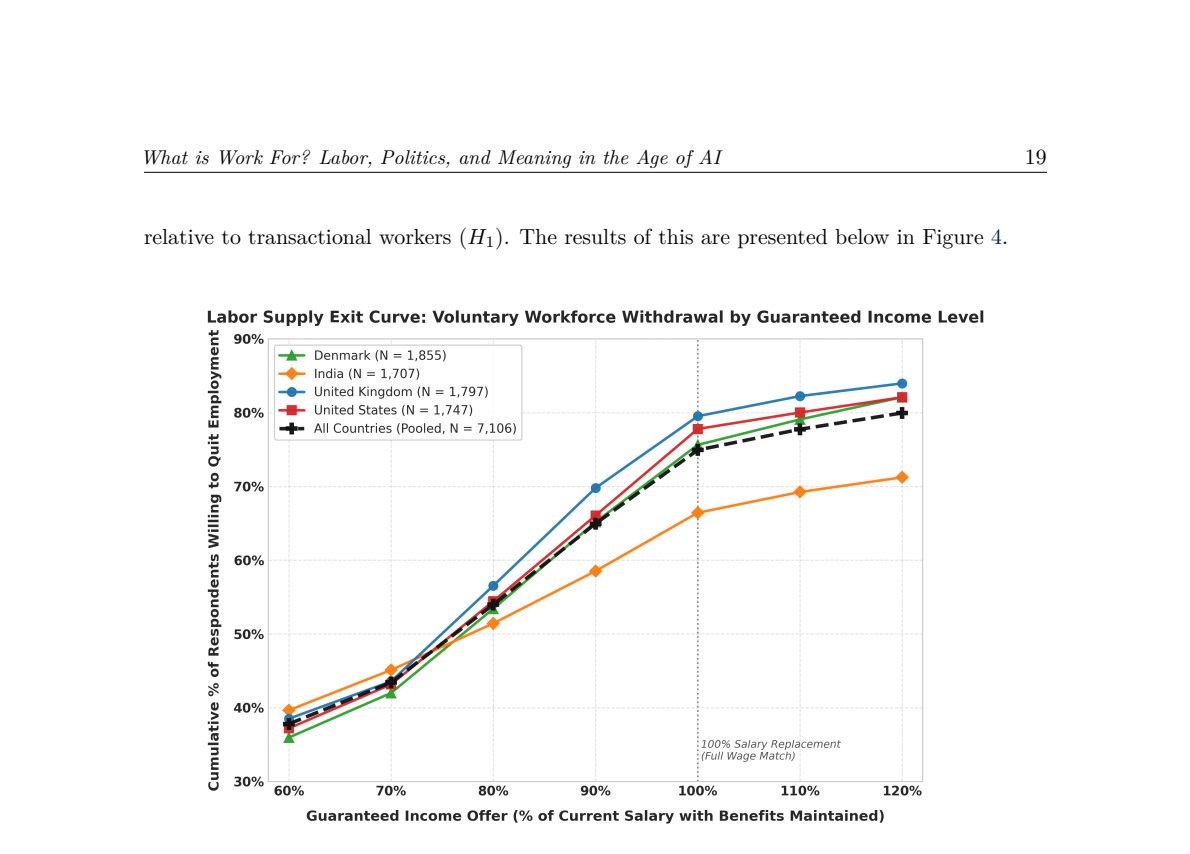
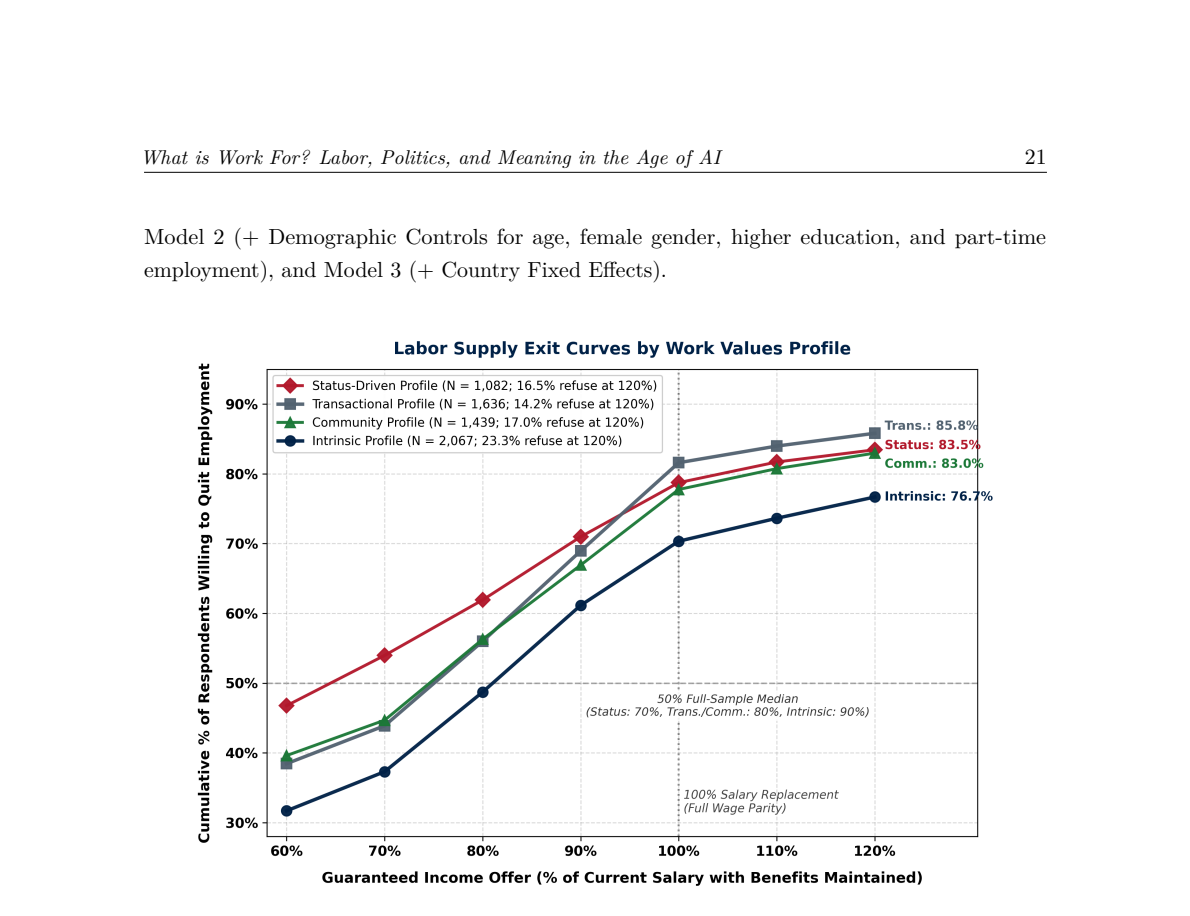
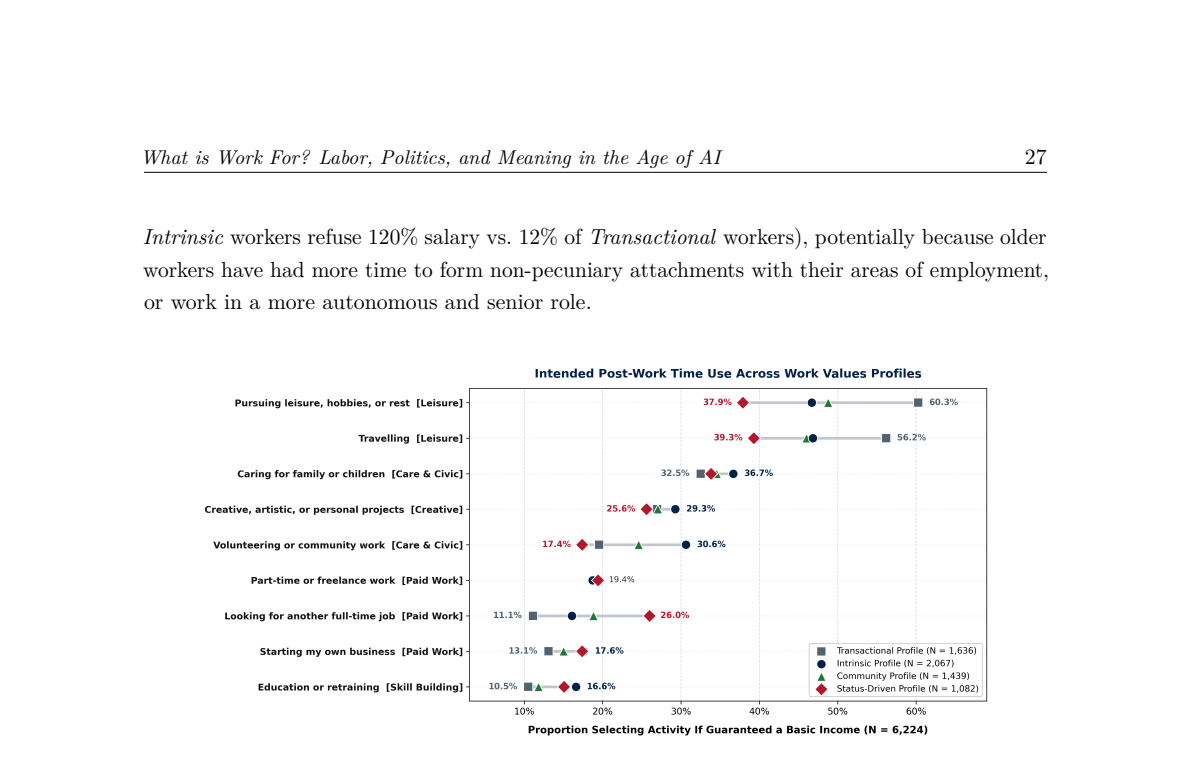
Using an original cross-national survey of 8,234 working-age adults across the UK, US, Denmark, and India, I study the factors that motivate people in their work, with an eye toward the future AI economic transformation. I find that 81% of respondents report being satisfied with their job, and a majority across all four countries are strongly motivated by the non-monetary components of their employment. Using an original "Work Values" Index, I show that one third of working respondents are motivated intrinsically by their job–valuing their role for its own sake. Nearly one quarter are driven by social and community-related aspects of their employment, 17% by social status, and just over one quarter by the transactional financial benefits of their job. Although a majority of people would leave their role if offered their current salary as a guaranteed income, one fifth of workers would stay even if offered up to 120% of their salary. Intrinsically motivated workers were disproportionately likely to refuse a basic income at any substitution level. Groups attached to their job for non-monetary reasons were also more likely to pursue volunteering or work-like activities if they received guaranteed income substitution but could no longer perform their role. Crucially, these non-monetary work motivations are evenly distributed across the income distribution and between white- and blue-collar workers. I argue that these findings have implications for managing the AI transition, understanding attitudes to AI, and making sense of policy preferences. Guaranteeing a basic income may indeed be necessary for managing any future AI labor shock, yet it could ultimately fail to compensate workers for any loss of the non-monetary benefits they derive from work.
from the abstract
Pith says
Machine review · deepseek-v4-flash · 30 Oct 2026 · of version 1 of the paper; version 2 is newer · what was read was not recorded · not checked by a person
It can be wrong. Challenge this review or reply to it.
Holds up, with conditions. A careful, honest descriptive study establishing that non-monetary work attachment is widespread and that Intrinsic workers demand a real reservation-wage premium, though the policy punchline rests on stated preferences and one robustness check the paper never actually shows. This line is wrong
2 major objections · 6 minor
How often objections from reviews like this one are right: not yet measured
Not checked: figures, code, what the references say.
The paper says, at Section 7; Section 3, n. 3; Table A4; Table 4
The review did not quote this passage.
Pith says: Objection 1 of 2 · major
The paper's main response to its own key limitation, that Work Values Profiles may be endogenous to job quality (Section 7), is asserted rather than shown. Footnote 3 of Section 3 promises that Section 5 shows the profile premiums hold when controlling directly for overall job satisfaction, but no specification including a job-satisfaction control appears in Section 5 or in any appendix table; the Section 7 discussion repeats the claim without coefficients.
more of objection 1
This matters because the Intrinsic-minus-Transactional premium is the quantity behind the Eq. 5 conclusion that income substitution cannot replace lost non-pecuniary value, and because the validation regressions in Table A4 omit the job-characteristic dimensions (autonomy, task meaningfulness, contract security) on which the endogeneity scenario operates. I request that the job-satisfaction-controlled estimates be reported for the truncated OLS, the 130% top-code, and the Tobit specifications, and that Table A4 be supplemented with job-characteristic controls. In fairness, the unconditional holdout evidence (20% refusing 120%) does not depend on the profiles and is robust to this concern; the unresolved part is the profile-specific attribution and the dollar-valued premiums derived from it.
This objection may describe the copy Pith gave the reviewer, not the paper.
The paper says, at Section 5; Eq. (5); Figure 7
The review did not quote this passage.
Pith says: Objection 2 of 2 · major
The paper should state more precisely which counterfactual the reservation-wage premium informs. The auction measures the transfer required to induce voluntary exit from the respondent's current job, and Section 7 reframes the profiles as a realized relationship within the current job.
more of objection 2
Under that reframing, the premium bundles irreplaceable meaning together with ordinary job amenities (autonomy, flexibility, colleagues), and the Figure 7 time-use data show that non-Transactional workers expect to substitute into other work, volunteering, or caregiving. Eq. (5) presents the non-monetary deficit as unconditional, but the welfare loss from displacement depends on whether the worker can re-engage in comparable activities or roles. The conclusion that transfers are necessary but not sufficient survives either reading, but the stronger formulation in the abstract (income substitution could ultimately fail to compensate workers for any loss of non-monetary benefits) should be tied explicitly to the income-only counterfactual. I suggest either modeling the re-employment and amenity-substitution margin or qualifying the claim accordingly.
6 minor objections
The paper says, at Abstract; Figure 4 notes
Pith says: minor objection 1 of 6
The headline that one fifth of workers would stay even at 120% of salary is a pooled figure partly driven by the non-representative India online sample (28.8% holdout), whereas the UK, US, and Denmark holdout rates are 16.0%, 17.9%, and 17.9%. Because the policy discussion is aimed mainly at developed economies, the abstract should report or qualify the Western-subset figure.
The paper says, at Section 4; Table A4; Figure 2
Pith says: minor objection 2 of 6
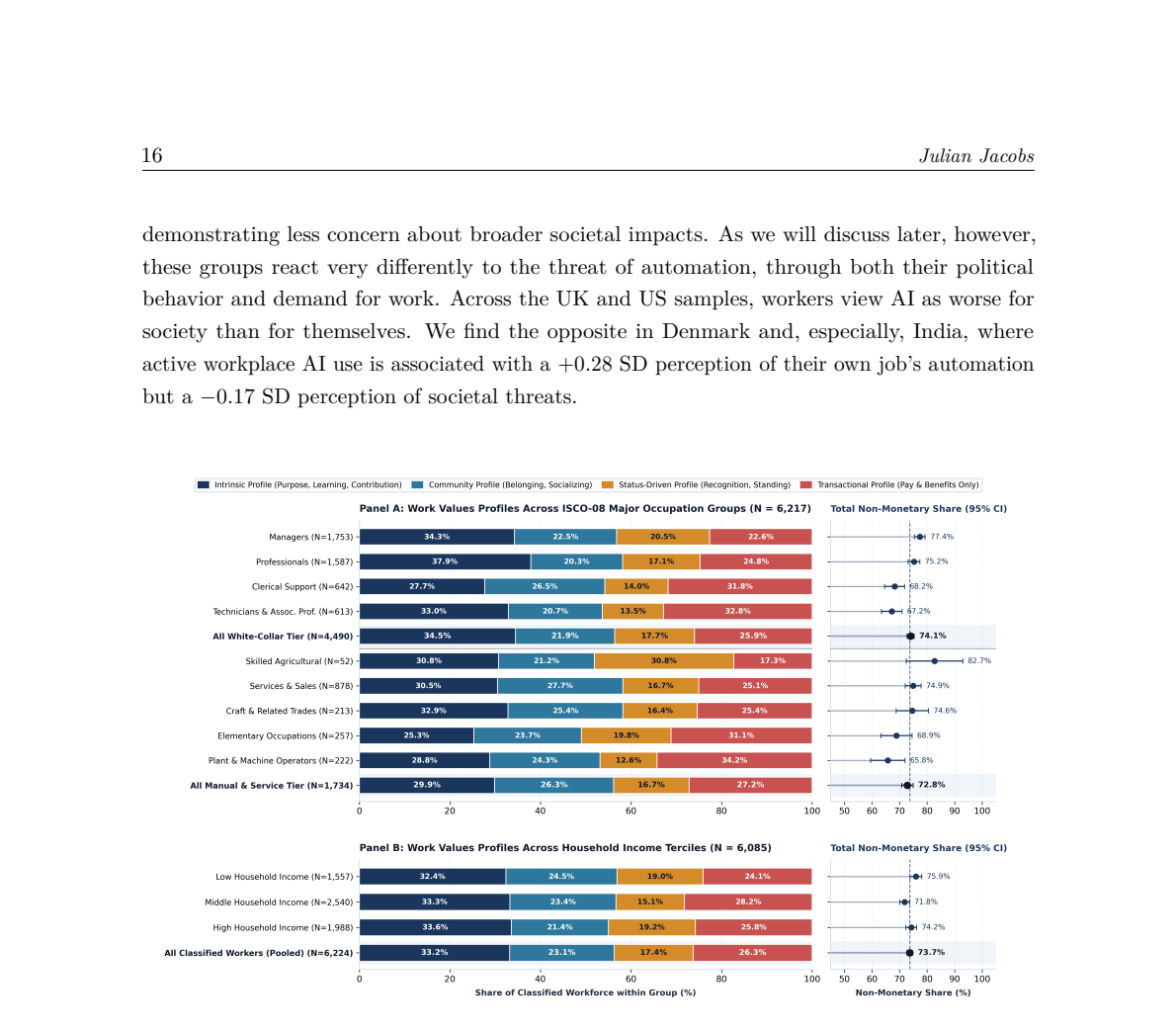
The claim that non-monetary motivations are evenly distributed across income and occupation is slightly stronger than the evidence: Table A4 shows that higher education predicts Intrinsic membership (+0.06, p < 0.01), part-time status predicts Community (+0.04, p < 0.01) and negatively predicts Transactional (-0.06, p < 0.01), and white-collar status predicts Intrinsic (p < 0.10) and negatively predicts Community (p < 0.05).
more of objection 2
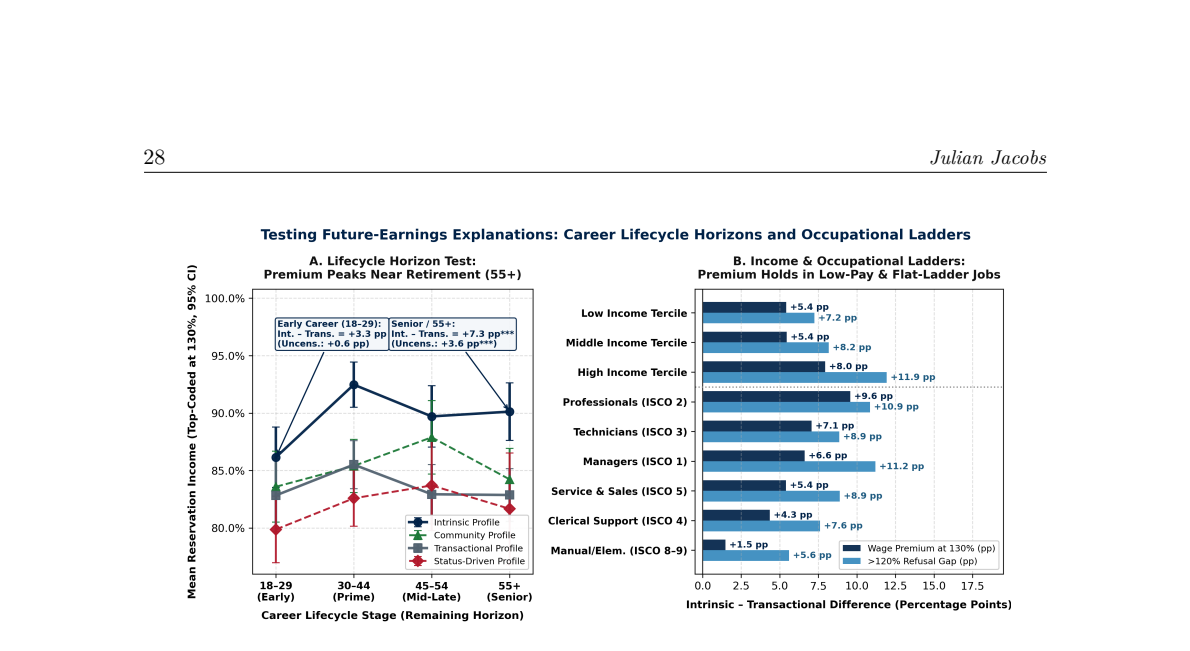
The occupational spread in Figure 2 (38% Intrinsic among Professionals versus 31% among Services and Sales) is modest but not null. Suggest softening the abstract wording.
show 4 more
The paper says, at Section 4
Pith says: minor objection 3 of 6
The fixed 3.0 importance cutoff and the pooled rarity-based tie-break assume cross-country comparability of response styles, yet no measurement-invariance or translation-equivalence analysis is reported. The large cross-country differences in profile shares (Table 2: 37.8% Transactional in the US versus 19.2% in Denmark) and the reported Western-only sensitivity checks only partly address this concern.
The paper says, at Section 7; Table A3
Pith says: minor objection 4 of 6
The limitations discussion refers to a two-part hurdle model that does not appear under that name in the appendix; if Columns 1 and 2 of Table A3 are intended as the hurdle specification, this should be stated explicitly.
The paper says, at Equations (4)-(5)
Pith says: minor objection 5 of 6
The rendered equations contain LaTeX brace artifacts (bracehtipupleft and similar) that should be cleaned before publication.
The paper says, at Section 5, footnote 19
Pith says: minor objection 6 of 6
The outside re-employment confidence estimates are confined to a footnote despite being central to the job-quality concern; moving them into the main table would make the robustness case easier to evaluate.
What would settle it
Re-estimate Table 4 Model 3 (N = 4,860) and the refusal linear-probability model of Appendix Table A3 Column 2 (N = 5,947) with standardized job satisfaction and perceived outside re-employment confidence (lose_job_confident) added to the conditioning set, and report the new Transactional−Intrinsic coefficients. If the Intrinsic premium and refusal gap shrink to statistical or economic insignificance, the Work Values premium is a job-quality proxy and the Eq. 5 policy inference is unsupported. If the coefficients remain close to −1.85 pp and −7.23 pp, the endogeneity concern is substantially defused.
from the skeptic's reading
How the review went
4 readings by deepseek-v4-flash · 30 Oct 2026
- Reader holds up, with conditions
- Skeptic agrees
- Editor wrote the verdict above
- Referee major revision: 2 major objections, 6 minor
Not run on this paper: the simulated authors' defence.
Pith did not check this review's objections against the paper.
The review in full
The review in brief, machine-written
Worth your time if you work on AI displacement or basic income policy. The empirical core is new: a four-country survey with a four-profile Work Values classification mapped onto a reservation-wage auction. The headline numbers—20% of workers refuse to quit even at 120% of salary, a third are Intrinsic-motivated, non-monetary attachment roughly flat across income and occupation—are real findings that will get cited.
The craft is solid. The profiles come from a nine-item Likert battery independent of the auction outcome, so the Intrinsic premium is not manufactured from the dependent variable; the circularity concern does not land. The censoring work is genuinely careful: truncated OLS as a lower bound, top-coding bounds at 120/130/150/200%, a right-censored Tobit, and robustness across five classification cutoffs (Table A11). The authors are also unusually candid in Section 7 about cross-sectional design, stated preferences, and the endogeneity of Work Values to job quality (b468–b469). That candor is earned.
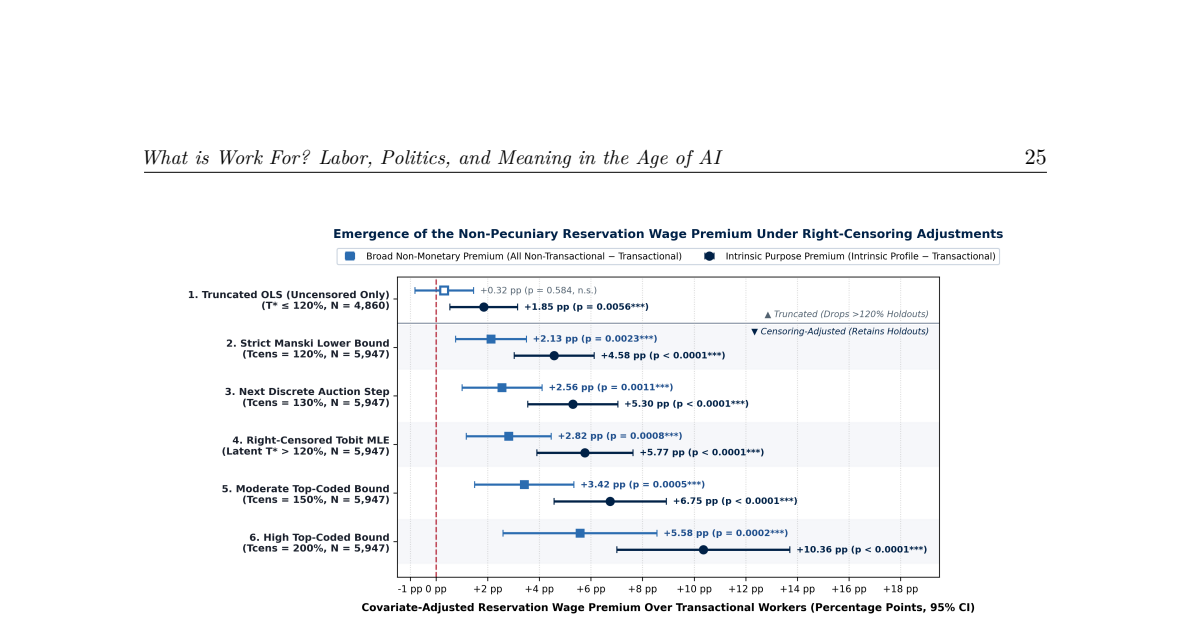
Where I would push back: the load-bearing inference is that the Intrinsic premium reflects non-monetary value that transfers cannot replace, rather than job quality or amenities a larger transfer might offset. The authors acknowledge the risk and say that controlling for standardized job satisfaction leaves the premium intact—but that specification never appears in any table. The outside re-employment confidence control is reported in a footnote with numbers (−1.99 pp, p < 0.01), so part of the check is auditable; the job-satisfaction check is not. Since that check carries real weight in the argument, its absence is a genuine soft spot, though not a fatal one.
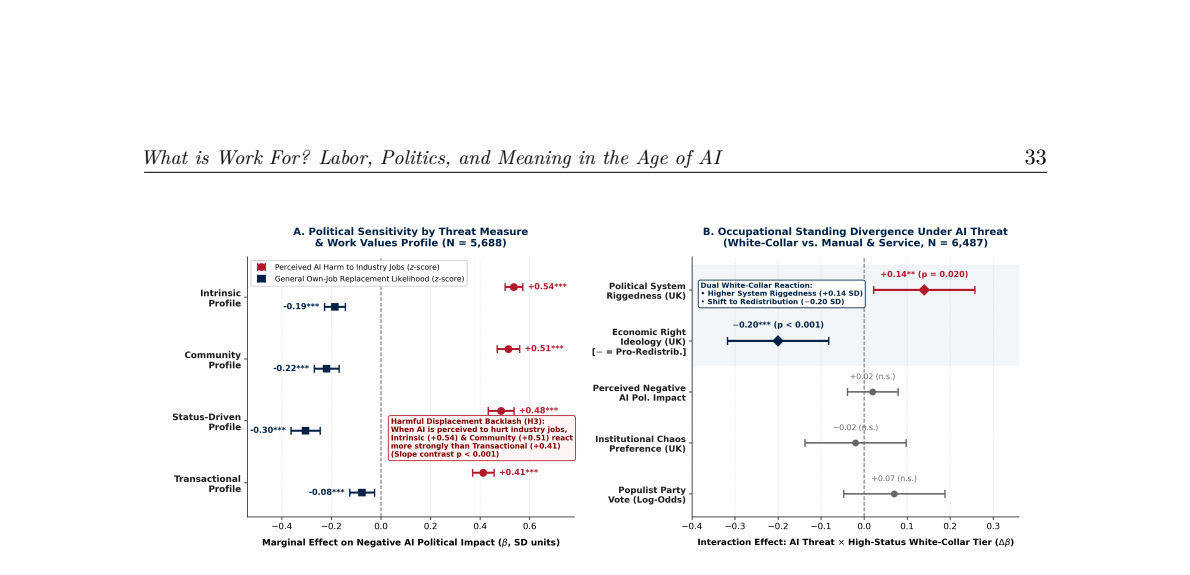
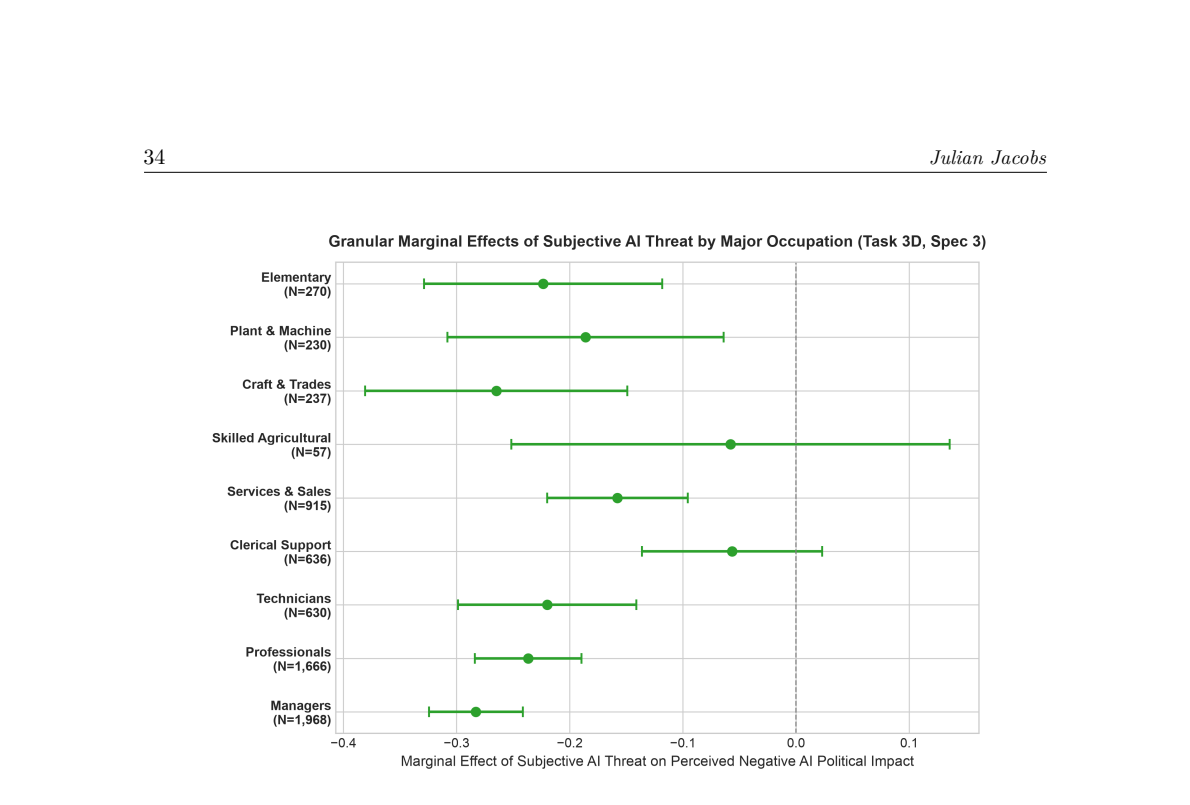
Other caveats, in proportion: the evidence is stated preference, not revealed behavior (acknowledged, with a Hausman citation); the most conservative premium is 1.85 percentage points, small even if directionally consistent; 24% of respondents fall into the excluded "Other" category via the cutoff and tie-break rules; the India sample is online-only and skewed white-collar (acknowledged); no replication data or code is shipped. None of these sink the paper. Section 6, the political analysis, is the weakest—the directional claims run through a threat measure the authors concede could be reversed—but they label it clearly as relational.
Bottom line: a well-executed descriptive contribution that deserves a serious referee. For revision I would want the job-satisfaction-controlled regression displayed, replication materials, and the policy conclusion scaled down to match the correlational, stated-preference evidence. I would bring it to reading group.
The strongest objection
The policy conclusion—that even full income substitution is insufficient (Eq. 5, with NW > NNW)—rests on interpreting the Intrinsic−Transactional reservation-wage premium as evidence of non-pecuniary value that transfers cannot replace. The load-bearing condition is that the Work Values Profiles measure something about the worker's valuation of non-monetary work aspects, not a downstream marker of unobserved job quality or amenities that a larger transfer could offset. The authors acknowledge this risk (Section 7, sentence b469): workers in rewarding, autonomous jobs may report intrinsic motivation precisely because their jobs are good. If that is what is happening, the +1.85 pp truncated OLS premium, the +5.77 pp Tobit premium, and the 23% vs. 14% holdout gap may be proxies for better-paid, more flexible, or otherwise more desirable jobs, rather than evidence that income substitution cannot compensate workers for lost meaning. The authors state that controlling for standardized job satisfaction leaves the Intrinsic premium intact, and that controlling for outside re-employment confidence strengthens it, but these specifications are not shown in any table. The validation regressions in Appendix Table A4 show that income, occupation, and party preference do not predict profile membership, but they do not include autonomy, task meaningfulness, contract security, or other job-quality measures. The concern is therefore not that the authors are silent about endogeneity; it is that the check they invoke to defuse the concern is unavailable to the reader, and the remaining evidence is consistent with the premium being a job-quality premium rather than a non-pecuniary worker-orientation premium.
The reader's weakest-assumption identification matches my own: the central empirical quantity—the Intrinsic reservation-wage premium—is only policy-relevant if Work Values Profiles are not artifacts of job quality, income, or political attitudes. The authors transparently acknowledge this in Section 7, and they cite two checks (job satisfaction controls and outside re-employment confidence controls), but neither is reported in the paper, so the concern remains unresolved rather than refuted. The paper deserves credit for its extensive censoring corrections, threshold sensitivity analysis (Appendix Table A11), and honest discussion of stated-preference limitations; none of those address the specific omitted-variable question of job quality. The conditional verdict remains appropriate: the descriptive patterns are plausible and directionally consistent, but the load-bearing exogeneity condition is asserted more than demonstrated. A single additional table would settle whether this concern lands, which is why I recommend no change to the reader's CONDITIONAL verdict rather than a rejection.
The referee's report
If the results withstand scrutiny, this is a useful contribution to the political economy of the AI transition and to the empirical literature on the non-pecuniary value of work. The strengths are substantial: an original cross-national dataset; an exemplary treatment of right-censoring in the reservation-wage measure (truncated OLS, refusal linear-probability model, top-coding bounds at 120-200%, and Tobit MLE, all in Table A3); sensitivity analysis of the classification cutoff across five thresholds (Table A11); three independent tests against a future-earnings explanation (Fig. 8, Fig. A4); and an unusually candid limitations section. The stated-preference auction and the cross-sectional design are acknowledged rather than hidden, and the main descriptive results (a large minority refusing 120% substitution; Intrinsic workers over-represented among holdouts) are robust to the paper's own sensitivity checks. The contribution is conditional: the profile-specific premium that carries the Eq.
Pith's reading of the paper (a machine's summary, not the authors')
The paper sets out to establish that work is more than a paycheck: it is a source of purpose, belonging, and social standing, and this non-monetary value is what income-support policy misses when it treats job loss as purely an income problem. Drawing on a new survey of 8,234 working-age adults in the UK, the US, Denmark, and India, the paper classifies workers into four motivation profiles and finds that nearly three-quarters are attached to their jobs for non-monetary reasons, spread evenly across income levels and across blue- and white-collar work. One fifth of workers say they would stay on the job even if paid 120 percent of their salary to leave, and intrinsically motivated workers demand a consistent wage premium to quit — 1.85 percentage points of guaranteed income in the most conservative estimate, rising to about 5.8 points once workers who refuse any offer are properly counted. The paper formalizes this as a non-monetary premium inside a worker's reservation income and concludes that guaranteed income is a necessary but insufficient response to AI-driven labor displacement.
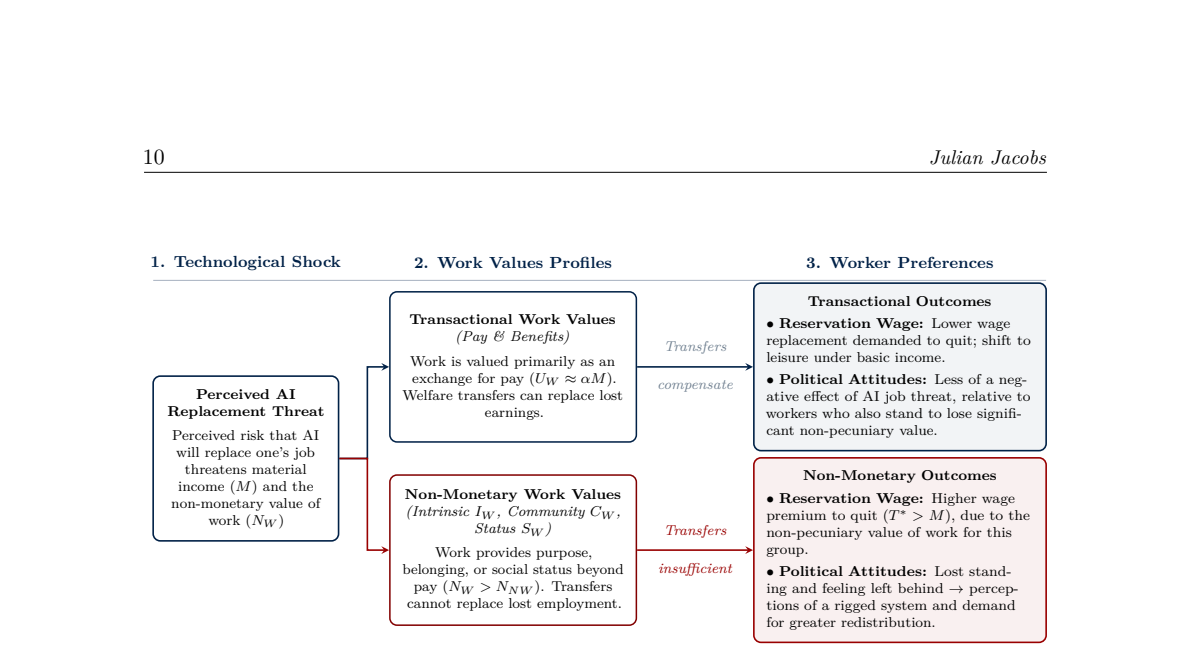
What carries the argument. The carrying object is the Work Values Profile, a four-way classification that assigns each surveyed worker a single dominant motivation — Transactional (pay and benefits), Intrinsic (purpose and contribution), Community (belonging and sociability), or Status-Driven (prestige and recognition) — built from a nine-item Likert battery with a 3.0 importance threshold and a rarity-based tie-break that assigns ceiling-scorers to the empirically rarer domain. The second piece of machinery is an auction-style reservation-wage question that walks workers from 60 to 120 percent of current salary in ten-point steps to elicit the guaranteed income at which they would quit, together with truncation-corrected estimators (top-coded bounds and a right-censored Tobit) that recover the premium hidden in the refused offers. The third is the utility decomposition of Equations 1 through 5, which expresses a worker's reservation transfer as $T^{*} = M + (NW - N_{NW})/\alpha$ — the material wage plus a non-monetary premium — and shows in Equation 5 that even $T = M$ leaves a deficit for any worker with $NW > N_{NW}$.
Core claim. The paper's central claim is that a large share of workers value employment for non-pecuniary reasons, that this valuation is measurable, and that it changes what compensation would make a displaced worker whole. Using a new Work Values Profile classification built from a nine-item importance battery, the author finds that one third of workers are intrinsically motivated (purpose, learning, societal contribution), 23 percent are community-motivated, 17 percent status-driven, and 26 percent transactional, and that these profiles cut evenly across income terciles and occupational tiers — making non-monetary attachment a feature of the whole workforce, not a perk of well-paid white-collar jobs. In an auction-style reservation-wage exercise, intrinsically motivated workers demand a covariate-adjusted premium of 1.85 to 5.77 percentage points of guaranteed income over transactional workers, and 23 percent of them refuse to quit even at 120 percent of salary, versus 14 percent of transactional workers. The paper's formal model provides the mechanism: with utility from work decomposed into material, intrinsic, community, and status components, even full income substitution $T = M$ leaves an uncompensated deficit $NW > N_{NW}$ for any worker whose job carries non-monetary value, so cash transfers cannot restore what automation takes.
The premise it rests on. The load-bearing premise is that the Work Values Profiles measure a worker's genuine orientation toward work rather than being an echo of job quality or income; if workers in rewarding, autonomous jobs report intrinsic motivation precisely because their jobs are good, the measured premium tracks job quality instead of a distinct non-monetary value, and the conclusion that income support under-compensates workers is overstated — an endogeneity risk the author explicitly acknowledges.
If the paper is right (Pith's inferences, not the authors')
If the central claim is right, basic income and similar transfers are necessary but not sufficient: displaced workers with non-monetary attachment suffer a welfare loss that cash cannot price, so policy must also address purpose, community, and standing.
Because non-monetary attachment is evenly distributed across income and occupation, no income tier or occupational class can be assumed to escape this uncompensated loss in an AI-driven transition.
Post-displacement time use would split by motivation: transactional workers retire into leisure, intrinsic and community workers shift toward volunteering and caregiving, and status-driven workers use income support to fund new work or entrepreneurship.
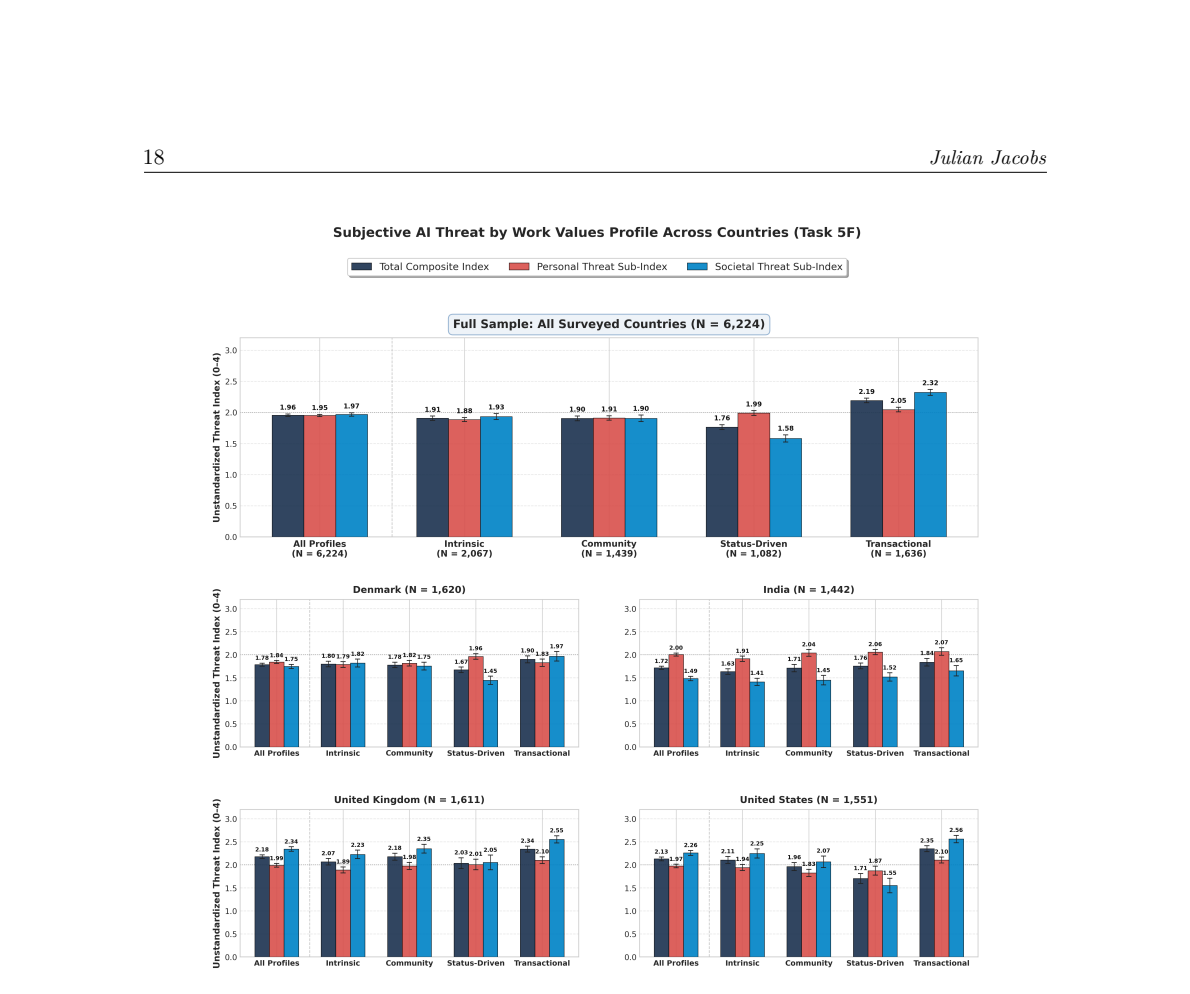
Workers who perceive a high AI threat demand lower compensation to exit, so anticipated displacement itself softens measured work attachment — which, if perceptions are accurate, means the very workers about to be automated would report the smallest premium.
If Work Values are partly downstream of job quality — the endogeneity the author flags — a complementary policy lever appears that the paper does not develop: improving job quality (autonomy, meaning, social contact) could substitute for part of the lost non-monetary value.
Because the tie-break rule makes profiles relative to each other, the striking cross-country pattern (38 percent transactional in the US versus 19 percent in Denmark) may partly reflect labor-market institutions shaping which motivations dominate, a testable implication the paper leaves implicit.
The framework extends naturally to a post-work economy: if the intrinsic and community components of work value can be re-homed in non-market activities such as volunteering and care, the uncompensated deficit shrinks, and the paper's own time-use findings suggest intrinsically motivated workers already know where to re-home it.
A revealed-preference version of the auction — paying real buyouts to leave a job — would show whether the 120 percent holdout rate is a genuine reservation value or survey cheap talk; the paper's own stated-versus-revealed preference caveat keeps both readings open.
Check this review
Pith stored no record of this review's passes and took no fingerprint of it. Reviews made by code from 13 Nov 2026 on carry both.
How often reviews like this one are right
Reviews like this one: written by deepseek-v4-flash, where what was read was not recorded.
How often objections from reviews like this one are right: not yet measured
Reviews by people
This review was written by a machine. No person has reviewed this paper on Pith yet. A scientist listed on Pith can review it for a fee, and their review is published here whatever it concludes.
The paper
Abstract
This paper investigates the role of work in providing meaning, purpose, community, and other non-monetary benefits. Using an original cross-national survey of 8,234 working-age adults across the UK, US, Denmark, and India, I study the factors that motivate people in their work, with an eye toward the future AI economic transformation. I find that 81% of respondents report being satisfied with their job, and a majority across all four countries are strongly motivated by the non-monetary components of their employment. Using an original "Work Values" Index, I show that one third of working respondents are motivated intrinsically by their job–valuing their role for its own sake. Nearly one quarter are driven by social and community-related aspects of their employment, 17% by social status, and just over one quarter by the transactional financial benefits of their job. Although a majority of people would leave their role if offered their current salary as a guaranteed income, one fifth of workers would stay even if offered up to 120% of their salary. Intrinsically motivated workers were disproportionately likely to refuse a basic income at any substitution level. Groups attached to their job for non-monetary reasons were also more likely to pursue volunteering or work-like activities if they received guaranteed income substitution but could no longer perform their role. Crucially, these non-monetary work motivations are evenly distributed across the income distribution and between white- and blue-collar workers. I argue that these findings have implications for managing the AI transition, understanding attitudes to AI, and making sense of policy preferences. Guaranteeing a basic income may indeed be necessary for managing any future AI labor shock, yet it could ultimately fail to compensate workers for any loss of the non-monetary benefits they derive from work.
The paper's own sentences, arranged, kept beside the review and separate from it. Each label is drawn from a closed vocabulary; the number beside it is the probability the classifier gave that label. No sentence in this record was written by a model.
abstract compiled · 2026-10-30
The authors' main claim, as the classifier picked it out 1.00
“Guaranteeing a basic income may indeed be necessary for managing any future AI labor shock, yet it could ultimately fail to compensate workers for any loss of the non-monetary benefits they derive from work.”
How the main claim is stated: hedged possibility 1.00
What the abstract itself states, as probabilities: claims first 0.06 · states limitation 0.22 · human participants 0.97 · controlled comparison 0.11 · randomized assignment 0.02 · states quantitative result 0.99 · compares with prior results 0.09 · mentions code or data availability 0.02
The abstract, sentence by sentence
This table labels the abstract only (arXiv listing abstract v1). The number is the probability the classifier gave the label.
| Sentence | Role | The authors' own work | States the main conclusion | Strength |
|---|---|---|---|---|
| This paper investigates the role of work in providing meaning, purpose, community, and other non-monetary benefits. | contribution 0.69 | 0.46 | 0.04 | unclear 0.57 |
| Using an original cross-national survey of 8,234 working-age adults across the UK, US, Denmark, and India, I study the factors that motivate people in their work, with an eye toward the future AI economic transformation. | method 0.85 | 0.93 | 0.02 | asserted 0.84 |
| I find that 81% of respondents report being satisfied with their job, and a majority across all four countries are strongly motivated by the non-monetary components of their employment. | result 1.00 | 0.96 | 0.08 | asserted 1.00 |
| Using an original "Work Values" Index, I show that one third of working respondents are motivated intrinsically by their job--valuing their role for its own sake. | result 0.96 | 0.96 | 0.05 | asserted 1.00 |
| Nearly one quarter are driven by social and community-related aspects of their employment, 17% by social status, and just over one quarter by the transactional financial benefits of their job. | result 1.00 | 0.92 | 0.03 | asserted 1.00 |
| Although a majority of people would leave their role if offered their current salary as a guaranteed income, one fifth of workers would stay even if offered up to 120% of their salary. | result 1.00 | 0.93 | 0.05 | asserted 1.00 |
| Intrinsically motivated workers were disproportionately likely to refuse a basic income at any substitution level. | result 1.00 | 0.92 | 0.07 | asserted 1.00 |
| Groups attached to their job for non-monetary reasons were also more likely to pursue volunteering or work-like activities if they received guaranteed income substitution but could no longer perform their role. | result 1.00 | 0.88 | 0.06 | asserted 0.98 |
| Crucially, these non-monetary work motivations are evenly distributed across the income distribution and between white- and blue-collar workers. | result 1.00 | 0.90 | 0.05 | asserted 1.00 |
| I argue that these findings have implications for managing the AI transition, understanding attitudes to AI, and making sense of policy preferences. | interpretation 0.99 | 0.22 | 0.12 | asserted 0.69 |
| Guaranteeing a basic income may indeed be necessary for managing any future AI labor shock, yet it could ultimately fail to compensate workers for any loss of the non-monetary benefits they derive from work. | interpretation 1.00 | 0.20 | 0.81 | hedged possibility 1.00 |
What kind of paper the classifier reports this is: empirical study 1.00 · evidence from observation or experiment 0.97
What was examined, and what was not
Sources read
- arXiv listing abstract v1
Not examined
- full text
- figures and tables
- references and citing sentences
- relations to other papers
Levels run
- P abstract
Not run
- S sections
- T body sentences
- C citations
- R cross-paper relations
How the labels were made
Compiled by classifier-1.13.0 via TypeSafe API, question bank abstract-p1-20260923, 2026-10-30: 1 request, 8,370 input tokens.
Every quoted sentence on this record is the authors'. Every label is from Pith's closed vocabulary, with the probability shown beside it. This record as JSON
Figures (10)
Figures are the authors', reproduced from the paper.
Challenges and discussion
Disagree with the review, or know something it missed? Leave a comment, or challenge this review formally: a challenge becomes a permanent entry in this paper's record, and its decision is published here.
Come back by email
A short list of the week's newly reviewed papers. Nothing is sent until you confirm from your inbox, and every email has a link that stops it. No account.
No comments yet.
Sign in to comment