High Energy Physics - Phenomenology · arXiv:2610.39697 v1 · submitted 29 Oct 2026 · 43 references
Radiative θ in Left-Right Universal Seesaw
The paper says
“We investigate radiative corrections to the QCD θ̄ parameter in the minimal left-right symmetric model with a universal seesaw mechanism, where parity symmetry ensures θ̄ = 0 at tree level.”
more of the abstract
Assuming Hermitian vector-like quark mass matrices, we identify the CP-odd rephasing invariants contributing to θ̄ and evaluate the leading two-loop corrections to the light-quark mass matrices induced by soft parity breaking. We find that the dominant contributions do not decouple and depend sensitively on the mass splittings as well as flavor mixings of the vector-like quarks. For hierarchical vector-like quark masses, the resulting θ̄ typically exceeds the current experimental bound from the neutron electric dipole moment. Satisfying this bound requires either nearly degenerate vector-like quark masses or strongly suppressed additional flavor mixing angles. In the former case, the radiative corrections are suppressed by a GIM-like mechanism. For generic mixing parameters, the dimensionless relative mass splittings are constrained to be below approximately 10−2 and 10−4 in the up- and down-type vector-like quark sectors, respectively. These results severely restrict the inverted vector-like quark mass hierarchy motivated by the universal seesaw mechanism.
from the abstract
Pith says
Machine review · deepseek-v4-flash · 30 Oct 2026 · what was read was not recorded · not checked by a person
It can be wrong. Challenge this review or reply to it.
Holds up, with conditions. Solid two-loop calculation with one honest caveat: the headline up-type splitting bound is a Yukawa-only result, and the paper's own estimate says the omitted gauge diagrams may dominate at the claimed threshold. This line is wrong
2 major objections · 4 minor
How often objections from reviews like this one are right: not yet measured
Not checked: figures, code, what the 43 references say.
The paper says, at Sec. 3.2 / Sec. 4, Eq. (4.6)
The review did not quote this passage.
A classifier read this sentence of the paper as acknowledging the concern (probability 0.79):
“In this paper, we consider the diagrams which consist of the Yukawa couplings, not the gauge cou- pling and the Higgs quartic coupling.”
Pith says: Objection 1 of 2 · major
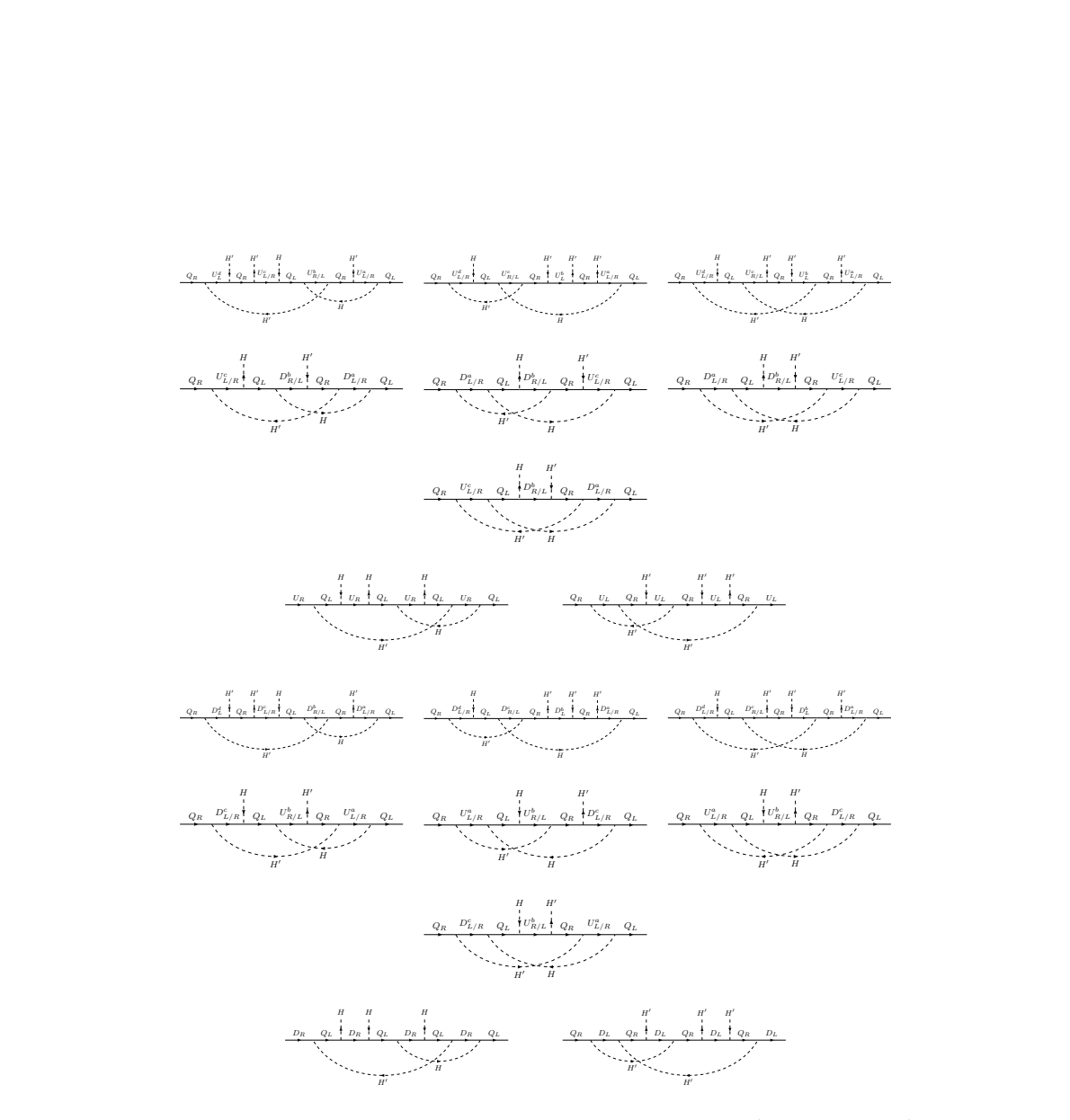
The headline constraints Delta_u <~ 10^-2 and Delta_d <~ 10^-4, and the 'viable' tuned point of Fig. 6, rest entirely on Eq. (3.30), which sums only two-loop diagrams built from Yukawa vertices (Sec. 3.2: 'we consider the diagrams which consist of the Yukawa couplings, not the gauge coupling and the Higgs quartic coupling').
more of objection 1
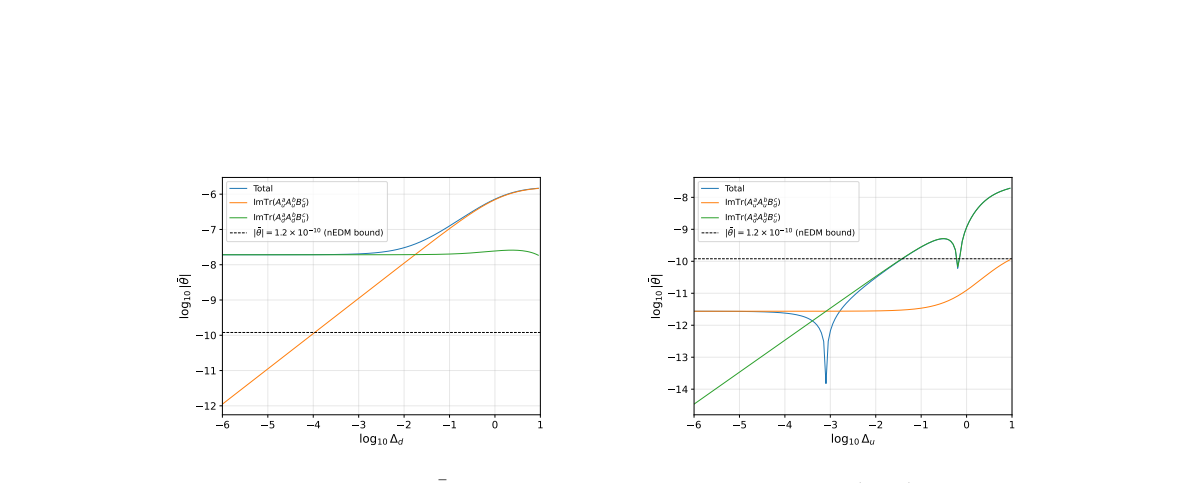
The paper's own order-of-magnitude estimate, Eq. (4.6) with g^2 ~ 0.3, gives the omitted gauge contribution alone as |theta-bar| ~ 3 x 10^-8 x Delta_u, which exceeds the nEDM bound 1.2 x 10^-10 at the very point Delta_u = 10^-2 that Fig. 6 calls viable. The computed Yukawa coefficient in that sector is 10^-9, so the uncomputed gauge term is estimated to be a factor ~30 larger. Because the invariants of the gauge contributions (Eqs. 4.3-4.4) have different flavor structure from the computed Im Tr(A_u^a A_u^b B^c_d), the interference sign is unknown: the true bound on Delta_u could tighten to ~4 x 10^-3, or relax by up to an order of magnitude. The paper acknowledges this ('A quantitative determination of this constraint requires an explicit calculation of these contributions'), but the abstract, the conclusions, and Fig. 6 present Delta_u = 10^-2 as an established bound and a viable configuration without this caveat. Since the central quantitative claim of the paper depends on this dominance assumption, this must be resolved (by computing the gauge and Higgs-quartic two-loop contributions, or by re-deriving and clearly labeling the up-type bound as conditional). The down-type bound Delta_d <~ 10^-4 is less exposed (the gauge term is ~40% of the Yukawa term there) and can stand with a stated qualification.
The paper says, at Sec. 4, Eq. (4.1) and footnote 2
The review did not quote this passage.
A classifier read this sentence of the paper as acknowledging the concern (probability 0.70):
“However, we use Eq. (2.5) even whenMaq ≃v ′ in this paper since the formula is much simpler.”
Pith says: Objection 2 of 2 · major
The quantitative benchmarks place M_3u = v' = m_H' (Eq. 4.1), i.e., exactly at the boundary of the v' <~ M_a^q expansion underlying the mass formulas (2.4)-(2.5). Footnote 2 acknowledges that Eq. (2.5) is approximate when M_a^q ~ v' and asserts, without demonstration, that the modifications 'do not change our results qualitatively.'
more of objection 2
The qualitative conclusion may survive, but the numerical constraints quoted for Delta_u and Delta_d are extracted from this benchmark, so the quantitative headline inherits this approximation. The paper should either state the sensitivity to the v'/M_a^q corrections or show that the extracted bounds are stable when the expansions are refined.
4 minor objections
The paper says, at Figure 1 caption
Pith says: minor objection 1 of 4
The caption writes 'ab (fifth to seventh rows)' where the text and figure meaning require 'a_d'; this is a typo that should be corrected for clarity.
The paper says, at Sec. 3.1 (after Eq. 3.19)
Pith says: minor objection 2 of 4
The phrase 'in the universal seesaw in the universal seesaw' contains a duplicated clause that should be removed.
show 2 more
The paper says, at Sec. 4, Fig. 5 (right panel)
Pith says: minor objection 3 of 4
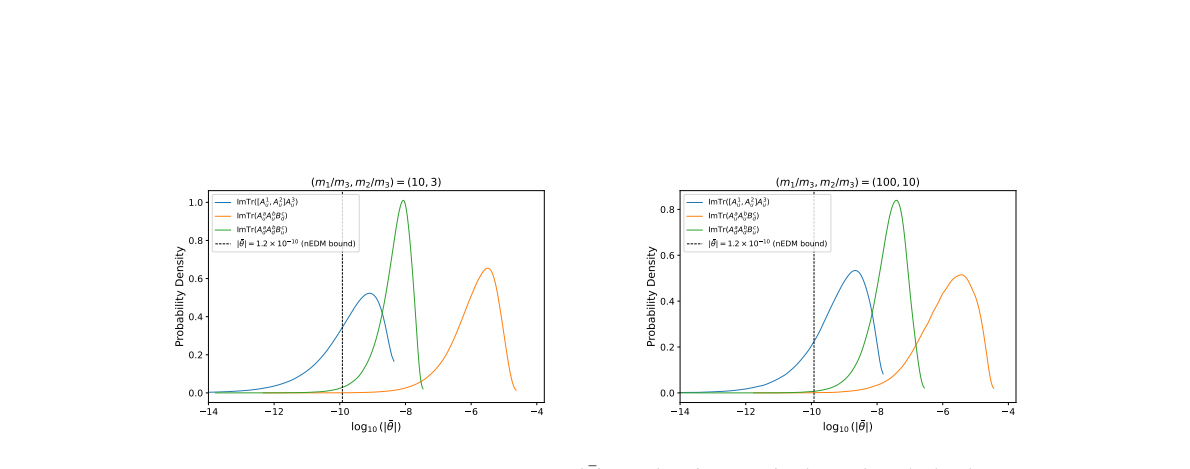
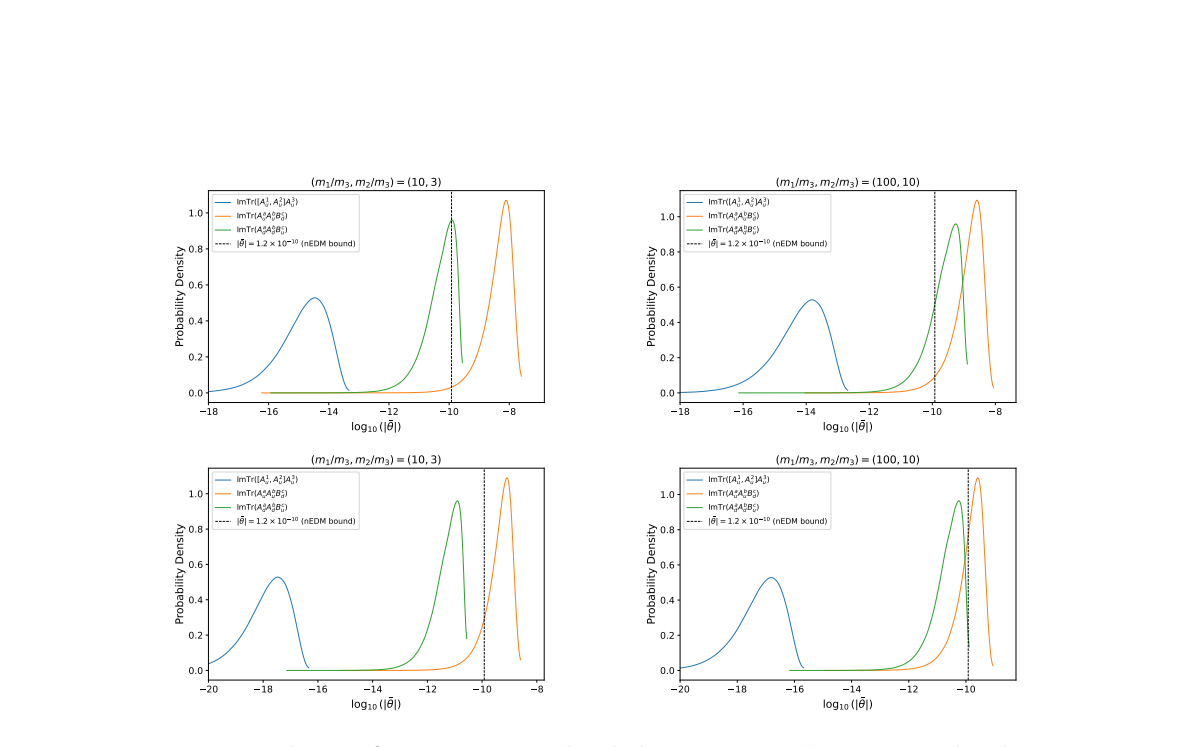
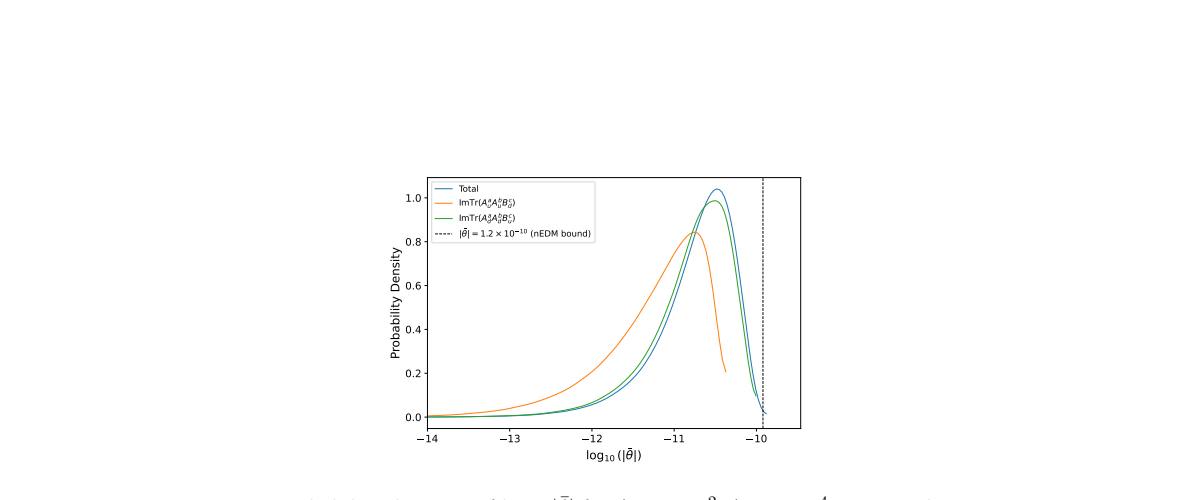
The two peaks in the right panel are attributed to 'accidental cancellation' among contributions; it would help the reader to state explicitly which terms cancel in each case (the text says the log10 Delta_u ~ 0 peak comes from cancellations among Im Tr(A_d^a A_d^b B^c_u) terms and the log10 Delta_u ~ -3 peak from cancellations between the two invariants, but the figure itself does not mark them).
The paper says, at Sec. 1, references [11]-[12]
Pith says: minor objection 4 of 4
Reference [12] is an arXiv preprint (arXiv:2607.10606) used to quote the stronger lattice bound |theta-bar| <~ 3.6 x 10^-11; the paper adopts 1.2 x 10^-10 as its reference bound. It would be useful to state explicitly that adopting the stronger bound would strengthen all derived constraints by roughly a factor of three.
What would settle it
Explicitly evaluate the two-loop gauge and Higgs-quartic corrections to au, b̄u, and ad — the Fig. 1 topologies with one Yukawa vertex replaced by a W/W'/U(1)B-L gauge or Higgs-quartic vertex — at the Fig. 5 sample point V'U = V'(6.08, 5.11, 3.73, 2.41, 1.66, 4.07), V'D = V'(3.72, 4.76, 0.191, 3.60, 4.59, 0.0254) with (Δu, Δd) = (10^-2, 10^-4), mH = 0, using Eq. (3.15). Compare the total |θ-bar| (computed plus gauge) to 1.2×10^-10. If the gauge contribution saturates the Eq. (4.6) estimate, the Δu constraint tightens to ~4×10^-3 and the Fig. 6 region is excluded; if it cancels the computed Im Tr(AadAbdBcu) term substantially, the up-type bound needs softening. This single numerical point fixes the sign and magnitude and settles which abstract numbers survive.
from the skeptic's reading
How the review went
4 readings by deepseek-v4-flash · 30 Oct 2026
- Reader holds up, with conditions
- Skeptic agrees
- Editor wrote the verdict above
- Referee major revision: 2 major objections, 4 minor
Not run on this paper: the simulated authors' defence.
Pith did not check this review's objections against the paper.
The review in full
The review in brief, machine-written
Worth your time. This is the first full two-loop evaluation of theta-bar in the minimal left-right universal seesaw for non-degenerate Hermitian vector-like quark spectra. The technical core is serious: the authors organize the CP-odd rephasing invariants, separate light- and heavy-quark contributions to the mass-matrix formula, evaluate the two-loop integrals with analytic expressions supplied in an ancillary file, and scan a million parameter points. The structure is coherent. The new step beyond Refs. [30, 31] is the non-degenerate case, and the finding that non-degenerate down-type vector-like quarks generate the largest invariant and force Delta_d < 1e-4 is a genuine step forward. The qualitative conclusion, that hierarchical and inverted vector-like spectra generically violate the nEDM bound unless the spectrum is nearly degenerate or the new mixings are small, looks robust.
The soft spot is the one the paper itself names. Section 3.2 keeps only diagrams built from Yukawa couplings; gauge and Higgs-quartic two-loop diagrams are omitted. The authors' own estimate, Eq. (4.6), gives the gauge contribution as about 3e-8 times Delta_u, which at Delta_u = 1e-2 is 3e-10, above the nEDM bound of 1.2e-10. So at the tuned point the paper calls viable for the up sector, the uncomputed term is estimated to be comparable to or larger than the computed one. The interference sign is unknown because the gauge invariants in Eqs. (4.3)-(4.4) have different flavor structure. The abstract's Delta_u < 1e-2 is therefore conditional, not established; if the gauge term adds constructively, the constraint tightens. Delta_d < 1e-4 is less exposed, since the gauge estimate there is roughly forty percent of the Yukawa term, but it carries the same unknown sign. This is an acknowledged limitation rather than a hidden one, and the footnote about the accuracy of the approximate invariants at large mixing is also honest. I see no circularity: no parameter is fitted to theta-bar, and the constraints are thresholds obtained by inverting the computed relation.
The citation pattern looks normal, and the paper gives clear credit to the Hermitian-limit and three-loop-counting predecessors. The ancillary file is a useful reproducibility gesture, though I could not independently verify the integrals.
This paper is for model-builders working on parity solutions to the strong CP problem and universal seesaw models, and for the EDM community looking for concrete targets. It deserves a serious referee. I would send it to review with a request that the gauge and quartic two-loop contributions either be computed or that the quantitative claims be explicitly framed as Yukawa-only estimates. My own guess is the down-type bound survives and the up-type bound tightens, but that is a guess until the omitted diagrams are done.
The strongest objection
The central quantitative claim, the abstract's constraints Δu ≲ 10^-2 and Δd ≲ 10^-4, comes from Eq. (3.30), which sums only two-loop diagrams built from Yukawa vertices (Sec. 3.2: 'we consider the diagrams which consist of the Yukawa couplings, not the gauge coupling and the Higgs quartic coupling'). The most load-bearing weakness is the unverified dominance of these diagrams, and the paper itself quantifies why it fails in the up-type sector. Eq. (4.6) estimates the omitted gauge contribution as 3×10^-8 × Δu for g^2 ~ 0.3, i.e., 3×10^-10 at Δu = 10^-2, above the nEDM bound of 1.2×10^-10; the computed Yukawa coefficient for the up-type term is 10^-9 (the '0.01' in Eq. 4.6). So at the point the paper calls viable for the up sector (right panel of Fig. 5; the Δu = 10^-2, Δd = 10^-4 configuration of Fig. 6), the uncomputed contribution is estimated to dominate. The effect is not a mere precision shift: Eqs. (4.3)-(4.4) show the gauge invariants Im Tr(AauBbd) and Im Tr(AadBbu) have different flavor structure from the computed Im Tr(AadAbdBcu), so the interference sign is unknown — the true Δu bound could tighten to ~4×10^-3 or relax by up to an order of magnitude. The down-type bound is less exposed: the gauge term is ~40% of the Yukawa term at Δd = 10^-4. The paper concedes this ('A quantitative determination of this constraint requires an explicit calculation of these contributions'), so the headline numbers are conditional, not established. The qualitative conclusion — hierarchical and inverted vector-like spectra generically violate the nEDM bound — is not threatened.
My reading: the central claim is the quantitative pair of constraints (Δu ≲ 10^-2, Δd ≲ 10^-4) plus the existential statement that the inverted hierarchy is severely restricted. The quantitative pair is directly load-bearing: for it to hold, the Yukawa-only two-loop diagrams of Sec. 3.2 must dominate θ-bar. The paper's own estimate (Eq. 4.6 and the sentence following it) demonstrates that this premise is doubtful in the up-type sector: the gauge-induced contribution alone is estimated at 3×10^-10 for Δu = 10^-2, 2.5 times the nEDM bound. The reader's weakest_assumption identifies exactly this gap, and the paper states it plainly ('A quantitative determination of this constraint requires an explicit calculation of these contributions'), so this is an acknowledged but unresolved premise rather than a hidden flaw. I weighed whether some other concern is more fundamental. (i) The approximate invariants (3.18)-(3.19): the numerics are described as evaluating Eq. (3.30) with the exact trace invariants (3.20)-(3.21), so footnote 4 qualifies the analytic shortcut, not the plotted curves; I weight this less than the reader. (ii) The leading-order v'/M expansion in the top sector (M3u = v'): acknowledged in the text, and the 1%-versus-0.01% conclusions are claimed to survive; plausible but unproven. (iii) Dropped terms proportional to Im Tr([A1d,A2d]A3d) (b̄d, parts of ad): the order-of-magnitude estimate makes them ~10^-3 of the up-sector antisymmetric invariant, itself subdominant in Fig. 2; not obviously load-bearing. The qualitative conclusion survives any outcome of the test: the PDFs peak at |θ-bar| ~ 10^-5 to 10^-6, orders above the bound, and no omitted diagram class plausibly cancels that generic excess. Hence the concern, while real, does not overturn the paper's thrust; it makes the precise abstract numbers conditional on an uncomputed diagram class. I therefore recommend keeping the reader's CONDITIONAL verdict unchanged.
The referee's report
If the quantitative claims survive, the paper delivers a substantial result: a parity-based solution of the strong CP problem realized through the universal seesaw is shown to be in tension with the nEDM bound unless the vector-like quark spectrum is nearly degenerate, which would gut the inverted-hierarchy motivation of the universal seesaw. The paper's strengths are real and specific: the CP-odd invariants (3.16)-(3.19) are manifestly rephasing-invariant; the calculation is non-circular (no parameter is fitted to theta-bar; the scan inputs are masses, mixings and phases); the non-decoupling of the dominant invariant is demonstrated; and the GIM-like suppression in the degenerate limit is identified explicitly. The Monte Carlo scans (10^6 points, perturbativity-filtered) give concrete distributions, and the treatment distinguishes the light- versus heavy-quark contributions to theta-bar carefully. The weakness is equally specific: the abstract-level numbers for Delta_u rest on an unverified, and by the paper's own estimate questionable, dominance assumption, so the headline constraints are conditional rather than established.
Pith's reading of the paper (a machine's summary, not the authors')
This paper asks whether the parity-based solution of the strong CP problem survives radiative corrections in the minimal left-right symmetric model with a universal seesaw, in which ordinary quark masses arise through mixing with heavy vector-like singlet quarks and the Standard Model mass hierarchy can be traced to an inverted hierarchy among those heavy partners. The authors identify the CP-odd rephasing invariants that can generate the QCD $\bar{\theta}$ parameter and compute the leading two-loop corrections to the light-quark mass matrices induced by soft parity breaking, finding that the dominant contribution does not decouple as the heavy quarks get heavier. For the hierarchical vector-like spectra the universal seesaw prefers, the resulting $|\bar{\theta}|$ typically peaks around $10^{-5}$--$10^{-6}$, orders of magnitude above the neutron EDM bound $|\bar{\theta}| \lesssim 1.2 \times 10^{-10}$. Meeting the bound forces either strongly suppressed extra mixing angles or nearly degenerate vector-like quark masses, with generic mixings allowing relative splittings of only about $10^{-2}$ in the up-type and $10^{-4}$ in the down-type sector; the paper concludes that the inverted hierarchy at the heart of the universal seesaw is severely restricted.
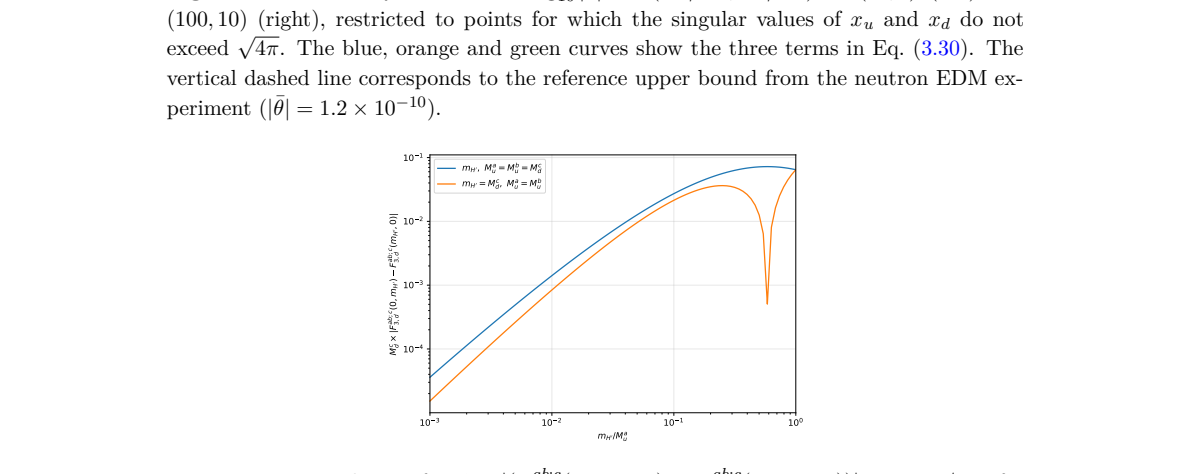
What carries the argument. The engine of the argument is Eq. (3.30), which expresses the radiatively generated $\bar{\theta}$ as a sum of three terms, each a CP-odd rephasing invariant multiplied by a two-loop integral over vector-like quark and Higgs propagators. The building blocks are the Hermitian outer products $A_q^a = x_q^a (x_q^\dagger)^a$ built from one generation of the Yukawa matrices and the matrices $B_q^a = x_q^a (x_q^{-1})^a$ containing the inverse couplings; the terms with $B$ do not decouple when the heavy quark masses grow, and they dominate. Soft parity breaking enters through the loop functions $F^{1,u}$, $F^{2,u}$, and $F^{3,q}$, whose parity-violating combinations such as $F^{3,d}(m_H, m_{H'}) - F^{3,d}(m_{H'}, m_H)$ vanish when the two Higgs doublets are degenerate, so the effect is switched on only through $v' \neq v$ and $m_{H'} \neq m_H$. Because $\bar{\theta}$ is dimensionless, the loops depend only on ratios of the vector-like quark masses, which is why the constraint transfers directly to the mass splittings; in the exactly degenerate limit the phases of the extra mixing matrices $V'^U$ and $V'^D$ become unphysical and the whole contribution cancels, the GIM-like suppression that defines the surviving parameter region.
Core claim. At tree level the parity symmetry forbids the bare QCD $\theta$ term and makes the determinants of the quark mass matrices real, so $\bar{\theta}=0$; the discovery is that soft parity breaking -- the dimension-two operator that makes $\langle H'\rangle = v' \neq v = \langle H\rangle$ and splits $m_{H'}$ from $m_H$ -- switches on two-loop corrections to the light-quark mass matrices that regenerate $\bar{\theta}$. The corrections organize into three CP-odd rephasing invariants, Eqs. (3.16), (3.18), and (3.19), which feed Eq. (3.30): a fully antisymmetric combination of the three up-type Yukawa outer products, and two invariants built from mixed up- and down-type couplings that contain the inverse Yukawa matrix $B_q^a = x_q^a (x_q^{-1})^a$ and are therefore non-decoupling. The dominant term, proportional to $\operatorname{Im Tr}(A_u^a A_u^b B_d^c)$, is nonzero even if the only CP violation is the CKM phase, is enhanced by the square-root mass ratios $\sqrt{m_b/m_d}$ and $\sqrt{m_b/m_s}$, and is controlled by the splittings of the down-type vector-like quark masses. For the benchmark hierarchies $(m_1/m_3, m_2/m_3) = (10, 3)$ and $(100, 10)$, the probability distribution of $|\bar{\theta}|$ with generic mixings peaks near $10^{-5}$--$10^{-6}$, well above the neutron EDM bound; holding $\bar{\theta}$ below the bound requires the down-type vector-like partners to match to about $10^{-4}$ and the up-type to about $10^{-2}$ through a GIM-like cancellation that suppresses the correction as the heavy masses approach degeneracy, or the new mixing angles to be strongly suppressed. The authors conclude that the inverted vector-like mass hierarchy motivated by the universal seesaw is severely restricted, and they state that the required tuning stays at roughly the 1% and 0.01% level even when higher-order terms in the $v'/M$ expansion are included.
The premise it rests on. The calculation keeps only two-loop diagrams built from Yukawa couplings and omits diagrams with gauge couplings and the Higgs self-coupling, so the quantitative bounds assume this class of diagrams dominates; the paper itself estimates that the gauge piece alone would give $|\bar{\theta}| \sim 3 \times 10^{-8}\,\Delta_u$ with $g^2 \sim 0.3$, already above the neutron EDM bound at the allowed $\Delta_u = 10^{-2}$, which would tighten the up-type constraint (or loosen it, if the pieces cancel) once computed explicitly.
If the paper is right (Pith's inferences, not the authors')
If the two-loop Yukawa calculation is correct, the inverted vector-like quark mass hierarchy that the universal seesaw uses to soften the Yukawa hierarchy is effectively ruled out at generic mixings: the down-type partners must match to $\Delta_d \lesssim 10^{-4}$ and the up-type partners to $\Delta_u \lesssim 10^{-2}$, which removes the very hierarchy the mechanism was introduced to create.
The allowed region is the GIM-like regime of nearly degenerate vector-like quark masses, in which the phases of the extra mixing matrices $V'^U$ and $V'^D$ become unphysical, so the model's new mixing phases are pinned to negligibility by the EDM constraint rather than serving as free parameters.
Because the computed contribution does not decouple, the bound cannot be evaded by raising the overall scale of the vector-like quark masses; heavier masses only push the Yukawa couplings toward the nonperturbative limit, so the constraint acts on the mass ratios $m_1/m_3$, $m_2/m_3$ rather than on the overall scale.
Suppressing the extra mixing angles offers only a bounded escape: restricting the six new angles to the range $10^{-2}$ reduces the dominant terms by about three orders of magnitude, and restricting them to $10^{-3}$ by about four, yet the viable band below the bound remains limited, as the paper's figures show.
If the paper's own estimate of the omitted gauge diagrams is representative, the up-type constraint tightens from $\Delta_u \lesssim 10^{-2}$ toward roughly $10^{-3}$, and the deliberately tuned benchmark configuration shown in Fig. 6 would fail unless the gauge and Yukawa pieces interfere destructively; an explicit evaluation of those diagrams is the natural next calculation.
The mechanism is plausibly generic: any parity-solution model in which light-quark mass matrices receive two-loop corrections from non-degenerate heavy parity partners should regenerate $\bar{\theta}$ through the same kind of non-decoupling invariant, so the near-degeneracy requirement likely extends to mirror-quark and other vector-like constructions, not only the minimal model studied here.
Because the dominant invariant is already nonzero with the CKM phase alone, the EDM constraint bites even when all new CP phases in the vector-like sector vanish; the neutron EDM search is therefore also a probe of the heavy-quark mass spectrum, independent of whether the model introduces new sources of CP violation.
Check this review
Pith stored no record of this review's passes and took no fingerprint of it. Reviews made by code from 13 Nov 2026 on carry both.
How often reviews like this one are right
Reviews like this one: written by deepseek-v4-flash, where what was read was not recorded.
How often objections from reviews like this one are right: not yet measured
Reviews by people
This review was written by a machine. No person has reviewed this paper on Pith yet. A scientist listed on Pith can review it for a fee, and their review is published here whatever it concludes.
The paper
Abstract
We investigate radiative corrections to the QCD θ̄ parameter in the minimal left-right symmetric model with a universal seesaw mechanism, where parity symmetry ensures θ̄ = 0 at tree level. Assuming Hermitian vector-like quark mass matrices, we identify the CP-odd rephasing invariants contributing to θ̄ and evaluate the leading two-loop corrections to the light-quark mass matrices induced by soft parity breaking. We find that the dominant contributions do not decouple and depend sensitively on the mass splittings as well as flavor mixings of the vector-like quarks. For hierarchical vector-like quark masses, the resulting θ̄ typically exceeds the current experimental bound from the neutron electric dipole moment. Satisfying this bound requires either nearly degenerate vector-like quark masses or strongly suppressed additional flavor mixing angles. In the former case, the radiative corrections are suppressed by a GIM-like mechanism. For generic mixing parameters, the dimensionless relative mass splittings are constrained to be below approximately 10−2 and 10−4 in the up- and down-type vector-like quark sectors, respectively. These results severely restrict the inverted vector-like quark mass hierarchy motivated by the universal seesaw mechanism.
The paper's own sentences, arranged, kept beside the review and separate from it. Each label is drawn from a closed vocabulary; the number beside it is the probability the classifier gave that label. No sentence in this record was written by a model.
abstract compiled · 2026-10-30
The authors' main claim, as the classifier picked it out 0.95
“These results severely restrict the inverted vector-like quark mass hierarchy motivated by the universal seesaw mechanism.”
How the main claim is stated: asserted 1.00
What the abstract itself states, as probabilities: claims first 0.03 · states limitation 0.78 · human participants 0.01 · controlled comparison 0.04 · randomized assignment 0.01 · states quantitative result 0.98 · compares with prior results 0.16 · mentions code or data availability 0.01
The abstract, sentence by sentence
This table labels the abstract only (arXiv listing abstract v1). The number is the probability the classifier gave the label.
| Sentence | Role | The authors' own work | States the main conclusion | Strength |
|---|---|---|---|---|
| We investigate radiative corrections to the QCD $\bar{\theta}$ parameter in the minimal left-right symmetric model with a universal seesaw mechanism, where parity symmetry ensures $\bar{\theta}=0$ at tree level. | contribution 0.79 | 0.78 | 0.05 | asserted 0.97 |
| Assuming Hermitian vector-like quark mass matrices, we identify the $CP$-odd rephasing invariants contributing to $\bar{\theta}$ and evaluate the leading two-loop corrections to the light-quark mass matrices induced by soft parity breaking. | method 0.75 | 0.93 | 0.04 | asserted 0.98 |
| We find that the dominant contributions do not decouple and depend sensitively on the mass splittings as well as flavor mixings of the vector-like quarks. | result 1.00 | 0.96 | 0.20 | asserted 1.00 |
| For hierarchical vector-like quark masses, the resulting $\bar{\theta}$ typically exceeds the current experimental bound from the neutron electric dipole moment. | result 0.99 | 0.90 | 0.31 | asserted 0.70 |
| Satisfying this bound requires either nearly degenerate vector-like quark masses or strongly suppressed additional flavor mixing angles. | result 0.75 | 0.83 | 0.36 | asserted 0.97 |
| In the former case, the radiative corrections are suppressed by a GIM-like mechanism. | interpretation 0.69 | 0.79 | 0.07 | asserted 0.99 |
| For generic mixing parameters, the dimensionless relative mass splittings are constrained to be below approximately $10^{-2}$ and $10^{-4}$ in the up- and down-type vector-like quark sectors, respectively. | result 1.00 | 0.91 | 0.22 | asserted 0.98 |
| These results severely restrict the inverted vector-like quark mass hierarchy motivated by the universal seesaw mechanism. | interpretation 0.97 | 0.85 | 0.48 | asserted 1.00 |
What kind of paper the classifier reports this is: theoretical result 1.00 · evidence from proof or derivation 0.98
What was examined, and what was not
Sources read
- arXiv listing abstract v1
Not examined
- full text
- figures and tables
- references and citing sentences
- relations to other papers
Levels run
- P abstract
Not run
- S sections
- T body sentences
- C citations
- R cross-paper relations
How the labels were made
Compiled by classifier-1.13.0 via TypeSafe API, question bank abstract-p1-20260923, 2026-10-30: 1 request, 6,334 input tokens.
Every quoted sentence on this record is the authors'. Every label is from Pith's closed vocabulary, with the probability shown beside it. This record as JSON
Figures (6)
Figures are the authors', reproduced from the paper.
References (43)
- [1] M. Kobayashi and T. Maskawa, “CP Violation in the Renormalizable Theory of Weak Interaction,” Prog. Theor. Phys.49(1973) 652–657. [2]Particle Data GroupCollaboration, “Review of Particle Physics,” Int. J. Mod. Phys. A41 (2026) 2630011 on Pith
- [3] S. L. Adler, “Axial vector vertex in spinor electrodynamics,” Phys. Rev.177(1969) 2426–2438 on Pith
- [4] J. S. Bell and R. Jackiw, “A PCAC puzzle:π0→γγin theσmodel,” Nuovo Cim. A60 (1969) 47–61 on Pith
- [5] S. L. Adler and W. A. Bardeen, “Absence of higher order corrections in the anomalous axial vector divergence equation,” Phys. Rev.182(1969) 1517–1536 on Pith
- [6] G. ’t Hooft and M. J. G. Veltman, “Regularization and Renormalization of Gauge Fields,” Nucl. Phys. B44(1972) 189–213 on Pith
- [7] K. Fujikawa, “Path Integral Measure for Gauge Invariant Fermion Theories,” Phys. Rev. Lett.42(1979) 1195–1198 on Pith
- [8] I. B. Khriplovich, “Quark Electric Dipole Moment and InducedθTerm in the Kobayashi-Maskawa Model,” Phys. Lett. B173(1986) 193–196 on Pith
- [9] M. E. Pospelov, “CP odd effective gluonic Lagrangian in the Kobayashi-Maskawa model,” Phys. Lett. B328(1994) 441–449[hep-ph/9402317] on PithPith's reviewarXiv
- [10] C. Abelet al., “Measurement of the Permanent Electric Dipole Moment of the Neutron,” Phys. Rev. Lett.124(2020) 081803[arXiv:2001.11966]. [11]χQCDCollaboration, “Nucleon electric dipole moment from theθterm with lattice chiral fermions,” Phys. Rev. D108(2023) 094512[arXiv:2301.04331] on PithPith's reviewarXiv
- [12] T. Blum,et al., “The Neutron Electric Dipole Moment from Lattice QCD using a Background Electric Field.”arXiv:2607.10606. – 20 – on PithPith's reviewarXiv
- [13] R. D. Peccei and H. R. Quinn, “CP Conservation in the Presence of Instantons,” Phys. Rev. Lett.38(1977) 1440–1443 on Pith
- [14] S. Weinberg, “A New Light Boson?” Phys. Rev. Lett.40(1978) 223–226 on Pith
- [15] F. Wilczek, “Problem of StrongPandTInvariance in the Presence of Instantons,” Phys. Rev. Lett.40(1978) 279–282 on Pith
- [16] A. E. Nelson, “Naturally Weak CP Violation,” Phys. Lett. B136(1984) 387–391 on Pith
- [17] S. M. Barr, “Solving the Strong CP Problem Without the Peccei-Quinn Symmetry,” Phys. Rev. Lett.53(1984) 329 on Pith
- [18] S. M. Barr, “A Natural Class of Nonpeccei-quinn Models,” Phys. Rev. D30(1984) 1805 on Pith
- [19] M. A. B. Beg and H. S. Tsao, “Strong P, T Noninvariances in a Superweak Theory,” Phys. Rev. Lett.41(1978) 278 on Pith
- [20] R. N. Mohapatra and G. Senjanovic, “Natural Suppression of Strong p and t Noninvariance,” Phys. Lett. B79(1978) 283–286 on Pith
- [21] K. S. Babu and R. N. Mohapatra, “CP Violation in Seesaw Models of Quark Masses,” Phys. Rev. Lett.62(1989) 1079 on Pith
- [22] S. M. Barr, D. Chang, and G. Senjanovic, “Strong CP problem and parity,” Phys. Rev. Lett. 67(1991) 2765–2768 on Pith
show 23 more
- [23] A. Davidson and K. C. Wali, “Universal Seesaw Mechanism?” Phys. Rev. Lett.59(1987) 393 on Pith
- [24] A. Davidson and K. C. Wali, “Family Mass Hierarchy From Universal Seesaw Mechanism,” Phys. Rev. Lett.60(1988) 1813 on Pith
- [25] A. Davidson, S. Ranfone, and K. C. Wali, “Quark Masses and Mixing Angles From Universal Seesaw Mechanism,” Phys. Rev. D41(1990) 208 on Pith
- [26] S. Ranfone, “Three generation seesaw model for quarks,” Phys. Rev. D42(1990) 3819–3828 on Pith
- [27] K. S. Babu and R. N. Mohapatra, “A Solution to the Strong CP Problem Without an Axion,” Phys. Rev. D41(1990) 1286 on Pith
- [28] N. Craig, I. Garcia Garcia, G. Koszegi, and A. McCune, “P not PQ,” JHEP09(2021) 130 [arXiv:2012.13416] on PithPith's reviewarXiv
- [29] L. J. Hall and K. Harigaya, “Implications of Higgs Discovery for the Strong CP Problem and Unification,” JHEP10(2018) 130[arXiv:1803.08119] on PithPith's reviewarXiv
- [30] J. de Vries, P. Draper, and H. H. Patel, “Do Minimal Parity Solutions to the StrongCP Problem Work?”arXiv:2109.01630 on PithPith's reviewarXiv
- [31] J. Hisano, T. Kitahara, N. Osamura, and A. Yamada, “Novel loop-diagrammatic approach to QCDθparameter and application to the left-right model,” JHEP03(2023) 150 [arXiv:2301.13405] on PitharXiv
- [32] Y. Kiyo, T. Morozumi, P. Parada, M. N. Rebelo, and M. Tanimoto, “Quark mass hierarchy, FCNC and CP violation in a seesaw model,” Prog. Theor. Phys.101(1999) 671–706 [hep-ph/9809333] on PithPith's reviewarXiv
- [33] R. Dcruz, “Flavor physics constraints on left-right symmetric models with universal seesaw,” Nucl. Phys. B1001(2024) 116519[arXiv:2301.10786]. – 21 – on PithPith's reviewarXiv
- [34] R. N. Mohapatra and Y. Zhang, “TeV Scale Universal Seesaw, Vacuum Stability and Heavy Higgs,” JHEP06(2014) 072[arXiv:1401.6701] on PithPith's reviewarXiv
- [35] J. N. Benabou, A. Hook, C. A. Manzari, H. Murayama, and B. R. Safdi, “Clearing up the StrongCPproblem.”arXiv:2510.18951 on PitharXiv
- [36] T. Banno, J. Hisano, T. Kitahara, K. Ogawa, and N. Osamura, “Impact of the electroweak Weinberg operator on the electric dipole moment of electron,” JHEP02(2025) 082 [arXiv:2408.02375] on PithPith's reviewarXiv
- [37] T. Banno, J. Hisano, T. Kitahara, K. Ogawa, and N. Osamura, “Two-loop corrections to QCDθangle from evanescent operator in the BMHV scheme,” JHEP09(2025) 135 [arXiv:2502.14500] on PitharXiv
- [38] E. E. Jenkins, A. V. Manohar, and P. Stoffer, “Low-Energy Effective Field Theory below the Electroweak Scale: Anomalous Dimensions,” JHEP01(2018) 084[arXiv:1711.05270] on PithPith's reviewarXiv
- [39] C. Jarlskog, “Commutator of the Quark Mass Matrices in the Standard Electroweak Model and a Measure of MaximalCPNonconservation,” Phys. Rev. Lett.55(1985) 1039 on Pith
- [40] C. Ford, I. Jack, and D. R. T. Jones, “The Standard model effective potential at two loops,” Nucl. Phys. B387(1992) 373–390[hep-ph/0111190]. [Erratum: Nucl.Phys.B 504, 551–552 (1997)] on PithPith's reviewarXiv
- [41] A. I. Davydychev and J. B. Tausk, “Two loop selfenergy diagrams with different masses and the momentum expansion,” Nucl. Phys. B397(1993) 123–142 on Pith
- [42] A. I. Davydychev and J. B. Tausk, “A Magic connection between massive and massless diagrams,” Phys. Rev. D53(1996) 7381–7384[hep-ph/9504431] on PithPith's reviewarXiv
- [43] M. Caffo, H. Czyz, S. Laporta, and E. Remiddi, “The Master differential equations for the two loop sunrise selfmass amplitudes,” Nuovo Cim. A111(1998) 365–389 [hep-th/9805118] on PithPith's reviewarXiv
- [44] J. R. Espinosa and R.-J. Zhang, “Complete two loop dominant corrections to the mass of the lightest CP even Higgs boson in the minimal supersymmetric standard model,” Nucl. Phys. B586(2000) 3–38[hep-ph/0003246]. [45]CMSCollaboration, “Search for W’ bosons decaying to a top and... on PithPith's reviewarXiv
- [46] F. Herren and M. Steinhauser, “Version 3 of RunDec and CRunDec,” Comput. Phys. Commun.224(2018) 333–345[arXiv:1703.03751]. – 22 – on PithPith's reviewarXiv
Topics: The Strong CP Problem
Challenges and discussion
Disagree with the review, or know something it missed? Leave a comment, or challenge this review formally: a challenge becomes a permanent entry in this paper's record, and its decision is published here.
Come back by email
A short list of the week's newly reviewed papers. Nothing is sent until you confirm from your inbox, and every email has a link that stops it. No account.
No comments yet.
Sign in to comment