Efficient detection of chaos through the computation of the Generalized Alignment Index (GALI) by the multi-particle method
Pith reviewed 2026-05-25 08:43 UTC · model grok-4.3
The pith
Multi-particle method computes Generalized Alignment Index for chaos detection without variational equations.
A machine-rendered reading of the paper's core claim, the machinery that carries it, and where it could break.
Core claim
The multi-particle method (MPM) implemented with double precision accuracy (ε ≈ 10^{-16}) performs reliably for deviation vector sizes d0 ≈ ε^{1/2}, renormalization times τ ≲ 1, and relative energy errors Er ≲ ε^{1/2}. These results hold for systems with many degrees of freedom and demonstrate that the MPM is a robust and efficient method for studying the chaotic dynamics of Hamiltonian systems by eliminating the need for variational equations.
What carries the argument
The multi-particle method (MPM), which approximates deviation vectors through finite differences between multiple nearby trajectories rather than integrating linearized variational equations.
If this is right
- GALI-based chaos detection becomes feasible for high-dimensional Hamiltonian systems where deriving variational equations is impractical.
- Numerical studies of chaotic dynamics can now use standard integration routines without additional linearized equations.
- The method maintains accuracy across the tested models when deviation vector size, renormalization time, and energy error satisfy the stated bounds.
- Exploration of chaotic behavior is enabled in a much larger class of many-body Hamiltonian systems.
Where Pith is reading between the lines
- The same multi-particle idea could be tested on other deviation-vector-based indicators such as the smaller alignment index.
- In simulations with thousands of particles the computational savings might allow longer integration times or ensemble studies.
- The error bounds might be used to select integration step sizes automatically in adaptive codes.
Load-bearing premise
The leading-order error estimation derived for the multi-particle method accurately captures the dominant numerical errors across the tested models and parameter regimes, and the two prototypical systems are representative of general Hamiltonian systems with many degrees of freedom.
What would settle it
Run the MPM and variational GALI computations in parallel on a third Hamiltonian system with at least ten degrees of freedom, using the stated parameter ranges, and check whether the GALI values agree to within the predicted leading-order error bounds.
Figures



read the original abstract
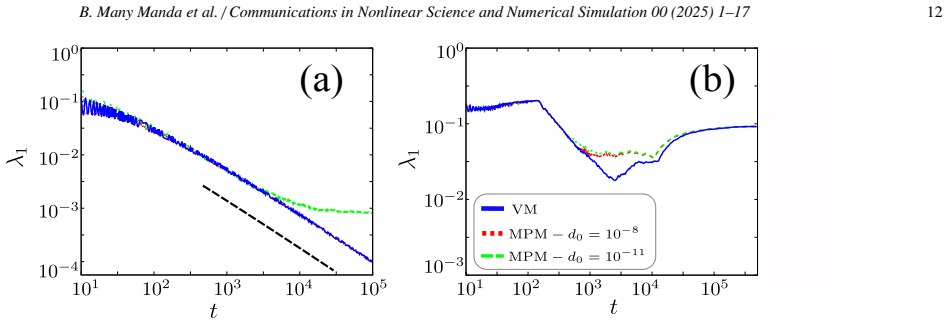
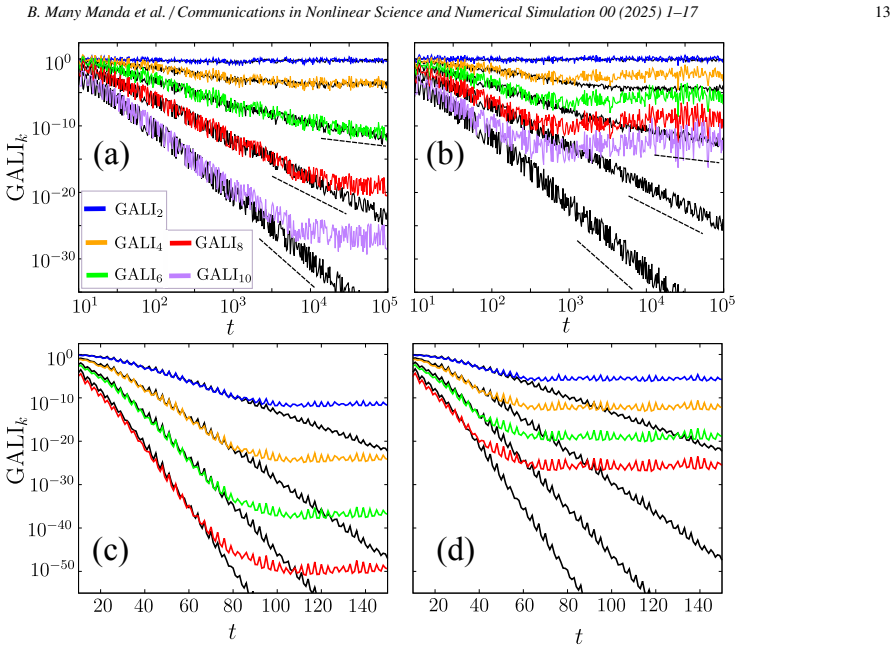
We present a method for the computation of the Generalized Alignment Index (GALI), a fast and effective chaos indicator, using a multi-particle approach that avoids variational equations. We show that this approach is robust and accurate by deriving a leading-order error estimation for both the variational (VM) and the multi-particle (MPM) methods, which we validate by performing extensive numerical simulations on two prototypical models: the two degrees of freedom H\'enon-Heiles system and the multidimensional $\beta$-Fermi-Pasta-Ulam-Tsingou chain of oscillators. The dependence of the accuracy of the GALI on control parameters such as the renormalization time, the integration time step and the deviation vector size is studied in detail. We test the MPM implemented with double precision accuracy ($\varepsilon \approx 10^{-16}$) and find that it performs reliably for deviation vector sizes $d_0\approx \varepsilon^{1/2}$, renormalization times $\tau \lesssim 1$, and relative energy errors $E_r \lesssim \varepsilon^{1/2}$. These results hold for systems with many degrees of freedom and demonstrate that the MPM is a robust and efficient method for studying the chaotic dynamics of Hamiltonian systems. Our work makes it possible to explore chaotic dynamics with the GALI in a vast number of systems by eliminating the need for variational equations.
Editorial analysis
A structured set of objections, weighed in public.
Referee Report
Summary. The manuscript introduces a multi-particle method (MPM) for computing the Generalized Alignment Index (GALI) without solving variational equations. It derives leading-order error estimates for both the variational method (VM) and MPM, validates the approach via extensive numerical simulations on the 2DOF Hénon-Heiles system and the multidimensional β-Fermi-Pasta-Ulam-Tsingou chain, studies dependence on renormalization time, integration step, and deviation vector size, and recommends reliable parameter windows (d0 ≈ ε^{1/2}, τ ≲ 1, Er ≲ ε^{1/2}) for double-precision implementations, claiming these hold for systems with many degrees of freedom.
Significance. If the error estimates are accurate and the method generalizes beyond the tested models, the MPM would enable efficient GALI-based chaos detection in high-dimensional Hamiltonian systems where variational equations are costly to implement, representing a practical advance for studying chaotic dynamics in many-body problems. The explicit parameter recommendations and numerical validation on two models constitute concrete strengths.
major comments (2)
- [Abstract] Abstract and concluding section: the claim that 'these results hold for systems with many degrees of freedom' and enable exploration 'in a vast number of systems' is load-bearing for the central conclusion, yet rests solely on validation for the 2DOF Hénon-Heiles system and a nearest-neighbor 1D β-FPUT chain; no analytic argument or cross-check on a long-range or all-to-all Hamiltonian is supplied to confirm that the bound Er ≲ ε^{1/2} and the (d0, τ) window transfer when global error accumulation differs.
- [Error estimation section] Error estimation section (leading-order derivation for MPM): the analysis is presented as capturing dominant numerical errors across tested regimes, but the derivation's implicit assumptions (e.g., regarding locality of interactions in deviation-vector propagation or renormalization) are not stated explicitly, creating a correctness-risk for the generality assertion over arbitrary many-DOF Hamiltonians.
minor comments (2)
- [Notation] The notation for relative energy error Er and deviation vector size d0 should be defined at first use with an explicit equation reference to aid readers.
- [Figures] Figure captions for the numerical results on the two models could more clearly indicate the number of realizations and integration tolerances used.
Simulated Author's Rebuttal
We thank the referee for the detailed and constructive report. We address the two major comments below, agreeing that the claims of generality require qualification and that assumptions in the error analysis should be stated explicitly. We will make targeted revisions to the abstract, conclusions, and error estimation section.
read point-by-point responses
-
Referee: [Abstract] Abstract and concluding section: the claim that 'these results hold for systems with many degrees of freedom' and enable exploration 'in a vast number of systems' is load-bearing for the central conclusion, yet rests solely on validation for the 2DOF Hénon-Heiles system and a nearest-neighbor 1D β-FPUT chain; no analytic argument or cross-check on a long-range or all-to-all Hamiltonian is supplied to confirm that the bound Er ≲ ε^{1/2} and the (d0, τ) window transfer when global error accumulation differs.
Authors: We agree that the numerical evidence is restricted to the two tested models and that no additional cross-check on long-range interactions is provided. The leading-order error estimates were derived from the general structure of the deviation equations and renormalization without assuming nearest-neighbor locality. Nevertheless, to avoid overstatement we will revise the abstract and concluding section to qualify the parameter recommendations as validated for the Hénon-Heiles and β-FPUT systems and expected to apply more broadly on the basis of the error analysis, while noting that verification on long-range Hamiltonians remains desirable. revision: partial
-
Referee: [Error estimation section] Error estimation section (leading-order derivation for MPM): the analysis is presented as capturing dominant numerical errors across tested regimes, but the derivation's implicit assumptions (e.g., regarding locality of interactions in deviation-vector propagation or renormalization) are not stated explicitly, creating a correctness-risk for the generality assertion over arbitrary many-DOF Hamiltonians.
Authors: We will revise the error estimation section to list the assumptions explicitly: (i) deviation vectors remain small enough for the leading-order Taylor expansion of the flow to hold, (ii) renormalization is performed by rescaling the Euclidean norm at fixed intervals, and (iii) the dominant error sources are local truncation error of the integrator and floating-point round-off, independent of interaction range. The derivation uses only the general form of the Hamiltonian vector field and does not invoke locality. revision: yes
Circularity Check
No circularity: error derivation and numerical validation are independent
full rationale
The paper derives a leading-order error estimation for both VM and MPM methods from first principles and validates the resulting accuracy bounds through direct numerical simulations on the Hénon-Heiles and β-FPUT models. No equation or claim reduces by construction to a fitted parameter renamed as a prediction, a self-referential definition, or a load-bearing self-citation chain; the central reliability statements for many-DOF systems rest on the explicit derivations and tests rather than on quantities defined in terms of themselves.
Axiom & Free-Parameter Ledger
free parameters (2)
- deviation vector size d0
- renormalization time τ
axioms (1)
- domain assumption Numerical integration schemes preserve the leading-order error behavior assumed in the analytic estimates.
Reference graph
Works this paper leans on
-
[1]
R. C. Hilborn, Chaos and nonlinear dynamics: an introduction for scien- tists and engineers, Oxford University Press on Demand, 2000
work page 2000
-
[2]
D. Carpintero, N. Ma ffione, L. Darriba, Lp-vicode: A program to com- pute a suite of variational chaos indicators, Astronomy and Computing 5 (2014) 19
work page 2014
- [3]
-
[4]
A. Pikovsky, A. Politi, Lyapunov exponents: a tool to explore complex dynamics, Cambridge University Press, 2016
work page 2016
-
[5]
G. Benettin, L. Galgani, A. Giorgilli, J.-M. Strelcyn, Lyapunov character- istic exponents for smooth dynamical systems and for Hamiltonian sys- tems; a method for computing all of them. Part 1: Theory, Meccanica 15 (1980) 9
work page 1980
-
[6]
G. Benettin, L. Galgani, A. Giorgilli, J.-M. Strelcyn, Lyapunov character- istic exponents for smooth dynamical systems; a method for computing all of them. Part 2: Numerical application, Meccanica 15 (1980) 21
work page 1980
-
[7]
C. Skokos, The Lyapunov characteristic exponents and their computation, Lecture Notes in Physics 790 (2010) 63
work page 2010
-
[8]
J. Awrejcewicz, A. V . Krysko, N. P. Erofeev, V . Dobriyan, M. A. Barulina, V . A. Krysko, Quantifying chaos by various computational methods. Part 1: Simple systems, Entropy 20 (2018) 175
work page 2018
-
[9]
M. Rautenberg, M. G ¨arttner, Classical and quantum chaos in a three-mode bosonic system, Phys. Rev. A 101 (2020) 053604
work page 2020
-
[10]
W. Szumi ´nski, A new model of variable-length coupled pendulums: from hyperchaos to superintegrability, Nonlinear Dynamics 112 (2024) 4117– 4145
work page 2024
-
[11]
W. Szumi ´nski, A. J. Maciejewski, Dynamics and non-integrability of the double spring pendulum, Journal of Sound and Vibration 589 (2024) 118550
work page 2024
-
[12]
C. Froeschl ´e, E. Lega, R. Gonczi, Fast Lyapunov indicators. Application to asteroidal motion, Celestial Mechanics and Dynamical Astronomy 67 (1997) 41
work page 1997
-
[13]
E. Lega, M. Guzzo, C. Froeschl ´e, Theory and applications of the fast Lyapunov indicator (FLI) method, Lecture Notes in Physics 915 (2016) 35
work page 2016
-
[14]
Cincotta, P. M., Sim ´o, C., Simple tools to study global dynamics in non- axisymmetric galactic potentials - I, Astronomy and Astrophysics Sup- plement Series 147 (2000) 205
work page 2000
-
[15]
P. M. Cincotta, C. M. Giordano, Theory and applications of the mean exponential growth factor of nearby orbits (MEGNO) method, Lecture Notes in Physics 915 (2016) 93
work page 2016
-
[16]
C. Skokos, Alignment indices: a new, simple method for determining the ordered or chaotic nature of orbits, Journal of Physics A: Mathematical and General 34 (2001) 10029
work page 2001
- [17]
- [18]
-
[19]
R. J. Lewis-Swan, A. Safavi-Naini, J. J. Bollinger, A. M. Rey, Unify- ing scrambling, thermalization and entanglement through measurement of fidelity out-of-time-order correlators in the Dicke model, Nature Com- munications 10 (2019) 1581
work page 2019
-
[20]
M. Hillebrand, G. Kalosakas, A. Schwellnus, C. Skokos, Heterogeneity and chaos in the Peyrard-Bishop-Dauxois DNA model, Physical Review E 99 (2019) 022213
work page 2019
-
[21]
E. E. Zotos, F. L. Dubeibe, A. F. Steklain, T. Saeed, Orbit classification in a disk galaxy model with a pseudo-Newtonian central black hole, As- tronomy & Astrophysics 643 (2020) A33
work page 2020
-
[22]
E. Kov ´ari, B. ´Erdi, Z. S´andor, Application of the Shannon entropy in the planar (non-restricted) four-body problem: the long-term stability of the Kepler-60 exoplanetary system, Monthly Notices of the Royal Astronom- ical Society 509 (2022) 884. 15 B. Many Manda et al. / Communications in Nonlinear Science and Numerical Simulation 00 (2025) 1–17 16 Fi...
work page 2022
- [23]
-
[24]
B. Ghanbari, On detecting chaos in a prey-predator model with prey’s counter-attack on juvenile predators, Chaos Solitons & Fractals 150 (2021) 111136
work page 2021
-
[25]
A. F. Steklain, A. Al-Ghamdi, E. E. Zotos, Using chaos indicators to de- termine vaccine influence on epidemic stabilization, Physical Review E 103 (2021) 032212
work page 2021
-
[26]
E. Blumenthal, J. W. Rocks, P. Mehta, Phase transition to chaos in com- plex ecosystems with nonreciprocal species-resource interactions, Physi- cal Review Letters 132 (2024) 127401
work page 2024
- [27]
-
[28]
E. Gerlach, S. Eggl, C. Skokos, E fficient integration of the variational equations of multidimensional Hamiltonian systems: Application to the Fermi–Pasta–Ulam lattice, International Journal of Bifurcation and Chaos 22 (2012) 1250216
work page 2012
-
[29]
B. Senyange, C. Skokos, Computational e fficiency of symplectic integra- tion schemes: application to multidimensional disordered Klein–Gordon lattices, The European Physical Journal Special Topics 227 (2018) 625
work page 2018
-
[30]
G. Tancredi, A. S ´anchez, F. Roig, A comparison between methods to compute Lyapunov exponents, The Astronomical Journal 121 (2001) 1171
work page 2001
-
[31]
L. Mei, L. Huang, Reliability of Lyapunov characteristic exponents com- puted by the two-particle method, Computer Physics Communications 224 (2018) 108
work page 2018
-
[32]
M. Hillebrand, S. Zimper, A. Ngapasare, M. Katsanikas, S. Wiggins, C. Skokos, Quantifying chaos using Lagrangian descriptors, Chaos: An Interdisciplinary Journal of Nonlinear Science 32 (2022) 123122
work page 2022
-
[33]
A. Bazzani, M. Giovannozzi, C. E. Montanari, G. Turchetti, Performance analysis of indicators of chaos for nonlinear dynamical systems, Phys. Rev. E 107 (2023) 064209
work page 2023
- [34]
-
[35]
K. L. Johnson, Contact mechanics, Cambridge university press, 1987
work page 1987
-
[36]
C. Lee, X. Wei, J. W. Kysar, J. Hone, Measurement of the elastic prop- erties and intrinsic strength of monolayer graphene, Science 321 (2008) 385
work page 2008
-
[37]
E. Cadelano, P. L. Palla, S. Giordano, L. Colombo, Nonlinear elasticity of monolayer graphene, Phys. Rev. Lett. 102 (2009) 235502
work page 2009
-
[38]
H. Schlegel, Exploring potential energy surfaces for chemical reactions: an overview of some practical methods, Journal of Computation Chem- istry 24 (2003) 1514
work page 2003
-
[39]
W. R. Smith, W. Qi, Molecular simulation of chemical reaction equilib- rium by computationally efficient free energy minimization, ACS Central Science 4 (2018) 1185
work page 2018
-
[40]
K. J. Naidoo, T. Bruce-Chwatt, T. Senapathi, M. Hillebrand, Multidimen- sional free energy and accelerated quantum library methods provide a gateway to glycoenzyme conformational, electronic, and reaction mecha- nisms, Accounts of Chemical Research 54 (2021) 4120
work page 2021
-
[41]
M. Hillebrand, B. Many Manda, G. Kalosakas, E. Gerlach, C. Skokos, Chaotic dynamics of graphene and graphene nanoribbons, Chaos 30 (2020) 063150
work page 2020
-
[42]
M. H ´enon, C. Heiles, The applicability of the third integral of motion: some numerical experiments, The Astronomical Journal 69 (1964) 73
work page 1964
-
[43]
Ford, The Fermi-Pasta-Ulam problem: Paradox turns discovery, Physics Reports 213 (1992) 271
J. Ford, The Fermi-Pasta-Ulam problem: Paradox turns discovery, Physics Reports 213 (1992) 271
work page 1992
-
[44]
G. P. Berman, F. M. Izrailev, The Fermi-Pasta-Ulam problem: Fifty years of progress, Chaos 15 (2005) 015104
work page 2005
-
[45]
Hyper- chaos in constrained Hamiltonian system and its control
W. Szumi ´nski, M. Przybylska, A. J. Maciejewski, Comment on “Hyper- chaos in constrained Hamiltonian system and its control” by J. Li, H. Wu and F. Mei, Nonlinear Dynamics 101 (1) (2020) 639–654
work page 2020
-
[46]
S. He, K. Sun, Y . Peng, Detecting chaos in fractional-order nonlinear sys- tems using the smaller alignment index, Physics Letters A 383 (2019) 2267
work page 2019
- [47]
- [48]
-
[49]
T. Mai, A. Dhar, O. Narayan, Equilibration and universal heat conduction in Fermi-Pasta-Ulam chains, Physical Review Lett. 98 (2007) 184301
work page 2007
-
[50]
M. Onorato, L. V ozella, D. Proment, Y . V . Lvov, Route to thermalization in the α-Fermi-Pasta-Ulam system, Proceedings of the National Academy of Sciences 112 (2015) 4208
work page 2015
-
[51]
C. Danieli, D. K. Campbell, S. Flach, Intermittent many-body dynamics at equilibrium, Physical Review E 95 (2017) 060202
work page 2017
-
[52]
H. Zhao, Z. Wen, Y . Zhang, D. Zheng, Dynamics of solitary wave scatter- ing in the Fermi-Pasta-Ulam model, Physical Review Letters 94 (2005) 025507
work page 2005
- [53]
-
[54]
T. Cretegny, T. Dauxois, S. Ru ffo, A. Torcini, Localization and equipar- tition of energy in the β-FPU chain: Chaotic breathers, Physica D 121 (1998) 109
work page 1998
-
[55]
H. Yan, M. Robnik, Chaos and quantization of the three-particle generic Fermi-Pasta-Ulam-Tsingou model. I. Density of states and spectral statis- tics, Physical Review E 109 (2024) 054210
work page 2024
-
[56]
C. Antonopoulos, T. Bountis, C. Skokos, Chaotic dynamics of N-degree of freedom Hamiltonian systems, International Journal of Bifurcation and Chaos 16 (2006) 1777–1793
work page 2006
-
[57]
C. Antonopoulos, T. Bountis, Stability of simple periodic orbits and chaos in a Fermi-Pasta-Ulam lattice, Physical Review E 73 (2006) 056206
work page 2006
-
[58]
T. Dauxois, A. Litvak-Hinenzon, R. MacKay, A. Spanoudaki, Energy lo- calisation and transfer, World Scientific, 2004
work page 2004
- [59]
- [60]
- [61]
-
[62]
A. Farr ´es, J. Laskar, S. Blanes, F. Casas, J. Makazaga, A. Murua, High precision symplectic integrators for the solar system, Celestial Mechanics and Dynamical Astronomy 116 (2013) 141
work page 2013
-
[63]
C. Danieli, B. Many Manda, T. Mithun, C. Skokos, Computational ef- ficiency of numerical integration methods for the tangent dynamics of many-body Hamiltonian systems in one and two spatial dimensions, Mathematics in Engineering 1 (2019) 447
work page 2019
-
[64]
H. Fan, J. Jiang, C. Zhang, X. Wang, Y .-C. Lai, Long-term prediction of chaotic systems with machine learning, Phys. Rev. Res. 2 (2020) 012080
work page 2020
-
[65]
M. Przybylska, W. Szumi ´nski, A. J. Maciejewski, Destructive relativ- ity, Chaos: An Interdisciplinary Journal of Nonlinear Science 33 (2023) 063156
work page 2023
-
[66]
W. Szumi ´nski, M. Przybylska, A. J. Maciejewski, Chaos and integrability of relativistic homogeneous potentials in curved space, Nonlinear Dy- namics 112 (2024) 4879. 17
work page 2024
discussion (0)
Sign in with ORCID, Apple, or X to comment. Anyone can read and Pith papers without signing in.