Co-evolving Agent Architectures and Interpretable Reasoning for Automated Optimization
Pith reviewed 2026-05-10 05:18 UTC · model grok-4.3
The pith
Representing agent workflows as evolvable AOE-style networks and co-evolving their topologies with reasoning paths improves automated operations research performance and adds structural interpretability.
A machine-rendered reading of the paper's core claim, the machinery that carries it, and where it could break.
Core claim
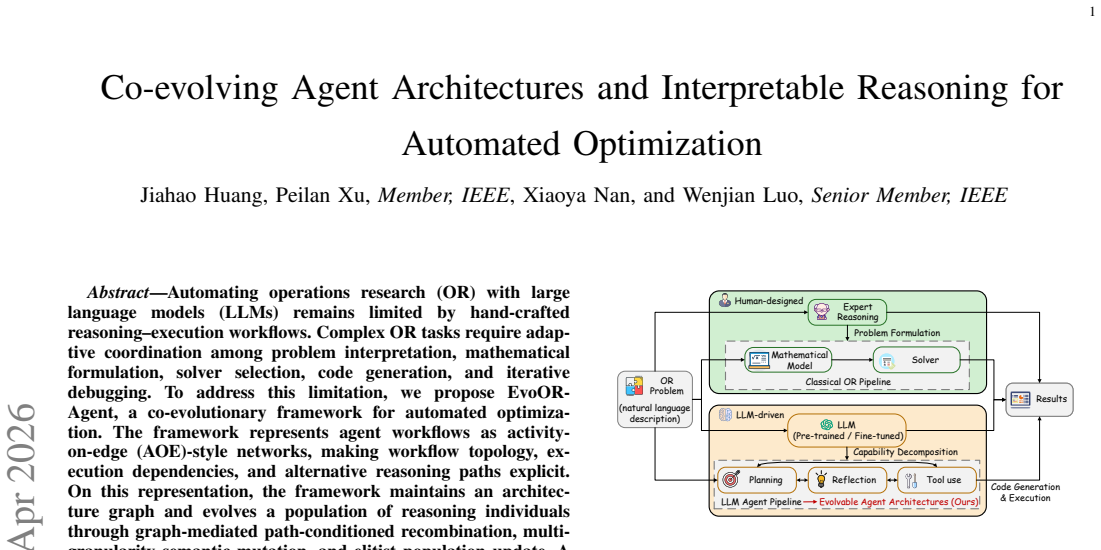
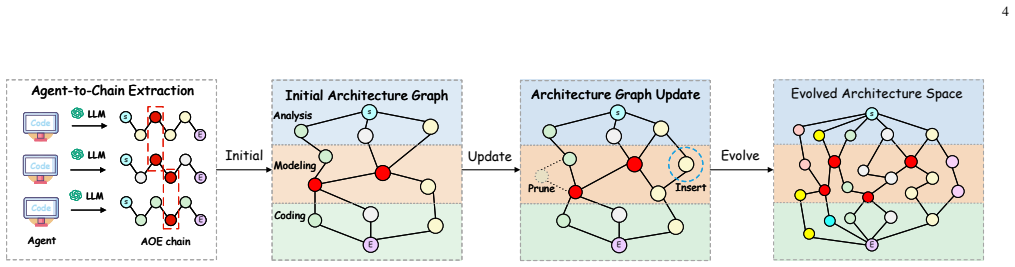
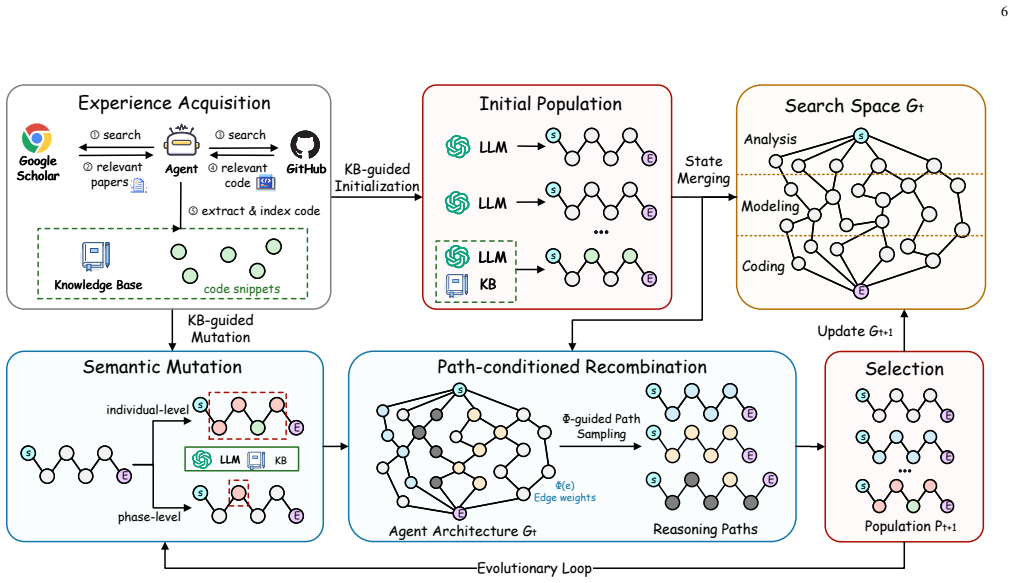
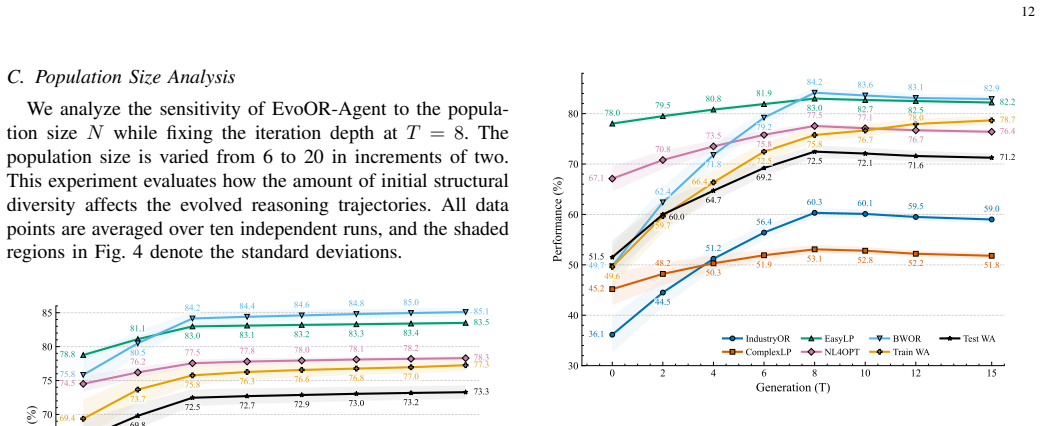
The EvoOR-Agent framework represents agent workflows as AOE-style networks that expose topology, dependencies, and alternative paths. It then maintains an architecture graph and evolves populations of reasoning individuals via graph-mediated path-conditioned recombination, multi-granularity semantic mutation, and elitist updates, augmented by knowledge-base-assisted experience acquisition. On heterogeneous OR benchmarks this produces consistent improvements over zero-shot LLMs, fixed-pipeline agents, and earlier evolutionary frameworks, with case studies and ablations attributing gains to explicit architecture evolution and graph-supported trajectory search.
What carries the argument
AOE-style network representation of agent workflows, which makes topology and dependencies explicit and supports graph-mediated path-conditioned recombination plus multi-granularity semantic mutation for joint evolution of architectures and reasoning.
If this is right
- Agent coordination among interpretation, formulation, solver selection, code generation, and debugging becomes adaptive rather than hand-crafted.
- Reasoning trajectories gain explicit, inspectable alternative paths through the graph representation.
- Reusable OR practices can be systematically injected into both initialization and variation steps.
- Performance improvements appear on heterogeneous benchmarks spanning different problem types and scales.
Where Pith is reading between the lines
- The same graph-evolution approach could be tested on non-OR domains that also require multi-step reasoning and tool use, such as scientific modeling pipelines.
- Structural interpretability might allow human experts to intervene or prune unproductive branches in deployed agent systems.
- If architecture evolution proves robust, future agent frameworks could start from minimal seeds and grow task-specific topologies without manual redesign.
- Scalability questions remain around how graph size and population size trade off against compute cost on larger industrial instances.
Load-bearing premise
Representing workflows as AOE-style networks and evolving them with graph-mediated recombination and semantic mutation will yield meaningful, generalizable gains on complex OR tasks.
What would settle it
Running the framework on a fresh collection of OR benchmarks and finding no consistent outperformance versus zero-shot LLMs and fixed-pipeline agents, or finding that ablations removing architecture evolution erase the reported gains.
Figures
read the original abstract
Automating operations research (OR) with large language models (LLMs) remains limited by hand-crafted reasoning--execution workflows. Complex OR tasks require adaptive coordination among problem interpretation, mathematical formulation, solver selection, code generation, and iterative debugging. To address this limitation, we propose EvoOR-Agent, a co-evolutionary framework for automated optimization. The framework represents agent workflows as activity-on-edge (AOE)-style networks, making workflow topology, execution dependencies, and alternative reasoning paths explicit. On this representation, the framework maintains an architecture graph and evolves a population of reasoning individuals through graph-mediated path-conditioned recombination, multi-granularity semantic mutation, and elitist population update. A knowledge-base-assisted experience-acquisition module further injects reusable OR practices into initialization and semantic variation. Empirical results on heterogeneous OR benchmarks show that the proposed framework consistently improves over zero-shot LLMs, fixed-pipeline OR agents, and representative evolutionary agent frameworks. Case studies and ablation analyses further indicate that explicit architecture evolution and graph-supported reasoning-trajectory search contribute to both performance improvement and structural interpretability. These results suggest that treating agent architectures and reasoning trajectories as evolvable objects provides an effective route toward adaptive and interpretable automated optimization.
Editorial analysis
A structured set of objections, weighed in public.
Referee Report
Summary. The manuscript proposes EvoOR-Agent, a co-evolutionary framework for LLM-based automated optimization in operations research. Agent workflows are represented as activity-on-edge (AOE) networks to expose topology and dependencies; a population of reasoning individuals is then evolved via graph-mediated path-conditioned recombination, multi-granularity semantic mutation, and elitist selection, with an auxiliary knowledge-base module injecting reusable OR practices. The central claim is that this architecture evolution yields consistent performance gains over zero-shot LLMs, fixed-pipeline OR agents, and prior evolutionary agent frameworks on heterogeneous OR benchmarks, while also improving structural interpretability.
Significance. If the empirical results can be shown to arise specifically from the AOE-graph operators rather than ancillary factors, the work would offer a concrete, interpretable route to automated agent design for complex reasoning tasks. The explicit graph representation of workflows is a clear methodological contribution that could transfer to other multi-step agent systems. At present, however, the significance remains provisional because the manuscript supplies no quantitative metrics, population/generation details, or controlled ablations that would allow attribution of gains to the proposed mechanisms.
major comments (3)
- [Abstract / Empirical Results] Abstract and empirical evaluation: the claim that the framework 'consistently improves' over baselines is asserted without any numerical results, benchmark names, performance deltas, or error analysis. This is load-bearing for the central contribution; without these data the reader cannot evaluate whether the AOE-network evolution produces meaningful, generalizable gains.
- [Framework Description] Framework description: the knowledge-base-assisted experience-acquisition module is described as injecting 'reusable OR practices' into initialization and mutation, yet no details are given on its construction, automation, or curation process. If this module relies on human-curated examples or extra LLM queries absent from the fixed-pipeline baselines, the headline improvement cannot be attributed to the co-evolutionary operators.
- [Ablation Analyses / Case Studies] Ablation and case-study sections: while the abstract states that 'case studies and ablation analyses further indicate that explicit architecture evolution and graph-supported reasoning-trajectory search contribute' to gains, no quantitative ablation isolating graph-mediated recombination versus semantic mutation versus the knowledge base is supplied. This leaves the key mechanistic assumption untested.
minor comments (2)
- [Abstract] The acronym AOE is introduced in the abstract without immediate expansion; a parenthetical definition on first use would improve readability.
- [Framework Description] Notation for the architecture graph and path-conditioned recombination operators should be formalized (e.g., with a small diagram or pseudocode) to make the evolutionary operators reproducible.
Simulated Author's Rebuttal
We thank the referee for the constructive and detailed review. The comments highlight important areas for strengthening the empirical claims and mechanistic clarity. We address each major comment below and will revise the manuscript accordingly to incorporate the requested details, metrics, and analyses.
read point-by-point responses
-
Referee: [Abstract / Empirical Results] Abstract and empirical evaluation: the claim that the framework 'consistently improves' over baselines is asserted without any numerical results, benchmark names, performance deltas, or error analysis. This is load-bearing for the central contribution; without these data the reader cannot evaluate whether the AOE-network evolution produces meaningful, generalizable gains.
Authors: We agree that the abstract and empirical presentation would benefit from explicit numerical support. The current manuscript reports results on heterogeneous OR benchmarks but does not include specific deltas, benchmark names, or error analysis in the abstract. In the revision we will update the abstract to include key performance metrics, benchmark names, deltas, and error information drawn from the experiments. We will also add population and generation details to the methods and results sections to enable full evaluation of the gains. revision: yes
-
Referee: [Framework Description] Framework description: the knowledge-base-assisted experience-acquisition module is described as injecting 'reusable OR practices' into initialization and mutation, yet no details are given on its construction, automation, or curation process. If this module relies on human-curated examples or extra LLM queries absent from the fixed-pipeline baselines, the headline improvement cannot be attributed to the co-evolutionary operators.
Authors: We acknowledge that insufficient detail is currently provided on the knowledge-base module, which prevents clear attribution of improvements to the co-evolutionary operators versus the auxiliary component. In the revised manuscript we will expand the framework description with a dedicated subsection detailing the construction process, automation steps, curation of reusable OR practices, and any additional LLM queries employed. This will allow readers to assess the module's role relative to the fixed-pipeline baselines. revision: yes
-
Referee: [Ablation Analyses / Case Studies] Ablation and case-study sections: while the abstract states that 'case studies and ablation analyses further indicate that explicit architecture evolution and graph-supported reasoning-trajectory search contribute' to gains, no quantitative ablation isolating graph-mediated recombination versus semantic mutation versus the knowledge base is supplied. This leaves the key mechanistic assumption untested.
Authors: We agree that the current ablation and case-study material is insufficient to isolate the contributions of graph-mediated recombination, semantic mutation, and the knowledge base. Although the manuscript contains case studies, it lacks the requested quantitative controlled ablations. In the revision we will add a new subsection with quantitative ablation experiments, including performance tables that systematically remove or isolate each component to test the mechanistic assumptions. revision: yes
Circularity Check
No circularity: empirical framework proposal with external benchmarks
full rationale
The paper presents EvoOR-Agent as a new co-evolutionary framework that explicitly represents agent workflows as AOE-style networks and applies graph-mediated recombination, semantic mutation, and knowledge-base injection. All central claims rest on empirical comparisons against zero-shot LLMs, fixed-pipeline agents, and other evolutionary frameworks on heterogeneous OR benchmarks, plus ablation studies. No equations, derivations, or first-principles results are described that reduce to self-definitions, fitted parameters renamed as predictions, or load-bearing self-citations. The architecture and operators are introduced as independent design choices whose value is tested externally rather than assumed by construction. This is the normal case of a self-contained empirical proposal.
Axiom & Free-Parameter Ledger
axioms (2)
- domain assumption Large language models can reliably perform problem interpretation, mathematical formulation, solver selection, code generation, and iterative debugging for OR tasks when guided by structured workflows.
- domain assumption Evolutionary operators applied to graph representations of workflows can discover superior reasoning trajectories and architectures.
invented entities (2)
-
EvoOR-Agent co-evolutionary framework
no independent evidence
-
AOE-style network representation of agent workflows
no independent evidence
discussion (0)
Sign in with ORCID, Apple, or X to comment. Anyone can read and Pith papers without signing in.