AutoRubric-T2I: Robust Rule-Based Reward Model for Text-to-Image Alignment
Pith reviewed 2026-05-22 09:16 UTC · model grok-4.3
The pith
AutoRubric-T2I turns tiny preference data into a compact set of explicit rubrics that let VLMs judge text-to-image alignment more accurately than trained reward models.
A machine-rendered reading of the paper's core claim, the machinery that carries it, and where it could break.
Core claim
AutoRubric-T2I first synthesizes reasoning traces from preference pairs into candidate rubrics, scores paired images under each rubric with a VLM to obtain pairwise differences, and applies an L1-regularized logistic regression refiner to select the top-N most discriminative rubrics. The resulting compact, interpretable rule set yields high-quality reward signals from under 0.01 percent of typical annotated data, outperforms strong reward-model baselines on MMRB2, and improves generation quality when used as an RL reward in pipelines such as Flow-GRPO on diffusion models for tasks including TIIF and UniGenBench++.
What carries the argument
The AutoRubric-T2I pipeline that converts preference pairs into candidate rubrics via synthesized reasoning traces and refines them with L1-regularized logistic regression to produce a small set of explicit, discriminative rules for VLM-based scoring.
If this is right
- Reward models for text-to-image alignment can be built from orders-of-magnitude less human preference data than current practice.
- Evaluation criteria become explicit and human-readable, allowing inspection and editing of the rules that drive scoring.
- The same learned rubric set can be reused across different vision-language models without retraining the reward component.
- Reinforcement learning loops for diffusion models achieve higher generation quality when guided by these rubric-based rewards instead of scalar models.
- The data-efficiency gain opens the possibility of rapidly adapting alignment signals to new domains or user populations.
Where Pith is reading between the lines
- The rubric-learning approach could be tested for transfer to other generative modalities such as video or audio where preference data is also scarce.
- Examining the final selected rubrics might surface which visual attributes humans weigh most heavily when judging prompt alignment.
- One could measure whether the same rubrics remain effective when the underlying VLM is replaced by a newer or differently trained model.
- The method suggests a route to hybrid systems that combine the speed of trained scalar rewards with the transparency of rule-based judges.
Load-bearing premise
The synthesized reasoning traces from preference pairs can be turned into rubrics whose VLM-derived scores reliably reflect the original human preferences, and the L1-regularized logistic regression step selects a set of rubrics that generalize beyond the data used to create them.
What would settle it
Running the full pipeline on a fresh human preference dataset and finding that the selected rubrics produce VLM scores whose agreement with human judgments falls to chance level or below the agreement achieved by a standard scalar reward model trained on the same data.
Figures


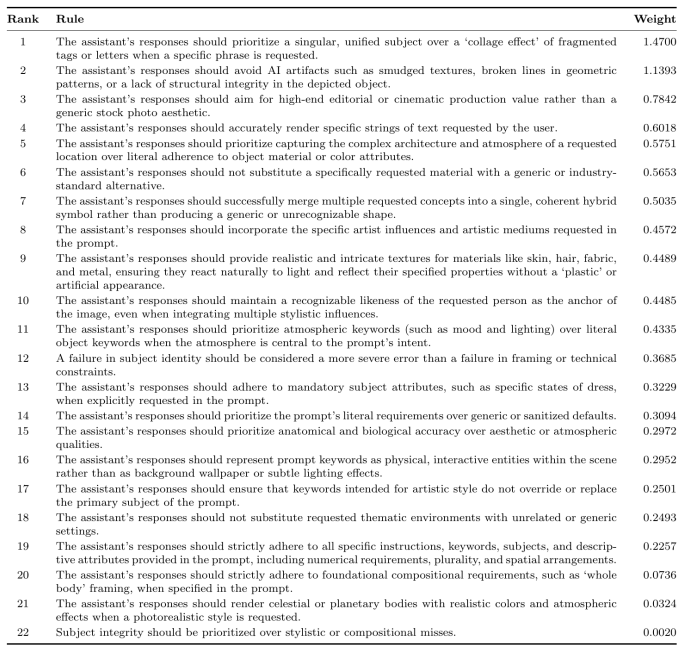
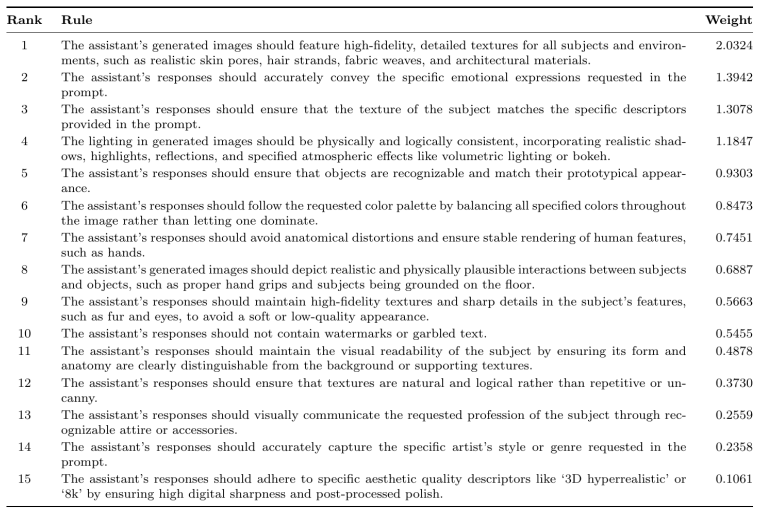
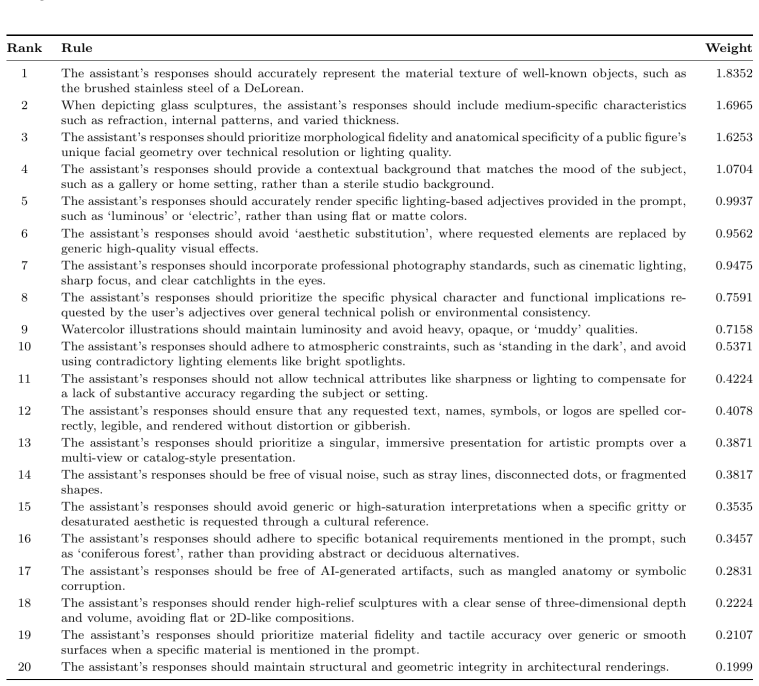
read the original abstract
Aligning Text-to-Image (T2I) generation models with human preferences increasingly relies on image reward models that score or rank generated images according to prompt alignment and perceptual quality. Existing reward models are commonly trained as Bradley-Terry (BT) preference models on large-scale human preference corpora, making them costly to train, difficult to adapt, and opaque in their evaluation criteria. Meanwhile, Vision-Language Model (VLM) judges can provide more fine-grained assessments through textual rubrics, but their manually designed or heuristically generated scoring rules may fail to reliably reflect human preferences. In this paper, we propose AutoRubric-T2I, the first rubric learning framework in T2I that automatically synthesizes and selects explicit rubrics for guiding VLM judges. AutoRubric-T2I first synthesizes reasoning traces from preference pairs into candidate rubrics, then uses a VLM judge to score paired images under each rubric, producing pairwise rubric-score differences for preference learning. To remove noisy and redundant rules, we further employ a $\ell_1$-Regularized Logistic Regression Refiner, which selects the Top-$N$ most discriminative rubrics. Extensive evaluations show that AutoRubric-T2I produces high-quality, interpretable reward signals using less than 0.01% of the annotated preference data, substantially reducing the need for large-scale reward-model training. On image reward benchmarks such as MMRB2, AutoRubric-T2I outperforms strong reward model baselines. We further validate AutoRubric-T2I as an RL reward on downstream T2I tasks, including TIIF and UniGenBench++, where it improves generation quality over scalar reward models using the Flow-GRPO pipeline on diffusion models.
Editorial analysis
A structured set of objections, weighed in public.
Referee Report
Summary. The paper presents AutoRubric-T2I, a framework for automatically learning explicit rubrics to guide Vision-Language Model (VLM) judges in evaluating text-to-image (T2I) generations. It synthesizes reasoning traces from a small subset (<0.01%) of human preference pairs into candidate rubrics, scores paired images using a VLM under each rubric, and applies an ℓ1-regularized logistic regression to select the top-N most discriminative rubrics. The approach claims to produce high-quality, interpretable reward signals that outperform strong baselines on benchmarks like MMRB2 while improving downstream T2I generation quality in RL fine-tuning, all with drastically reduced data requirements.
Significance. If validated, this work offers a significant advancement in making reward models for T2I alignment more data-efficient, interpretable, and adaptable compared to traditional Bradley-Terry models trained on large corpora. By leveraging VLM judges with learned rubrics, it addresses opacity in existing reward models and reduces the cost of large-scale preference data collection. The potential for rule-based, human-aligned evaluation could influence future work in multimodal alignment and RL for generative models.
major comments (2)
- [§3.2–3.3] §3.2–3.3 (rubric scoring and L1 refiner): The logistic regression is fit directly to pairwise score differences computed from the identical small preference subset used to synthesize the candidate rubrics in §3.1. This creates a dependence that risks selecting rubrics exploiting VLM-specific artifacts or in-sample correlations rather than generalizable rules; no held-out rubric validation or causal test is described to rule out overfitting.
- [§4] §4 (experiments): Claims of outperforming baselines on MMRB2 and improving downstream RL tasks (TIIF, UniGenBench++) with <0.01% data are stated without reported numerical values, error bars, ablation on Top-N or regularization strength, or controls for systematic bias in the VLM judge itself. These omissions make it impossible to verify that the reported gains are robust rather than artifacts of the synthesis set.
minor comments (2)
- [§3.3] The free parameters (Top-N, L1 strength) are mentioned but their selection procedure or sensitivity analysis is not detailed; add a short paragraph or table showing how they were chosen.
- [§3.2] Notation for rubric-score differences and the logistic target should be formalized with an equation to improve clarity.
Simulated Author's Rebuttal
We thank the referee for the detailed and constructive feedback. We address each major comment below and have revised the manuscript to strengthen the presentation of our method and results.
read point-by-point responses
-
Referee: [§3.2–3.3] §3.2–3.3 (rubric scoring and L1 refiner): The logistic regression is fit directly to pairwise score differences computed from the identical small preference subset used to synthesize the candidate rubrics in §3.1. This creates a dependence that risks selecting rubrics exploiting VLM-specific artifacts or in-sample correlations rather than generalizable rules; no held-out rubric validation or causal test is described to rule out overfitting.
Authors: We agree that fitting the L1-regularized logistic regression on the same small subset used for rubric synthesis introduces a risk of selecting rules that capture in-sample correlations or VLM-specific patterns. The synthesis step generates candidate rubrics from reasoning traces, but the subsequent scoring and selection occur on the identical pairs. To address this, we have added a held-out validation procedure in the revised §3.3: after rubric selection on the synthesis subset, we evaluate the selected rubrics on a disjoint held-out portion of the preference data and report the resulting preference prediction accuracy. We also include a brief causal-style check by measuring rubric stability across different random splits of the synthesis set. These additions are now described in the revised manuscript. revision: yes
-
Referee: [§4] §4 (experiments): Claims of outperforming baselines on MMRB2 and improving downstream RL tasks (TIIF, UniGenBench++) with <0.01% data are stated without reported numerical values, error bars, ablation on Top-N or regularization strength, or controls for systematic bias in the VLM judge itself. These omissions make it impossible to verify that the reported gains are robust rather than artifacts of the synthesis set.
Authors: The original submission emphasized relative improvements and data efficiency but did not include the full set of quantitative results, error bars, or ablations requested. We have revised §4 to include: (i) exact numerical scores and standard deviations on MMRB2 for AutoRubric-T2I versus the strongest baselines, (ii) ablation tables varying Top-N and the L1 regularization coefficient, (iii) error bars across three random seeds for both reward-model and downstream RL experiments, and (iv) a control experiment that replaces the learned rubrics with a fixed generic VLM prompt to isolate the contribution of the selected rubrics from any systematic VLM bias. These results are now reported with the corresponding tables and figures in the revised manuscript. revision: yes
Circularity Check
No significant circularity; empirical pipeline with external validation
full rationale
The paper presents an empirical framework that synthesizes candidate rubrics from a small subset of preference pairs, scores them via an external VLM, and applies L1-regularized logistic regression for selection. This process is a standard data-driven feature selection step within a proposed method, not a first-principles derivation or prediction that reduces to its inputs by construction. Performance is assessed on separate benchmarks (MMRB2) and downstream RL tasks, with no load-bearing self-citations, uniqueness theorems, or self-definitional equations identified in the described chain. The approach remains self-contained against external evaluation.
Axiom & Free-Parameter Ledger
free parameters (2)
- Top-N
- L1 regularization strength
axioms (1)
- domain assumption Reasoning traces extracted from preference pairs can be converted into explicit rubrics that, when scored by a VLM, produce differences correlated with the original human judgments.
Lean theorems connected to this paper
-
IndisputableMonolith/Cost/FunctionalEquation.leanwashburn_uniqueness_aczel unclear?
unclearRelation between the paper passage and the cited Recognition theorem.
min_w λ∥w∥1 + Σ logσ(z(i) Σ w_j Δs(i)_j) solved by block coordinate descent with hard-pair mining
What do these tags mean?
- matches
- The paper's claim is directly supported by a theorem in the formal canon.
- supports
- The theorem supports part of the paper's argument, but the paper may add assumptions or extra steps.
- extends
- The paper goes beyond the formal theorem; the theorem is a base layer rather than the whole result.
- uses
- The paper appears to rely on the theorem as machinery.
- contradicts
- The paper's claim conflicts with a theorem or certificate in the canon.
- unclear
- Pith found a possible connection, but the passage is too broad, indirect, or ambiguous to say the theorem truly supports the claim.
Reference graph
Works this paper leans on
-
[1]
Training Diffusion Models with Reinforcement Learning
Kevin Black, Michael Janner, Yilun Du, Ilya Kostrikov, and Sergey Levine. Training diffusion models with reinforcement learning.arXiv preprint arXiv:2305.13301, 2023
work page internal anchor Pith review Pith/arXiv arXiv 2023
-
[2]
Odin: Disentangled reward mitigates hacking in rlhf.arXiv preprint arXiv:2402.07319, 2024
Lichang Chen, Chen Zhu, Davit Soselia, Jiuhai Chen, Tianyi Zhou, Tom Goldstein, Heng Huang, Mehrdad Farajtabar, and Hongyang Li. Odin: Disentangled reward mitigates hacking in rlhf.arXiv preprint arXiv:2402.07319, 2024
-
[3]
Scaling rectified flow trans- formers for high-resolution image synthesis
Patrick Esser, Sumith Kulal, Andreas Blattmann, Rahim Entezari, Jonas Müller, Harry Saini, Yam Levi, Dominik Lorenz, Axel Sauer, Frederic Boesel, et al. Scaling rectified flow trans- formers for high-resolution image synthesis. InForty-first international conference on machine learning, 2024
work page 2024
-
[4]
Xuelu Feng, Yunsheng Li, Ziyu Wan, Zixuan Gao, Junsong Yuan, Dongdong Chen, and Chunming Qiao. Rubricrl: Simple generalizable rewards for text-to-image generation.arXiv preprint arXiv:2511.20651, 2025
-
[5]
Google DeepMind. Gemini 3 system card. https://deepmind.google/technologies/ gemini/, 2025. Accessed: 2026-04-23
work page 2025
-
[6]
Rubrics as Rewards: Reinforcement Learning Beyond Verifiable Domains
Anisha Gunjal, Anthony Wang, Elaine Lau, Vaskar Nath, Yunzhong He, Bing Liu, and Sean Hendryx. Rubrics as rewards: Reinforcement learning beyond verifiable domains.arXiv preprint arXiv:2507.17746, 2025
work page internal anchor Pith review Pith/arXiv arXiv 2025
-
[7]
DeepSeek-R1: Incentivizing Reasoning Capability in LLMs via Reinforcement Learning
Daya Guo, Dejian Yang, Haowei Zhang, Junxiao Song, Runxin Zhang, Runze Xu, Qihao Zhu, Shirong Ma, Peiyi Wang, Xiao Bi, et al. Deepseek-r1: Incentivizing reasoning capability in llms via reinforcement learning.arXiv preprint arXiv:2501.12948, 2025
work page internal anchor Pith review Pith/arXiv arXiv 2025
-
[8]
Yunqi Hong, Kuei-Chun Kao, Hengguang Zhou, and Cho-Jui Hsieh. Understanding reward hacking in text-to-image reinforcement learning.arXiv preprint arXiv:2601.03468, 2026
- [9]
-
[10]
Yushi Hu, Reyhane Askari-Hemmat, Melissa Hall, Emily Dinan, Luke Zettlemoyer, and Marjan Ghazvininejad. Multimodal rewardbench 2: Evaluating omni reward models for interleaved text and image.arXiv preprint arXiv:2512.16899, 2025
-
[11]
Reinforcement learning with rubric anchors
Zenan Huang, Yihong Zhuang, Guoshan Lu, Zeyu Qin, Haokai Xu, Tianyu Zhao, Ru Peng, Jiaqi Hu, Zhanming Shen, Xiaomeng Hu, et al. Reinforcement learning with rubric anchors. arXiv preprint arXiv:2508.12790, 2025
-
[12]
Orthogonal matching pursuit with replacement
Prateek Jain, Ambuj Tewari, and Inderjit Dhillon. Orthogonal matching pursuit with replacement. Advances in neural information processing systems, 24, 2011. 10
work page 2011
-
[13]
Dongfu Jiang, Max Ku, Tianle Li, Yuansheng Ni, Shizhuo Sun, Rongqi Fan, and Wenhu Chen. Genai arena: An open evaluation platform for generative models.Advances in Neural Information Processing Systems, 37:79889–79908, 2024
work page 2024
-
[14]
Dongzhi Jiang, Ziyu Guo, Renrui Zhang, Zhuofan Zong, Hao Li, Le Zhuo, Shilin Yan, Pheng- Ann Heng, and Hongsheng Li. T2i-r1: Reinforcing image generation with collaborative semantic-level and token-level cot.arXiv preprint arXiv:2505.00703, 2025
-
[15]
Yuval Kirstain, Adam Polyak, Uriel Singer, Shahbuland Matiana, Joe Penna, and Omer Levy. Pick-a-pic: An open dataset of user preferences for text-to-image generation.Advances in neural information processing systems, 36:36652–36663, 2023
work page 2023
-
[16]
Baiqi Li, Zhiqiu Lin, Deepak Pathak, Jiayao Li, Yixin Fei, Kewen Wu, Tiffany Ling, Xide Xia, Pengchuan Zhang, Graham Neubig, and Deva Ramanan. Genai-bench: Evaluating and improving compositional text-to-visual generation.arXiv preprint arXiv:2406.13743, 2024
-
[17]
Sunzhu Li, Jiale Zhao, Miteto Wei, Huimin Ren, Yang Zhou, Jingwen Yang, Shunyu Liu, Kaike Zhang, and Wei Chen. Rubrichub: A comprehensive and highly discriminative rubric dataset via automated coarse-to-fine generation.arXiv preprint arXiv:2601.08430, 2026
-
[18]
Flow-GRPO: Training Flow Matching Models via Online RL
Jie Liu, Gongye Liu, Jiajun Liang, Yangguang Li, Jiaheng Liu, Xintao Wang, Pengfei Wan, Di Zhang, and Wanli Ouyang. Flow-grpo: Training flow matching models via online rl.arXiv preprint arXiv:2505.05470, 2025
work page internal anchor Pith review Pith/arXiv arXiv 2025
-
[19]
Openrubrics: Contrastive rubric generation for reward models.arXiv preprint arXiv:2505.14826, 2025
Zhen Liu, Yixin Wang, Jianfei Chen, and Jun Zhu. Openrubrics: Contrastive rubric generation for reward models.arXiv preprint arXiv:2505.14826, 2025
-
[20]
Hpsv3: Towards wide-spectrum hu- man preference score
Yuhang Ma, Xiaoshi Wu, Keqiang Sun, and Hongsheng Li. Hpsv3: Towards wide-spectrum hu- man preference score. InProceedings of the IEEE/CVF International Conference on Computer Vision, pages 15086–15095, 2025
work page 2025
-
[21]
Yagyensh Chandra Pati, Ramin Rezaiifar, and Perinkulam Sambamurthy Krishnaprasad. Or- thogonal matching pursuit: Recursive function approximation with applications to wavelet decomposition. InProceedings of 27th Asilomar conference on signals, systems and computers, pages 40–44. IEEE, 1993
work page 1993
-
[22]
Keivan Rezaei, Xuechen He, and Percy Liang. Onlinerubrics: Dynamic rubric elicitation for online reinforcement learning.arXiv preprint arXiv:2507.09832, 2025
-
[23]
Yifan Shen, Xiang Li, Wei Zhang, and Yang Liu. Rrd: Recursive rubric decomposition for scalable reward modeling.arXiv preprint arXiv:2601.05743, 2026
-
[24]
Tevin Wang and Chenyan Xiong. Autorule: Reasoning chain-of-thought extracted rule-based rewards improve preference learning.arXiv preprint arXiv:2506.15651, 2025
-
[25]
Yibin Wang, Zhimin Li, Yuhang Zang, Jiazi Bu, Yujie Zhou, Yi Xin, Junjun He, Chunyu Wang, Qinglin Lu, Cheng Jin, et al. Unigenbench++: A unified semantic evaluation benchmark for text-to-image generation.arXiv preprint arXiv:2510.18701, 2025
-
[26]
Unified Reward Model for Multimodal Understanding and Generation
Yibin Wang, Yuhang Zang, Hao Li, Cheng Jin, and Jiaqi Wang. Unified reward model for multimodal understanding and generation.arXiv preprint arXiv:2503.05236, 2025
work page internal anchor Pith review Pith/arXiv arXiv 2025
-
[27]
Tiif-bench: How does your t2i model follow your instructions?arXiv preprint arXiv:2506.02161, 2025
Xinyu Wei, Jinrui Zhang, Zeqing Wang, Hongyang Wei, Zhen Guo, and Lei Zhang. Tiif-bench: How does your t2i model follow your instructions?arXiv preprint arXiv:2506.02161, 2025
-
[28]
Xumeng Wen, Zihan Liu, Shun Zheng, Shengyu Ye, Zhirong Wu, Yang Wang, Zhijian Xu, Xiao Liang, Junjie Li, Ziming Miao, et al. Reinforcement learning with verifiable rewards implicitly incentivizes correct reasoning in base llms.arXiv preprint arXiv:2506.14245, 2025
work page internal anchor Pith review Pith/arXiv arXiv 2025
-
[29]
Xiaoshi Wu, Yiming Hao, Keqiang Sun, Yixiong Chen, Feng Zhu, Rui Zhao, and Hongsheng Li. Human preference score v2: A solid benchmark for evaluating human preferences of text-to-image synthesis.arXiv preprint arXiv:2306.09341, 2023
work page internal anchor Pith review Pith/arXiv arXiv 2023
-
[30]
Xiaoshi Wu, Yiming Li, Keqiang Zhang, and Hongsheng Li. Rewarddance: Scaling visual reward modeling via generative next-token prediction.arXiv preprint arXiv:2504.12345, 2025. 11
-
[31]
Lipeng Xie, Sen Huang, Zhuo Zhang, Anni Zou, Yunpeng Zhai, Dingchao Ren, Kezun Zhang, Haoyuan Hu, Boyin Liu, Haoran Chen, et al. Auto-rubric: Learning from implicit weights to explicit rubrics for reward modeling.arXiv preprint arXiv:2510.17314, 2025
-
[32]
Imagereward: Learning and evaluating human preferences for text-to-image generation
Jiazheng Xu, Xiao Liu, Yuchen Wu, Yuxuan Tong, Qinkai Li, Ming Ding, Jie Tang, and Yuxiao Dong. Imagereward: Learning and evaluating human preferences for text-to-image generation. Advances in Neural Information Processing Systems, 36:15903–15935, 2023
work page 2023
-
[33]
Ran Xu, Tianci Liu, Zihan Dong, Tony Yu, Ilgee Hong, Carl Yang, Linjun Zhang, Tao Zhao, and Haoyu Wang. Alternating reinforcement learning for rubric-based reward modeling in non-verifiable llm post-training.arXiv preprint arXiv:2602.01511, 2026
-
[34]
DanceGRPO: Unleashing GRPO on Visual Generation
Zeyue Xue, Jie Wu, Yu Gao, Fangyuan Kong, Lingting Zhu, Mengzhao Chen, Zhiheng Liu, Wei Liu, Qiushan Guo, Weilin Huang, et al. Dancegrpo: Unleashing grpo on visual generation. arXiv preprint arXiv:2505.07818, 2025
work page internal anchor Pith review Pith/arXiv arXiv 2025
-
[35]
An Yang, Anfeng Li, Baosong Yang, Beichen Zhang, Binyuan Hui, Bo Zheng, Bowen Yu, Chang Gao, Chengen Huang, Chenxu Lv, et al. Qwen3 technical report.arXiv preprint arXiv:2505.09388, 2025
work page internal anchor Pith review Pith/arXiv arXiv 2025
-
[36]
Yongjin Yang, Sihyeon Kim, Hojung Jung, Sangmin Bae, SangMook Kim, Se-Young Yun, and Kimin Lee. Automated filtering of human feedback data for aligning text-to-image diffusion models.arXiv preprint arXiv:2410.10166, 2024
-
[37]
Ian E Yen, Ting-Wei Lin, Shou-De Lin, Pradeep Ravikumar, and Inderjit S Dhillon. Sparse random feature algorithm as coordinate descent in hilbert space.Advances in Neural Information Processing Systems, 27, 2014
work page 2014
-
[38]
Does this image satisfy this rule?
Junkai Zhang, Zihao Wang, Lin Gui, Swarnashree Mysore Sathyendra, Jaehwan Jeong, Victor Veitch, Wei Wang, Yunzhong He, Bing Liu, and Lifeng Jin. Chasing the tail: Effective rubric- based reward modeling for large language model post-training.arXiv preprint arXiv:2509.21500, 2026. 12 Table of Contents of Appendix A AutoRubric-T2I Pipeline Algorithm 14 B RL...
-
[39]
[10] is a recent omni reward-model benchmark covering four subtasks—text-to-image,image editing,interleaved generation, andmultimodal reasoning(“thinking-with-images”)—with 1,000 expert-annotated preference pairs per subtask drawn from 23 frontier models across 21 source tasks. Generative T2I Benchmarks.For T2I generative quality assessment on RL post-tra...
discussion (0)
Sign in with ORCID, Apple, or X to comment. Anyone can read and Pith papers without signing in.