Probing the Higgs Portal to a Strongly-Interacting Dark Sector at the FCC-ee
Pith reviewed 2026-05-25 08:10 UTC · model grok-4.3
The pith
Graph neural networks can identify semi-visible jets from Higgs decays into dark quarks at the FCC-ee, reaching per-mille sensitivity on exotic branching ratios.
A machine-rendered reading of the paper's core claim, the machinery that carries it, and where it could break.
Core claim
The proposed strategy of using kinematic features for high invisible fractions and a graph neural network jet tagger for lower fractions can effectively probe a wide parameter space for confining dark sector models, constraining the Higgs boson exotic branching ratios into dark quarks at the permille level.
What carries the argument
A graph neural network jet tagger that exploits differences in substructure, lepton, and photon content of semi-visible jets compared to Standard Model backgrounds.
If this is right
- It enables sensitivity to dark sectors with varying invisible particle fractions.
- The method improves discovery prospects for Higgs-induced semi-visible jets.
- It can constrain a variety of signatures in Higgs portal dark sector models.
- Exotic branching ratios can be limited to the 0.001 level at the FCC-ee.
Where Pith is reading between the lines
- If the tagging works, the same GNN approach might be adapted for searches at hadron colliders like the LHC where backgrounds are higher.
- Success would encourage development of dedicated triggers for semi-visible jet events at future e+e- machines.
- The results assume specific dark sector parameters, so varying the confinement scale could lead to different jet properties worth exploring further.
Load-bearing premise
The dark sector is confining and produces semi-visible jets whose substructure and lepton or photon content differ enough from Standard Model backgrounds that a graph neural network trained on simulation can tag them reliably at low invisible fractions.
What would settle it
If the graph neural network, when applied to real FCC-ee data, cannot achieve the simulated discrimination power between semi-visible jets and Standard Model backgrounds, the projected constraints would not hold.
Figures


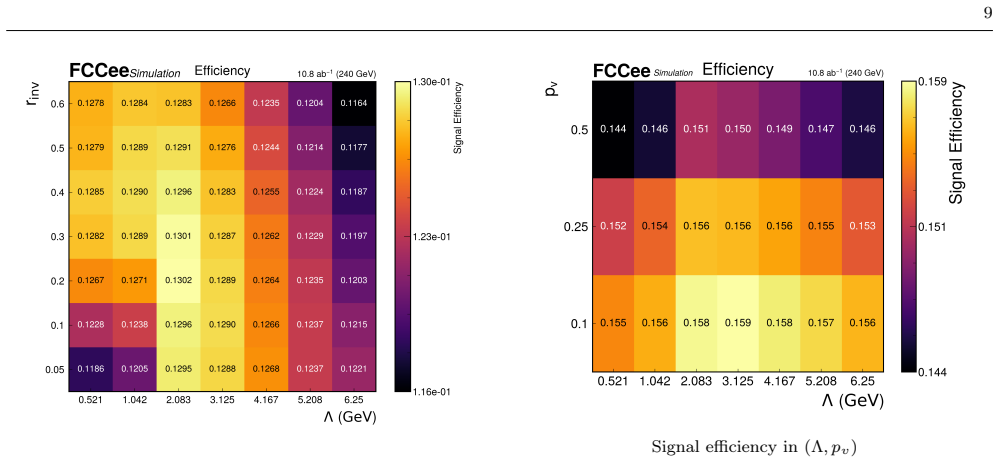


read the original abstract
This work explores exotic signatures from confining dark sectors that may arise in the $e^+e^-$ collision mode at the Future Circular Collider. Assuming the Higgs boson mediates the interaction between the Standard Model and the dark sector, dark quarks can be produced in $e^+e^-$ collisions. The ensuing strong dynamics may lead to semi-visible jet final states, containing both visible and invisible particles. We investigate semi-visible jets with different fractions of invisible states, and enriched in leptons and photons. When the invisible component is large, selections based on kinematic features, such as the missing energy in the event, already provide good signal-to-background discrimination. For smaller invisible fractions, the reduced missing energy makes these signals more similar to Standard Model events, and we therefore employ a graph neural network jet tagger exploiting differences in jet substructure. This machine learning strategy improves sensitivity and enhances the discovery prospects of Higgs boson-induced semi-visible jets at the Future Circular Collider. Our results show that the proposed strategy can effectively probe a wide parameter space for the models considered, and a variety of signatures, constraining the Higgs boson exotic branching ratios into dark quarks at the permille-level.
Editorial analysis
A structured set of objections, weighed in public.
Referee Report
Summary. The manuscript explores exotic Higgs decays to dark quarks in a confining dark sector at the FCC-ee, leading to semi-visible jets. It shows that for high invisible fractions, missing energy selections work well, but for low invisible fractions, a graph neural network jet tagger exploiting substructure differences improves sensitivity, allowing constraints on exotic branching ratios at the permille level.
Significance. If the results hold, this provides a concrete strategy to search for strongly interacting dark sectors at future e+e- colliders using ML techniques, which could be significant for the field as it addresses the challenging low-MET regime. The use of GNN for jet tagging in this context is a positive aspect.
major comments (1)
- [Abstract] Abstract: The claim that the GNN strategy constrains exotic Higgs branching ratios at the permille level rests on the tagger delivering usable discrimination for small invisible fractions; however, the manuscript provides no data-driven closure tests, control-region validation, or variations of dark-sector hadronization parameters to quantify how the quoted efficiencies and sensitivities degrade under realistic modeling uncertainties in jet substructure.
Simulated Author's Rebuttal
We thank the referee for the positive assessment of the work's significance and for highlighting the need to better quantify modeling uncertainties in the GNN tagger performance. We address the major comment below and will incorporate revisions to strengthen the robustness discussion.
read point-by-point responses
-
Referee: [Abstract] Abstract: The claim that the GNN strategy constrains exotic Higgs branching ratios at the permille level rests on the tagger delivering usable discrimination for small invisible fractions; however, the manuscript provides no data-driven closure tests, control-region validation, or variations of dark-sector hadronization parameters to quantify how the quoted efficiencies and sensitivities degrade under realistic modeling uncertainties in jet substructure.
Authors: We agree that additional quantification of modeling uncertainties would strengthen the presentation. As this is a prospective study for the future FCC-ee collider, data-driven closure tests and control-region validations using real collision data are not possible. However, we will add a new subsection (Section 4.3) performing variations of key dark-sector parameters, including the confinement scale, dark hadronization models (e.g., Lund string vs. cluster), and invisible fraction assumptions, to assess the stability of the GNN efficiencies and resulting branching ratio limits. These studies will be used to attach systematic uncertainty bands to the quoted sensitivities. We will also revise the abstract to include a brief caveat noting that the permille-level projections assume the baseline simulation setup and are subject to dark-sector modeling uncertainties. revision: partial
- Data-driven closure tests and control-region validations cannot be performed, as the analysis is a Monte Carlo projection study for a future collider with no existing data.
Circularity Check
No circularity: sensitivity derived from independent Monte Carlo and ML simulation chain
full rationale
The paper's central results are obtained by generating simulated events for signal and background, training a graph neural network on those samples, and extracting efficiencies and limits from the trained tagger performance. No equation or parameter is defined in terms of the final sensitivity; the GNN training and kinematic selections are standard external tools whose outputs are not forced to reproduce the input assumptions. No self-citation chain is invoked to justify uniqueness or an ansatz. The derivation is therefore self-contained against external benchmarks.
Axiom & Free-Parameter Ledger
free parameters (2)
- invisible fraction
- dark quark mass and confinement scale
axioms (2)
- domain assumption Higgs boson mediates all interactions between the Standard Model and the dark sector
- domain assumption Dark sector is confining and produces semi-visible jets with distinct substructure
invented entities (1)
-
dark quarks
no independent evidence
Forward citations
Cited by 1 Pith paper
-
Probing the electron Yukawa coupling via resonant Higgs boson production at FCC-ee via $e^+e^- \to H \to WW^*$ in lepton-plus-jets final states
Simulation projects 2.0 sigma significance for resonant Higgs production at FCC-ee, yielding an upper limit of kappa_e less than or equal to 1.35 at 95% CL on the electron Yukawa coupling modifier with 10 ab inverse l...
Reference graph
Works this paper leans on
-
[1]
G. Bertone, D. Hooper, J. Silk, Phys. Rept.405, 279 (2005). URLhttps://doi.org/10.1016/j.physrep. 2004.08.031
-
[2]
N. Aghanim, Y. Akrami, M. Ashdown, J. Aumont, et al., Astronomy & Astrophysics641, A6 (2020). URLhttp: //dx.doi.org/10.1051/0004-6361/201833910
-
[3]
M.J. Strassler, K.M. Zurek, Phys. Lett. B651(5–6), 374 (2007). URLhttp://dx.doi.org/10.1016/j.physletb. 2007.06.055
-
[4]
E. Bernreuther, F. Kahlhoefer, M. Krämer, P. Tunney, JHEP01(1), 162 (2020). URLhttp://dx.doi.org/10. 1007/JHEP01(2020)162
work page 2020
-
[5]
H. Beauchesne, E. Bertuzzo, G. Grilli Di Cortona, JHEP04, 118 (2019). URLhttps://doi.org/10.1007/ JHEP04(2019)118
work page 2019
- [6]
-
[7]
T. Cohen, M. Lisanti, H.K. Lou, Phys. Rev. Lett. 115(17), 171804 (2015). URLhttps://link.aps.org/ doi/10.1103/PhysRevLett.115.171804
- [8]
-
[9]
H. Beauchesne, E. Bertuzzo, G. Grilli Di Cortona, Z. Tabrizi, JHEP08, 030 (2018). URLhttps://doi. org/10.1007/JHEP08(2018)030
-
[10]
H. Beauchesne, G. Grilli di Cortona, JHEP02, 196 (2020). URLhttps://doi.org/10.1007/JHEP02(2020) 196
- [11]
-
[12]
C. Cazzaniga, A. Russo, E. Sitti, A. de Cosa, Eur. Phys. J. C84(11), 1223 (2024). URLhttps://doi.org/10. 1140/epjc/s10052-024-13613-9
work page 2024
-
[15]
P. Azzurri, G. Bernardi, S. Braibant, D. d’Enterria, J. Eysermans, P. Janot, A. Li, E. Perez, Eur. Phys. J. Plus137(1), 23 (2022). URLhttps://doi.org/10.1140/ epjp/s13360-021-02202-4
work page 2022
-
[16]
Higgs measurement at e+e- circular colliders
M. Ruan, Nucl. Part. Phys. Proc.273-275, 857 (2016). URLhttps://doi.org/10.48550/arXiv.1411.5606
work page internal anchor Pith review Pith/arXiv arXiv doi:10.48550/arxiv.1411.5606 2016
-
[17]
S. Antusch, et al., Eur. Phys. J. Plus136(11), 1163 (2021). DOI 10.1140/epjp/s13360-021-01875-1. URL https://link.springer.com/article/10.1140/epjp/ s13360-021-01875-1
-
[19]
A. Berlin, N. Blinov, S. Gori, P. Schuster, N. Toro, Phys. Rev. D97(5), 055033 (2018). URLhttps://doi.org/ 10.1103/PhysRevD.97.055033
-
[20]
P. Ilten, Y. Soreq, M. Williams, W. Xue, Journal of High Energy Physics2018(6) (2018). URLhttp://dx.doi. org/10.1007/JHEP06(2018)004
-
[21]
FCCAnalyses: Framework for physics analysis at FCC (2025)
FCC Collaboration. FCCAnalyses: Framework for physics analysis at FCC (2025). URLhttps://github. com/HEP-FCC/FCCAnalyses. Accessed: 20 March 2025
work page 2025
-
[22]
A comprehensive guide to the physics and usage of PYTHIA 8.3
C. Bierlich, et al., SciPost Physics Codebases (2022). URLhttps://doi.org/10.48550/arXiv.2203.11601
work page internal anchor Pith review Pith/arXiv arXiv doi:10.48550/arxiv.2203.11601 2022
-
[24]
L. Carloni, T. Sjostrand, JHEP09, 105 (2010). URL https://doi.org/10.1007/JHEP09%282010%29105
-
[25]
J. de Favereau, C. Delaere, P. Demin, A. Giammanco, et al., JHEP02, 057 (2014). URLhttps://doi.org/10. 1007/JHEP02(2014)057
work page 2014
-
[26]
M. Abbrescia, et al., (2025). URLhttps://doi.org/10. 48550/arXiv.2502.21223
-
[27]
M. Cacciari, G.P. Salam, G. Soyez, JHEP04, 063 (2008). URLhttps://doi.org/10.1088/1126-6708/ 2008/04/063
-
[29]
M. Benedikt, et al., (2025). URLhttps://doi.org/10. 17181/CERN.9DKX.TDH9
work page 2025
-
[30]
G. Albouy, et al., Eur. Phys. J. C82(12), 1132 (2022). URLhttp://dx.doi.org/10.1140/epjc/ s10052-022-11048-8
-
[31]
Asymptotic formulae for likelihood-based tests of new physics
G. Cowan, K. Cranmer, E. Gross, O. Vitells, The Eu- ropean Physical Journal C71(2) (2011). URLhttp: //dx.doi.org/10.1140/epjc/s10052-011-1554-0
work page internal anchor Pith review doi:10.1140/epjc/s10052-011-1554-0 2011
-
[32]
F.A. Dreyer, H. Qu, JHEP03, 052 (2021). URLhttps: //doi.org/10.1007/JHEP03(2021)052
-
[33]
F.A. Dreyer, G.P. Salam, G. Soyez, JHEP12, 064 (2018). URLhttps://doi.org/10.1007/JHEP12%282018%29064
- [34]
-
[35]
J. Gallicchio, J. Huth, M. Kagan, M.D. Schwartz, K. Black, B. Tweedie, JHEP04, 069 (2011). URL https://doi.org/10.1007/JHEP04%282011%29069
-
[36]
T. Junk, Nucl. Instrum. Meth. A434, 435 (1999). URL https://doi.org/10.1016/S0168-9002%2899%2900498-2
-
[37]
A.L. Read, J. Phys. G28, 2693 (2002). URL https://iopscience.iop.org/article/10.1088/ 0954-3899/28/10/313
work page 2002
-
[38]
A. Hayrapetyan, et al., Comput. Softw. Big Sci. 8(1), 19 (2024). URLhttps://doi.org/10.1007/ s41781-024-00121-4
work page 2024
-
[39]
URL https://cds.cern.ch/record/2800581
A.e.a.Tumasyan,Phys.Lett.B816,136188(2021). URL https://cds.cern.ch/record/2800581
discussion (0)
Sign in with ORCID, Apple, or X to comment. Anyone can read and Pith papers without signing in.